
An overheating brake caliper, a failing ignition coil, a parasitic drain in a wiring harness — these are the ghosts that baffle even seasoned mechanics until the right tool reveals them. An automotive thermal camera turns invisible heat signatures into visual data, letting you pinpoint electrical shorts, coolant blockages, and exhaust leaks before they strand a vehicle or cause a fire. This is not about taking pretty pictures; it is about cutting diagnostic time from hours to minutes.
I’m Min — the co-founder and writer behind Gadgets Feed. I have spent countless hours cross-referencing sensor specifications, refresh rates, and temperature ranges to separate professional-grade thermal imagers from overpriced novelties in the automotive diagnostics space. This guide distills that research into a clear ranking of the top tools on the market.
Whether you are a fleet technician tracking down an intermittent misfire or a weekend racer checking tire temperatures after a hot lap, the best automotive thermal camera is the difference between a confident repair and a prolonged headache.
How To Choose The Best Automotive Thermal Camera
Automotive thermal cameras vary wildly in resolution, connectivity, and ruggedness. The wrong choice means blurry images that miss a 1mm solder joint short or a tool that dies after one drop onto a concrete shop floor. Focus on four critical factors before clicking “buy.”
IR Resolution and Pixel Count
The native sensor resolution defines how many discrete temperature points the camera measures. A 160×120 sensor (19,200 pixels) can spot a leaking radiator hose, but it will fail to resolve a single overheated transistor on an ECU. For automotive electrical diagnostics, aim for at least 256×192 native pixels — enhanced via TISR or X³ algorithms to 512×384 for far better edge definition on small components like relays and fuses.
Refresh Rate (Frame Rate)
Standard entry-level cameras run at 9Hz, which produces a choppy image that smears when you pan across an engine bay. A 25Hz or 60Hz refresh rate delivers smooth, real-time video, crucial for scanning a hot exhaust manifold for cracks or watching a brake disc cool evenly after a dyno pull. For any moving or rapidly changing heat source, 25Hz is the practical minimum.
Laser Pointer and Visual Camera Fusion
Thermal images alone can be disorienting — it is hard to tell which black-and-white blob corresponds to which hose or wire. A built-in laser pointer lets you physically mark the hot spot, while a visible-light camera with overlay fusion (MSX or PIP modes) overlays thermal data onto a real-world photo. This combination is essential for documenting faults in a work order or explaining a finding to a customer.
Durability and Field Usability
A shop floor is unforgiving: dropped tools, oil spray, and extreme temperature swings. Look for an IP54 or higher dust/water resistance rating and a drop-test specification of at least 2 meters. For automotive-specific dedicated units like the TOPDON NV001, also confirm the cable and mounting hardware are rated for under-hood temperatures and road vibration.
Quick Comparison
On smaller screens, swipe sideways to see the full table.
| Model | Category | Best For | Key Spec | Amazon |
|---|---|---|---|---|
| VEVOR Thermal Camera | Smartphone Dongle | Budget-friendly mobile diagnostics | 512×384 TISR & 25Hz | Amazon |
| TOPDON TC004 | Handheld Standalone | All-day inspections & reporting | 3.5″ display & 8-hour battery | Amazon |
| FOXWELL RT280 PRO | Handheld Standalone | Dual-camera precision targeting | 2MP visual cam & laser pointer | Amazon |
| Thermal Master P3 | Smartphone Dongle | PCB & electronics macro work | Manual focus & 8mm min distance | Amazon |
| Thermal Master Thor 002 | Handheld Standalone | Extended field sessions | 5000mAh battery & 10.5H run | Amazon |
| TOPDON NV001 | Vehicle-Integrated NV | Night driving hazard detection | 656ft range & AI collision alerts | Amazon |
| THINKWARE U3000 PRO | Dash Cam | Continuous driving & parking recording | 4K front + STARVIS 2 sensor | Amazon |
| Klein Tools TI290 | Handheld Compact | Quick electrical spot checks | 76,800 pixels & 3 color palettes | Amazon |
| FLIR E6-XT | Professional Handheld | Professional building & vehicle audits | MSX visual overlay & FLIR Ignite | Amazon |
In‑Depth Reviews
1. TOPDON TC004 Thermal Imaging Camera
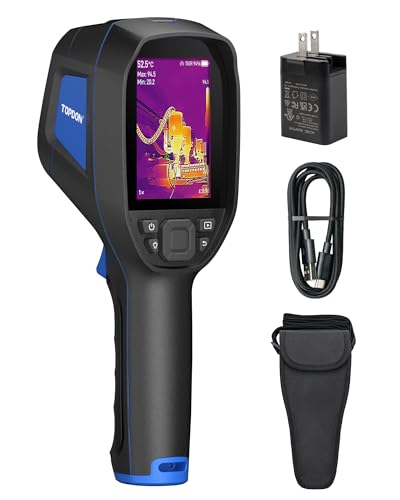
The TOPDON TC004 strikes the hardest balance between image quality and real-world usability for automotive work. Its native 256×192 sensor — upscaled to 512×384 via TISR — delivers enough pixel density to spot a 2°C difference on a corroded battery terminal or a cracked exhaust manifold. The 3.5-inch screen is significantly larger than the 2.4-inch panels found on budget handhelds, reducing eye strain during long diagnostic sessions under a hood.
Battery life is the standout feature here: 8 hours of active scanning means you can chase intermittent heat faults across multiple vehicles without stopping to recharge. The built-in 64GB storage eliminates the anxiety of filling a tiny SD card mid-inspection, and IP54 plus 2-meter drop protection ensures the unit survives the inevitable slide off a fender. The red laser pointer is a small detail that makes a huge difference — you can literally point at the suspect component while the camera shows the thermal data on screen.
The primary catch is that file transfer to a PC requires a third-party archive tool for RAR extraction, and the remote video clips cannot have temperature data overlaid later. For a shop that needs robust on-camera analysis and wireless report generation, the TC004 is a proven workhorse.
Why it’s great
- 8-hour runtime covers a full workday of automotive diagnostics
- Large 3.5″ display with a comfortable pistol-grip for one-handed use
- Built-in 64GB memory means no lost data between transfers
Good to know
- PC analysis requires a separate archive utility to access RAR files
- No post-hoc temperature analysis on recorded video footage
2. Thermal Master Thor 002 Handheld Thermal Camera
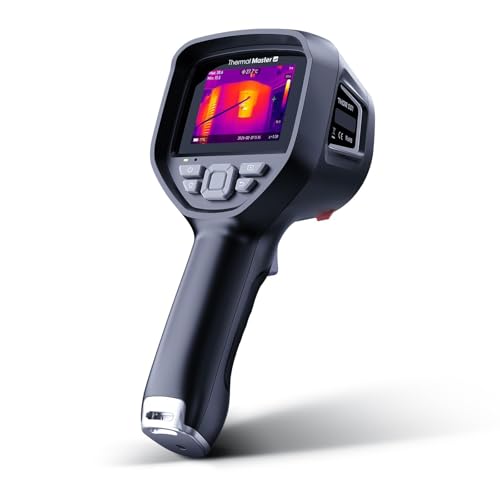
The Thor 002 from Thermal Master is built for extended field use, powered by a 5000mAh battery that delivers up to 10.5 hours of continuous operation — enough for a full day of fleet vehicle inspections without a charger. The X³ algorithm boosts the native 256×192 sensor to a clean 512×384 effective resolution, and the 40mK thermal sensitivity picks up subtle temperature gradients that lower-tier cameras blur together. This matters when you are trying to decide whether a wheel bearing is running 8°C hotter than ambient or a safe 4°C.
The 3.5-inch 640×480 IPS display is crisp even in bright daylight, and the 2MP visible-light camera with multiple fusion modes lets you switch between thermal-only, picture-in-picture, and full overlay. Wireless connectivity via Wi-Fi and USB allows real-time PC monitoring, which is useful when you need a second set of eyes on a hard-to-reach engine compartment. The 32GB internal storage plus 8GB RAM handle 25Hz video recording without dropped frames.
A small number of units have exhibited a boot failure that is fixed by holding the power and play buttons for 10 seconds — a quirk that should not exist at this price point. If you need the longest possible battery life for multi-vehicle diagnostics, the Thor 002 is the clear leader.
Why it’s great
- 10.5-hour battery life easily outlasts a full shift
- 40mK thermal sensitivity reveals tiny temperature variations
- Supports Wi-Fi and USB for real-time PC monitoring
Good to know
- Occasional boot failure requires a hard reset of power and play buttons
- Heavier than some competitors at over 3 pounds
3. FOXWELL RT280 PRO Thermal Camera
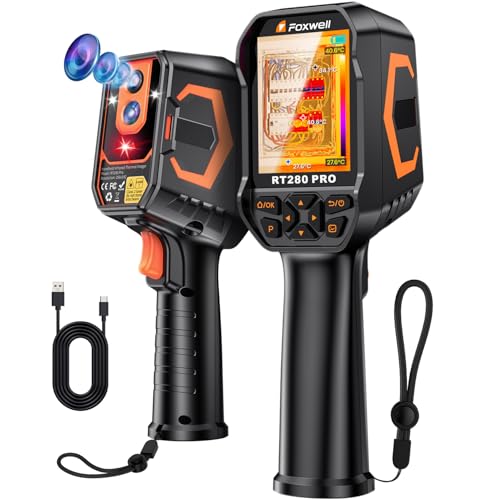
The FOXWELL RT280 PRO packs more usable features per dollar than almost any other handheld in its segment. The 2.8-inch LCD screen is smaller than the TC004’s, but the dual-camera system — a dedicated 256×192 IR sensor plus a 2MP visible-light camera — with five fusion modes (thermal, visible, outline, PIP, and overlay) makes it much easier to map a hot spot back to the actual part. The laser pointer and built-in LED light let you work in a dark engine bay or under a car lift without a second flashlight.
Temperature accuracy is rated at ±3.6°F or ±2%, which is solid for automotive use, and the 25Hz frame rate keeps the image smooth when scanning across a hot exhaust system. The free PC analysis software — supporting point, line, and area temperature analysis plus 2D/3D rendering — transforms raw thermal data into professional reports, a feature rarely seen at this price. The IP54 and 6.6-foot drop rating match the TC004’s ruggedness.
The trade-off is the lower display resolution and lack of a macro lens for close-up PCB inspection. If you need a versatile, report-capable thermal imager for general automotive and HVAC work without spending premium money, the RT280 PRO is the smart pick.
Why it’s great
- Five image fusion modes and a laser pointer for precise targeting
- Free PC software generates 2D/3D thermal analysis reports
- IP54 and 6.6-foot drop resistance for shop floor durability
Good to know
- No macro lens for inspecting tiny circuit board components
- 2.8-inch screen is smaller than some competitors’ displays
4. VEVOR Thermal Imaging Camera
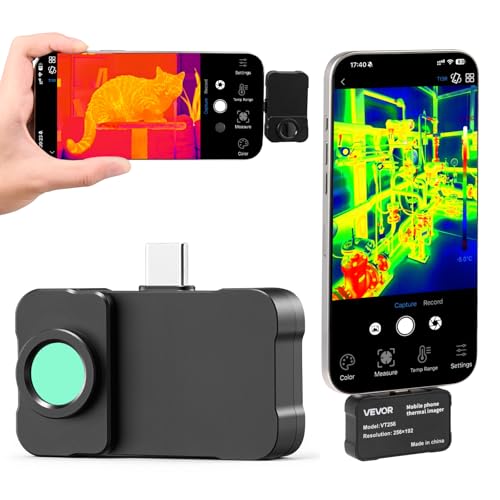
VEVOR’s smartphone dongle is the entry point that does not feel like a compromise. The native 256×192 sensor is upscaled to 512×384 using TISR, and the 25Hz refresh rate keeps the feed smooth enough to watch a thermostat open in real time. The included macro lens screws onto the front, letting you focus as close as a few inches — ideal for inspecting individual fuses or solder joints on an ECU. Temperature range spans -4°F to 1022°F, covering everything from a frozen A/C line to a glowing exhaust manifold.
Compatibility with both Android (via Type-C) and iOS (via included Lightning adapter) means it works across your whole toolbox’s worth of devices. The app is QR-code activated and includes high/low temperature alarms, six color palettes, and PiP mode. At only 1.12 ounces, you will forget it is in your pocket until you need it.
Because it relies on your phone’s battery and screen, extended sessions will drain your device. Also, the app interface is functional but not as polished as dedicated cameras. For the mobile mechanic who already carries a smartphone, this is a ridiculously portable and capable option.
Why it’s great
- Ultra-light at 1.12 ounces, easy to carry daily
- Macro lens included for close-up PCB and component work
- Works with both Android and iOS via included adapters
Good to know
- Drains phone battery during extended use
- App interface is less refined than standalone camera menus
5. Thermal Master P3 Thermal Camera
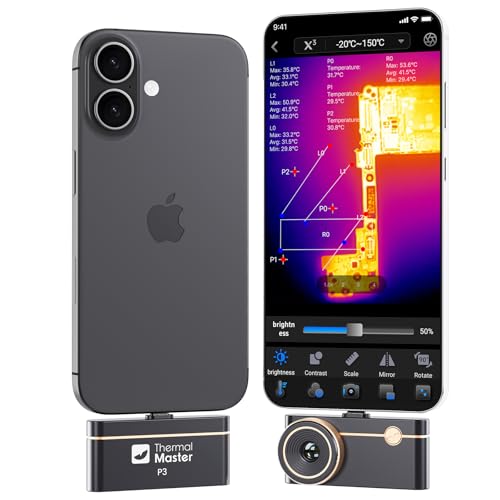
The Thermal Master P3 is purpose-built for precision electronics diagnostics inside vehicles. Its manual focus ring lets you dial in sharp thermal images at distances as close as 8mm — unlocking macro capability that no fixed-focus dongle can match. This is critical for pinpointing a 1mA leakage current on a PCB or a single overheated voltage regulator. The X³ algorithm brings the native sensor to 512×384 effective resolution, and the 0.035°C thermal sensitivity is best-in-class for this form factor, detecting the faintest warm-up in a failing component.
At just 26.3 grams, the P3 is almost weightless. It draws power from the host device (0.32W), so there is no battery to manage — plug it into a USB-C phone or tablet and it runs for 5 to 8 hours straight. The free Thermal Master app offers 12 color palettes, adjustable alarms, and one-click report export. The inclusion of a Lightning adapter and a 50cm extension cable means you can position the camera inside a cramped footwell while the tablet rests on the passenger seat.
The lack of a built-in battery is a double-edged sword: it keeps the weight down, but it also means the P3 is useless if your phone is dead. Also, the app defaults to Celsius, and the red font color on some palette modes can be hard to read. For a repair shop that does heavy ECU-level electronics work, the P3 is an indispensable scalpel.
Why it’s great
- Manual focus with 8mm minimum distance for macro PCB inspection
- 0.035°C thermal sensitivity catches incredibly subtle heat faults
- Weighs only 26.3g and draws power from the host device
Good to know
- No internal battery — requires a powered phone or tablet
- App font color can clash with certain palette choices
6. TOPDON NV001 Automotive Thermal Night Vision System

The TOPDON NV001 is the only product on this list designed as a vehicle-integrated safety system rather than a handheld diagnostic tool. It mounts to the grille or license plate and feeds thermal video to a 5-inch display inside the cabin, giving you a 656-foot forward view that cuts through fog, rain, and oncoming headlight glare. The image enhancement boosts the sensor from 256×192 to 384×288, providing enough resolution to distinguish a deer from a road sign at highway speeds.
AI collision alerting uses a color-coded threat system (green, yellow, red) with audible warnings. The system correctly identified pedestrians and vehicles in most test scenarios, though some users report false alerts from oncoming traffic at close range. The 17-degree field of view creates a tunnel-vision effect — you see what is directly ahead in high detail, but lose peripheral awareness. Installation is moderately involved, requiring mounting the camera and running a coaxial cable through the firewall.
The biggest weakness is the small display size — sitting two feet away, the 5-inch screen can feel cramped, and there is no brightness adjustment for nighttime use. The IP69K waterproof rating ensures the camera survives car washes and torrential rain. If you frequently drive rural roads at night where animals and pedestrians are a real hazard, the NV001 is a transformative safety upgrade.
Why it’s great
- 656-foot detection range provides ample reaction time at highway speeds
- AI color-coded alerts for pedestrians, animals, and vehicles
- IP69K waterproof rating survives extreme weather and car washes
Good to know
- Narrow 17° FOV creates a tunnel-vision effect
- Small in-cabin display can be hard to read at a glance
7. THINKWARE U3000 PRO 2CH Dash Cam
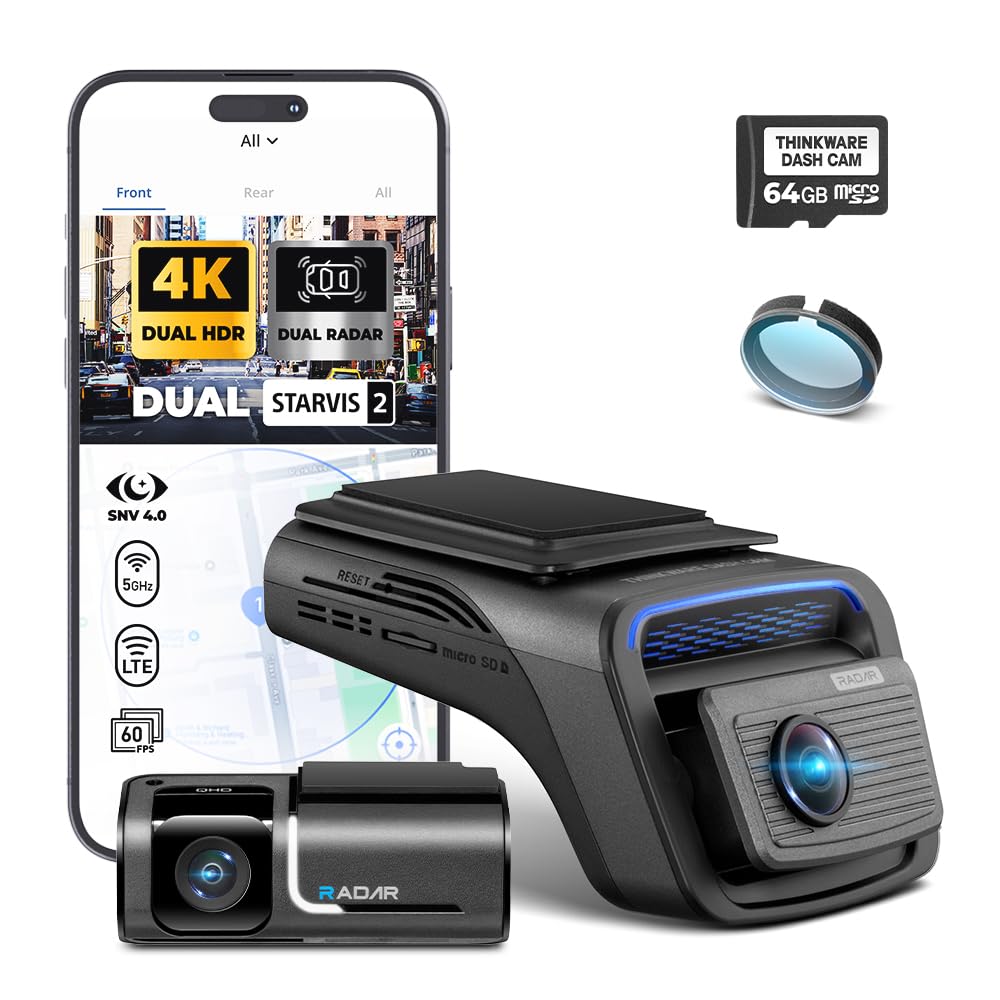
The THINKWARE U3000 PRO shifts the thermal conversation: rather than a dedicated IR camera, it uses Sony STARVIS 2 sensors to achieve exceptional low-light performance — essentially thermal-adjacent visibility without a thermal sensor. The 4K front camera with a 147.2-degree field of view can read license plates from two cars ahead even at night, and the rear 2K STARVIS 2 camera provides complementary coverage. This is not a tool for diagnosing engine heat, but a safety device that records thermal details of the road environment.
Radar parking mode is the standout feature: the internal radar detects motion around the parked vehicle and wakes the camera to record a 20-second clip, saving battery compared to continuous buffered recording. The OBD-II power cable includes voltage monitoring to prevent battery drain, and the 64GB microSD card is included. LTE module support (sold separately) enables live view and remote alerts, turning the dash cam into a full vehicle security system.
The companion app is functional but noticeably slower for retrieving older footage compared to direct-card transfer. The U3000 Pro also lacks an integrated thermal camera — it relies purely on visible-light STARVIS 2 sensors, so it cannot see through fog or total darkness the way a true thermal camera does. For a driver who wants the best possible low-light recording and parking surveillance, this is the benchmark.
Why it’s great
- 4K STARVIS 2 front sensor excels in extremely low-light conditions
- Radar parking mode saves battery while providing continuous protection
- OBD-II cable with voltage monitoring prevents battery drain
Good to know
- No actual thermal sensor — relies on visible-light night vision
- App interface is slower for retrieving old recordings
8. Klein Tools TI290 Rechargeable PRO Thermal Imaging Camera
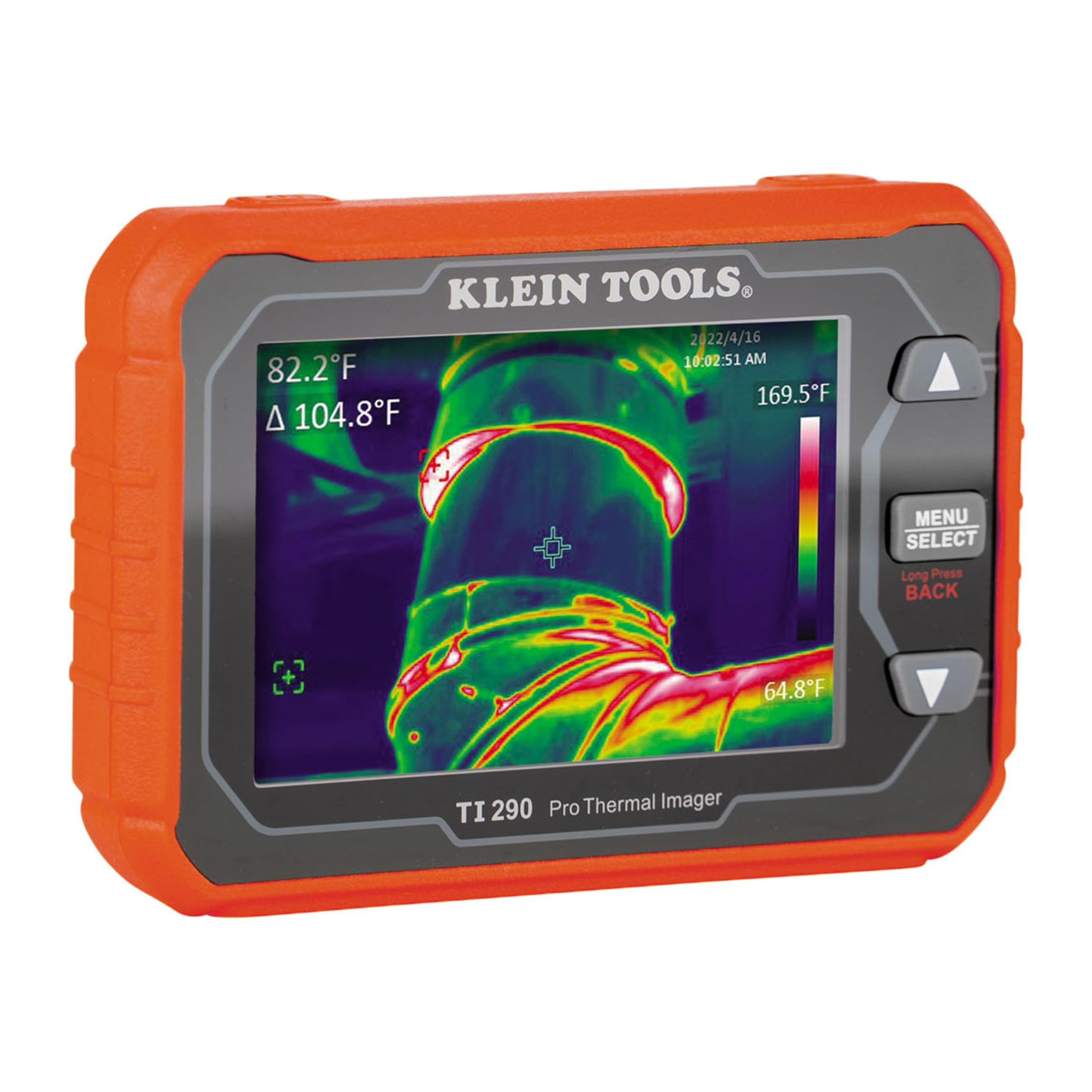
Klein Tools builds the TI290 for electricians who need a quick go/no-go thermal check on breakers, fuses, and motor windings — not for extended thermographic analysis. The 76,800-pixel sensor (roughly 277×277) produces adequate image detail for spotting a 20°C difference on a bus bar, but it will struggle to resolve a single overheated diode on a control module. The three color palettes (ironbow, rainbow, grayscale) cover the basics, and the adjustable emissivity from 0.01 to 0.99 lets you correct for reflective surfaces like polished aluminum engine parts.
Build quality is classic Klein: rubberized overmold, a 6.6-foot drop rating, and a soft pouch with a carabiner clip for belt carry. The Wi-Fi connection to the Klein Tools app lets you capture and share images, though the connection can be finicky, sometimes requiring two or three attempts. The micro-USB charging port feels dated compared to the USB-C found on newer competitors.
The low refresh rate is the TI290’s biggest limitation — the image stutters noticeably when you move it across a hot surface, making it poor for scanning engine bays or finding intermittent faults. For a dedicated electrician doing routine thermal checks on panels and disconnects, it is a reliable pocket tool. For automotive diagnostics, the slow frame rate is a real handicap.
Why it’s great
- Rugged Klein build quality with rubberized overmold and drop protection
- Adjustable emissivity from 0.01 to 0.99 for accurate surface readings
- Compact design with pouch and carabiner for daily carry
Good to know
- Low refresh rate causes image stutter during rapid scanning
- Wi-Fi connection to the app is unreliable and drops frequently
9. FLIR E6-XT Commercial Thermal Imaging Camera

The FLIR E6-XT is the established reference standard in professional thermal imaging, and its performance in automotive contexts is equally authoritative. The 240×180 native resolution (43,200 pixels) is lower on paper than many competitors on this list, but FLIR’s patented MSX technology embosses visual details — edge outlines, lettering, component shapes — directly onto the thermal image, creating a composite that is dramatically easier to interpret than a raw thermal blob. For a technician documenting a cracked cylinder head or a leaking heater core for a customer report, this clarity saves time.
Temperature range of -4°F to 1022°F covers every automotive scenario from A/C evaporator freeze-up to exhaust system red heat. FLIR Ignite cloud integration lets you upload, store, and share images wirelessly, and over-the-air firmware updates keep the camera current without cables. The 4-second boot time is the fastest in this roundup, so you never miss a transient heat event while waiting for the camera to wake up.
The price is a serious barrier: the E6-XT costs more than some complete tool sets. Its 9Hz refresh rate is adequate for building diagnostics but feels sluggish for scanning a fast-warming engine block. Also, the physical resolution (240×180) means you still need to be relatively close to small objects to resolve them. For a professional shop that bills by the hour and needs indisputable visual evidence for every diagnosis, the FLIR E6-XT is the ultimate invoice-justifying tool.
Why it’s great
- FLIR MSX overlay embeds text and edges for instantly readable images
- FLIR Ignite cloud integration streamlines report generation
- Fastest boot time at 4 seconds — never miss a transient heat event
Good to know
- 9Hz refresh rate feels sluggish for scanning fast-warming components
- 240×180 native resolution is low compared to modern 256×192+ sensors
FAQ
Can I use a building inspection thermal camera for automotive engine diagnostics?
What is the difference between a smartphone dongle thermal camera and a standalone handheld?
Why does my thermal camera show a cold engine block as the same temperature as the hood?
Final Thoughts: The Verdict
For most users, the best automotive thermal camera winner is the TOPDON TC004 because it combines a large 3.5-inch display, an 8-hour battery, and 512×384 enhanced resolution into a rugged handheld that handles a full day of shop diagnostics. If you need macro-level precision for electronics and PCB repair, grab the Thermal Master P3 for its manual focus and 0.035°C sensitivity. And for night-time driving safety where detecting animals and pedestrians is the priority, nothing beats the TOPDON NV001.