
Our readers keep the lights on and my morning glass full of iced black tea. As an Amazon Associate, I earn from qualifying purchases.
Specs are compiled from manufacturer listings and verified buyer reviews and can change over time — please confirm the key details on the product page before buying.
Forget the weekend ritual of pushing a loud machine around your property. An autonomous commercial lawn mower uses GPS and cameras to steer itself, cut the grass, and return to its charging dock without you lifting a finger, even on large, tricky lawns.
I’m Min — the founder and writer behind Gadgets Feed. This guide is built by comparing the manufacturers’ published specifications and the patterns across verified customer reviews, so you get each pick’s real strengths and trade-offs instead of marketing spin.
We’ve broken down the top models, from slope-climbing giants to modular systems that handle snow too, so you can find the right autonomous commercial lawn mower for your land.
Quick Picks
- WORX Landroid Vision WR344 — Top Performer
- Lymow One Plus Robot Lawn Mower — Best Overall
- YARBO Robot Lawn Mower — Best Value
- YARBO Lawn Mower Pro — Premium Pick
- YARBO Robot Lawn Mower + Snow + Leaf Blower — All-Season Master
How To Choose The Best Autonomous Commercial Lawn Mower
Buying a robotic mower for a large property is a major decision. While the tech is impressive, the real differentiators come down to how the machine handles your specific land—its slopes, its obstacles, and its sheer size.
Match the Machine to Your Terrain
The steepest part of your yard dictates which mower you can buy. While many residential bots struggle on anything past a gentle incline, the models on this list are built for the hard stuff—climbing slopes from 70% all the way up to 100% (that’s a 45-degree angle). If you have a hilly property, a tracked model is non-negotiable.
Coverage and Cutting Width
Time is money on a commercial property. A mower with a wider cutting deck covers more ground per pass, so a 20-inch deck will finish a job noticeably faster than a 16-inch one. You also need to check the battery runtime and how quickly the machine can recharge and get back out to finish the job.
Wire-Free Navigation and Mapping
Modern mowers use RTK (Real-Time Kinematic) satellite positioning, often fused with Vision AI and VSLAM cameras. This means you no longer need to bury a perimeter wire around your entire lawn. Instead, the mower learns your yard’s boundaries and obstacles via an app, letting you set virtual no-go zones for gardens or driveways.
Quick Comparison
| Model | Best For | Cutting Width | Slope Rating | Cut Height Range | Amazon |
|---|---|---|---|---|---|
| WORX Landroid Vision | Tech-savvy, extreme slopes | 8.7 inches | Up to 84% | 1.57″ – 3.54″ | Amazon |
| Lymow One Plus | High cut quality, value | 16 inches | 100% (45°) | 1.2″ – 4″ | Amazon |
| YARBO Robot Mower | Massive acreage, modular | 20 inches | Up to 70% | 1.2″ – 4.0″ | Amazon |
| YARBO Lawn Mower Pro | Commercial-grade power spec | 20 inches | 70% (35°) | 0.8″ – 4.0″ | Amazon |
| YARBO 3-in-1 System | Year-round property care | 20 inches | Up to 70% | 1.2″ – 4″ | Amazon |
In-Depth Reviews
1. WORX Landroid Vision WR344
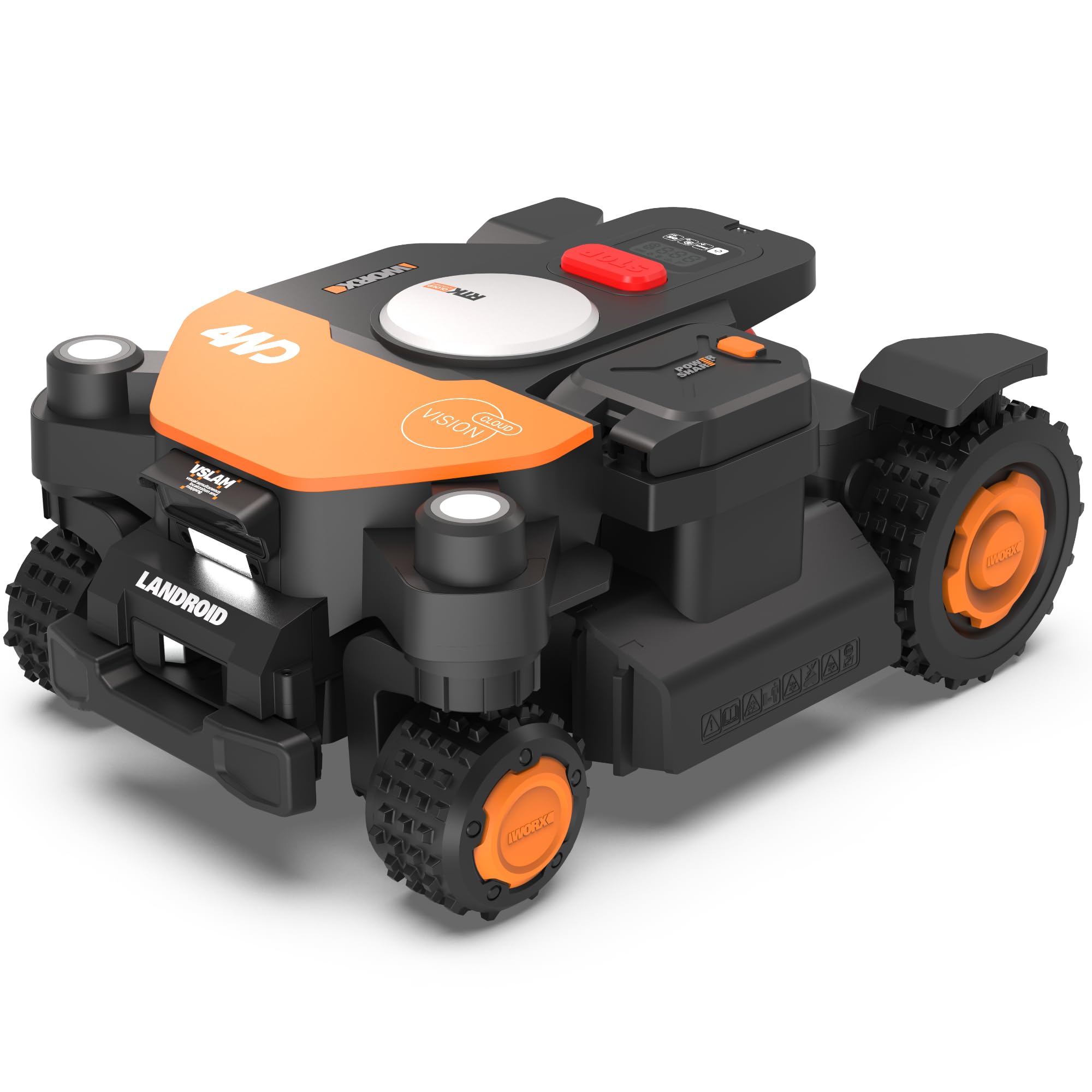
The wireless mower that climbs 84% grades and trims right to the edge.
If your property has punishing hills, the WORX Landroid Vision is engineered for exactly that. It uses a terrain-adaptive chassis and true front-wheel steering to keep traction on steep slopes up to 84% (~40°) without ripping up the turf. While its 8.7-inch cutting width is narrow compared to the Lymow’s 16 inches—an 84% smaller gap in one pass—it makes up for it with precision.
Where this mower shines is the finish. The Vision AI understands different boundary types, and the Cut-to-Zero offset blade lets it trim right along fixed borders, minimizing the string-trimming you need to do by hand. Buyers report a clean, precise cut with minimal manual edging thanks to the Cut-to-Zero blade.
You can mow after dark safely thanks to the FiatLux light system (a set of eye-safe LEDs), so you can run schedules past daylight. In open areas, navigation relies on RTK Cloud accuracy (a satellite-based positioning service that corrects GPS errors to within inches), and when you move into shaded spots, V-SLAM sensor fusion (a camera-and-sensor system that maps surroundings in real time) takes over without interruption. Be aware that setup depends heavily on the app, and some owners mention connection roadblocks—a few say the mower gets lost between lawn zones, so you need a stable GPS signal for reliable operation.
Serious Hill Power
- 84% slope capability with true front-wheel steering
- Cut-to-Zero blade reduces manual edging
- Automatic light sensing enables night mowing
- GPS Find My Landroid tracking for security
Smart Trade-Offs
- Narrow 8.7″ deck means slower full coverage on vast lawns
- App-based setup and connectivity can frustrate some users
- V-SLAM and RTK reliability depends on open-sky access
Reach for this if: you own a steep, complex property and want a mower that handles the slopes and edges without a buried wire, all from your phone.
Look elsewhere if: you need maximum acres-per-hour—this one trades sheer width for terrain prowess.
2. Lymow One Plus Robot Lawn Mower
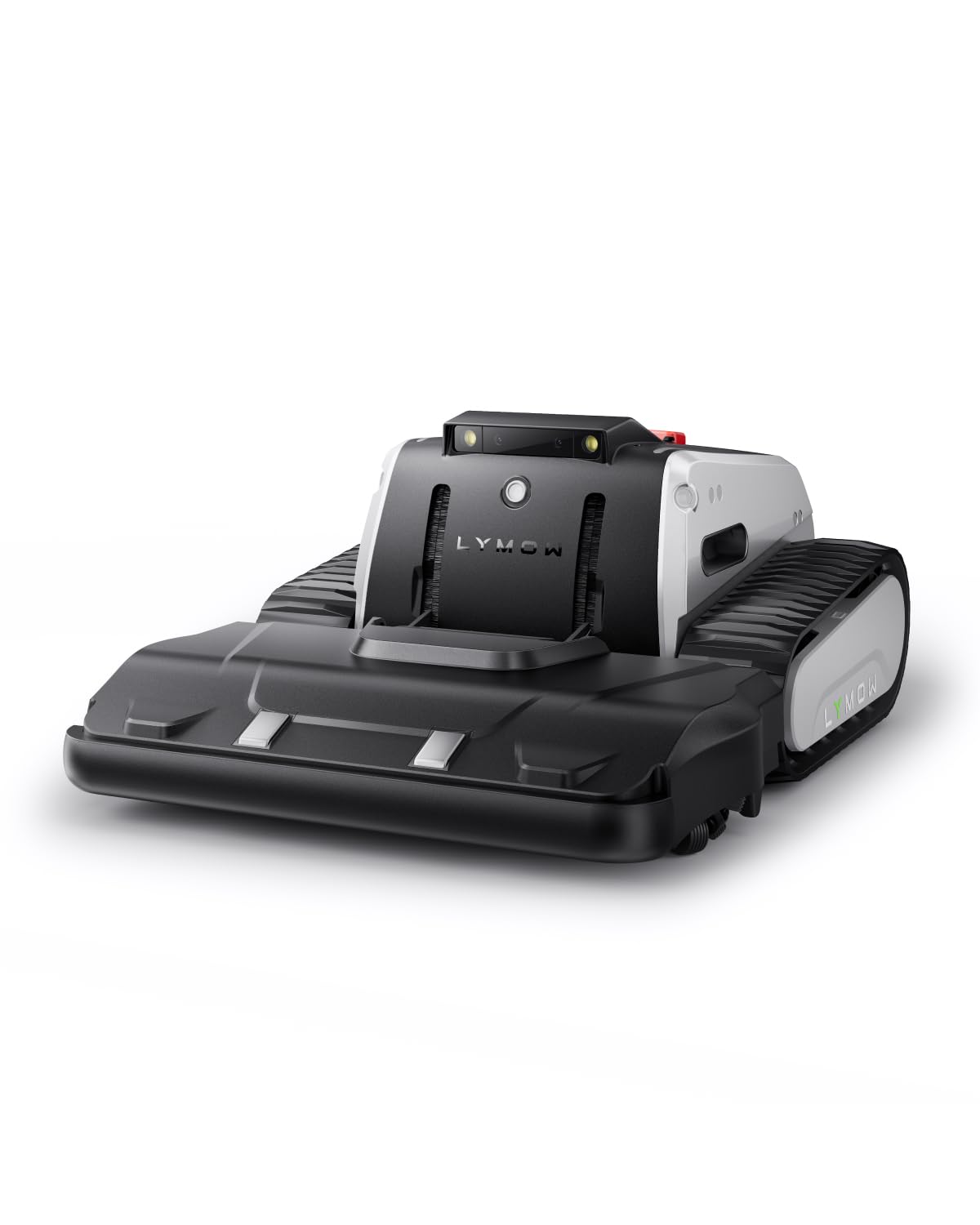
A 16-inch tracked beast that mows a 1.73-acre daily, slopes included.
If you have a large property with challenging terrain, the Lymow One Plus delivers the speed and capability you need. Its defining feature is the Terrain Master track drive system (a set of heavy-duty rubber tracks instead of wheels), which climbs slopes up to 45°—a 100% gradient,. Those tracks grip loose soil and wet grass without slipping or leaving ruts, so it can cross swales and stone paths that would stall wheeled mowers like the YARBO.
It pairs serious traction with a wide 16-inch dual rotary blade deck, giving it an 84% wider cut than the WORX’s 8.7 inches. The Lycut System 2.0 uses dual SK5 tool steel blades at 50 HRC and a 1785W peak power motor spinning up to 6,000 RPM, with cutting heights you can set anywhere from 1.2 to 4 inches. That power lets it handle grass up to 3 inches in a single pass and even mulch leaves into fine particles.
A 15000mAh LiFePO₄ battery—rated for 2,000+ cycles—delivers mowing for a full 3-hour charge, covering 0.57 acres each time. With up to 3 auto-resume cycles a day, it covers 1.73 acres daily without you touching it. What wins people over is the cut quality; customers note clean, even stripes that look professionally maintained, and the app’s double-cut feature cleans up any thick patches. Owners note a setup learning curve, but once past it, the mower becomes a reliable time-saver.
The verdict: the best balance of sheer cutting power, speed, and extreme-slope capability for demanding residential and light-commercial properties.
Be patient with: the first-time mapping—the GPS + VSLAM navigation rewards a careful initial setup.
3. YARBO Robot Lawn Mower
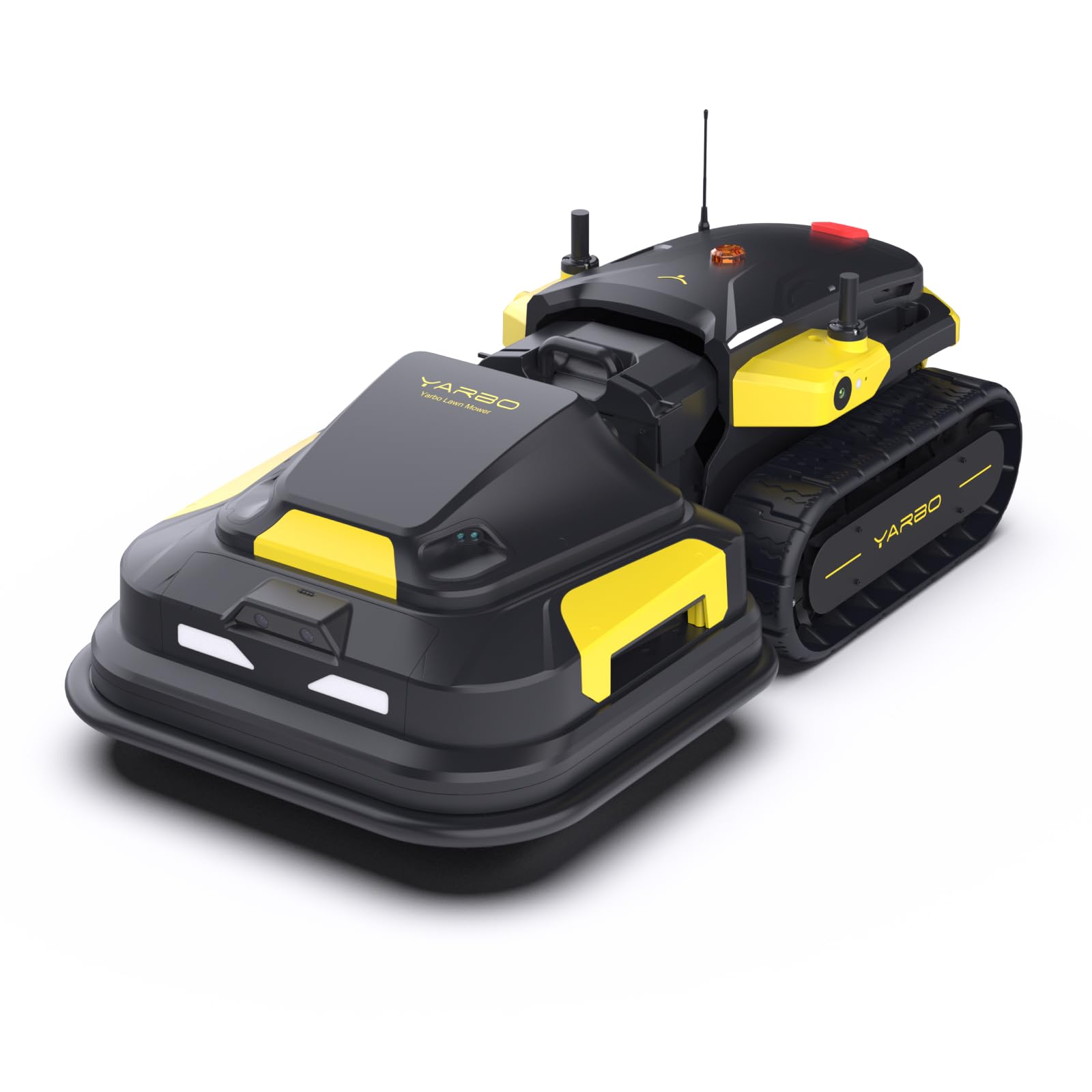
A 20-inch deck and patented tracks turn huge properties into push-button tasks.
For wide-open spaces where smaller bots run out of battery, the YARBO covers up to 6.2 acres (25,000 square meters) per charge, thanks to a 120-minute runtime. Its 20-inch cutting width—the widest in this lineup alongside its Pro sibling—lets you lay down professional stripes faster than the Lymow One Plus’s 16-inch deck. You can adjust the cutting height from 1.2 to 4.0 inches to suit different grass lengths, giving you a top cut that is 13% taller than the WORX’s 3.54 inches.
The unique All-Terrain Patented Tracks let it master hills up to a 70% slope, giving it the confidence to tackle uneven ground, ditches, and steep inclines that would stop wheeled models. It also uses AI Vision + RTK Navigation for wire-free boundary setup via its controller, with tree avoidance and no-go zones. Setup requires a clear 120° view of the sky for its Data Center Set—the key installation detail—and it ships in 4 boxes with a ~200 lb metal chassis, so plan for two adults at assembly.
Owners consistently praise the crisp, professional-looking stripes it produces. Owners on 2–4 acres report saving 2–3 hours weekly, and the modular base accepts leaf-blowing or snow-blowing attachments (sold separately). Just keep in mind that while the cut quality is superb, it moves slower than a tractor, so most owners schedule it to run a couple of times a week rather than expecting one quick pass.
What sells it: the widest deck in this roundup and a track system that laughs at muddy or steep terrain, all wrapped in a chassis that saves you hours weekly.
The reality check: it’s a heavy machine demanding a committed setup, and reviewers point out that the app isn’t the most intuitive—patience is part of the deal here.
4. YARBO Lawn Mower Pro
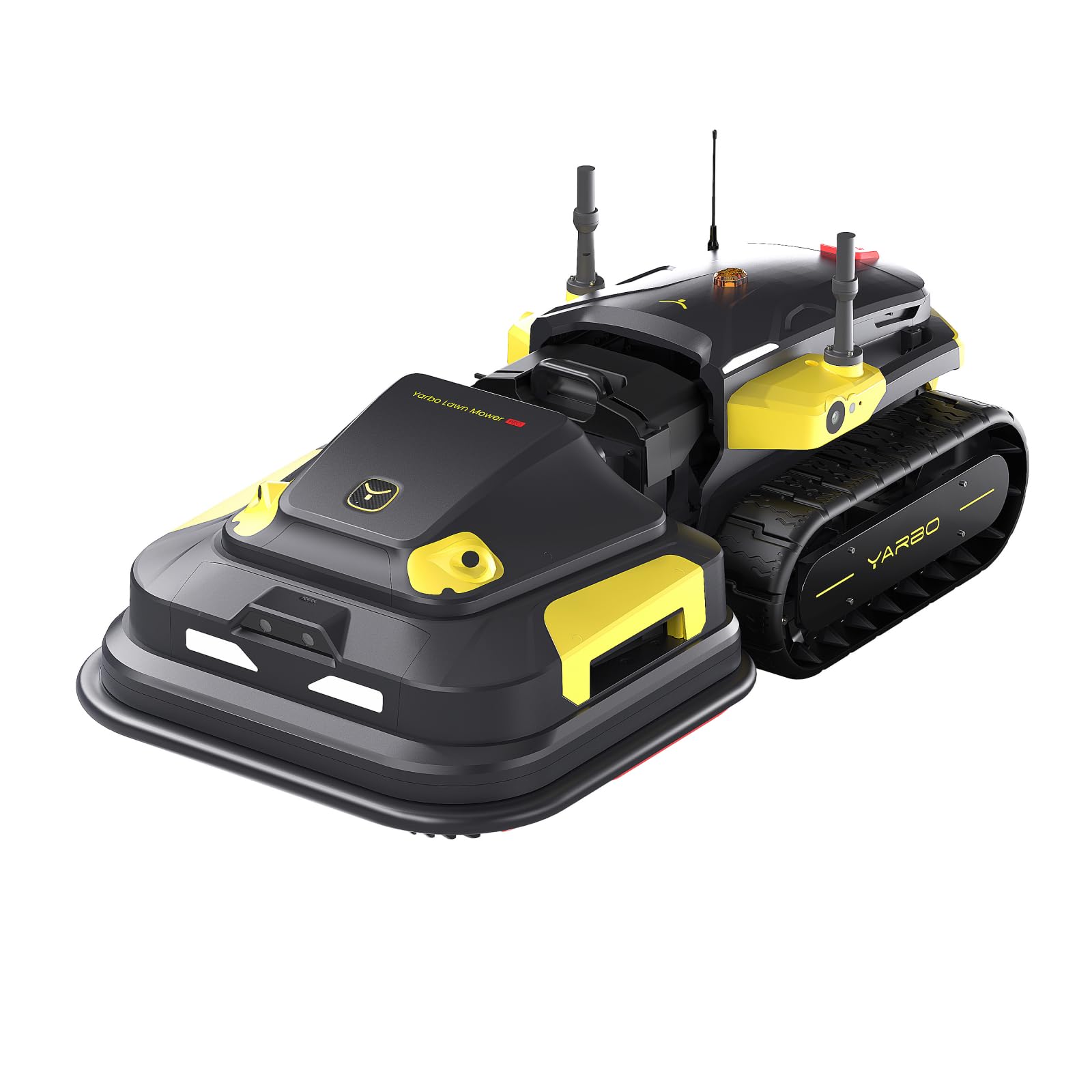
Built to chew through thick, wet, overgrown grass on estates and golf courses.
Where the standard YARBO impresses with size, the Pro version raises the bar on sheer cutting muscle. It swaps in a 300W dual-motor system and a high-efficiency grass ejection design, which owners say lets it power through dense, damp warm-season grass without clogging up. This is the machine Yarbo points at homes, golf courses, turf farms, luxury hotels, and resorts—land that demands more than just a tidy trim.
The mowing precision comes from its triple-fusion navigation (RTK-GPS + binocular vision + multi-sensor PPVS). The binocular cameras and ultrasonic sensors aren’t just seeing obstacles; they’re detecting suspended ones too, optimizing paths for safer avoidance. That nav power helps it handle complex layouts, and the all-steel skid shoes protect the deck over stony or uneven yards, with a 70% (35°) climbing gradient to keep it stable.
Versatility is a key pitch here. It includes two blade options—razor blades for cool-season grasses and straight blades for thick warm-season ones—and cuts as low as 0.8 inches, the lowest minimum height in this lineup, up to 4.0 inches. The trade-off is that this commercial-grade power demands a significant setup effort. Shoppers say a steep learning curve, with heavy tree canopies interrupting GPS during initial mapping—expect real time invested before hands-off operation.
Commercial-Grade Muscle
- Dual 300W motors tackle thick, wet grass without clogging
- Lowest cut at 0.8″ for pristine golf-course finishes
- Triple-fusion nav detects even suspended obstacles
- IPX6 rating and auto-charge for all-weather use
Heavy Commitment
- Setup takes significant time and effort to map properly
- GPS can drop under dense tree canopies
- Learning curve is real for complex properties
Who this beats: the biggest, nastiest, most overgrown jobs that would choke a lesser mower—if your grass gets thick and wet, this is the one that keeps running.
Who it tests: anyone expecting a true set-and-forget device from hour one; mapping is a genuine chore first.
5. YARBO Robot Lawn Mower + Snow + Leaf Blower
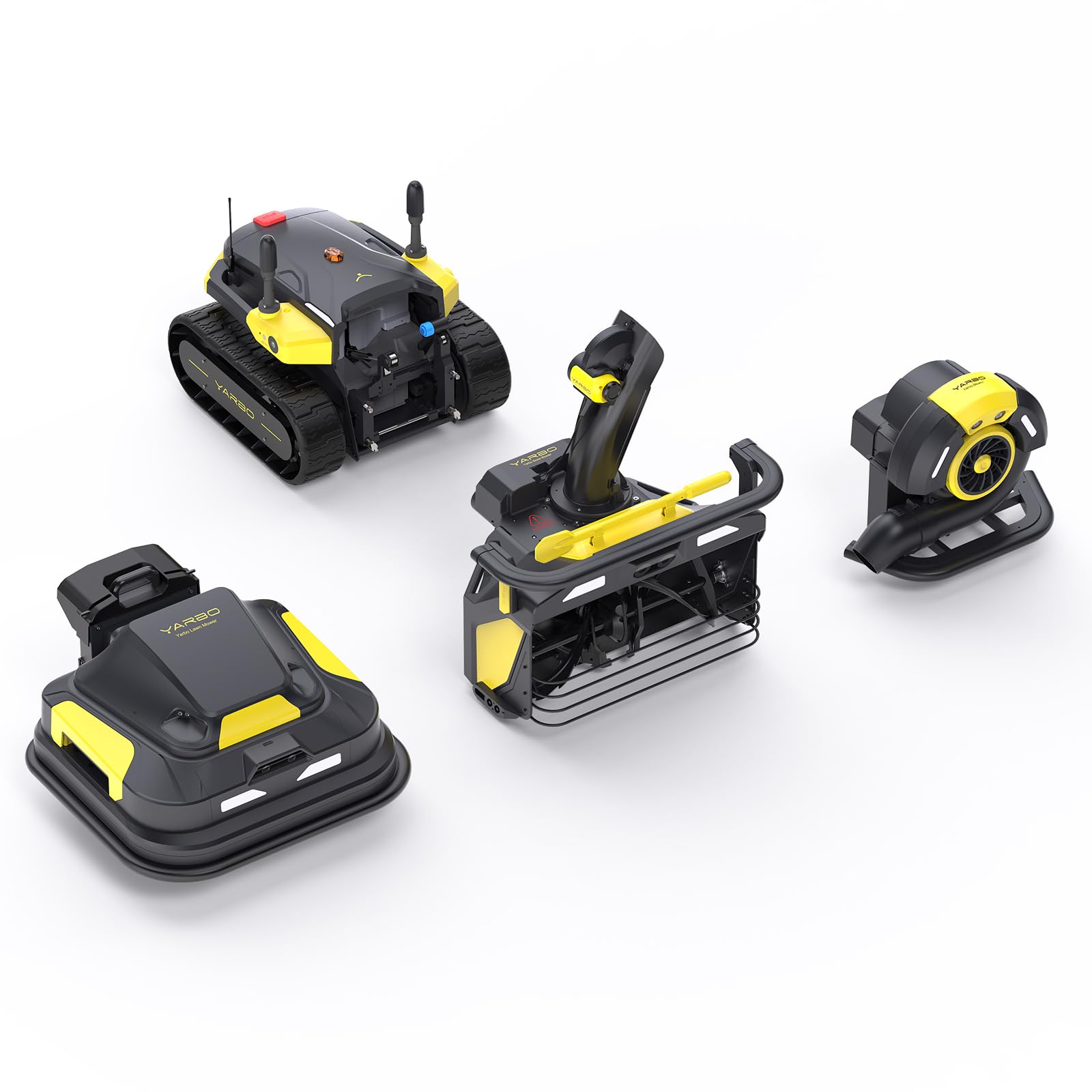
One tracked base that mows your lawn, then swaps to blow snow in winter.
This is the ultimate ROI play for someone who owns a large property and hates every chore that comes with it. Instead of buying separate machines for grass, leaves, and snow, the modular YARBO Core lets you swap attachments for year-round tasks. You get the full lawn-mowing capability of the standard model—a 20-inch cutting width, coverage for 6.2-acre large yards, and All-Terrain Patented Tracks for 70% slopes.
When winter hits, you swap in the 2-stage cordless electric snowblower module with a 24-inch cleaning width, which can go from 0-80% charge in approximately 120 minutes. The 2000W variable-speed leaf blower module then handles fall cleanup, eradicating 99% of debris from thick piles down to rain-soaked leaves. One heavy-duty alloy steel chassis (323 pounds) does all three jobs, so you’re not storing three separate tools.
The reality of this system is best framed by what buyers actually experience: the mowing capability is genuinely praised, with the remote-controlled snow blowing being a particular favorite. Buyers report mowing 0.5 acres in about 45 minutes at slow speed while using just 11% of the battery. However, this is the most complex system here, and the reviews are sharply split—many praise the customer service, while others report a frustrating troubleshooting experience when things go wrong. It delivers on the promise, but only if you’re ready to be an early adopter.
Why it earns its place: it’s the only system here that replaces your mower, snowblower, and leaf blower with one autonomous tracked base—a genuine all-season yard master.
Who should hesitate: if you want simple, guaranteed reliability and aren’t prepared to troubleshoot or wait on support, this complexity might test your patience.
Understanding the Specs
Cutting Width and Speed
This number tells you how wide a strip of grass the mower slices in a single pass. A wider deck, like 20 inches, covers more ground per trip than a 16-inch one, meaning fewer laps to finish a property. It’s the single biggest factor in how quickly a job gets done, which is why commercial operators often prioritize it over raw speed.
Slope Rating (Percentage and Degrees)
This tells you the steepest incline the mower can climb without losing traction or tipping. Ratings like 70% or 84% refer to a percentage grade, while 100% slope equals a 45-degree angle. Track-driven mowers (like Lymow and YARBO) grip loose and wet ground far better than wheeled ones, so check this spec against the steepest hill on your property.
RTK and Vision Navigation
RTK (Real-Time Kinematic) uses satellite signals—often delivered from the cloud—to pinpoint the mower’s position within centimeters. Vision AI adds cameras that recognize objects like toys or pets. Together they allow “wire-free” operation, meaning you set virtual boundaries on an app instead of burying a physical wire around your lawn.
Coefficient of Friction (COF)
This is a measure of how much grip a surface provides. Mowers with aggressive treads or tracks need higher friction to climb slopes without slipping. It’s a hidden factor that determines whether a mower can actually handle the grade you plan to send it up, especially on wet morning grass.
FAQ
Will an autonomous mower work on my lawn if it has steep hills?
Do I need to bury a perimeter wire for these mowers to work?
How long does it take to set up the initial mapping?
Can a commercial robot mower handle thick, wet, or overgrown grass?
What happens if it rains or the battery runs low mid-mow?
Is a 16-inch cutting width enough for a large commercial property?
Can I use these mowers while I’m away from the property?
What does “modular design” mean on the YARBO models?
How much maintenance do these mowers actually need?
Final Thoughts: The Verdict
If you want one dependable pick, the autonomous commercial lawn mower winner is the Lymow One Plus because it delivers the widest practical cut, verified 45-degree slope capability, and a high-quality finish at a price that doesn’t require a commercial budget. If you want the most powerful cut for thick, golf-course-grade grass, grab the YARBO Lawn Mower Pro. And for those who want one machine to handle every season—mowing, leaves, and snow—the YARBO 3-in-1 System is the one to reach for.
How We Picked
We do not accept paid placement. Every pick is matched to a real buyer and a real use-case; we do not hands-on test units.
Sources & Methodology
Specifications: manufacturer listings and product documentation. Review insights: verified customer reviews, as of September 2026. Pricing: not shown on this page (it changes often); check the current price via the retailer link.
As an Amazon Associate, Gadgets Feed earns from qualifying purchases. This does not affect which products we feature.