
The difference between a lawn that limps into spring and one that explodes out of dormancy is decided months earlier, when soil temperatures drop below 55°F and cool-season grasses switch from top-growth to root-building mode. An autumn fertilizer application is a strategic investment in carbohydrate storage, crown density, and early-season vigor — and choosing the wrong NPK ratio or release mechanism can leave your turf vulnerable to winter kill.
I’m Min — the co-founder and writer behind Gadgets Feed. I’ve spent hundreds of hours cross-referencing soil science papers, granular release curves, and seasonal application timing to separate the formulas that actually fuel root respiration from those that simply green the leaf for a few weeks.
Whether you manage a fescue lawn in the Northeast or a Bermuda pasture transitioning into dormancy, this guide to the best autumn lawn fertilizer breaks down nitrogen sources, potassium loads, and organic alternatives so you can winterize with confidence.
How To Choose The Best Autumn Lawn Fertilizer
Fall fertilization isn’t about forcing green growth — it’s about fueling root storage before the snow flies. The wrong NPK ratio can push tender new shoots that die at first frost, while the right formula builds the carbohydrate reserves your lawn needs to green up early and fight spring weeds.
Nitrogen Source and Release Curve
Cool soil slows microbial activity, so slow-release synthetic nitrogen (sulfur-coated urea or polymer-coated particles) provides steady feeding over 6–8 weeks without a growth flush. Quick-release ammonium sulfate delivers an immediate green-up but risks winter injury. Organic sources like feather meal or composted poultry manure release even slower and improve soil biology, but they require warmer soil to activate — apply them in early fall, not late.
Potassium’s Role in Winter Hardiness
Potassium (the K in NPK) regulates stomatal function, strengthens cell walls against freeze-thaw cycles, and drives carbohydrate transport to roots. A fall fertilizer should carry a high K number — look for ratios where the third digit equals or exceeds the first, such as 10-0-20 or 22-0-10. Phosphorus (the middle digit) is rarely needed for established lawns; skip it unless a soil test confirms a deficiency.
Granule Size and Application Uniformity
Professional-grade fertilizers like The Andersons PGF use ultra-fine particles that deliver twice the coverage per square foot, reducing the striping and burn patterns common with large-prill products. For liquid formulations, look for hose-end sprayer compatibility and a mixing ratio that allows even distribution across 5,000 sq. ft. per gallon of concentrate.
Quick Comparison
On smaller screens, swipe sideways to see the full table.
| Model | Category | Best For | Key Spec | Amazon |
|---|---|---|---|---|
| GreenView Fall Lawn Food | Granular Winterizer | Deep root feeding over 8 weeks | 22-0-10 NPK, 15,000 sq. ft. | Amazon |
| Jonathan Green Winter Survival | High-K Granular | Potassium-driven root storage | 10-0-20 NPK, 15,000 sq. ft. | Amazon |
| The Andersons PGF 16-0-8 | Pro-Grade Granular | Ultra-fine particle distribution | Humic DG, 18 lb covers 5,000 sq. ft. | Amazon |
| Espoma Organic All Season | Organic Granular | Pet-safe, slow organic feeding | 9-0-0 NPK, 28 lb bag | Amazon |
| Urban Farm Liquid Lawn | Liquid Concentrate | Immediate root uptake + microbes | 13-1-2 NPK, 1 gal treats 40,000 sq. ft. | Amazon |
| Scotts Turf Builder WinterGuard | Granular Winterizer | Heat-stress recovery + deep roots | 32-0-10 NPK, 12,000 sq. ft. | Amazon |
| Great Big Roses Liquid Booster | Liquid Soil Activator | Amplifying existing granular fertilizer | 70 minerals + humic acid, 32 oz | Amazon |
In‑Depth Reviews
1. GreenView Fall Lawn Food – 48 lb. Bag

The GreenView Fall Lawn Food earns the top spot because its GreenSmart Enhanced Efficiency coating delivers a controlled nitrogen release across the full 8-week fall window — exactly what cool-season grasses need to store carbohydrates without pushing a vulnerable growth flush before winter. The 22-0-10 analysis provides a strong potassium dose that improves cold hardiness, while the zero-phosphorus formula prevents runoff into waterways, a smart choice for established lawns where soil tests already show adequate phosphorus levels.
Each 48-pound bag covers 15,000 square feet, making it one of the most cost-efficient large-area options on the list. Customers consistently report visible root mass increase after a single application, and the spring green-up effect is well-documented across cooler climates. The granules are medium-sized and flow well through both drop and broadcast spreaders without bridging or clogging.
One trade-off: the 22-0-10 ratio is aggressive for warm-season grasses like Bermuda or Zoysia entering dormancy, so this is best reserved for Northern fescue, bluegrass, or ryegrass lawns. Additionally, the slow-release coating performs best when soil temperatures remain above 40°F — if you apply too late in a hard-freeze zone, the nitrogen may not fully activate until spring thaw.
Why it’s great
- Precise 8-week slow-release nitrogen prevents winter growth flushes
- High potassium content (10) directly supports root carbohydrate storage
- 48 lb bag covers 15,000 sq. ft. — excellent value for large properties
Good to know
- Too nitrogen-rich for warm-season grasses entering dormancy
- Slow release stalls if ground freezes before activation
2. Jonathan Green Winter Survival Fall Lawn Food

The Jonathan Green Winter Survival flips the conventional fall NPK script with a 10-0-20 analysis — double the potassium relative to nitrogen. This ratio is engineered specifically for root-cell fortification against freeze-thaw cycles, and it shows in the application results. The slow-release nitrogen component keeps grass greener later into November without forcing tender top growth, while the massive potassium load drives carbohydrate translocation into the crown and root system.
At 45 pounds covering 15,000 square feet, the granule size is noticeably larger than competitive products, which means you’ll want to calibrate your spreader carefully to avoid striping. Customers in the Northeast and Midwest report that front lawns treated with Winter Survival in early November remained visibly healthier through mid-December compared to untreated back lawns — a strong indicator of real winter-stress resistance rather than cosmetic greening.
The main consideration is that this is a niche product optimized for cold-climate winterizing. If your lawn experiences mild winters or you overseed with ryegrass in the fall, the 10-0-20 ratio may not provide enough nitrogen to support seedling establishment. It’s also one of the pricier options per pound, though per-square-foot cost remains competitive given the coverage.
Why it’s great
- 20-point potassium load directly strengthens cell walls against frost
- Slow-release N keeps grass green without winter growth flush
- Proven winter survival difference in side-by-side lawn tests
Good to know
- Large granules require careful spreader calibration for even coverage
- Low nitrogen ratio doesn’t support fall overseeding well
3. Scotts Turf Builder WinterGuard Fall Lawn Fertilizer

The Scotts Turf Builder WinterGuard is the most widely available fall fertilizer on retail shelves, and its 32-0-10 analysis reflects a dual-purpose strategy: high quick-release nitrogen provides visible green-up within days, while the potassium content supports root recovery from summer heat stress. The 32.3-pound bag covers 12,000 square feet, and the granular formulation works on all grass types including Bermuda, St. Augustine, and Zoysia.
Application feedback consistently highlights the immediate color response — lawns treated in late September stay vibrant green into November, even as nighttime temperatures drop. The nitrogen release leans toward quick-release sources, which means the greening is real but the root-building signal is less pronounced than with a high-K winterizer like Jonathan Green. For homeowners who want a fast cosmetic rebound after a tough summer while still getting some winter protection, this is a pragmatic middle ground.
The 32% nitrogen content is high enough to burn if applied during active heat, so timing the application after the first killing frost or when daytime highs stay below 60°F is critical. Also, the 10-point potassium is adequate but not exceptional for extreme-cold regions — if your zone averages below -10°F, pair this with a dedicated potassium supplement.
Why it’s great
- Fast visible green-up within a week of application
- Compatible with all common grass types
- Widely available and easy to find at most retailers
Good to know
- High quick-release N risks burn if applied above 60°F
- Potassium load (10) is modest for deep-winter hardiness
4. The Andersons Professional PGF 16-0-8 with Humic DG
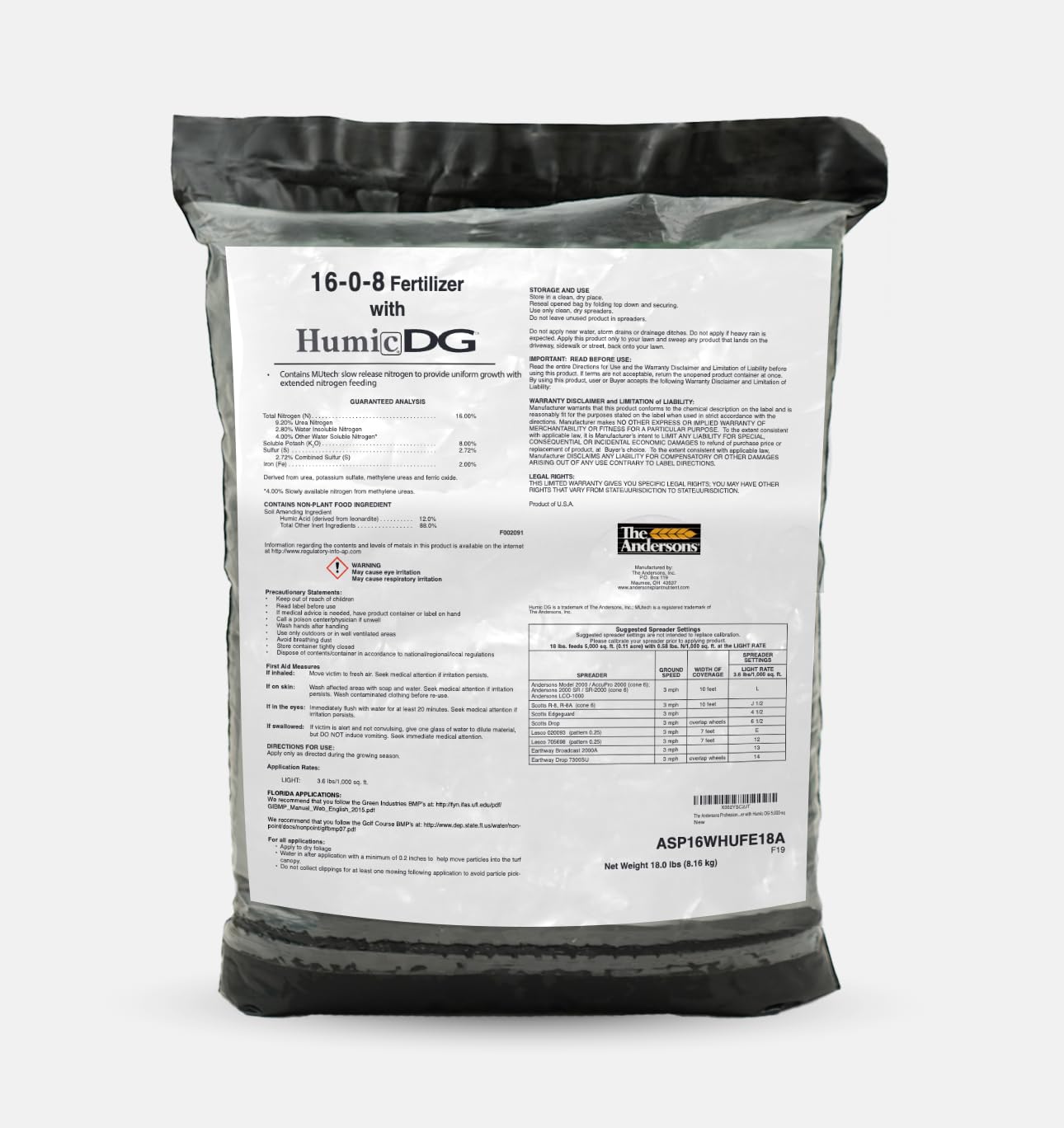
The Andersons PGF 16-0-8 is a professional-grade granular fertilizer distinguished by its ultra-fine particle size — each square foot receives roughly twice the number of granules compared to standard prill fertilizers. This translates to more uniform nutrient distribution, less striping, and reduced risk of hot spots that cause burn. The 16-0-8 analysis provides a moderate nitrogen load with slow-release longevity, plus a complementary potassium dose, while the zero phosphorus makes it ideal for lawns with already-high soil phosphorus.
The inclusion of Humic DG — a dispersible granular humic acid — is the standout feature for fall feeding. Humic acid increases cation exchange capacity in cool soils, helping the grass roots access both the applied nutrients and existing soil reserves more efficiently. The quick-release nitrogen component provides initial green-up, while the slow-release fraction feeds steadily for up to 8 weeks. Customers report dramatic turf density improvements after one season, particularly on lawns that had been neglected.
The 18-pound bag covers only about 5,000 square feet, which is half the coverage of comparably priced products. That makes it a premium option for smaller lawns or targeted sections. Additionally, this product is not available for sale in California or Oregon, so West Coast buyers will need to check retailer policies.
Why it’s great
- Ultra-fine granules provide exceptional coverage uniformity
- Humic DG enhances nutrient uptake in cold fall soils
- Balanced slow + quick release for sustained 8-week feeding
Good to know
- Small bag coverage (5,000 sq. ft.) is expensive for large lawns
- Not available for sale in CA or OR
5. Urban Farm Fertilizers Liquid Lawn Fertilizer – 1 Gallon

Urban Farm Fertilizers’ Liquid Lawn is a hand-crafted, micro-brewed concentrate that delivers a 13-1-2 NPK profile plus mycorrhizae, humic acid, enzymes, and chelated iron — all in a single gallon that treats up to 40,000 square feet when used with a hose-end sprayer at the 1:256 mixing ratio. The liquid formulation bypasses the soil activation lag that plagues granular fertilizers in cool fall conditions, providing immediate root-level availability of nitrogen, iron, and micronutrients.
The inclusion of mycorrhizal fungi and humic acid sets this apart as a soil-biology-first approach. While the nitrogen load is moderate, the microbial inoculants help break down thatch and improve soil structure for winter. Customers with cool-season lawns report dramatic greening within one week and visible thickness improvement after two applications. The liquid format also allows precise spot-treatment of thin areas without the over-application risk of granules.
The main drawback is that users need a quality hose-end sprayer (like an Ortho Dial-N-Spray) to achieve the correct dilution, and the concentrate is thick — shaking thoroughly before each use is essential to avoid clogging. Additionally, foliar feeding works best when temperatures stay above 50°F, so this is an early-fall solution rather than a late-November winterizer.
Why it’s great
- 40,000 sq. ft. per gallon — extreme coverage value
- Mycorrhizae + humic acid improve soil biology during fall
- Immediate root uptake bypass cold-soil activation lag
Good to know
- Thick concentrate requires thorough shaking and proper sprayer
- Foliar feeding less effective below 50°F soil temperature
6. Espoma Organic All Season Lawn Food – 28 lb

The Espoma Organic All Season Lawn Food is a 9-0-0 granular formula built around the company’s proprietary Bio-tone blend of beneficial microbes and natural organic ingredients. With zero synthetic chemicals, zero phosphorus, and a nitrogen source derived from feather meal and composted poultry manure, this is the safest choice for households with pets, children, or edible gardens adjacent to the lawn. The 28-pound bag covers an entire season rather than a single application.
The slow-release organic nitrogen feeds soil microbes before feeding the grass, which means the greening effect is gradual and steady rather than dramatic. This is ideal for organic turf management programs where the goal is long-term soil health over short-term color. The 9-0-0 analysis is low enough to be virtually burn-proof, even if you accidentally double-apply near walkways. Customers consistently report thicker, darker lawns after two seasons of regular use, with fewer weeds popping up due to denser turf.
The trade-off is clear: organic nitrogen releases slowly in cold soil. If you apply this in late October with soil temperatures below 50°F, the grass may not see significant nitrogen uptake until spring thaw. For optimal fall results, apply this in early September while the soil is still biologically active. It’s also the lowest-NPK product on this list, so it won’t produce the quick cosmetic results that synthetic winterizers deliver.
Why it’s great
- 100% organic with Bio-tone microbes for soil health
- Safe for pets, children, and edible garden borders
- Burn-proof 9-0-0 analysis for worry-free application
Good to know
- Organic N release stalls below 50°F soil temp
- Low NPK won’t produce fast cosmetic winter green-up
7. Great Big Roses and Flowers Liquid Fertilizer Booster
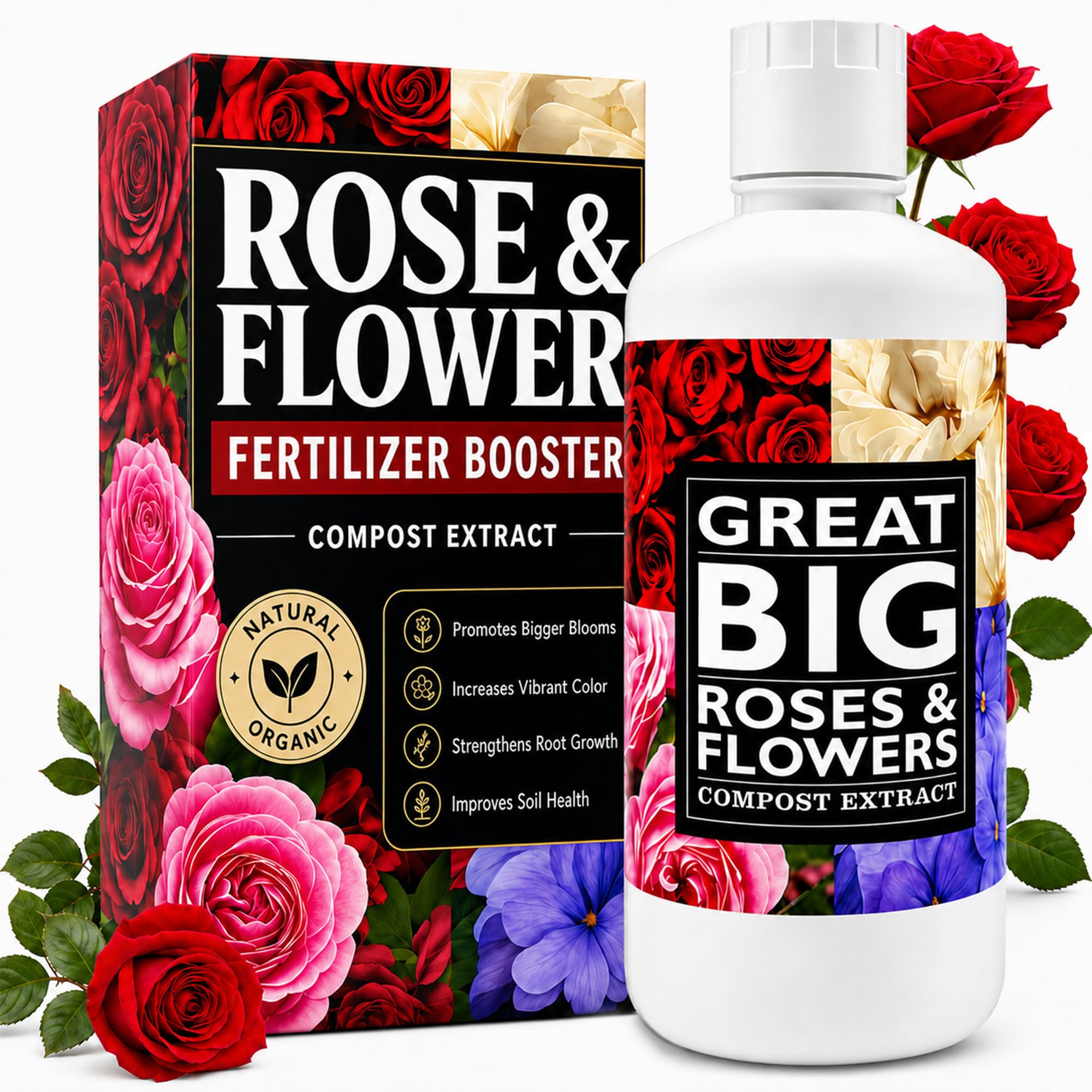
The Great Big Roses Liquid Fertilizer Booster is technically formulated for flowering ornamentals, but its broad-spectrum micronutrient profile — 70 chelated trace minerals plus humic acid and seaweed extract — makes it an effective soil activator for lawns that need a biological kick rather than a nitrogen spike. The 32-ounce concentrate dilutes to 8 gallons of finished solution, treating roughly 800–1,000 square feet per gallon, which means a single bottle covers an entire growing season for a modest garden lawn.
Rather than providing bulk NPK, this booster works by unlocking nutrients already present in the soil. The humic acid chelates bound minerals, the seaweed supplies growth-promoting cytokinins, and the trace mineral array corrects hidden deficiencies that limit root development. Customers report that lawns treated with this booster alongside a standard granular fertilizer show deeper greening and denser turf than the granular alone — it’s a synergist, not a standalone winterizer.
The 32-ounce jug has a notoriously wide mouth that makes measuring into a watering can messy — many customers report spilling concentrate during every use. It’s also priced per ounce as one of the most expensive products here if used as a primary fertilizer. Buy it as a soil conditioner to complement a dedicated fall NPK fertilizer, not as your sole autumn lawn feeding.
Why it’s great
- 70 chelated minerals + humic acid unlock soil-bound nutrients
- Seaweed extract provides cytokinins for root growth signal
- 8-gallon yield per bottle covers full season for small lawns
Good to know
- Not a standalone fertilizer — must pair with NPK source
- Wide-mouth jug design causes frequent spillage during measuring
FAQ
When is the latest I can apply autumn lawn fertilizer before winter?
Can I use a spring or summer fertilizer for fall feeding?
Should I water in fall fertilizer after application?
How many times should I fertilize my lawn in autumn?
Final Thoughts: The Verdict
For most users, the best autumn lawn fertilizer winner is the GreenView Fall Lawn Food because its 22-0-10 ratio combined with the GreenSmart 8-week slow-release coating provides the precise root-feeding signal cool-season lawns need to survive winter and explode green in spring. If you want maximum potassium-driven winter hardiness, grab the Jonathan Green Winter Survival with its 10-0-20 analysis. And for organic soil-building without synthetic chemicals, nothing beats the Espoma Organic All Season Lawn Food — just apply it early while the soil biology is still active.