
Our readers keep the lights on and my morning glass full of iced black tea. As an Amazon Associate, I earn from qualifying purchases.
Specs are compiled from manufacturer listings and verified buyer reviews and can change over time — please confirm the key details on the product page before buying.
Your car stereo, your old home amplifier, your wired headphones — they all still sound fine. What they cannot do is accept music from your phone without a cable dangling across the console or armchair. That is the whole job of an aux Bluetooth receiver: it plugs into the 3.5mm aux jack you already have and turns that wired socket into a wireless one. The trick is picking the right one, because these little pucks split into two very different jobs — some are built for a hands-free call in the car, others for feeding a home stereo clean, high-resolution audio, and a few do both.
I’m Min — the founder and writer behind Gadgets Feed. This guide is built by comparing the manufacturers’ published specifications and the patterns across verified customer reviews, so you get each pick’s real strengths and trade-offs instead of marketing spin.
Below you will find nine aux adapters ranked by what they actually do best, from a crowd favorite that adds Bluetooth to an older car to a Hi-Fi model with a built-in DAC. Every pick here fits that same 3.5mm jack, so the real question is which one suits your setup, and the best Aux Bluetooth Receiver for your dashboard is rarely the one with the longest spec sheet.
Our Picks at a Glance

How To Choose The Best Aux Bluetooth Receiver
Start with the socket, not the spec sheet. Every product on this list ends in a 3.5mm jack or an RCA pair, because those are the two inputs sitting on the back of older stereos, soundbars, and car head units. Once you know which jack you have, three things decide whether you will be happy: whether the unit has its own battery or needs constant power, what codec (the audio format your phone sends over the air) it can handle, and if you need a microphone for calls.
Receiver versus transmitter — get this wrong and nothing pairs
A receiver takes Bluetooth in and sends audio out through a wire. A transmitter does the opposite: it takes a wired source and broadcasts it to your Bluetooth headphones. Most of the units here are receiver-only, which means they will not talk to a pair of Bluetooth headphones no matter how hard you try. A couple are 2-in-1 models that flip between both modes. If your goal is using wireless headphones on a plane or with a TV, you need the transmitter half; if your goal is playing Spotify through a 2005 car stereo, you need the receiver half.
Battery or constant power
Battery-powered adapters clip to a sun visor or sit loose in a cupholder, and the good ones run from around 13 hours up to a claimed 24 hours of playback. The catch is charging. Wall-powered models never need a charge, but they need a free USB outlet or power brick wherever they sit, which is awkward in a car unless you have a spare USB port. In a car, battery wins. Behind a home stereo, wall power wins because the unit almost always lives near an outlet anyway.
Codecs, latency, and the honest limits
LDAC and aptX HD are higher-quality wireless formats that carry more musical detail than the standard SBC codec, but they only help if both your phone and the receiver support them. Low latency matters if you are watching video, because the audio and picture can drift apart without it. What no small receiver can do is make a quiet recording louder than its source, or fix a car stereo that already sounds thin. Match the adapter to what you have.
Quick Comparison
| Model | Best For | Wireless Version | Battery Life | Output / Input | Amazon |
|---|---|---|---|---|---|
| COMSOON Bluetooth Receiver for Car★ Best Overall | Everyday car use | Bluetooth 5.0 | Up to 16 hours | 3.5mm AUX | Amazon |
| SUYEE Bluetooth 5.3 ReceiverBest Value | Home stereo, multi-output | Bluetooth 5.3 | None (wall power) | RCA / 3.5mm / Optical | Amazon |
| Enhanlife Ultrbeka-BR03Best for Travel | Flights and travel | Bluetooth 6.0 | Up to 15 hours | 3.5mm AUX | Amazon |
| UGREEN Bluetooth 5.4 Car Adapter | Calls on the road | Bluetooth 5.4 | Up to 15 hours | 3.5mm AUX | Amazon |
| FiiO BTR11 | Wired headphones go wireless | Bluetooth 5.3 LDAC | Up to 15 hours | 3.5mm AUX | Amazon |
| Esinkin Bluetooth Audio Adapter | Whole-home stereo range | Bluetooth | None (wall power) | 3.5mm / RCA | Amazon |
| SONRU Bluetooth 6.0 Receiver | All-day home playback | Bluetooth 6.0 | Up to 24 hours | 3.5mm / RCA | Amazon |
| 1Mii B06S+ | Hi-Res on a vintage stereo | Bluetooth 5.3 LDAC | None (wall power) | RCA / 3.5mm | Amazon |
| 1Mii B06HD+ | Audiophile digital output | Bluetooth 5.3 LDAC | Up to 13 hours | Optical / Coaxial / RCA / AUX | Amazon |
In‑Depth Reviews
1. COMSOON Bluetooth Receiver for Car, 3.5mm AUX Bluetooth Car Adapter
Our pick — 4.5★ from 56,500+ verified ratings; the strongest balance of quality and price.
The pocket-sized adapter that turns any 3.5mm car jack into a wireless one in about a minute.
If your car predates Bluetooth audio — or only takes phone calls over it, like plenty of 2013-era models — this is the simplest fix on the list. You plug the 3.5mm connector into the aux port, pair your phone over Bluetooth 5.0, and your music plays through the car speakers. The Bluetooth 5.0 chip (the wireless standard that handles how far and how reliably your phone stays connected) gives a stable link with a wide usable range, and pairing is quick enough that you will not be sitting in the driveway fiddling with menus. It is the crowd favorite here by a wide margin, and the review pages back that up.
The battery is the headline. You get up to 16 hours of calls or music per charge, and a full top-up takes about 2.5 hours over the included Type-C cable. That is roughly two commutes a week before you think about charging, and critically, you can run it while it charges, so a long road trip will not leave you silent. It also pairs with two devices at once, which means your phone and your partner’s can both be connected and you just pause one to play the other. There is a genuine microphone on board, so hands-free calls work, and the single MFB button answers, redials, hangs up, and rejects calls. It will even read out navigation prompts from your phone, so you keep your eyes on the road instead of glancing down at a screen.
Two honest catches. First, a car Bluetooth adapter cannot pair with Bluetooth headphones — it only converts wired gear to wireless, so do not buy it hoping to free up a pair of wired cans. Second, sound quality is clean and full through the CVC8.0 noise cancellation and DSP processing (the built-in tweaks that quiet background noise like wind and traffic), but this is not a Hi-Fi component and nobody should expect studio-grade output from an aux puck. For the money, it does the one job it promises, and it does it well. What wins people over is the combination of price, ease, and that 16-hour battery, and the recurring gripe is battery longevity over the long haul — a small number of units eventually stop holding a charge — so treat the charging habits gently and you will get years of it.
What It Gets Right
- Up to 16 hours of playback or calls, and it works while charging — so road trips stay quiet-free
- Dual pairing means two phones can connect at once, no re-pairing to swap who is DJ
- Built-in mic plus a single MFB button for answer, redial, hang up, and reject
- Compact enough to tuck into a cupholder or console, with quick automatic reconnection once paired
Where It Falls Short
- Receiver-only: it will not pair with Bluetooth headphones, only wired ones
- The voice prompts announcing power on or low battery are loud regardless of your volume setting
- Battery life has been mixed over long-term ownership for a minority of buyers
Best suited to: anyone driving a car with a 3.5mm aux port who wants phone music and hands-free calls without ripping out the head unit.
Look elsewhere if: you need to feed a home stereo with digital optical output or want Hi-Fi codec support — this one is a car-first piece.
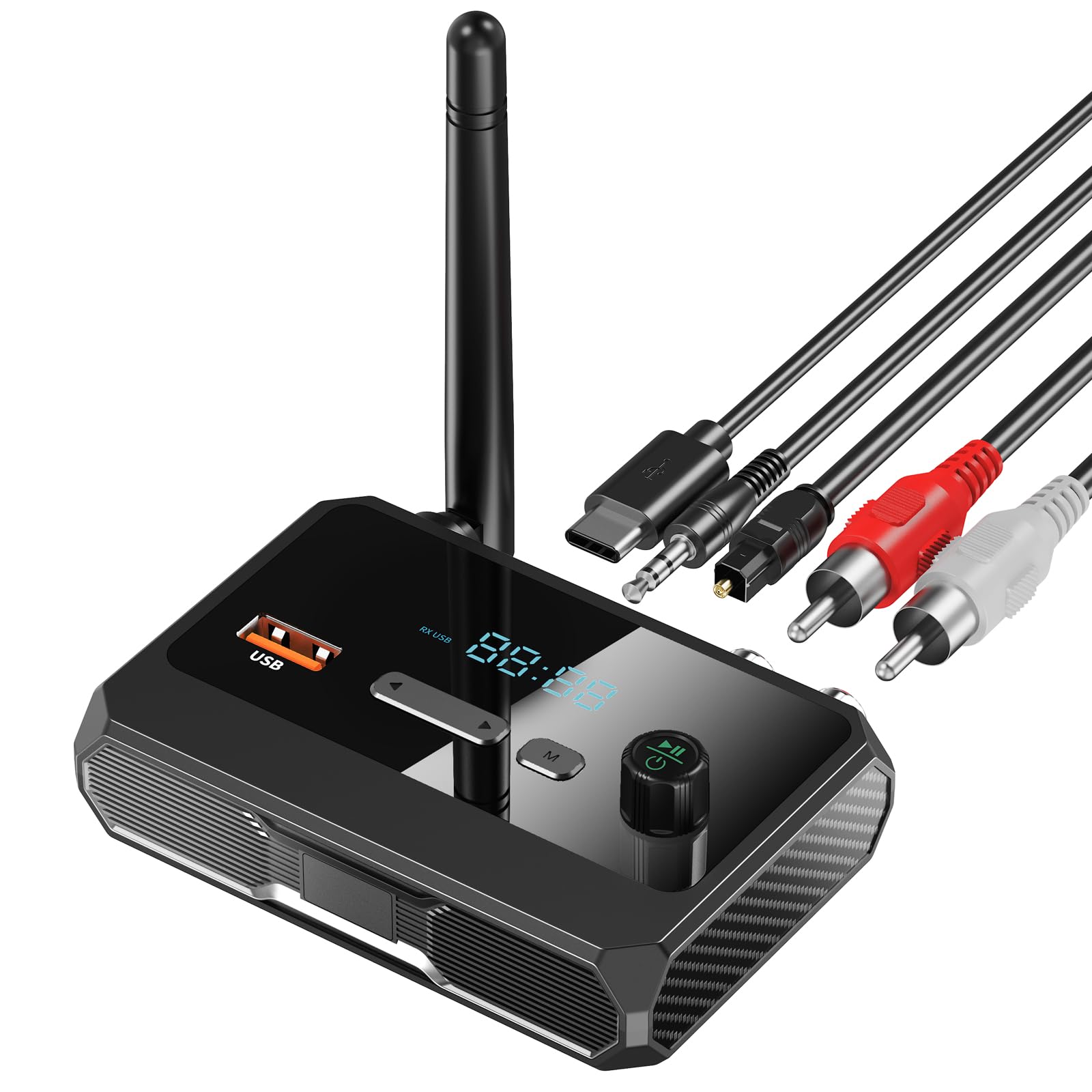
2. SUYEE Bluetooth 5.3 Receiver for Home Stereo, RCA Bluetooth Adapter
Three output options in one small box — RCA, 3.5mm, and optical — for the stereo that has everything but Bluetooth.
This one earns its spot by being the most flexible connection on the list for the price. It reads Bluetooth 5.3 and carries the latest wireless codecs for HQ sound, and it can output over RCA, 3.5mm, or digital optical TOSLINK (the square optical jack with the little light inside, common on AV receivers). It also plays music straight off a USB drive, which is a scarce feature at this level. If you own a stack of gear with mismatched inputs, this is the adapter that slots into whichever hole you have free. The review pages are full of people reviving vintage amps with it — as one owner summed it up, “Hooked up to my vintage home stereo amp and Samsung cellphone via Bluetooth for smooth quality sound!”
What makes it pleasant day to day is the LCD screen. It shows volume level, playback mode, and connection status right on the unit, so you are not fumbling with your phone mid-song just to check whether it is connected. Range runs to about 33 feet with stable transmission, which comfortably covers a living room, and it auto-reconnects to your last paired device as soon as it powers on. For a device that lives behind an amplifier, that automatic reconnection is the difference between plug-and-play and plug-and-fuss every single evening. It also takes a type-C power cable, and no built-in battery means you never wonder how much charge is left.
The catch is that it wants constant power, so you need a free USB outlet or adapter wherever you put it — no battery means no portability. Setup is also less polished than the marketing suggests. The instructions are thin and the pairing steps take some trial and error even for people who know their way around stereo gear, though it works perfectly once you get there. If you want a home stereo receiver you plug in and forget about, this is one of the strongest value plays here.
Straight read: the multi-output design is what separates it — RCA, 3.5mm, and optical covers nearly any receiver you might own, where cheaper single-output units leave you buying adapters.
One thing to plan for: set aside fifteen quiet minutes for setup. The instructions barely help, but once paired, the auto-reconnect means you rarely touch it again.
Buy it when: you are wiring an old amplifier or AV receiver and want the widest choice of outputs.
Pass it over if: you need something that runs on its own battery out in a car or on the move.
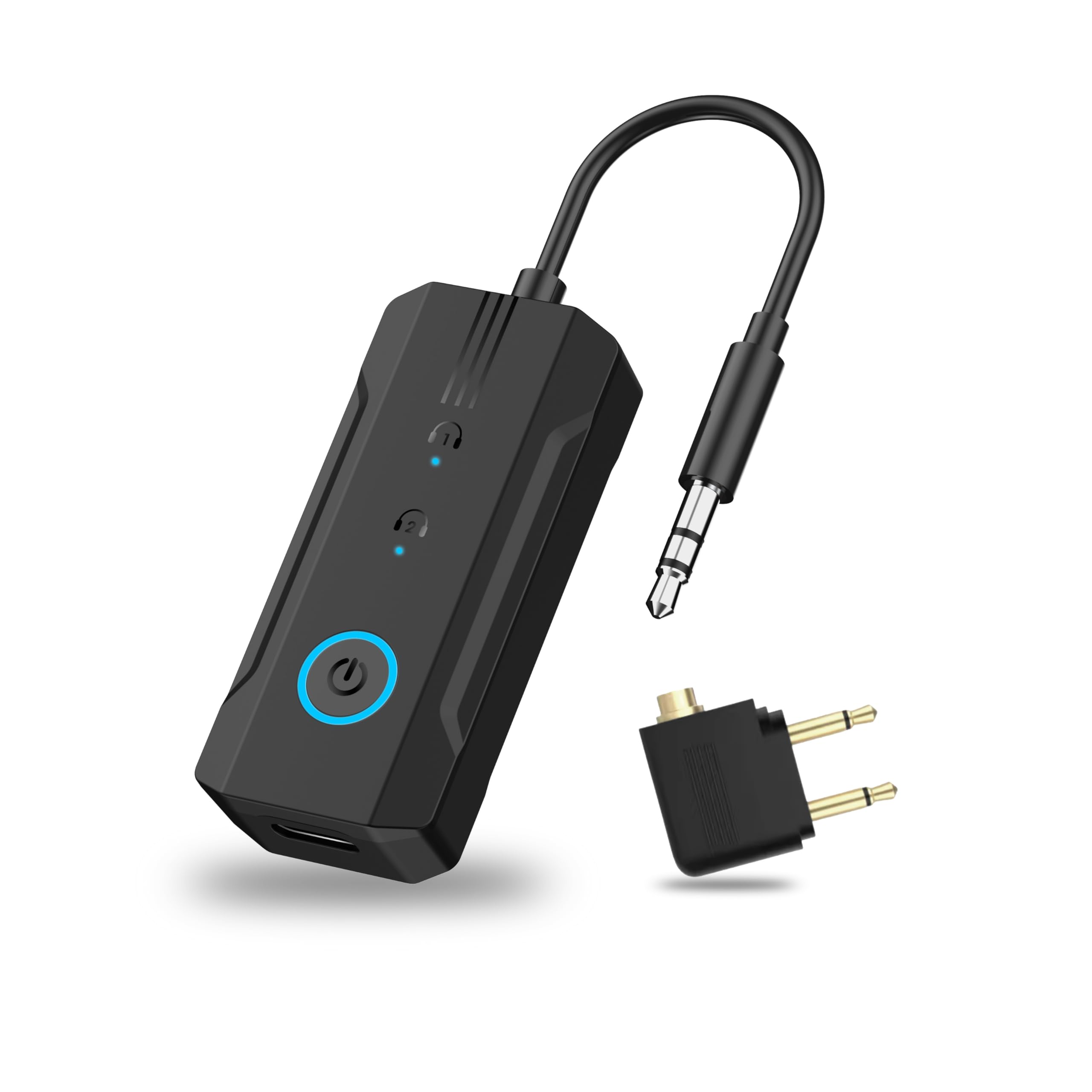
3. Enhanlife 2026 Bluetooth 6.0 Transmitter Receiver, 2-in-1 Airplane Travel Adapter
The only adapter here that sends as well as receives — plug into a seatback screen and use your own headphones.
For frequent flyers, the killer feature is not the wireless standard; it is the TX mode. In transmitter mode you plug the 3.5mm jack into a plane’s entertainment system or a TV’s headphone socket, and the adapter broadcasts that audio to your Bluetooth headphones. In receiver mode it does the more familiar job of taking Bluetooth from your phone and feeding a car stereo or old speakers. Two modes, one tiny puck. It runs Bluetooth 6.0 with faster pairing and more stable transmission, which reduces audio-video delay — the moment where someone’s lips on screen finish a sentence before you hear it. It carries a 1.5-hour charge time and weighs in as a featherweight unit.
Battery is up to 15 hours in either mode, which covers a long-haul flight with room to spare, and the compact size means it disappears into a carry-on pocket. What makes it click for travel is the flexibility: no more buying a second pair of wired headphones just for planes, and no more pulling down an armrest screen with broken audio. Buyers describe it as straightforward once they get the pairing done, and the instructions are genuinely easy to follow. Set it up in the airport lounge, not at altitude, and it is a smooth experience.
Two things to know before you buy. First, it is more delicate than the car-first models — it lives in a bag and takes knocks, so treat it like the small electronics it is. Second, the pairing routine depends on your headphone brand. The listing walks you through the button holds for AirPods of different generations, Beats, Sony, and Bose, which is a hint that some models take a little patience on the first connection. Once paired, though, it reconnects quickly. The recurring honest note on the review side is that connectivity takes a bit of practice before it feels automatic, so give yourself a first setup session at home.
Why travelers keep it: the 2-in-1 design is the selling point. Most adapters do one direction and force you to buy a second unit for the other, which is exactly the fix this eliminates.
The honest trade-off: it is a lightweight puck, not a ruggedized piece of kit — pack it thoughtfully and it will serve you well.
Reach for this if: you fly often and want your own wireless headphones on every seatback screen, plus a car-stereo receiver in the same device.
skip it if: you need a set-and-forget piece hardwired behind a home amp with no interest in headphones.
4. UGREEN Bluetooth 5.4 Car Adapter, Hands-Free Call & Noise Cancelling

Built for people who talk on the road — a hands-free adapter with the newest Bluetooth standard on this list.
Bluetooth 5.4 is the newest wireless version in this lineup, and it shows up where it matters: faster pairing, a stronger link, and lower latency than the 5.3 and 5.0 models around it. That latency figure is the one that keeps music and navigation prompts in step with what you are seeing, so the voice telling you to turn just before the turn arrives on time. The onboard microphone and one-button control handle calls without you touching your phone, and noise cancellation quiets background noise so you can be heard clearly at highway speed. It also runs a claimed 15 hours per charge and charges over USB-C while it works, so a long drive will not die mid-album.
The one feature that surprises people is dual pairing with share. Two phones can be connected at once and you swap between them by pausing one and playing the other — no re-pairing ritual when your passenger hands you the aux. It is the kind of thing that rarely appears in cheaper units and makes carpooling a lot less awkward. Setup is simple and the connection is stable in the cars people actually use it in; the recurring notes on the review side mention an occasional dropout, which is worth knowing, but the overall picture is a compact unit that does its job.
A couple of real-world caveats. This is a receiver only — it cannot pair with your Bluetooth headphones, and it does not work on planes. In cold weather it can be slow to power on, and the manufacturer suggests warming it briefly with a hair dryer if it will not boot, which is a quirky but documented behavior. There is also a note from buyers that, in cars with always-on USB ports, it can stay connected after you leave the vehicle and potentially drain the car battery over time — so unplug it or power down the port if you park for long stretches. For the money, it is a strong pick for anyone who wants the newest standard and a real microphone without paying premium money.
Standout Strengths
- Bluetooth 5.4 is the newest standard on the list — lower latency for music and GPS voice prompts
- Dual-phone pairing with share lets two people connect and swap without re-pairing
- Built-in mic and one-button control for hands-free calls, run-and-charge over USB-C
- Up to 15 hours of playback per charge, enough for commuting and road trips
Terms of the Deal
- Receiver only — it will not pair with Bluetooth headphones, and it does not work on planes
- Cold weather can make it slow to boot; the maker recommends a brief warm-up
- Stays connected in some always-on USB cars after you leave, which can drain the car battery if parked long
Who it is for: drivers who take a lot of calls and want the newest wireless standard without premium-tier money.
Who should keep looking: home-stereo listeners who need optical or RCA outputs and do not care about a microphone.
5. FiiO BTR11 Bluetooth 5.3 Receiver LDAC 3.5mm Headphone Amplifier Adapter

A 12.5-gram clip-on that turns wired headphones wireless, with LDAC and a real headphone amp inside.
Most adapters here are built to feed speakers through a jack. This one is built to ride on your shirt collar and drive actual headphones. It weighs just 12.5 grams and runs about 5.5cm long, so it clips to a pocket, a lanyard, or a waistband and disappears under a shirt. Inside is an independent ear amplifier with an output power of up to 45mW into 16 ohms, which is the spec that tells you it can push wired IEMs and headphones to a satisfying volume instead of dribbling out quiet audio. It supports LDAC — the higher-bitrate wireless format that carries more musical detail than standard Bluetooth — and runs on Bluetooth 5.3.
The real trick is what it does for a pair of wired IEMs or headphones that are otherwise tethered to a phone. As one satisfied owner put it, it “breathed new life into my wired headphones” by freeing them from the cable with no noticeable lag on video. It pairs quickly, clips to a shirt, and runs up to 15 hours of continuous music per charge, with a fast top-up that gets to 90% in about an hour. It also has a high-sensitivity omnidirectional microphone with call noise reduction for phone calls on the go.
The honest caveats here are worth knowing for the price, because this is a value-tier Hi-Fi gadget. Battery life under real streaming lands closer to 7-10 hours for heavier users than the full 15 in the listing. The clip and build are light plastic, and the mic is fine for calls but not for anything more demanding. If you want to convert wired headphones the way a portable amp does — with sonic quality that makes LDAC worth it — this is the specialist pick here. It also brings out one of the more striking traits in this lineup: at 12.5 grams and about 5.5cm, it is about the size of a USB thumb drive, per owners, which is miles tinier than the wall-powered home units on this list.
Why headphones people love it: the onboard amplifier and LDAC support are unusual at this tier — most adapters at this level are speaker-first and do not try to drive headphones properly.
The realistic catch: day-to-day battery lands closer to 7-10 hours than the 15-hour listing claim, so heavy streamers should plan a midday charge.
Perfect for: wired-headphone and IEM owners who want to listen to phone or TV audio without the leash, and do not mind a small plastic gadget.
Not the pick if: you need to feed a home stereo through RCA or optical — this device is aimed at headphones, not amplifiers.
6. Esinkin Bluetooth Audio Adapter for Music Streaming Sound System

The veteran of the group — plug it into a stereo once and forget it, with range that stretches across the whole house.
This is the simplest adapter here, and its fans love it for exactly that reason. You connect it to your stereo via the 3.5mm cable or an RCA cable (both work), power it on, and pair your phone with a single press of the big Bluetooth button in the middle. There is no app, no menu tree, no hunting for a pairing mode. The specs are modest — no built-in battery, Bluetooth only, receiver only — but what it does, it does reliably. As multiple owners put it, it is “just as advertised” and takes about a minute to get working. Owners wire it into vintage CD players and old Bose systems and leave it powered on permanently.
The range is the headline feature. Indoors, with no obstacles, it connects up to 30-40 feet according to the listing — and owners say it stretches further than that in open space, staying connected at over 100 feet when transmitted from inside a cabinet in a boathouse, well beyond what most people expect from a device this small. It reconnects automatically to your last device on power-up, so your phone or tablet does the heavy lifting when you get home. Because it never runs off a battery, it also never mysteriously dies on you — it just sits there, running off the included power adapter, waiting to receive music.
The honest downsides: this is an older design, and a couple of owners note the hiss at idle volume, especially at low listening levels. The stock cable has also been criticized by a few purists as the weak link in the signal chain. Neither is a dealbreaker for casual listening, but if you want the cleanest possible quiet-volume playback, you may notice a faint hiss at the very low end — especially on a quiet track in a quiet room — and should consider plugging it in through USB power instead of the wall adapter. It is a small piece of consumer audio gear, not a component audiophile system.
What It Does Best: no-fuss setup and the sheer range — people report walking around the house with zero dropouts, even in tricky spots like a boathouse. The bigger the building, the more this one makes sense.
Keep in mind: no battery means no portability, and if you listen at very low volumes, the idle hiss is something to plan around.
Buy it for: whole-home coverage on a permanent stereo setup where you want to pair once and leave it wired to the system.
Skip it for: car use or any situation that calls for a battery — this is a stationary piece of home gear.
7. SONRU Bluetooth 6.0 Receiver, 24-Hour Battery Life with AUX 3.5mm/RCA
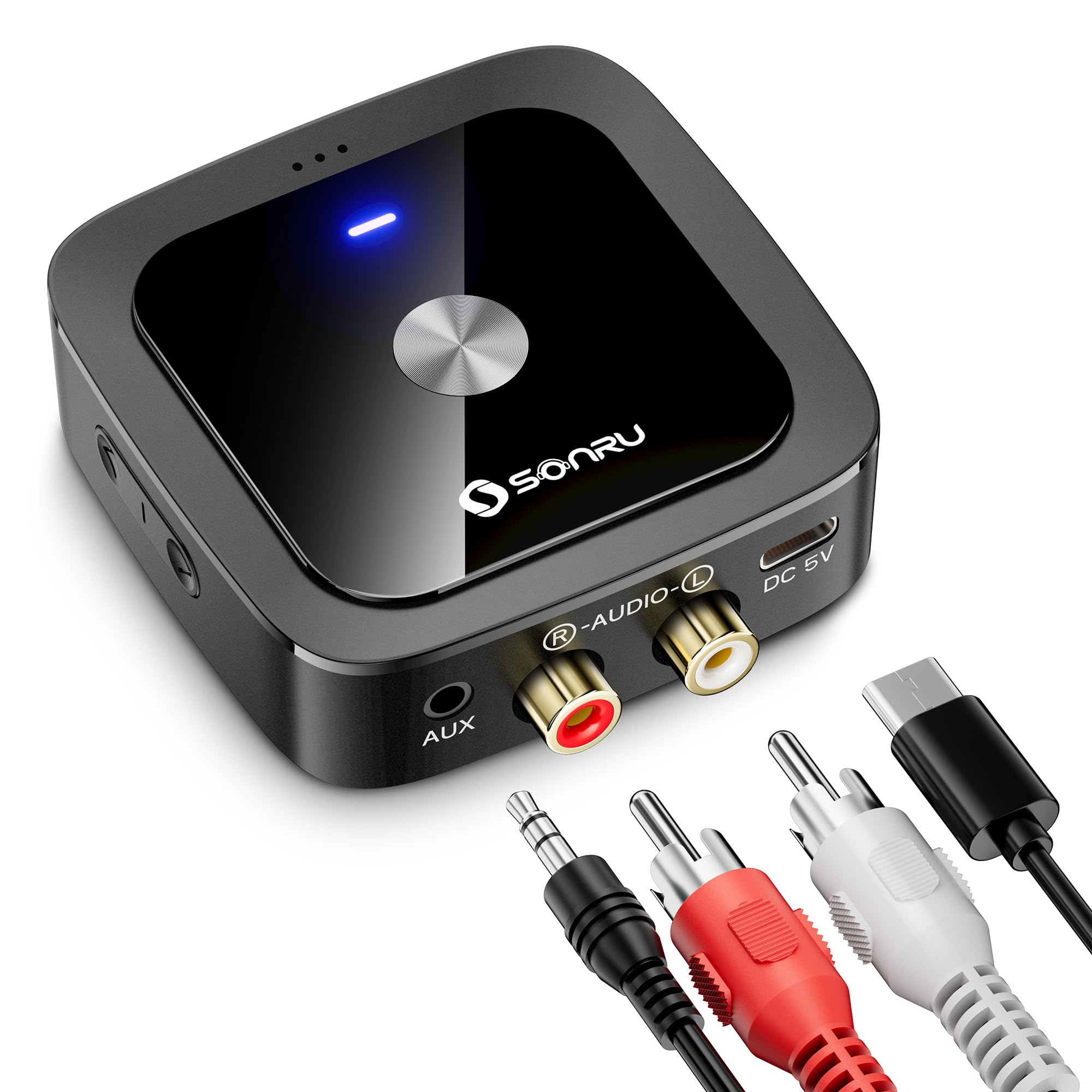
A claimed 24 hours of playback from a full charge, so you can leave it on all day and never think about it.
If you hate fussing with a receiver — the wall outlet, the dangling cable, the dead-battery silence mid-album — this is where you look. The 24-hour battery life runs on a claimed 2-hour charge, and that figure doubles what most of the car-focused adapters here manage. It runs the latest Bluetooth 6.0 standard, which bests the 5.0 and 5.3 units above it on signal stability and — more importantly — latency for video and calls. Where this really earns its place is a home stereo you leave on all day: you plug it into your old stereo via 3.5mm cable or RCA cable, pair your phone, laptop, or pocket recorder, and it stays connected from morning until night.
Dual device switching means two devices can be paired at once, and it pauses music automatically to take a call before resuming playback — no re-pairing required when someone calls. The buttons on top are tactile and simple, and the compact body makes it easy to travel with. Owners praise it for great range (one person reports walking 100 feet away from the device without interruption) and for the sound quality, which is better than they expected from a small, inexpensive unit.
The realistic caveat: a long battery life that dependable also means the occasional unit goes wrong in the other direction, and a small number of reports mention a unit being dead after a matter of months. Every product here has a certain failure rate; this one’s is worth knowing about so you treat the charging routine with care. It also has to be paired from a separate power source before going wireless, which is a small extra step on first setup. Once it is connected and charged, the day-to-day experience is genuinely hands-off.
Standout trait: the 24-hour battery is the longest here by a clear margin — most rivals top out at 15 to 16 hours — and it charges in about 2 hours.
One caution: a minority of units have reportedly stopped holding a charge after several months, so leave yourself some warranty headroom by buying from a reputable channel.
Ideal for: home listeners who want a leave-it-on device around an old stereo with the longest possible runtime between charges.
Less ideal if: you want the lowest-latency pick on this list — the wired-only house models above suit that better for heads-down audio.
8. 1Mii B06S+ LDAC Bluetooth 5.3 Receiver for Home Stereo Hi-Res Music Streaming
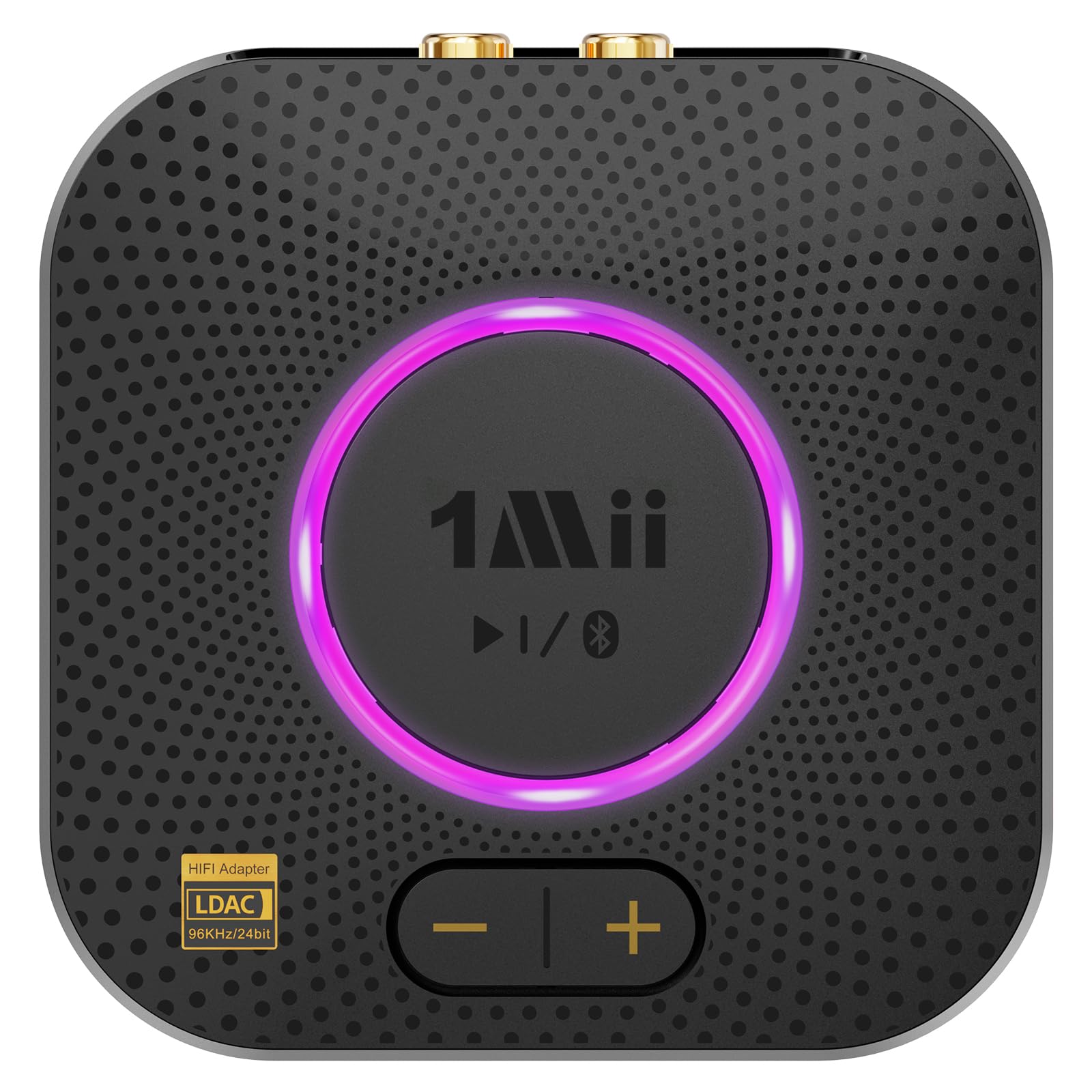
The 1Mii step-up: LDAC support over Bluetooth 5.3 and volume controls, priced for everyday Hi-Fi upgrades.
The B06S+ carries the LDAC audio codec up to a maximum bitrate of 990kbps, which is the amount of musical data per second being thrown down the wireless pipe — the higher the number, the more detail survives the trip. It also handles aptX HD and aptX Low Latency for synchronised sound. Bluetooth 5.3 keeps the link stable across a stated range of up to 98 feet line-of-sight outside and about 50 feet indoors with obstacles. For the money, this is the balance for anyone with a vintage stereo and a phone that supports LDAC. It even handles playback controls directly: press the volume button to adjust, and hold it for 2 seconds to skip tracks — a rare convenience at this price.
Owners pair it with old Bose iPhone docks and 1999-era Sony stereos and report cleaner detail from the same speakers. The included cables make setup a first-time-no-problem job — one power cable, one 3.5mm-to-RCA cable. It outputs over RCA or 3.5mm AUX, and it powers on straight into pairing mode. People describe the bump in sound quality as like getting a new stereo, with detail and clarity that make the old speakers sound better than they have in years, especially if you are piping LDAC from a compatible Android phone.
The honest caveats: it is wall-powered with no built-in battery and no on/off switch, so it either sits on a power strip or needs unplugging. There are also reports of a small number of units failing within six months, and the volume control tops out lower than some speakers can use — so if you are feeding a very low-sensitivity speaker, this may not have enough output. It is honest gear for stereo heads, not a rugged or battle-ready device.
Why it picks up where cheaper units leave off: LDAC up to 990kbps plus aptX HD and aptX LL is real Hi-Res support at a mainstream price — most competitors at this level only handle standard SBC or basic aptX.
Two practical realities: no on/off switch (unplug it or use a switched outlet), and a handful of long-term buyers report units giving out — neither is universal, but both are worth knowing.
Best paired with: an older stereo and an Android phone or high-res source, where the LDAC codec actually gets used.
Think twice if: your speakers are unusually quiet or hard to drive — the volume ceiling here is lower than some systems need.
9. 1Mii B06HD+ Hi-Res LDAC Bluetooth 5.3 Receiver with Built-in DAC and OLED Display
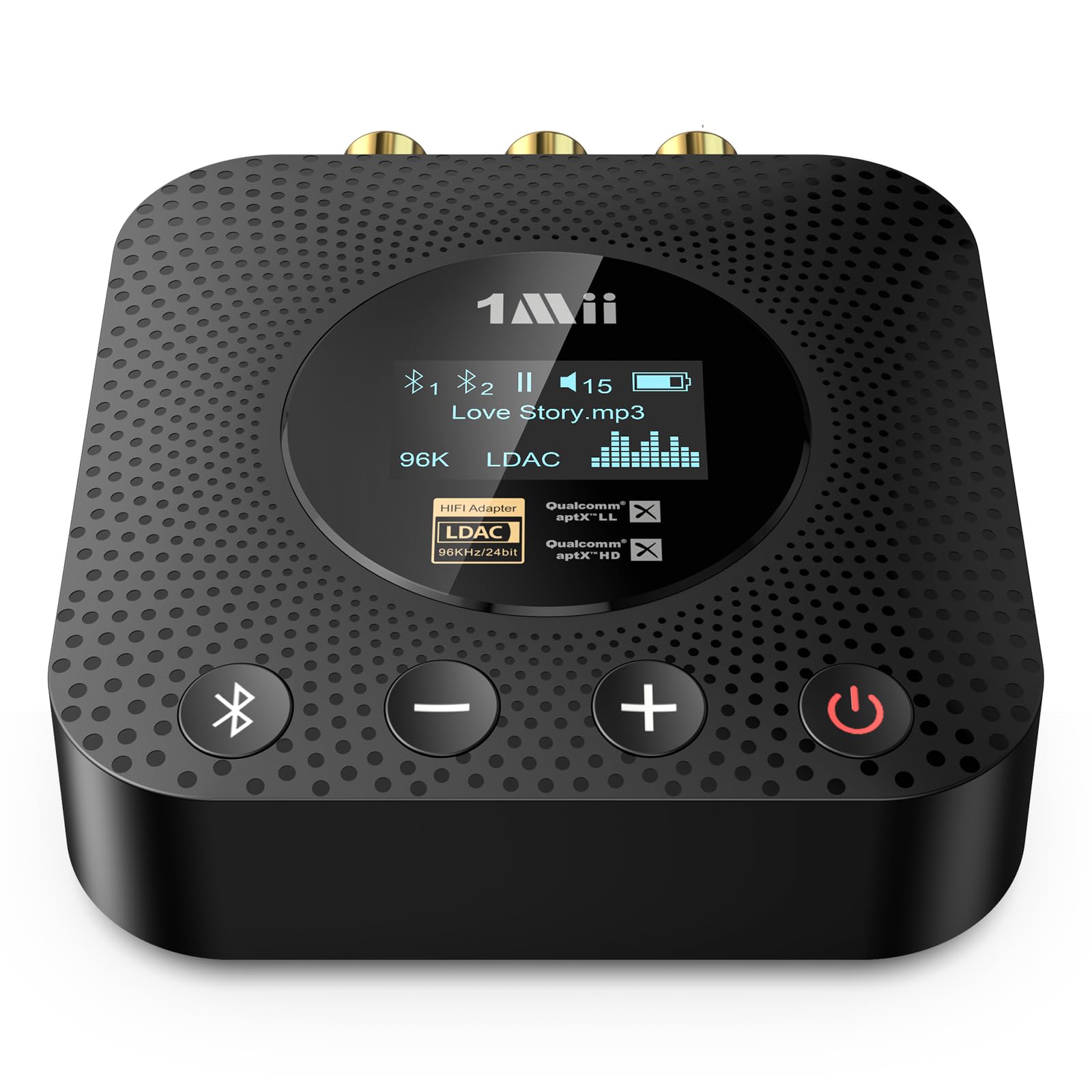
The most capable adapter here — a built-in audiophile DAC, OLED display, and digital outputs for the deep-end stereo setup.
This is the one you buy when the rest of your system is good enough to hear the difference. It packs the ES9018K2M DAC chip — a dedicated digital-to-analog converter that is normally the job of a separate component — so the audio it hands to your amplifier is refined before it ever reaches the receiver. It supports LDAC, aptX HD, and aptX Low Latency, which is the full Hi-Res codec suite. And it gives you the option that most adapters here do not: digital output over optical or coaxial, in addition to RCA and 3.5mm AUX. If your receiver has an optical input, this is the cleanest wireless path into it. That matters, because a wireless signal that has been converted to analog and then plugged into an analog input has already lost some quality before your stereo ever sees it.
The OLED display is genuinely usable — it shows the song name, the active Bluetooth codec, sampling rate, volume level, and connection status. Owners who care about that information love having it right there on the unit, and those who just want music can ignore it. Range is extraordinary: the listing rates up to 197 feet line-of-sight outdoors, and up to 50-80 feet indoors, which beats the shorter range of the B06S+ above. It also carries a built-in battery good for up to 13 hours of use, so it survives short power interruptions without dropping out. The whole package reads like a serious component rather than an accessory.
The catch is that this level of capability requires some setup care. The default codec from the start is LDAC at a high bitrate that some older receivers cannot accept over optical or coaxial, so if your older digital input has a maximum bitrate lower than the adapter defaults to, you may need to switch it to aptX HD in your phone settings. Buyers narrow that down quickly, but it takes a moment. There is also a known quirk with pairing — the unit sometimes needs turning off after use and on again before connecting, particularly if you leave it powered on. Get past that, and the audio hold is rock-solid with no dropouts.
Where It Leads
- Built-in ES9018K2M DAC chip does the conversion in the adapter, giving your amplifier a cleaner signal
- Four outputs — optical, coaxial, RCA, and 3.5mm AUX — so it fits nearly any receiver’s best input
- OLED display shows codec, sampling rate, volume, and connection status at a glance
- Up to 197 ft line-of-sight range outdoors and 50-80 ft indoors, plus up to 13 hours of built-in battery
Where to Plan Ahead
- Default LDAC bitrate can exceed older digital inputs, so you may need to switch codecs on first use
- Occasional pairing quirk: some units connect more reliably when powered off between sessions
- Higher-tier price than everything else on this list — the DAC and digital outputs are what you are paying for
This is the pick for: owners of a decent home stereo who want the cleanest-sounding wireless signal and are willing to set up the codec once.
Overkill for: car dashboards and casual Bluetooth headsets — the digital outputs and DAC are wasted on those.
Understanding the Specs
The Spec That Matters Most: Bluetooth Version
The version number — 5.0, 5.3, 5.4, 6.0 — tells you how new the wireless chip is. Newer versions tend to pair faster, hold a stable link further from the source, and cut the audio-to-video delay. If you watch video on a phone or TV, a delay shows up as lips moving before the sound arrives. A Bluetooth 6.0 adapter like the Enhanlife and SONRU units above is the most current here, while the crowd-favorite COMSOON uses Bluetooth 5.0. Both work; the newer ones are just a touch smoother to live with.
LDAC, aptX HD, and Why the Codec Is Your Real Quality Ceiling
A codec is the audio format your phone uses to send sound over the Bluetooth link. Standard SBC is fine for casual listening, but LDAC and aptX HD carry more data per second, which preserves detail from high-quality sources. The catch is that both ends must support the codec — your phone and the adapter. If you are using an older handset without LDAC, an adapter that supports it still works; it simply falls back to the standard. The 1Mii B06HD+ and B06S+ units on this list go furthest here, with LDAC up to 990kbps on the B06S+.
Outputs: RCA, 3.5mm, Optical, and Coaxial
The output is how the adapter hands audio to your system. 3.5mm is the standard headphone jack and the most universal. RCA is the round red-and-white pair on the back of home stereos. Optical and coaxial are digital routes into a receiver that has those inputs, and they skip one conversion step compared with analog. If your receiver has an optical input, use it — see the 1Mii B06HD+ above. If it only has RCA or 3.5mm, any of the models here will work.
Battery Versus Constant Power
Battery-powered adapters travel with you and clip to a shirt or visor, but need charging. Wall-powered ones sit behind a stereo forever and never die, but need a free outlet. Most car adapters here run 15-16hours, while the wall-powered home models (Esinkin, SUYEE, 1Mii B06S+) rely on a separate adapter. If you plan to move between rooms or vehicles, pick a battery model. If the unit will live in one spot, wall power is one less thing to think about. A built-in battery also buys a useful extra: brief power interruptions will not silence your music.
FAQ
Will an aux Bluetooth receiver work with my car if it only has a 3.5mm aux jack and no USB port?
Can I use one of these to make my wired headphones Bluetooth?
Does a higher Bluetooth version number mean better sound quality?
How long do these aux Bluetooth receivers typically last on a charge?
What is the difference between a Bluetooth receiver and a Bluetooth transmitter?
Why does my adapter keep connecting to the wrong device when I have two paired?
Will an aux Bluetooth receiver work through walls or across a room?
Why do some of these make a hissing sound at low volume?
Can I use an aux Bluetooth receiver with a vinyl turntable or a CD player?
Do I need to leave the adapter plugged in or will it work while charging?
Final Thoughts: The Verdict
For most people, the aux bluetooth receiver that makes the most sense is the COMSOON Bluetooth Receiver for Car — an easy-going car adapter with up to 16 hours of battery, a dual-connection trick, and a microphone for hands-free calls, all at a mainstream price. The review pages show a majority of owners are happy with it, so if you are plugging into a car’s 3.5mm jack, it is the safe first pick. If your goal is Hi-Res listening on a home stereo, step up to the 1Mii B06S+ for LDAC up to 990kbps, or the 1Mii B06HD+ with its ES9018K2M DAC and optical output. And if you just want to free your wired headphones from the cable, the FiiO BTR11 is the specialist to reach for. Whichever you choose, match the adapter to the jack and the job — do that, and one small puck will end years of cable fuss.
How We Picked
We do not accept paid placement. Every pick is matched to a real buyer and a real use-case; we do not hands-on test units.
Sources & Methodology
Specifications: manufacturer listings and product documentation. Review insights: verified customer reviews, as of September 2026. Pricing: not shown on this page (it changes often); check the current price via the retailer link.
As an Amazon Associate, Gadgets Feed earns from qualifying purchases. This does not affect which products we feature.