
Our readers keep the lights on and my morning glass full of iced black tea. As an Amazon Associate, I earn from qualifying purchases.
Specs are compiled from manufacturer listings and verified buyer reviews and can change over time — please confirm the key details on the product page before buying.
The problem with a laptop’s built-in speakers isn’t the volume — it’s the thin, hollow sound that makes music feel flat and dialogue hard to follow. An aux speaker solves that instantly by tapping into the 3.5mm jack that’s been sitting unused on your computer or phone, delivering real bass and clear highs without Bluetooth pairing headaches or battery anxiety. This guide ranks the best wired and aux-compatible speakers for desks, gaming rigs, and home setups.
I’m Min — the founder and writer behind Gadgets Feed. This guide is built by comparing the manufacturers’ published specifications and the patterns across verified customer reviews, so you get each pick’s real strengths and trade-offs instead of marketing spin.
You’ll learn which specs actually affect your listening experience and which marketing claims to ignore, so you can pick the right aux speaker for your desk layout, volume needs, and budget without wasting money on the wrong one.
Our Picks at a Glance


How To Choose The Best Aux Speaker
Before comparing wattage and driver sizes, match the speaker to your room size and primary use. A desk speaker that fills a small office will frustrate you in a living room, and gaming rigs need different features than a calm work-from-home corner.
Power Source: USB Simplicity vs Wall-Powered Punch
The biggest fork in the road is the power source: USB or wall-powered. USB-powered models plug straight into your computer’s port, which means one less wall adapter and a cleaner desk — but they’re capped in how loud they can realistically go. Wall-powered speakers (some with their own power brick) have more headroom, so they can push deeper bass and higher volumes without straining, which matters if you’re filling a whole room.
Connectivity: Pure Aux vs Aux Plus Bluetooth
A dedicated 3.5mm aux input gives you a stable, lossless connection with zero pairing lag — plug it in and it just works. Many modern speakers layer Bluetooth on top of the aux jack, which is handy for quickly playing music from your phone without unplugging anything. If you’ll mostly use it with one computer, a pure wired speaker is simpler and often cheaper.
Wattage and Bass: What the Numbers Really Mean
Watts measure amplifier power, and more watts generally means louder, cleaner sound before distortion. But wattage alone doesn’t guarantee good sound — driver size and a passive radiator (a membrane that reinforces low frequencies) matter more for bass than raw power. A compact 14W speaker with a passive radiator can sound punchier than a 20W speaker without one.
Quick Comparison
| Model | Best For | Power Output | Connectivity | Driver Size | Amazon |
|---|---|---|---|---|---|
| Creative Pebble★ Best Overall | Budget desk upgrades | USB-powered | USB + AUX | 12.6 cm | Amazon |
| FUNLOGY SpeakerBest Value | Compact office audio | 14W | USB + AUX | 48 mm | Amazon |
| Amazon Basics Stereo 2.0Smart Budget Pick | No-fuss basic sound | USB-powered | USB + AUX | Dynamic Driver | Amazon |
| OFFSIR RGB Speakers | Gaming desks with style | 2 x 5W | USB + AUX | 5 inches | Amazon |
| JUOVI Bluetooth Speaker | Outdoor and portable use | 20W | BT 6.0 + AUX + SD | Dual drivers | Amazon |
| Sanyun SW208 | HiFi bookshelf sound | 30W x 2 | BT 5.0 + AUX + USB | 7.62 cm | Amazon |
| Logitech Z207 | Dual-device switching | AC-powered | BT + AUX | Full-range driver | Amazon |
| Edifier G2000 | Serious gaming audio | 32W peak | USB + AUX + BT | 2.75 inches | Amazon |
| Maraawa Sound Bar | TV and home theater | 120W | BT 5.3 + ARC + Optical + AUX | Wired subwoofer | Amazon |
In‑Depth Reviews
1. Creative Pebble 2.0 USB Desktop Stereo Speakers
Our pick — over 4.5★ from 67,500+ verified ratings; the strongest balance of quality and price.
A tiny white pair that tilts sound up toward your ears and rewrites what budget desktop audio can be.
The defining trick here is the 45° improve drivers, which angle sound directly at your head instead of straight across the desk — you get a focused, personal listening bubble without cranking the volume. A single USB cable handles both power and audio, so there’s no wall adapter to hide and no separate power cord to route.
What wins people over is the sound-per-dollar ratio. The custom-tuned far-field drivers pair with rear-facing passive radiators (secondary membranes that push air to add bass depth), which is remarkable for a speaker this small. This is the most-reviewed pick here, and owners consistently call it the best budget option for everyday computer use.
The honest trade-offs: volume gets mixed feedback, so don’t expect to fill a large room, and reliability questions do surface now and then, with a few reporting the speakers stopping working after about 4 months. There’s also a fixed cable tethering the two units together, which limits how far apart you can place them.
Why It Wins Desks Over
- 45° angled drivers aim sound at your ears for clear near-field listening
- Passive radiators add surprising bass for the size
- Single USB cable powers and connects — zero clutter
- Compact footprint that disappears on a desk
Where It Hits Its Limit
- Not loud enough to fill a large room
- Occasional reports of units failing after a few months
- Speakers are permanently wired together, limiting placement
Reach for this if: you want the safest budget bet for a home office or dorm desk and care about clarity over raw volume.
Look elsewhere if: you need room-filling power or a speaker you can spread wide apart on a big desk.
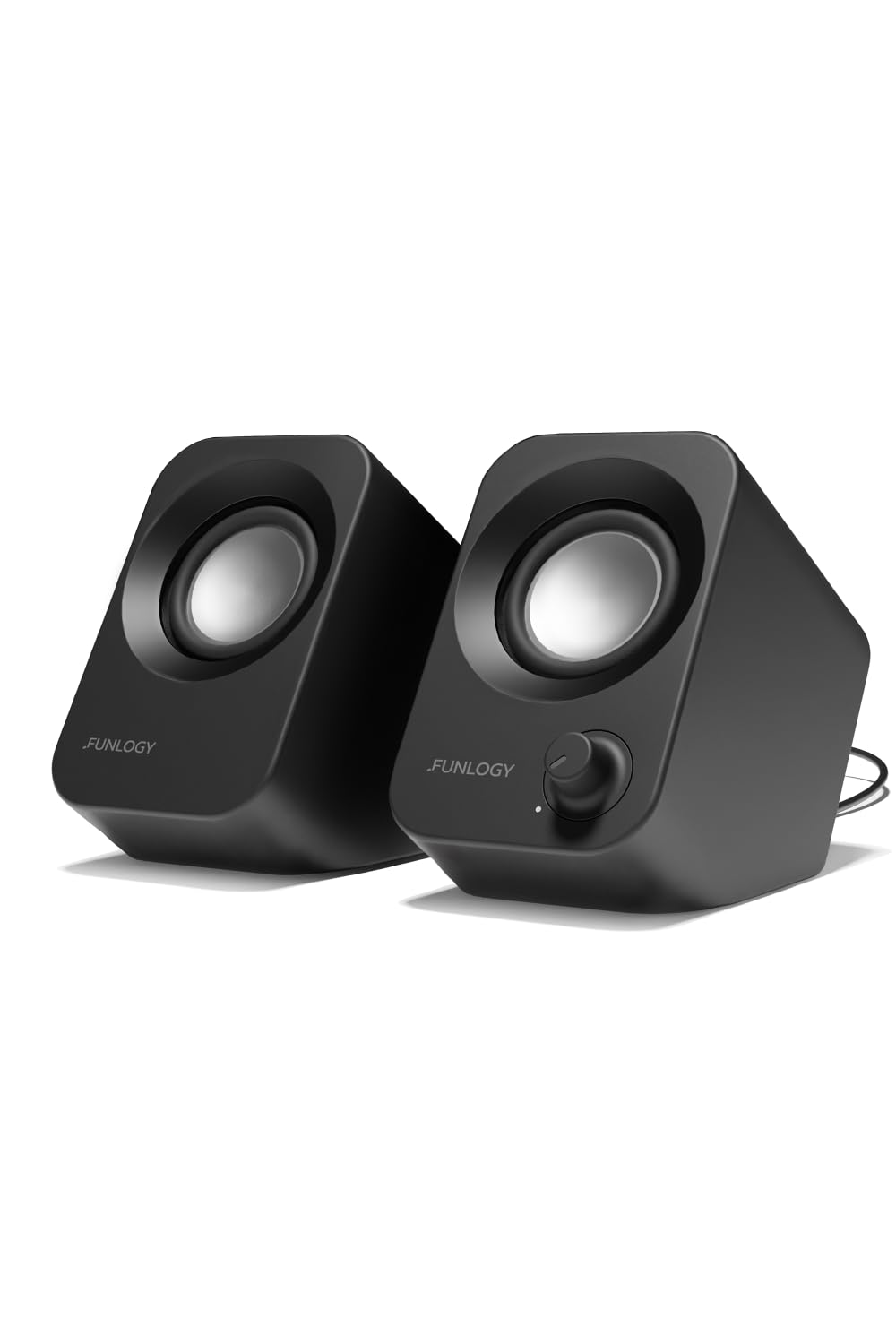
2. FUNLOGY Speaker 14W Stereo PC Speakers
A palm-sized pair with a 30° tilt that locks onto your ears and a dial that makes quiet listening feel precise.
The acoustic angle here is the 30° upward-facing layout, which points the dual 48mm full-range drivers straight at your head — budget speakers often blast sound past you, but this design aims it like a spotlight. It pushes 14W of total output with passive radiators for bass that shouldn’t exist at this size.
What stands out in the feedback is the volume dial, which owners love for dialing in very low background levels at work — a rare feature that most cheap speakers get wrong. Quality and sound are the two most-praised aspects, with buyers noting it easily outperforms the speakers built into modern monitors.
The catch: it can’t handle a lot of volume, so this is a near-field desk speaker, not a room-filler. Buyers also note Windows may identify it as “headphones” via the headphone jack, which is cosmetic but worth knowing.
Precision dial, real limits: the tactile volume knob and 30° tilt make this the pick for people who actually adjust volume often — but its 14W ceiling means it’s happiest a couple feet from your face.
Who it beats: it’s a clear step up from any built-in monitor speaker, and the quality-focused design shows in the matte finish and tidy build.
Grab it for: a tidy office setup where you want low-volume background music with a smooth dial and sharp voice clarity.
Think twice if: you blast music across a large room — this one is built for close listening.
3. Amazon Basics Stereo 2.0 Speakers
A clean black pair that tucks under your monitor and leans on a bottom radiator for springy bass.
These are among the simplest picks here: USB-powered straight from your computer, with an in-line volume control on the cable for quick tweaks without reaching behind your monitor. The bottom radiator does the bass work, giving music a “springy” low end that reviewers describe as surprisingly rich for the price — good enough for orchestral scores per one owner.
Buyers like the compact size (it fits neatly under a monitor) and the blue LED lights, which add a touch of style even if you can’t turn them off. Sound quality and value for money are the two most-cited strengths, and for casual listening these clearly beat whatever came built into your laptop.
The noise and durability figures are honest caveats rather than dealbreakers — some buyers report a hiss or a unit arriving defective. The classic scenario: one speaker failing from the start is a real QC issue that occasionally crops up. Bass is also on the weak side for a pair this size, and the volume is decent rather than impressive.
Simple, affordable, done: this is the buy-and-forget option — plug in the USB and 3.5mm cables, and you have amplified audio with zero setup fuss.
Keep your expectations in check: it’s a basic computer speaker, not a hi-fi system, so treat it as a big upgrade from laptop audio rather than a mini stereo.
Pick it if: you want an inexpensive, dead-simple fix for a PC that has no speakers and you don’t care about flashy features.
skip it if: you’re sensitive to background hiss or want a speaker that doubles for music listening at higher volumes.
4. OFFSIR 2-in-1 RGB Gaming Speakers
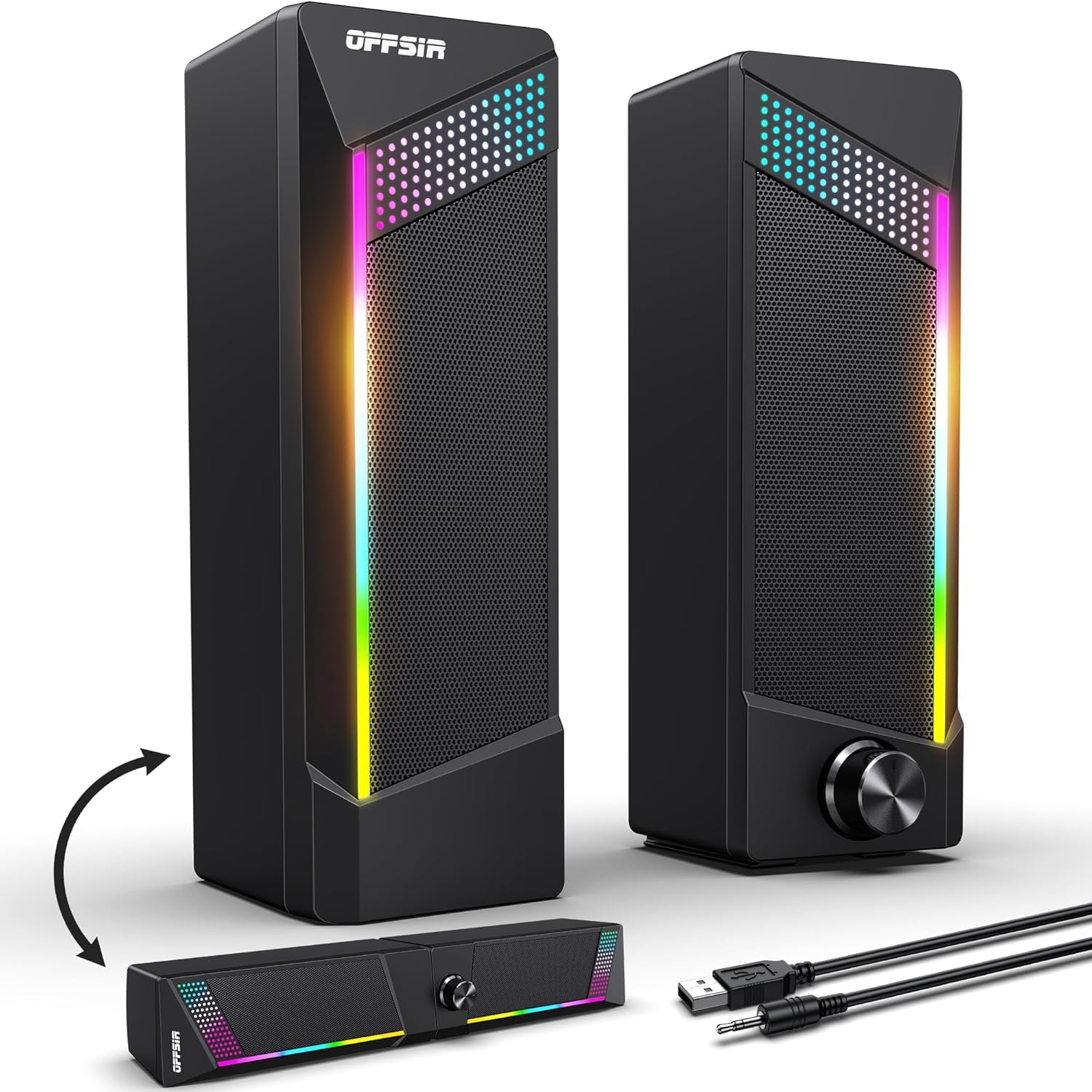
A two-piece set that clips into a single soundbar and dresses your desk in touch-controlled RGB light.
The a neat extra is the 2-in-1 design: the two detachable speakers can sit apart on either side of your monitor, or snap together into one soundbar when you want a single streamlined unit. Each side packs a 5W driver for a 2.0-channel stereo core, and the long cables — 58.3 inches for the USB and 3.5mm, 52 inches between speakers — give you real freedom in how you arrange them.
Gamers will appreciate the touch-sensitive top that cycles through four RGB light modes (rainbow, red, green, blue, or off) to match the mood of your setup. The feedback is consistently positive on quality and sound, with buyers calling it a solid step up from laptop speakers and praising how easy it is to set up.
The trade-offs: volume is mixed — plenty for a desk, but not for filling a room — and the RGB isn’t customizable beyond the four presets, just adjustable in speed. The USB and audio cables only peel apart a few inches, which can limit how you route them around a monitor arm.
Desk drama without the price: you get RGB lighting and a convertible soundbar design for less than most gaming-branded pairs, and the touch light control is genuinely easy to use.
The honest gap: it’s a budget build with budget volume, so it shines for looks and casual gaming, not for audiophile listening or loud parties.
Ideal for: a tight desk setup under dual monitors where you want RGB flair and the flexibility of a split or joined configuration.
Not for: anyone who needs high volume or fully customizable lighting effects.
5. JUOVI Bluetooth Speaker IP68 Waterproof
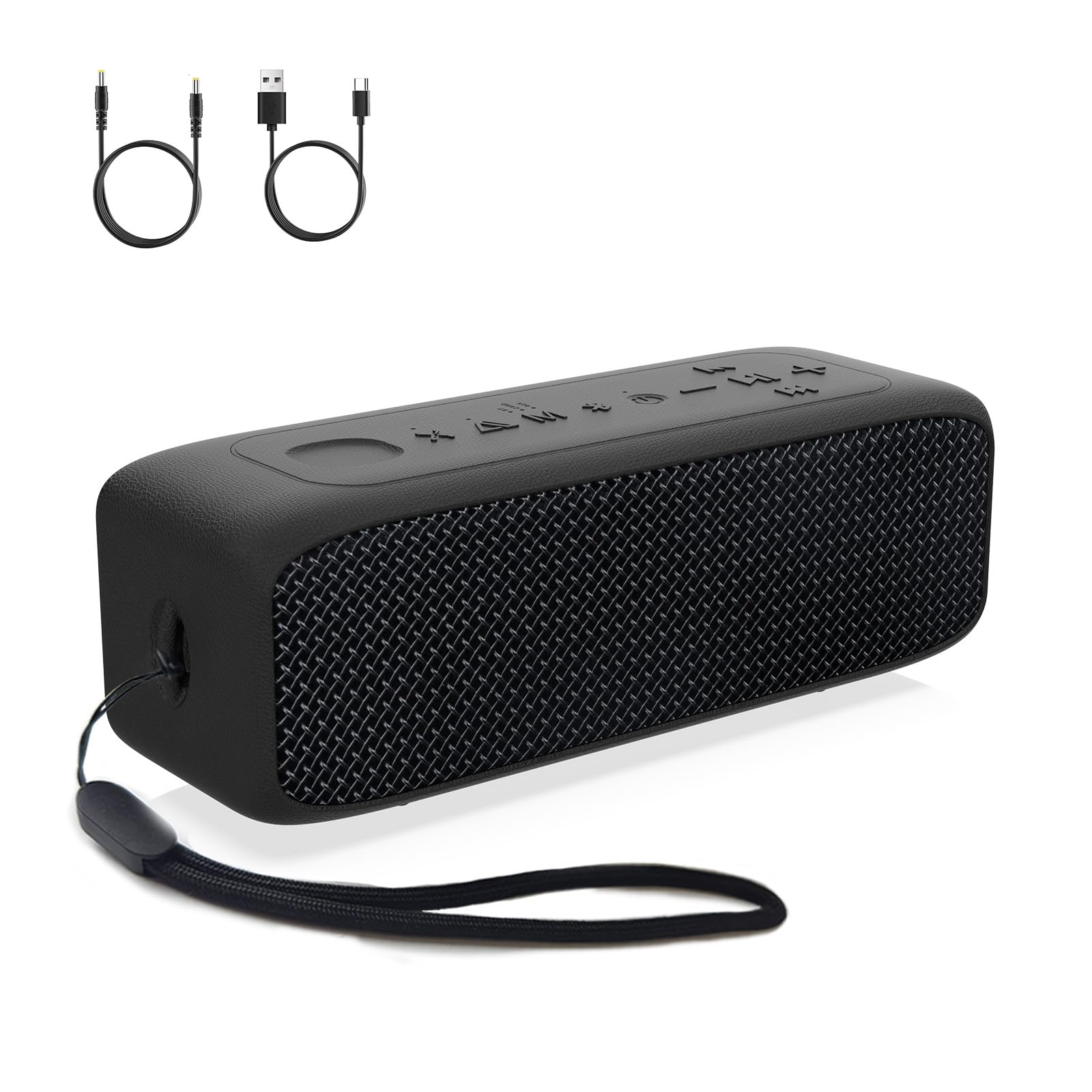
A rugged 20W portable that shrugs off pools and beaches while still offering a 3.5mm aux lifeline.
This is the only pick that’s genuinely portable — a 20W dual-driver speaker rated IP68 (fully dust-tight and submersible) that’s built for the shower, poolside, or a rainy campsite. It runs up to 24 hours on a charge and includes a lanyard, making it the easy grab-and-go choice.
What makes it relevant to aux fans is the versatility: alongside Bluetooth 6.0, you get a 3.5mm aux input and MicroSD card playback, so you can go fully wireless or plug in for a stable, lossless connection. Two units can pair via TWS (true wireless stereo) to create left and right channels at up to 40W combined.
Buyers call the sound “great” and the volume impressive for the size, with one using it in the bathroom for shower music. The honest caveats: the power button is hard to spot against the black finish, and SD card mode occasionally drops out with a “not recognized” message. Sound quality is the most-praised aspect, but the speaker is a smaller brand with fewer owners behind it.
Aux flexibility, outdoor brawn: this one earns its keep wherever you take it — the aux jack keeps it useful even when Bluetooth is flaky, and the 24-hour battery means you’re rarely hunting for an outlet.
Know the quirks: the invisible power button and occasional SD hiccup are minor annoyances, not dealbreakers, for an outdoor-focused speaker.
Choose this for: the pool, shower, beach, or travel where you need waterproofing and long battery life alongside a wired aux option.
Look past it if: you want a stationary desktop pair with richer, room-filling sound — this is a portable, not a bookshelf unit.
6. Sanyun SW208 3″ Active Bookshelf Speakers

A proper bookshelf pair with carbon-fiber drivers and real tone controls that graduate you past desktop toy speakers.
You get warm mids and a deeper low end than any USB-powered speaker can manage, thanks to a 30W x 2 setup with carbon fiber speaker units and multi-layer voice coil technology. The built-in 24-bit DAC (a digital-to-analog converter that processes audio more precisely) pulls digital signal straight from your computer over USB, cutting lossy conversion along the way.
Buyers consistently call it the value pick for a small office or classical music, praising the clean black design and easy setup. The on-speaker controls are the differentiator: separate treble, bass, and volume knobs on the side let you tune the sound to your room instead of accepting a factory preset.
The catch is honest and practical: placement matters a lot here. One owner found it sounded flat near a monitor and “excellent” once moved 4 feet apart at 45° angles. It’s also not a room-filler — max volume is moderate, and it drops sharply off-axis, so you need to be aimed at it. Pairing it with a subwoofer helps if you crave heavy bass.
Tone controls are the secret weapon: no other pick here lets you dial in treble and bass independently, which is huge for tuning out a boomy room.
Placement is everything: this speaker rewards a little setup effort — give it space and aim, and it sounds dramatically better than crammed against a wall.
Best for: anyone who wants a genuine step up in sound quality with adjustable tone, and doesn’t mind positioning speakers carefully.
pass on it if: you need maximum loudness for a big room or want a subwoofer-free setup with heavy, chest-thumping bass.
7. Logitech Z207 2.0 Stereo Speakers

A desktop pair that plays a wired aux source and a Bluetooth phone at the same time without asking you to choose.
The standout feature here isn’t the sound — it’s the dual-source flexibility. Each speaker has a powered full-range driver plus a passive radiator for bass extension, and the pair handles both a 3.5mm aux cable and Bluetooth simultaneously, so your computer can be wired while your phone stays connected for quick music swaps. Logitech’s Easy-Switch tech lets you move between sources just by pausing one and pressing play on the other.
Wall-powered rather than USB, these don’t drain your laptop’s battery and have more volume headroom. The on-speaker controls include a headphone jack on the front, which is handy for private listening without digging behind your desk. Setup is the most-praised aspect, with buyers calling it ideal for office use.
Sound quality is the honest mixed note: some find it very clear, others describe it as tinny, and bass is on the weak side. Buyers also note the volume knob dot is nearly invisible against the black finish, and the rubber strips don’t fully stop the speakers from sliding.
The Dual-Source Edge
- Plays AUX and Bluetooth simultaneously for smooth device switching
- Wall-powered — no laptop battery drain
- Front headphone jack for quick private listening
- Compact footprint that fits any desk
What Owners Tolerate
- Bass is mediocre — don’t expect deep lows
- Some find the sound tinny at higher volumes
- Hard-to-see volume knob dot and slippery base
Pick this if: you juggle a wired PC and a Bluetooth phone or tablet and want both connected without constantly replugging cables.
Look elsewhere if: bass depth and rich, warm sound are your top priorities over connection flexibility.
8. Edifier G2000 32W Gaming Speakers

A wall-powered gaming pair with 12 RGB effects and three sound modes that actually change how your games feel.
This is the serious gamer’s pick, pushing 32W of peak power through 2.75-inch full-range drivers with a rear bass port for authority that USB speakers can’t touch. It runs wall-powered, so there’s real volume headroom, and the column-shaped cabinet sits at a 10-degree elevation to aim sound up toward your head.
The signature feature is the EQ system: Game, Music, and Movie modes that genuinely reshuffle the audio profile, plus a subwoofer output jack if you ever want to bolt on deeper bass. Buyers call the sound crisp and the soundstage impressive for the footprint — one owner swapped out a boomier Logitech set and never looked back, praising how it fills a small room without distortion.
The honest quirks: volume control is button-based (not a smooth knob) and some find it finicky, settings reset when you unplug the unit, and there’s a power on/off “woosh” sound some users dislike. It’s also the priciest pure desktop pair here — buyers acknowledge the cost but say the sound justifies it.
The Gaming Muscle
- 32W peak power with real bass from the rear port
- Game, Music, Movie EQ modes for different media
- 12 RGB lighting effects to match your setup
- Subwoofer output for future bass upgrades
The Gamer’s Complaints
- Button volume control beats a knob, but it’s fiddly
- Settings reset when unplugged from power
- Power on/off jingle annoys some owners
Choose it for: a hardcore gaming setup where you want loud, clear sound, RGB flair, and the option to add a sub later.
Pass on it if: you want a budget pair or prefer the simplicity of a single volume knob over button cycling.
9. Maraawa Sound Bar with Wired Subwoofer

A full 120W soundbar with a dedicated wired subwoofer that turns TV dialogue from muffled to movie-theater clear.
This is a different beast entirely — a proper home theater soundbar, not a desktop pair, and it brings a wired subwoofer for the kind of chest-thumping bass that explosions and movie scores demand. At 120W of output, it’s the most powerful pick here by a wide margin and the only one that includes a subwoofer in the box.
The aux jack is just one of its four connection paths — you also get Bluetooth 5.3, ARC (a single HDMI-style connection that syncs audio with your TV remote), and Optical. That flexibility means it works with a TV, PC, projector, or streaming device, and the wired sub keeps audio perfectly synced with on-screen action without wireless lag.
Setup takes minutes: place it on a stand or mount it on the wall with the included hardware, then use the remote to control volume, bass, and input modes. Buyers rave about the thumping bass, easy setup, and how it crushes built-in TV speakers for clarity — dialogue is the strength here.
Subwoofer included, no asterisks: unlike the Edifier above, this one ships with bass already built in, so you get the full cinema experience without buying a second component.
Room-size honest truth: it’s made for living rooms and entertainment spaces, not a cramped desk — bring it where you watch movies, and it delivers.
Best for: TV and movie lovers who want clear dialogue, cinematic bass, and a one-box upgrade from weak TV speakers.
Not for: a simple desk setup — the subwoofer and soundbar footprint suit a dedicated entertainment space.
Understanding the Specs
Passive Radiators and Bass
A passive radiator is a secondary membrane that moves air in response to the main driver’s pressure, adding low-end depth without needing its own amplifier. Speakers that list “passive radiators” (like the Creative Pebble) can produce noticeably punchier bass than same-size drivers without them — it’s the cheapest way to fake a bigger speaker.
Watts and Real-World Volume
Watts measure amplifier power, and more watts generally means louder, cleaner sound before distortion. But the number only tells part of the story — a USB-powered speaker can’t draw as much current as a wall-powered one, so a 14W USB speaker like the FUNLOGY will sound quieter than a 32W wall-powered pair like the Edifier, even if the math looks close. Match wattage to your room size: 14-20W for a desk, 30W+ for a small room, 120W for a living room.
FAQ
Do I need a powered speaker for a 3.5mm aux connection?
Will an aux speaker work with my phone or tablet?
What is the difference between USB-powered and wall-powered speakers?
Is a passive radiator better than a port for bass?
Can I connect an aux speaker and Bluetooth at the same time?
How do I get better bass from a compact desktop speaker?
Is a bookshelf speaker like the Sanyun SW208 better than a soundbar?
What does the 30° tilt design on a speaker actually do?
Do RGB lights on a speaker affect sound quality?
What is a DAC and why does it matter in a speaker?
Final Thoughts: The Verdict
For most people, the aux speaker winner is the Creative Pebble because it delivers the best blend of sound, value, and ease of use — the 45° angled drivers and passive radiators make it the crowd favorite for desks everywhere. If you want a step up in audio quality with tunable tone, grab the Sanyun SW208. And for a movie-ready living room, the Maraawa Sound Bar with its wired subwoofer is the one to reach for.
How We Picked
We do not accept paid placement. Every pick is matched to a real buyer and a real use-case; we do not hands-on test units.
Sources & Methodology
Specifications: manufacturer listings and product documentation. Review insights: verified customer reviews, as of August 2026. Pricing: not shown on this page (it changes often); check the current price via the retailer link.
As an Amazon Associate, Gadgets Feed earns from qualifying purchases. This does not affect which products we feature.