
Our readers keep the lights on and my morning glass full of iced black tea. As an Amazon Associate, I earn from qualifying purchases.
Specs are compiled from manufacturer listings and verified buyer reviews and can change over time — please confirm the key details on the product page before buying.
Your transmission is the hardest-working part of your truck, and heat is its biggest enemy. An auxiliary cooler is the first line of defense, keeping fluid temperatures in a safe range whether you’re towing a camper through mountain passes or just sitting in stop-and-go city traffic. Low fluid temps mean smoother shifts, longer component life, and far less risk of a costly rebuild.
I’m Min — the founder and writer behind Gadgets Feed. This guide is built by comparing the manufacturers’ published specifications and the patterns across verified customer reviews, so you get each pick’s real strengths and trade-offs instead of marketing spin.
Your aux transmission cooler choice depends on three things: your vehicle’s size, your towing weight, and whether you prefer a simple bolt-on or a full remote-mounted setup with a fan.
Our Picks at a Glance


How To Choose The Best Aux Transmission Cooler
Start with how you actually use your vehicle. A daily commuter needs far less cooling capacity than a truck that regularly hauls 10,000 pounds up a grade. Match the cooler to your worst-case driving scenario, not your average commute.
Cooling Capacity and GVW Ratings
Manufacturers rate coolers by Gross Vehicle Weight (GVW), which tells you the heaviest vehicle the unit can handle. A 40,000 GVW rating covers heavy-duty trucks, vans, and towing rigs, while smaller units suit light trucks and daily drivers. Bigger isn’t always better—oversized coolers can over-cool in winter, which is why some setups use a thermostat.
Core Design: Stacked Plate vs Tube and Fin
Stacked-plate cores use layered plates to boost surface area and heat transfer with minimal pressure drop. Tube-and-fin designs are lighter and simpler but generally less efficient per square inch. For serious towing, stacked plate is the clear winner. Both styles drop temperatures noticeably, but the plate design does more with less airflow.
Installation Reality Check
Mounting brackets, hose quality, and fittings matter as much as the core itself. Pre-drilled brackets make the job easier, but many owners replace the bundled hose and clamps with transmission-specific lines. Check your line size—1/2-inch ID lines need matching fittings, and some universal kits don’t include them. Measure your mounting space before ordering.
Quick Comparison
| Model | Best For | Core Type | Weight | Temp Drop | Amazon |
|---|---|---|---|---|---|
| Hayden 676★ Best Overall | Daily drivers & light towing | Tube and Fin | 2.2 lb | 40-50°F | Amazon |
| A-Premium 8 PassBest Value | Universal value pick | Tube and Fin | 2.4 lb | 40°F | Amazon |
| LPD47391 (SINTLY)Heavy Duty Pick | Heavy-duty towing | Brazed Aluminum | 5.73 lb | 20-30°F | Amazon |
| BARTOO 16 Pass | Versatile cooling | Tube and Fin | 3.39 lb | 60°F | Amazon |
| 40k LPD47391 (Gagsu) | Budget heavy-duty | Aluminum | 6.26 lb | 40°F | Amazon |
| Hayden 689 | Class A motorhomes | Plate and Fin | — | — | Amazon |
| Derale 13504 | Performance & heavy towing | Plate and Fin | 2.9 lb | 25-50°F | Amazon |
| Mishimoto MMTC-SP-13N | Premium truck builds | Stacked Plate | 6 lb | 40-45°C | Amazon |
| Derale 15960 | Remote mount with fan | Stacked Plate | 10 lb | 10-20°F | Amazon |
In‑Depth Reviews
1. Hayden Automotive 676
Our pick — over 4.5★ from 850+ verified ratings; the strongest balance of quality and price.
This 2.2-pound tube-and-fin cooler drops fluid temps 40-50°F with a simple bolt-on install.
At just 2.2 pounds, the Hayden 676 is the go-to auxiliary cooler for owners of 2006 Infiniti M45s, 2005 Odysseys, and 2008 Acura TLs who want a simple, proven upgrade. Its patented internal turbulation increases heat transfer while keeping pressure drop minimal, so your fluid flows freely while shedding heat.
The 11.0” x 5.875” x 0.70” footprint fits neatly behind a grille or in front of a condenser, and pre-drilled mounting brackets simplify the install. Owners consistently report 40-50 degree temperature reductions, with one noting it kept fluid temps low and the transmission happy for over two years.
What’s the catch? The build quality is solid, but some owners note the hose quantity is limited — a few needed to buy extra line. The size also gets mixed reactions; it’s perfect for daily drivers but smaller than what some expected.
Build & Value: The thing everyone raves about is the quality — this cooler feels well-made and sturdy once secured, and one owner even used it as a power steering cooler on a 4Runner successfully.
Fit Note: Installation is straightforward with easy-to-read instructions, but a handful found the included hose wasn’t quite enough and had to buy more.
Reach for this if: you drive a daily truck or SUV and want a proven, lightweight cooler that fits most grille spaces without modifications.
Look elsewhere if: you’re planning heavy towing — the smaller core is better suited to light duty than 10,000-pound hauls.
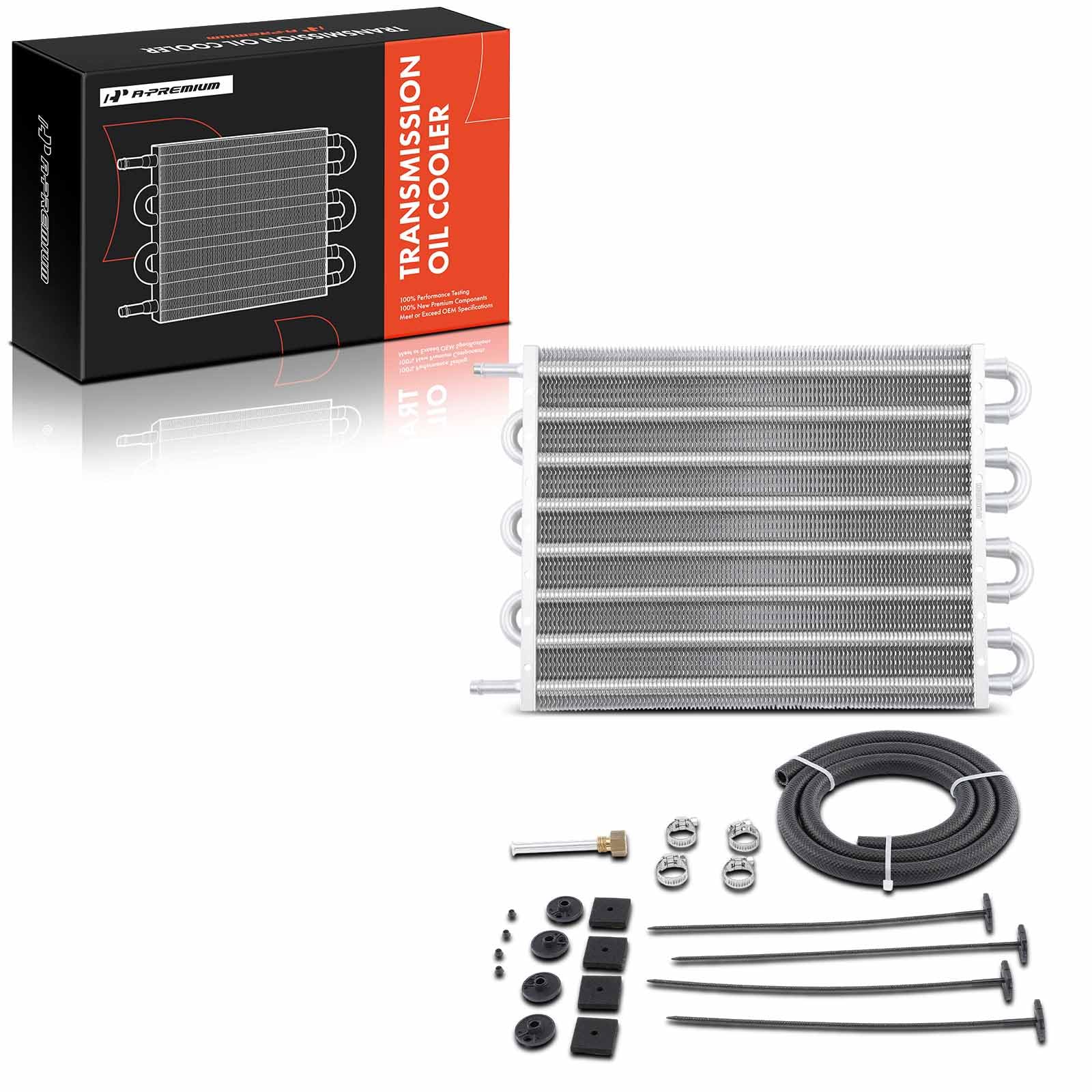
2. A-Premium Universal Aluminium 8 Pass
This 8-pass aluminum cooler cut a GMC Yukon’s towing temps by 40°F.
When a 2008 GMC Yukon owner needed to tame towing heat, this universal kit delivered: “lowered trans temps by 40 degrees F” — a number that shows up repeatedly in owner reports. The 8-pass design means fluid passes through the core eight times, extracting heat with aluminum tube-and-fin construction.
Weighing just 2.4 pounds, this cooler fits most cars with its universal mounting straps. The catch is the hardware: owners on a 2002 Acura MDX noted the kit was missing 3/8-inch to 1/2-inch hose fittings, which had to be sourced separately. One Nissan owner reported a perfect fit, though.
A-Premium includes a one-year unlimited-mileage guarantee, so you get confidence without paying extra. If you tow light loads, this cooler gives you the best balance of price and cooling for your money.
Cooling Efficiency: The 40-degree drop on a full-size Yukon proves this little core punches well above its size class.
Install Reality: It’s easy for some, a puzzle for others — the included straps need creativity, and missing fittings are a known gripe.
Best for: budget-minded owners of light trucks and SUVs who want a real temp drop without spending on a premium brand.
Who it misses: anyone expecting a complete bolt-on kit — verify your line fittings before starting.
3. LPD47391 40k (SINTLY)
This 5.73-pound brazed aluminum core holds Silverado towing temps at 130-140°F in 100°F mountain heat.
This 8.5″ x 22.75″ x 1.3″ cooler is built for serious work, rated for 40,000 GVW max with towing applications. A 2016 Silverado owner running a 850-mile trip through 100°F mountains saw temps hold at a cool 130-140°F — a dramatic improvement. The low-pressure-drop design means your transmission doesn’t fight to push fluid through.
The brazed aluminum structure resists corrosion and high temperatures, which is why owners trust it for heavy towing. But the build quality gets mixed reviews: some call it excellent, others describe the hose as poor quality. The durability aspect is the biggest concern, with multiple reports of leaks.
Owners strongly suggest upgrading the line to transmission-specific hose with stainless band clamps — the included hardware is the weak link. Professional installation is recommended for anyone who hasn’t done a cooler before.
Temperature Control Wins
- Dropped towing temps from 210-260°F to around 150°F
- Easy mounting with bendable brackets
- Corrosion-resistant brazed aluminum
The Known Trade-Offs
- Recurring reports of pinhole leaks after 2-3k miles
- Included hose quality is a weak point
- Fins bend easily during handling
Count on it for: heavy towing where you need raw cooling capacity — the core delivers.
Stay cautious if: you want a set-and-forget install—you’ll need to replace the hose and clamps for reliable performance.
4. BARTOO 1/2″ 16 Pass
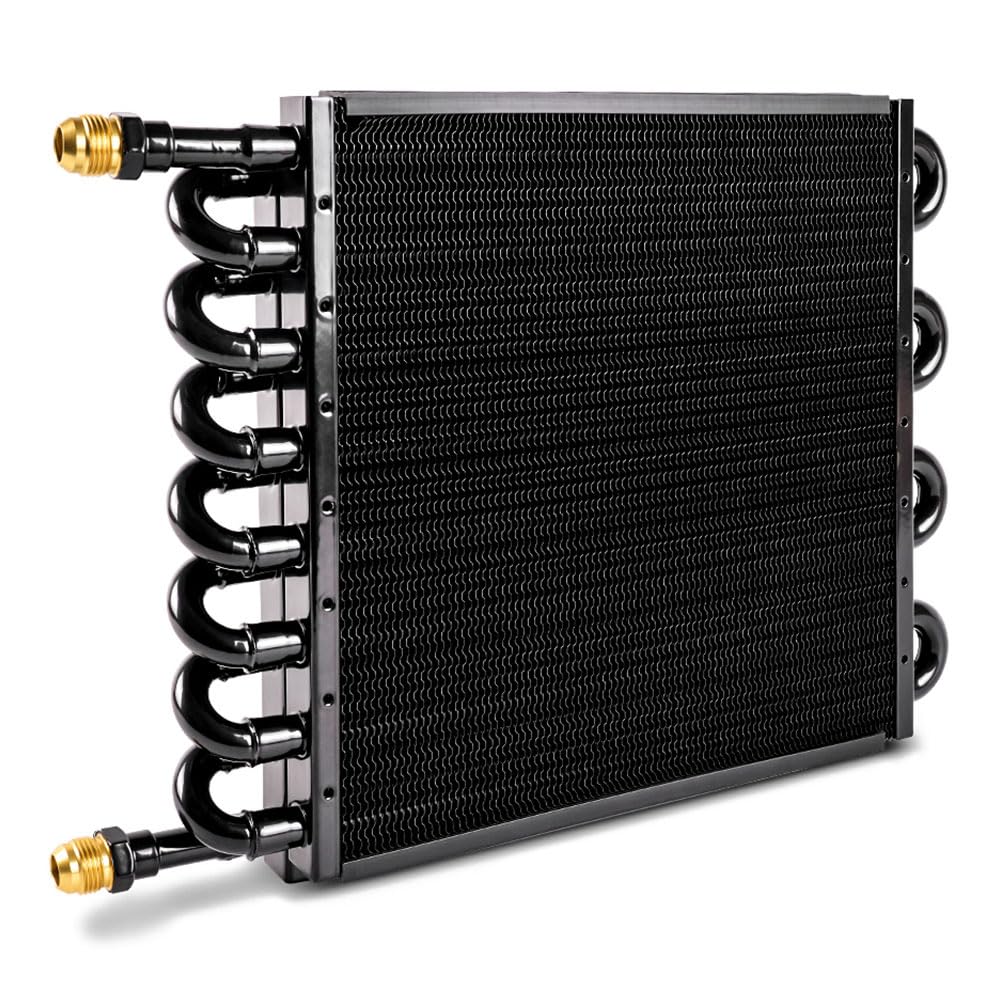
This T-6061 aluminum 16-pass core cools transmissions and air compressors, dropping compressed air from 310°F to 80°F.
What makes the BARTOO stand out is how often owners repurpose it: one used it as an air compressor aftercooler, dropping compressed air from 310°F to a cool 80°F. As a transmission cooler on a 2003 S-10, another reported a massive 60-degree temperature drop.
The 16-pass design pushes fluid through the core sixteen times, and at 145 psi working pressure with a -40°F to 257°F range, it handles demanding conditions. The T-6061 aluminum alloy is high-quality, straight, and defect-free, with owners praising the well-made construction.
The universal fit works with most vehicles using 1/2-inch ID transmission lines — just measure your mounting space first. The one recurring complaint is that the installation hardware isn’t included, so you’ll need your own clamps and fittings.
Performance Across Uses: From transmission cooling to compressor intercooling, the 16-pass design dissipates heat impressively — owners call it a “phenomenal” upgrade.
Setup Note: Plan for aftermarket fittings; the cooler itself is leak-free, but the hose and clamps need your attention.
Pick this up if: you want one cooler that can serve a transmission, engine oil, or even a compressor with genuine efficiency.
Think twice if: you’re looking for a complete kit — this is a bare core that rewards DIYers.
5. 40k Transmission Cooler (Gagsu)

This 40,000 GVW aluminum cooler kept a lifted truck’s temps under 164°F during aggressive driving.
When a 7-inch lift and heavy wheels pushed a truck’s transmission to 230-246°F, this cooler pulled it back to a max of 164°F under aggressive driving. A 2022 Chevy Colorado ZR2 owner towing a 3,400-lb trailer saw a 30-degree drop from 220°F to 190°F highway temps.
Weighing 2.84 kg (about 6.26 pounds), this aluminum cooler includes all necessary mounting parts and installs in about two hours. The 3-year manufacturer warranty is a bonus at this tier. Owners praise the simple installation and effective temperature control.
However, this is a classic “good core, weak extras” story. The included clamps drip, the screws strip easily, and there are durability concerns — one owner reported a leak from the fins after months of use due to thin metal and a poor weld. Most owners recommend aftermarket clamps and hoses.
Cooling You Can Feel
- Buttery shifts after install — overdrive noticeably improved
- Temps dropped 40 degrees on one Silverado
- Full hardware kit included
Where It Cuts Corners
- Cheap clamps that drip under pressure
- Screws strip too easily
- Thin metal raises durability questions
Grab it if: you’re on a budget but need 40,000 GVW-rated cooling for a lifted or towing rig.
Swap parts if: you want long-term reliability — upgrade the clamps and hose right away.
6. Hayden Automotive 689

This plate-and-fin cooler handles Class A motorhomes and 10,000-pound towing with six flare fittings.
While the Hayden 676 is for daily drivers, the 689 is the big brother aimed at Class A motorhomes, large travel trailers, and 5th wheels. Its 11.6″ x 11″ x 0.75″ core can handle up to 10,000 pounds of towing, making it the choice for serious hauling.
It comes with six male flare fittings so you can hard-plumb it into your system, plus pre-drilled mounting brackets. An owner on a 2020 Tundra noted that Toyota omitted coolers on 2018-2021 models, and this unit was a complete bolt-in with factory lines — just what that truck needed.
Owners rave about the temperature control, with one Trans Am build running a cool 130°F on a cool day and 160°F in heat with a 4L80E and Holley Terminator. It earned the label “one of the best coolers I’ve ever used” from a builder.
Heavy-Duty Credentials: The plate-and-fin design with six flare fittings makes this a permanent, professional-grade addition to any tow rig.
Who It Serves Best: Owners of large vehicles where factory cooling falls short — Tundra owners specifically note it’s a near-perfect fit.
Trust this for: Class A motorhomes, 5th wheels, and heavy trucks that demand real cooling capacity.
skip it if: you drive a light commuter — this is serious hardware for serious towing.
7. Derale 13504 Series 8000

This furnace-brazed aluminum plate cooler reduced a Chevy Avalanche’s towing temps by 25°F.
Derale’s 13504 is the choice for owners who want maximum heat transfer in a compact package. The embossed turbulators inside each tube agitate the fluid, forcing maximum heat exchange. A 2010 Chevy Avalanche owner saw a 25°F reduction in max towing temperatures with a camper in tow.
The furnace-brazed aluminum construction is sturdy, and the extruded plastic fins protect the core from debris. A 2003 GMC 2500 owner towing 15,000 pounds noted the transmission “barely warms daily” now, where it previously overheated. Kit dimensions are 11″ wide, 12″ tall, and 7/8″ deep.
Installation is straightforward but expects some mods: one owner noted the included zip ties didn’t fit radiator fins and required custom brackets. A Corvette owner reported a 50°F temp drop after bypassing the radiator entirely — almost too effective, suggesting a thermostat for cold weather.
Serious Cooling Muscle
- 50°F drop reported on a Corvette with stall converter
- Handles 15,000-lb towing without breaking a sweat
- Sturdy furnace-brazed construction
Install Considerations
- Zip ties don’t fit all radiator fins
- May over-cool in winter without a thermostat
- Hose included is tight — some prefer 3/8″ with clamps
Choose this when: you’re towing heavy on the regular and want proven plate-and-fin performance.
Be ready for: a little creativity on mounting — the core is superb, but the kit expects a DIY attitude.
8. Mishimoto MMTC-SP-13N

This 13-row stacked-plate core with O-ring fittings dropped an Arizona Silverado from 260°F to 145°F.
When it’s 105-117°F outside in Arizona, most coolers struggle. The Mishimoto dropped a 2008 Silverado 1500’s transmission temps from a dangerous 250-260°F down to 145-157°F in the morning and 126-137°F during the day — a massive difference in extreme heat. The 13-row stacked-plate design delivers this with minimal pressure loss.
What separates Mishimoto from cheaper clones is the complete package: precision-machined 3/4″-16 to 3/8″ hose barb fittings with integrated O-rings prevent the seepage common with basic compression fittings. The kit includes 50 inches of SAE J1532-rated hose with spiral polyester reinforcement, stainless clamps, and universal mounting brackets.
Rated for 40,000 GVW, it fits trucks, SUVs, and performance vehicles. A 2019 Subaru Forester CVT owner saw temps drop from 95°C to 50°C (a 45°C drop), though they noted it’s overkill for a CVT — a sign of just how much cooling this unit provides. The lifetime warranty seals the deal.
The Premium Payoff
- O-ring sealed fittings that don’t leak
- Complete kit — no extra parts needed
- Lifetime warranty backing the build
Reality Check
- Large core barely fits midsize trucks like a GMC Canyon
- Included hose may be short for some installs
- Overkill for small cars or CVTs
Worth the jump for: anyone towing in extreme heat or running a performance build where every degree counts.
Measure twice: the 22.85″ x 7.10″ core demands real mounting space — check your front end first.
9. Derale 15960 Hyper-Cool
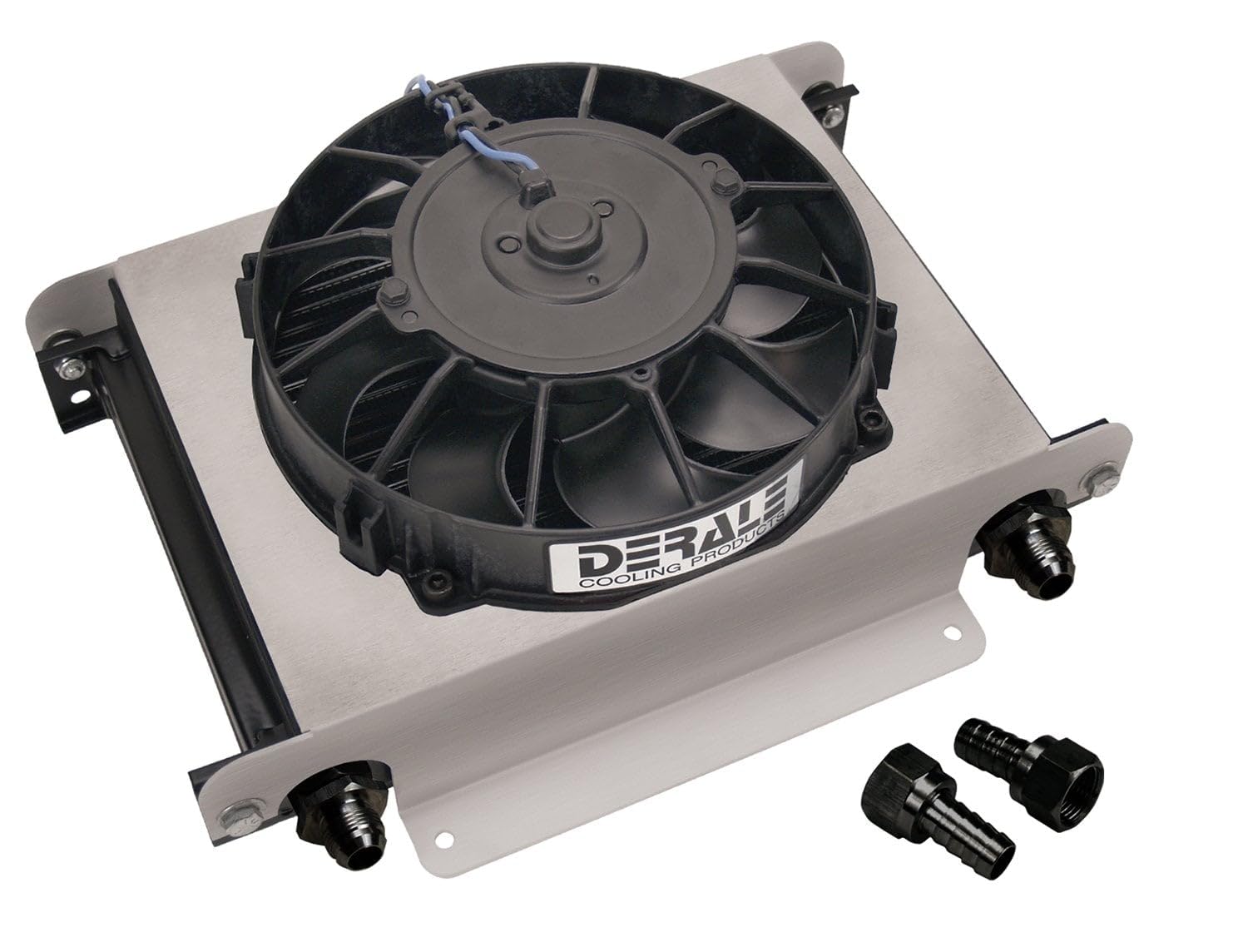
A 10-pound remote cooler with an electric fan that mounts anywhere you have space.
The Derale 15960 is the solution when you have no room behind the grille. With a 7-1/2 x 9-inch mounting footprint, it goes anywhere space permits — a Silverado owner recorded a 200-225°F drop down to 140-165°F without even turning the fan on, just from the stacked-plate core and airflow.
The built-in electric fan supplies optimum airflow when you’re idling or crawling off-road, where natural airflow drops. Buyers report it “hardly runs when towing” — the core is that efficient. A 2008 Silverado dropped from 200-225°F to 140-165°F without the fan activated.
The trade-off is the fittings. The o-rings provided tend to squish and leak when over-tightened — owners recommend replacing them with thicker 1″ OD x 7/8″ ID rings. The thermostatic switch mount is also cheap, with one owner fixing a leak with RTV sealant. Expect to refine the hardware.
Flexible Power
- Remote mount solves space constraints
- Fan keeps temps low even at idle
- Dropped 225°F temps to 140°F on a Silverado
Hardware Gremlins
- O-ring fittings tear if over-tightened
- Thermostatic switch mount is flimsy
- Fan shroud can crack if bent
Ideal for: builds with zero grille space or anyone wanting active fan-forced cooling in extreme conditions.
Budget for extras: plan on replacing the o-rings and upgrading the thermostatic switch for a trouble-free install.
Understanding the Specs
GVW Rating
Gross Vehicle Weight rating tells you the heaviest vehicle the cooler can protect. A 40,000 GVW unit handles heavy-duty trucks, vans, and towing rigs, while smaller ones suit light trucks. Choosing a rating below your vehicle’s weight means the cooler can’t shed heat fast enough. When in doubt, size up.
Core Design and Pass Count
Stacked-plate cores layer metal plates for maximum surface area and heat transfer. Tube-and-fin designs use tubes with fins attached. “Pass” counts (8, 13, 16) refer to how many times fluid crosses the core. More passes mean more cooling but also more pressure drop — a trade-off in low-pressure-drop units.
FAQ
What size transmission cooler do I need for towing?
Can the transmission run too cold with an auxiliary cooler?
What’s the difference between stacked plate and tube and fin coolers?
Will an auxiliary cooler fit my truck without modifications?
Do I need a cooler with a fan?
Should I install the cooler before or after the radiator?
What hose and fittings do I need?
How do I know if my transmission is overheating?
What’s the difference between a cooler and a radiator for the transmission?
Will adding a cooler void my warranty?
Final Thoughts: The Verdict
The crowd favorite is the aux transmission cooler winner, the Hayden 676, because its quality and 40-50 degree drops make it the proven pick for daily drivers and light towers. If you’re pulling seriously heavy loads, the Derale 13504 handles 15,000 pounds with ease. And for extreme heat or zero grille space, the Mishimoto MMTC-SP-13N pairs O-ring sealed fittings with a lifetime warranty — worth every degree in Arizona summers.
How We Picked
We do not accept paid placement. Every pick is matched to a real buyer and a real use-case; we do not hands-on test units.
Sources & Methodology
Specifications: manufacturer listings and product documentation. Review insights: verified customer reviews, as of August 2026. Pricing: not shown on this page (it changes often); check the current price via the retailer link.
As an Amazon Associate, Gadgets Feed earns from qualifying purchases. This does not affect which products we feature.