
Building a real home theater means choosing the nerve center that decodes Dolby Atmos, routes 4K HDR video to your TV, and powers your speakers without distorting at reference levels. The challenge is finding a receiver that delivers clean amplification, modern HDMI connectivity, and room calibration—all without blowing past a strict budget.
I’m Min — the co-founder and writer behind Gadgets Feed. I’ve spent hundreds of hours researching AV receiver specifications, comparing amplification topologies, and analyzing real-world user feedback to find the models that offer genuine performance for the money in today’s market.
Cutting through the marketing noise to find a capable receiver for your setup doesn’t have to be painful. This guide breaks down the real contenders for the best av amp under $500, focusing on the specs that actually matter for your listening experience.
How To Choose The Best AV Amp Under $500
An AV receiver is the most consequential single component in your home theater. Choosing wrong means bottlenecking your speakers or feeling immediate upgrade pressure. Here are the core criteria serious buyers check before clicking add to cart.
HDMI Specification and eARC Support
The HDMI board is the most expensive part of a modern receiver. Models with HDMI 2.1 inputs (4K/120Hz or 8K/60Hz pass-through) allow connection of PlayStation 5, Xbox Series X, or PC gaming rigs without sacrificing high frame rates. eARC (Enhanced Audio Return Channel) lets your TV send lossless Dolby TrueHD and DTS-HD Master Audio to the receiver over a single HDMI cable. Without eARC, you will be limited to compressed Dolby Digital Plus from built-in TV apps.
Channel Count and Amplifier Power
A 5.1 channel receiver is the traditional minimum for a front left, center, right, and two surround speaker system. Stepping up to 7.1 channels adds rear surrounds for a more enveloping sound field. Pay attention to the power rating—manufacturers often list peak power at a single channel driven. A more honest comparison is the continuous RMS power with two or five channels driven simultaneously. A receiver with higher current delivery will drive low-impedance speakers (4 ohm) more stably, reducing distortion at higher listening levels.
Room Calibration and Auto EQ
Basic room calibration systems, like Yamaha YPAO or basic Audyssey, measure speaker distances, levels, and crossover points. More advanced systems, such as Audyssey MultEQ XT, perform finer frequency-domain correction to tame room modes and resonances. A receiver with a good auto-EQ system can make a modest speaker setup sound significantly more coherent and balanced.
Quick Comparison
On smaller screens, swipe sideways to see the full table.
| Model | Category | Best For | Key Spec | Amazon |
|---|---|---|---|---|
| Denon AVR-X1700H | Renewed Premium | Dolby Atmos & Gaming | 7.2ch, 80W RMS, 8K HDMI | Amazon |
| Denon AVR-S770H | Full-Feature Premium | Multi-Room & Streaming | 7.2ch, 75W RMS, HEOS | Amazon |
| Onkyo TX-NR5100 | Gaming Focus | VRR & 4K/120Hz Gaming | 7.2ch, 80W RMS, HDMI 2.1 | Amazon |
| Pioneer VSX-935 | Budget Atmos | Dolby Atmos Virtualization | 7.2ch, 80W RMS, 8K HDMI | Amazon |
| Yamaha RX-V4A | Smart Control | Alexa/Google Voice Control | 5.2ch, 80W RMS, Wi-Fi | Amazon |
| Yamaha RX-V385 | Entry Level | Solid 5.1 Foundation | 5.1ch, 70W RMS, 4K HDMI | Amazon |
| Sony STRDH590 | Value Surround | Simple 5.2 Setup | 5.2ch, 725W Peak, 4K HDMI | Amazon |
| JBL MA310 | Slim Design | Compact Media Console | 5.2ch, 60W RMS, 4K HDMI | Amazon |
| Sony STRDH190 | Stereo Budget | 2-Channel Music & Vinyl | 2ch, 100W RMS, Bluetooth | Amazon |
In‑Depth Reviews
1. Denon AVR-S770H 7.2 Ch Home Theater Receiver

Denon’s AVR-S770H punches well above its price bracket with a full suite of HDMI 2.1 inputs supporting 4K/120Hz pass-through and VRR, making it a serious option for gamers who want fluid motion without dropping frames. The 75W RMS per channel (two channels driven) is conservatively rated and translates to clean headroom for most bookshelf and tower speakers in medium-sized rooms. Built-in HEOS multi-room streaming allows synchronized audio across Denon wireless speakers, so you can extend your music system beyond the main theater space without buying additional hardware.
The Audyssey MultEQ room calibration system measures speaker distances, levels, and performs frequency-domain correction for smoother bass response. Reviews consistently report that the AVR-S770H delivers warm, detailed sound with clear dialogue reproduction, a common weakness in lower-tier receivers. The setup guide is laid out with color-coded speaker terminals, significantly reducing the time needed to get everything wired and running correctly.
One recurring note from owners is the depth of the on-screen menu system—the initial configuration involves navigating multiple submenus, which has a learning curve. The remote control is functional but button-dense, requiring a few days to memorize the layout. For users building a 5.1.2 Atmos system or a 7.1 surround setup, this receiver offers the best feature-per-dollar ratio in this guide, though its sticker price places it at the very top of the budget window.
Why it’s great
- HDMI 2.1 with eARC, VRR, and ALLM for flawless gaming
- Audyssey MultEQ provides real room correction, not just basic distance setting
- HEOS multi-room streaming comes built-in without extra cost
Good to know
- Menus are deep and require patience during initial setup
- 75W RMS may feel underpowered for very large rooms or inefficient 4-ohm speakers
2. Denon AVR-X1700H 7.2ch 8K Home Theater Receiver (Renewed)

This renewed Denon AVR-X1700H is the most future-proof option in the sub-$500 tier, offering three dedicated 8K/60Hz and 4K/120Hz HDMI inputs with HDCP 2.3 compliance. The 7-channel amplifier delivers a rated 80W per channel (8 ohms, 20Hz–20kHz, 0.08% THD), which gives it a meaningful power advantage over entry-level models when driving a full 5.1.2 Atmos speaker configuration. Dolby Atmos Height Virtualization Technology creates phantom overhead effects without physical height channels, a useful compromise for rooms where ceiling speakers are impossible.
Audyssey MultEQ XT is the calibration system here, performing high-resolution filtering across more measurement points than the basic version found in lower-tier Denon models. Users report that the setup process is guided by the on-screen Quick Setup wizard, which walks through speaker connection, EQ adjustment, and source configuration with clear prompts. The phono input on the back panel means turntable owners can connect directly without an external preamp, saving both money and rack space.
The renewed units have had their power supplies and circuit boards tested, but buyers should note that the warranty period is shorter than a new-in-box model. Some users reported needing to use certified 48Gbps HDMI cables to avoid intermittent signal dropouts at 4K/120Hz, so budget extra for high-quality cabling. For a buyer who wants 8K readiness, advanced room EQ, and Dolby Atmos support without exceeding the budget well beyond $500, this renewed unit is a strategic choice.
Why it’s great
- 8K/60Hz and 4K/120Hz inputs with VRR and ALLM for next-gen gaming
- Audyssey MultEQ XT provides superior frequency-domain correction
- Built-in phono input for direct turntable connection
Good to know
- Renewed unit means shorter warranty and potential for cosmetic wear
- Requires certified ultra-high-speed HDMI cables for full 48Gbps bandwidth
3. Onkyo TX-NR5100 7.2-Channel 8K Smart AV Receiver

The Onkyo TX-NR5100 is tuned for gamers, with HDMI 2.1 support including Variable Refresh Rate (VRR), Auto Low Latency Mode (ALLM), and Quick Frame Transport (QFT) to reduce input lag and eliminate screen tearing. The 7.2-channel amplifier is rated at 80W per channel, and the receiver supports Dolby Atmos and DTS:X object-based audio decoding plus Dolby Atmos Height Virtualization for phantom overhead channels. The front-panel display is larger than many competitors, showing input names and volume level clearly from across the room.
Built-in Chromecast, AirPlay 2, and Spotify Connect provide broad streaming compatibility, and the receiver integrates with major voice assistants. The remote is simplified compared to previous Onkyo designs, with dedicated input buttons and a clear layout that reduces initial confusion. Owners note that the twist-style speaker terminals on the front two channels are robust, while the spring-loaded clips for the surround channels feel less secure with thicker gauge wire—using banana plugs or pin connectors for those channels is advisable.
Bluetooth performance has been a point of contention in user reports, with some experiencing sync issues when using Bluetooth headphones or streaming from an Apple TV without a direct wireless connection. The receiver’s value proposition is strong for a gamer building a 5.1.2 setup who prioritizes HDMI 2.1 gaming features over streaming polish, but buyers who rely heavily on Bluetooth should test their specific use case.
Why it’s great
- Full HDMI 2.1 gaming feature set: VRR, ALLM, and QFT
- Simplified remote layout with clearer button differentiation
- Large front display for at-a-glance status checking
Good to know
- Bluetooth implementation can have sync and connectivity issues
- Rear surround channels use spring clips instead of binding posts
4. Pioneer VSX-935 7.2 Channel Surround Sound Network Receiver
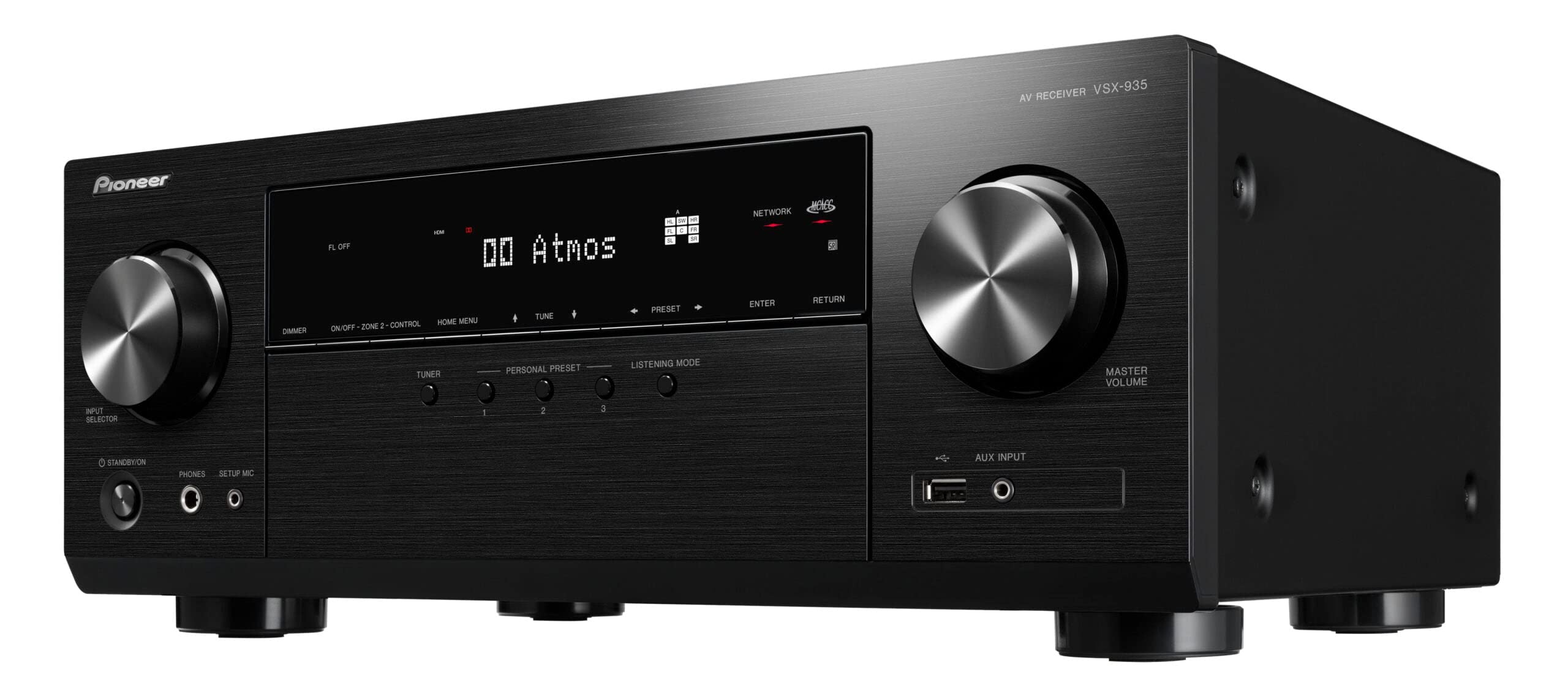
Pioneer’s VSX-935 brings Dolby Atmos Height Virtualization to a 7.2-channel platform, allowing a standard 5.1 or 7.1 speaker layout to simulate overhead sound without physical height speakers. The amplifier delivers 80W per channel (8 ohms, 20Hz–20kHz, 0.08% THD) and includes MCACC (Multi-Channel Acoustic Calibration) room correction, which measures speaker distances, levels, and standing waves. The built-in Chromecast, AirPlay 2, and DTS Play-Fi support make it easy to stream high-resolution audio from a phone or desktop without running additional cables.
The back panel is laid out with clearly labeled HDMI inputs (including one on the front panel for quick device connection), dual subwoofer pre-outs, and a phono input for turntables. The remote is RF-based, which means it does not require line-of-sight to the receiver—useful if the unit is tucked inside a cabinet. Users report that the initial auto-calibration results can sound a bit dull, requiring manual tweaking of the equalizer to bring out livelier treble and tighter bass.
Bluetooth connectivity is the unit’s weakest link; the two-way Bluetooth function can be unreliable for headphone pairing and lacks a dedicated button, making it frustrating to use for those who frequently switch between Bluetooth and HDMI sources. For a buyer focused on building a 7.1 Dolby Atmos system on a strict budget, the VSX-935 offers a strong feature set for the price, but the wireless quirks are worth noting.
Why it’s great
- Dolby Atmos Height Virtualization works with standard speaker layouts
- RF remote control eliminates line-of-sight requirement
- Dual subwoofer outputs for deeper, more even bass
Good to know
- Room calibration often needs manual EQ adjustment for best sound
- Bluetooth pairing process is clunky and unreliable for some users
5. Yamaha RX-V4A 5.2-Channel AV Receiver with MusicCast

Yamaha’s RX-V4A is a 5.2-channel receiver that focuses on voice-controlled convenience and multi-room audio via the MusicCast ecosystem. It supports Amazon Alexa and Google Assistant for hands-free volume adjustment, input switching, and music playback. The HDMI section is HDMI 2.1 compliant with eARC, supporting 4K/120Hz and 8K/60B pass-through, making it suitable for both current-gen consoles and future-proofing for higher-resolution displays. YPAO auto-calibration measures speaker distances and levels to optimize the listening position in a few minutes.
MusicCast enables synchronized playback across compatible Yamaha wireless speakers and soundbars, expanding the audio system beyond the main room without buying a second receiver. The Wi-Fi streaming supports TIDAL, Spotify Connect, Qobuz, and Amazon Music HD natively, bypassing Bluetooth compression for better fidelity. The on-screen setup menu is menu-driven but not as intuitive as Denon’s Quick Setup wizard; some users found the initial HDMI configuration confusing without referring to the manual.
The remote control is small with densely packed buttons that can be hard to differentiate by touch in a dark theater room—several users have resorted to using the MusicCast smartphone app for daily control. A small number of owners reported HDMI switching issues where the receiver would fail to pass 4K to certain monitors or lose audio sync temporarily. For a buyer who already uses smart home voice controls and wants integrated multi-room streaming, the RX-V4A is a logical choice, but the learning curve is steeper than some alternatives.
Why it’s great
- Full voice control with Alexa and Google Assistant built in
- MusicCast enables seamless multi-room audio streaming
- HDMI 2.1 with eARC supports 4K/120Hz gaming
Good to know
- On-screen setup menu is not beginner-friendly
- Remote buttons are small and difficult to use without looking
6. Yamaha RX-V385 5.1-Channel 4K Ultra HD AV Receiver with Bluetooth

Yamaha’s RX-V385 is a straightforward 5.1-channel receiver that skips Wi-Fi and multi-room gimmicks to focus on core surround sound performance and 4K video switching. It decodes Dolby TrueHD and DTS-HD Master Audio, the lossless codecs used by Blu-ray and streaming services that ensure you hear the full dynamic range your content was mastered with. The four HDMI inputs support 4K pass-through with HDR10, Dolby Vision, and Hybrid Log-Gamma, covering the major HDR formats used by modern TVs and projectors.
YPAO auto-calibration is included, using the supplied microphone to measure speaker distances, levels, and crossover points in about two minutes. The amplifier section delivers 70W per channel (1kHz, 0.9% THD), which is adequate for driving most entry-level bookshelf speakers in a small to medium-sized living room. The binding posts accept banana plugs, making speaker connection much more convenient than spring clips—especially important when connecting five speakers plus a subwoofer.
The Bluetooth implementation is basic, supporting only SBC codec and lacking low-latency aptX, so there may be noticeable audio lag when watching video. The FM tuner uses a proprietary antenna connector that is not compatible with standard coaxial roof antennas, limiting over-the-air radio use. For a buyer building a dedicated home theater on a strict budget, the RX-V385 is a reliable workhorse that gets the fundamentals right without unnecessary complexity.
Why it’s great
- Supports lossless Dolby TrueHD and DTS-HD Master Audio
- Binding posts on all channels accept banana plugs for easy setup
- YPAO provides reliable automatic room calibration
Good to know
- Only basic SBC Bluetooth codec, no aptX or low-latency support
- FM antenna connector is proprietary, not standard coaxial
7. Sony STRDH590 5.2 Channel Surround Sound Home Theater Receiver
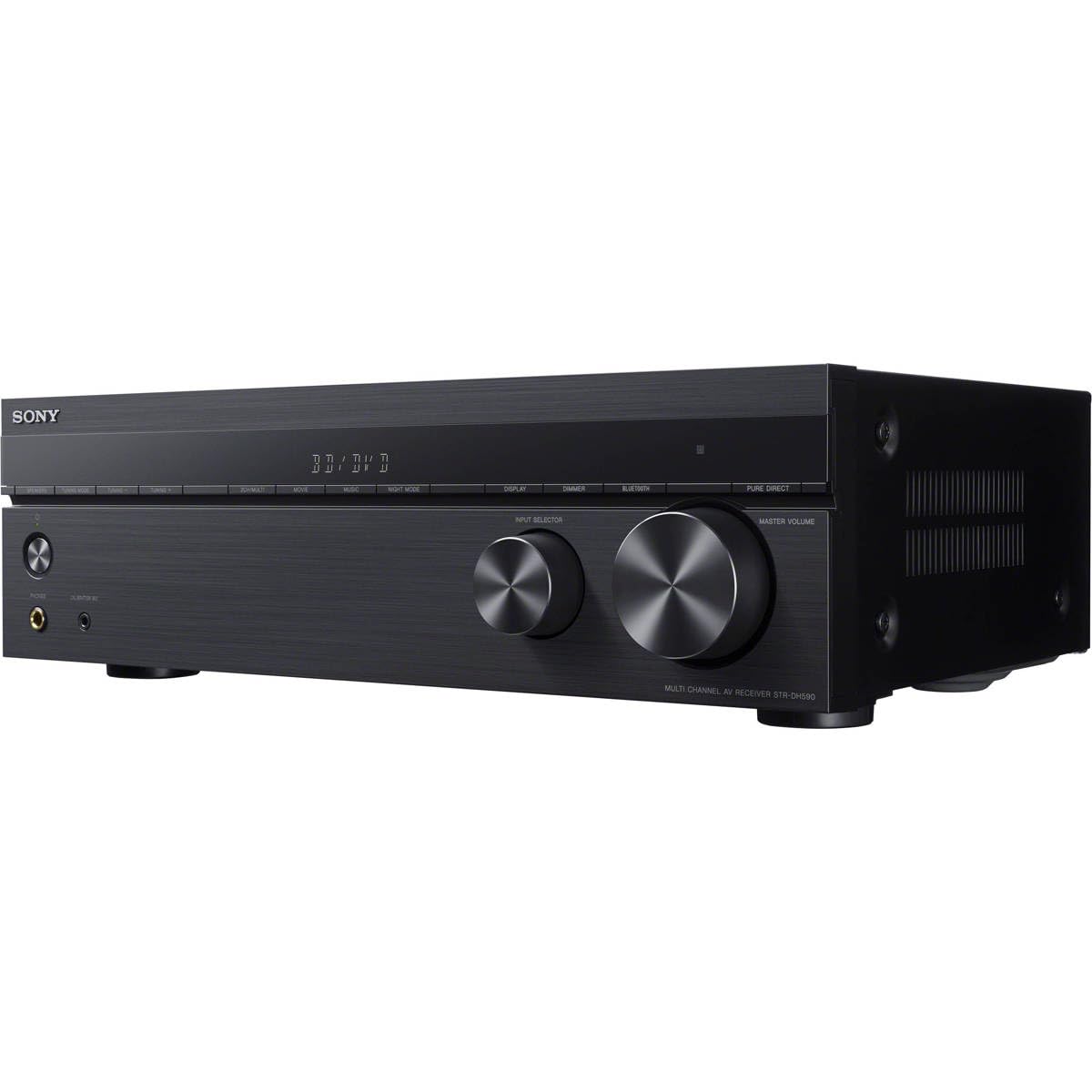
Sony’s STRDH590 is a slim 5.2-channel receiver (just 5.25 inches tall) that fits into media consoles where traditional receivers cannot. It provides four HDMI inputs with 4K HDR passthrough and Audio Return Channel, supporting HDCP 2.2 for compatibility with modern streaming devices. S-Force PRO Virtual Surround Sound mode synthesizes a wider soundstage from just two speakers, which is useful for spaces where a full surround system is impractical. The amplifier is rated at 725W total peak power (145W per channel at 6 ohms), but continuous RMS is lower—real-world output is sufficient for casual movie watching with efficient speakers.
The auto-calibration microphone adjusts channel levels and distances but does not perform advanced frequency correction like more expensive Sony ES series models. The remote is simple with dedicated buttons for FM/AM, TV, and Bluetooth sources, though the lettering is small. Users found that enabling audio passthrough on their streaming device required some trial and error to get 5.1 sound from stereo content, and the receiver lacks a dedicated clear-voice dialogue enhancer.
The speaker terminals are a combination of screw-style for the front pair and spring-loaded pin-style for the center and surround channels, which limits wire gauge options for the non-front channels. The FM wire antenna picks up strong stations decently but may struggle in fringe reception areas. For a buyer who needs a compact, simple 5.1 receiver with basic HDMI switching and no interest in Wi-Fi streaming or multi-room, the STRDH590 is a functional space-saving solution.
Why it’s great
- Compact chassis fits easily in shallow media cabinets
- S-Force PRO provides convincing virtual surround from just two speakers
- Simple remote with dedicated input buttons for daily use
Good to know
- Speaker terminals mix screw and spring-clip types for different channels
- No advanced room EQ, only basic distance and level calibration
8. JBL MA310 5.2 Channel (60 Watt x 5) 4K AV Receiver

JBL’s MA310 is a slim 5.2-channel receiver with clean industrial design and four HDMI inputs, one of which supports ARC for sending audio back from the TV. The amplifier outputs 60W RMS per channel (8 ohms, 20Hz–20kHz, 0.08% THD), which is modest but sufficient for driving efficient speakers like the Polk RC65i in-wall series used by many owners. The unit natively decodes Dolby and DTS 5.1 soundtracks, and Bluetooth v5.1 with Low Energy provides stable wireless streaming without noticeable audio lag in most tests.
The shallow chassis depth of roughly 11 inches means it slides into media cabinets that would not accept deeper receivers—a meaningful advantage for console-mounted setups. Users note that the initial setup is confusing because the receiver does not show a setup menu on its front display; all configuration must be done through the on-screen interface over HDMI. Once the firmware update is applied via wired network connection, the unit works reliably, automatically switching inputs based on HDMI CEC signals from the TV.
The remote is not backlit, which is a genuine annoyance in darkened home theater rooms. The auto-shutoff timer defaults to 20 minutes and must be manually disabled through the menu if you want to avoid interruptions during long listening sessions. The bright blue LED on the front panel cannot be dimmed and can be distracting in a pitch-black room. For a buyer who prioritizes clean aesthetics, a compact fit, and simple 5.1 surround for a secondary room or apartment, the MA310 delivers a solid experience with a few ergonomic compromises.
Why it’s great
- Shallow chassis fits in media consoles too narrow for standard receivers
- Bluetooth v5.1 provides stable low-latency wireless streaming
- Clean minimalist design that blends into modern furniture
Good to know
- Remote has no backlight, difficult to use in dark rooms
- Auto-shutoff times out after 20 minutes by default, adjustable in menu only
9. Sony STRDH190 2-ch Stereo Receiver with Phono Inputs and Bluetooth

The Sony STRDH190 is a 2-channel stereo receiver that sacrifices surround sound for superior music playback performance. It delivers 100W per channel into 8 ohms, which is significantly more clean power than most entry-level surround receivers can muster per channel. The built-in phono preamp allows direct connection of a turntable without an external phono stage, making it a natural centerpiece for a vinyl-focused listening setup. High-Resolution Audio support (up to 24-bit/192kHz via the analog inputs) ensures the amplifier can reproduce the full frequency range of studio-quality digital recordings.
Bluetooth connectivity includes Bluetooth Standby mode, meaning the receiver can be powered on remotely from a paired smartphone. The large power transformer is a design detail that directly affects audio quality—the substantial power supply provides stable current delivery during dynamic peaks, resulting in tighter bass control and cleaner transients compared to budget surround receivers. The four analog audio inputs plus a dedicated output for recording gear give it real flexibility for a stereo-focused system.
This is not a home theater receiver—there is no HDMI input, no surround decoding, and no subwoofer crossover management. The FM tuner uses a proprietary antenna connection that does not work with standard coaxial antennas, limiting radio reception. The included bundle adds 100 feet of speaker wire and banana plugs, which is genuinely useful for setting up a two-channel speaker system. For a dedicated music listener or someone running a simple TV+speakers setup, the STRDH190 offers audiophile-adjacent power and connectivity at an unbeatable price point.
Why it’s great
- 100W RMS per channel provides real headroom for dynamic music
- Built-in phono preamp eliminates need for external turntable gear
- High-Resolution Audio support preserves studio recording detail
Good to know
- No HDMI inputs or surround sound processing at all
- FM antenna uses proprietary connector, not standard coaxial
FAQ
What is the minimum HDMI version I need for a modern 4K setup?
Can I add height speakers later if I buy a 7.1 receiver now?
Final Thoughts: The Verdict
For most users, the av amp under $500 winner is the Denon AVR-S770H because it combines HDMI 2.1 gaming support, Audyssey room EQ, and HEOS multi-room streaming without exceeding the budget. If you want wired gaming features and Dolby Atmos Height Virtualization, grab the Onkyo TX-NR5100. And for a dedicated two-channel music setup with phono input and ample power, nothing beats the Sony STRDH190.