
Our readers keep the lights on and my morning glass full of iced black tea. As an Amazon Associate, I earn from qualifying purchases.
Specs are compiled from manufacturer listings and verified buyer reviews and can change over time — please confirm the key details on the product page before buying.
Choosing a new AV receiver is really choosing the brain of your entire home theater. It is the box that decides whether movie dialogue sounds clear, whether game audio feels like it is happening around you, and whether your fancy 8K TV actually gets the signal it needs. A well-matched receiver delivers clear dialogue and rich audio; a mismatched one leaves you wrestling with weak sound and dead ports.
I’m Min — the founder and writer behind Gadgets Feed. This guide is built by comparing the manufacturers’ published specifications and the patterns across verified customer reviews, so you get each pick’s real strengths and trade-offs instead of marketing spin.
You need to match the receiver’s power output, channel count, and HDMI capabilities to your speakers and TV. The ideal av amplifier receiver should also support the latest audio formats to keep you immersed in every scene.
Our Picks at a Glance


How To Choose The Best AV Amplifier Receiver
Before you look at any specific model, you need to map out what your system needs to do. The most expensive receiver in the world is worthless if it lacks the right number of channels for your speakers or the right HDMI ports for your devices.
Count your channels first
The first number in “7.2” tells you how many main speakers the receiver can power, and the second tells you how many subwoofer outputs it has. A 7.2 receiver handles a standard 7.1 setup or a 5.1.2 Atmos layout, which adds two ceiling or up-firing speakers for height effects. If you dream of a 7.1.4 setup with four height channels, you need a 9-channel receiver like the Onkyo TX-RZ50.
Match power to your speakers
Power per channel, measured in watts, tells you how loudly the receiver can drive your speakers before distortion sets in. A high-wattage amplifier gives you more headroom, meaning explosive movie scenes stay clean and controlled. If you have low-sensitivity speakers that need extra juice, look for a higher wattage rating like 100 W or more per channel.
Don’t overlook HDMI and room correction
HDMI inputs are the lifeline of your system, so count what you need today and tomorrow. Look for 8K pass-through to future-proof your TV, and eARC to send high-quality audio back from the TV to the receiver with one cable. Room correction software, whether it is Audyssey, Dirac Live, or YPAO, automatically adjusts the sound to fix how your walls and furniture reflect audio, which is essential for balanced sound in square, echoey, or oddly-shaped rooms.
Quick Comparison
| Model | Best For | Channels | Power Per Channel | HDMI Inputs | Amazon |
|---|---|---|---|---|---|
| Denon AVR-X1700H★ Best Overall | Easiest set-up and everyday value | 7.2 | 80W | 6 | Amazon |
| Yamaha RX-V6AGaming Pick | Gaming and heavy HDMI connectivity | 7.2 | — | 7 | Amazon |
| Onkyo TX-NR6100THX Certified | Big clean power and THX certification | 7.2 | 210 W | 3 | Amazon |
| JBL MA710 | Simple plug-and-play upgrades | 7.2 | 110W | 6 | Amazon |
| Denon AVR-S970H | Balanced all-around music and movies | 7.2 | 90W | 8 | Amazon |
| Yamaha RX-A2A | Premium build with smart room tuning | 7.2 | — | 7 | Amazon |
| Onkyo TX-RZ50 | Serious home theaters and future-proofing | 9.2 | — | 6 | Amazon |
| Sony STR-AZ1000ES | Sony purists and high-end integration | 7.2 | 100 W | 6 | Amazon |
| Marantz Cinema 60 | Cinephiles who value a musical sound | 7.2 | 100 W | 6 | Amazon |
In-Depth Reviews
1. Denon AVR-X1700H
Our pick — 4.5★ from 650+ verified ratings; the strongest balance of quality and price.
The Denon AVR-X1700H pairs a guided on-screen setup with 80W per channel, making 7.1.2 Atmos sound easy for first-time buyers.
After one movie night, you will understand why the Denon AVR-X1700H is the receiver most buyers recommend to friends. It delivers 80W per channel, enough to drive a 7.1.2 setup (seven main speakers, one subwoofer, and two height speakers) in a medium room, so action scenes feel theater-like without straining. The guided on-screen setup walks you through connecting your TV and tuning the EQ (equalizer, which adjusts sound balance) using color-coded back-panel connections, so you are up and running quickly.
It is built for today’s content, too, with 8K/60Hz and 4K/120Hz pass-through on three dedicated 8K inputs. Dolby Atmos and DTS:X bring object-based audio into your room, and the Dolby Atmos Height Virtualization can fake height effects even if you don’t have ceiling speakers. Buyers report that it replaced 12-year-old Sony units and still felt like a worthy upgrade, calling it pricey but worth it.
Music lovers get the Denon HEOS platform, which lets you stream Spotify or Pandora to a second room while another family member watches a movie. The input lag from switching HDMI ports is a minor annoyance, and the Bluetooth connectivity gets mixed feedback, but the sheer quality and easy setup make it the safest pick.
Why it wins the room
- On-screen guide makes setup a breeze for beginners
- Plenty of HDMI ports for all your gear
- Dolby Atmos Height Virtualization adds immersion without extra speakers
The trade-offs to know
- Bluetooth pairing can be finicky for some owners
- Zone 2 and Atmos share the same terminals, so you can’t run both at once
- Lacks RCA AUX input ports
Reach for this if: you want the most reliable, easy-to-live-with receiver for a first-time or mid-range setup.
Look elsewhere if: you need more than 80W of pure power for inefficient speakers.
2. Yamaha RX-V6A
The Yamaha RX-V6A offers 7 HDMI inputs with HDMI 2.1 support, giving gamers ample ports for consoles and lag-free 4K120 signal.
The Yamaha RX-V6A makes its case with 7 HDMI inputs, a 2.3x advantage over the Onkyo TX-NR6100’s 3 ports, giving you room to plug in every console, streaming stick, and cable box without juggling cables. It offers 4K60, 4K120AB, and 8K60B support with HDMI 2.1 and HDCP 2.3, meaning the signal from a next-gen console arrives crisp and lag-free. YPAO R.S.C. with multipoint measurement tunes the sound so those gaming explosions stay balanced in your specific room.
On the audio side, it decodes Dolby Atmos and DTS:X, and Yamaha’s Height Virtualization can simulate height channels from a traditional layout. Owners call it “a simply awesome receiver for the money,” a sentiment shared across repeated reviews that praise the feature set and the sound quality with smaller bookshelf speakers. The catch is that it really wants a powered subwoofer in the mix to deliver the low-end punch.
Music fans get Wi-Fi, Bluetooth, AirPlay 2, and Spotify Connect built in, plus MusicCast multi-room support across the house. The setup process gets mixed feedback, with a slightly confusing menu system, and the lack of a physical manual forces you to hunt online. Still, for stepping up from an older 5.1 Yamaha, owners expect a solid 10-year lifespan and call the upgrade spectacular.
Best for gamers: the HDMI 2.1 ports with ALLM and VRR support make it the natural choice for a console-focused living room.
Heads up: owners note it demands a powered sub for full bass, and the app is required for some features like Bluetooth and Internet Radio.
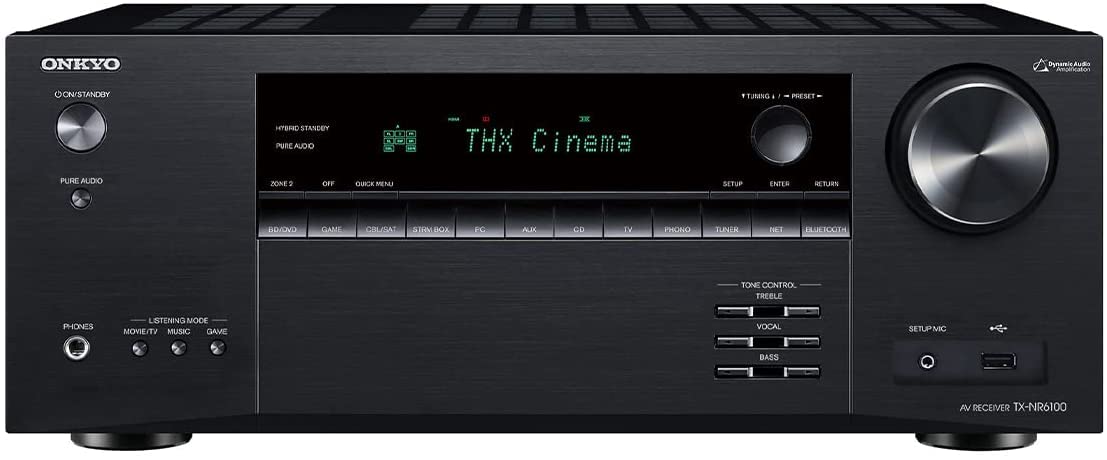
3. Onkyo TX-NR6100
The Onkyo TX-NR6100 delivers 210W per channel with THX Select certification, driving demanding speakers loudly and cleanly for the price.
The Onkyo TX-NR6100 is the power player of this group, rated at 210W per channel — a 2.6x gap versus the Denon AVR-X1700H’s 80W. That kind of headroom means a demanding 5.1 Klipsch speaker setup can play louder and cleaner than many rivals, and owners mention it indeed runs louder than the Denon X1700 while driving their gear with confidence. It is THX Select Certified, so the signal stays true from source to speaker.
For movies, it plays 5.2.2-channel Dolby Atmos and DTS:X (object-based surround formats that place sounds around you), with precise directional effects that make action scenes feel genuinely rich. It also handles 8K video through HDMI 2.1 at 40Gbps (gigabits per second) on its three inputs, so it is ready for the newest TVs and consoles. Customers note the per-device sound modes and app control, calling it a great value after a year of happy use.
That said, reliability is the number one topic in the review data, and it is a mixed bag — some units have dropped audio randomly or failed to connect to wireless networks. It is note, too, that the depth is significant compared to the Yamaha RX-V6A, so double-check that your media cabinet has the space. Despite the gripes, the consensus is that the setup is easy and the feature set is rich for the money.
Power and polish
- THX certification guarantees authentic sound with no added coloration
- Massive 210W per channel for loud, clean volume
- Discrete Zone 2 audio and video for multi-room use
Know before you buy
- Reliability is the most-discussed topic, with some random audio drops reported
- Deep chassis may not fit shallow entertainment centers
Who this is for: you, if you have power-hungry speakers and want THX certification (a quality standard for accurate sound) without spending flagship money.
Think twice if: you want a slim, shallow unit or need maximum HDMI ports.
4. JBL MA710

The JBL MA710 offers 110W across 7 channels with 8K HDMI and a phono input, making it a simple, future-ready upgrade.
If you are replacing an old, outdated receiver and want a low-maintenance day-one win, the JBL MA710 is the pick. It delivers 110W across 7 channels, decoding Dolby Atmos and DTS:X for up to a 7.1 or 5.1.2 configuration (seven main speakers plus one sub, or five main plus two height). Reviewers point out the swap took minutes with their surround sound system, and the crisp, clear output impressed them.
The connectivity is future-ready with 6 HDMI inputs and 1 output, plus eARC for that single-cable audio return from your smart TV. JBL also kept the analog folks in mind with a moving magnet phono input, so a turntable plugs straight in without a separate preamp. Wireless streaming comes via Bluetooth, Apple AirPlay 2, and Google Chromecast, covering the major phone ecosystems.
The trade-off is that user feedback is much thinner here, so you are dealing with a less-proven track record than the big names. A few owners note minor glitches that firmware updates have lessened over time, and one suspects their DIRECTV box was the source of a signal hiccup rather than the receiver. For a clean, well-priced upgrade, the JBL delivers a sharp-looking unit that sounds as good as it looks.
Set-and-forget value: this is a low-fuss receiver that owners praise for easy installation and great sound.
A fair caution: a small number of owners hit minor glitches that improved with firmware updates.
5. Denon AVR-S970H

The Denon AVR-S970H delivers 90W per channel with 8 HDMI ports and gaming features like VRR, covering music, movies, and games affordably.
The Denon AVR-S970H sits above the X1700H in power at 90W per channel, and it shows real versatility across every kind of content. It is 8K-ready with 8 HDMI ports (6 in / 2 out) including three 8K inputs, which is the most flexible connection bank in this lineup. For gamers, it supports Variable Refresh Rate (VRR), Quick Frame Transport (QFT), and Auto Low Latency Mode (ALLM) for smooth, tear-free motion.
Music performance is a real highlight, with owners praising clear, rich sound even from just a 5.0 setup, and the phono input works great with vintage turntables. The HEOS multi-room platform lets you send Pandora, Spotify, or TIDAL to other rooms, and shoppers say it runs cooler than previous gear at 80°F versus 90-92°F. The on-screen setup with video walkthroughs is user-friendly, and the smartphone app doubles as a remote.
Honest owners note that the powered Zone 2 uses the back channels, so running it changes the system to a 5.2 setup. There is also no programmable TV power button on the remote, a small daily annoyance for some. For a receiver that does a little of everything well, this is a strong, well-loved choice.
Strong all-around performer
- 90W per channel beats comparable Yamaha models rated at 75W
- Phono input works flawlessly with vintage turntables
- Runs cooler than many rivals during heavy use
Minor compromises
- Zone 2 shares back channels, turning a 7.2 into a 5.2 setup
- No programmable TV power button on the remote
Grab it if: you want one receiver that handles music, movies, and gaming with ease.
skip it if: you need full 7.2 output and a second zone running simultaneously.
6. Yamaha RX-A2A AVENTAGE

The Yamaha RX-A2A AVENTAGE combines premium construction with Surround:AI and YPAO R.S.C. for refined, adaptive sound.
The Yamaha RX-A2A is the entry point into Yamaha’s higher-end AVENTAGE series, and the difference shows in the details. It packs 7 HDMI inputs with all of them supporting 4K60, plus three that step up to 8K60B and 4K120AB for next-gen gaming. Advanced room calibration via YPAO R.S.C. with multipoint measurement takes the guesswork out of tuning, and the Surround:AI technology analyzes the scene in real-time to tune the sound effects as you watch.
Owners upgrading from 10-year-old receivers praise the noticeable audio improvement and balanced sound, especially during demanding soundtracks. One repeat buyer owns three Yamaha units, proof of the brand’s pull. The 7.2-channel receiver supports Dolby Atmos and DTS:X, and the phono input covers vinyl listeners. It also works with Sonos via a separate Sonos Port, so it can slide into an existing multi-room system.
The honest critique is that some owners find it overpriced at full retail, and a few have encountered signal loss with certain Sony TVs that a power cycle fixes. But the consensus is that the sound quality and amplifier quality are exceptional, with buyers calling it far better than a Denon they tried first. For a long-term investment, the AVENTAGE build quality justifies the premium.
The premium upgrade: better construction and real-time sound optimization make this the pick for those who value refinement.
A fair note: a few owners have reported signal loss issues with specific Sony TVs that require a power cycle to fix.
7. Onkyo TX-RZ50

The Onkyo TX-RZ50 offers 9.2 channels with Dirac Live calibration, delivering professional-grade room correction for serious home theaters.
The Onkyo TX-RZ50 is for the person building a serious home theater and wants room to grow. It is a 9.2-channel receiver with up to 11.2 channels of processing power, which means it can run a 7.1.4 system when paired with an external two-channel amp. The headline feature is Dirac Live, premium room calibration software, which automatically measures your room and adjusts speaker output for more precise sound that owners say noticeably improves clarity and crossover.
For content, it handles 8K60 and 4K120 HDMI on its six ports, supports eARC, and is THX Certified. There is a Klipsch tune Mode that automatically applies the correct crossover values for new Klipsch Reference speakers. On the multi-room side, it is Works With Sonos Certified, so it can join or start a Sonos system with a Sonos Port, and it handles up to three zones with different streaming services.
The setup process gets mixed feedback, with Dirac calibration being a bit finicky on first go, and the on-screen interface feels dated to some. Owners also note an HDMI switching delay of around 12-15 seconds. But the praise for sound quality and performance is loud and clear, with one buyer calling it the best value for a 7.1.4 system. For a dedicated home theater enthusiast, this is the one.
Serious capability
- Dirac Live calibration delivers a noticeable improvement in sound clarity
- 11.2 channels of processing for a future 7.1.4 setup
- THX Certified and Works with Sonos for full ecosystem integration
Points to know
- HDMI switching can feel slow at 12-15 seconds
- Dirac calibration is finicky and may need a laptop for best results
- Needs an external amp to power all 11 channels
Perfect for: the enthusiast assembling a 7.1.4 system who wants premium room correction built in.
Not for: casual listeners who will never use more than five channels.
8. Sony STR-AZ1000ES

Sony’s premium ES series with a signature spatial audio trick that has to be heard.
The Sony STR-AZ1000ES is a premium 7.2-channel receiver rated at 100W plus 100W into 8 ohms (a standard speaker impedance), carrying Sony’s high-end ES pedigree. It supports 8K and 4K/120 HDMI with HDMI 2.1 across 6 inputs and 2 outputs, so you can connect multiple modern sources. The standout feature is 360 Spatial Sound Mapping combined with Digital Cinema Auto Calibration IX (automatic speaker tuning), which owners call a standout that makes audio feel like it is playing inside your head.
It decodes Dolby Atmos and DTS:X and supports Dolby Vision, HDR10, Hybrid Log-Gamma, and IMAX Enhanced for video. The “Works with Sonos” integration means it slots into an existing Sonos ecosystem, and it streams via Bluetooth, Wi-Fi, Chromecast built-in, Spotify Connect, and Apple AirPlay. There is a phono stage for turntables and it is tune for custom in-home integration with IP control for leading control systems.
Owners describe the build quality as high-end and love how it works with Sony Bravia TVs as a centerpiece. The calibration process is complex, and you have to plug the height channels into specific ports or the calibration fails. Sound quality gets mixed feedback in the data, with some finding it wonderful and others reporting their speakers underperform. For a dedicated Sony fan or someone who wants cutting-edge spatial audio, this is a special unit.
The Sony difference: 360 Spatial Sound Mapping creates an rich bubble of audio, standing apart from the Denon AVR-X1700H’s more conventional surround field.
A word of caution: calibration is complex, and matching it with quality speakers is essential to hear its best.
9. Marantz Cinema 60

The hand-tuned Marantz that pairs cinema power with genuinely musical sound.
The Marantz Cinema 60 is the audiophile’s choice, promising the warm, enveloping “Most Musical Sound” the brand has built its name on for decades. Each unit is hand-tuned at Marantz’s Shirakawa facility in Japan, and that attention shows in the sound, which one owner says is “as if it’s playing inside your own head.” It delivers 100W per channel across 7.2 channels, bringing commanding dynamics to both movies and music, though it lacks the 8K passthrough of the Sony STR-AZ1000ES.
It is loaded with six HDMI inputs, three of which are 8K-compatible, plus analog, digital, and phono connections for virtually any source. Audyssey MultEQ XT calibrates the sound to your specific room using the included microphone and stand, and owners find it does an excellent job of setting speaker distances automatically. Powered by HEOS, it streams high-res audio from Spotify, TIDAL, and Amazon Music HD.
The design is symmetrical and elegant, built with premium materials, and the remote is a cut above the typical plastic throw-in. One long-term owner reports being very happy a year later, praising the speaker timing tuning. The setup process earns mixed feedback, with most finding the guide helpful but a few hitting odd quirks. For cinephiles who want a receiver that also excels at stereo music, this Marantz is the one.
Why it is special
- Hand-tuned at the Shirakawa facility for a signature warm sound
- Audyssey MultEQ XT offers precise room calibration with the included mic
- Elegant, premium build that looks as refined as it sounds
Consider this
- Setup can throw a few odd quirks despite the helpful guide
- Sits at the premium end of the price spectrum
Choose this if: you treat music and movies with equal seriousness and want a receiver that feels like an instrument.
pass on it if: you are chasing maximum HDMI ports or a budget-friendly spec sheet.
Understanding the Specs
Channels and Power
The first number in a spec like “7.2” is the number of main amplified channels, and the second is the subwoofer outputs. A 7-channel receiver powers seven speakers for a standard 7.1 layout or a 5.1.2 Atmos setup with two height channels. Power per channel, listed in watts, determines how loud and clean your system can play, so match it to your speaker’s sensitivity and your room size
HDMI, eARC, and 8K
HDMI inputs count the devices you can plug in, from game consoles to streaming boxes. Look for 8K pass-through and eARC (Enhanced Audio Return Channel), which lets your TV send high-quality audio back to the receiver through the same cable. This matters if you use your TV’s built-in apps, since eARC ensures Dolby Atmos sound gets from the TV to your speakers.
Dolby Atmos and DTS:X
These are object-based audio formats that place sounds in a three-dimensional space around you, so a helicopter can fly overhead or rain can fall all around. Atmos Height Virtualization can simulate those height effects using your regular speakers, so you get some immersion even without ceiling-mounted units. DTS:X is a similar competing format, and many receivers support both.
Room Correction Software
This is the invisible hero of great sound. Software like Audyssey, Dirac Live, and YPAO uses a microphone to measure how your room reflects sound, then adjusts speaker output for balanced audio. It corrects for echoey walls, odd furniture placement, and subwoofer boominess, so you get a more accurate soundstage without an acoustics degree.
FAQ
What is the difference between a 5.1.2 and a 7.2 channel receiver?
How do I know if my receiver supports 8K passthrough?
What does eARC do and why is it important?
What is Dolby Atmos Height Virtualization?
How much power do I really need in a receiver?
Can I connect a turntable to a modern AV receiver?
What is room correction and does it really matter?
Is it better to buy a receiver with more HDMI ports?
Final Thoughts: The Verdict
If you want one dependable pick, the av amplifier receiver winner is the Denon AVR-X1700H because it pairs easy setup with reliable performance and great value. If you want maximum power to drive demanding speakers, grab the Onkyo TX-NR6100. And for a serious home theater with room to grow, the Onkyo TX-RZ50 is the one to reach for.
How We Picked
We do not accept paid placement. Every pick is matched to a real buyer and a real use-case; we do not hands-on test units.
Sources & Methodology
Specifications: manufacturer listings and product documentation. Review insights: verified customer reviews, as of August 2026. Pricing: not shown on this page (it changes often); check the current price via the retailer link.
As an Amazon Associate, Gadgets Feed earns from qualifying purchases. This does not affect which products we feature.