
Our readers keep the lights on and my morning glass full of iced black tea. As an Amazon Associate, I earn from qualifying purchases.
Specs are compiled from manufacturer listings and verified buyer reviews and can change over time — please confirm the key details on the product page before buying.
Match the receiver to your room, speakers, and sources, not just the biggest spec number. Decide on channel count, HDMI 2.1 needs for your TV and console, and the value of automatic room calibration. A well-matched receiver integrates your TV, speakers, and sources into one cohesive system, while a poor fit can leave you wrestling with menus and a remote you never master.
I’m Min — the founder and writer behind Gadgets Feed. This guide is built by comparing the manufacturers’ published specifications and the patterns across verified customer reviews, so you get each pick’s real strengths and trade-offs instead of marketing spin.
The Denon AVR-X1700H earns a 4.4-star rating from hundreds of owners who praise its build quality and rich sound. Prioritize features you’ll use daily over raw power you may never fully utilize.
Our Picks at a Glance


How To Choose The Best AV Amplifiers
Choosing an AV receiver starts with a realistic look at your room size and speaker layout, not the most expensive model you can find. An over-spec’d receiver for a small room adds cost and complexity without audible benefit. Focus on what connects to your TV, how many speakers you plan to run, and if you need advanced features like 8K video passthrough.
Count Your Channels and Speakers
In a spec like “7.2,” the first number is the main speaker channels, the second is subwoofers. A 5.2 receiver handles a front left, center, front right, and two surround speakers. A 7.2 adds two more for a richer bubble of sound. If you want height speakers on your ceiling for Dolby Atmos, you need extra channels — a 7.2 receiver can run a 5.2.2 setup (five main, two subs, two heights). Think about whether you will actually install ceiling speakers before paying for channels you may never use.
Match HDMI to Your TV and Gaming Needs
Your receiver is the hub connecting your TV, cable box, streaming stick, and game console. If you own a 4K TV, any modern receiver with HDCP 2.3 will pass the signal fine. If you have an 8K TV or a new game console that outputs 4K at 120 frames per second, you want HDMI 2.1 ports that support those speeds. Look for eARC (enhanced Audio Return Channel) too, which lets your TV’s built-in apps send high-quality audio back to the receiver over a single HDMI cable.
Decide How Much You Care About Room Calibration
Automatic room correction uses a microphone to listen to test tones and adjust speaker levels, distances, and equalization to fix problems caused by your room’s shape and furniture. Basic room correction like Audyssey MultEQ (Denon) or YPAO (Yamaha) works well for most rooms. Premium models from Onkyo and Marantz offer more advanced systems like Dirac Live or Audyssey MultEQ XT that give finer control, often requiring a computer to get the full benefit.
Quick Comparison
| Model | Best For | Channels | Power (per ch) | HDMI (In/Out) | Amazon |
|---|---|---|---|---|---|
| Denon AVR-X1700H★ Best Overall | Best Overall Value | 7.2 | 80W | 6/1 | Amazon |
| Onkyo TX-RZ50Premium Pick | Premium Room Correction | 9.2 | — | 8/— | Amazon |
| Marantz Cinema 60Style Icon | Musical Fidelity | 7.2 | 100W | 6/— | Amazon |
| Yamaha RX-A6A | High-End Flexibility | 9.2 | — | 7/3 | Amazon |
| Pioneer VSX-935 | Easy 8K Setup | 7.2 | — | 6/— | Amazon |
| Onkyo TX-NR7100 | Serious Gaming + Dirac | 9.2 | — | 7/3 | Amazon |
| Yamaha RX-A2A | Refined AVENTAGE Build | 7.2 | — | 7/1 | Amazon |
| Sony STR-AN1000 | 360 Spatial Sound | 7.2 | — | 6/2 | Amazon |
| Denon AVR-S970H | 8K Gaming Power | 7.2 | 90W | 6/2 | Amazon |
| Onkyo TX-NR6100 | THX Certified Value | 7.2 | — | — | Amazon |
| JBL MA310 | Compact Budget Pick | 5.2 | 60W | 4/1 | Amazon |
In‑Depth Reviews
1. Denon AVR-X1700H
Our pick — over 4★ from 650+ verified ratings; the strongest balance of quality and price.
The all-rounder that delivers a true theater feel in a medium room while staying affordable.
The X1700H justifies its position as the crowd favorite with a 4.4-star score across a huge pool of owners — the thing everyone raves about is the overall build and sound quality, with owners repeatedly describing the leap from older gear as a genuine upgrade. One buyer who replaced a 12-year-old Sony called it “pricey but worth it,” noting that running a 7.1.2 setup in a medium room delivers a genuine theater experience.
Under the hood, it pushes 80W per channel across 7.2 channels — enough to fill a medium living room with sound from a 7.2 or 5.2.2 layout. What makes it future-proof is the video section: three dedicated 8K inputs and one output handle 8K/60Hz and 4K/120Hz pass-through, and it upscales 4K on all six HDMI inputs. It supports HDR10+, Dolby Vision, and HLG, so your TV gets the best possible picture signal.
Setup is the most praised practical feature here — the color-coded back panel and on-screen wizard are called out as the easiest of any receiver owners have used, though the auto-calibration mic is described as only decent, with manual tweaks recommended for odd-shaped rooms. The main frustrations are the clunky HEOS app and the occasional HDMI handshake quirk with older 4K TVs. It also lacks RCA aux ports, so check your legacy gear before committing.
Why owners stick with it
- Excellent sound quality for movies and music
- 8K-ready with eARC and 3 dedicated 8K inputs
- Fast Bluetooth pairing with phones and tablets
Things to know
- HEOS app feels dated and clunky
- Auto-calibration needs manual fine-tuning
- No RCA aux inputs for older gear
The smart money pick: This is the receiver to buy if you want 7.2-channel sound and 8K video support without stepping up to premium pricing.
Look elsewhere if: You live on legacy RCA connections, or you want a receiver that runs cooler than average under heavy load.
2. Onkyo TX-RZ50
The audiophile’s choice for serious room correction that makes speakers disappear into the room.
The TX-RZ50 earns its premium tag by pairing 9.2 channels of amplification with 11.2 channels of processing, making it a genuine stepping stone for anyone planning a large Dolby Atmos layout. Owners consistently describe the sound improvement as massive — one buyer who upgraded from a 14-year-old Denon noted the difference was worth the effort, especially with the Dirac Live calibration running.
Dirac Live is the headline feature here, and it is a double-edged sword. Owners who push through the setup process describe the results as impressive, with the calibration making a dramatic improvement over simpler systems. The catch is that the process is finicky — buyers report network drops and errors during calibration, with many finding the desktop software works better than the mobile app. It is worth the effort, but budget a few hours.
Connectivity is generous with eight HDMI inputs supporting 8K/4K pass-through, plus phono, component, and composite connections for older hardware. The criticism is honest: the user interface feels sluggish, the remote has a poorly placed back button, and you technically need an external amplifier to use all 11 channels of processing. The audio performance after calibration, however, is described as outstanding, with Blu-ray and lossless formats sounding incredible.
The calibration king: Dirac Live transforms the sound in difficult rooms, and after calibration the TX-RZ50 is described by owners as a “beast” that outperforms receivers costing more.
The honest trade-off: Expect a learning curve with Dirac, a sluggish menu, and the need for an external amp if you want to run a full 7.2.4 setup.
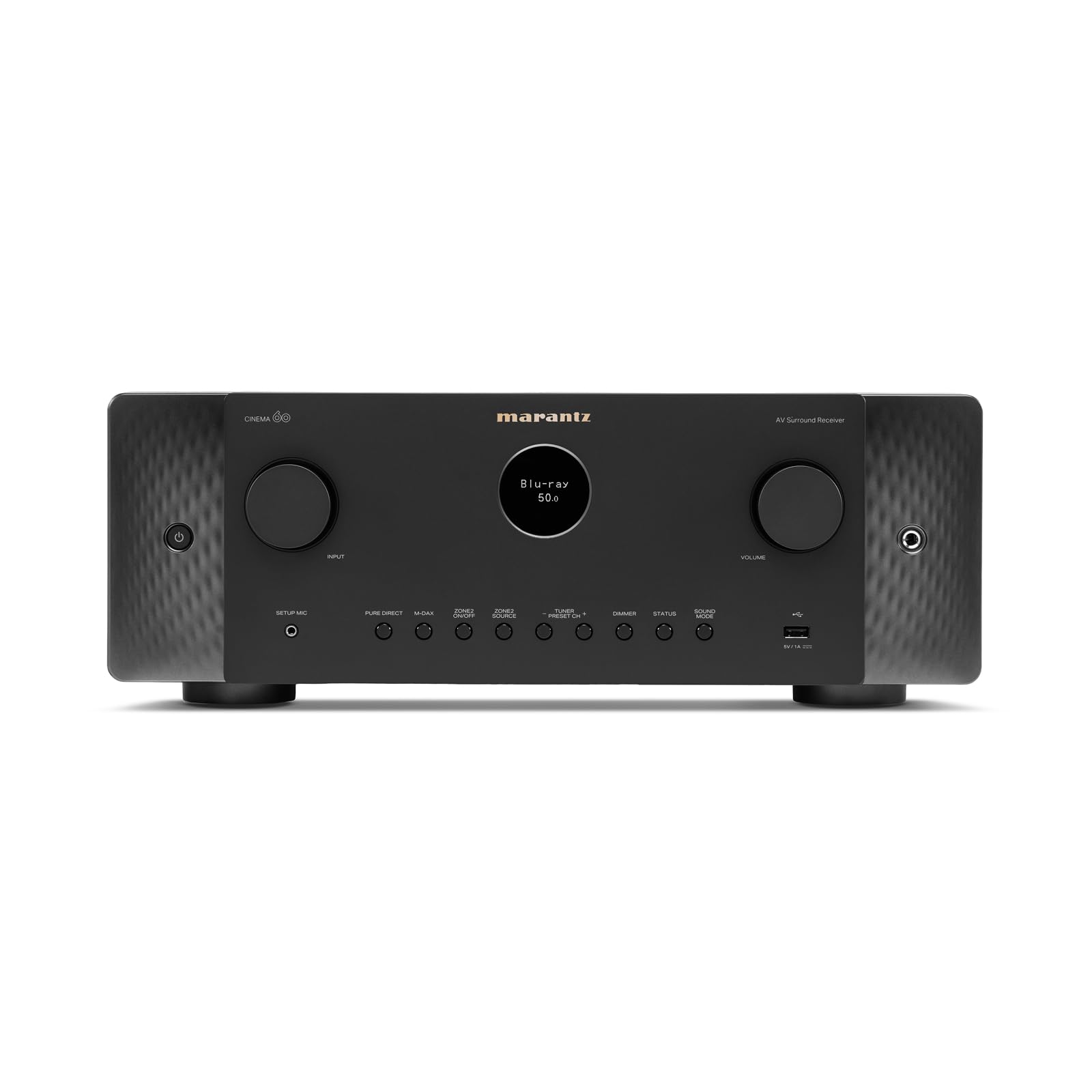
3. Marantz Cinema 60
The refined performer that brings a warm, enveloping musicality to both movies and stereo.
The Cinema 60 leads with its signature Marantz tuning — hand-tuned at the company’s Shirakawa facility in Japan, it delivers what owners consistently describe as clean, clear sound that feels as the sound editor intended. One owner running JBL and SVS speakers noted that commercial breaks even sound amazing, which is high praise for how rich the amp makes everyday content.
Power is uncompromising at 100W per channel across 7.2 channels, giving it a 20W-per-channel and a 33% power advantage over the JBL MA310’s 60W. This headroom means commanding dynamics for action scenes and subtle nuance for quiet passages. The video section handles 8K passthrough on three of its six HDMI inputs, so you are covered for modern TVs and future upgrades.
Owners praise the Audyssey MultEQ XT room calibration, which measures your room and tailors the sound to your space. Some owners mention they could not get everything working exactly as desired, so there is a learning curve. The design is a big part of the appeal — symmetrical, elegantly proportioned, and built with premium materials that make it look as refined as it sounds.
The enthusiast’s upgrade: If you value musical fidelity and want an amp that feels as premium as it sounds, this Marantz is the one to reach for.
The premium reality: It carries a high-end price tag, and a few owners find the setup process more involved than they expected.
4. Yamaha RX-A6A AVENTAGE

The versatile powerhouse that anchors a serious home theater with superior DACs and rich sound.
The RX-A6A is the receiver owners describe as the “heart” of a 9.1 Atmos home theater, with setup so easy and largely automatic that one buyer thought they must be missing something. It is a 9.2-channel amp with 11.2 channels of processing, giving you room to grow, and it handles Dolby Atmos, DTS:X, and Auro-3D rich audio formats.
what separates it is the sound quality — owners consistently praise the high-quality DACs and impressive Atmos soundfield, describing the experience as superior to the competition. The video section is fully future-proof with 7 HDMI inputs and 3 outputs, all supporting 8K60 and 4K120 at 40 Gbps, plus ALLM and VRR for lag-free next-gen gaming. The Surround:AI feature automatically tune sound in real-time, which owners say works great for older content.
Owners note the YPAO calibration with multi-position measurement is worth the time, especially the height and angle tests. Honest downsides include the MusicCast app, which is described as unintuitive and disappointing, and a requirement to update firmware via USB for full 120Hz support. There is also a documented case of a unit failing after three weeks with crackly audio, so quality control is not perfect.
The serious home theater pick: This is the receiver for buyers who want 9.2 channels, future-proof 8K HDMI, and audiophile-grade sound in one box.
The honest caveat: The MusicCast app is a weak point, and you will need an external amp to power all 11 channels of processing.
5. Pioneer VSX-935
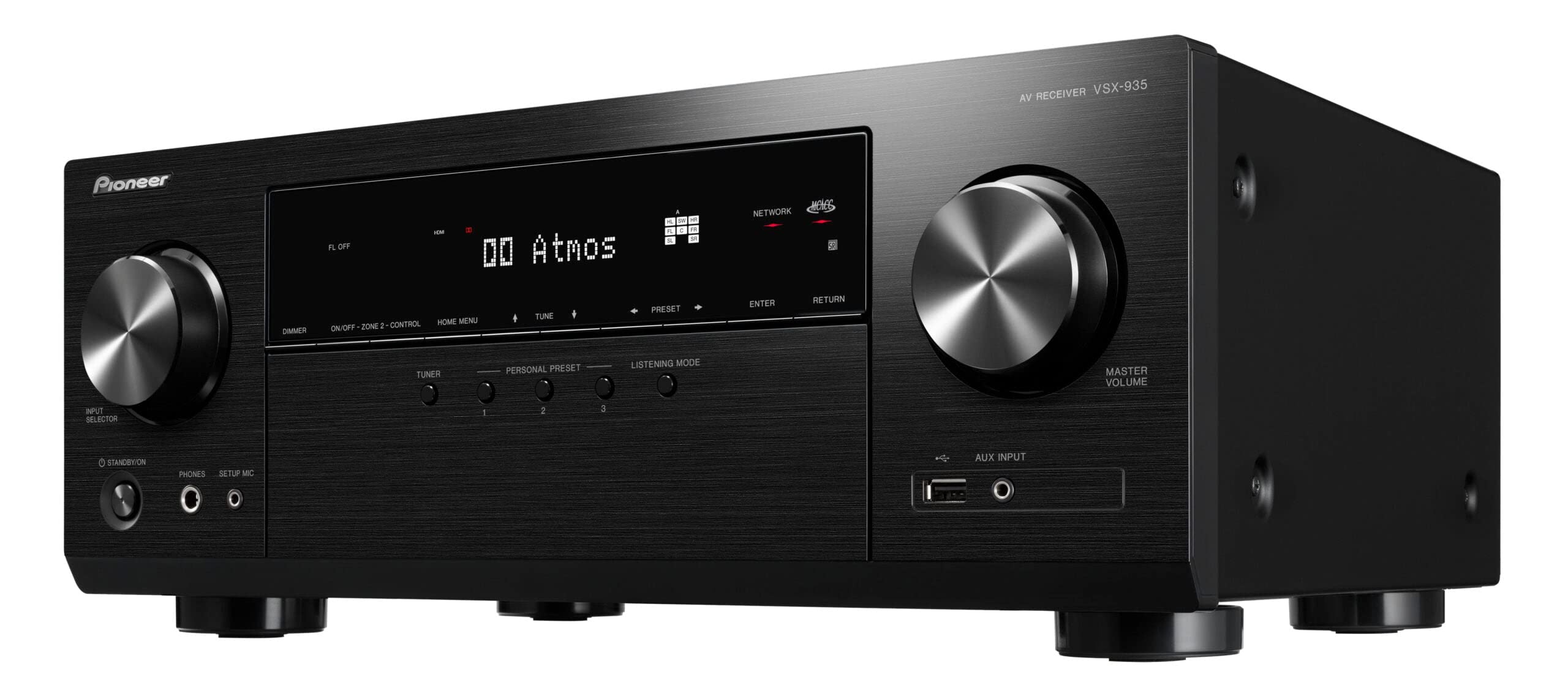
The straightforward 7.2-channel receiver that impresses with easy hookup and incredible sound.
The VSX-935 offers a compelling mix of 7.2 channels and HDMI 2.1 with 8K support at a mid-range price. Customers note that hooking it up to existing speakers is remarkably easy — one first-time amplifier owner called the sound “incredible” when connecting it to their Bose speakers. It is a 38% channel-count increase over the JBL MA310’s 5.2 configuration, giving you more room to grow your speaker layout.
It supports Dolby Atmos Height Virtualization, which creates a virtual surround effect from traditional speaker layouts — a useful feature if you do not want to install ceiling speakers. The sound is described as crisp, clear, and loud, with owners noting it plays all speakers for music. Enhanced gaming support and faster Wi-Fi for streaming services round out the package.
The honest trade-off is in the controls and reliability. Owners give mixed feedback on the auto-calibration, with most finding manual setup sounds significantly better. The Bluetooth implementation for two-way audio is described as unreliable and menu-heavy, and a few units arrived with defects — one had a dead display, another needed toggling a room setting to produce sound. The sound quality when working is excellent, though.
The easy upgrade path: This is a great pick if you want 7.2 channels and 8K HDMI without a steep learning curve.
Who this is not for: If you rely heavily on Bluetooth audio or want a receiver with polished, reliable software, look elsewhere.
6. Onkyo TX-NR7100
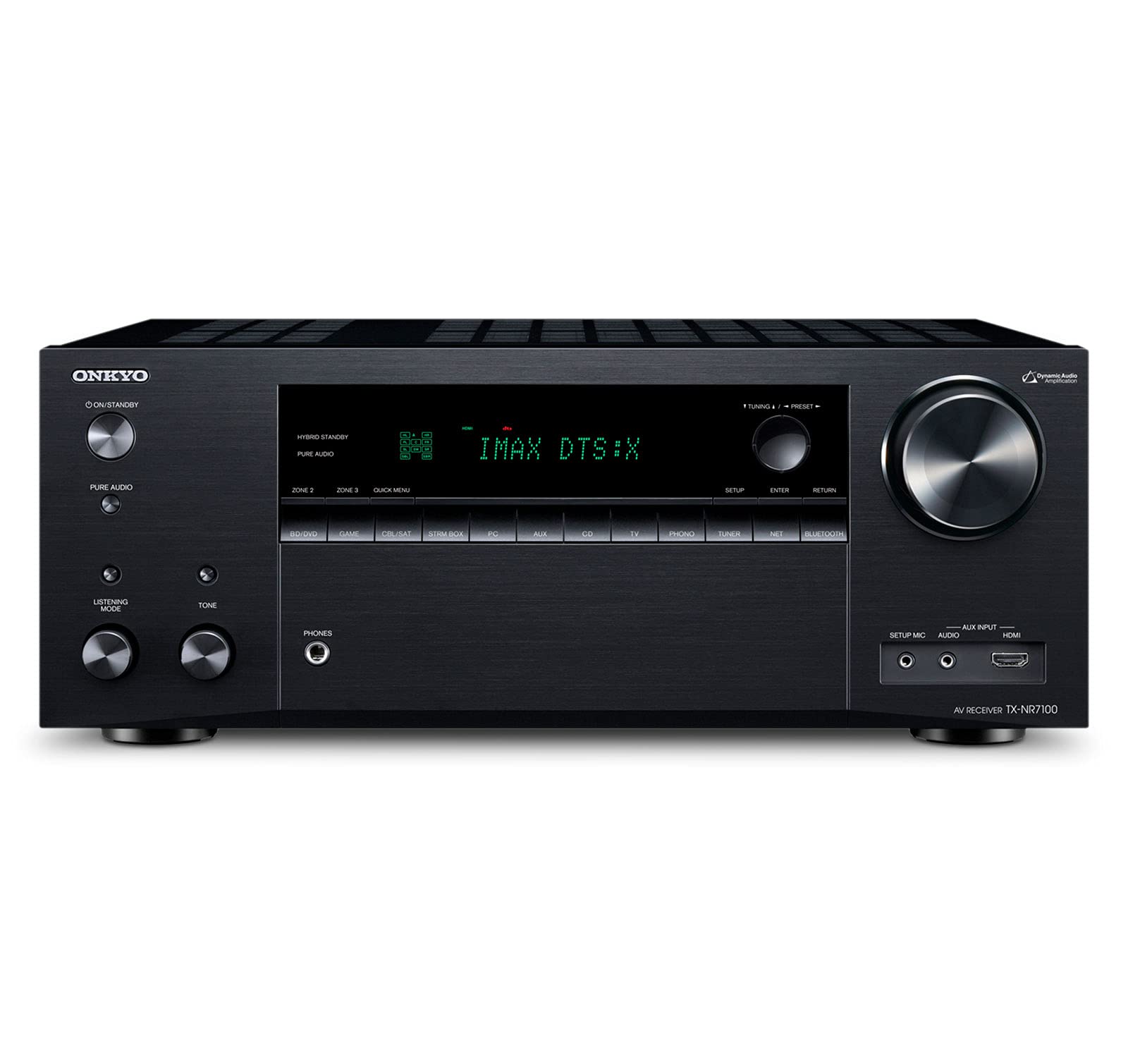
The Dirac-equipped gamer’s dream that pairs THX certification with low-latency 4K/120 gaming.
The TX-NR7100 is a 9.2-channel THX Certified receiver that owners consistently call the best receiver they have owned, with magnificent sound quality and a clean, dynamic presentation when paired with quality speakers. It offers 9 channels of processing with three HDMI outputs supporting uncompressed 8K/4K transfer at 40 Gbps, and its Discrete Zone 2 HDMI switching lets you watch a movie in the home theater while kids watch cartoons in another room.
For gamers, the 4K/120Hz HDR pass-through is the headline feature, supporting VRR, ALLM, and QFT to eliminate lag and frame-tearing. The Dolby Atmos Height Virtualizer adds rich height effects even without physical height speakers. It is also Works with Sonos Certified, meaning it can join an existing Sonos system using a Sonos Port, controlling volume and inputs from the Sonos app.
Owners find Dirac Live effective but time-consuming to set up, with some reporting the process failed repeatedly until they reset the receiver. The unit runs warm, and some buyers describe the faceplate as plastic rather than premium, despite a high list price. Bluetooth is bidirectional — you can stream to it or send audio to wireless headphones using aptX HD codecs.
What wins people over
- Dirac Live room correction delivers precise, balanced audio
- 4K/120Hz gaming with VRR, ALLM, and QFT
- Discrete Zone 2 HDMI switching for two rooms
The honest trade-offs
- Dirac setup is time-consuming and can glitch
- Plastic faceplate feels less premium than the price suggests
- Runs warm under heavy load
The serious gamer’s receiver: If you game at 4K/120Hz and want high-end room correction, this is the value pick in the premium tier.
Reach for this if: You are building a Sonos-integrated system and want a receiver that plays nicely with it.
7. Yamaha RX-A2A AVENTAGE

The AVENTAGE build-quality leader that delivers refined, balanced sound and smart features.
The RX-A2A is the entry point into Yamaha’s AVENTAGE line, which owners describe as a top-tier series with premium build quality and a 5th center foot for stability. It is a 7.2-channel receiver with Zone 2 support, running Dolby Atmos and DTS:X rich audio. One owner noted a noticeable audio improvement over their decade-old receiver, calling the sound more balanced and refined.
Video handling is solid with 7 HDMI inputs and 1 output supporting HDCP 2.3 and eARC. All inputs handle 4K60, while three support 8K60 and 4K120 for next-gen gaming with ALLM and VRR. It supports Dolby Vision, HDR10+, and HLG for high-quality picture. The Surround:AI technology automatically tune sound in real-time, adapting the audio to what is happening on screen.
Room calibration uses YPAO R.S.C. with multipoint measurement, and reviewers point out a quick 10-minute setup process. Streaming is comprehensive with Wi-Fi, Bluetooth, AirPlay 2, Spotify Connect, and MusicCast multi-room. Some shoppers say issues with certain Sony TVs showing no-signal errors that require a power cycle, and owners disagree on value — it is praised when on sale but criticized at full MSRP for lacking analog video inputs.
The balanced performer: This is the receiver for buyers who value Yamaha’s refined sound and premium AVENTAGE build without needing 9 channels.
The honest note: Check your TV compatibility first, and aim to buy it on sale for the best value.
8. Sony STR-AN1000

The rich-sound specialist whose 360 Spatial Sound Mapping transforms the home theater experience.
The STR-AN1000 leads with Sony’s 360 Spatial Sound Mapping, a feature owners describe as a standout that transforms immersion and is the best feature of the receiver. It is a 7.2-channel unit delivering 165W at 6 ohms, with support for Dolby Atmos and DTS:X object-based sound. One owner who upgraded from an Onkyo that died from a DTS chip failure noted the Sony sound is much crisper and clearer.
Video connectivity is strong with 6 HDMI inputs and 2 outputs supporting 8K and 4K/120 with HDMI 2.1. It handles Dolby Vision, HDR10, Hybrid Log Gamma, and IMAX Enhanced. Owners note the 4K upscaling is very good, with one buyer confirming it can handle 2160p 4K HDR content well. It also works with Sonos and supports Chromecast built-in, Spotify Connect, and Apple AirPlay for streaming.
Setup uses Digital Cinema Auto Calibration IX with a graphical interface, which owners find helpful, though one noted the subwoofer distance was off by 12 feet and required manual correction. The plastic remote is a common complaint, described as cheap with a max range of 5 meters. There is a known issue with no Dolby Vision passthrough for Apple TV 4K, so check your sources. The sound field display is also unreadable from a distance.
The rich upgrade: If you want the most enveloping, spatial sound experience Sony can offer, this receiver delivers it.
Who this is not for: Apple TV 4K users needing Dolby Vision passthrough, or anyone who hates cheap-feeling remotes.
9. Denon AVR-S970H

The 8K gaming powerhouse that rattle windows with 90 watts per channel across seven channels.
The AVR-S970H is the Denon that owners describe as a “beast,” delivering 90W across 7 channels — more wattage than the comparable Yamaha’s 75W per channel. It fills medium-size rooms using a 7.2 or 5.2.2 setup, and one owner noted it has enough power to rattle windows. It provides rich surround sound with pristine video via 8K/60Hz pass-through.
For next-gen gaming, it supports Variable Refresh Rate (VRR), Quick Frame Transport (QFT), and Auto Low Latency Mode (ALLM) with 8K/60Hz pass-through. This means smooth, lag-free gameplay with reduced frame tearing. Connectivity is generous with 8 HDMI ports (6 in / 2 out) including three 8K inputs, plus a phono input for turntables and USB for media.
Owners praise the easy setup, with one noting the user-friendly onscreen menus meant they never touched the manual. It also features a phono input for vinyl, with one buyer calling the sound excellent for vinyl, movies, and 4K video. The HEOS multi-room app is occasionally glitchy, and the unit runs hot when played loud — one owner recommends active cooling fans. It lacks tape deck connections for legacy audio gear.
Its standout wins
- 90W/channel for powerful, room-filling sound
- 8K/60Hz with VRR, QFT, and ALLM for gaming
- Phono input for turntable lovers
What to watch
- Runs hot at high volumes — cooling fans recommended
- HEOS app occasionally glitchy
- No tape deck connections
The gamer’s Denon: This is the receiver for PS5 and Xbox Series X owners who want smooth 8K/60Hz gaming with full HDMI 2.1 support.
skip it if: You have a small room and do not need the extra wattage or 8K inputs.
10. Onkyo TX-NR6100

The THX Certified value champion that delivers superb sound at a surprisingly accessible price.
The TX-NR6100 is the receiver owners consistently call the best value for money, with surprisingly easy setup and superb sound quality. It is a 7.2-channel THX Certified Select receiver with 210W per channel amplification, making it a powerful option for medium to large rooms. One owner running a 5.1 Klipsch setup noted it sounds louder than the Denon X1700H.
It handles 5.2.2-channel Dolby Atmos and DTS:X playback, with Discrete Zone 2 Audio and Video for multi-room use. The 8K HDMI 2.1 inputs at 40Gbps future-proof your setup for modern TVs and gaming consoles. Owners find the auto-calibration microphone works well, and the unit has been reliable over 9 months of use including a Roku remote that can power it on and off.
The honest feedback is mixed on reliability — while many units work flawlessly, some buyers report units quitting after 14 months or randomly turning off, and one arrived defective. The build quality receives mixed feedback as well. It is a second Onkyo for one 14-year owner who still finds it works great and sounds incredible, so the experience is genuinely split between happy long-term owners and those who hit defects.
The budget-friendly THX route: If you want THX Certified sound and 8K HDMI without stepping up to the premium tier, this is the value pick.
The honest caveat: Quality control is inconsistent, so buy from a reputable seller and check your unit on arrival.
11. JBL MA310

The compact 5.2-channel powerhouse that delivers warm, round sound for a modest outlay.
The MA310 is a compact 5.2-channel receiver delivering 60W per channel across five channels — a full 38% fewer channels than the 7.2 Pioneer VSX-935, so it suits smaller setups rather than ambitious Atmos builds. Owners describe it as a nice little powerhouse with crisp sound quality, describing the sound as warm and round like an old-school amp when driving quality towers and subwoofers.
It handles 4K video with 4 HDMI inputs and 1 output plus ARC, and natively decodes 5-channel Dolby and DTS formats. Bluetooth v5.1 with Low Energy lets you stream wirelessly from your phone. Owners find it runs cool and compact, making it a good fit for smaller entertainment centers. One buyer did note it was too deep to fit their console once wires were connected, so measure your space.
Setup is where opinions split. Some owners find it simple and easy, while others report a learning curve, noting all tweaks should be done on the TV screen rather than the receiver display. The documentation is described as poor, and the unit only supports 4K60Hz, which can cause black screens with some sources. It lacks the features of pricier receivers, making it best for JBL or Harman loyalists or simple setups.
Why it earns its spot
- Warm, round, old-school sound quality
- Compact design that runs cool
- Straightforward 5.2-channel setup
Where it cuts corners
- Only 4K60Hz — no 8K or 4K/120 support
- Poor documentation and minimal features
- Measure your cabinet depth before buying
The entry-level balance: This is the receiver for budget buyers who want a simple 5.2 setup with warm, quality sound.
Look elsewhere if: You need 8K support, more than 5 channels, or an interface that holds your hand through setup.
Understanding the Specs
Channel Count and Dolby Atmos
The channel count (like 5.2 or 7.2) tells you how many speakers the receiver can power. In a 5.2 setup, you have five main speakers (front left, center, front right, two surrounds) and two subwoofers. A 7.2 adds two more speakers, often for height or rear surround duties. For Dolby Atmos — a format that places sounds in 3D space above you — you typically want those extra height channels. A 9.2 receiver like the Onkyo TX-RZ50 or Yamaha RX-A6A can run a full 7.2.4 setup (seven main, two subs, four heights) for the most rich experience, though you may need an external amp for all channels.
HDMI 2.1, 8K, and eARC
HDMI is the cable standard that carries both video and audio from your sources to the receiver. HDMI 2.1 is the latest version, supporting 8K resolution at 60Hz and 4K at 120Hz — essential for next-gen gaming. eARC (enhanced Audio Return Channel) lets your TV send high-quality audio back to the receiver over a single HDMI cable, so your TV’s built-in streaming apps sound great too. 8K pass-through means the receiver can send an 8K signal from your source to your TV without downgrading it, which future-proofs your system. Look for HDCP 2.3 support to ensure compatibility with the latest 4K Blu-ray players and streaming devices.
Room Correction: Audyssey, YPAO, and Dirac
Room correction is automatic software that uses a microphone to listen to test tones from your speakers, then adjusts levels, distances, and equalization to fix sound problems caused by your room. Denon uses Audyssey MultEQ, Yamaha uses YPAO R.S.C., and premium Onkyo models use Dirac Live. Dirac is widely considered the most powerful, offering more precise and balanced audio, but is the most time-consuming to set up — often requiring a computer for the full experience. Simpler systems like basic Audyssey or YPAO work well for most rooms and are much faster to run.
Power Output and Sensitivity
Power output, measured in watts per channel, tells you how loud a receiver can drive your speakers. More watts mean more headroom — the ability to handle sudden loud peaks without distortion. A receiver with 80W to 100W per channel (like the Denon AVR-X1700H or Marantz Cinema 60) is plenty for most medium rooms. High-end units like the Onkyo TX-NR6100 push 210W per channel for very large spaces. A more sensitive speaker (higher dB rating) needs less power to go loud, so very efficient speakers can work with lower-wattage receivers.
FAQ
How many channels do I really need for my home theater?
What is the difference between 4K and 8K HDMI pass-through?
Does a receiver with more watts always sound louder or better?
What is eARC and why does it matter for my TV apps?
Will my old speakers work with a new AV receiver?
Do I need a separate amplifier for Dolby Atmos height channels?
What is the best room correction system for a beginner?
Can I stream music from my phone to an AV receiver?
How do I know if a receiver will fit in my entertainment center?
Is a THX Certified receiver worth the extra cost?
Final Thoughts: The Verdict
For most people, the av amplifiers winner is the Denon AVR-X1700H because it balances 7.2-channel power, 8K video support, and a crowd-pleasing 4.4-star rating at a mid-range price point. If you want premium room correction and are willing to invest time in Dirac Live calibration, grab the Onkyo TX-RZ50. And for a compact, budget-friendly 5.2-channel setup with warm sound, the JBL MA310 is the one to reach for.
How We Picked
We do not accept paid placement. Every pick is matched to a real buyer and a real use-case; we do not hands-on test units.
Sources & Methodology
Specifications: manufacturer listings and product documentation. Review insights: verified customer reviews, as of September 2026. Pricing: not shown on this page (it changes often); check the current price via the retailer link.
As an Amazon Associate, Gadgets Feed earns from qualifying purchases. This does not affect which products we feature.