
Our readers keep the lights on and my morning glass full of iced black tea. As an Amazon Associate, I earn from qualifying purchases.
Specs are compiled from manufacturer listings and verified buyer reviews and can change over time — please confirm the key details on the product page before buying.
You can spend a lot on a 9.2-channel receiver and still end up short on power for your speakers. That happens when a receiver processes more channels than it amplifies — you then need an extra amplifier to fill your room. This guide breaks down five 9.2 receivers by what they genuinely deliver, what they cost you in setup time, and which one fits your space.
I’m Min — the founder and writer behind Gadgets Feed. This guide is built by comparing the manufacturers’ published specifications and the patterns across verified customer reviews, so you get each pick’s real strengths and trade-offs instead of marketing spin.
You want a receiver that powers your speakers properly and calibrates to your room without weeks of frustration. The right av receiver 9.2 depends on if you need all nine channels amplified or plan to add an external amp later.
Our Picks at a Glance

How To Choose The Best AV Receiver 9.2
A 9.2 receiver powers nine speakers with its own amplifiers and gives you two separate subwoofer outputs. That covers a 5.2.4 or 7.2.2 layout — five or seven ear-level speakers, two subwoofers, and four or two height speakers that place sound above you. Before you pick one, know where your room is headed.
Processing vs. Amplification: The Number That Trips Everyone Up
Some 9.2 receivers can decode 11.2 channels but only power nine. That lets you run a 7.2.4 layout (seven ear-level, two sub, four height) if you add an external stereo amplifier for the last two channels. If you never plan to expand, this gap won’t affect you. If you might grow your system, check that the receiver has pre-outs — line-level outputs that feed an external amp — for those extra channels.
Take three examples. The Onkyo TX-RZ50 decodes up to 11.2 channels and gives you pre-outs for a 7.2.4 layout, but its built-in amp powers nine channels. The Yamaha RX-A6A also decodes 11.2 with a nine-channel amp. The TX-NR7100 decodes nine channels with no expansion path. Know which camp you’re in before you buy.
Room Correction: Dirac Live vs. YPAO vs. Sony’s Auto Calibration
Room correction software plays test tones through your speakers, listens with a microphone, then adjusts timing, level, and frequency response to offset your walls, furniture, and seating position — so dialogue stays clear and bass stops booming. Dirac Live, found on the Onkyo models here, is the most detailed of the three systems in this lineup. Yamaha uses YPAO R.S.C. with 3D and multipoint measurement. Sony uses Digital Cinema Auto Calibration IX with 360 Spatial Sound Mapping.
Here’s the practical split. Dirac Live tends to need more setup effort but lets you fine-tune crossover points per channel. YPAO is generally simpler to run, but several owners found it needed extra manual tuning. Sony’s system is praised for making a 5.1.2 setup sound like a larger array, though some users reported adjusting speaker distances by hand afterward.
Quick Comparison
| Model | Best For | Amplified Channels | Room Correction | HDMI In / Out | Amazon |
|---|---|---|---|---|---|
| Onkyo TX-RZ50★ Best Overall | Best overall 9.2 with expandability | 9 (11.2 processing) | Dirac Live | 6 in / 2 out | Amazon |
| Onkyo TX-NR7100Best Value | Mid-range value with Dirac Live | 9 | Dirac Live | 3 out | Amazon |
| Onkyo TX-RZ30 | Entry into RZ-series amplification | 9 (100W per channel) | Dirac Live (full bandwidth) | — | Amazon |
| Yamaha RX-A6A | Premium multi-zone audiophile builds | 9 (11.2 processing) | YPAO R.S.C. with 3D | 7 in / 3 out | Amazon |
| Sony STRAZ3000ES | Custom install and spatial audio | 9 (120W per channel) | Digital Cinema Auto Cal IX | 6 in / 2 out | Amazon |
In‑Depth Reviews
1. Onkyo TX-RZ50 9.2-Channel THX Certified AV Receiver
Our pick — over 4★ from 600+ verified ratings; the strongest balance of quality and price.
The receiver that powers nine channels now and leaves the door open for eleven.
The TX-RZ50 takes the top spot because it decodes up to 11.2 channels and gives you pre-outs (line-level outputs that feed a separate amplifier) for a 7.2.4 layout — seven ear-level speakers, two subwoofers, four height speakers — while its built-in amp drives nine of those. So if you add an external stereo amp later, the wiring path to 11 channels is already there. That expansion headroom is what the TX-NR7100 lacks, since it decodes nine channels with no route to eleven.
What wins people over is Dirac Live room correction working beside THX certification. Dirac measures your room — walls, furniture, seating — and adjusts crossover points and timing so your speakers sound balanced where you actually sit, so dialogue lands clean instead of muddy. The included wired mic handles calibration, or you can run the Dirac Live app on a PC or Mac with a third-party USB mic. You also get Dolby Atmos and DTS:X with the Height Virtualizer option for rooms with no overhead speakers. The Klipsch tune Mode automatically applies crossover values if you run Reference or Reference Premiere speakers.
The recurring gripe is that Dirac calibration can be finicky. As buyers report, the app sometimes throws setup errors, and working through the measurement process takes patience — one reviewer noted needing YouTube walkthroughs to push past the errors. The app is also weak next to what Yamaha offers. Once calibrated, though, owners mention the sound quality draws consistent praise, and the three-year warranty eases the reliability question. HDMI inputs switch with a described lag of around 12 to 15 seconds, worth knowing if you flip between sources often.
Strengths That Stick
- 11.2 channels of processing with pre-outs for 7.2.4 — room to grow
- Dirac Live room correction included at no extra cost
- THX Certified with Dolby Atmos and DTS:X support
- Works with Sonos Certified — integrates with up to three Sonos Ports across three zones
- HDMI 2.1 with 8K60 and 4K/120 pass-through for gaming and UHD disc players
Where It Tests Your Patience
- Dirac Live setup can throw errors and demands time to complete correctly
- The Onkyo remote app feels dated and lacks Zone 2 HDMI control
- Input switching lag runs roughly 12 to 15 seconds, which some find sluggish
- Needs an external amp for the last two channels if you want 11 powered
Grab this one if: you want a 9.2 receiver with genuine headroom to grow into 11 channels, and you’re willing to invest an afternoon in Dirac Live calibration for the payoff in sound quality.
Pause and consider: if you want plug-and-play setup with no calibration fuss, the TX-NR7100 or Yamaha RX-A6A will get you listening faster.
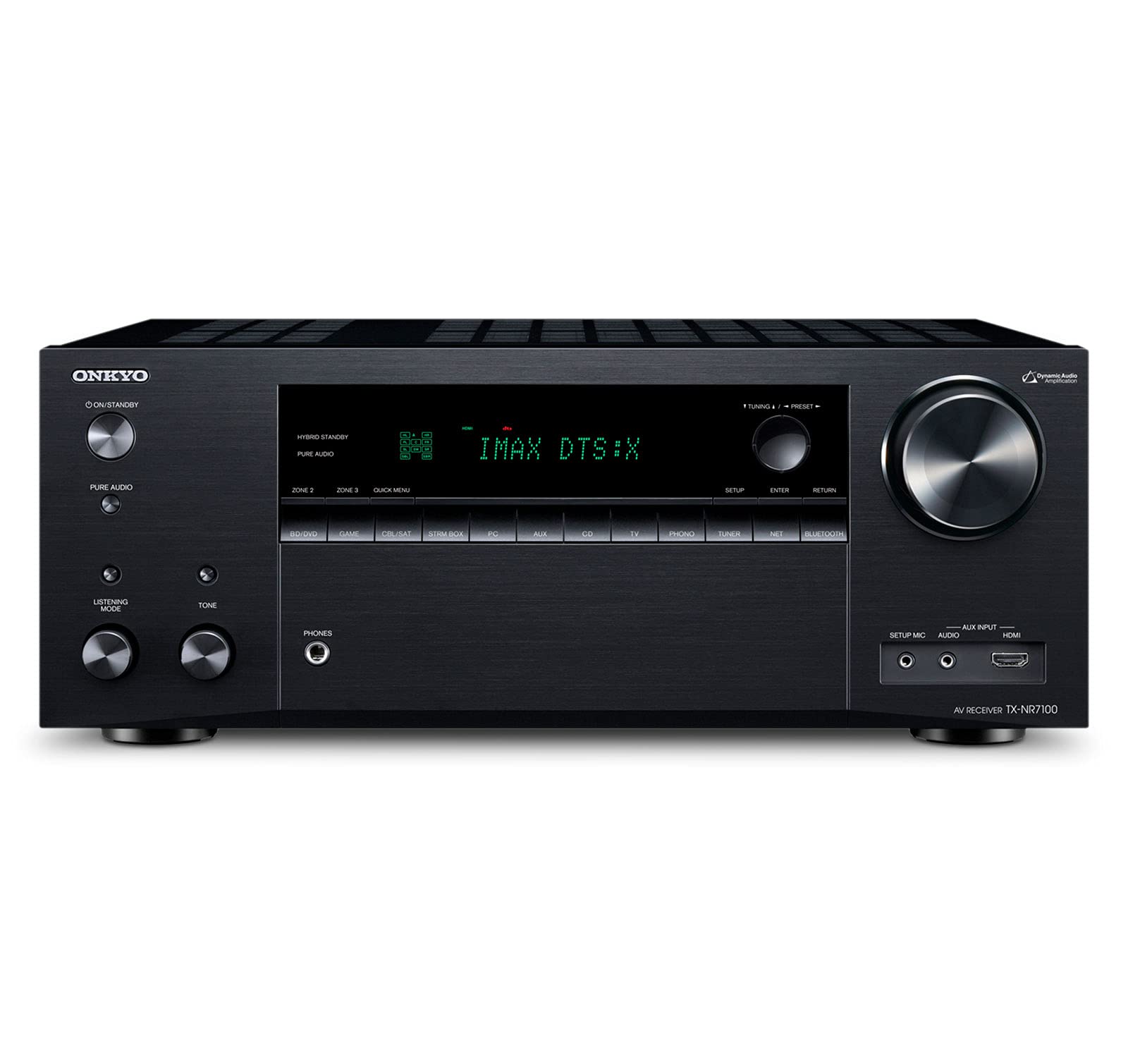
2. Onkyo TX-NR7100 9.2-Channel THX Certified AV Receiver
The mid-range pick that brings Dirac Live and HDMI 2.1 without the flagship price tag.
Nine channels of amplification and 40 Gbps HDMI 2.1 bandwidth are what buy this receiver its place — 40 Gbps is the data rate that lets a PS5 or Xbox Series X pass 8K60 and 4K/120 video through clean, without dropping to a lower refresh rate. Three HDMI-out options let you run discrete zone 2 HDMI switching, so your main theater and a second room can watch different sources at once. It is smaller than the TX-RZ50 — 14.9 inches deep versus 15.68 inches — so it slides into a standard media cabinet more easily.
The sound draws strong reactions. Owners running Klipsch Reference towers, a ported subwoofer, and Atmos elevation speakers describe clean, dynamic output across movies and music. Dirac Live does the same heavy lifting it does on the RZ50, flattening the room curve so speakers sound balanced at your seat. Gaming gets VRR (Variable Refresh Rate) to cut stutter and screen tearing, ALLM (Auto Low Latency Mode) to shrink the delay between your controller and the screen, and QFT (Quick Frame Transport) for smoother motion.
The honest caveat: several customers note a roughly two-second audio dropout whenever they switch content — sound cuts on the first second and reconnects. That’s minor but noticeable. Wi-Fi connectivity also drew complaints about unreliable app connections. And if you connect a PC, Bluetooth audio and video data separation can cause playback glitches with YouTube and media players. For console and TV use, none of these matter much.
What most buyers agree on: the sound quality and Dirac correction punch well above this receiver’s price tier, and the HDMI 2.1 feature set covers consoles and 4K players without compromise.
The honest trade-off: Wi-Fi stability and occasional audio dropouts on source switching are the recurring complaints. If you rely on a PC connection for media playback, this receiver may frustrate you; for a standard home theater with a TV and game console, it’s a strong fit.
Solid fit for: buyers who want Dirac Live room correction and full HDMI 2.1 gaming features at a mid-range tier, especially if their setup centers on a TV and game consoles.
Look elsewhere if: you need rock-solid Wi-Fi streaming or plan to use a PC as your primary media source — the connectivity quirks will surface.
3. Onkyo TX-RZ30 9.2-Channel AV Receiver

100 watts per channel with a full-bandwidth Dirac license straight from the start.
Open the box and the Dirac Live Room Correction Full Bandwidth license is already inside — you don’t buy an upgrade to open up the full frequency range. Full bandwidth means Dirac corrects the whole audible spectrum, from deep bass through high treble, so nothing in the range gets left flat. The amp section delivers 100 watts per channel, and custom low-noise power transformers and smoothing capacitors push frequency response from 5 Hz on the low end to 100 kHz on the high end. It weighs 29.3 pounds.
Two independent subwoofer outputs let you place two subs in different spots to even out bass across your room — a real fix if one corner booms while another seat feels thin. IMAX Enhanced certification adds object-based audio processing that places sound precisely in 3D space, plus a proprietary video algorithm that adjusts color accuracy, contrast, and detail. Dolby Vision handles per-frame brightness adjustment for HDR content. You also get Klipsch tune Mode and Sonos integration via a Sonos Port.
Setup experiences split sharply. Owners pairing the RZ30 with Bower and Wilkins speakers and dual-amping the front channels found calibration straightforward and the surround effects impressive. Reviewers point out Dirac Live setup stays the sticking point, though — at least one buyer returned the unit after four hours of failed optimization attempts and unclear app guidance. That pattern runs across every Dirac-equipped Onkyo in this lineup: the software delivers when it works, but the process can test your patience.
Value read from the specs: the included full-bandwidth Dirac license, 100 watts per channel, and dual independent subwoofer outputs put serious home theater capability here — owners describe it delivering the performance of dedicated hi-fi gear.
Watch out for: a 21-inch depth and 29.3-pound weight mean this needs a deep, sturdy shelf. And the Dirac calibration process itself remains the most common friction point, with setup experiences mixed between smooth and frustrating.
Choose this if: you want a full Dirac Live license included, dual subwoofer outputs for even bass, and 100 watts per channel — and you’re prepared to work through the calibration process carefully.
skip it if: you want the simplest possible setup path or need a shallow-depth receiver for a compact cabinet.
4. Yamaha RX-A6A AVENTAGE 9.2-Channel AV Receiver

The multi-zone powerhouse for whole-house audio with seven HDMI inputs and Zone 2/3/4.
Seven HDMI inputs and three outputs — all supporting 8K60 and 4K/120 at 40 Gbps with HDCP 2.3 (the copy-protection standard for 4K and 8K sources) and eARC — make this the most connectable receiver here. The TX-RZ50 offers six HDMI inputs and two outputs. So if a cable box, game console, Blu-ray player, streaming stick, PC, and a spare device all want a port, the RX-A6A has the room. Zone 2, 3, and 4 outputs route audio to separate rooms independently, so the kitchen can play music while the theater runs a movie. It decodes 11.2 channels with a nine-channel amp, matching the TX-RZ50 — pre-outs let you add an external amp for the last two channels if you move to an 11-channel layout.
Surround:AI adjusts sound and effects in real time based on what you’re watching — a dialogue-heavy scene gets different processing than an action sequence with heavy bass. Auro-3D joins Dolby Atmos and DTS:X for a third rich audio format. YPAO R.S.C. with 3D uses multipoint measurement and precision EQ, plus a low-frequency mode for subwoofer tuning. The receiver works with AirPlay 2, Spotify Connect, MusicCast, and Sonos via a Sonos Port. It also supports Amazon Alexa, Siri via AirPlay 2, and Google Assistant for voice control.
Two things owners consistently mention: the sound quality with high-quality DACs is excellent, and the MusicCast app is not intuitive. One owner found the app cumbersome for basic operations. Shoppers say the firmware updates for full 4K/120 support may require a USB install if the web interface fails, and at least one buyer mentioned YPAO’s self-EQ needing extra manual tuning through an external equalizer. At 18.7 kg, plan your shelf accordingly. For multi-zone setups, though, the flexible routing and app-based control of each zone make the trade-offs worthwhile.
what separates it
- Seven HDMI inputs and three outputs — the most connection flexibility here
- Zone 2/3/4 support for multi-room audio distribution
- 11.2-channel processing with pre-outs for external amp expansion
- Surround:AI automatically tune audio in real time
- Auro-3D, Dolby Atmos, and DTS:X — three rich formats covered
- Voice control via Amazon Alexa, Siri, and Google Assistant
Where It Demands Work
- MusicCast app is not intuitive, especially for zone management
- Firmware updates for 4K/120 may require USB installation
- At 18.7 kg, it needs a sturdy, deep shelf
- YPAO auto-EQ may need manual adjustment for best results
Built for: whole-home audio setups with multiple zones, or anyone who needs more HDMI inputs than the Onkyo models provide and wants flexible routing across rooms.
Not the best fit if: you want simple app-based control or a lighter unit that’s easy to move during installation.
5. Sony STRAZ3000ES Premium ES 9.2 CH 8K A/V Receiver

Spatial audio that makes a 5.1.2 setup sound like a larger speaker array.
120 watts per channel into 8 ohms is the highest per-channel rating in this lineup, and it’s the reason this receiver makes the list. The defining feature is 360 Spatial Sound Mapping, which uses phantom speaker technology to create virtual speaker positions around your room. Owners running a 5.1.2 setup with front Dolby elevation speakers describe it sounding like a full 7.1.4 array — so if your room can’t fit physical surround speakers behind the seating, this works around that wall. Digital Cinema Auto Calibration IX handles room correction, and IMAX Enhanced plus Dolby Vision, HDR10, and HLG are all supported for video.
Six HDMI inputs and two outputs with HDMI 2.1 support 8K and 4K/120 pass-through, so a next-gen console keeps its full frame rate. If you’re working with an installer or building a smart-home setup, the smooth IP control works with leading control systems — that’s the network-based control a rack-mounted system uses to talk to a panel. Streaming options include Bluetooth, Wi-Fi, Chromecast built-in, Spotify Connect, and Apple AirPlay. Google Assistant voice control is onboard, and Works with Sonos lets it join an existing Sonos system. The front panel display and on-screen graphical interface give you two ways to navigate setup.
At 32.8 pounds, it’s the heaviest receiver here, so measure your shelf before it arrives. Input switching takes time to learn. Buyers report some audio quirks: hissing that compounds with certain sound profiles, pops at volume steps, and occasional reboots. At least one owner found the dual subwoofer output is shared rather than true dual independent outputs — worth checking if you plan to run two subs in separate locations. Sony’s customer support drew praise for identifying and resolving a TV signal issue that caused the unit to auto-turn on after ten minutes. In a room where physical surround speakers aren’t practical, the 360 Spatial Sound Mapping is the standout reason to choose this over the TX-RZ50.
Where it wins: 120 watts per channel and 360 Spatial Sound Mapping make this the pick for rooms that can’t accommodate rear or overhead speakers, or for custom installs needing IP control integration with dedicated control panels.
Where it needs care: setup and input switching take time to learn. Some users report audio artifacts — hissing, pops, reboots — and the dual subwoofer output is shared rather than independently assignable, which matters if you want true dual-subwoofer bass management.
Reach for this when: your room layout won’t allow physical surround speakers and you want spatial audio to fill the gap, or you’re building a custom install with IP control integration.
Think twice if: you want true dual independent subwoofer outputs, or you prefer a receiver with a simpler learning curve from the start.
Understanding the Specs
Channel Count: Processing vs. Amplification
A “9.2” receiver powers nine speakers with its own amps and gives you two subwoofer outputs. But some models decode more channels than they amplify. The Onkyo TX-RZ50 and Yamaha RX-A6A both decode 11.2 channels, letting you run a 7.2.4 layout — seven ear-level speakers, two subs, four height speakers — if you add an external stereo amplifier for the last two channels. If you never plan to expand past 5.2.4 or 7.2.2, a nine-channel amp is all you need. If you might grow, check that the receiver has pre-outs for those extra channels before you buy.
Dirac Live, YPAO, and Digital Cinema Auto Calibration
Room correction uses a microphone to measure how speakers interact with your walls, furniture, and seating. Dirac Live (found on the Onkyo models) applies the most detailed correction and allows per-channel crossover adjustment. Yamaha’s YPAO R.S.C. with 3D uses multipoint measurement and precision EQ. Sony’s Digital Cinema Auto Calibration IX pairs with 360 Spatial Sound Mapping. Expect all three to improve clarity and balance — but expect to spend time running the calibration correctly. Dirac Live in particular has a reputation for throwing setup errors that take patience to resolve.