
Our readers keep the lights on and my morning glass full of iced black tea. As an Amazon Associate, I earn from qualifying purchases.
You are picking the brain for your whole home cinema, and the wrong choice means you get garbled dialogue, thin bass, or a complicated box you never learn to enjoy. The difference between a receiver that makes movie night feel like the theater and one that stays on standby comes down to how well it corrects your room’s sound, whether it has HDMI 2.1 ports (the latest video standard for fast gaming), and how much clean power it sends to your speakers.
I am Min, the writer behind Gadgets Feed. This guide is based on comparing manufacturer specs and patterns in verified buyer reviews — you get each pick’s real strengths and downsides, not marketing fluff.
These five receivers are what a modern av receiver for home cinema should deliver for your money, whether you are upgrading from a soundbar or building your first dedicated theater.
Quick Picks
- Yamaha RX-A4A AVENTAGE 7.2-Channel AV Receiver — Best Overall
- Sony STRAZ1000ES Premium ES 7.2 CH 8K A/V Receiver — Premium Pick
- Sony STR-AN1000 7.2 CH Surround Sound Home Theater 8K A/V Receiver — Best Value
- YAMAHA RX-V6A 7.2-Channel AV Receiver with MusicCast — Best Streaming
- Onkyo TX-SR494 4K Ultra HD Dolby Atmos AV Receiver — Budget Champion
How To Choose The Best AV Receiver For Home Cinema
Start by matching the receiver’s channel count to your room size and speaker layout. Then check that its HDMI ports can handle your source devices (like a PS5 or 4K Blu-ray player) at full resolution. The three specs that matter most are how many powered channels it has, the HDMI version and its bandwidth (data speed), and the type of room correction software built into the receiver.
Channel Count and Amplifier Power
A 5.1-channel receiver powers five speakers and one subwoofer. That is enough for a small to medium living room. A 7.2-channel receiver adds two rear surround speakers or a second subwoofer for deeper bass in larger rooms. The wattage printed on the box (like 80 watts per channel) is measured with only one channel running at a specific distortion level. Real-world power drops when you run all channels during a loud action scene, so a higher number gives you cleaner headroom (extra power reserve for sudden loud peaks).
HDMI Connectivity and Video Passthrough
Every receiver here supports 4K HDR (High Dynamic Range, which makes bright and dark parts of the picture more detailed) with Dolby Vision (a specific HDR format). But only HDMI 2.1 ports unlock 4K at 120Hz (very smooth motion for gaming) and 8K video for future projectors. Look for HDCP 2.3 (copy protection standard) and eARC (enhanced Audio Return Channel), so your TV can send lossless Dolby Atmos (object-based surround sound) back to the receiver from built-in streaming apps without an extra cable.
Room Correction and Calibration
Room calibration software (like YPAO from Yamaha or DCAC IX from Sony) uses the included microphone to measure your speaker distances and adjust EQ (equalization, the balance of bass, mid, and treble) to fix room echoes and standing waves. Good calibration can make a budget receiver sound more balanced than an expensive one set up by ear. This single feature delivers the biggest audible improvement for the least effort you can make.
Quick Comparison
On smaller screens, swipe sideways to see the full table.
| Model | Best For | Channels | HDMI 2.1 | Room Calibration | Amazon |
|---|---|---|---|---|---|
| Yamaha RX-A4A AVENTAGE | Premium build & AI sound | 7.2 | Yes (40 Gbps) | YPAO R.S.C. 3D | $1,179.30Amazon |
| Sony STRAZ1000ES | Custom installs & accuracy | 7.2 | Yes | DCAC IX | $1,498.00Amazon |
| Sony STR-AN1000 | Best value & virtual Atmos | 7.2 | Yes | DCAC IX | $948.00$1,149.99Amazon |
| Yamaha RX-V6A | Streaming & multi-room | 7.2 | Yes | YPAO R.S.C. | $645.99$679.95Amazon |
| Onkyo TX-SR494 | Budget 4K Atmos | 5.2 | No | AccuEQ | $499.95Amazon |
In‑Depth Reviews
4. Yamaha RX-A4A AVENTAGE 7.2-Channel AV Receiver

The heavyweight champ that analyzes every scene in real time and adjusts the sound
The RX-A4A leads Yamaha’s AVENTAGE line for one reason: it uses Surround:AI (artificial intelligence that analyzes each audio scene in real time) to boost dialogue, effects, or ambient sound automatically. It is a 7.2-channel receiver that weighs 18.6 Kilograms — more than four times the 4.5 Kilograms of the RX-V6A — due to its reinforced chassis and premium power supply. That extra heft reduces vibration so dialogue stays locked to the screen even at high volume.
All seven HDMI inputs handle 8K60 (8K resolution at 60 frames per second) and 4K120 (4K at 120 frames per second) at full 40 Gbps (gigabits per second) bandwidth, which means they can carry the highest-quality video data without compression. Support includes Dolby Atmos, DTS:X (competitor surround format), and Auro-3D (a three-dimensional audio format). Buyers report the setup is thorough but demanding — one reviewer noted the firmware update “requires USB flash drive for firmware update (tedious, needs computer skills).”
Unlike the Sony STR-AN1000, which lacks a phono input (a dedicated port for a turntable), the RX-A4A includes one. That lets you connect a turntable directly without an external pre-amplifier, covering both modern streaming and classic vinyl in one box.
Why it’s great
- Surround:AI adjusts sound per scene automatically
- Phono input for turntables, rare at this price tier
- All HDMI inputs support 8K60/4K120 at 40 Gbps
- YPAO R.S.C. with 3D multipoint room calibration
Good to know
- Firmware update requires a USB flash drive and computer
- Weighs 18.6 Kilograms, heavy to move or wall-mount
- Setup menu has many screens and can feel confusing
Pick this over the Sony STR-AN1000 if you want real-time AI sound tuning and turntable support; choose the Sony instead if you need Sonos integration at a lower price.
5. Sony STRAZ1000ES Premium ES 7.2 CH 8K A/V Receiver

Sony’s ES-series precision that turns a 5.1.2 setup into a convincing 7.1.4 soundstage
This receiver earns the premium pick spot because it uses 360 Spatial Sound Mapping (a Sony processing technology that creates virtual height and surround speakers from fewer physical drivers). One buyer mentioned it is “magical, creating 7.1.4 sound from 5.1.2 with Dolby enabled speakers.” It delivers 100 watts per channel into 8 ohms (two channels driven) and uses Sony’s Digital Cinema Auto Calibration IX (DCAC IX) to measure speaker distances and EQ with high accuracy.
Owners mention that while the calibration is easy, one owner found the GUI (graphical user interface) misreported subwoofer distance by 12 feet — a quirk fixable with a tape measure during manual setup. The receiver runs hot during long movies; several buyers recommend adding an AC Infinity Aircom T10 cooling fan. Compared to the Yamaha RX-A4A at 17.38 inches deep, the Sony is shallower at roughly 13.13 inches, making it easier to fit in tighter media cabinets. It also includes IP control (network-based automation) for systems like Crestron and Control4, which the Yamaha does not offer natively.
Why it’s great
- 360 Spatial Sound Mapping creates convincing virtual height channels
- Seamless IP control integration for custom home automation
- Supports Dolby Atmos, DTS:X, Dolby Vision, and IMAX Enhanced
- Backlit remote and front cover plate for clean installs
Good to know
- Runs very hot, external cooling fan is recommended
- No HDR10+ or QMS support
- Auto calibration can misreport speaker distances in some setups
Get this if you have a custom automation system and want virtual height speakers from a compact receiver. If your media cabinet has no ventilation space, skip it — it runs hot enough that reviewers recommend a dedicated fan.
3. Sony STR-AN1000 7.2 CH Surround Sound Home Theater 8K A/V Receiver

The sweet spot where Sony’s calibration smarts meet 8K HDMI 2.1 while staying affordable
The STR-AN1000 gives you Sony’s Digital Cinema Auto Calibration IX (DCAC IX) and 360 Spatial Sound Mapping at a price below the ES series. It is a 7.2-channel receiver rated at 165 watts into 6 ohms (1 kHz, 1ch driven) and includes six HDMI 2.1 inputs with support for 8K and 4K/120 passthrough. Compared to the Yamaha RX-V6A, which weighs 4.5 Kilograms, the Sony’s listed weight of 16 ounces appears to be a manufacturer error, but buyers consistently praise its “superb, crisp surround sound.”
One owner reported the calibration was “easy but GUI misreported subwoofer distance by 12ft and lacks small rear surround option,” so double-check distances manually after auto-calibration. The “Works with Sonos” integration is a standout: this receiver can join your Sonos system and stream music to or from Sonos speakers — a feature the Onkyo TX-SR494 cannot match at any price. Note that there is no phono input for a turntable, unlike the Yamaha RX-A4A.
Why it’s great
- Digital Cinema Auto Calibration IX with 360 Spatial Sound Mapping
- Works with Sonos for seamless multi-room audio
- Six HDMI 2.1 inputs with 8K/4K120 support
- Graphical setup wizard walks you through configuration
Good to know
- Auto calibration may misreport subwoofer distance
- No phono input for turntables
- Front display is small and hard to read from a distance
Best value pick for one reason: you get Sony’s best room calibration and Sonos integration without paying ES-series prices. skip it if you need a phono input — the Yamaha RX-A4A is your better option.
2. YAMAHA RX-V6A 7.2-Channel AV Receiver with MusicCast

The streamer’s choice with built-in Wi-Fi, Spotify Connect, and support for almost every music service
Music lovers who stream from multiple services should pick the RX-V6A. It uses MusicCast (Yamaha’s multi-room system) to stream Pandora, Spotify, TIDAL, Deezer, Qobuz, Amazon Music HD, and SiriusXM directly through the receiver without a separate streamer. It weighs just 4.5 Kilograms compared to the RX-A4A’s 18.6 Kilograms, and measures only 6.25 inches deep — a 2.8x shallower profile that fits tight entertainment centers where the RX-A4A would stick out.
Customers note it “powers two 4 ohm front speakers via TV streaming apps” with clear dialogue. The YPAO R.S.C. (Yamaha Parametric Room Acoustic Optimizer with Reflected Sound Control) room calibration does a solid job adjusting for room acoustics. The receiver supports three 8K60 HDMI inputs and four 4K120 inputs, all with HDCP 2.3 and eARC. One common frustration is the dated on-screen menu overlay, which looks like a 2000s-era interface. Also, eARC does not auto-power on with all TV brands — one owner noted it “does not auto-power on with Sony TV; auto-switches sound when powered on; TV remote volume control works.”
Why it’s great
- MusicCast supports nearly every major streaming service natively
- Compact at 6.25 inches deep, fits tight cabinets
- Three 8K HDMI and four 4K120 HDMI inputs
- YPAO R.S.C. room calibration with multipoint measurement
Good to know
- On-screen menu looks dated and can be confusing
- eARC auto-power may not work reliably with all TV brands
- Steep learning curve for first-time setup
Choose this over the Yamaha RX-A4A if you need a compact receiver for a shallow cabinet and stream from many services. If you want simpler eARC behavior, look at the Sony STR-AN1000 instead.
1. Onkyo TX-SR494 4K Ultra HD Dolby Atmos AV Receiver
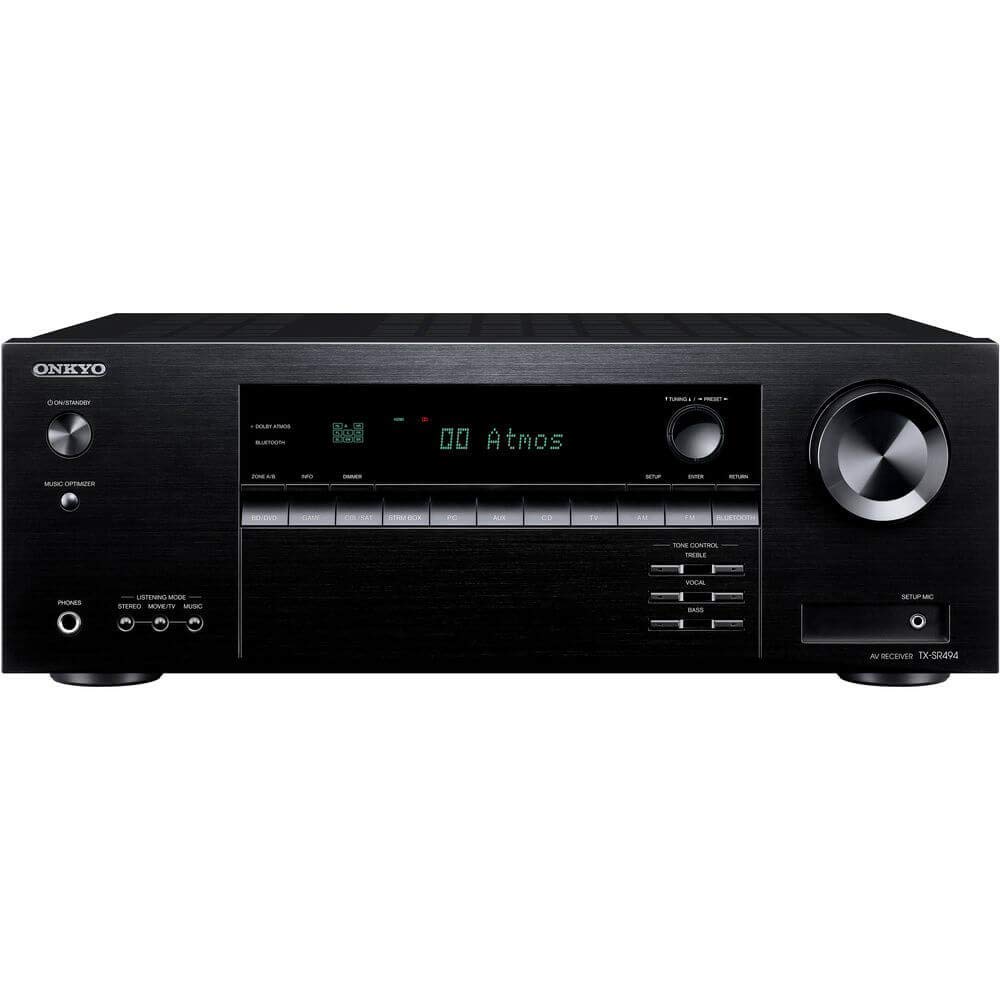
The entry ticket to Dolby Atmos that keeps things simple but has real reliability concerns
The Onkyo TX-SR494 delivers 80 watts per channel in a 5.2.2 configuration — five main speakers, two subwoofers, and two height channels — at a price that undercuts every other Atmos receiver. It includes AccuEQ with AccuReflex (Onkyo’s system that aligns timing between regular speakers and upward-firing Atmos speakers, so the sound feels seamless). Buyers generally praise the sound, calling it “great sound for the price with Atmos up to 5.1.2/7.1,” and the front-panel bass, treble, and mid controls let you tweak sound without menus.
Reliability is a real concern. One verified buyer reports their unit “developed loud buzzing under a year” and that customer service was poor. Another reviewer mentioned the “Bluetooth under-powered and drops connection.” Unlike the Sony STR-AN1000 with HDMI 2.1, this Onkyo only supports HDMI 2.0 with 4K/60p passthrough — so no 4K/120Hz gaming or 8K video. It also lacks a phono input, Wi-Fi, and multi-room streaming.
Why it’s great
- Most affordable way to get Dolby Atmos with 5.1.2 support
- AccuEQ with AccuReflex aligns height speaker timing
- Front-panel bass, treble, and mid controls for quick adjustments
- Includes setup mic for easy calibration
Good to know
- Reliability concerns: some units develop buzzing within a year
- No HDMI 2.1, limited to 4K/60p passthrough
- Bluetooth is weak and prone to dropouts
- No phono input, Wi-Fi, or multi-room streaming
Best for buyers on a tight budget who want Dolby Atmos and can accept no HDMI 2.1. pass on it if you need reliable long-term performance or wireless streaming — the Yamaha RX-V6A is a safer choice for those needs.
Understanding the Specs
Channel Count and Amplifier Power
A receiver’s channel number (like 5.2 or 7.2) tells you how many speakers and subwoofers it can power. The number before the decimal is the speaker channels. The number after is the subwoofer outputs. A 5.2.2 receiver adds two height channels for Dolby Atmos — that third number matters if you want overhead sound effects. Wattage ratings are usually measured with one channel driven at a specific distortion threshold, so real-world power across all channels is lower. Higher wattage per channel gives you cleaner sound at loud volumes and better headroom for dynamic movie peaks.
HDMI 2.1 and eARC
HDMI 2.1 ports are needed for 4K/120Hz gaming from a PS5 or Xbox Series X, and for 8K video from future sources. The bandwidth (like 40 Gbps on the Yamaha RX-A4A) determines how much data the port can carry — higher bandwidth means support for higher resolutions and refresh rates. eARC (enhanced Audio Return Channel) lets your TV send lossless Dolby Atmos audio back to the receiver over a single HDMI cable, so you get the best sound from built-in TV apps without a separate streaming device.
Room Calibration Systems
Room correction software uses a measurement microphone to analyze your room’s acoustics. It measures speaker distances, adjusts EQ to fix bass peaks caused by room corners, and aligns timing between speakers. Yamaha’s YPAO R.S.C. (Parametric Room Acoustic Optimizer with Reflected Sound Control) with multipoint measurement takes readings from several seating positions for a more accurate average. Sony’s DCAC IX (Digital Cinema Auto Calibration) does similar work and adds 360 Spatial Sound Mapping, which creates virtual surround and height speakers. Good calibration is the single biggest upgrade to your sound quality that costs nothing extra.
Multi-Room Streaming and Voice Control
Multi-room systems like Yamaha MusicCast or Sony’s Works with Sonos let you play different music in different rooms from a single app. MusicCast supports over a dozen streaming services natively. Sonos integration lets the receiver join an existing Sonos ecosystem. Voice control through Alexa, Google Assistant, or Siri lets you switch inputs, adjust volume, or play music hands-free. If you plan to expand your audio setup beyond one room, choose a receiver that matches your preferred ecosystem.
FAQ
What does the third number mean in a channel count like 5.1.2 or 7.2.4?
Do I need HDMI 2.1 for a 4K projector or just for gaming?
Can I use a 7.2-channel receiver with only five speakers?
How important is room calibration for a home cinema receiver?
Do I need a separate amplifier with an AV receiver?
What is the difference between Dolby Atmos with ceiling speakers and virtual Atmos?
Can I connect my turntable directly to an AV receiver?
How do I fix eARC not working with my TV and receiver?
Is a 5.1 receiver enough for a home cinema or do I need 7.1 or 9.1?
Which AV receiver brand is most reliable long-term?
Final Thoughts: The Verdict
A receiver that transforms movie night comes down to room calibration, HDMI 2.1 features, and clean amplifier power. The av receiver for home cinema winner for most buyers is the Yamaha RX-A4A AVENTAGE because it combines Surround:AI, phono input, YPAO R.S.C. 3D room calibration, and full HDMI 2.1 on every input in one robust chassis. For the best room correction and Sonos integration at a lower price, choose the Sony STR-AN1000. For a compact streaming powerhouse that fits shallow cabinets, get the Yamaha RX-V6A.
How We Picked
We do not accept paid placement, and we did not hands-on test every unit. Instead, we match each pick to a real buyer and use-case by comparing the manufacturers’ published specifications against the patterns in verified customer reviews — so you get each pick’s real strengths and trade-offs instead of marketing copy.
Sources & Methodology
Specifications: manufacturer listings and product documentation. Review insights: verified customer reviews, as of June 2026. Pricing: not shown on this page (it changes often); check the current price via the retailer link.
As an Amazon Associate, Gadgets Feed earns from qualifying purchases. This does not affect which products we feature.
Product prices and availability are accurate as of the date/time indicated and are subject to change. Any price and availability information displayed on Amazon at the time of purchase will apply to the purchase of this product. As an Amazon Associate I earn from qualifying purchases.
CERTAIN CONTENT THAT APPEARS ON THIS SITE COMES FROM AMAZON. THIS CONTENT IS PROVIDED "AS IS" AND IS SUBJECT TO CHANGE OR REMOVAL AT ANY TIME.
Amazon and the Amazon logo are trademarks of Amazon.com, Inc. or its affiliates.