
The leap to HDMI 2.1 has turned the AV receiver market inside out. You’re no longer just buying a box that amplifies sound — you’re buying the traffic cop for a 4K/120Hz gaming console, an 8K streaming puck, and a legacy Blu-ray player that refuse to talk to each other. One wrong choice and you’ll be staring at a black screen with audio but no video, or worse, a blinking HDMI handshake error during the final act of your movie.
I’m Min — the co-founder and writer behind Gadgets Feed. I’ve spent years dissecting HDMI chipset revisions, comparing discrete amplifier topologies, and tracking how firmware updates turn capable receivers into paperweights so you don’t have to roll those dice blind.
Choosing the wrong receiver means spending more time troubleshooting handshake issues than listening to your system. This guide filters out the noise — room correction science, real HDMI 2.1 bandwidth, gaming features that actually matter, and amplifier power you can feel — so you can confidently pick the av receiver hdmi 2.1 that matches your room and your gear.
How To Choose The Best AV Receiver HDMI 2.1
Selecting an AV receiver with HDMI 2.1 is no longer a simple count of ports. The HDMI 2.1 label covers a range of actual bandwidth capacities — from the entry-level 24 Gbps to the full-fat 48 Gbps on premium chips. Your console, your TV’s eARC implementation, and your speaker layout all place specific demands on the receiver. Ignore any one of these and your system will underperform.
HDMI 2.1 Bandwidth: 40 Gbps vs 48 Gbps
Every receiver on this list supports at least 40 Gbps HDMI 2.1, which handles 4K/120Hz with 10-bit HDR and VRR. The premium tier offers 48 Gbps, adding headroom for 8K/60Hz 12-bit signals. Unless you own an 8K display, 40 Gbps is sufficient. The critical detail is whether all inputs share full bandwidth or if some ports are capped — check how many inputs are labeled “8K” vs “4K” in the spec sheet.
Room Correction: Dirac Live vs Audyssey vs YPAO
Room correction is the hidden spec that determines whether your speakers sound like they belong in a studio or a tile-floored living room. Dirac Live (found on certain Onkyo models) offers the most surgical frequency and time-domain correction, while Audyssey MultEQ XT32 (Denon, Marantz) excels at managing multiple subwoofers. YPAO R.S.C. (Yamaha) provides reliable tonal balance with less complexity. A receiver without good room correction will struggle to eliminate bass nulls and harsh reflections.
Amplifier Channel Count and Power Ratings
A 7.2–channel receiver can drive a 5.1.2 Dolby Atmos layout or a traditional 7.1 without height channels. A 9.2–channel unit unlocks 5.1.4 or 7.1.2. Power-per-channel matters most when you have low-sensitivity speakers (under 88 dB) or sit more than 12 feet away. Look for two-channel driven ratings (typically 100–125W at 8 ohms) rather than the inflated all-channels-driven numbers. Denon and Marantz tend to be conservative with their wattage claims; budget brands sometimes overstate.
Quick Comparison
On smaller screens, swipe sideways to see the full table.
| Model | Category | Best For | Key Spec | Amazon |
|---|---|---|---|---|
| Marantz Cinema 60 | Premium | Musical fidelity and build quality | 100W x 7, HDAM, Audyssey MultEQ XT32 | Amazon |
| Sony STRAZ1000ES | Premium | 360 Spatial Sound Mapping | 7.2 ch, 100W, 360SSM, backlit remote | Amazon |
| Yamaha RX-A4A | Premium | Surround:AI real-time optimization | 7.2 ch, 8K/60Hz, Auro-3D | Amazon |
| JBL MA7100HP | Mid-Range | High-power Class D efficiency | 125W x 7, 8K, eARC | Amazon |
| Sony STR-AN1000 | Mid-Range | Easy calibration and Sony ecosystem | 7.2 ch, 165W 6 ohms, DCA IX | Amazon |
| Denon AVR-S970H | Mid-Range | Phono input and HEOS multi-room | 90W x 7, 8K, VRR/ALLM | Amazon |
| Denon AVR-S770H | Mid-Range | Guided setup and gaming features | 75W x 7, 8K/60Hz, Dolby Atmos | Amazon |
| Onkyo TX-NR7100 | Mid-Range | Dirac Live out of the box | 9.2 ch, 100W, 8K/40 Gbps, THX | Amazon |
| Onkyo TX-NR6100 | Mid-Range | THX Select with gaming focus | 7.2 ch, 210W/ch, 8K/40 Gbps | Amazon |
| Yamaha RX-V6A | Mid-Range | MusicCast and multi-room streaming | 7.2 ch, 8K/60Hz, YPAO | Amazon |
| Pioneer VSX-935 | Entry-Level | Budget 8K HDMI 2.1 with basic features | 7.2 ch, 8K, Dolby Atmos Virtualization | Amazon |
In‑Depth Reviews
1. Marantz Cinema 60

The Marantz Cinema 60 is the receiver that feels like a serious instrument from the moment you lift it out of the box. Its 100W per channel into 8 ohms is delivered through Marantz’s proprietary HDAM circuitry, which gives vocals a warmth and instrument separation rarely heard at this level. The Audyssey MultEQ XT32 room correction is among the most capable in its class, taming room modes and smoothing frequency response more effectively than the standard Audyssey found on lower-tier Denon models.
Gamers benefit from three 8K/60Hz HDMI 2.1 inputs supporting VRR, ALLM, and QFT — all standard for the premium segment. The HEOS multi-room platform works reliably with Denon speakers and third-party streaming services, while AirPlay 2 and Alexa voice control round out the smart features. Owners report that sequential firmware updates fixed early quirks, but the initial setup can take a couple of hours if you optimize room correction fully. The remote is solid and backlit, a detail that matters when you’re watching movies in the dark.
If you value musical sound quality and room correction that can make a modest speaker setup sing, the Cinema 60 justifies its price with tangible performance. It is the best all-rounder for anyone building a dedicated home theater with quality speakers and a demanding ear.
Why it’s great
- HDAM discrete circuitry delivers exceptionally warm, detailed sound
- Audyssey MultEQ XT32 provides highly effective room correction
- Three HDMI 2.1 inputs with full gaming features
- Backlit remote and solid build quality
Good to know
- Setup requires multiple firmware updates out of the box
- Premium price may exceed budget for some buyers
2. Sony STRAZ1000ES

Sony’s ES series has always been about build integrity and processing sophistication, and the STRAZ1000ES carries that torch with its 360 Spatial Sound Mapping technology. Instead of simply decoding Atmos, it uses advanced DSP to create virtual phantom speakers that expand the soundstage far beyond the physical speaker boundaries. Combined with Digital Cinema Auto Calibration IX, the result is a remarkably cohesive bubble of sound that makes a 5.1.2 layout feel like a 7.1.4 system.
On the HDMI front, you get six inputs and two outputs with full 8K/60Hz and 4K/120Hz support, plus VRR and ALLM for gaming. The unit runs hot under load — many owners add a small USB fan — but the fanless design keeps acoustic noise at zero. The remote is backlit and well-laid-out, a clear step above the STR-AN1000’s offering. Note that HDR10+ is not supported, which only matters if you own a Samsung or Panasonic display that uses it. The “Works with Sonos” integration is seamless, letting you unify a Sonos system with the receiver’s zones.
This is the choice for those who want class-leading processing and a receiver that will remain relevant for years. The 360SSM effect is genuinely addictive once you hear it on well-mixed Atmos content.
Why it’s great
- 360 Spatial Sound Mapping is a unique, impressive technology
- Excellent build quality and backlit remote
- Seamless Sonos integration
- Full HDMI 2.1 gaming features
Good to know
- Runs hot; external cooling recommended
- No HDR10+ support
3. Yamaha RX-A4A

The Yamaha RX-A4A is the flagship of the AVENTAGE line and it prioritizes soundstage realism above all else. Its Surround:AI technology analyzes each scene in real-time and adjusts frequency, dynamics, and channel levels to match the on-screen action — dialogue becomes clearer during quiet conversation and explosions gain weight without distortion. The 7.2–channel layout supports Dolby Atmos, DTS:X, and Auro-3D, making it one of the most format-complete receivers in its tier.
All seven HDMI inputs support 8K60 and 4K120 at 40 Gbps, with eARC, ALLM, and VRR for gaming. The YPAO R.S.C. room correction with multipoint measurement is reliable but less granular than Dirac Live or Audyssey XT32. The MusicCast multi-room system is polished and supports a wide range of streaming services. The unit is large and heavy at over 40 lbs, so measure your cabinet depth before buying. Owners report that firmware updates require a USB flash drive, which is an unnecessary hassle.
The RX-A4A is for those who want a set-and-forget flagship that automatically optimizes sound to the content. Its Auro-3D support is a bonus if you enjoy upmixed immersive audio from stereo tracks.
Why it’s great
- Surround:AI real-time optimization is genuinely effective
- Supports Dolby Atmos, DTS:X, and Auro-3D
- All HDMI inputs support 8K/60Hz
- Excellent MusicCast multi-room platform
Good to know
- Firmware update process requires a USB drive
- Very heavy and deep chassis
4. JBL MA7100HP
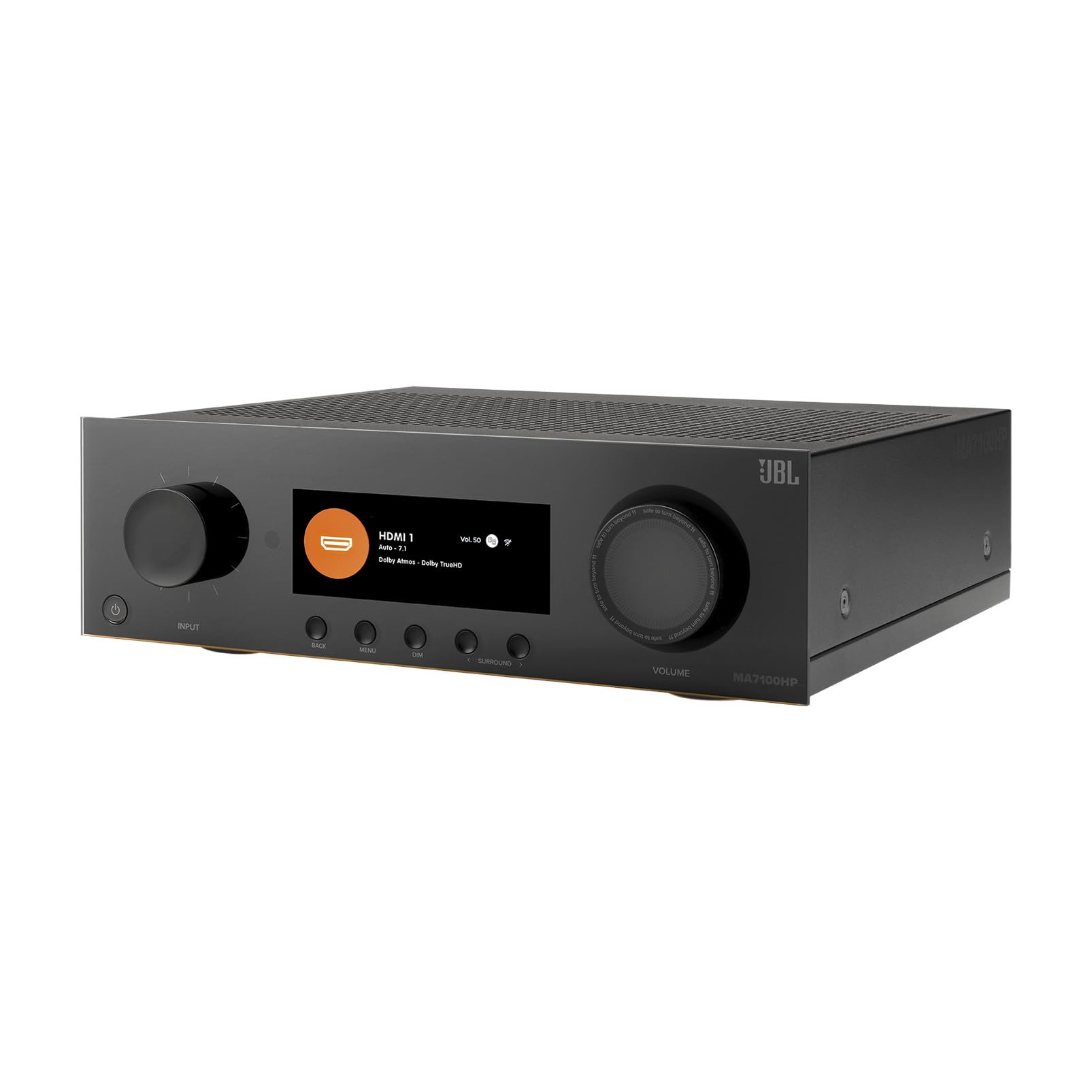
JBL’s return to the AV receiver market is marked by the MA7100HP, a 7.2–channel unit that delivers 125 watts per channel via efficient Class D amplification. This is real-world power — enough to drive low-sensitivity towers like Polk ES60s without breaking a sweat. The six HDMI inputs include full 8K/60Hz and 4K/120Hz support with eARC. The shallow chassis is a practical blessing for media cabinets with limited depth.
Dolby Atmos and DTS:X decoding are standard, and network streaming comes via Apple AirPlay 2, Google Chromecast, and Bluetooth. The initial setup can be confusing because the receiver demands a firmware update before it functions, and the network configuration sometimes requires a laptop. The remote is not backlit, which several owners find frustrating in a dark room. There is also a known limitation: the MA7100HP does not downmix DTS-HD Master Audio to 2.1, so it’s not ideal for stereo-only systems playing Blu-ray audio.
If you need affordable high power and 8K support in a compact frame, and you can tolerate a few setup quirks, the JBL MA7100HP offers the best watts-per-dollar ratio on this list.
Why it’s great
- 125W per channel delivers substantial headroom
- Shallow chassis fits most cabinets
- Full 8K/60Hz and 4K/120Hz HDMI 2.1
- Apple AirPlay 2 and Google Chromecast built-in
Good to know
- Remote is not backlit
- No DTS-HD MA downmix for 2.1 setups
- Initial setup can be clunky
5. Sony STR-AN1000

Sony’s STR-AN1000 strikes a careful balance between features and price. Its 165W per channel into 6 ohms provides ample real-world power for most home theater setups. The Digital Cinema Auto Calibration IX system is easier to run than Dirac Live — it guides you through the mic placement with on-screen prompts, and the 360 Spatial Sound Mapping creates convincing phantom height channels. The six HDMI inputs support 8K/60Hz and 4K/120Hz, though the Dolby Vision passthrough has a known issue with Apple TV 4K that some users report.
The unit supports Chromecast, AirPlay 2, Spotify Connect, and “Works with Sonos” integration. The calibration system is clever but occasionally misjudges subwoofer distance — a quick manual correction during setup solves this. There is no phono input, so vinyl listeners will need an external preamp. Owners praise the crisp dialogue clarity and the near-Atmos effect from the virtualizer. The front panel display is small and hard to read from a distance.
For buyers already in the Sony ecosystem or those who value streamlined calibration over exhaustive control, the STR-AN1000 delivers polished performance without overwhelming complexity.
Why it’s great
- Easy auto-calibration with on-screen guidance
- 360 Spatial Sound Mapping enhances immersion
- Full Apple AirPlay 2 and Chromecast support
- “Works with Sonos” integration
Good to know
- No phono input
- Dolby Vision passthrough may have issues with Apple TV
- Front display is difficult to read
6. Denon AVR-S970H

The Denon AVR-S970H is the most feature-dense mid-range receiver, offering 90W per channel across seven channels, a built-in phono input for turntables, and HEOS multi-room streaming. It has three 8K/60Hz HDMI 2.1 inputs with VRR, ALLM, and QFT for gaming, plus two HDMI outputs for dual-display setups. The on-screen setup wizard is the most guided in its class — first-time buyers can have the system calibrated in under 30 minutes.
The unit runs cooler than many competitors, with owners reporting chassis temperatures around 80°F under normal use. The HEOS app is functional but less polished than MusicCast or Sonos. Owners note that Zone 2 is powered but reduces the main zone to 5.2 channels, which is standard for this price point. The remote lacks a dedicated TV power button, a small but recurring complaint. The built-in FM tuner has cumbersome preset management.
If you need a receiver that handles modern gaming and a vintage turntable with equal competence, the AVR-S970H is the most versatile mid-range option. It is also a safe pick for anyone planning a 5.1.2 Atmos upgrade in the future.
Why it’s great
- Built-in phono input for turntable users
- Three 8K HDMI 2.1 inputs with full gaming support
- Easy setup wizard
- Runs cooler than many competitors
Good to know
- HEOS app is less refined than alternatives
- No dedicated TV power button on remote
7. Denon AVR-S770H

The Denon AVR-S770H is the most affordable entry point into HDMI 2.1 with true 8K/60Hz and 4K/120Hz passthrough. Its 75W per channel into 8 ohms is modest but sufficient for bookshelf speakers and small to medium rooms. The on-screen guided setup is the same excellent wizard found on the S970H, making it the easiest receiver to configure for a first-time buyer. Dolby Height Virtualization and DTS Virtual:X create convincing overhead effects without ceiling speakers.
The six HDMI inputs support HDR10+, Dolby Vision, and Dynamic HDR, plus VRR and ALLM for gaming. HEOS multi-room streaming is built-in, and Alexa voice control works out of the box. Some owners report a recurring firmware bug where volume randomly drops to zero — Denon has addressed this in subsequent updates, but it is worth checking that the unit ships with the latest firmware. The remote is not backlit and has a learning curve.
For budget-conscious buyers who want future-proof 8K support and a simple setup, the AVR-S770H delivers core HDMI 2.1 functionality without premium extras. It is the right pick for a starter Atmos system.
Why it’s great
- Most affordable entry to HDMI 2.1 8K/60Hz
- Excellent guided setup for beginners
- Dolby Height Virtualization for phantom overhead sound
- HEOS and Alexa support
Good to know
- 75W per channel limits speaker options
- Some owners report firmware volume bugs
- Remote is not backlit
8. Onkyo TX-NR7100
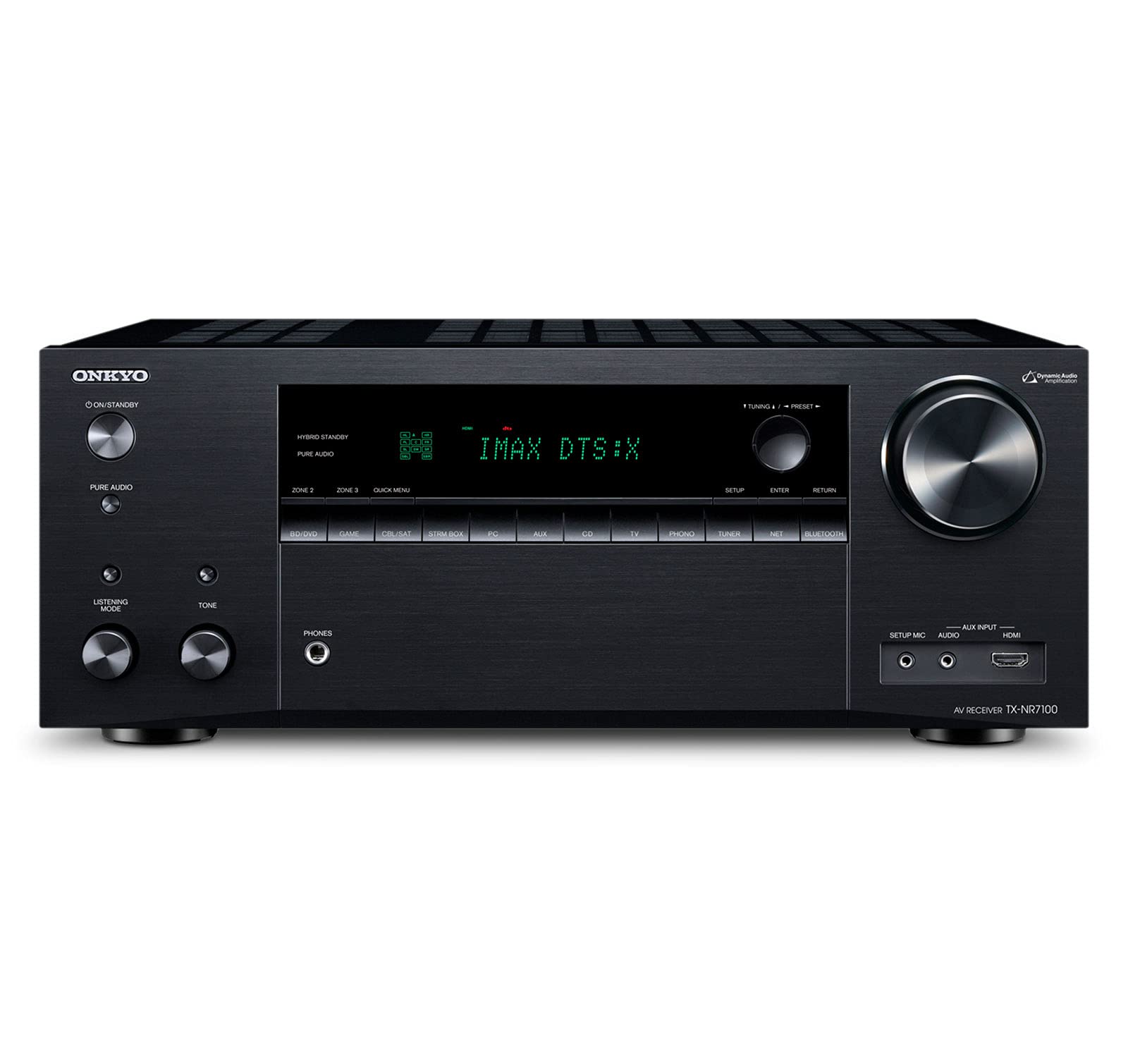
The Onkyo TX-NR7100 is the most accessible receiver to include Dirac Live out of the box — a room correction system that typically requires a separate purchase. Dirac Live measures both frequency and impulse response, correcting time-domain issues that standard EQ cannot touch. The result is tighter bass, clearer imaging, and a soundstage that remains stable even as you move around the room. The 9.2–channel processing supports 5.1.4 or 7.1.2 Atmos layouts, giving you flexibility for future expansion.
The HDMI section delivers three 8K/60Hz inputs at 40 Gbps with VRR and ALLM, plus eARC. The unit runs warm — owners report chassis temperatures around 90°F — so adequate ventilation is essential. The remote is not backlit and the on-screen menus are utilitarian. There are occasional reports of HDMI handshake issues, and the Dirac Live calibration process takes significantly longer than Audyssey or YPAO. Onkyo’s customer support requires the owner to pay shipping for warranty repairs.
If you prioritize room correction above all else, the TX-NR7100 is the best value for achieving professional-grade speaker integration in a non-ideal room.
Why it’s great
- Dirac Live included at no extra cost
- 9.2–channel processing for 5.1.4 or 7.1.2 Atmos
- Full HDMI 2.1 gaming support
- Sonos certified and DTS Play-Fi ready
Good to know
- Runs warm; good ventilation required
- Dirac setup is time-consuming
- Remote is not backlit
9. Onkyo TX-NR6100
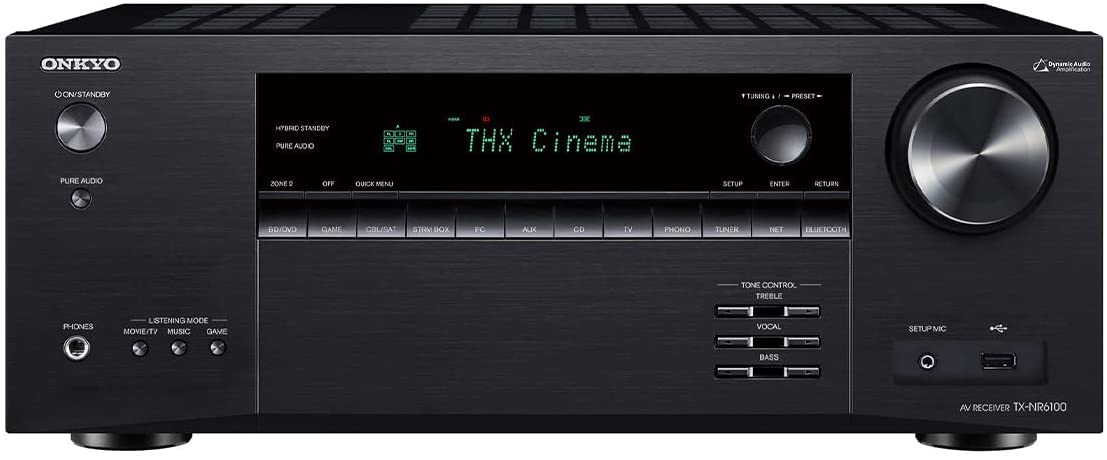
The Onkyo TX-NR6100 is THX Select certified, meaning it meets rigorous standards for reference-level sound in medium-sized rooms. Its 210W per channel specification is dynamic peak power — realistic continuous output is closer to 100W, but headroom is generous for transient peaks. The receiver is fully compatible with PS5 and Xbox Series X, delivering 4K/120Hz with VRR and ALLM. The eight HDMI ports are plentiful enough to connect every modern source plus legacy devices.
The Zone 2 output supports discrete video, letting you watch a different source in another room. The sound signature is forward and aggressive, excellent for action movies and gaming. However, owners report a loud fan that becomes audible during quiet scenes, and a small number of units have experienced HDMI 2.1 failure after extended use. The remote is not backlit. The unit supports bi-amping, though this reduces the channel count to 5.1.
The TX-NR6100 is the best gaming-focused receiver at its price point, especially for those who want THX certification and abundant HDMI ports. Just ensure you have return protection in case of early failure.
Why it’s great
- THX Select certification for guaranteed performance
- Eight HDMI ports with full 4K/120Hz gaming
- Discrete Zone 2 video output
- Excellent with PS5 and Xbox Series X
Good to know
- Fan can be audible in quiet scenes
- Some reports of HDMI 2.1 failure over time
- Remote is not backlit
10. Yamaha RX-V6A

The Yamaha RX-V6A is a workhorse 7.2–channel receiver that focuses on reliability and Yamaha’s mature MusicCast multi-room platform. It offers seven HDMI inputs, three of which support 8K/60Hz and 4K/120Hz at 40 Gbps. The YPAO room correction is straightforward and effective, though not as detailed as Dirac Live. The unit drives 4-ohm speakers without difficulty, a sign of robust power supply design. Owners consistently praise the solid build and consistent performance over years of use.
The MusicCast app is one of the best multi-room controllers, supporting Spotify, TIDAL, Qobuz, and Amazon Music HD natively. Voice control works with Alexa and Google Assistant. The remote is functional but not backlit, and the setup has a moderate learning curve — especially for configuring multi-zone audio. Some owners note that the receiver does not auto-switch to the TV input when the TV turns on, requiring a manual input change.
For buyers who prioritize long-term reliability and a proven streaming platform over the latest gaming features, the RX-V6A is a safe, predictable choice. It is ideal for a mixed-use living room setup.
Why it’s great
- Proven Yamaha reliability and build quality
- Excellent MusicCast multi-room platform
- Drives 4-ohm speakers reliably
- Seven HDMI inputs with 8K support
Good to know
- YPAO room correction is less advanced than competitors
- Setup has a moderate learning curve
- Remote is not backlit
11. Pioneer VSX-935
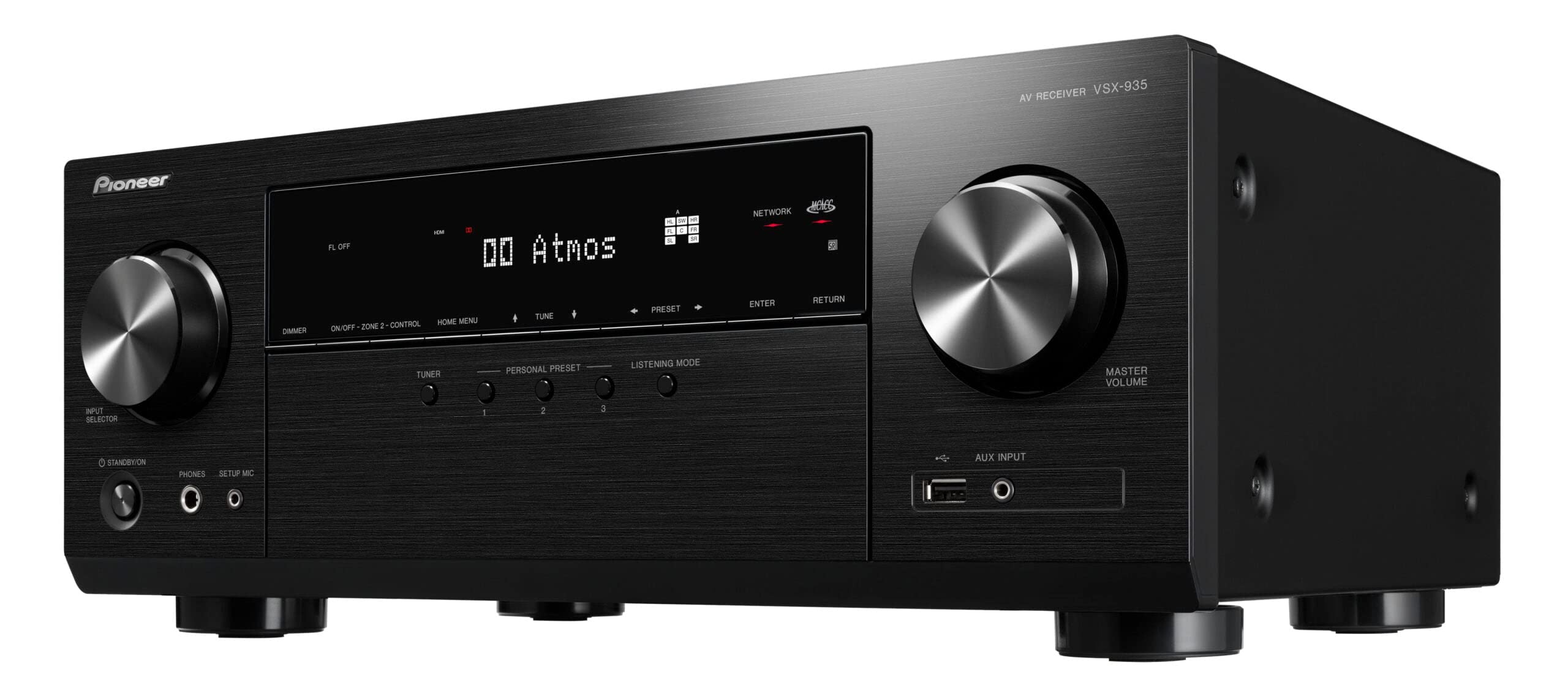
The Pioneer VSX-935 is the most budget-friendly HDMI 2.1 receiver on this list, offering 8K/60Hz passthrough and Dolby Atmos Height Virtualization at a significantly lower price point than competitors. Its 7.2–channel layout supports a standard 5.1.2 Atmos configuration. The audio quality is surprisingly crisp and clear for the price — owners upgrading from decade-old receivers report a noticeable improvement in detail and dynamics.
The RF remote is a practical touch, offering reliable control without line-of-sight. The receiver supports dual-zone audio output, streaming via Bluetooth and Wi-Fi, and has a clear front display with adjustable dimmer. However, the Bluetooth implementation is unreliable and half-duplex — it cannot stream to headphones while playing audio. The on-screen interface feels dated, and some units ship with firmware bugs that require immediate updates. A small number of owners experienced hardware failure within the first unit.
If your budget is tight but you need HDMI 2.1 compliance for a gaming console or 8K TV, the VSX-935 gets the job done. Just be prepared for a less polished software experience and occasional quirks.
Why it’s great
- Most affordable entry to HDMI 2.1 8K
- Clear, detailed sound for the price
- RF remote works without line-of-sight
- Dual-zone audio output
Good to know
- Bluetooth implementation is unreliable
- Some units ship with firmware bugs
- Interface feels dated
FAQ
Can I use a 40 Gbps HDMI 2.1 receiver with my PS5 or Xbox Series X?
Do I need height speakers for Dolby Atmos, or will virtual height work?
What does THX Select certification mean for a receiver?
Can I use a turntable with a modern AV receiver?
Final Thoughts: The Verdict
For most users, the av receiver hdmi 2.1 winner is the Marantz Cinema 60 because it combines warm, musical amplification with best-in-class Audyssey MultEQ XT32 room correction and full HDMI 2.1 gaming support. If you want Dirac Live room correction at a mid-range price, grab the Onkyo TX-NR7100. And for a budget-friendly HDMI 2.1 entry point that still handles 8K and gaming, nothing beats the Pioneer VSX-935.