
Our readers keep the lights on and my morning glass full of iced black tea. As an Amazon Associate, I earn from qualifying purchases.
Building a home theater around a modern AV receiver is the single most impactful upgrade you can make for your movie and gaming audio. The difference between standard surround sound and a properly calibrated Dolby Atmos system with height virtualization is the difference between hearing a film and being inside it—objects move with precise vertical placement, rain feels like it’s falling from above, and the soundstage becomes a true 360-degree bubble. But choosing the right chassis from the dozens of models on shelves requires navigating a maze of HDMI 2.1 specs, room correction platforms, channel counts, and amplifier topology that even seasoned enthusiasts find daunting.
I’m Min — the co-founder and writer behind Gadgets Feed. For this guide, I’ve spent dozens of hours dissecting the technical specifications, real-world amplifier power ratings, HDMI 2.1 bandwidth limitations, and room correction philosophies across eleven different AV receivers to separate genuine performance from marketing noise.
After methodically comparing amplifier stages, DAC implementations, and channel configurations, I’ve identified the models that deliver the most immersive object-based audio and the most reliable video processing in 2024. This is the definitive analysis of the best av receiver with dolby atmos for building a future-proofed home theater.
How To Choose The Best AV Receiver With Dolby Atmos
An AV receiver is the brain of your entire entertainment system. The Dolby Atmos decoding itself is now standard even on entry-level models, so the real differentiators lie in HDMI 2.1 capabilities, room correction sophistication, amplifier power, and channel processing flexibility. Buyers who focus solely on wattage or brand name often end up with a receiver that can’t handle their TV’s 4K/120Hz signal or a room correction system that leaves bass uneven across the listening area.
HDMI 2.1 Bandwidth and Gaming Features
If you own a PS5, Xbox Series X, or a high-end gaming PC, every HDMI input on your receiver must support 40Gbps or 48Gbps bandwidth. This ensures 4K/120Hz HDR passthrough without chroma subsampling. Look for explicit support for Variable Refresh Rate (VRR), Auto Low Latency Mode (ALLM), and Quick Frame Transport (QFT). Some receivers limit these gaming features to only two or three of their HDMI inputs, so check the specific port mapping before buying.
Room Correction Philosophy and Results
Room correction is not a luxury—it’s a necessity for accurate Dolby Atmos imaging. Dirac Live offers the most granular control with a PC-based tool that measures thousands of points. Audyssey MultEQ XT32 (found on Denon and Marantz) is excellent for automatically balancing frequency response and time alignment. YPAO R.S.C. with 3D on Yamaha AVENTAGE models provides very natural sound staging. Sony’s Digital Cinema Auto Calibration IX and 360 Spatial Sound Mapping create a bubble of sound that is particularly effective with height virtualization. A receiver with poor room correction will leave your height channels sounding disconnected from the bed layer.
Amplifier Power and Channel Configuration
A receiver’s power rating matters, but most brands measure at a single channel driven. A more honest metric is how many watts per channel the receiver can sustain when all channels are driven simultaneously. A 7.2 channel receiver with 100W per channel (all channels driven) will sound more dynamic than a 9.2 channel receiver with 75W per channel. Also consider whether the receiver allows bi-amping, has pre-outs for adding external amplification later, and offers separate zone processing if you want audio in another room.
Quick Comparison
On smaller screens, swipe sideways to see the full table.
| Model | Category | Best For | Key Spec | Amazon |
|---|---|---|---|---|
| Denon AVR-S770H | Mid-Range | Best Overall Value | 75W x 7, Audyssey MultEQ | Amazon |
| Onkyo TX-NR7100 | Mid-Range | Dirac Live Room Correction | 100W x 9, Dirac Live, THX | Amazon |
| Yamaha RX-V6A | Mid-Range | MusicCast Multi-Room | 100W x 7, YPAO, HDMI 2.1 | $645.00$679.95Amazon |
| Pioneer VSX-935 | Mid-Range | Budget-Friendly Performance | 80W x 7, Height Virtualization | $539.00Amazon |
| Onkyo TX-NR6100 | Mid-Range | THX Certified Gaming | 210W/Ch Dynamic, THX Select | $649.00Amazon |
| JBL MA710 | Mid-Range | Phono Input, Slim Chassis | 110W x 7, 8K, eARC | $699.95$879.95Amazon |
| Denon AVR-S970H | Premium | Gaming Features & Phono | 90W x 7, 8K, VRR/ALLM | $849.00$949.00Amazon |
| Sony STR-AN1000 | Premium | 360 Spatial Sound Mapping | 165W/Ch (6Ω), D.C.A.C. IX | $948.00$1,149.99Amazon |
| Yamaha RX-A4A | Premium | Surround:AI & Build Quality | 110W x 7, Auro-3D, Pre-outs | $1,179.29Amazon |
| Marantz Cinema 60 | Premium | HDAM Circuitry & Audiophile Sound | 100W x 7, Audyssey XT32, 8K | $1,800.00Amazon |
| Sony STRAZ3000ES | Premium | High-End 9.2 Channel System | 120W x 9, 360SSM, Pre-outs | $2,198.00Amazon |
In‑Depth Reviews
1. Denon AVR-S770H 7.2 Ch Home Theater Receiver

The Denon AVR-S770H strikes the most compelling balance of audio quality, video features, and ease of use in the mid-range segment. Its 75W per channel into 7 channels is conservative on paper, but the current feedback amplifier topology delivers surprisingly dynamic headroom with Klipsch, Polk, or ELAC speakers. The Audyssey MultEQ room correction, while not the full XT32 version, effectively tames common room modes and aligns speaker distances for a coherent Dolby Atmos soundstage. The on-screen guided setup is the most beginner-friendly in this category, walking you through speaker configuration and source assignment without requiring a degree in audio engineering.
For gamers, the HDMI 2.1 implementation supports 4K/120Hz passthrough with VRR, ALLM, and QFT across multiple inputs—critical for Xbox Series X and PS5 owners who want full bandwidth without chroma subsampling. The receiver also handles Dolby Vision, HDR10+, and HLG without any handshake issues, which is rare at this price point. The HEOS multi-room platform allows you to stream TIDAL, Spotify, and Amazon Music HD to compatible Denon speakers in other rooms, effectively turning the receiver into the hub of a whole-home audio system.
Some users report that the remote control layout takes time to memorize and that the on-screen menu can feel dense with options. A small number of units have experienced firmware-related volume drops that require a reset to resolve. However, Denon has been proactive with firmware updates, and the core hardware reliability is excellent. For the vast majority of buyers building a 5.1.2 or 7.1 system, this receiver provides a level of polish that punches well above its price.
Why it’s great
- Audyssey MultEQ room correction delivers precise time alignment for Atmos height channels
- Full HDMI 2.1 feature set with 4K/120Hz, VRR, and ALLM across multiple inputs
- HEOS multi-room streaming integrates with a wide ecosystem of wireless speakers
Good to know
- Remote layout is dense and takes time to learn without backlighting
- Occasional firmware volume drop requires reboot
- 75W per channel may feel limited in very large rooms with low-sensitivity speakers
2. Onkyo TX-NR7100 9.2-Channel AV Receiver
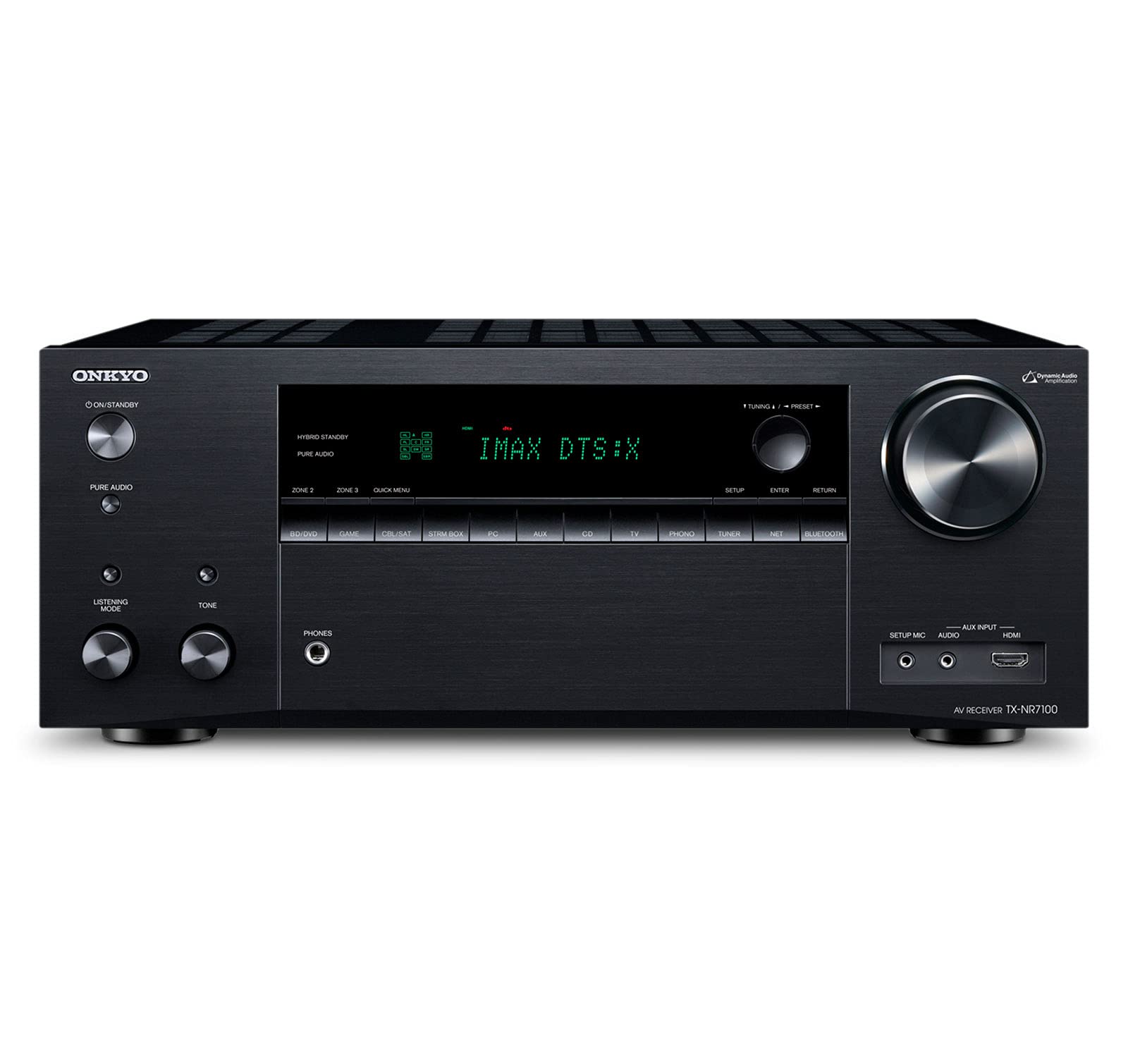
The Onkyo TX-NR7100 is the most affordable AV receiver to include Dirac Live room correction out of the box—a feature typically reserved for units costing significantly more. Dirac Live measures the acoustic response of your room at multiple listening positions and applies filters that correct time-domain and frequency-domain errors with surgical precision. The result is a Dolby Atmos soundstage where height effects snap into position with uncanny accuracy, and bass response becomes smooth rather than boomy or hollow. The 100W per channel across 9 channels provides plenty of headroom for a 5.1.4 or 7.1.2 configuration.
Beyond room correction, the TX-NR7100 is THX Certified Select, ensuring it meets strict performance standards for reference-level playback in medium-sized rooms. The HDMI 2.1 board runs at 40Gbps and supports 4K/120Hz, 8K/60Hz, VRR, ALLM, and QFT, making it a strong choice for gaming. The receiver also includes bi-directional Bluetooth with aptX HD, allowing you to transmit high-resolution audio to wireless headphones without losing fidelity. The Works with Sonos certification means it can join an existing Sonos system using a Sonos Port, giving you voice control and multi-room flexibility.
Dirac Live setup requires a PC or Mac application for full control, and the calibration microphone included is wired rather than wireless, which some users find inconvenient. A small number of units have developed crackling static after extended use, though Onkyo’s warranty service has been responsive. The remote control lacks backlighting, and the on-screen menu design feels dated compared to Denon or Sony. For buyers who prioritize room correction above all else, however, the TX-NR7100 is the clear value champion.
Why it’s great
- Dirac Live room correction is a genuine game-changer for bass nulls and speaker time alignment
- THX Select Certified ensures reference-level performance in medium rooms
- 9 channels of amplification allow for immersive 5.1.4 Atmos setups
Good to know
- Dirac Live setup requires a computer for full calibration
- Remote is not backlit and on-screen menus feel basic
- Some units have reported crackling static that required warranty service
3. YAMAHA RX-V6A 7.2-Channel AV Receiver

The Yamaha RX-V6A is a spacious-sounding, feature-rich receiver that leverages Yamaha’s MusicCast multi-room ecosystem to excellent effect. The YPAO R.S.C. (Reflected Sound Control) room calibration uses multipoint measurement to correct for early reflections and frequency response imbalances, resulting in a clean, natural Dolby Atmos presentation that doesn’t sound overly processed. The 100W per channel amplifier section has a high slew rate that preserves transient detail during explosive action sequences, making dialogue remain clear even during the loudest moments. Dolby Atmos Height Virtualization is available for setups without physical height speakers.
On the video side, the RX-V6A includes three HDMI 2.1 inputs capable of 8K/60Hz and 4K/120Hz passthrough, along with HDCP 2.3, eARC, Dolby Vision, and HDR10+. The MusicCast app is well-designed and allows you to group the receiver with other Yamaha wireless speakers for synchronized whole-home audio. Voice control works with Alexa, Google Assistant, and Siri via AirPlay 2. The receiver also includes a phono input for turntable enthusiasts, a feature that is increasingly rare in this price segment.
Some users note that the setup process has a steep learning curve, particularly around HDMI-CEC and ARC behavior with certain TV brands. The receiver does not automatically power on with some TVs, requiring a manual power press. The firmware update process can be confusing for non-technical users. Once dialed in, however, the RX-V6A delivers a balanced, musical sound that Yamaha is known for, and the MusicCast platform adds real value for households with multiple zones.
Why it’s great
- MusicCast multi-room system is one of the most user-friendly and flexible in the industry
- YPAO R.S.C. room correction provides natural, unprocessed sound staging
- High slew rate amplifier preserves transient detail for dynamic movie soundtracks
Good to know
- HDMI-CEC and ARC setup can be finicky with certain TV brands
- Does not always auto-power on with the TV
- Firmware update process requires patience and a stable internet connection
4. Pioneer VSX-935 7.2 Channel Network Receiver
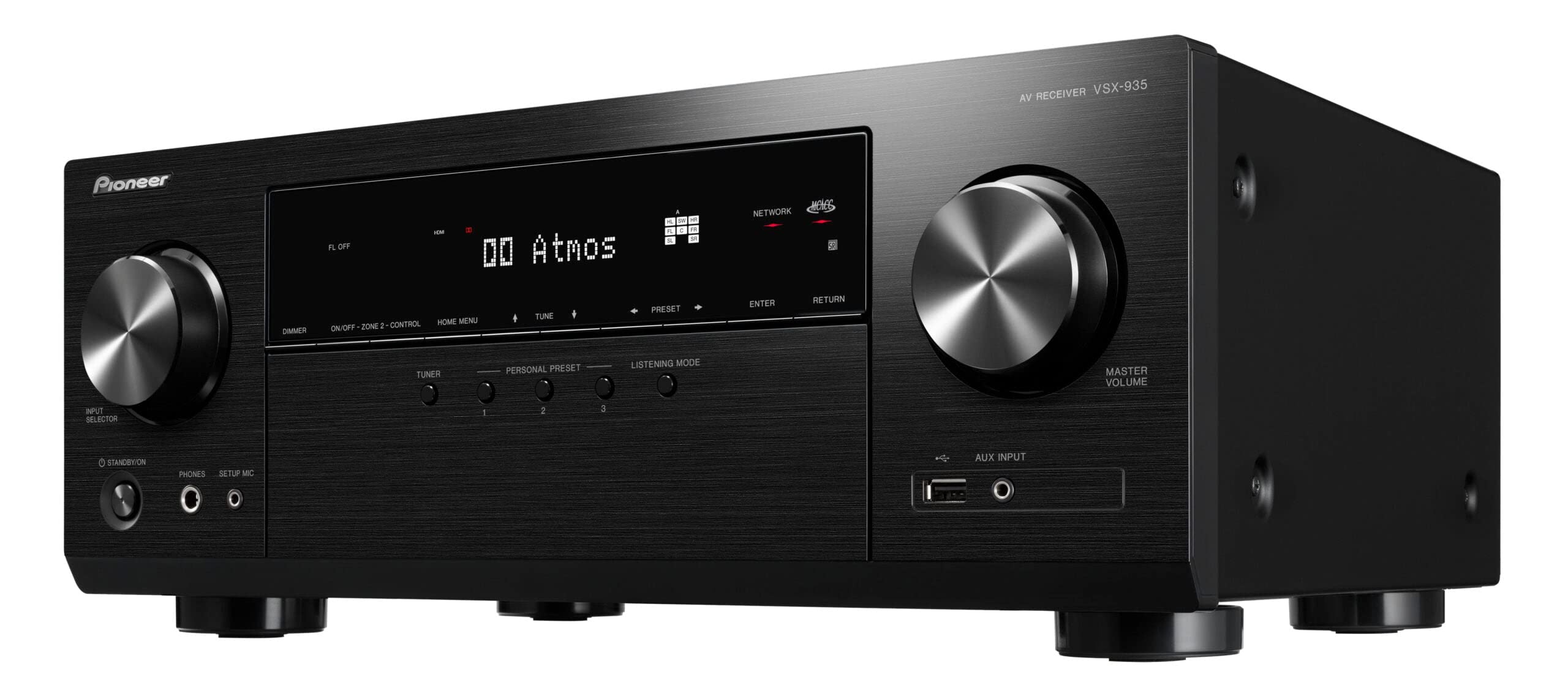
The Pioneer VSX-935 delivers genuine Dolby Atmos support and HDMI 2.1 connectivity at a price that undercuts most competitors by a significant margin. The 80W per channel amplifier stage is clean and loud, with volume ramping gradually until the 50% mark and then accelerating rapidly beyond that—a quirk that gives it more usable headroom than its modest spec sheet suggests. The Dolby Atmos Height Virtualization feature is particularly effective for buyers who cannot install physical height speakers, creating a convincing phantom height layer through psychoacoustic processing that works with standard 5.1 or 7.1 layouts.
The receiver includes three HDMI 2.1 inputs with 8K/60Hz and 4K/120Hz passthrough, supporting VRR and ALLM for gaming. The built-in Wi-Fi is faster than previous Pioneer generations, and the streaming support covers Spotify, TIDAL, and Amazon Music HD. The Pioneer remote is RF-based, meaning it works without direct line-of-sight—a thoughtful touch. The front display is clear and includes a dimmer that can be adjusted for dark theater rooms.
Customer reports indicate that the auto-setup (MCACC) is less accurate than manual calibration, particularly for speaker distance and crossover settings. The Bluetooth implementation is two-way but the menu navigation to activate it is buried and unintuitive. Some units have arrived with display defects or no sound output, though replacements have been handled promptly by vendors. For buyers who are comfortable with manual speaker setup, the VSX-935 is the most cost-effective entry into Dolby Atmos.
Why it’s great
- Lowest price entry point for HDMI 2.1 and Dolby Atmos support
- RF remote works without line-of-sight for flexible placement
- Height Virtualization is surprisingly convincing for setups without ceiling speakers
Good to know
- Auto-setup calibration is less accurate than manual configuration
- Bluetooth pairing menu is buried and difficult to access
- Some units have experienced display or audio defects out of the box
5. Onkyo TX-NR6100 7.2 Channel THX Certified Network AV Receiver
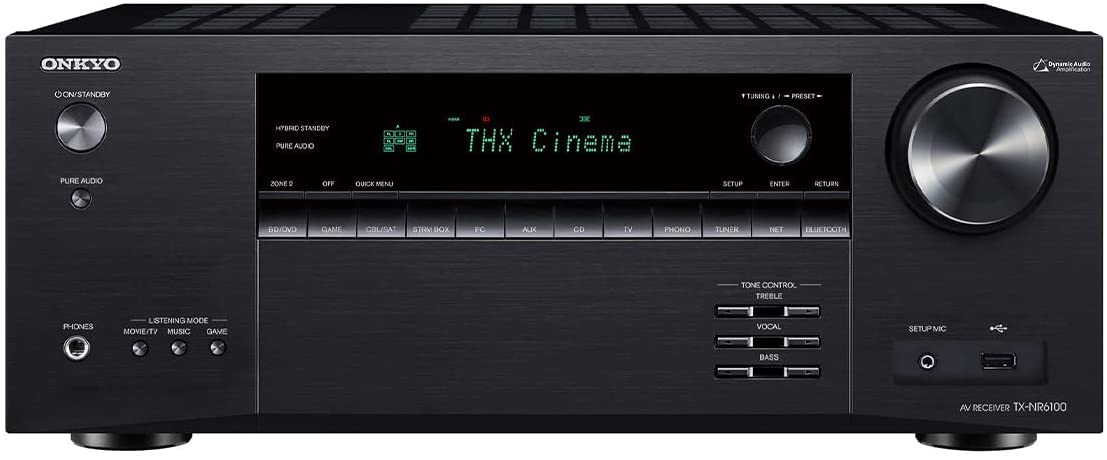
The Onkyo TX-NR6100 is built around a THX Select Certified amplifier that uses a high-current, low-impedance design rated at 210W per channel dynamic power. This translates to authoritative bass control and effortless loudness with low-sensitivity speakers, making it a favorite among buyers running Klipsch Reference or JBL Studio series. The 5.2.2 channel Dolby Atmos and DTS:X decoding is robust, and the receiver includes IMAX Enhanced certification for those who want the expanded aspect ratio and sound mix on compatible discs. The eight HDMI inputs—three of which are HDMI 2.1 with 40Gbps bandwidth—provide ample connectivity for multiple consoles.
The auto-calibration system (AccuEQ) is straightforward and does a good job setting speaker distances and levels, though it lacks the advanced filter capability of Dirac or Audyssey XT32. The Onkyo Controller app is responsive and allows source switching, volume control, and sound mode selection without needing the remote. The discrete Zone 2 output supports both audio and video, so you can send a separate 4K signal to a second room. The receiver runs cooler than many comparable models, which is a practical advantage for enclosed media cabinets.
Some users report that the remote is not backlit and that inputs 4 through 6 are limited to 4K (not 8K), which is an important detail for planning your connection layout. Bi-amping the front speakers disables the rear surround channels, limiting you to a 5.1 configuration. A few customers have received defective units from third-party sellers, so purchasing from an authorized dealer is strongly recommended. Overall, for gamers and home theater enthusiasts who want THX-certified dynamics without jumping to the premium tier, the TX-NR6100 is a compelling choice.
Why it’s great
- THX Select Certification ensures high-current, low-impedance amplifier performance
- Eight HDMI inputs provide ample connectivity for multiple consoles and streaming devices
- Discrete Zone 2 with video out for multi-room setup
Good to know
- Remote is not backlit and inputs 4-6 are 4K-only, not 8K
- Bi-amping disables surround back channels, limiting to 5.1
- Some defective units from third-party sellers have been reported
6. JBL MA710 7.2 Channel 8K AV Receiver

The JBL MA710 is a surprisingly capable 7.2-channel receiver that combines a shallow chassis design (only 4.3 inches tall) with 110 watts of clean amplification per channel. This low-profile construction is a major advantage for media consoles where vertical space is tight, and the minimalist front panel with a discreet display looks clean in a modern living room. The Dolby Atmos and DTS:X decoding supports up to 5.1.2 configurations, and the receiver includes Dolby Atmos Height Virtualization for rooms without ceiling speakers. A built-in moving magnet phono input lets you connect a turntable directly.
Streaming is handled via Bluetooth, Apple AirPlay 2, and Google Chromecast built-in, though the selection of native streaming apps within the receiver is more limited than what you get with HEOS or MusicCast. The six HDMI inputs all support 8K/60Hz and 4K/120Hz passthrough with eARC, Dolby Vision, and HDR10+. The setup process is guided through an on-screen interface that is clear and easy to follow, though initial firmware updates can be slow. The unit drives Polk, JBL, and Klipsch speakers with authority, delivering a musical, warm presentation that is particularly enjoyable for two-channel listening.
The remote control is not backlit, which is a notable oversight for a receiver at this price point. The auto shut-off defaults to 20 minutes and must be manually changed. Some users report that the receiver does not properly mix down DTS-HD Master Audio to 2.1 for stereo listening, though Dolby TrueHD downmixing works correctly. For buyers who value a slim profile, a phono input, and musical amplifier character, the MA710 offers a distinctive set of features that few competitors match at this price.
Why it’s great
- Shallow 4.3-inch chassis fits media consoles with limited vertical clearance
- 110W per channel provides clean headroom for dynamic movie soundtracks
- Built-in phono input eliminates the need for an external preamp
Good to know
- Remote is not backlit, making dark-room operation difficult
- Limited native streaming app support compared to Denon or Yamaha
- DTS-HD Master Audio downmixing to 2.1 has known limitations
7. Denon AVR-S970H 8K Ultra HD 7.2 Channel AV Receiver

The Denon AVR-S970H sits above the S770H in Denon’s lineup, offering 90W per channel across seven channels along with a built-in phono preamp that the S770H lacks. This makes it the ideal hub for a hybrid system combining a turntable with a Dolby Atmos home theater. The Audyssey MultEQ room correction is the standard version (not XT32), but it still provides meaningful correction of frequency response errors and speaker distance alignment. The amplifier section runs notably cooler than competitors—typically hovering around 80°F under load—which is a practical advantage for enclosed AV cabinets.
Gaming features are fully loaded: 8K/60Hz and 4K/120Hz passthrough across three HDMI inputs, with VRR, ALLM, and QFT support ensuring tear-free, low-latency gameplay. The HEOS multi-room platform is robust, supporting Pandora, Spotify, TIDAL, and Amazon Music HD with seamless grouping of compatible wireless speakers. The on-screen setup wizards are among the best in the industry, with video guides that explain each step clearly. The Zone 2 functionality allows you to send a separate audio source to another room, though it uses the back speaker channels, limiting you to 5.1 in the main room.
The remote is not backlit, and there is no programmable TV power button, which means you’ll need to use your TV remote separately for power control. The HEOS platform does not allow Bluetooth output from a HEOS source, which limits some sharing scenarios. Video quality is pristine, with Dolby Vision and HDR10+ pass-through that many users report as superior to their previous receivers. For buyers who want a phono input and robust gaming features in a Denon package, the S970H is the logical upgrade.
Why it’s great
- Built-in phono preamp allows direct turntable connection without an external box
- Full HDMI 2.1 gaming feature set with VRR, ALLM, and QFT
- Runs cooler than many competitors, ideal for enclosed cabinets
Good to know
- Remote is not backlit and lacks a programmable TV power button
- Zone 2 uses rear speaker channels, limiting main room to 5.1
- HEOS Bluetooth output is restricted from HEOS source inputs
8. Sony STR-AN1000 7.2 CH Surround Sound Home Theater 8K A/V Receiver

The Sony STR-AN1000 leverages Sony’s Digital Cinema Auto Calibration IX and 360 Spatial Sound Mapping to create a uniquely immersive audio bubble that extends beyond the physical speaker locations. The 360SSM technology analyzes the room acoustics and synthesizes phantom speakers at specific spatial coordinates, resulting in a Dolby Atmos presentation where the height layer feels seamless and the front soundstage has unusual width. The amplifier delivers 165W per channel into 6 ohms, providing substantial current for dynamic peaks without strain.
On the video side, the AN1000 supports 8K/60Hz and 4K/120Hz with HDMI 2.1 across multiple inputs, along with Dolby Vision, HDR10, HLG, and IMAX Enhanced. The Works with Sonos certification allows seamless integration with Sonos systems using a Sonos Port. The setup GUI is among the most polished in this segment, with clear walkthroughs for speaker configuration and source assignment. Zone 2 and Zone 3 distribution give you multi-zone flexibility. The receiver also includes a dedicated S-Center input that syncs the dialogue channel with compatible Sony TVs for ultra-clear vocal reproduction.
There is no phono input, so vinyl listeners will need an external preamp. Some users report an HDMI handshake issue with Apple TV 4K where Dolby Vision passthrough is inconsistent—the workaround is to connect the Apple TV directly to the TV and use eARC for audio. The front panel display is small and difficult to read from a normal viewing distance. The 360 Spatial Sound Mapping is most effective with a full 7.1 speaker layout; its benefits diminish with smaller configurations. For Sony loyalists and those who want the most advanced spatial audio processing, the AN1000 is the clear choice.
Why it’s great
- 360 Spatial Sound Mapping creates phantom speakers for a wider, more immersive soundstage
- S-Center input syncs dialogue with compatible Sony TVs for crystal-clear vocals
- Polished setup GUI with clear calibration walkthroughs
Good to know
- No phono input for turntable connectivity
- Dolby Vision passthrough can be inconsistent with Apple TV 4K
- Front panel display is small and difficult to read from a distance
9. Yamaha RX-A4A AVENTAGE 7.2-Channel AV Receiver

The Yamaha RX-A4A is the entry point into Yamaha’s top-tier AVENTAGE line, distinguished by premium build quality including a rigid frame, anti-resonance feet, and high-quality DAC components. The Surround:AI technology analyzes audio content in real-time and automatically adjusts the sound field parameters to optimize dialogue clarity, surround immersion, and height effects—it’s not a gimmick; it genuinely makes movies sound more engaging without requiring manual EQ adjustments. The receiver supports Dolby Atmos, DTS:X, and Auro-3D, giving you three distinct immersive audio formats to choose from depending on your source material.
All HDMI inputs support 8K60 and 4K120 at 40Gbps with HDCP 2.3, eARC, Dolby Vision, HDR10+, and HLG. The YPAO R.S.C. with 3D and multipoint measurement is one of the most refined auto-calibration systems available, and the precision EQ is particularly effective at taming room resonance without making the sound sterile. The MusicCast multi-room system is excellent, and the receiver is Roon Tested for high-end music streaming. The inclusion of pre-outs for all channels means you can add external amplifiers later for even greater headroom.
The setup process is famously complex, requiring careful reading of the manual—particularly for firmware updates, which must be done via USB drive in some cases. The remote control is functional but uninspiring, and the on-screen menus are utilitarian rather than polished. The receiver is heavy at over 18 kilograms, which is a testament to its robust power supply and chassis construction. For buyers who prioritize build quality, format flexibility (including Auro-3D), and the intelligence of Surround:AI, the RX-A4A is a long-term investment that will remain relevant for years.
Why it’s great
- Surround:AI analyzes content in real-time for optimized sound field parameters
- Pre-outs for all channels allow future expansion with external amplifiers
- Supports Dolby Atmos, DTS:X, and Auro-3D for maximum format compatibility
Good to know
- Setup process is complex and requires reading the manual for firmware updates
- Heavy chassis (over 18 kg) may be difficult to position in some cabinets
- On-screen menus are functional but visually outdated compared to competitors
10. Marantz Cinema 60 7.2-Ch Receiver

The Marantz Cinema 60 is built around Marantz’s legendary HDAM (Hyper Dynamic Amplifier Module) discrete circuitry and current feedback amplification, delivering a warm, rich tone with exceptional micro-detail retrieval that audiophiles will immediately recognize. The 100W per channel amplifier stage is conservatively rated but robust, driving even difficult speaker loads with ease. The Audyssey MultEQ XT32 room correction is the same professional-grade platform found in Marantz’s flagship models, offering 32x resolution filtering that provides the most accurate time alignment and frequency response correction in this list. The result is a Dolby Atmos soundstage that is precise, musical, and deeply immersive.
Video processing is equally impressive, with 8K/60Hz and 4K/120Hz passthrough, Dolby Vision, HDR10+, Dynamic HDR, and HLG support. The HDMI 2.1 implementation includes QFT, QMS, VRR, and ALLM for lag-free gaming. The HEOS multi-room platform is fully integrated, allowing streaming from Pandora, Spotify, TIDAL, and Amazon Music HD. The phono input is of higher quality than typical built-in stages, with low noise and good gain. The remote control is a standout—it looks like a premium component rather than an afterthought, with a clean layout and solid feel.
The price positions it firmly in the premium tier, and some features—like the full complement of 8K inputs—require firmware updates to unlock fully, which can be frustrating out of the box. The Cinema 60 does not include pre-outs for external amplification, limiting upgrade paths. The unit is physically larger than many competitors, so measure your cabinet space carefully. For buyers who prioritize sonic refinement, the Cinema 60 delivers a level of musicality that transforms both movies and two-channel listening into a genuinely high-end experience.
Why it’s great
- HDAM discrete circuitry delivers warm, detailed sound with exceptional micro-dynamics
- Audyssey MultEQ XT32 provides professional-grade room correction
- Premium remote control with excellent build quality and ergonomic layout
Good to know
- No pre-outs for external amplifier expansion
- Some features require firmware updates that can be time-consuming
- Larger chassis dimensions require careful cabinet measurement
11. Sony STRAZ3000ES Premium ES 9.2 CH 8K A/V Receiver

The Sony STRAZ3000ES is the crown jewel of Sony’s ES (Evolutionary Standard) series, offering 9.2 channels of amplification at 120W per channel (8 ohms, 2ch driven) with the most advanced room correction platform Sony has ever created. The 360 Spatial Sound Mapping Elite uses a sophisticated algorithm that creates multiple phantom speakers at specific coordinates around the listening position, effectively turning a 5.1.4 configuration into a much larger immersive bubble. The Digital Cinema Auto Calibration IX measures with exceptional precision, and the receiver’s 32-bit DAC implementation reveals details in movie soundtracks that lesser receivers gloss over.
Video routing is handled with military-grade HDMI 2.1 switching supporting 8K/60Hz and 4K/120Hz, Dolby Vision, HDR10, HLG, and IMAX Enhanced. The Works with Sonos certification allows seamless integration into larger home ecosystems. The setup can be performed through a graphical interface, a web browser, or a dedicated app—offering flexibility for custom integrators. The backlit remote is a rarity in this category and is genuinely appreciated in dark theater rooms. The front cover plate hides seldom-used controls and gives the receiver a clean, professional appearance. At 32.8 pounds, the amplifier section is built with a massive toroidal transformer and discrete output transistors.
The receiver lacks HDR10+ support, which is a surprising omission at this price point. It also does not include QMS (Quick Media Switching) or QFT, though VRR and ALLM are present. The unit runs very hot, requiring at least 5 inches of clearance above the chassis for proper ventilation. Some users report that the auto-calibration sets speaker distances incorrectly and that manual adjustment is needed for optimal imaging. For buyers building a reference-quality 7.1.4 or 5.1.4 system who want Sony’s most advanced spatial processing, the STRAZ3000ES is the definitive choice.
Why it’s great
- 360 Spatial Sound Mapping Elite creates an exceptionally immersive phantom speaker array
- 120W per channel with massive toroidal transformer delivers effortless dynamics
- Backlit remote and front cover plate enhance the premium user experience
Good to know
- No HDR10+ support, limiting compatibility with some streaming content
- Runs hot and requires generous ventilation clearance
- Auto-calibration sometimes sets speaker distances incorrectly
FAQ
How many physical height speakers do I need for Dolby Atmos to work well?
What is the difference between Dolby Atmos and DTS:X?
Is it worth paying more for THX Certification on an AV receiver?
Can I use a Dolby Atmos AV receiver with my existing 5.1 speaker setup?
Final Thoughts: The Verdict
For most users, the best av receiver with dolby atmos winner is the Denon AVR-S770H because it combines Audyssey room correction, full HDMI 2.1 gaming features, and HEOS multi-room streaming at a price that leaves room in your budget for better speakers. If you want Dirac Live room correction for the most accurate soundstage calibration, grab the Onkyo TX-NR7100. And for a premium audiophile experience with HDAM discrete circuitry, nothing beats the Marantz Cinema 60.
Product prices and availability are accurate as of the date/time indicated and are subject to change. Any price and availability information displayed on Amazon at the time of purchase will apply to the purchase of this product. As an Amazon Associate I earn from qualifying purchases.
CERTAIN CONTENT THAT APPEARS ON THIS SITE COMES FROM AMAZON. THIS CONTENT IS PROVIDED "AS IS" AND IS SUBJECT TO CHANGE OR REMOVAL AT ANY TIME.
Amazon and the Amazon logo are trademarks of Amazon.com, Inc. or its affiliates.