
The difference between a mediocre home theater and a truly immersive one often comes down to a single component: the AV receiver. It is the brain and brawn of your system, handling everything from decoding Dolby Atmos object-based audio to switching HDMI 2.1 signals for your gaming console. Picking the wrong one means leaving performance on the table — or worse, dealing with dropouts, heat issues, or a phono stage that hums.
I’m Min — the co-founder and writer behind Gadgets Feed. I’ve spent hundreds of hours cross-referencing power output curves, HDMI 2.1 bandwidth specifications (40Gbps vs 48Gbps), manufacturer room correction suites (Audyssey, YPAO, Dirac Live), and the real-world reliability data buried in customer feedback to separate the genuine performers from the spec-sheet heroes.
This guide breaks down eleven of the most compelling models currently available, from entry-level 7.2-channel units to flagship 13.2-channel behemoths. After reading, you will know exactly which av receiver matches your speaker configuration, source devices, and room size without overspending on channels you will never use.
How To Choose The Best AV Receiver
Your receiver is the nerve center of your home theater. It powers your speakers, decodes your audio formats, and routes your video sources to the TV. Choose based on your speaker configuration (how many channels you need), your source devices (HDMI 2.1 requirements for consoles and PCs), and the room correction system that will tune the sound to your specific space. Ignoring any of these three pillars usually leads to buyer’s remorse.
Channel Count And Speaker Configuration
A 5.1-channel setup powers five main speakers and one subwoofer. A 7.1-channel setup adds two rear surround speakers. The first number after the decimal refers to subwoofers (e.g., 7.2 means two subwoofer outputs). The third number — 5.1.2 or 7.1.4 — indicates overhead or height channels for Dolby Atmos and DTS:X. A 5.1.2 setup requires a 7-channel receiver (five ear-level plus two height channels), while a 7.1.4 setup needs at least 11 channels of processing. Do not buy more channels than your room and speaker budget support, but leave room for expansion if you plan to add heights later.
HDMI 2.1 Bandwidth And Gaming Features
If you own a PlayStation 5, Xbox Series X, or a high-end PC with an RTX 30/40 series card, HDMI 2.1 is non-negotiable. The spec supports 4K at 120Hz and 8K at 60Hz. However, not all HDMI 2.1 ports deliver the full 48Gbps bandwidth; some receivers are limited to 40Gbps, which still handles 4K/120Hz at 10-bit color but may not support full 12-bit 4:4:4 at higher resolutions. Look for VRR (Variable Refresh Rate), ALLM (Auto Low Latency Mode), and QFT (Quick Frame Transport) if competitive gaming matters to you.
Room Correction And Calibration
A receiver’s internal amplifier is only as good as the calibration that tunes it to your room. Basic systems like Yamaha YPAO and Onkyo AccuEQ offer decent automatic EQ. Mid-range Denon models include Audyssey MultEQ, which provides more granular frequency correction. Premium receivers like the Onkyo TX-RZ50 and higher-end Yamaha Aventage models feature Dirac Live or YPAO R.S.C. with multipoint measurement — these can dramatically improve bass response and imaging by correcting for room modes and reflections. If you are a perfectionist, prioritize Dirac Live or Audyssey MultEQ XT32.
Quick Comparison
On smaller screens, swipe sideways to see the full table.
| Model | Category | Best For | Key Spec | Amazon |
|---|---|---|---|---|
| Denon AVR-X1700H | Mid-Range 7.2 | Best overall entry-level 5.1.2 Atmos | Audyssey MultEQ, eARC, 8K/60Hz passthrough | Amazon |
| Onkyo TX-RZ50 | Premium 9.2 | Best for Dirac Live calibration and 7.1.4 setups | Dirac Live, THX Select, 11.2ch processing | Amazon |
| Yamaha RX-A4A AVENTAGE | Premium 7.2 | Best for MusicCast multi-room and build quality | YPAO R.S.C. 3D, Surround:AI, 40Gbps HDMI | Amazon |
| Sony STR-AZ1000ES | Premium 7.2 | Best for 360 Spatial Sound Mapping and PS5 integration | 360SSM, DCAC IX, 100W/ch (8 ohm) | Amazon |
| Marantz SR8015 | Flagship 11.2 | Best for reference-grade 7.1.4 home theaters | 140W/ch (8 ohm), 11ch amplifier, HEOS | Amazon |
| Sony STR-AZ7000ES | Flagship 13.2 | Best for massive custom 9.2.6 or 7.2.6 installations | 150W/ch (8 ohm), 13ch amplifier, 48Gbps HDMI | Amazon |
| Yamaha RX-V6A | Mid-Range 7.2 | Best for MusicCast and reliable day-to-day use | YPAO, MusicCast, 7ch HDMI 2.1 inputs | Amazon |
| Onkyo TX-NR6100 | Mid-Range 7.2 | Best for THX certification at a competitive price | THX Select, 210W/ch dynamic, 40Gbps HDMI | Amazon |
| Denon AVR-S970H | Mid-Range 7.2 | Best for phono input and small-to-medium rooms | Audyssey MultEQ, 90W/ch, HEOS multi-room | Amazon |
| Pioneer VSX-935 | Entry-Level 7.2 | Best for budget-conscious 5.1.2 Atmos setups | Dolby Atmos Height Virtualization, 8K HDMI 2.1 | Amazon |
| JBL MA710 | Entry-Level 7.2 | Best for shallow cabinets and simple integration | Dolby Atmos/DTS:X, phono input, Chromecast built-in | Amazon |
In‑Depth Reviews
1. Denon AVR-X1700H 7.2ch 8K Home Theater Receiver

The Denon AVR-X1700H strikes the most balanced ratio of channel count, room correction quality, and HDMI 2.1 features in the sub- price tier. Its 7-channel amplifier (90W per channel into 8 ohms) drives a 5.1.2 Dolby Atmos layout without external amplification, and the three dedicated 8K HDMI inputs support 4K/120Hz and 8K/60Hz passthrough for next-gen consoles. Audyssey MultEQ room correction — a feature usually reserved for more expensive Denon models — provides genuine frequency-domain smoothing across multiple listening positions, which significantly tightens bass response and clears up muddied dialogue in untreated rooms.
Setup is notably beginner-friendly thanks to the company’s on-screen Quick Start Guide and color-coded speaker terminals. The HEOS multi-room platform streams from Spotify, TIDAL, and Amazon Music HD, while voice control via Alexa, Google Assistant, and Siri (AirPlay 2) covers hands-free input switching and volume adjustment. The phono input supports moving magnet turntables directly, eliminating the need for an external preamp for vinyl listeners.
Refurbished units from Denon’s certified program offer the same performance at a notable discount, though buyers should use certified 48Gbps HDMI cables with this receiver to avoid intermittent handshake issues reported on earlier firmware revisions. The remote lacks backlighting, and the power supply runs adequately cool in open racks but needs at least 4-5 inches of ventilation above the chassis. For most first-time Atmos builders and gamers, this is the single most logical starting point in the entire category.
Why it’s great
- Audyssey MultEQ delivers noticeably cleaner bass and vocal clarity compared to basic EQ systems
- Three 8K HDMI inputs with 4K/120Hz support cover PS5, Xbox Series X, and Apple TV 4K simultaneously
- Phono input and HEOS multi-room make it a genuine hub for both home theater and whole-home audio
Good to know
- Refurbished units may require certified 48Gbps HDMI cables to prevent picture dropouts
- Rear-panel USB port is for service only, not media playback
- Zone 2 operation reduces main channels to 5.1, which may conflict with existing Atmos height configurations
2. Onkyo TX-RZ50 9.2-Channel AV Receiver

Onkyo packed Dirac Live — typically a – add-on license in other brands — directly into the TX-RZ50 at no extra cost, making it the most compelling room-correction value in the premium segment. The nine built-in amplifier channels (120W each into 8 ohms) power a full 7.1.4 Atmos setup when paired with an external two-channel amp for the rear heights, or run a 5.2.4 configuration straight out of the box. The 11.2-channel processing engine supports up to a 7.2.4 pre-out configuration using the RCA outputs for external amplification.
THX Select certification guarantees the receiver maintains reference-level output with minimal distortion in rooms up to 2,000 cubic feet. The HDMI 2.1 section supports 8K/60Hz and 4K/120Hz on three inputs at the full 40Gbps bandwidth, with VRR and ALLM for latency-sensitive gaming. Onkyo’s collaboration with Klipsch produced an Optimize Mode that automatically applies ideal crossover points for specific Reference and Reference Premiere speaker models — a genuine convenience if you own Klipsch speakers.
Critically, the RZ50 lacks independent dual subwoofer outputs (they are summed, not individually EQ’d), and the Wi-Fi card has been a weak point on some early production batches — confirm current firmware or exchange eligibility with the seller. The fan is quieter than most high-power receivers, staying silent during normal listening levels. For buyers who want professional-grade room tuning without paying for a separate MiniDSP and calibration mic, this is the receiver to beat in its price bracket.
Why it’s great
- Full Dirac Live license included at no additional cost, saving hundreds over comparable Denon/Marantz models
- THX Select certification ensures clean output at reference levels in standard living rooms
- Klipsch Optimize Mode auto-configures crossover points for popular speaker models
Good to know
- Dual subwoofer outputs are summed, not independently calibrated
- Some units have shown Wi-Fi card failures; confirm return window with the seller
- HDMI switching delay of 12-15 seconds is slower than some competitors
3. Yamaha RX-A4A AVENTAGE 7.2-Channel AV Receiver

The AVENTAGE line represents Yamaha’s top-tier engineering focus, and the RX-A4A exemplifies it with a rigid H-frame chassis, fifth-foot vibration damping, and premium DACs that yield a noticeably higher signal-to-noise ratio than the brand’s RX-V series. The seven-channel amplifier delivers 110W per channel into 8 ohms, and the Surround:AI technology analyzes audio scenes in real time to optimize dialogue clarity, surround effects, and bass impact without manual intervention. YPAO R.S.C. with 3D and multipoint measurement provides accurate frequency correction across up to eight listening positions.
All seven HDMI inputs support 40Gbps HDCP 2.3 with 8K/60Hz and 4K/120Hz passthrough, including VRR and ALLM for gaming. The eARC port simplifies audio return from the TV’s smart apps. MusicCast is Yamaha’s mature multi-room ecosystem, supporting Spotify Connect, TIDAL, Qobuz, and Apple AirPlay 2, and the unit is Roon Tested for high-res file playback. The unit integrates with Sonos via a Sonos Port for whole-home audio blending.
The RX-A4A is picky about firmware updates — it requires a USB flash drive, not an internet download, for major version jumps, which is a tedious process in 2024. The menu system is dense, and the remote’s button layout can be confusing until you memorize it. The lack of a front HDMI port is a minor annoyance for temporary connections. Once set up, however, the A4A delivers exceptionally clean sound with a wide soundstage that competes easily with receivers costing 50% more. It is a genuine long-term investment.
Why it’s great
- Surround:AI automatically optimizes audio in real time for movies, music, and games
- Premium chassis construction with anti-vibration design reduces mechanical noise
- MusicCast multi-room is one of the most reliable ecosystems for whole-home audio
Good to know
- Major firmware updates require a USB flash drive — no direct internet update path
- Setup menu is complex and requires a careful read of the online manual
- No front HDMI input for quick device connections
4. Sony STR-AZ1000ES Premium ES 7.2 CH 8K A/V Receiver

Sony’s ES line has long been revered in custom installation circles, and the STR-AZ1000ES brings 360 Spatial Sound Mapping (360SSM) to a seven-channel format. 360SSM creates phantom height and surround speakers from fewer physical drivers — a 5.1.2 physical layout can convincingly emulate a 7.1.4 system by intelligently processing phase and amplitude cues. The Digital Cinema Auto Calibration IX (DCAC IX) system measures speaker distances and angles, then applies both frequency EQ and time-alignment filters that are unusually effective for a fully automated system.
The amplifier section is rated at 100W per channel into 8 ohms, and while that number appears modest compared to competitors, Sony’s high-current design delivers clean transient response into low-impedance 4-ohm loads. The HDMI section includes six inputs and two outputs with 4K/120Hz and 8K/60Hz passthrough, though the receiver notably omits HDR10+ support (it covers Dolby Vision, HDR10, and HLG). Chromecast built-in, Apple AirPlay 2, and Spotify Connect handle streaming, and it integrates with Sonos via a Sonos Port.
Heat management is a genuine concern — the AZ1000ES runs significantly hotter than comparable Marantz or Yamaha units, and users consistently recommend an external cooling fan (like AC Infinity Aircom T10) for rack installations. The unit does not support QMS or QFT, which matters if you switch between radically different frame rates during gameplay. Despite those omissions, the sound quality in Atmos movies is genuinely immersive, with a spaciousness that few receivers under can match. It is a specialized tool for Sony fans and installers who prioritize spatial processing.
Why it’s great
- 360 Spatial Sound Mapping creates convincing virtual height and surround channels from a smaller physical layout
- DCAC IX calibration is fast and produces excellent time alignment for the price
- High-current amplifier design drives low-impedance 4-ohm speakers cleanly
Good to know
- Runs very hot; a dedicated cooling fan is recommended for longevity
- No HDR10+ support — Dolby Vision and HDR10 only
- Omits QMS and QFT gaming features found on some competitors
5. Marantz SR8015 11.2 Channel 8K AV Receiver

The Marantz SR8015 is a genuine 11-channel amplifier with all 11 powered channels delivering 140W each into 8 ohms. It requires no external amplification for a full 7.1.4 Dolby Atmos layout, which is rare among non-flagship receivers. The HDAM (Hyper Dynamic Amplifier Module) buffer circuit and Marantz’s proprietary current-feedback topology produce a warmer, more musically engaging sound compared to the more clinical Denon equivalents — a difference audible to listeners who care about two-channel music reproduction as much as home theater.
The HDMI section supports 8K/60Hz and 4K/120Hz on all eight inputs, with eARC, VRR, ALLM, and QMS. HEOS multi-room handles streaming from all major services, and the unit supports AirPlay 2, Bluetooth, and voice control via Alexa and Google Assistant. The phono input accepts moving magnet cartridges, and the pre-outs allow for additional external amplification on any channel. The build quality is exceptional, with a thick aluminum faceplate and copper-plated chassis shielding against RF interference.
There are notable quirks: subwoofer outputs default to off and must be enabled manually in the menu, which has tripped up many first-time users. The remote control feels hollow and unresponsive — an unacceptable flaw at this price point. The unit runs warm and requires at least 8 inches of clearance above the chassis; 3-4 inches of clearance will trigger thermal shutdown during extended high-volume sessions. At its current street price, often found below its original MSRP, the SR8015 offers the most affordable path to a wired 7.1.4 system with no external amp boxes, making it a benchmark for anyone building a serious dedicated theater room.
Why it’s great
- 11 powered channels at 140W each eliminates the need for any external amplification in a 7.1.4 setup
- Marantz HDAM and current-feedback topology produce a warm, musical signature prized by two-channel enthusiasts
- Full pre-outs for all channels allow future expansion to external amplification
Good to know
- Subwoofer outputs default to off — must be manually enabled in setup menu
- Remote control is cheap-feeling and occasionally unresponsive at this price point
- Needs at least 8 inches of top clearance to avoid thermal shutdown during demanding use
6. Sony STR-AZ7000ES Premium ES 13.2 CH 8K A/V Receiver

The Sony STR-AZ7000ES is the brand’s current flagship, packing 13 channels of built-in amplification at 150W each into 8 ohms. This allows a complete 9.2.6 or 7.2.6 configuration without external amplifier modules — something only a handful of receivers in the world can claim. The 360 Spatial Sound Mapping engine is at its most effective here, leveraging the extra channels to create a seamless bubble of sound with remarkably precise object placement. DCAC IX calibration handles the increased channel count without drama, measuring and correcting up to 12 listening positions.
HDMI connectivity includes seven inputs and two outputs, all supporting 48Gbps bandwidth for full 4K/120Hz 12-bit 4:4:4 — the only unit in this roundup to hit the maximum HDMI 2.1 speed without compromise. Dolby Vision, HDR10, HLG, and IMAX Enhanced are all supported, though HDR10+ remains absent. Chromecast built-in, AirPlay 2, and Spotify Connect handle streaming, and the ES line’s IP control integration is seamless with Control4, Crestron, and Savant systems.
Like its smaller sibling, the AZ7000ES runs hot, and the cooling fan noise can become audible in quiet scenes if the chassis is enclosed. The weight (55.85 pounds) demands solid shelving. The remote is backlit — a welcome upgrade over many competitors — and the front panel includes a metal cover plate for a clean installation aesthetic. This receiver is overkill for anyone with fewer than nine channels of speakers, but for custom theater builders who want 13 channels of uncompromised DSP and amplification from a single chassis, it is the definitive choice.
Why it’s great
- 13 powered channels at 150W each support 9.2.6 or 7.2.6 layouts without any external amplification
- Full 48Gbps HDMI 2.1 bandwidth enables flawless 4K/120Hz 12-bit color passthrough
- Backlit remote and front cover plate deliver a polished custom installation experience
Good to know
- Runs very hot; a powered cooling fan is essential for rack or enclosed cabinet installation
- At 55.85 pounds, it requires sturdy AV furniture or rack mounting
- No HDR10+ support — Dolby Vision and HDR10 only
7. Yamaha RX-V6A 7.2-Channel AV Receiver with MusicCast

Yamaha’s RX-V6A is the most comprehensive value play in the mid-range, offering seven HDMI 2.1 inputs with 40Gbps bandwidth, 8K/60Hz and 4K/120Hz passthrough, and MusicCast multi-room streaming — all at a price that undercuts most competitors with comparable input counts. The 7.2-channel amplifier delivers 100W per channel into 8 ohms (1kHz, 0.9% THD), and its high slew-rate design yields a snappier transient response than earlier RX-V models, making action movie soundtracks feel more immediate. YPAO calibration includes multipoint measurement for decent frequency correction across a sofa.
Dolby Atmos with Height Virtualization creates convincing overhead effects from a 5.1 speaker layout without adding ceiling speakers — a useful feature for renters or rooms with vaulted ceilings. The unit supports Dolby Vision, HDR10+, HLG, and BT.2020 pass-through on all HDMI inputs. Voice control via Alexa and Google Assistant is built in, and the MusicCast app is one of the more stable multi-room platforms for streaming from Pandora, SiriusXM, TIDAL, and Amazon Music HD.
The RX-V6A has a known behavior that can frustrate some users: it does not auto-power on with Sony Bravia TVs over eARC, requiring the remote to power it separately. The setup requires the latest firmware to unlock full HDMI 2.1 features, and the firmware update process is straightforward via Ethernet. The remote is not backlit. Overall, this receiver is an excellent choice for households with multiple HDMI 2.1 devices — a PS5, Apple TV 4K, and cable box can all connect simultaneously without an external switch.
Why it’s great
- Seven HDMI 2.1 inputs at 40Gbps — more than enough for a full console, streaming box, and cable setup
- MusicCast multi-room is a mature, stable ecosystem with broad streaming service support
- Dolby Atmos Height Virtualization creates phantom overhead effects without ceiling speakers
Good to know
- No auto-power-on with some TV brands (e.g., Sony Bravia) over eARC
- Requires firmware update via Ethernet to unlock full HDMI 2.1 capability
- Remote lacks backlighting for dark theater rooms
8. Onkyo TX-NR6100 7.2 Channel THX Certified Network AV Receiver
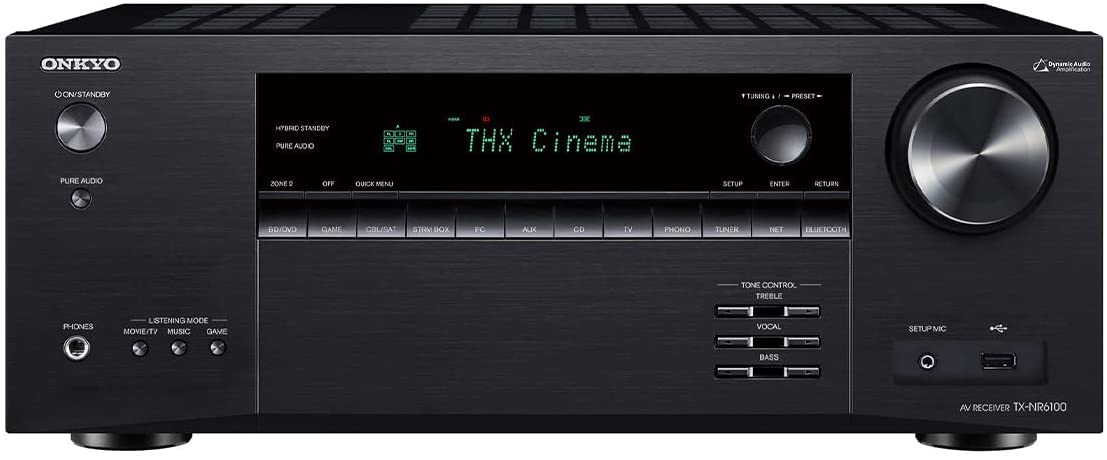
THX Select certification at this price point is the TX-NR6100’s headline feature — it guarantees the receiver maintains reference-level clarity and SPL in rooms up to 2,000 cubic feet, which covers most living rooms and dedicated theater spaces. The 7.2-channel amplifier delivers 210W per channel dynamically (6 ohms, 1kHz, 10% THD), which translates to robust headroom for sudden transients in action films and games. The amplifier runs cooler than many competing THX-certified units, an advantage for enclosed media cabinets.
HDMI 2.1 support includes three inputs at 40Gbps with 8K/60Hz and 4K/120Hz passthrough, VRR, ALLM, and QMS for smooth gaming. The IMAX Enhanced mode optimizes playback for IMAX-encoded Blu-rays, while Dolby Atmos and DTS:X decoding covers the standard immersive audio formats. Onkyo’s AccuEQ room calibration is less sophisticated than Dirac or Audyssey MultEQ, but it effectively tames the most egregious room modes in the sub-bass region. The unit also features a discrete Zone 2 HDMI output for different content in a second room.
Buyers should be aware of a growing number of reports about HDMI 2.1 board failures in Onkyo units from this generation — some users reported input dropouts and video loss after extended use. The remote lacks a backlight, and the on-screen interface feels dated compared to Denon’s and Sony’s modern overlays. If you buy this receiver, ensure it comes with a solid return or warranty policy. When working correctly, the TX-NR6100 offers THX certification at a price that no other brand currently matches.
Why it’s great
- THX Select certification ensures reference-quality output in normal-sized rooms
- 210W dynamic power per channel provides ample headroom for transient peaks
- Discrete Zone 2 HDMI output allows different 4K content in a second room
Good to know
- Reports of HDMI 2.1 board failures after extended use — verify warranty coverage
- AccuEQ room calibration is basic compared to Dirac Live or Audyssey MultEQ
- On-screen interface is visually dated and less intuitive than competitors
9. Denon AVR-S970H 8K Ultra HD 7.2 Channel AV Receiver

The Denon AVR-S970H occupies a sweet spot for buyers who want genuine Audyssey MultEQ room correction and a phono input without jumping to the X-series. The amplifier section delivers 90W per channel into 8 ohms — adequate for medium-sized rooms with speakers of 88dB sensitivity or higher. The three 8K HDMI inputs support 4K/120Hz and 8K/60Hz passthrough with VRR, ALLM, and QFT for gaming, and the two HDMI outputs allow simultaneous display on a TV and projector — a rare feature in this price tier.
HEOS multi-room streaming handles TIDAL, Spotify, Amazon Music HD, and Pandora, and the onboard phono stage performs well enough for entry-level turntables without external preamp noise. The on-screen setup assistant is clear and walks through speaker configuration, EQ, and source naming step by step. The unit runs cooler than comparable Onkyo and Sony receivers, typically idling around 80°F measured at the top vent, which makes it suitable for enclosed media consoles with moderate ventilation.
Zone 2 operation reduces the main channels to 5.1 — a trade-off that is common but worth noting if you plan to use powered Zone 2 speakers with an Atmos height configuration. The remote has no programmable TV power button, which means juggling two remotes for basic on/off. The lack of a printed manual (digital only) can be frustrating during initial setup. For listeners who prioritize Audyssey room correction and a clean phono stage, the S970H is the smartest buy in its class.
Why it’s great
- Audyssey MultEQ provides genuine frequency-domain correction that most budget receivers lack
- Two HDMI outputs allow simultaneous feed to a TV and projector
- Phono input and HEOS make it a versatile hub for vinyl and streaming music
Good to know
- Zone 2 operation limits main channels to 5.1
- Remote lacks a programmable TV power button
- No printed manual included — online PDF only
10. Pioneer VSX-935 7.2 Channel Surround Sound Network Receiver
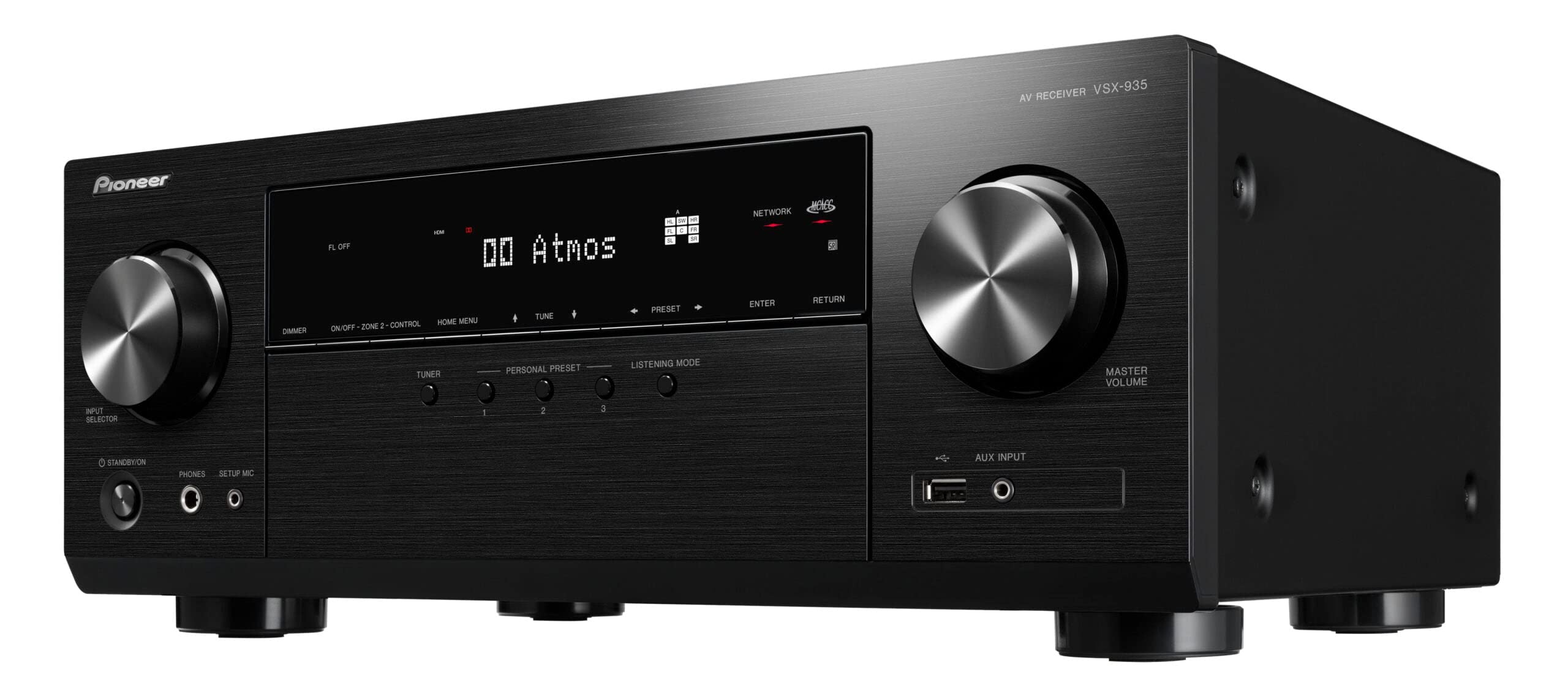
The Pioneer VSX-935 packs an uncommon feature set for its price: a 7.2-channel amplifier with HDMI 2.1 inputs supporting 8K/60Hz and 4K/120Hz pass-through, Dolby Atmos Height Virtualization, and dual subwoofer outputs. The amplification is rated at 80W per channel (8 ohms, 20Hz–20kHz, 0.08% THD), which is honest power that drives most bookshelf and center-channel speakers to satisfying levels in small-to-medium rooms. The Dolby Atmos Height Virtualization mode is particularly useful for 5.1 setups without ceiling speakers — it processes the Atmos metadata to create a convincing sense of overhead space without physical height channels.
The unit supports streaming via built-in Wi-Fi, Bluetooth, and Chromecast, and the network connectivity is notably faster than some older Pioneer models. The front-panel display is clear and includes a dimmer function for dark rooms. The RF remote — which works without line-of-sight — is a genuinely thoughtful inclusion for installations where the receiver is hidden inside a cabinet.
The VSX-935 has documented firmware quirks. Bluetooth connectivity can be unreliable — some users report the two-way Bluetooth feature (which transmits audio to headphones) is difficult to set up and drops out. A small number of units have experienced random display failures resolved by toggling Zone 2 power. The on-screen interface looks and behaves like a product from the 2000s. If you are comfortable working through firmware updates and can tolerate the dated UI, the core audio performance at this price is hard to beat.
Why it’s great
- HDMI 2.1 with 8K/60Hz and 4K/120Hz pass-through at a genuinely entry-level price
- Dolby Atmos Height Virtualization creates overhead effects without ceiling speakers
- RF remote works through cabinets — no line-of-sight required
Good to know
- Bluetooth connectivity is unreliable; some users report frequent dropouts
- Occasional display failure requires toggling Zone 2 power to reset
- On-screen interface is visually outdated and unintuitive
11. JBL MA710 7.2 Channel 8K AV Receiver

JBL’s MA710 is one of the few AV receivers designed with a shallow chassis depth (13.7 inches) that fits inside standard 14- to 15-inch media consoles without requiring rear clearance cutouts. The 7.2-channel amplifier delivers 110W per channel into 8 ohms, which is honest power for a compact unit. It supports Dolby Atmos and DTS:X decoding for up to a 5.1.2 speaker layout, and the included moving magnet phono input accommodates turntable connection without an external preamp — a feature that is still surprisingly rare in compact receivers.
Streaming is handled via Apple AirPlay 2, Google Chromecast built-in, and Bluetooth, covering the major wireless protocols. The HDMI section includes six inputs and one output with eARC, 8K/60Hz and 4K/120Hz passthrough, Dolby Vision, and HDR10+. The setup menu appears on the TV screen via HDMI, which simplifies configuration compared to the front-panel-only approach of cheaper receivers.
The remote lacks backlighting, which is an annoyance in dark rooms. A known firmware bug prevents the DTS-HD Master Audio format from being mixed down to 2.1 channels for stereo systems — if you run a 2.1 setup, Dolby TrueHD works but DTS-HD does not. JBL’s firmware update cadence has been slow, with no new updates released in over a year at the time of writing. Despite these quirks, the MA710’s shallow depth makes it the only genuine option for many built-in or wall-mounted media cabinetry solutions where standard receivers simply will not fit.
Why it’s great
- Shallow 13.7-inch depth fits inside standard media consoles where most receivers cannot
- 110W per channel into 8 ohms is strong power for a compact chassis
- Built-in Chromecast and AirPlay 2 cover the two most common streaming protocols
Good to know
- Remote lacks backlighting for dark home theater use
- DTS-HD Master Audio cannot be mixed down to 2.1 channels — problematic for stereo-only setups
- Firmware updates have been slow; no new update in over a year
FAQ
Do I need a 9.2 or 7.2 receiver for a 5.1.2 Atmos setup?
Can I use a 4K receiver with a 1080p TV for better audio?
What is the difference between Dolby Atmos Height Virtualization and physical height speakers?
Why does my receiver audibly click when switching inputs?
Can I bi-amp my front speakers with a 7-channel receiver?
Final Thoughts: The Verdict
For most users, the av receiver winner is the Denon AVR-X1700H because it delivers genuine Audyssey MultEQ room correction and full HDMI 2.1 support at a price that does not force compromises on speaker configuration. If you want Dirac Live room correction without paying extra for external software, grab the Onkyo TX-RZ50. And for a massive 13-channel 9.2.6 installation with the highest HDMI 2.1 bandwidth available, nothing beats the Sony STR-AZ7000ES.