
Our readers keep the lights on and my morning glass full of iced black tea. As an Amazon Associate, I earn from qualifying purchases.
Specs are compiled from manufacturer listings and verified buyer reviews and can change over time — please confirm the key details on the product page before buying.
Your eyes take roughly 30 minutes to fully adapt to the dark, and a single blast of white light in the cockpit wipes that out in an instant. That is why every serious pilot carries a light with a dedicated red mode, and why the choice depends on beam quality, battery strategy, and how it rides on your kit. Here are the top contenders built around that one non-negotiable feature.
I’m Min — the founder and writer behind Gadgets Feed. This guide is built by comparing the manufacturers’ published specifications and the patterns across verified customer reviews, so you get each pick’s real strengths and trade-offs instead of marketing spin.
The right aviation flashlight preserves your night-adapted vision while still throwing enough light for preflight checks, and this guide finds the one that fits your flying style.
Our Picks at a Glance

How To Choose The Best Aviation Flashlight
Before you compare specs, understand that an aviation light has one job above all others: keep your night vision intact while still letting you see. A red or green LED does this because those wavelengths don’t trigger the same rod-cell response as white light, so your dark-adapted eyes stay dark-adapted.
Lumens vs. Candela
Lumens measure total light output, while candela measures intensity or throw. A high-lumen flood is great for illuminating a cabin, but a high-candela spot throws a tight beam further down a runway or taxiway. For cockpit work, you want enough candela to read instruments without blasting the whole panel.
Battery Strategy
Your choice of battery affects weight, runtime, and what happens when you run dry. AA alkaline lights are easy to source anywhere but are heavier. Rechargeable lithium-ion units offer long runtime and consistent output but need a charging cable. Some pilots prefer AA because they can share spares with a headset battery.
Quick Comparison
| Model | Best For | Max Lumens | Battery Life | Weight | Amazon |
|---|---|---|---|---|---|
| OLIGHT Oclip Pro★ Best Overall | Hands-free night work | 500 lumens | 144 hours | 1.87 oz | Amazon |
| OLIGHT ArkPro LiteMost Versatile | Versatile EDC with UV | 1200 lumens | 10 days (moonlight) | 3.68 oz | Amazon |
| Pelican 2370 | Simple AA durability | 106 lumens | 3h 45m / 41h 15m | 8.8 oz | Amazon |
| Streamlight Sidewinder III | Helmet-mounted missions | 275 lumens | 100+ hours (low) | — | Amazon |
| SureFire Aviator | Premium two-color output | 250 lumens | 2.5 hours | — | Amazon |
In‑Depth Reviews
1. OLIGHT Oclip Pro Rechargeable EDC Clip-on Flashlight
Our pick — over 4.5★ from 3,000+ verified ratings; the strongest balance of quality and price.
This pocket-sized workhorse clips to your uniform and frees both hands for the task.
Clip this 1.87 oz light to your shirt, bag, or car hood and it stays put, thanks to a strong clip and magnetic base built for hands-free work. For night patrols or preflight checks, the 500-lumen floodlight covers a wide area, while the 40-lumen red light preserves your night vision without forcing you to hold anything.
Battery life is the headline here — 144 hours on a single charge, which is a 38.4x gap versus the Pelican 2370’s 3.75 hours. That means weeks of night shifts before you even think about the USB-C cable, and it doubles as an emergency beacon when you need it most.
Buyers report it is “patrol-proven” with a “strong clip on uniform” and a “bright flood beam” that makes it “essential for night workers.” The crowd favorite — 4.7 stars across 3,400+ owners — with brightness by far the most-praised trait, followed closely by its compact size.
What wins pilots over
- 144-hour battery life means you rarely recharge
- Magnetic base sticks to metal panels for repairs
- Three lighting solutions: flood, spot, and red
- Tough, water-resistant metal body
Who should look elsewhere
- Built-in battery is non-removable, so no field swap
- 500 lumens trails the brighter ArkPro Lite’s 1200
- No dedicated helmet mount for aircrew use
Reach for it if: you want a lightweight, clip-and-go light for night work, repairs, or flight bags that rarely needs charging.
Think twice if: you need a helmet-mounted solution or a removable battery for multi-day field operations.
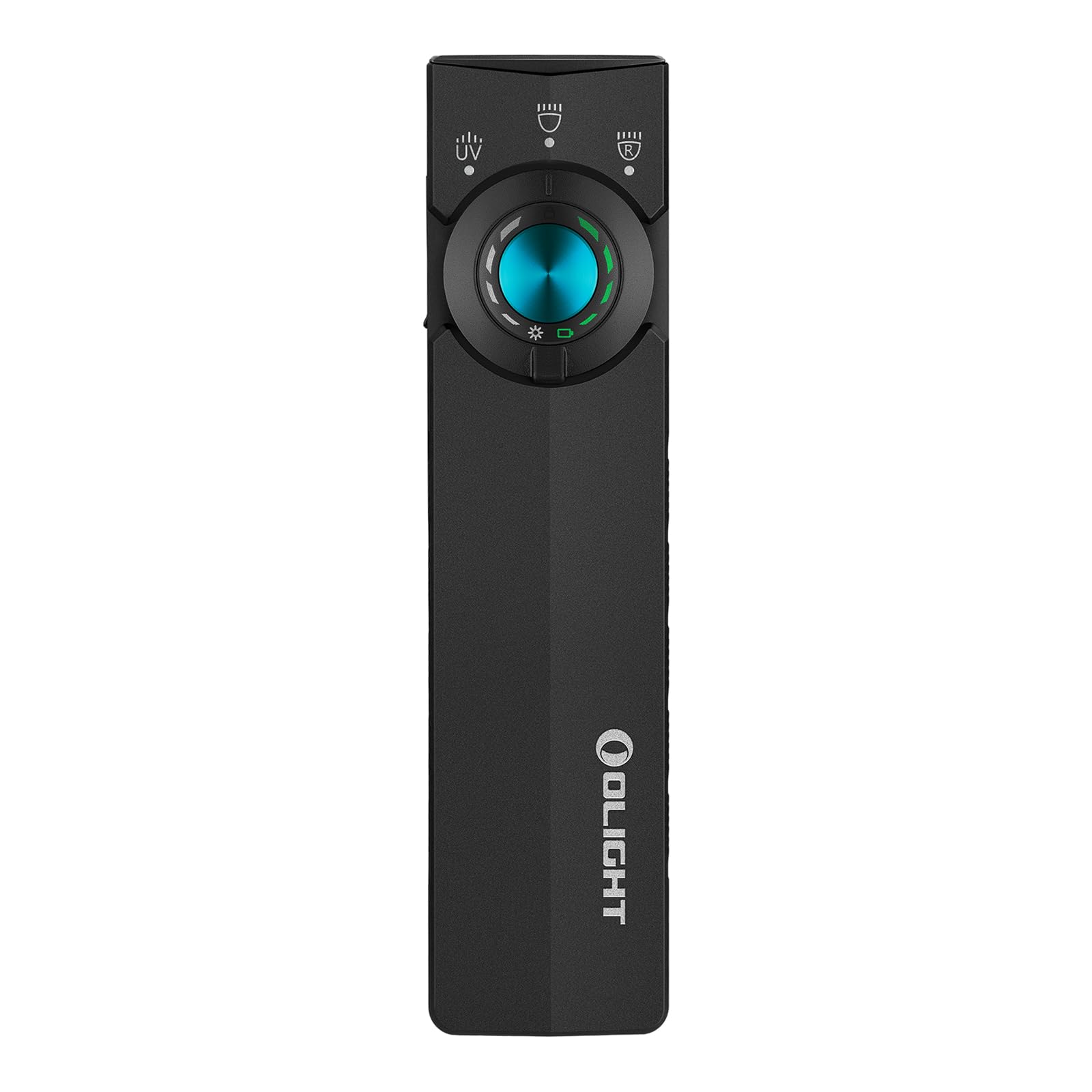
2. OLIGHT ArkPro Lite EDC Pocket Flashlight with UV Light
This flat-bodied three-in-one outshines the Oclip Pro’s 500 lumens with a 1200-lumen punch.
Dropping this 3.68 oz flat light into a trouser pocket is easy thanks to a slim profile and anti-slip texture. Its red light preserves night vision for map reading, and the SOS mode offers a reliable rescue signal when you need it.
The 365nm UV light at 1000mW goes beyond flying — it exposes pet urine stains and bathroom grime that are invisible to the naked eye, making this a true multi-tool. Charging is flexible with both magnetic and USB-C options, and a full charge delivers up to 10 days of continuous use in moonlight mode.
Owners mention the “UV outperforms dedicated UV light even on low,” and the “secure pocket clip” plus “strong magnetic base” make it a daily carry favorite. Functionality is the second-most praised aspect after brightness, with owners calling it a “most-used work essential.”
Standout feature: the 1200-lumen white LED makes this the brightest pick here — 2.4x the Oclip Pro’s 500 lumens — while the UV and red modes cover almost any task you can name.
Grab this if: you want one light that handles cockpit work, inspections, and everyday EDC without carrying a toolbox.
Look elsewhere if: you prefer a simpler two-mode light or need helmet-mount compatibility for aircrew missions.
3. Pelican 2370 Tactical Flashlight

This AA-powered, milled-aluminum light is trusted by Navy ships and night-fliers.
Powered by two AA alkaline batteries (included), this 8.8 oz light is noticeably heavier than the 3.68 oz ArkPro Lite — a 2.4x gap — but that weight comes from a Type II anodized aluminum body built to shrug off years of abuse. One Navy owner reported using it for 2+ years on ship with heat, moisture, and impacts and seeing no degradation.
The white, red, and green LEDs are selected via a magnetic click selector that remembers your last color choice. At 106 lumens high and 13 lumens low, it delivers a 190-meter beam path, and the red or green modes preserve night vision for cockpit map reading. Buyers love that it can “light up a moderate size room,” and they note the low mode is perfect for bridge work at night.
The “Led options” drew mixed reactions — some received white/red/green rather than white/red/blue — so check the exact variant before ordering. Still, with the Pelican Limited Lifetime Guarantee of Excellence behind it, this is the durability pick.
Real-world take: the runtime split is the key spec — 3h 45m on high stretches to 41h 15m on low, and sharing AA cells with a headset battery makes logistics simple.
Best for: pilots who want a bombproof, AA-powered light with simple color selection and zero charging cables.
Not for: those who need a pocket-friendly 3-ounce light or a rechargeable unit for daily use.
4. Streamlight Sidewinder III Aviation Flashlight

This angled-head light mounts to an HGU-84 helmet and tilts 185 degrees to aim where you look.
This is the pick for rotary-wing aircrew: it ships with an NVG mount compatible with the HGU-84 helmet, so it rides on your head and frees both hands. The 185-degree tilting body lets you aim the beam exactly where you need it without moving your head.
Four fixed LEDs — white, green, blue, and IR — each offer four brightness levels plus strobe, covering everything from cockpit tasks to night-vision-compatible lighting. On the included non-rechargeable battery, it throws up to 275 lumens and drops to over 100 hours of continuous low output when every minute counts.
The high-impact nylon housing is O-ring sealed and IPX7 waterproof to 1m for 30 minutes, plus 3m impact-tested to MIL-STD-810H. Customers note it works flawlessly with both CR123 and AA batteries, and it has survived being “dirty wet dropped banged and works every time” in EMS work.
Why aircrew love it
- Tool-free NVG helmet mount included
- IR mode for night-vision surveillance
- IPX7 waterproof and impact-tested
- Four LED colors with strobe
The trade-offs
- No strap included in the box
- IR blue light may be visible under Gen3 night vision
- 275 lumens is moderate versus the ArkPro Lite’s 1200
Choose this if: you fly with a helmet and need a hands-free, mission-ready light with IR capability.
skip it if: you just need a pocket light for the flight bag — the helmet mount won’t earn its keep there.
5. SureFire Aviator 250 Lumen Flashlight
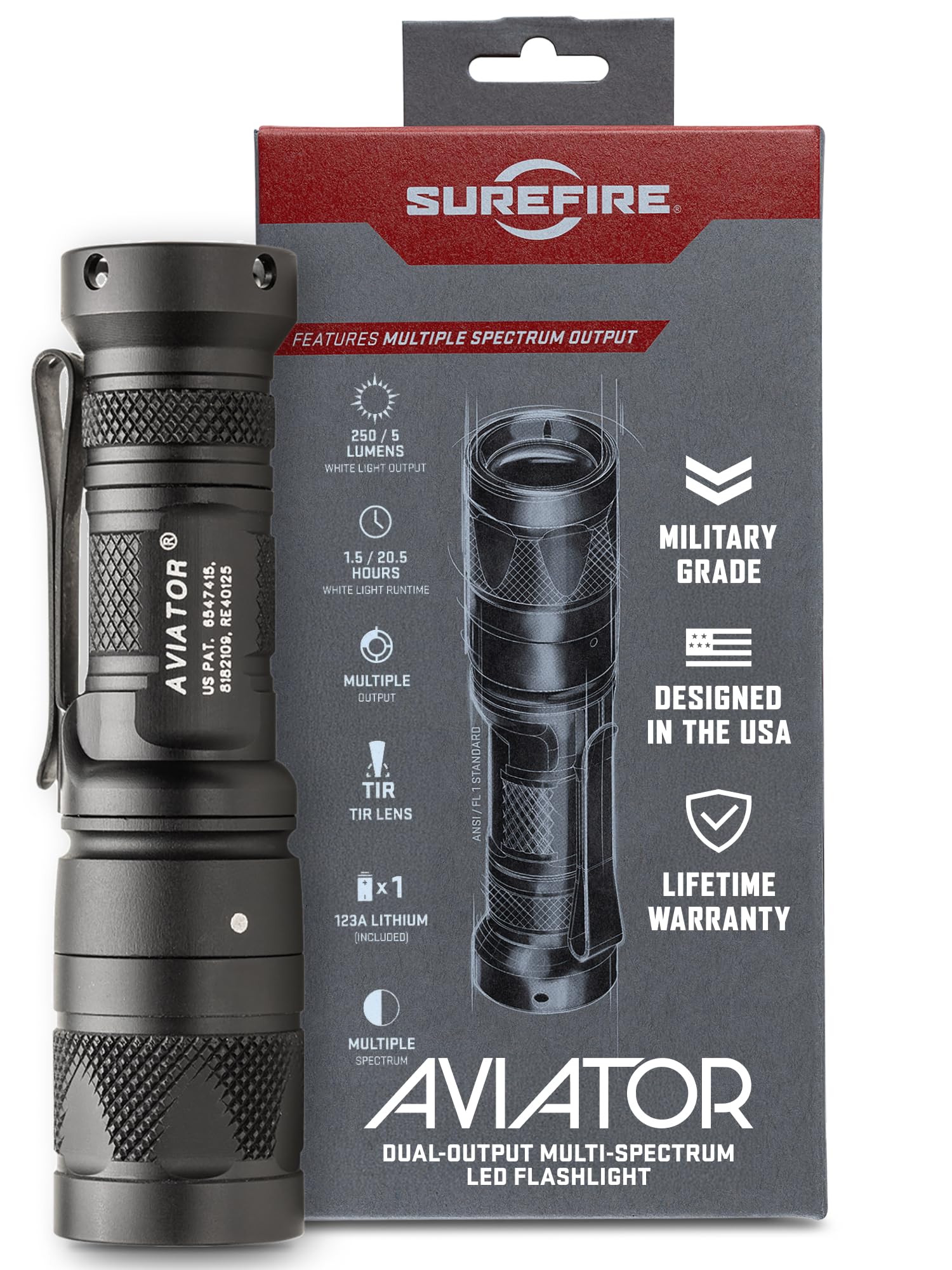
This aviator’s heirloom is a dual-output light with red low as the default first setting.
Long-time owners call it the light that ends flashlight obsessions. The rotating head switches between off, white, and red, and the red low mode activates first, preserving night vision before you ever reach a bright setting. The 1-lumen red low is nearly too bright, one owner noted, but that’s a compliment to its usefulness.
Built from Mil-Spec hard-anodized aerospace aluminum with an optically coated tempered window, it handles the abuse of daily carry with a positive lockout that prevents accidental activation in a bag. The dual-output tail cap gives you press for momentary-on high, click for constant-on, and a second press for low.
At 9,300 candela, this 250-lumen light throws a long, focused beam — perfect for preflight inspections and spotting obstacles. Reviewers point out it is “pricey but worth it” and call it “my favorite Surefire” for its “reliable, solid feel, tactile controls, and right size for carry.”
The honest catch: some shoppers say issues with the red light functionality, and the 2.5-hour battery life on lithium cells means you’ll want spares for long nights.
Worth it for: pilots who want the gold-standard build and a beam that reaches while staying intuitive to operate in the dark.
Think twice if: you need rechargeable power or a multi-color UV/IR setup — this focuses purely on white and red.
Understanding the Specs
Lumens vs. Candela
Lumens tell you total light output; candela tells you how tightly that light is focused. A high-lumen flood lights a wide room, while high candela throws a pencil beam further. For aviation, you want enough candela to see instruments and runway markers without washing out your night vision.
Red Light Modes
Red (or green) wavelengths preserve your scotopic vision — the eye’s ability to see in low light. A light with a true red low mode, like the SureFire’s 1-lumen setting, lets you read charts and then look out the window without re-adapting.
FAQ
Why is red light preferred for night flying?
How many lumens do I need for a cockpit flashlight?
Can I use a regular flashlight for aviation?
What is the difference between a clip-on and a helmet-mounted light?
Is a UV light useful for pilots?
How long should an aviation flashlight battery last?
Are rechargeable or AA battery flashlights better for aviation?
What does IPX7 waterproof mean for a flashlight?
Final Thoughts: The Verdict
For most pilots, the aviation flashlight winner is the OLIGHT Oclip Pro because it blends a 144-hour battery, a true red mode, and a clip-on design that handles night work hands-free. If you want the brightest all-rounder with a UV bonus, the OLIGHT ArkPro Lite delivers 1200 lumens in a pocket-friendly flat body. And for helmet-mounted aircrew missions, the Streamlight Sidewinder III is the one to reach for with its NVG mount and IR capability.
How We Picked
We do not accept paid placement. Every pick is matched to a real buyer and a real use-case; we do not hands-on test units.
Sources & Methodology
Specifications: manufacturer listings and product documentation. Review insights: verified customer reviews, as of September 2026. Pricing: not shown on this page (it changes often); check the current price via the retailer link.
As an Amazon Associate, Gadgets Feed earns from qualifying purchases. This does not affect which products we feature.