
Losing comms in the pattern isn’t just an inconvenience—it’s a genuine safety risk. A quality aviation handheld radio bridges that gap, giving you a direct line to tower, approach, and other traffic when the panel goes dark or when you’re on the ground monitoring pre-flight. But not every airband transceiver delivers the transmission clarity and battery endurance a pilot actually needs.
I’m Min — the co-founder and writer behind Gadgets Feed. I’ve spent countless hours dissecting the technical specifications, customer feedback, and real-world performance data on every major airband handheld to identify which models truly earn their spot in a flight bag.
If you need a reliable backup for cockpit emergencies or a dedicated unit for flight instructing, this guide to the best aviation handheld radio will steer you toward the model that matches your mission and your budget.
How To Choose The Best Aviation Handheld Radio
An aviation handheld radio is a long-term investment in safety. The wrong choice means garbled transmissions, dead batteries mid-flight, or a radio that can’t interface with your headset. Focus on a few critical specs to avoid those pitfalls.
Transmission Power and Audio Output
Measured in Watts PEP (peak envelope power), a higher output—5W or 6W—ensures your voice reaches tower from farther distances, especially crucial when operating near terrain or at uncontrolled fields. Pair that with a loud speaker (1400 mW or more) so you can hear callouts even with engine noise or without a headset plugged in.
Battery System: Li-Ion vs. AA Trays
A built-in high-capacity lithium-ion pack (2000 mAh or above) gives you a full day of pattern work on a single charge. Many radios also offer an optional AA battery tray—this is a lifesaver when you can’t access a charging outlet and need to grab alkaline cells from the FBO. Look for USB-C charging for convenient top-ups from a power bank.
Channel Capacity and Frequency Coverage
You need at least 200 memory channels to store common frequencies for your home airport, practice areas, and cross-country routes. Ensure the radio covers the full aviation band (118–137 MHz) and, ideally, NOAA weather channels. Models with 8.33 kHz spacing are mandatory for operations in Europe and desirable for future-proofing.
Durability and Water Resistance
A handheld that lives in a flight bag gets banged around. An IPX5 or IP67 rating protects against rain and splashes. A rugged chassis with a reliable antenna connector (BNC is standard) and a sturdy belt clip matters more than you’d think on every preflight walk-around.
Quick Comparison
On smaller screens, swipe sideways to see the full table.
| Model | Category | Best For | Key Spec | Amazon |
|---|---|---|---|---|
| Yaesu FTA-250L | COM Only | Reliable backup comms | 5W TX, 1950mAh Li-ion | Amazon |
| Sporty’s PJ2+ | COM Only | Simple pilot operation | 6W PEP, 6x AA batteries | Amazon |
| Yaesu FTA550 | NAV/COM | ILS/VOR navigation | 108-137 MHz, 200 ch | Amazon |
| Icom IC-A16 | COM Only | Professional durability | 2400mAh Li-ion, 17h | Amazon |
| Icom IC-A16B 51 | COM + Bluetooth | Wireless headset freedom | Bluetooth, IP67, 6W | Amazon |
| Wouxun KG-S74A | COM Only | Budget-friendly option | 6W PEP, USB-C, IP67 | Amazon |
| C. Crane CC Skywave SSB 2 | Receiver Only | Listening and backup | AM/FM/SSB/Air, 60h | Amazon |
| Garmin Rino 750t | GMRS/GPS | Ground coordination | TOPO maps, 5W GMRS | Amazon |
| Lightspeed Sierra ANR | ANR Headset | Cockpit noise cancelling | ANR, Bluetooth, 16 oz | Amazon |
In‑Depth Reviews
1. Yaesu FTA-250L Handheld VHF Airband Transceiver
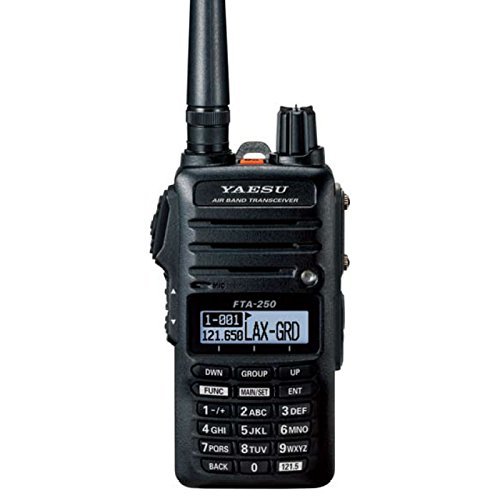
The Yaesu FTA-250L hits the sweet spot between price and reliable performance. With a 5W transmitter and 700 mW of audio output, it delivers clear transmissions and strong receive audio even in moderately noisy environments. Its digital squelch system provides a significant advantage over older analog designs, eliminating annoying noise bursts between transmissions.
The included 1950 mAh Li-ion battery offers solid endurance for a full day of training flights or a cross-country trip. The package comes with a drop-in charging cradle, AC adapter, 12V DC cable, and a quality headset adapter that screws on securely. At just over 4 inches tall, it fits easily into any flight bag compartment alongside the essential checklists.
Support for 8.33 kHz narrow-band spacing makes it suitable for European operations where older 25 kHz-only radios are being phased out. The IPX5 water resistance rating means it can handle a light rain on the ramp without concern. Overall, the FTA-250L offers the best combination of build quality, feature set, and price for most pilots.
Why it’s great
- Excellent digital squelch eliminates background noise
- Compact size with premium Yaesu build quality
- Includes drop-in charger, AC and DC cables
Good to know
- Charges only via cradle, no direct USB port
- Speaker sound is treble-heavy at max volume
2. Sporty’s PJ2+ COM Aviation Handheld Radio

The Sporty’s PJ2+ is designed from the ground up for no-fuss operation. Its defining feature is the built-in dual PJ headset jacks—no adapters required. You plug your headset straight in, and you’re live. The large, backlit keypad is easy to operate with one hand while flying, and the dedicated “flip-flop” button lets you swap between active and standby frequencies instantly.
Rated at 6W PEP transmission power, the PJ2+ consistently reaches tower from pattern altitude and beyond. The radio runs on six AA batteries, which stay fresh in storage for months—ideal for a backup radio you grab in an emergency. Alternatively, the included USB-A to USB-C cable lets you power it directly from a panel port or power bank.
There are no complex menus to navigate; simply power it on, punch in the frequency, and talk. A dedicated 3.5mm headphone jack is also on board for listening-only scenarios like airshows or student monitoring. For instructors and private pilots who value simplicity above all else, the PJ2+ is a smart, reliable choice.
Why it’s great
- Built-in PJ headset jacks eliminate adapter headaches
- Extremely simple, intuitive operation
- USB-C backup power option for in-panel charging
Good to know
- Uses disposable AA batteries if not using USB power
- No VOR/ILS navigation capability
3. Yaesu FTA550 Handheld VHF Transceiver

The Yaesu FTA550 stands out in this lineup as the only model with true NAV capability—VOR and ILS navigation. If you’re flying IFR or training for an instrument rating, the ability to intercept a localizer or track a VOR radial with your handheld is a huge bonus when the panel-mounted NAV radios fail. The FTA550 receives from 108 to 136.975 MHz, covering both the NAV and COM bands.
It runs on two AA batteries (included with the purchase) rather than a proprietary Li-ion pack. This is a double-edged sword: on one hand, you can find fresh batteries anywhere; on the other, you won’t get the runtime of a 2400 mAh Li-ion cell. The menus are functional but feel dated compared to more modern units, and programming can be tedious without the optional software.
Users report tight battery compartment tolerances—Ni-MH rechargeables may require a gentle extraction with a screwdriver. The receive audio is loud and clear, and the headset adapter is included. If navigating is part of your backup plan and you don’t mind the AA trade-offs, the FTA550 earns its spot for the VOR/ILS capability alone.
Why it’s great
- Only handheld in this tier with VOR/ILS navigation
- AA batteries are universally available
- Loud, clear receive audio
Good to know
- AA battery tray is tight and difficult to open
- Menu interface is outdated and not user-friendly
4. Icom IC-A16 VHF COM Aviation Handheld

The Icom IC-A16 brings the build quality and reliability that aviation professionals expect from the brand. Its 2400 mAh Li-ion battery delivers an industry-leading average life of 17 hours per charge, easily lasting through long shifts, cross-country flights, or multi-day training events. The 1500 mW loudspeaker output ensures you hear transmissions clearly even in high ambient noise.
A dedicated emergency button for 121.5 MHz is prominently placed for instant access when seconds count. The full keypad allows direct frequency entry, and the sidetone function lets you hear your own voice through an aviation headset. The auto noise reduction circuit intelligently filters background noise to enhance transmission clarity without distorting speech.
The included rapid charger replenishes the battery quickly, minimizing downtime between flights. The IC-A16 receives from 108 to 136.99166 MHz and also covers 161.650–163.275 MHz for weather and other services. While the manual is sparse and programming requires a YouTube tutorial or two, the radio itself is rock-solid. For a no-compromise primary handheld, the IC-A16 is hard to beat.
Why it’s great
- Exceptional 2400 mAh battery with long runtime
- Automatic noise reduction improves clarity
- Rapid charger included for quick turnaround
Good to know
- Limited to 200 memory channels
- Manual lacks detailed programming instructions
5. Icom IC-A16B 51 USA Aviation Bluetooth Handheld
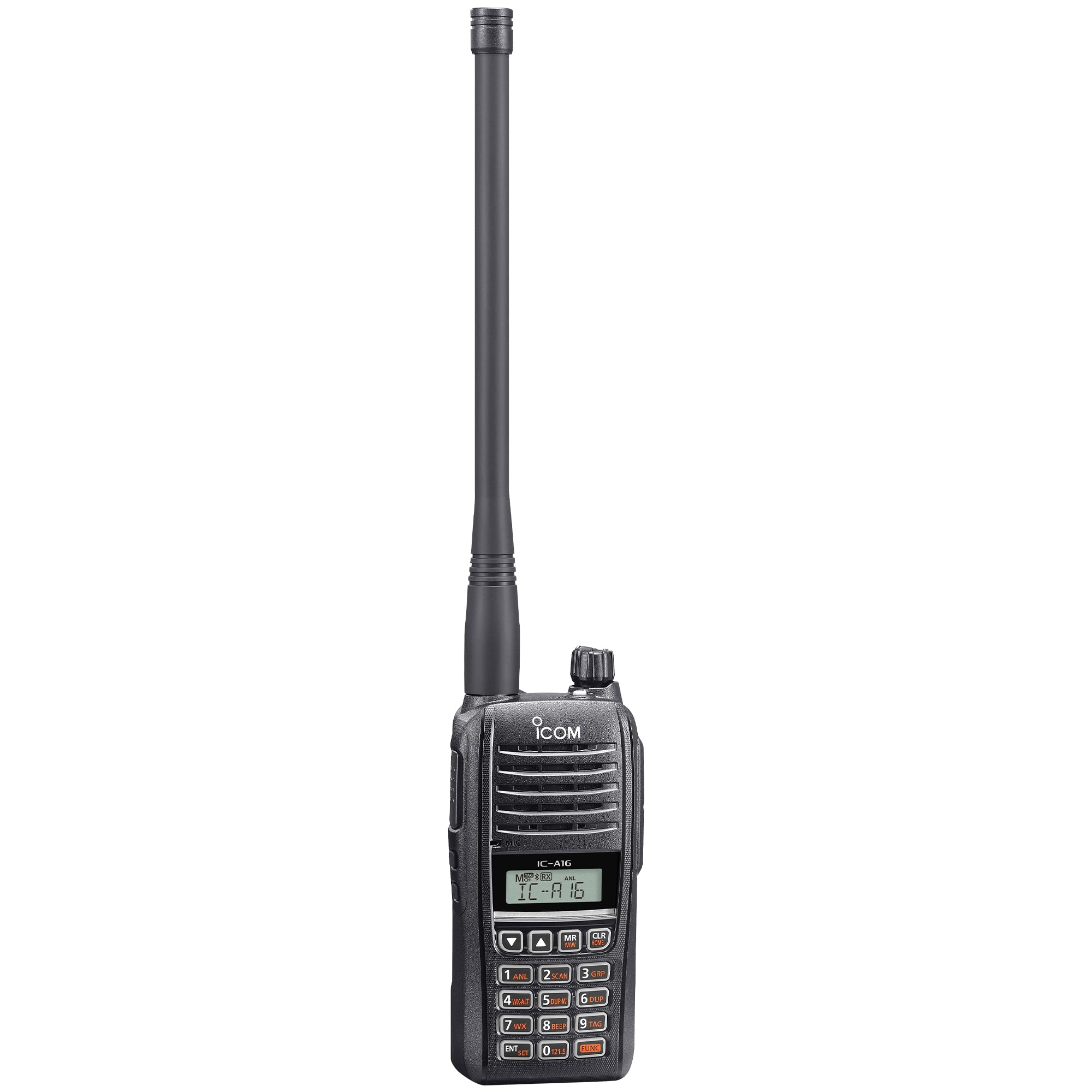
The Icom IC-A16B takes everything great about the standard IC-A16 and adds Bluetooth connectivity for wireless freedom. Pair it with a Bluetooth aviation headset like the Bose A20, and you eliminate the cable between your headset and the radio—a genuine quality-of-life improvement for flight instructors who are constantly in and out of the cockpit.
The radio retains the same 2400 mAh battery and 6W PEP transmission power as the standard A16, but adds IP67 waterproofing (fully dust-tight and submersible). The 1500 mW audio output remains loud and clear. It supports both 8.33 kHz and 25 kHz channel spacing, making it compliant with international frequency standards.
The illuminated keypad and LCD screen are easy to read in low-light conditions. The Bluetooth pairing process involves a sub-menu that isn’t immediately intuitive, but once connected, the performance is seamless. The only significant drawback is the lack of USB charging—you’re tied to the provided drop-in cradle—so consider that if you travel without a reliable 110V source. For wireless cockpit integration, this is the premium choice.
Why it’s great
- Bluetooth pairs with wireless headsets and AirPods
- IP67 rated for dust and water submersion
- Excellent 6W PEP transmit power
Good to know
- No USB-C charging; requires cradle and AC adapter
- Bluetooth setup requires navigating complex menus
6. Wouxun KG-S74A Compact VHF Aviation Radio

The Wouxun KG-S74A is the most affordable fully-featured aviation handheld in this roundup, making it an excellent entry point for student pilots or those who need a dedicated airband radio for ground monitoring. It delivers up to 6W PEP output with a superheterodyne receiver that pulls in clear reception from traffic miles away.
Battery life is a standout feature: the 2000mAh Li-ion pack provides up to 26 hours of use with the battery save function engaged. The built-in USB-C port lets you charge from any standard power bank or laptop charger, eliminating the need for a proprietary cradle. The backlit LCD and keypad make it easy to operate in dim conditions, and a built-in flashlight is a nice bonus for preflight inspections.
The IP67 waterproof rating means it can survive a drop in a puddle or a sudden downpour. With 400 memory channels and NOAA weather alert notifications, it’s a capable radio that covers all the basics. The manual is confusing, and programming requires some trial and error. It also lacks VOR navigation. As a cost-effective airband transceiver for air-to-air communication, the KG-S74A delivers surprising value.
Why it’s great
- Excellent 26-hour battery life with USB-C charging
- IP67 waterproof for all-weather reliability
- Affordable price for full airband capability
Good to know
- Confusing manual with steep learning curve
- Not CHIRP-compatible for software programming
7. C. Crane CC Skywave SSB 2 Multiband Radio
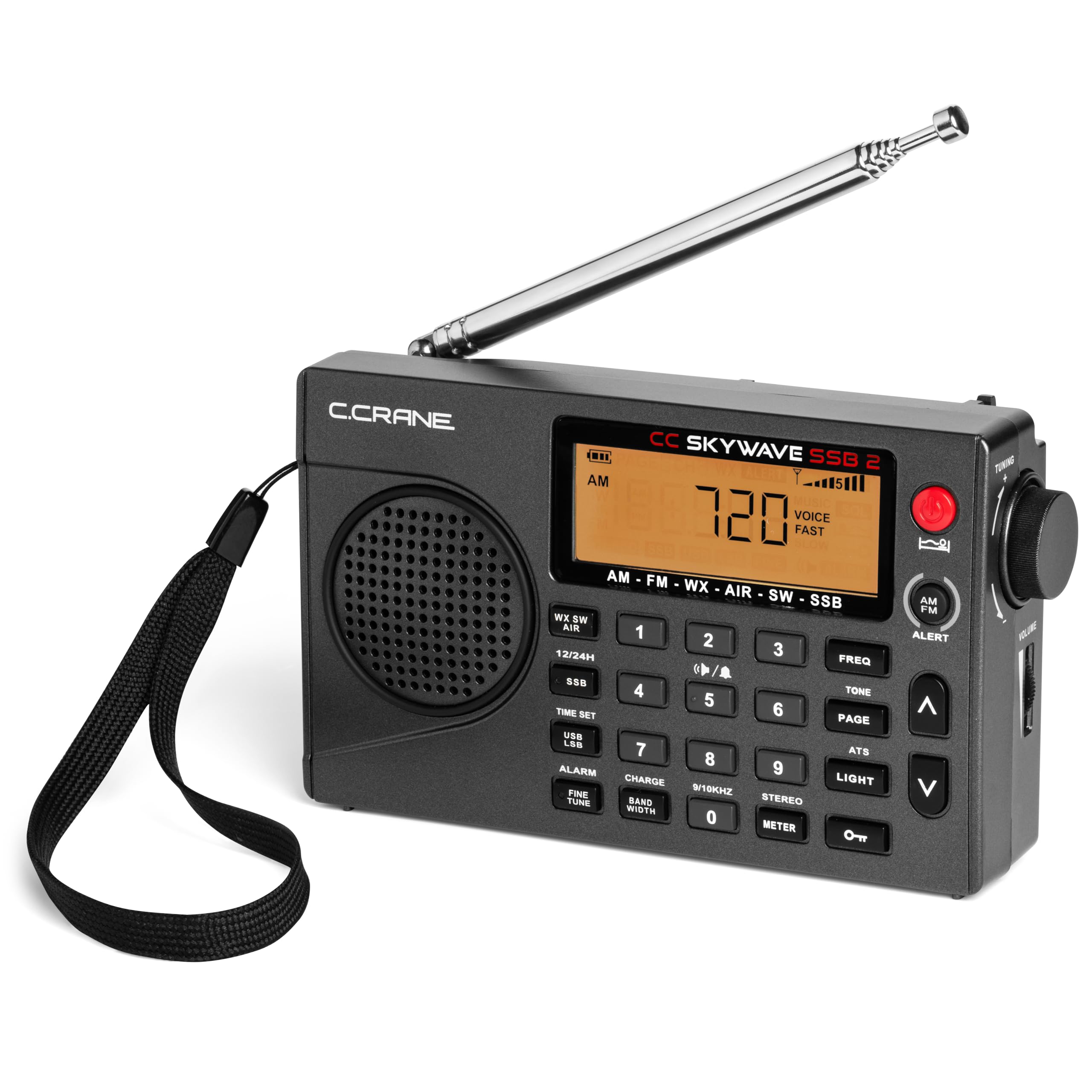
The C. Crane CC Skywave SSB 2 is not a transceiver—it is a high-performance multiband receiver that includes VHF aviation band reception. This distinction matters: you can listen to ATC, ATIS, and traffic perfectly, but you cannot transmit. For non-pilots monitoring air traffic, or pilots who want a pocket-sized backup receiver, this unit excels.
Beyond aviation, it covers AM, FM, NOAA weather with alerts, shortwave from 1711–29999 kHz, and single sideband (SSB). SSB is a crucial emergency communication mode after natural disasters when normal infrastructure is down. The receiver is digitally tuned with superior selectivity, and multiple bandwidth settings let you optimize for clear or crowded frequencies.
It runs approximately 70 hours on two AA alkaline batteries—efficiency that outstrips most handheld transceivers by a factor of three. At only 6 ounces and measuring 4.75″ x 3″ x 1.1″, it disappears into a flight bag or glovebox. Includes a 23-foot portable shortwave reel antenna, earphones, and a faux leather case. For a receive-only companion that does more than just airband, the CC Skywave is a versatile tool.
Why it’s great
- Incredible 70-hour run time on AA batteries
- Covers AM, FM, SSB, airband, and shortwave
- Ultra-portable at only 6 ounces
Good to know
- Cannot transmit—receive only
- Small buttons make operation tricky for large hands
8. Garmin Rino 750t Two-Way Radio with Topo Mapping

The Garmin Rino 750t serves a different mission from the other products in this list: it is a GMRS two-way radio with integrated GPS and preloaded TOPO U.S. 100K maps. While it does not tune the aviation band, it is included here because it is a valuable companion for ground crew, ramp coordinators, and search-and-rescue pilots who need reliable ground-to-ground communication and navigation.
Its 3-inch sunlight-readable touchscreen is dual-orientation and works well in direct sunlight. The radio transmits at 5W on GMRS frequencies for up to 20-mile range, and supports both voice and unit-to-unit text messaging. The position reporting feature shows other Rino users on the same channel on the map, which is excellent for coordinating teams spread across an airport or search area.
The dual battery system accepts the included Li-ion pack or optional AA batteries for extended field use. Bluetooth connectivity enables smart notifications and automatic uploads to the Garmin Connect app. The interface feels slightly dated compared to modern smartphones, and navigation through the menus can be slow. For pilots who also need a robust ground radio with mapping, the Rino 750t is a specialized but powerful solution.
Why it’s great
- Excellent 3-inch sunlight-readable touchscreen with maps
- Unit-to-unit location sharing for team coordination
- Dual battery system for extended field use
Good to know
- Does not receive aviation airband frequencies
- Requires FCC license for GMRS use
9. Lightspeed Aviation Sierra ANR Headset

The Lightspeed Sierra is a full aviation headset with Active Noise Reduction (ANR), not a radio. It appears here because it is the most effective way to pair with any aviation handheld for crystal-clear communication in a noisy cockpit. The ANR circuit dramatically cuts engine drone and wind noise, reducing auditory fatigue on long flights and improving your ability to hear weak transmissions from your handheld.
At 16 ounces, the Sierra is lightweight and designed for comfort with breathable ear seals and minimal clamping force. It features built-in Bluetooth for wireless connection to your phone or a Bluetooth-enabled handheld like the Icom IC-A16B. The integrated control box provides easy access to volume, Bluetooth pairing, and auxiliary input for music or GPS audio.
Battery life is approximately 40 flight hours with Bluetooth active, running on two AA batteries. The ComPriority feature automatically lowers music volume whenever radio transmissions or intercom calls come in. The FlightLink app records incoming and outgoing communications. For the pilot who uses a handheld radio as their primary or backup comm, adding the Sierra ANR headset is the single biggest upgrade to audio quality you can make.
Why it’s great
- Excellent ANR dramatically reduces cockpit noise
- Bluetooth connects to phones and compatible handhelds
- Comfortable lightweight design for long flights
Good to know
- More expensive than a standalone radio
- Requires batteries; no rechargeable pack option
FAQ
Can I use a standard GMRS or Ham radio to listen to ATC?
What does 8.33 kHz channel spacing mean for me?
How long should a full battery charge last on an aviation handheld?
Do I need a headset adapter for these radios?
Can I use an aviation handheld radio as my primary in-flight communication?
Final Thoughts: The Verdict
For most users, the best aviation handheld radio winner is the Yaesu FTA-250L because it delivers the perfect balance of 5W transmit power, 250 memory channels, 8.33 kHz compatibility, and drop-in charging convenience at a price that won’t break your budget. If you want the simplicity of one-hand operation with no adapters, grab the Sporty’s PJ2+. And for wireless cockpit integration with Bluetooth and IP67 waterproofing, nothing beats the Icom IC-A16B 51.