
Flying at altitude means your body operates in a low-oxygen environment where even a minor drop in blood saturation can impair judgment, slow reaction times, and cause dangerous fatigue. An aviation oxygen tank is not a luxury item — it’s a critical piece of life-support equipment that must deliver pure, regulated O₂ on demand, whether you’re piloting an unpressurized piston single or supplementing cabin air in a complex aircraft. The market is crowded with tanks that vary wildly in fill capacity, valve compatibility, and durability under pressure, making the selection process a genuine safety decision.
I’m Min — the co-founder and writer behind Gadgets Feed. I’ve spent hundreds of hours cross-referencing DOT certification data, analyzing regulator flow rates, and comparing aluminum cylinder wall thicknesses across the entire O₂ tank supply chain to ensure this guide reflects real safety tolerances, not marketing claims.
After sifting through nine distinct contenders, from portable pony bottles to full-size welding-grade cylinders, I’ve isolated the models that deliver genuine utility and safety compliance. This guide to the best aviation oxygen tank is built around measurable specs — fill pressure, hydrostatic test windows, and valve thread standards — so you can match a tank to your specific airframe and mission profile without guesswork.
How To Choose The Best Aviation Oxygen Tank
Selecting an O₂ tank for aviation use requires filtering for three non-negotiable parameters: DOT compliance, valve thread standard, and physical capacity matched to your typical cruise altitude and crew size. A tank that passes these checks will serve reliably for a decade or more with proper hydrostatic retesting.
DOT Certification and Hydrostatic Test Windows
Every aviation-grade oxygen cylinder must carry a DOT (Department of Transportation) stamp indicating the original hydrostatic test date and the retest interval — usually 5 years for aluminum, 10 years for steel. Tanks sold as “new” should have a stamp dated within the last year, giving you the maximum usable window before recertification is required. The stamp also specifies the service pressure (typically 2015 PSI or 3000 PSI), which must match your regulator’s rated inlet.
Valve Type and Thread Standard
The valve on the tank dictates which regulator can be attached. CGA540 is the standard for high-pressure oxygen service in welding and general industrial use, with a 0.903″-14 thread. CGA870 (often found on medical E-size tanks) uses a different thread pitch and cross-seal design. For aviation applications, CGA540 provides the broadest regulator compatibility and is the preferred standard for non-medical cockpit use.
Capacity and Range Planning
Cylinder capacity is measured in cubic feet (cu/ft) at standard temperature and pressure. A 60 cu/ft tank at 2015 PSI provides roughly 2 to 3 hours of continuous O₂ for one person at 12,000 feet, while a 125 cu/ft tank extends that to 4 to 6 hours. For high-altitude work above 14,000 feet, where consumption rates climb, larger tanks reduce the risk of running short during extended legs.
Quick Comparison
On smaller screens, swipe sideways to see the full table.
| Model | Category | Best For | Key Spec | Amazon |
|---|---|---|---|---|
| Weldfabulous 125 cu/ft Oxygen Tank | Premium Full-Size Cylinder | Extended high-altitude flights with full O₂ system | 125 cu/ft capacity, 10-year hydrotest window | Amazon |
| 60 cu/ft Aluminum Oxygen Cylinder | Mid-Range Workhorse | General aviation and portable backup | 60 cu/ft, CGA540 valve, 7.3″ diameter | Amazon |
| Medfex Oxygen Tank Complete Set | Complete Kit with Cart | Pilots needing a ready-to-roll O₂ setup | 680L / E-size with toggle valve and regulator | Amazon |
| CHIKADIV Mini Scuba Tank 0.5L | Ultra-Compact Pony Bottle | Emergency backup bottle and pre-breathing | 0.5L / 3000 PSI, ~35 breaths, 6061 aluminum | Amazon |
| Nuvair O2 Quickstick Analyzer | Oxygen Purity Analyzer | Verifying O₂ concentration before flight | Marine-grade aluminum body, replaceable sensor | Amazon |
| MSA ALTAIR O₂ Single-Gas Detector | Personal Safety Monitor | Cabin O₂ level monitoring for crew safety | O₂ range 0-30%, IP67, 2-year battery life | Amazon |
| LIGHTSPEED Delta Zulu Headset | ANR Headset w/ CO Monitor | Pilot situational awareness and hearing protection | Built-in CO sensor, 30-hour battery, ANR | Amazon |
| Bose ProFlight Series 2 Headset | In-Ear Aviation Headset | Weight-sensitive pilots in pressurized turbine aircraft | 128g on-head weight, Bluetooth 5.0, ANC | Amazon |
| Miller Electric Air Fuel Outfit | Welding/Oxy-Fuel Torch Kit | Oxy-acetylene work requiring oxygen supply | Single-tank portable acetylene system | Amazon |
In‑Depth Reviews
1. Weldfabulous 125 cu/ft Oxygen Welding Gas Cylinder Tank CGA 540 – FULL

This 125 cu/ft cylinder is the heavy hauler of the group, delivering the most O₂ per fill for extended high-altitude operations or welding shop use. At 69 pounds with a 7-inch diameter, it’s a fixed-installation tank secured in a cradle — not something you’ll toss in a flight bag, but it provides enough capacity for a full day of flying or fabrication without refill anxiety. The CGA540 valve is the industrial standard, meaning nearly any oxygen regulator with that thread pattern will seat correctly.
Weldfabulous ships the tank full (the only model in this lineup that arrives with gas), and the hydrostatic test date is stamped within two years of the current date, giving you a full decade before recertification is due. The green finish and heavy wall construction meet DOT and ISO regulations, and the tank includes a handle for maneuvering. Several customer reviews confirm that local gas suppliers accept it for exchange or refill without hassle, which is a major logistical advantage.
The obvious tradeoff is weight and size — this is not a portable bottle. On a fixed-wing aircraft with a dedicated oxygen mounting bracket, the 125 cu/ft tank provides the best endurance-per-dollar ratio. For pilots flying unpressurized cabins at altitudes above 10,000 feet on regular cross-country legs, this tank eliminates the need for mid-flight oxygen management.
Why it’s great
- Full cylinder shipped (no separate fill required).
- 10-year hydrostatic test window maximizes service life.
- CGA540 valve ensures broad regulator compatibility.
Good to know
- 69-pound weight requires permanent mounting in most aircraft.
- No regulator or accessories included.
2. 60 cu/ft Aluminum Oxygen Cylinder with CGA540 Valve

This 60 cu/ft aluminum cylinder splits the difference between portability and capacity, making it the most versatile option for pilots who need a tank that can be moved from hangar to aircraft without a dolly. Weighing 25 pounds and measuring 27 inches in length with the valve and handle attached, it fits in a rear seat footwell or a dedicated cargo strap mount. The CGA540 valve and 1.125″ UNF thread match standard oxygen regulators used across the general aviation ecosystem.
The thick wall construction and DOT approval give this tank a 5-year hydrostatic retest interval, and the aluminum body resists corrosion better than steel in humid hangar environments. The tank ships empty, which means you’ll need to arrange a fill at a local welding supply or dive shop — but the upfront cost is lower, and you avoid paying for gas you might not use immediately. Customer reviews consistently highlight the prompt delivery and accurate hydro test date stamps, which indicates the seller is rotating fresh inventory.
For a pilot flying a Cessna 172 or Piper Archer at altitudes between 8,000 and 12,000 feet, this tank delivers roughly 2.5 hours of continuous O₂ for a single occupant at a moderate flow rate. That’s enough for a typical cross-country segment without the bulk of a 125 cu/ft cylinder. The cranberry collar and brushed aluminum finish also make it easy to identify as an oxygen cylinder in a mixed toolbox environment.
Why it’s great
- Manageable 25-pound weight allows manual transport.
- DOT-approved aluminum body with 5-year hydrotest cycle.
- CGA540 valve fits standard aviation regulators.
Good to know
- Ships empty – fill must be arranged separately.
- No regulator or cart included.
3. Medfex Oxygen Tank Complete Set – 680 Liter E-Size Kit
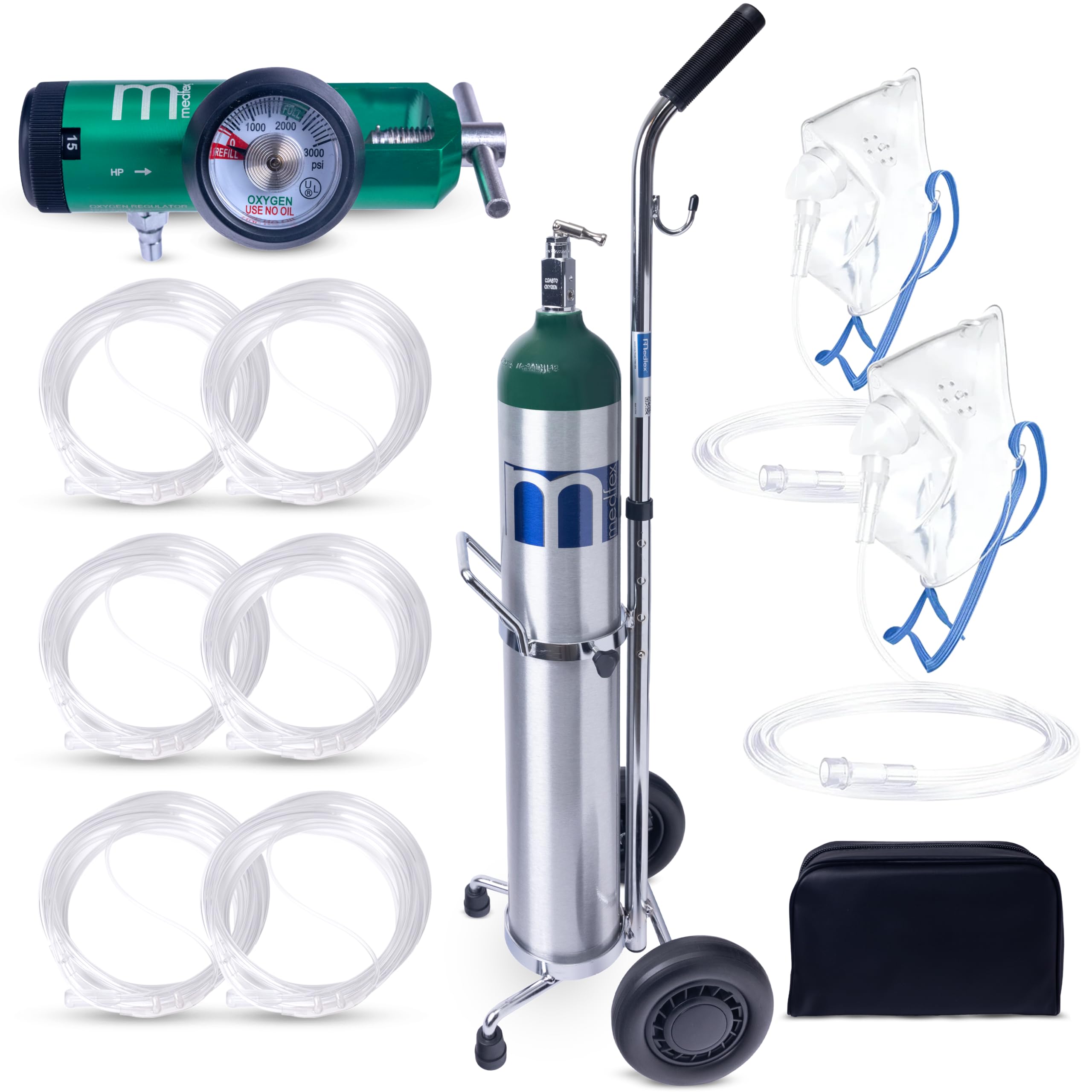
The Medfex set is the only bundle here that arrives as a fully functional system: E-size aluminum cylinder, CGA870 toggle valve, 0-15 LPM regulator, wheeled cart, four nasal cannulas, and two face masks. For pilots who need a turnkey oxygen solution without sourcing adapters and tubing separately, this kit eliminates compatibility guesswork. The toggle valve opens and closes without a wrench, which is especially useful if you’re wearing gloves in a cold cockpit or have limited hand strength.
The 680-liter capacity (roughly equivalent to a 22 cu/ft medical E tank) is on the smaller side compared to the industrial cylinders above, but it’s well-suited for pre-breathing before high-altitude flights or as a supplemental source for a single pilot in a pressurized cabin. The rolling cart is lightweight and fits through standard doorways, making it practical for hangar-to-aircraft transfer. Medfex claims the tank is USA-made, and the brushed aluminum finish with a green dome follows medical convention for oxygen cylinder identification.
The main limitation is the CGA870 valve — while common in medical oxygen setups, it does not accept CGA540 regulators. If you already own an aviation O₂ system built around CGA540, you’ll need an adapter. The kit ships empty, and a prescription is technically required to fill it at medical oxygen suppliers. For pilots, a welding supply shop can fill CGA870 tanks without a prescription, but it’s worth confirming compatibility with your local fill station before ordering.
Why it’s great
- Complete system includes cart, regulator, and cannulas.
- Toggle valve allows one-handed operation.
- USA-made aluminum cylinder with medical-standard finish.
Good to know
- CGA870 valve may require an adapter for aviation regulators.
- Smaller capacity limits use to shorter flights or pre-breathing.
4. CHIKADIV Mini Scuba Tank – 0.5L Pony Bottle
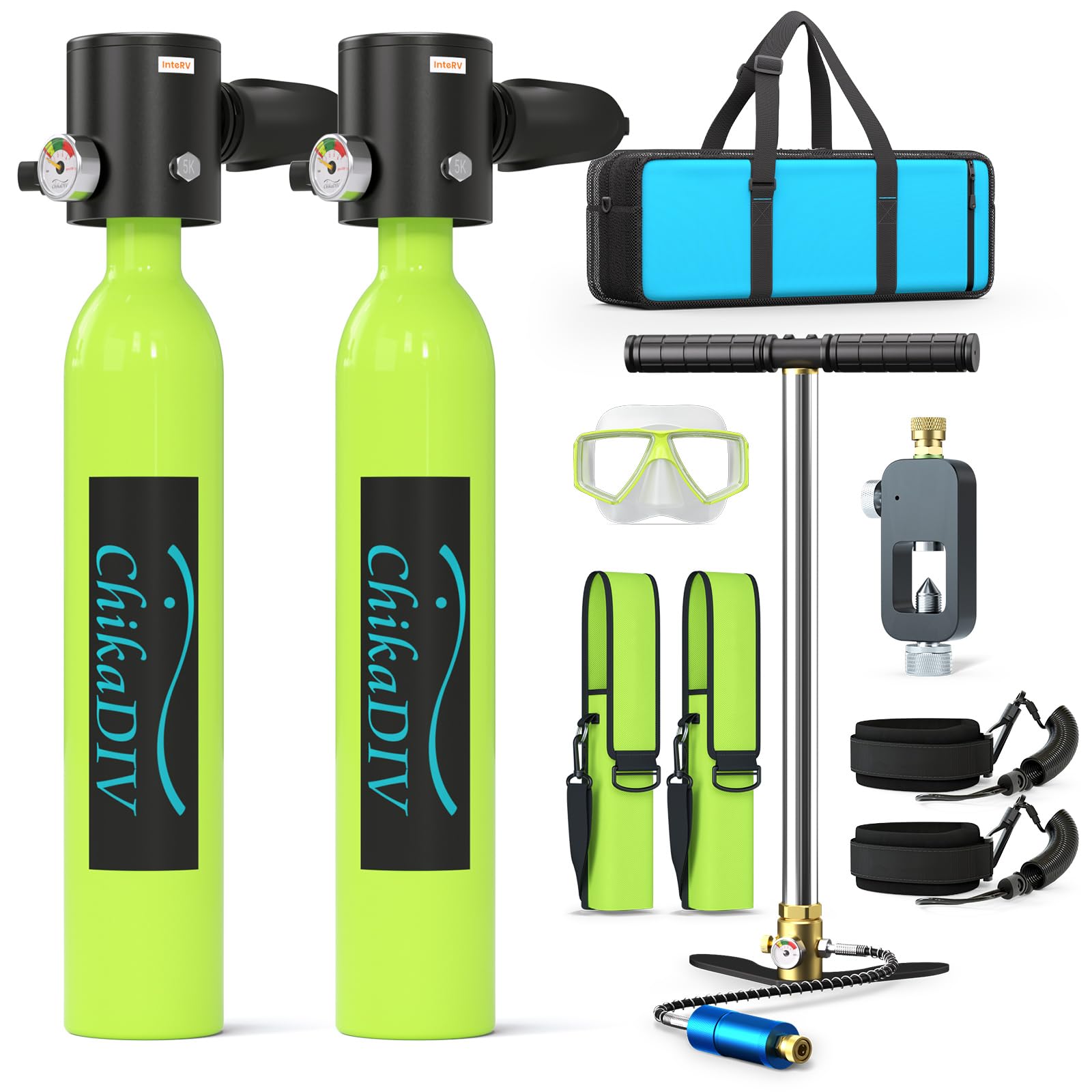
This 0.5L pony bottle is the most portable oxygen tank in the lineup, designed as an emergency breathing supply rather than a primary O₂ source for extended flight. Constructed from 6061 aviation aluminum with a 4mm wall thickness and a 5K-rated explosion-proof valve, it holds 3000 PSI (200 bar) and delivers roughly 35 breaths at a depth of 16 feet in scuba use — scaled to sea-level aviation, that translates to several minutes of supplemental oxygen during an emergency descent or depressurization event.
The DOT certification and one-way 8mm fill valve make it refillable at dive shops or with a high-pressure hand pump, though customer experiences note that hand-pump filling takes about 50 minutes. The tank is advertised as plane-friendly when disassembled, fitting in checked luggage for traveling pilots who want a personal emergency backup. The food-grade bite valve and compact form factor (approximately 10 inches long) allow it to be stashed in a flight bag or seat pocket.
This is not a tank for sustained hypoxia prevention on a three-hour leg. The limited breath count means it functions strictly as a last-resort safety device. Reviews are mixed: some users praise the build quality and portability, while others report that the claimed 35-breath capacity feels shorter in real use and that assembly instructions are minimal. If you’re looking for a primary aviation O₂ tank, size up to at least the 60 cu/ft option. As a backup for a flight kit, it adds negligible weight.
Why it’s great
- Extremely portable at 0.5L and 6.3 kg total weight.
- 6061 aluminum construction with explosion-proof valve.
- DOT certified and refillable at dive shops.
Good to know
- Very limited capacity — only ~35 breaths for emergency use.
- Hand pump filling is slow (50 minutes per fill).
5. Nuvair O2 Quickstick Oxygen Analyzer

Knowing your cylinder contains the correct O₂ concentration is just as important as having the right tank. The Nuvair O2 Quickstick is a handheld analyzer that measures oxygen percentage in a gas stream, allowing pilots to verify that a freshly filled tank actually delivers the 99.5%+ purity required for safe high-altitude breathing. The marine-grade anodized aluminum body and water-resistant housing make it suitable for hangar and flight line environments where moisture and grime are present.
Calibration is straightforward: a single button sets the zero point, and the fast-response electrochemical sensor stabilizes within seconds. The replaceable battery and sensor extend the unit’s service life beyond the typical two-year lifespan of integrated sensors in cheaper models. At 0.9 pounds and 10 inches long, it stows easily in a flight bag. Several customer reviews note that the Quickstick matches readings from professional dive shop analyzers, giving confidence that the O₂ percentage is accurate before connecting a regulator.
The unit lacks an auto-off feature, so you must remember to power it down manually — leaving it on will drain the battery. It’s also larger than some competing analyzers, with a form factor closer to a small flashlight than a pen. For pilots who share tanks with a flying club or rent cylinders from varied suppliers, this tool prevents the situation of breathing a hypoxic mix caused by an improperly filled bottle.
Why it’s great
- Fast-response sensor with easy single-button calibration.
- Replaceable battery and sensor for extended service life.
- Durable marine-grade aluminum housing.
Good to know
- No auto-off function — battery drains if left on.
- Bulky compared to pen-style analyzers.
6. MSA ALTAIR Single-Gas Detector – O₂ (Low 19.52%, High 23.0%)

The MSA ALTAIR is not an oxygen tank — it’s a personal gas monitor that continuously measures ambient O₂ levels in the cabin, alerting you with flashing LEDs, an audible alarm, and vibration when the concentration drops below 19.52% or rises above 23.0%. In an aviation context, this device serves as a secondary safety layer, detecting gradual oxygen displacement that might precede hypoxia symptoms. The IP67 rating ensures it survives rain, dust, and the occasional coffee spill in the cockpit.
This unit is maintenance-free for its two-year battery life (1,080 alarm minutes), requiring no sensor or battery changes. The built-in data logger records the last 25 alarm and test events, which can be communicated to MSA Link software via the IR port for post-flight review. The one-button operation is designed for gloved hands, and the large backlit LCD is readable in direct sunlight — all practical considerations for the flight deck.
Customer feedback is generally positive, with users praising its ease of use and reliability, though a small subset reports premature alarm failures after 10 months. The device is UL-standard approved and comes with a 2-year warranty. If you fly at altitudes where cabin pressurization might fail or in aircraft where O₂ systems are used intermittently, this monitor provides real-time assurance that the breathing environment is within safe limits.
Why it’s great
- Two-year maintenance-free battery with 1,080 alarm minutes.
- Triple alarm (visual, audible, vibration) for all environments.
- IP67 rated – survives cockpit spills and dust.
Good to know
- Not a tank – measures ambient O₂ in the cabin.
- Occasional reports of premature sensor failure.
7. LIGHTSPEED Delta Zulu ANR Aviation Headset

The Delta Zulu is not an oxygen tank — it’s an ANR headset with an integrated Kanari carbon monoxide sensor that monitors cabin air quality and provides audible and visual warnings at preset CO thresholds. Carbon monoxide poisoning in aircraft is a known hypoxia-mimic and safety hazard, especially in piston singles with cabin heat sourced from exhaust manifolds. Having a CO monitor built into your headset means one less device to strap to the panel, and the headset’s stainless steel and magnesium frame with a Kevlar-core cable promises durability far beyond typical consumer-grade electronics.
The HearingEQity feature, which runs a 12-frequency hearing test through the Lightspeed app and adjusts the audio profile to your personal hearing curve, is a genuine innovation for pilots with age-related hearing loss who need every decibel of ATC clarity. The 30-hour rechargeable battery and included spare AA pack give flexibility for multi-day trips without access to AC power. User reviews consistently point to the comfortable fit for 6+ hour flights, with the tapered ear seals working well around eyeglass frames.
The tradeoff is price — this is the most expensive item on the list, and its value proposition depends on how often you fly and how crucial audible warning of CO is in your aircraft type. The built-in CO sensor does not replace a dedicated O₂ tank, but it complements an oxygen system by alerting you to a scenario where hypoxia might occur from CO rather than altitude. For pilots flying older piston aircraft with known exhaust leak risks, this headset is a meaningful safety upgrade.
Why it’s great
- Built-in carbon monoxide sensor with visual/audible alerts.
- Personalized audio equalization based on hearing test results.
- 30-hour battery with dual power options (rechargeable + AA).
Good to know
- Premium price – significant investment for occasional flyers.
- Some users report app recording feature is unreliable.
8. Bose ProFlight Series 2 Aviation Headset

The Bose ProFlight Series 2 takes a radically different approach to cockpit audio: an in-ear design weighing just 128 grams (4.5 ounces) on the head, eliminating the clamp force of traditional over-ear headsets. This is the smallest, lightest headset Bose offers, and it’s engineered for pilots flying moderately noisy pressurized turbine aircraft — think King Airs and light jets where passive noise isolation from over-ear cups isn’t necessary but ANR still improves fatigue. The dual-plug cable and Bluetooth 5.0 connectivity allow seamless pairing with iPads and phones for approach plates and phone calls.
The ANC is adjustable, and the double-tap control on the cable allows talk-through communication without removing the earbuds. The 45-hour battery life from two AA batteries is class-leading for an ANR headset, and the thinner, more flexible cable on the Series 2 reduces snag risk in tight cockpits. Customer reviews from airline pilots flying 737s and A320s praise the comfort on 7+ hour duty days, with many noting a significant reduction in fatigue compared to earlier full-size headsets.
The in-ear form factor is not universally comfortable — the included silicone StayHear+ tips must fit your ear canal snugly, and some users report discomfort in one ear after an hour. The ANC is slightly weaker than the Bose A20 in very noisy piston aircraft, so it’s best matched to turbine environments. This headset does not contribute directly to oxygen delivery, but reducing auditory fatigue and improving ATC clarity indirectly supports better situational awareness during critical phases of flight when oxygen levels may also demand attention.
Why it’s great
- Ultralight 128g design eliminates head clamping fatigue.
- 45-hour battery life from two AA batteries.
- Adjustable ANC and seamless Bluetooth call mixing.
Good to know
- In-ear fit depends heavily on earbud tip selection.
- ANC is optimized for turbine aircraft, not high-noise pistons.
9. Miller Electric Air Fuel Outfit (NE835A)
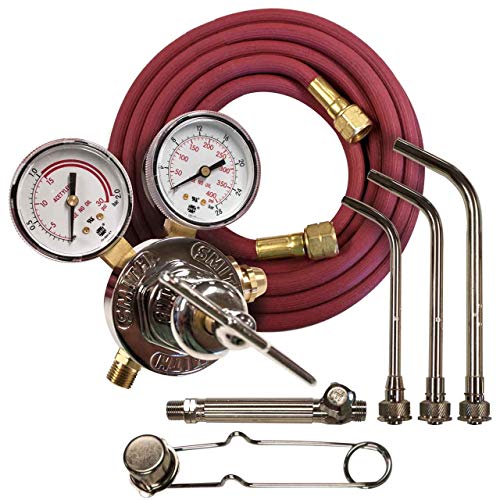
The Miller Air Fuel Outfit is an oxy-acetylene torch kit that uses a single-tank acetylene setup with oxygen supplied by the operator — the kit itself does not include an oxygen cylinder, but it is designed to work with a separate O₂ tank for welding, brazing, and silver soldering applications. The kit includes the NE835A torch handle, three welding tips (sizes 0, 1, and 3), and connections for standard oxygen and acetylene regulators. This is not an aviation breathing tank.
Within the context of aviation work, this torch kit supports fabrication and repair tasks such as brazing steel tube frames, silver-soldering fuel line fittings, and annealing aluminum parts — all of which require a regulated oxygen supply from a separate cylinder. The kit’s tips are small enough for precision jewelry and model work (size 0 is ideal for jump rings), but the #1 tip handles 2-inch copper water lines, making it versatile for general hangar maintenance. Customer reviews consistently report that the single-tank acetylene design is economical, with a small tank lasting weeks of intermittent use.
The torch ships without a regulator or hoses longer than the standard 12-foot pair, so you’ll need to purchase those separately along with the oxygen cylinder. For pilots and aircraft owners who perform their own metalwork, this outfit is a capable tool requiring a compatible O₂ tank from this guide — the 60 cu/ft or 125 cu/ft cylinders with CGA540 valves are the correct match. It is not a life-support device, but it is a legitimate aviation maintenance accessory that pairs with an oxygen supply.
Why it’s great
- Versatile tips (0, 1, 3) handle jewelry to 2” pipe work.
- Single-tank acetylene is economical for intermittent use.
- Well-regarded by jewelers and aircraft fabricators alike.
Good to know
- Does not include oxygen tank – requires separate purchase.
- No regulators or cutting attachment included.
FAQ
Can I use a medical oxygen tank (E-size) for aviation breathing?
How do I know if my oxygen tank is expired or unsafe?
What size aviation oxygen tank do I need for a typical cross-country flight?
Why do some tanks ship full while others ship empty?
Final Thoughts: The Verdict
For most pilots building a primary O₂ system, the best aviation oxygen tank is the 60 cu/ft Aluminum Cylinder because it balances a manageable 25-pound weight, CGA540 valve compatibility, and sufficient capacity for standard cross-country legs without requiring a permanent mounting cradle. If you need maximum endurance for high-altitude flights and have the space, the Weldfabulous 125 cu/ft arrives full and offers the best run time per dollar. For pilots who want a complete rolling system with a cart, regulator, and cannulas out of the box, the Medfex Complete Set eliminates component buying guesswork despite its smaller capacity.