
Our readers keep the lights on and my morning glass full of iced black tea. As an Amazon Associate, I earn from qualifying purchases.
Specs are compiled from manufacturer listings and verified buyer reviews and can change over time — please confirm the key details on the product page before buying.
You can hear air traffic control chatter, tower clearances, and pilot reports with the right receiver. But you need to balance frequency coverage, digital compatibility, and if you want a simple scanner or a two-way radio you can transmit on. Pick wrong, and you will miss modern digital systems or struggle to hear a distant tower.
I’m Min — the founder and writer behind Gadgets Feed. This guide is built by comparing the manufacturers’ published specifications and the patterns across verified customer reviews, so you get each pick’s real strengths and trade-offs instead of marketing spin.
This guide covers the best aviation scanners for pilots needing a backup COM and enthusiasts scanning from home.
Our Picks at a Glance


How To Choose The Best Aviation Scanner
Choosing the right aviation scanner depends on frequency coverage, digital compatibility, and form factor. Understanding these factors prevents buying a receiver that misses local transmissions.
Analog vs. Digital Compatibility
The biggest choice is digital vs. analog compatibility. Many modern public safety agencies and some aviation ground services use digital systems called Project 25 (P25 — a standard for encrypted and clear digital radio). If you live in a major city, a plain analog scanner will miss those digital signals entirely. Digital models like the Uniden SDS200 decode P25 systems, but they cost significantly more.
Airband Frequency Coverage
The aviation band lives between 118 MHz and 137 MHz. Every scanner on this list covers that range, but some stop there while others extend into VHF high band, UHF, and even 800 MHz for trunking. For aircraft-only listening, a simple airband receiver suffices. For weather, marine, and public safety, choose a scanner with wider frequency coverage.
Form Factor: Base, Mobile, or Handheld
A base scanner like the Uniden BC365CRS is designed for desktop use with a wall outlet. Mobile scanners work in a car or on a desk with a power adapter. Handheld units like the BC125AT let you take the scanner to airshows or on road trips, but they run on batteries and typically have smaller speakers.
Close Call and Trunking Features
Close Call RF Capture technology instantly tunes into nearby transmitter signals, which is useful for discovering active frequencies you didn’t know about. Trunking is a more advanced system used by public safety agencies and some airports to manage many users on a few frequencies. A trunking scanner follows these conversations, so you don’t miss half the conversation.
Quick Comparison
| Model | Best For | Airband Coverage | Digital Ready | Channels | Amazon |
|---|---|---|---|---|---|
| Uniden SDS200★ Best Overall | Best Overall / Simulcast Performance | Yes | Yes (P25/DMR/NXDN) | Unlimited (SD card) | Amazon |
| Uniden BC365CRSBest Value | Entry-Level / Desk Use | Yes | No (Analog only) | 500 | Amazon |
| Uniden BC355NCompact Pick | Mobile / Simple Analog | Yes | No (Analog only) | 300 | Amazon |
| Uniden BC125AT | Portable / Airshows | Yes | No (Analog only) | 500 | Amazon |
| BTECH UV-PRO | Amateur Radio + Airband | Yes (RX only) | No (Analog) | 180 | Amazon |
| C. Crane CC Skywave SSB 2 | Ultra-Portable / SSB | Yes (Scan) | No (Analog) | 400 (10 aviation) | Amazon |
| Sporty’s PJ2+ COM | Pilot Backup / Transmit | Yes (TX & RX) | N/A (Two-way Radio) | 760 | Amazon |
| Icom IC-A16 | Pilot Handheld / Build Quality | Yes (TX & RX) | N/A (Two-way Radio) | 200 | Amazon |
In‑Depth Reviews
1. Uniden SDS200 True I/Q TrunkTracker X Base/Mobile Digital Scanner
Our pick — 4.5★ from 850+ verified ratings; the strongest balance of quality and price.
The base station that silences the simulcast smear that plagues lesser digital scanners.
If you live anywhere near a major city with digital public safety or aviation trunking systems, the SDS200 is the gold standard. Its Software Defined Radio and True I/Q technology chew through challenging digital simulcast signals that cause garbling on older scanners — buyers consistently note its “excellent simulcast decoding” as the defining trait. The large 3.5-inch color display is fully customizable, letting you tune exactly what information each field shows, from frequency to talkgroup ID.
Location-based scanning using your zip code or GPS coordinates means you can set it up and let the built-in HomePatrol database (updated weekly by Uniden) handle the rest. This is the only model here that handles P25 Phase I/II, DMR, and NXDN right from the start (though some of those digital formats require a paid upgrade). It weighs 5 pounds and feels substantial on a desk, but the trade-off is that you cannot toss it in a bag for travel.
Brilliant Decode, Tough Learning Curve: The scanning performance is the most-praised feature by a wide margin — owners say it pulls in weak signals without overload and scans fast. The flip side is that the Sentinel software is essential for programming, and a few owners found the weather features clunky and the SD card awkward to reach. This is not a grab-and-go radio — it rewards patience with the best reception in its class.
Reach for this if: you demand the strongest simulcast decoding available and want a future-proof base station that can grow with digital upgrades.
Look elsewhere if: you only need to listen to basic analog airband on a budget, or you want something compact enough to carry to an airshow.
2. Uniden BC365CRS 500 Channel Scanner and Alarm Clock
A friendly all-in-one that wakes you to tower chatter and doesn’t break the bank.
The BC365CRS pulls triple duty as a scanner, FM radio, and alarm clock, all in a compact desktop shell. It saves 500 channels across pre-programmed search bands covering aircraft, marine, railroad, and non-digital police/fire traffic. The crowd favorite trait is build quality — owners highlight that this analog unit punches above its weight for reception, with “clear reception from 25+ miles” being a common real-world benchmark. The blue backlit LCD is easy to read in a dark bedroom, and the Do-Not-Disturb priority mode checks your most important frequencies every 2 seconds.
The major limitation is spelled out clearly: this is a conventional analog scanner only. It cannot decode P25, DMR, or any digital trunking system. If your local fire department or airport ground crew has gone digital, this radio will be silent on those channels. The alarm and snooze functions are a genuine plus for aviation enthusiasts who want to be woken by the morning push at the local airfield.
What Wins Owners Over
- Excellent analog reception with the supplied BNC telescopic antenna; a simple external antenna extends range dramatically
- Voice-tune audio that is loud and clear via the built-in speaker or rear audio jack
- Pre-programmed service bands make it usable right from the start with almost no setup
The Honest Trade-Offs
- Cannot receive any digital or trunked communications (Project 25, DMR, NXDN)
- Programming the clock and alarm settings is less intuitive than the scanner functions
- Plastic case and touch buttons feel less durable than metal-chassis models
Best for: someone who wants a straightforward analog scanner that also works as a bedside clock and FM radio — a great entry point for listening to nearby aircraft and weather.
Think twice if: your local agencies have migrated to digital trunking, or you need a portable radio to take on the road.
3. Uniden BC355N 300-Channel Base/Mobile Scanner
A no-frills analog workhorse that fits in a car cubbyhole and finds nearby transmissions instantly.
The BC355N packs Close Call RF Capture Technology, a feature that instantly tunes to signals from nearby transmitters — perfect for discovering active frequencies at an airshow or near an airport. It holds 300 channels split across six service banks for police, fire, EMS, marine, air, and weather. Compact dimensions (5.75″ x 5.18″ x 1.63″) make it a natural fit for a vehicle center console, and it ships with both an AC adapter and a DC power cable with automotive plug.
The crowd consensus is clearest on build quality — owners rate the build quality as the top positive aspect. But the sound quality receives mixed feedback; some find it perfectly clear while others want louder audio. Programming is where opinions split — the manual is dense, and several owners turned to YouTube for step-by-step guidance. The aircraft band frequency range is 108.0000 – 136.9916 MHz with 8.33 kHz steps, so modern narrowband aviation is covered.
Solid Analog, No Digital Surprises: This is an analog-only scanner, and Uniden is upfront about it. If you are looking for a simple, reliable way to monitor analog VHF airband, weather, and non-trunked public safety from your car or desk, the BC355N delivers at a price that keeps the entry barrier low. The Close Call feature is genuinely useful for catching transmissions you would otherwise miss.
Choose this for: a straightforward analog mobile scanner with Close Call for discovering active nearby frequencies — especially good for road trips and airshow spotting.
skip it if: you need digital trunking capability or you want a handheld you can take on walks around the airport perimeter.
4. Uniden Bearcat BC125AT Handheld Scanner

The lightweight go-anywhere analogue hunter that crams 500 alpha-tagged channels into your jacket pocket.
At just 0.9 pounds, the BC125AT is the definition of a grab-and-go aviation handheld. It covers civil and military air bands (108-174 MHz and 225-380 MHz) alongside marine, railroad, CB, and FRS/GMRS/MURS. The 500 channels can be organized into 10 storage banks with alpha tags — labels like “TWR” or “APP” so you know exactly who you are listening to. It runs on 2 AA rechargeable batteries (included) and claims a battery average life of 10 hours. Close Call RF Capture with Do-Not-Disturb mode prevents interruptions during active transmissions.
The scanner quality is the most-praised aspect by a wide margin — owners call it an “absolute bargain” for analog aviation and rail scanning. The free PC programming software simplifies channel loading significantly once you get past the learning curve. However, the manual documentation is the most-criticized aspect: it is dense and poorly organized. Several buyers report that it takes patience to master, and a small number encountered a “SCAN MODE ALL LOCKED!” error that the manual does not explain. This is an analog-only scanner — it cannot decode digital P25, DMR, or NXDN.
Why It Earns Its Spot
- crisp analog reception on civil and military airbands, praised by owners for pulling in distant towers
- Alpha tagging and PC programming software make organization manageable once learned
- Lightweight design with auto backlight and included rechargeable batteries
The Catch
- Cannot scan while charging via USB — a design quirk that frustrates some owners
- Poor printed manual; most owners rely on YouTube tutorials and community forums
- Occasional lock-out glitch reported; hard to clear without PC software
Reach for this if: you want a portable analog scanner with alpha tagging to take to airshows, the airport perimeter, or on road trips — the best value in a handheld form.
Look elsewhere if: you need digital trunking or want a radio you can program without referencing online guides.
5. BTECH UV-PRO Dual Band VHF/UHF Two-Way Radio

A modern ham radio that moonlights as an aviation band scanner with GPS and Bluetooth built in.
The BTECH UV-PRO is not just a scanner — it is a full-featured dual-band amateur radio that also receives the aviation band for listening. It brings APRS (Automatic Packet Reporting System) with smart beaconing, built-in GPS for location sharing, and Bluetooth HFP for hands-free audio with third-party headsets. The IP67 dust and water protection rating means it survives rain, dust, and even submersion up to 1 meter for 30 minutes — a ruggedness none of the pure scanners on this list can claim.
The aviation RX capability lets you monitor tower frequencies while also tracking NOAA weather alerts and using Frequency Sync Rapid Scanning to locate active traffic quickly. The phone app programming is widely praised as the easiest way to get set up — owners say it takes about 5 minutes with a CSV file, no desktop software or CHIRP needed. The catch is that the nonstandard microphone connector means most accessories require an adapter that breaks the IP67 seal.
Swiss Army Knife for the Skies: Sound quality and connectivity are the most-praised features — the Bluetooth KISS TNC works well for digital modes. The dual-band transmit capability requires an amateur radio license (Part 90 for commercial use). If your primary goal is aviation monitoring alone, a dedicated scanner is simpler. But if you are a ham operator who also wants to listen to the tower, this is the most versatile radio on the list.
Best for: licensed amateur radio operators who want APRS, GPS, and aviation band monitoring in one rugged, app-programmable package.
pass on it if: you are a pure aviation listener with no interest in ham radio — the extra features and license requirement add unnecessary complexity.
6. C. Crane CC Skywave SSB 2 Portable Travel Radio
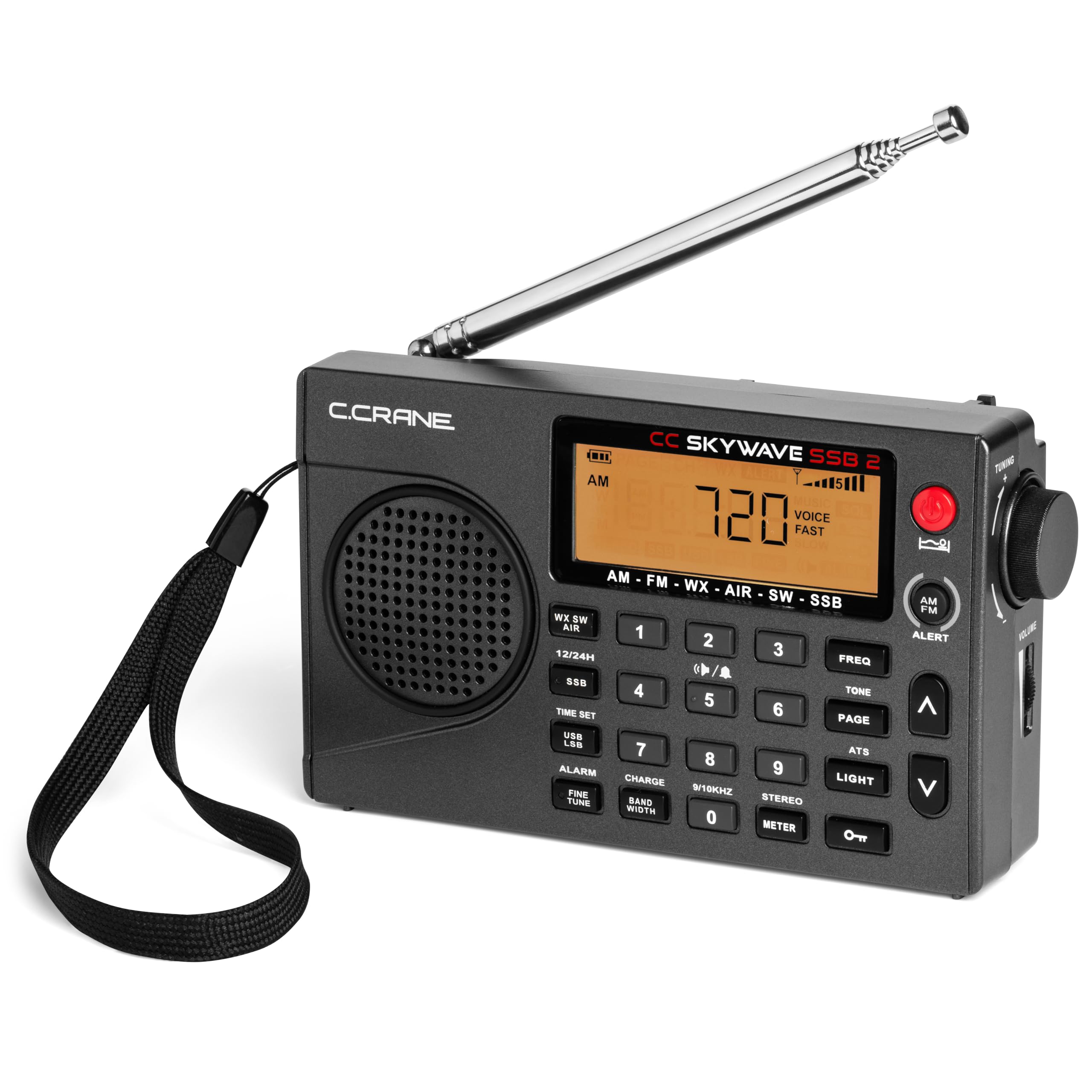
A pocket-sized multiband wonder that pulls in aircraft chatter, shortwave, and single sidebands.
The CC Skywave SSB 2 is one of the smallest radios with Single Side Band capability, a reliable way to receive long-range information when normal communications are down. For aviation enthusiasts, it includes a scannable VHF aviation band with 10 aviation memories — you can save your local tower, approach, and departure frequencies and scan them for activity. It also covers AM, FM, NOAA Weather with alerts, and shortwave from 1711 to 29999 kHz.
Weighing only 6 ounces without batteries and measuring 4.75 x 3 x 1.1 inches, it is the most portable option here. It runs for approximately 70 hours on two AA alkalines with earbuds, or about 60 hours through the built-in speaker. The supplied 23-foot shortwave reel antenna and CC Buds earphones add real value. Build quality is the most-loved aspect — owners say it pulls in stations from far away and performs like a desktop model in a palm-sized package.
Big Reach, Tiny Footprint: The frequency reception is excellent for its size — from the start it picks up NOAA, aircraft ATC, and shortwave without any extra antenna. The sound quality is good for a radio this small, though a few owners found the buttons fiddly due to multiple functions per key. This is not a true scanner with close-call or trunking — it is a multiband receiver that scans the aviation band, making it ideal for travelers and backpackers who want a backup communication tool.
Reach for this if: you want the most portable aviation band receiver that also works as an emergency shortwave/SSB radio for camping, backpacking, or off-grid trips.
Look elsewhere if: you need a full-featured scanner with digital trunking, close-call, or the ability to transmit on airband frequencies.
7. Sporty’s PJ2+ COM Aviation Handheld Radio

A backup radio built so a pilot can grab it and talk without wrestling with adapters.
The PJ2+ is a purpose-built two-way aviation COM radio, meaning it both receives and transmits on the 118-136.975 MHz aircraft band. Its standout design choice is the dual PJ headset plugs — no adapter is needed to connect standard GA headsets. The oversized keypad and dedicated “flip-flop” last-frequency button let you operate it with one hand while flying. Peak transmit power reaches 6 watts, providing clear communications when you need them most.
Owners consistently praise the sound quality and functionality, calling it a “reliable backup radio” that performed when a C172’s installed COM failed. The simple menu design is intentional — just power it on and enter your frequency. The battery life is a mixed note: it uses six AA batteries, and owners recommend using a power bank via USB-C to avoid leak damage from unattended alkalines. The battery compartment design is the most-criticized aspect, described as flimsy and difficult to open.
What Pilots Love
- Built-in dual PJ headset jacks mean no adapters needed for standard GA headsets
- Powerful and clear audio with 6-watt peak transmit power and good range
- Simple operation with no complex menus — designed for emergency use
The Nuisances
- Battery compartment is flimsy and hard to open; batteries can leak if left unattended
- Not a scanner — it is a two-way radio with frequency memory, not trunking or close-call
- AA batteries drain if left in the unit; using a power bank is the recommended workaround
Best for: pilots who need a simple, reliable backup handheld COM radio that works with standard aviation headsets right from the start.
it’s not for you if: you only want to listen (no transmit needed) — a dedicated scanner gives you more channels and features for less money.
8. Icom IC-A16 VHF COM Aviation Handheld

A rugged Icom aviation handheld that delivers clear voice and a dedicated emergency frequency button.
The IC-A16 is designed for pilots who demand reliability in a compact handheld. It covers the full VHF aviation band (RX: 108.000–136.99166 MHz, TX: 118.000–136.99166 MHz) and adds an exclusive button for the 121.5 MHz emergency frequency, letting you reach it instantly without scrolling through menus. The Li-ion battery (BP-280) provides a claimed battery average life of 17 hours, and owners mention it comfortably lasting an 8-hour shift on the ramp. Noise reduction is effective enough to cut through the sound of nearby power equipment.
The side tone function lets you hear your own voice through a third-party aviation headset — a crucial feature for ensuring your transmissions are clear. The BNC antenna connector makes it easy to attach an external antenna for better range. Reception quality is strong, with one owner reporting clear 6-mile range from the airport. The screen is on the small side, and a single owner reported a defective display on arrival, though Icom’s build quality is otherwise praised as reliable.
Built for the Flight Bag: The IC-A16 is a straightforward, high-quality aviation COM handheld. It does not have the broad frequency coverage of a multi-band scanner — it is purpose-built for the airband with extras like NOAA weather RX. The 200 memory channels are sufficient for a pilot’s needs. The battery life with the included 2400mAh Li-ion pack is excellent compared to AA-powered competitors. It is the priciest pure aviation handheld here, but the Icom reputation and noise reduction justify the cost for serious pilots.
Reach for this if: you are a pilot who wants a dedicated, durable aviation handheld with noise reduction, long battery life, and instant access to the emergency frequency.
Look elsewhere if: you are an enthusiast who wants to also listen to marine, railroad, or public safety bands — this is strictly a VHF COM radio.
Understanding the Specs
Simulcast Decoding
Simulcast distortion happens when multiple towers transmit the same digital signal at the same time, creating a garbled mess on older scanners. The Uniden SDS200 uses True I/Q Technology to solve this. If you live in a city or near an airport with multiple transmitter sites, this feature becomes essential for hearing clear audio instead of digital hash.
Close Call RF Capture Technology
This feature automatically tunes your scanner to the strongest nearby transmission signal. It is useful for discovering active frequencies at an airshow, near an airport ramp, or during an emergency. You do not need to know the frequency beforehand — the scanner finds it for you.
Airband vs. Wideband Coverage
Airband covers the 118-137 MHz range. Wideband scanners extend into VHF high (108-174 MHz), UHF (400-512 MHz), and sometimes 800 MHz for public safety trunking. A pure aviation scanner only covers airband. A wideband scanner gives you marine, weather, amateur, and public safety bands too.
Trunking vs. Conventional Scanning
Conventional scanning simply cycles through a list of frequencies you program in. Trunking follows conversations as they jump across multiple frequencies used by one agency — so you hear the whole exchange, not just one channel. Many modern airports and large public safety departments use trunking to handle more traffic. A trunking scanner like the Uniden SDS200 can follow these conversations smoothly.
FAQ
Do I need a digital scanner for aviation monitoring?
Can I transmit on aviation frequencies with a scanner?
What is the difference between the BC365CRS and BC125AT?
How far away can I hear aircraft with the supplied antenna?
Does the BTECH UV-PRO require a ham license to use the aviation band?
What does Single Side Band (SSB) mean on the CC Skywave?
How many channels do I actually need for aviation scanning?
Will a scanner work in an airplane for listening to ATC?
Final Thoughts: The Verdict
Across the board, the best aviation scanner winner is the Uniden SDS200 because its True I/Q technology and excellent simulcast decoding handle the trickiest digital environments while offering the broadest frequency coverage and database support. If you want a portable analog unit for airshows and road trips, grab the Uniden BC125AT. And for pilots who need a transmit-capable backup radio, the Sporty’s PJ2+ COM is the one to reach for — its no-adapters design and 6-watt transmit power make it the smart buy for a flight bag.
How We Picked
We do not accept paid placement. Every pick is matched to a real buyer and a real use-case; we do not hands-on test units.
Sources & Methodology
Specifications: manufacturer listings and product documentation. Review insights: verified customer reviews, as of July 2026. Pricing: not shown on this page (it changes often); check the current price via the retailer link.
As an Amazon Associate, Gadgets Feed earns from qualifying purchases. This does not affect which products we feature.