
Our readers keep the lights on and my morning glass full of iced black tea. As an Amazon Associate, I earn from qualifying purchases.
Specs are compiled from manufacturer listings and verified buyer reviews and can change over time — please confirm the key details on the product page before buying.
If your speakers are already powered by separate amplifiers, buying a full receiver means paying for amplification you’ll never use. That’s why the “AVR as preamp” route is so smart — you get the modern HDMI brains, room correction, and streaming smarts of a receiver, while your dedicated power amps do the heavy lifting. The trick is finding a receiver with the right pre-outs and processing power.
I’m Min — the founder and writer behind Gadgets Feed. This guide is built by comparing the manufacturers’ published specifications and the patterns across verified customer reviews, so you get each pick’s real strengths and trade-offs instead of marketing spin.
Adding a power amp to your system starts with finding the right control center, so here are the best avr as preamp options that let you upgrade your sound without replacing everything else.
Our Picks at a Glance


How To Choose The Best AVR As Preamp
Using an AV receiver purely as a preamp- processor means you connect its pre-outs to your external power amplifiers, so the receiver handles decoding and volume control while your amps supply the muscle. You need a unit with the right connectivity, processing power, and channel count to match your speaker layout.
Pre-Outs: How Many Channels Do You Actually Need?
Most serious home theater builds use at least five channels, so a receiver with at least 7.2 channels of pre-outs gives you room to expand. If you plan a 7.1.4 layout with four height speakers, you’ll need 11 channels of processing, even if the receiver only has 9 built-in amp channels. Always count the pre-outs, not just the wattage. Also check if the subwoofer outputs are independent — it matters if you run dual subs.
Room Correction: The Software That Tunes Your Room
Room correction software uses a microphone to measure how your room’s surfaces muffle or bounce sound, then applies filters so what you hear is cleaner. The two big names are Audyssey (found on Denon and Marantz) and Dirac Live (found on Onkyo). A full-bandwidth version like Dirac Live Full Bandwidth can dramatically tighten bass and improve imaging — it’s the feature serious buyers hunt for.
Quick Comparison
| Model | Best For | Channels | Pre-Outs | Room Correction | Amazon |
|---|---|---|---|---|---|
| Denon AVR-X1700H★ Best Overall | Entry 7.2 Setup | 7.2 | 2 Sub Outs Only | Audyssey MultEQ | Amazon |
| Denon DRA-900HStereo Purist | 2-Channel Hi-Fi | 2.2 | Main, Zone 2, Dual Subs | Audyssey MultEQ | Amazon |
| Onkyo TX-RZ50 | 7.1.4 Dolby Atmos | 9.2 | 7.2.4 Capable | Dirac Live | Amazon |
| Onkyo TX-RZ70 | Reference High-End | 11.2 | Full 11.2 | Dirac Live Full | Amazon |
| Marantz AV7706 | Dedicated Preamp | 11.2 | Full 11.2 | Audyssey MultEQ XT32 | Amazon |
In‑Depth Reviews
1. Denon AVR-X1700H 7.2 Channel AV Receiver
Our pick — 4.5★ from 650+ verified ratings; the strongest balance of quality and price.
The budget-friendly brains of a full theater, minus the amp muscle you don’t need.
This Denon gives you a complete modern preamp foundation without a premium price tag. It decodes Dolby Atmos and DTS:X (a special 3D sound format that makes audio feel like it moves around you), and even adds Dolby Atmos Height Virtualization, which fakes height effects when you have no ceiling speakers. That’s a lot of processing in a box that’s friendly to a first-time builder — its on-screen setup guide is genuinely praised as easy to follow.
Now the honest limit: this is a 7.2-channel receiver, and its pre-outs are just the two subwoofer outputs. There are no RCA pre-outs for feeding front, center, or surround channels to external amps — buyers report this plainly (one flagged “no pre-outs for external amps”). So it shines if you’re using its own 80W/channel amps for your main speakers and want to add powered subwoofers for extra bass. Connectivity can be finicky — the built-in HEOS streaming app is described by some as clunky, and Bluetooth pairing draws mixed feedback, though iPhone and iPad users report easy Wi-Fi and Bluetooth hookups.
What wins people over is build quality — it’s the single most-praised trait by a wide margin, with sound quality close behind. Fans call it a worthy upgrade after a decade-plus with an older Sony, and eARC (the audio return channel that sends TV sound back to the receiver through one HDMI cable) works flawlessly once you get past a complex setup. It’s simply the best value if your external-amp needs are limited to subwoofers. Compared to the Onkyo TX-RZ50’s full 7.2.4 pre-outs, this Denon is the smarter pick when you’re not driving separate power amps yet.
What Owners Rave About
- Build quality is the standout — owners praise its solid feel most often
- Sound quality earns near-universal praise, especially for the price
- Dual subwoofer pre-outs give you flexible bass management
Know Before You Buy
- No full-channel pre-outs — you can’t feed external amps for main speakers
- HEOS app and Bluetooth connectivity get mixed reactions
- Setup, while guided, is time-consuming for new users
Reach for this if: you want a complete 7.2 theater core with great sound and don’t need to power external amps for your main channels.
Look elsewhere if: your plan centers on feeding a separate multi-channel power amplifier — this Denon simply lacks the pre-outs for it.
2. Denon DRA-900H 2-Channel Stereo Receiver
A two-channel hi-fi hub with more pre-out flexibility than its bigger sibling.
If your world is stereo — a great pair of floorstanders, a turntable, and pure audio — the DRA-900H is a different animal from the AVR-X1700H above. It’s a 2.2-channel 8K receiver (that’s two main channels plus two subwoofer channels) delivering 100W/channel, and it packs pre-outs for the Main Zone, Zone 2, and dual subwoofers. That’s genuinely flexible: you can run your main speakers on an external stereo amp, push a second room, and still manage two subs. It also has a built-in phono input with an MM equalizer, so your turntable plugs straight in.
Owners mention it powers demanding speakers without breaking a sweat — “Powers 125W Klipsch speakers easily (100W/ch)” is a line straight from the review pages — and that it revives old vinyl while revealing new detail in CDs. The catch is reliability and setup. A couple of owners describe a frustrating scenario where Bluetooth playback triggers an unexitable setup mode, forcing a factory reset and a full Wi-Fi/HEOS re-setup that takes over an hour. Setup in general is polarizing: some say the app auto-connects and it’s easy, others say it took days to configure. This is a 100W/channel unit beating the AVR-X1700H’s 80W/channel by a solid 25% margin, so it earns its place for high-power stereo builds.
Sound quality draws the most conversation, and it’s genuinely split — some owners are blown away, others find it underwhelming, so treat that as a fit question rather than a league-leading claim. What’s not in doubt is the build quality, which draws consistent praise. For a pure-music system with external amplification, this is the one to reach for.
Pure-music pick: The 2.2-channel layout and full pre-outs for Main, Zone 2, and dual subs make this the most flexible stereo hub here for external amps.
Fair warning: A minority hit a nasty Bluetooth-setup bug that requires a factory reset, so treat setup day as potentially long.
Best for: the stereo-focused listener who wants to drive big, power-hungry speakers through a separate amp while keeping subwoofer control in one box.
Think twice if: you want dependable Bluetooth playback right from the start — that’s the weakest link in this unit’s armor.
3. Onkyo TX-RZ50 9.2-Channel THX Certified AV Receiver

The crowd-favorite processor that turns any room into a calibrated, THX-verified theater.
Here’s the receiver that serious home theater builders talk about most. The TX-RZ50 is a 9.2-channel THX Certified receiver (meaning it passed a strict certification that guarantees nothing gets added or stripped from the source audio), but the processing goes further — up to 11.2 channels with pre-outs for a full 7.2.4 layout. That’s four height speakers, which Dolby Atmos (a 3D audio format that places sound above you) uses to wrap you in effects. It’s also a 9.2-channel design, which gives you 4.2x the channel count of the DRA-900H’s 2.2 channels — a different planet entirely.
The headline feature is Dirac Live, a room-correction system (which uses a mic to measure and fix how your room colors the sound) that owners say dramatically tightens bass and sharpens imaging. Many call it a huge upgrade from older calibration suites, and it ships included rather than as a paid add-on. It has 6 HDMI inputs supporting 8K/60Hz and 4K/120Hz passthrough for gaming, independent crossovers per channel, and a Klipsch tune Mode that auto-applies the right crossover settings when you select your Klipsch Reference speakers. The thing everyone raves about is sound quality — it’s the most-praised trait by a healthy margin, with performance close behind.
The honest trade-offs: to reach 11 channels you’ll need an external amp for the last two, and the external amp connection only works for rear surrounds. Dual subwoofer outputs aren’t independent, and the on-screen interface is dated. Setup is split — some find Dirac easy, others wrestle with it. The crowd favorite — 4.4 stars from 600+ owners — says plenty about its value, and customers note it’s the least expensive path to a 7.1.4 Atmos system. Reviewers point out physical Blu-rays with TrueHD and DTS:X sound far superior to streaming Atmos, so feed it good sources.
The Strengths You’ll Feel
- Dirac Live included — owners say it transforms bass and clarity
- 7.2.4 pre-outs let you build a full Atmos layout with external amps
- THX Certified and Works with Sonos Certified for ecosystem flexibility
The Fine Print
- External amp supports only rear surrounds — a quirk to know
- Dual subwoofer outputs are not independently adjustable
- On-screen menu and remote feel dated to some owners
Your pick if: you’re building a 7.1.4 Atmos theater on a budget and want elite room correction without paying extra for software.
skip it if: you need independent dual-sub control or a slick, modern interface — this Onkyo trades those away for raw processing value.
4. Onkyo TX-RZ70 11.2-Channel AV Receiver
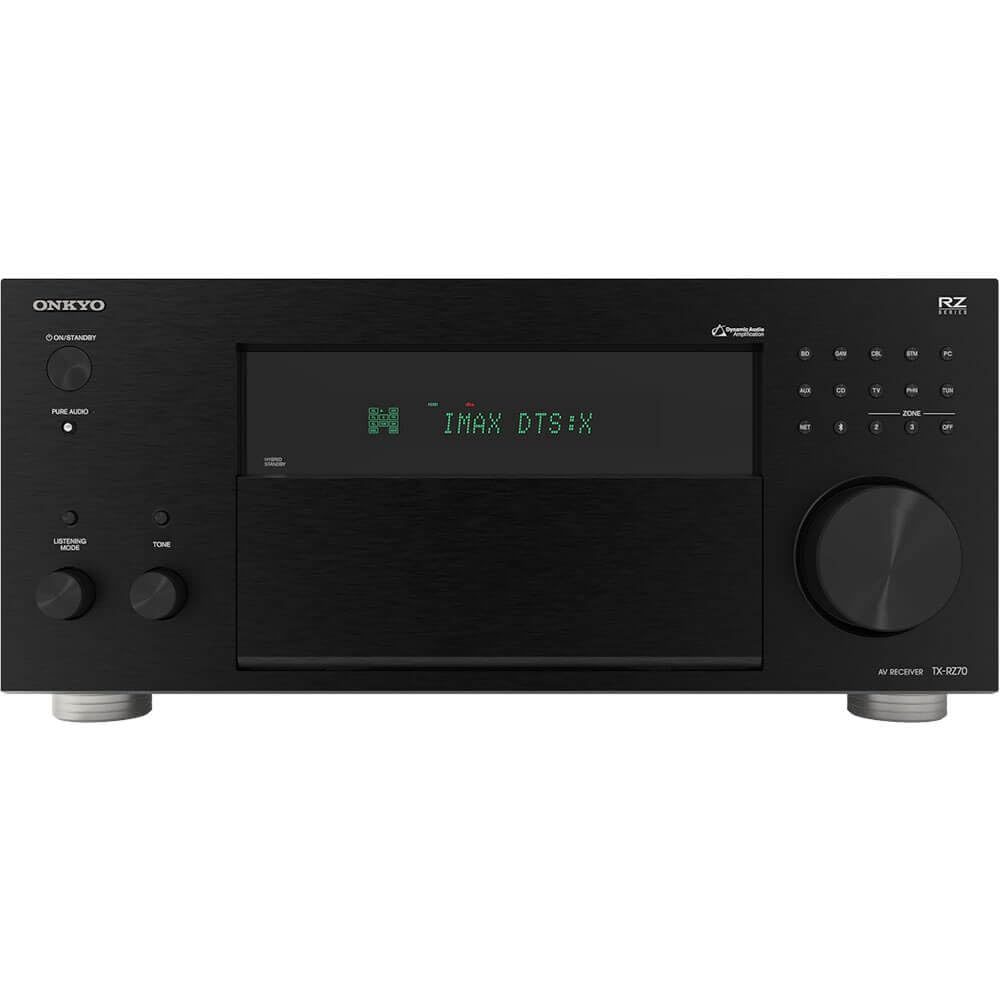
Reference-grade processing for the preamp-first builder who refuses to compromise.
This is the receiver where preamp-first thinking meets genuine flagship muscle. The TX-RZ70 is an 11.2-channel receiver pushing 140 watts per channel, and it’s explicitly celebrated by owners as a rock-solid preamp-processor. It packs full 11.2 pre-outs, so every channel can feed an external amp — this is exactly the kind of unit you want driving a rack of separate power amplifiers. It’s THX Certified, uses ESS Sabre DACs (the digital-to-analog converters that translate digital files into sound), and supports Auro-3D and IMAX Enhanced (a certification for recreating IMAX’s picture and sound standards at home).
What makes it special is Dirac Live Full Bandwidth built in — the room-correction software that owners say transforms bass and imaging. Big bass fans can even upgrade to Dirac Live Bass Control for single or multi-subwoofer tuning. Shoppers say it runs rock-stable with zero HDMI handshake issues (the digital hiccup where a display loses signal) even at 4K/120Hz with a PS5’s VRR (variable refresh rate, which prevents screen tearing). One calls it a “unicorn” — pricing and performance that rival processors costing thousands more. The review pages sum it up: its feature set rivals receivers two to three times its price.
At 57.9 pounds, this is a heavy, hulking unit that needs solid rack space. The remote is plasticky and cheap-feeling — a weird downgrade on a flagship. Reliability is the one mixed note: most owners are blown away, but a rare few report units that failed with error codes or a “Requires Ventilation” shutdown. Zone 2 control is poorly designed (no volume numbers, an 8-second activation window). Sound quality is the single most-praised trait, with build quality second — this is the premium pick for a serious, amp-driven theater.
Processor-first flagship: Full 11.2 pre-outs, Dirac Live Full Bandwidth, and zero handshake issues make it the most flexible amp-driven control center here.
The honesty check: It’s heavy, the remote is cheap, and a small minority had reliability issues — buy with a solid return policy.
Amp-driven builders, this is it: feed it your Parasound or separates and it’ll run a full 7.2.4 or 9.2.4 layout without breaking a sweat.
Look elsewhere if: you don’t need 11 channels of processing or can’t stomach a 58-pound component in your rack.
5. Marantz AV7706 11.2Ch 8K Ultra HD AV Surround Pre-Amplifier

The only true dedicated preamp here — zero amp channels, zero waste.
If you’re fully committed to external amplification, this is the cleanest solution in the lineup. The Marantz AV7706 is a dedicated 11.2-channel pre-amplifier — there’s no built-in amp at all, so every dollar goes into processing and connectivity. You connect it to power amps like the Marantz MM7055 or MM8077 to build a 7.1.4, 7.1, or 2.1 speaker setup. It supports IMAX Enhanced, Auro-3D, Dolby Atmos, and DTS:X (a suite of 3D audio formats that place sound around and above you), making it the most format-complete option here.
The video section is top-tier: 8 HDMI inputs (one dedicated 8K input) with 8K upscaling, 3 outputs with eARC (one HDMI cable carrying TV audio back to the preamp), and support for 8K/60Hz or 4K/120Hz passthrough, Dolby Vision, and BT.2020 (a wide color space standard for richer, more accurate colors). For room correction, it runs the Full Audyssey Platinum Suit with MultEQ XT32 (a high-end calibration system that measures multiple listening positions to fix room acoustics). Owners call Audyssey the best room correction they’ve used and note the setup, while complex and requiring study, is rewarding — one even joked that AI assistants help with the learning curve.
What owners praise most is sound quality, with performance second. Long-time Marantz buyers report the 7706 sounds noticeably better than older AV7702 and AV7704 models, with picture clarity a standout. The gripes are lighter: setup is genuinely complex, the remote lacks backlit text, and the Smart Select presets are locked to a fixed input set rather than per-input. Ease of use draws mixed feedback, so budget time for learning. It’s the priciest entry here, but it’s also the one that assumes you already own — or plan to own — separate amplifiers.
Why Go Dedicated
- No wasted amp channels — every component is purpose-built for processing
- Full 11.2 pre-outs with Audyssey MultEQ XT32 room correction
- 8 HDMI inputs including a dedicated 8K input for future-proofing
The Cost of Purity
- Setup is complex and takes study — not a plug-and-play experience
- Remote lacks backlit text and the GUI feels clunky for quick tweaks
- Smart Select presets are locked to a fixed input set
Your move if: you’re building a separates system with dedicated power amps and want the cleanest, most format-complete processor available.
Hold off if: you’re not ready for the setup learning curve or don’t yet own external amplification — this box does nothing on its own.
Understanding the Specs
Pre-Outs vs. Built-In Amps
Pre-outs are the output jacks that send an unamplified signal to external power amplifiers, letting you bypass a receiver’s internal amp section entirely. A receiver with full-channel pre-outs (say, 7.1 or 11.2) gives you the freedom to pair it with your choice of separate amps for each speaker. If a receiver only has subwoofer pre-outs, like the entry Denon above, you’re locked into its internal amps for your main channels.
Room Correction Software
Room correction uses a bundled microphone to measure how your room’s reflections and standing waves color the sound, then applies digital filters to flatten the response. Audyssey MultEQ XT32 (on the Marantz) and Dirac Live Full Bandwidth (on the Onkyo models) are the two heavyweights. In practice, good room correction can tighten muddy bass and improve imaging more than swapping speakers — it’s worth prioritizing in your budget.
FAQ
What is the difference between an AVR with pre-outs and a dedicated preamp?
How many channels of pre-outs do I need for a 7.1.4 setup?
Can I use an AVR as a preamp and still get 8K video passthrough?
What is Dirac Live and is it worth getting?
Will an AVR as preamp improve my sound quality over using its built-in amps?
How do I connect external amplifiers to an AVR?
What does THX Certified mean on a receiver?
Can I mix an AVR preamp with different brands of power amps?
Final Thoughts: The Verdict
For most buyers, the avr as preamp winner is the Onkyo TX-RZ50 because it delivers 7.2.4 pre-outs, Dirac Live room correction, and THX certification at a value the crowd has clearly embraced. If you want a dedicated preamp with no wasted amp channels, grab the Marantz AV7706. And for a full 11.2-channel flagship that runs your entire rack of external amps, the Onkyo TX-RZ70 is the one to reach for.
How We Picked
We do not accept paid placement. Every pick is matched to a real buyer and a real use-case; we do not hands-on test units.
Sources & Methodology
Specifications: manufacturer listings and product documentation. Review insights: verified customer reviews, as of August 2026. Pricing: not shown on this page (it changes often); check the current price via the retailer link.
As an Amazon Associate, Gadgets Feed earns from qualifying purchases. This does not affect which products we feature.