
Our readers keep the lights on and my morning glass full of iced black tea. As an Amazon Associate, I earn from qualifying purchases.
Specs are compiled from manufacturer listings and verified buyer reviews and can change over time — please confirm the key details on the product page before buying.
If you’ve ever watched an axe bounce off a trunk instead of biting in, you already know — the difference between a good day in the woods and a long, frustrating one depends on the right steel and swing geometry. This guide compares four full-size felling axes built for taking down trees, from a budget-friendly Michigan pattern up to hand-forged German tools that are practically heirlooms.
I’m Min — the founder and writer behind Gadgets Feed. This guide is built by comparing the manufacturers’ published specifications and the patterns across verified customer reviews, so you get each pick’s real strengths and trade-offs instead of marketing spin.
The key to matching your strength and skill level to the right axe is finding the right head weight and handle length. A 3.5 lb head on a 31-inch handle (the standard on the Helko Werk axes) gives the best power-to-control ratio for most people. These four picks represent the best axe for chopping down trees at every price tier, from a lightweight backpacking tool to a budget splitter.
Quick Picks
- Fiskars 28″ Chopping Axe — Top Performer
- 1844 Helko Werk Germany Classic Forester – 3.5 lb Felling Axe — Best Overall
- 1844 Helko Werk Germany Traditional Bavarian Woodworker Felling Axe — Precision Pick
- Truper 30520 3-1/2-Pound Single Bit Michigan Axe — Budget Champion
How To Choose The Best Axe For Chopping Down Trees
Picking the right felling axe depends on three things: head weight, steel quality, and handle feel. A 3.5 lb head is the balance — heavy enough to bite deep into hardwood but light enough to swing all day without wrecking your shoulders. Heavier heads (4+ lb) hit harder but fatigue you faster. Handle length also matters: 28 to 31 inches keeps you accurate for felling, while anything longer gives more leverage at the cost of control.
Head Weight: Power vs. Endurance
A 3.5-pound head (like most picks here) delivers a strong, clean cut on medium trees. A 4.5-pound head hits harder but demands more strength and technique. Beginners should stick to 3.5 lb until their swing is consistent — over-swinging a heavy head is how people miss the trunk and bury the axe in their shin.
Steel Type: Carbon vs. Alloy
High-carbon steel (C50, found on the Helko Werk axes) holds an edge longer and sharpens up easily with a file. Alloy steel heads (like the Truper) are more impact-resistant but dull faster. If you plan to sharpen in the field, carbon steel is easier to maintain.
Quick Comparison
On smaller screens, swipe sideways to see the full table.
| Model | Best For | Head Weight | Total Weight | Handle Length | Amazon |
|---|---|---|---|---|---|
| Fiskars 28″ Chopping Axe | Lightweight backpack felling | 3.5 lb | 3.5 lb | 28 in | $53.18Amazon |
| Helko Werke Forester 3.5 lb | All-around home felling | 3.5 lb | 5.5 lb | 31 in | $185.00Amazon |
| Helko Werke Bavarian Woodworker | Heavy felling & precision cuts | 3.5 lb | 5.5 lb | 31 in | $190.00Amazon |
| Truper 30520 Michigan Axe | Budget-first firewood splitting | 3.5 lb | 4.4 lb | 35 in | $38.27$41.57Amazon |
In‑Depth Reviews
1. Fiskars 28″ Chopping Axe
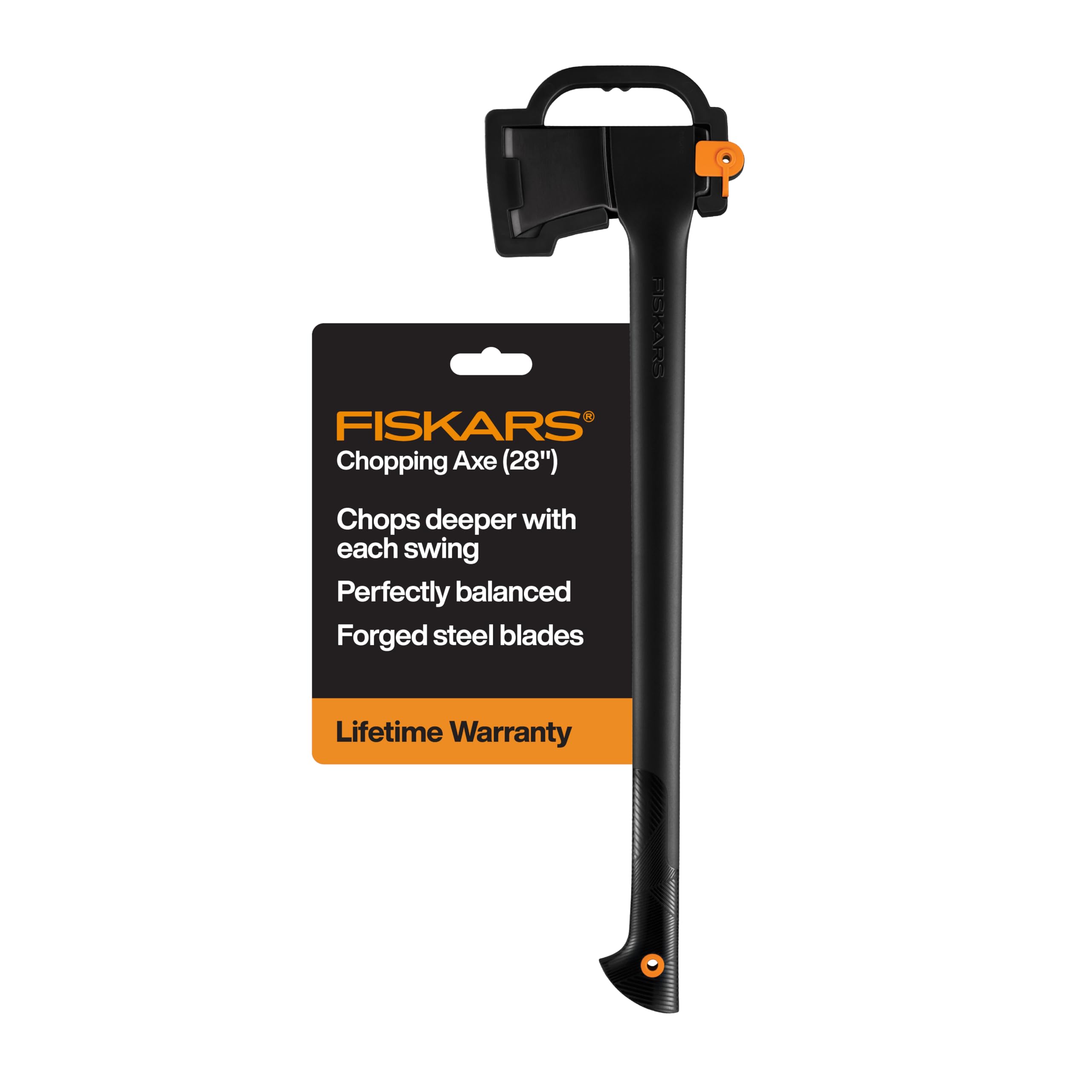
The featherweight that climbs without wheezing — 3.5 lb total, razor sharp, and balanced to swing all day through kindling and small trees.
At 3.5 pounds total (the head IS the whole tool here — no wooden handle adding heft), this Fiskars is the lightest pick on the list yet still chops with authority. Its ultra-sharp alloy steel blade uses a low-friction coating so it slides through wood rather than wedging tight. Buyers report the “ultra-sharp blade cuts wood easily,” and many note it fells small trees in minutes without the arm fatigue a heavier axe causes. The precision-balanced design helps the blade bite deeper with less effort, making it ideal for campsite prep or clearing saplings on a trail.
At 28 inches, the handle is shorter than any other pick here, which cuts reach but boosts accuracy — you are less likely to miss a narrow trunk. Unlike the 5.5-pound Helko Werk axes, this one fits in a backpack without overloading you on a hike. Buyers also mention the handle “keeps the felt impact to a minimum,” reducing joint strain over long sessions. The trade-off: you lose the raw momentum a 35-inch handle provides on big hardwood, so this is not a dedicated feller of oaks or maples.
The defining edge: This axe wins when weight matters most — at 3.5 lb total, it is 57% lighter than the 5.5 lb Helko Werk Traditional Bavarian Woodworker, making it the obvious pick for backpackers, campers, and anyone whose arm gives out before the wood pile does.
The honest catch: That 28-inch handle limits leverage on large standing trees. You will swing more times to fell a 12-inch trunk than you would with the Helko Forester.
Reach for this if: you backpack into your cutting site, hate exhaustion after 20 minutes, or need one tool that splits kindling AND fells small/medium trees without the gym membership arm.
Look elsewhere if: your primary goal is taking down large hardwoods (10″+ diameter) — you need the longer handle and heavier head of a Helko Werk or a dedicated felling axe.
2. 1844 Helko Werk Germany Classic Forester – 3.5 lb Felling Axe

Hand-forged German steel, a hand-finished hickory handle, and a convex grind that stays sharp through a season of felling.
This Forester is the just-right of full-size felling axes: a 3.5-pound head on a 31-inch handle — heavy enough to bite deep into medium and large trees without over-encumbering the average user, per the manufacturer. The C50 high carbon steel head is open-drop forged by hand in Germany and hardened to 53-56 HRC (the Rockwell scale that measures steel hardness), so it holds an edge noticeably longer than the alloy steel on the Fiskars or Truper. Buyers call out “excellent German craftsmanship; precise, symmetrical, beautiful grind” and note it arrives razor sharp from the start. The Grade A American hickory handle is sanded to 150 grit and finished with boiled linseed oil, giving a smooth grip that improves with use.
Total weight hits 5.5 pounds — nearly double the Fiskars — which translates to more momentum per swing on a thick oak trunk. The included full-grain leather sheath and a 1 oz bottle of Axe Guard protective oil keep the blade protected and rust-free between uses. One reviewer notes the 3.5 lb head “is not for novices” because the weight demands proper technique; beginners risk wild swings. The convex blade edge (a rounded grind that transitions smoothly into the cheek) slices cleaner than a flat grind but takes more skill to sharpen correctly. If you are upgrading from a hardware-store wedge, expect a learning curve, not a magic wand.
The heirloom upside
- C50 carbon steel (53-56 HRC) holds an edge far longer than the alloy steel on the Fiskars or Truper
- Hand-forged with polished Classic finish reduces rust and friction during cuts
- 31-inch handle delivers excellent leverage on medium-to-large trees while staying manageable for most adults
- Includes premium leather sheath and protective oil — nothing extra to buy
The honest trade-off
- At 5.5 lb total, it is 57% heavier than the Fiskars — your shoulder will feel the difference on day-long sessions
- Convex grind requires a round file to sharpen properly; beginners often mess up the edge profile
- Price is premium — around 3-4x the Truper — justified only if you use it heavily
Who this fits: homeowners with acreage, hobby woodcutters who fell a dozen trees per season, and anyone who wants one axe that will last decades with proper care.
The one caveat: if you are buying your first real felling axe and have never sharpened a convex edge, budget time to learn — or start with the Fiskars for its easier maintenance.
3. 1844 Helko Werk Germany Traditional Bavarian Woodworker Felling Axe

A slim, wide-bit Rheinland pattern that outperforms American felling axes at pure cutting — with heirloom-level fit and finish.
Like the Forester, this Bavarian Woodworker carries a 3.5-pound head on a 31-inch handle with a 5.5-pound total weight — but the head shape is different. The Rheinland pattern features a “sharp, slim, wide-bit blade” designed explicitly for cutting work, not splitting. The shallow cheeks allow the axe to glide through the wood fibers rather than wedging them apart. Owners mention “this came razor sharp from the factory” and love that the large bit aids precision cuts for both felling and hewing (squaring logs into beams). One reviewer noted the “hand-forged steel bites deep” and the shallow cheeks let you make controlled felling cuts that are harder to pull off with a thicker-profile axe like the Truper.
The handle is the same Grade A American hickory sanded to 150 grit with a linseed oil finish, but customers note the handle arrives “untreated, ready for oil” so you can finish it to your preference. The overstrike protector (a metal collar above the handle) did loosen on one buyer’s unit, but the company’s customer service quickly sent a free leather replacement collar — a sign of the support you pay for at this tier. Unlike the Fiskars, which is a single-piece synthetic unit, both Helko axes let you replace the handle if it breaks decades down the line, which is why many owners call them “heirloom-quality.”
The narrow advantage: This head pattern is the better chopper for clean felling cuts on standing trees — the Rheinland shape delivers more bite per swing than the broader, blunter Michigan pattern on the Truper.
The realistic limit: It weighs the same 5.5 lb total as the Forester, so it is not for backpacking.
Reach for this if: you are a serious woodworker or landowner who fells trees weekly and wants the purest cutting geometry German engineering offers.
Look elsewhere if: your main job is splitting firewood into stove-sized pieces — a splitting axe or maul with a wider wedge profile will free stuck heads faster.
4. Truper 30520 3-1/2-Pound Single Bit Michigan Axe

A classic 35-inch Michigan pattern with a heat-treated alloy steel head — the affordable option that needs a careful inspection before its first swing.
The Truper is the longest-handled pick here at 35 inches, giving you maximum reach and leverage for splitting firewood on the ground. Its 3.5-pound alloy steel head is heat-treated for impact resistance, and the hickory handle uses a wood-and-steel wedge assembly for a tight fit. At 4.4 pounds total, it is a full pound lighter than the Helko axes, partly because the head steel is less dense and the hardware is simpler. Many reviewers point out it is “well made” with “heartwood hickory of excellent quality” for the price, and one verified owner notes it “works great” compared to other wood-handled axes sold in big-box stores today. The head is a standard single-bit configuration (one blade edge) with a nail pull on the poll (the flat back), useful for light demolition.
The honest catch: quality control is inconsistent at this price point. One buyer reports the “axe handle split on first swing out of box; suspected pre-existing crack.” A cracked handle on day one is rare for the Helko Werk axes but not unheard of here, which means you should examine the handle grain and the wedge before any swing. The blade material is alloy steel rather than C50 carbon steel, so it will dull faster and be slightly harder to bring back to razor sharp with a file. If you are cutting only a few times a year and want the lowest cost of entry, this is usable — but do not expect the performance or durability of the German forged options.
The value case
- 35-inch handle provides the most leverage of any pick here for bending-over splitting
- Heat-treated alloy steel blade is impact-resistant for tough knots
- Wood and steel wedge assembly is traditional and simple to rehang if the handle eventually breaks
The risk you take
- Reported handle splitting on first swing — inspect the hickory grain and wedge fit before use
- Alloy steel edge dulls faster than C50 carbon steel on the Helko Werk axes
- No sheath included; blade arrives exposed, unlike the Helko axes with leather covers
Who this fits: budget-first buyers who need a full-size axe for occasional firewood splitting and are comfortable checking the handle for cracks before each use.
Who should skip it: anyone planning heavy weekly felling, or anyone who does not want to risk a handle failure on the first swing — spend the extra on the Fiskars for confidence.
Understanding the Specs
Head Weight & Steel
Head weight (measured in pounds) is the single most important number in a felling axe. A 3.5-pound head is the all-around standard — heavy enough for medium-to-large trees, light enough to swing all day. The steel type matters just as much: C50 high carbon steel (53-56 HRC on the Rockwell hardness scale) holds an edge far longer than alloy steel and is easier to re-sharpen with a file in the field. Alloy steel, used on the Truper, is cheaper and more impact-resistant but dulls faster.
Handle Length & Material
Handle length (28-35 inches) controls both reach and leverage. A 31-inch handle (the Helko Werk axes) strikes the best balance for general felling — long enough to generate momentum, short enough to stay accurate. Hickory wood handles absorb vibration better than synthetic handles and can be replaced if they crack, but they require periodic oiling to prevent drying. A 35-inch handle (Truper) gives maximum leverage for splitting on the ground but is harder to control for precision felling cuts. A 28-inch handle (Fiskars) is best for backpacking and close-quarters limbing.
FAQ
What head weight is best for felling medium trees like oak or maple?
Is a steel handle better than a hickory handle for a felling axe?
Can I use a 28-inch axe for felling large trees?
What does “C50 high carbon steel” mean for an axe?
How often should I sharpen a felling axe?
Does the Truper 30520 come with a sheath or guard?
What is the difference between a Michigan pattern and a Rheinland pattern axe head?
Can I replace the handle on a Fiskars axe if it breaks?
Final Thoughts: The Verdict
For the majority of shoppers, the axe for chopping down trees winner is the Helko Werk Classic Forester because its hand-forged C50 carbon steel head and 31-inch hickory handle deliver the best balance of bite power, durability, and control for medium-to-large trees. If you want a lightweight tool you can carry all day in a backpack without arm fatigue, grab the Fiskars 28″ Chopping Axe. And if your budget is tight and you need a long-handled Michigan pattern for splitting firewood around the homestead, the Truper 30520 gets the job done for under fifty dollars — just inspect the handle before you swing.
How We Picked
We do not accept paid placement, and we did not hands-on test every unit. Instead, we match each pick to a real buyer and use-case by comparing the manufacturers’ published specifications against the patterns in verified customer reviews — so you get each pick’s real strengths and trade-offs instead of marketing copy.
Sources & Methodology
Specifications: manufacturer listings and product documentation. Review insights: verified customer reviews, as of July 2026. Pricing: not shown on this page (it changes often); check the current price via the retailer link.
As an Amazon Associate, Gadgets Feed earns from qualifying purchases. This does not affect which products we feature.
Product prices and availability are accurate as of the date/time indicated and are subject to change. Any price and availability information displayed on Amazon at the time of purchase will apply to the purchase of this product. As an Amazon Associate I earn from qualifying purchases.
CERTAIN CONTENT THAT APPEARS ON THIS SITE COMES FROM AMAZON. THIS CONTENT IS PROVIDED "AS IS" AND IS SUBJECT TO CHANGE OR REMOVAL AT ANY TIME.
Amazon and the Amazon logo are trademarks of Amazon.com, Inc. or its affiliates.