
Our readers keep the lights on and my morning glass full of iced black tea. As an Amazon Associate, I earn from qualifying purchases.
Specs are compiled from manufacturer listings and verified buyer reviews and can change over time — please confirm the key details on the product page before buying.
You want a blade that can split kindling without anchoring your pack. The trick is finding the one that balances that cutting bite with a weight you will actually carry—most hikers overshoot both and end up with a log-splitter they leave at home or a toy that bounces off wet wood. This guide cuts through the noise by matching real specs (blade length, overall weight, steel type) to the actual trail tasks that matter.
I’m Min — the founder and writer behind Gadgets Feed. This guide is built by comparing the manufacturers’ published specifications and the patterns across verified customer reviews, so you get each pick’s real strengths and trade-offs instead of marketing spin.
You will find nine axes that earn their spot in a hiking pack, each chosen for a specific reason. Your axe for hiking needs to be light enough to forget, sharp enough to trust, and tough enough to handle one more season of wet campsites and dry deadfall.
Our Picks at a Glance


How To Choose The Best Axe For Hiking
The wrong hiking axe feels like a brick tied to your shoulder strap. The right one disappears into your pack until you need it, then bites hard and clean. Here are the three specs that separate a trail-worthy tool from a garage ornament.
Weight and Length: The Carry vs. Chop Trade-off
Every extra inch of handle gives you more leverage but adds bulk. Every extra ounce of head delivers more splitting force but drags on your back. For hiking, a total weight under 2 pounds and a length under 15 inches keeps the axe manageable inside a pack and easy to swing one-handed. An axe that is too short (under 10 inches) loses chopping power, while anything over 18 inches becomes awkward to stow.
Blade Steel and Edge Retention
The type of steel determines how sharp the edge stays and how easily you can touch it up on the trail. Forged alloy steel and boron steel hold a good edge through repeated use. Stainless steel resists rust, which is a real advantage in wet conditions. A blade that arrives sharp from the factory saves you a sharpening session before your first trip, but all edges eventually need maintenance—a small diamond file or puck is worth packing.
Handle Construction and Grip
A full tang axe (one continuous piece of steel running through the handle) eliminates the weak point between head and handle. A molded head design, where the head is insert-molded into a composite handle, prevents loosening and overstrike breakage. The grip material matters too: textured rubber or glass-filled nylon stays secure in wet hands, while a natural wood handle looks beautiful but can get slippery in rain or snow.
Quick Comparison
| Model | Best For | Weight | Blade Length | Handle Material | Amazon |
|---|---|---|---|---|---|
| Fiskars 375501-1001 Hatchet 14″★ Best Overall | All-Around Camping | 1.5 pounds | 14″ overall | DuraFrame (composite) | Amazon |
| Fiskars X13 Ultralight Hiking Axe 13″Ultralight Champ | Ultralight Backpacking | Under 1.5 lb (est.) | 13″ overall | FiberComp (composite) | Amazon |
| NedFoss Warthog Camping Hatchet 9″Compact Bushcraft | Compact Bushcraft | 15.5 oz (head) | 4.2 inches | Natural Wood | Amazon |
| Schrade Delta Class Bedrock Axe | Survival & Fire Starting | 1.4 pounds | 3.8 inches | Glass-filled PA + TPR rubber | Amazon |
| ESTWING Sportsman’s Axe 14″ | Premium All-Steel Durability | 1.8 pounds | 4 inches | Alloy Steel + Leather | Amazon |
| Kershaw Deschutes Skinner Hatchet 14″ | Lightweight Camp Axe | 1 lb 9 oz | 3.5 inches | Glass-filled nylon + rubber | Amazon |
| SOG Survival Hawk 12.1″ | Multi-Tool Tactical Use | 19.5 ounces | 3 inches | Glass-reinforced nylon + paracord | Amazon |
| Morakniv Boron Steel Camping Axe 12.7″ | Lightweight Medium-Duty | 17.6 ounces (0.5 kg) | 4.5 inches (115 mm) | Plastic (composite) | Amazon |
| Husqvarna Hatchet 14.97″ | Swedish Craftsmanship | 1.3 pounds (head) | 14.97″ overall | Hickory Wood | Amazon |
In‑Depth Reviews
1. Fiskars 375501-1001 Hatchet with Sheath, 14″, Black
Our pick — over 4.5★ from 700+ verified ratings; the strongest balance of quality and price.
The crowd-favorite hatchet with 4.8 stars from over 700 owners, built for real chopping without the weight.
You get a 14-inch hatchet that weighs 1.5 pounds and carries a blade ground with Fiskars’ proprietary technique for a sharper edge. The low-friction coating on the blade powers through wood and prevents the head from sticking. The shock-absorbing DuraFrame handle is stronger than steel, according to the manufacturer, which means you can swing with confidence even into tough grain.
The molded head design is a big deal here—it will not loosen over time, and it prevents the kind of overstrike breakage that ruins a trip. Buyers report that this hatchet splits logs into kindling with a small crack, and one calls it “an amazing tough to top chopper” that replaced a twenty-year-old X7. The included plastic sheath is fine for storage, though some owners wish it were more portable on the trail.
Quality and sharpness are the two most-discussed strengths by a wide margin. The blade arrives sharp enough to bite immediately, and the alloy steel holds that edge through repeated camp use. For a hiking axe that does not make you choose between packability and power, this is the one to beat.
What owners praise most
- Quality and sharpness top the charts—buyers call it “TOP NOTCH quality” that holds an edge
- Well-balanced feel makes one-handed swings feel natural and controlled
- Low weight (1.5 lb) and compact 14″ size fit easily inside a hiking pack
A few honest trade-offs
- Plastic sheath is bulky and not ideal for packing; some owners replace it
- Not the full-tang feel of a forged solid-steel axe if that is your preference
Best for the hiker who wants one axe for everything: splitting kindling at camp, batoning small logs, and clearing trail branches without a second tool.
Think twice if you need a longer handle: the 14-inch total length suits one-handed use; two-handed swingers will want something longer like the Estwing Sportsman’s Axe.
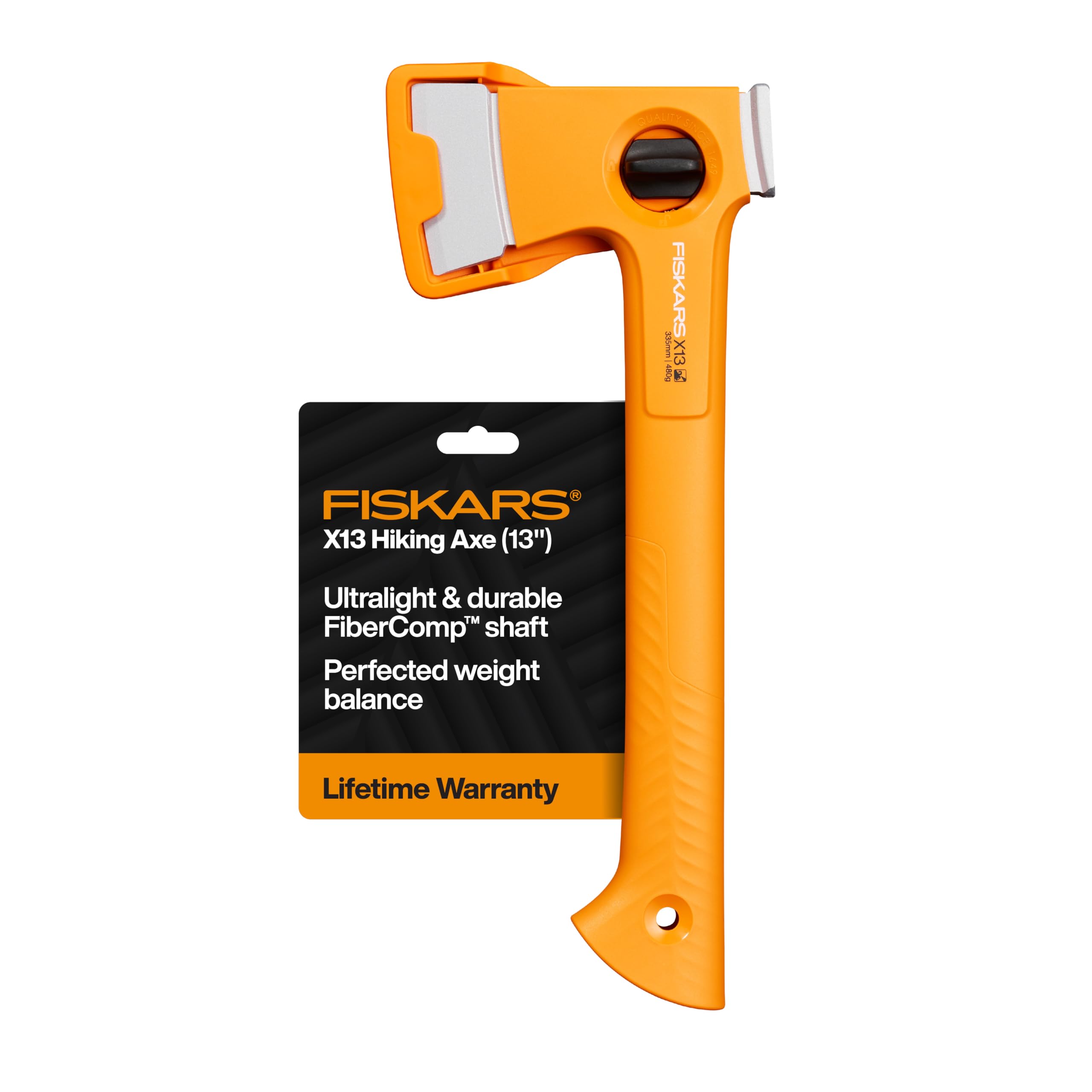
2. Fiskars X13 Ultralight Hiking Axe 13″, Camping Hatchet, Forged Steel Blade
The lightest Fiskars hiking axe yet, carved down 15 percent to shave every possible gram from your pack.
This 13-inch axe is designed specifically for the trail: the high-visibility orange FiberComp handle makes it easy to spot if you set it down in the woods. The double-hardened forged steel blade uses the same proprietary grinding technique as the larger Fiskars models, so you get the same sharp edge in a smaller package. A striking end on the handle doubles as a tent stake driver, which saves you from carrying a separate mallet.
The low-friction coating protects against rust and helps the blade glide through wood. The insert-molded head reduces loosening over time. Lightweight is the most-discussed aspect by owners, and buyers confirm it is “nice and light” for backpacking with the scouts. The integrated sheath attaches via a belt loop and uses a quarter-turn locking mechanism—owners find it convenient, though the initial sharpness gets mixed notes, with some reporting the edge arrived less sharp than expected and benefited from a touch-up.
For the gram-conscious hiker who still wants real chopping power, this is the most packable Fiskars money can buy. The 13-inch length tucks into a side pocket or lashes flat to a pack frame without sticking out.
Ideal trail companion: Ultralight backpackers who count every ounce but still need to process firewood and pound stakes will love this. The recurring note from owners: it is “very sharp” for dry firewood but can chip on dense wet branches, so keep the work to seasoned wood or touch up the edge after wet-weather trips.
Reach for this if: you prioritize weight above all else and need an axe that disappears into a backpacking load.
Look elsewhere if: you plan to split large rounds of wet hardwood daily—the edge on this ultralight is not the toughest, as some owners discovered.
3. NedFoss Warthog Camping Hatchet Axe, 9″ Full Tang Small Axe with Sheath
A full-tang 9-inch hatchet with a natural wood handle and a custom leather sheath that looks as good as it cuts.
At just 9 inches overall, this is the shortest axe in the lineup, but it packs a 4.2-inch stainless steel blade that is 5.0mm thick. The full-tang construction (one continuous piece of steel from blade to butt) makes it incredibly sturdy—no head to loosen over time. The natural wood handle is etched with a warthog design and shaped for a comfortable, ergonomic grip. The included leather sheath attaches to a belt for easy carry.
Build quality is by far the most mentioned strength, with 55 owners praising it directly. Owners call it “small, practical, and really well made,” and note that it “chips away at wood easily.” The 15.5-ounce head gives it enough heft for field dressing tasks, with one buyer mentioning its effectiveness on deer. At this length, it lacks the power for full-on log splitting, as the manufacturer states, but it is easier to control for carving, pruning, and fine bushcraft work.
The trade-off some owners flag is that the wood handle can feel slippery when wet, and the sheath catches the blade edge if you are not careful. For the bushcraft enthusiast who wants a precision tool for carving and small-wood processing, the compact size is a feature, not a limitation.
Who this fits: The bushcraft carver and ultralight backpacker who values a full tang over raw splitting power. The stainless steel resists rust, and the 4.2-inch blade is ideal for feather sticks and notch cutting. Just be aware the handle is wood—a light sanding and oiling helps with wet-weather grip.
Reach for this if: you want a full-tang mini axe that fits in a daypack and excels at fine woodwork and small camp chores.
Look elsewhere if: you need to split quarters or process thick logs—the 9-inch handle limits leverage compared to the Fiskars 14-inch or the Estwing 14-inch.
4. Schrade Delta Class Bedrock Axe with 3Cr13 Stainless Steel

An 11.8-inch survival axe that packs a hammer pommel and a hidden ferro rod inside the handle.
The Schrade Bedrock Axe is built for the bushcrafter who wants one tool that does more than chop. The 3Cr13 stainless steel blade is titanium-coated and comes sharp, with good edge retention according to owners. The glass-filled PA handle with a black TPR rubber grip features finger grooves for a secure, slip-resistant hold. A hammer pommel at the base lets you drive tent stakes, and the included ferrocerium fire starter rod stored in the shaft produces “large sparks” as one owner noted.
Quality (130 mentions) and sharpness (75 mentions) are the top positive aspects by far. Owners call it a “quality hatchet, comfortable handle” and find it suitable for light to medium camp use, splitting kindling, and backpacking. The ergonomic handle gets consistent praise for feeling good in hand. The axe comes with both a plastic belt sheath and a nylon sheath, giving you options for carry.
The biggest caveat from owner experience is mixed durability—some report the handle breaking within just two uses. The plastic sheath is also described as potentially fragile.
The survivalist’s edge: This axe includes features no other hiking axe here offers—a hammer pommel and a built-in fire starter. Owners confirm the ferro rod works well with a knife back for reliable sparks. The rubber grip with finger grooves makes it easy to control in wet conditions.
Best for: Hikers who want a single tool that chops, hammers stakes, and starts fires without carrying extras.
skip it if: you plan to baton through dense hardwood regularly—the composite handle is a known weak point under extreme stress.
5. Morakniv Boron Steel Camping Axe

A 17.6-ounce hatchet with a 0.24-inch thick boron steel blade that owners say takes a shaving-sharp edge.
The Morakniv Camping Axe weighs just 0.5 kg (17.6 ounces) with a total length of 12.7 inches, making it one of the lightest options here. The 4.5-inch boron steel blade is 6.0 mm thick and carries a black ED-coating to protect the head from scratches. The plastic handle is engineered for safe handling in all weather—it will not shrink, swell, or rot like wood. A vegetable-tanned Swedish leather sheath protects the edge when not in use.
Blade quality is the most praised aspect, with owners noting that the edge is “so sharp you can shave” straight from the start. The boron steel holds up well through months of heavy use with minimal touch-ups, according to long-term owners. The Scandi grind (a flat bevel that goes straight to the edge) is easy to maintain in the field. Owners also appreciate that the back of the head can hammer stakes, though a few note the back is narrow.
Where opinions split is cutting performance for heavy tasks. Some owners find it excellent for small chopping jobs, while others say it is not suitable for splitting large logs. The handle material is plastic, which some traditionalists find less appealing than wood or metal. For the backpacker who values a razor-sharp, minimal-weight axe for medium-duty work, this one delivers on its feathery promise.
The standout spec: 6.0 mm boron steel blade at just 17.6 ounces total weight—a ratio no other axe here matches. Owners who used it for months report minimal edge degradation. The leather sheath is a nice touch at this price tier.
Reach for this if: you want a super-light hatchet that shaves weight without sacrificing edge quality. The boron steel is genuinely tougher than standard stainless.
Look elsewhere if: your main use is splitting large logs—this is a medium-duty camp axe better suited to kindling, carving, and small branch work.
6. ESTWING Sportsman’s Axe – 14″ Special Edition Camping Hatchet

American steel forged in one piece in Rockford, IL—a 14-inch hatchet built like a tank with a hand-sanded leather grip.
The Estwing Sportsman’s Axe is a different animal. Crafted from a single piece of solid American steel, this design eliminates any weak point from castings or welds. The 4-inch cutting edge is hand-sharpened at the factory. The genuine leather grip is hand-sanded and lacquered, giving you a comfortable, durable hold that only gets better with age. A rugged ballistic nylon sheath with a belt loop keeps the blade protected and accessible.
Owners consistently praise the build quality: they call it “good quality, beautiful and functional” and note that “making kindling is easy now.” The 1.8-pound weight gives it substantial authority on the swing, yet it remains nimble enough for one-handed use. The hatchet also serves as a tent stake puller, a detail campers appreciate. At 14 inches, it sits right at the balance between a full-size axe and a compact hatchet.
The honest gripes are minor and cosmetic. A few owners mention that stickers on the handle are frustrating to remove, and some report paint smears or weld marks on the butt bolt. These are aesthetic issues on an otherwise excellent tool. For the hiker who wants a legendary American-made axe that will outlast them, this is it.
The one-piece edge: Forged from a single billet of American steel means there is zero risk of head separation—a failure mode that can happen on two-piece axes. The leather grip is comfortable in hand, and the ballistic nylon sheath is rugged. For durability, this is the benchmark.
Reach for this if: you value American craftsmanship and want an axe that will last generations. The forged one-piece construction is class-leading for durability.
Look elsewhere if: weight is your primary concern—at 1.8 pounds, it is heavier than the Fiskars options and may feel noticeable on a long ultralight hike.
7. Kershaw Deschutes Skinner Hatchet Camp Ax, 14″

A 14-inch full-tang hatchet from Kershaw with a glass-filled nylon handle and textured rubber inserts for wet-weather grip.
The Kershaw Deschutes uses 3Cr13 stainless steel in a full-tang design with blade cutouts that reduce weight without sacrificing strength. The black-oxide finish helps hide trail scratches. The tan glass-filled nylon handle features rubber overlay inserts for a secure grip even when your hands are wet or gloved. The included glass-filled nylon blade sheath secures with attached nylon straps that allow for versatile carry options.
Owners call it “very well balanced and very very sharp,” with many noting it holds an edge through moderate use. The 14-inch length and 1 lb 9 oz weight make it handle like a proper hatchet without being bulky. The integrated sheath and sling arrangement gets consistent praise for convenience. It handles carving kindling, clearing small branches, and felling small trees effectively.
The most honest pushback involves the blade thickness—several owners note it is “super thin” and not ideal for heavy splitting. The poll (the back of the head) is also thin, making it unsuitable for hammering. Some find the stainless steel soft, requiring more frequent sharpening than higher-carbon steels. For a car camper or light backpacker who needs a sharp, balanced tool for medium tasks, the Deschutes delivers Kershaw’s quality reputation.
What wins people over: The balance and sharpness are the most consistently praised traits. The sheath and sling are well-designed for quick access. It is an ideal truck or camp axe for moderate use.
Reach for this if: you want a modern, well-balanced camp axe with a secure grip and a smart carry system. Kershaw’s build quality is trusted.
pass on it if: you need a hammer poll or plan to baton through dense hardwood—the thin blade and lack of a striking face are real limitations.
8. SOG Survival Hawk – 12.1″ Tactical Hatchet with Fire Starter

A 12.1-inch tactical tomahawk with a 3-inch stainless blade, a hammer edge, a claw, and a hidden fire starter.
The SOG Survival Hawk is the Swiss Army knife of hiking axes. The 3-inch hardcased black stainless steel blade is full tang (forged one-piece through the handle), and the handle wraps in glass-reinforced nylon with a reflective paracord wrap that can be unspooled for emergency cordage. The checkered hammer edge drives stakes, the claw is designed for prying and wire cutting, and the ferrocerium fire starter rod stored in the handle produces sparks for campfires.
Quality and sharpness lead the owner feedback, with buyers noting it “cut down a 5-inch tree in minutes” without dulling after a week. The 19.5-ounce weight makes it light enough for a daypack. The ballistic nylon sheath can be worn on a belt or lashed to gear. The fire starter, while functional, draws some mixed feedback—owners find the included ferro rod works but is harder to reinsert than expected.
Durability is the most mixed aspect. While many owners find it sturdy, some report the flint breaking within days. The handle is thin for large hands, but the paracord wrap helps with grip. For the tactical-minded hiker who values multi-function over pure chopping power, this is a unique tool that does more than any other hatchet in this list.
The multi-tool advantage: No other hiking axe here packs a fire starter, claw, and hammer into a 19.5-ounce package. Owners confirm it chops effectively, and the full-tang construction gives it longevity. The reflective paracord is a nice survival bonus.
Best for: The survival-minded hiker who wants a single tool that chops, hammers, pries, and starts fires. The claw is genuinely useful for pulling nails and cutting wire.
Think twice if: you need a pure wood-processing axe for heavy splitting—the 3-inch blade is short, and the hammer/striker features add complexity that some traditionalists find unnecessary.
9. Husqvarna Hatchet, Small Axe with Leather Sheath and Hickory Handle
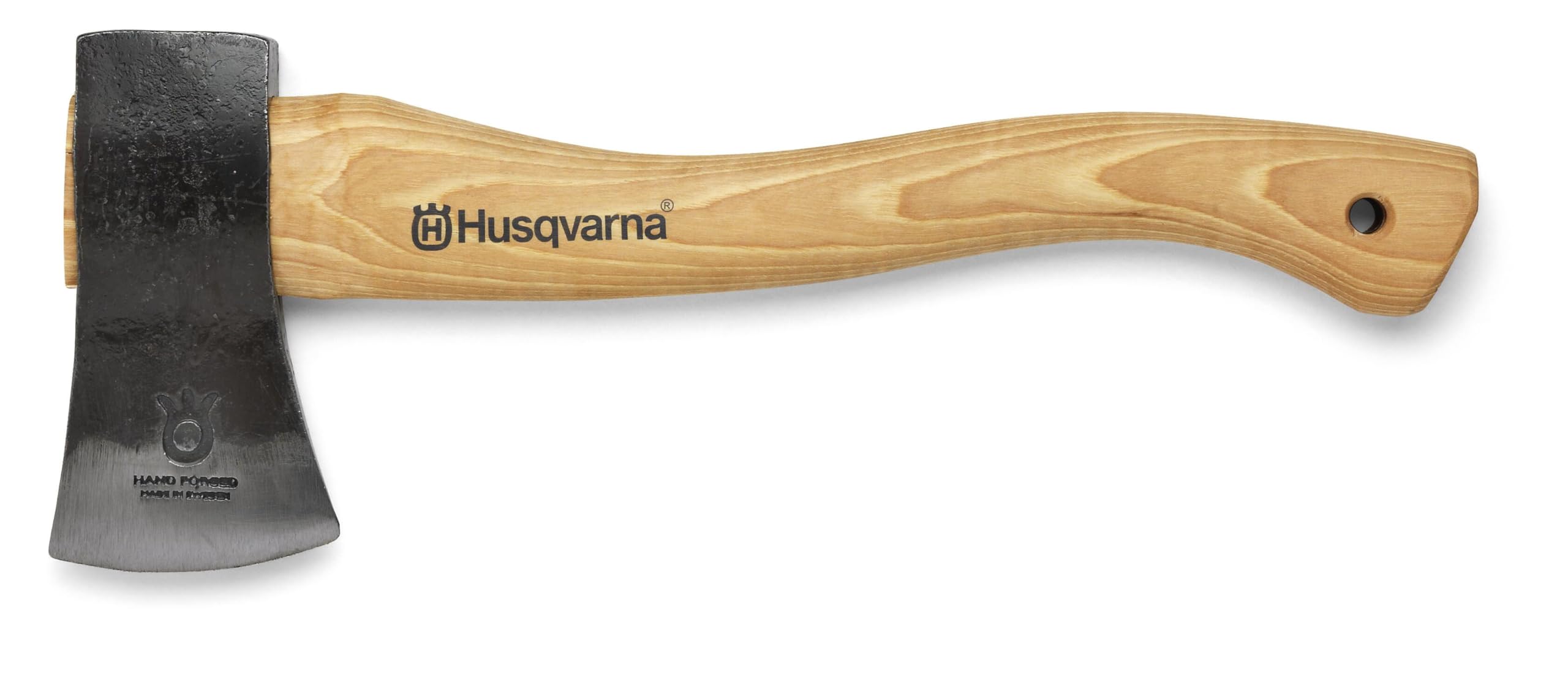
A hand-forged Swedish hatchet with a hickory handle and a genuine leather sheath, built for one-handed use on light wood.
The Husqvarna Hatchet is the most traditional axe in this lineup. The 1.32-pound head is hand-forged in Sweden from premium Swedish steel. The handle is American hickory—tight-grained, sturdy, and shaped for a comfortable grip that fills the hand. A genuine leather sheath with a metal snap protects the blade. The 14.97-inch total length is designed specifically for one-handed use on light wood cutting.
Quality and value for money are the most discussed positive aspects. Owners describe it as a “high-quality, hand-forged Swedish hatchet with classic aesthetic” and note that the Swedish steel “takes an edge well.” The handle shape gets specific praise for allowing powerful swings. The hickory wood grows more comfortable with use and a coat of tung oil, as some owners discovered. The leather sheath is thick and features brass rivets, adding to the premium feel.
The honest note from owners: the blade often arrives dull or with a poor factory bevel, requiring a sharpening session before first use. Some owners also note that the handle benefits from a light sanding and oil finish. For the traditionalist who wants a heirloom-quality tool and enjoys the ritual of maintenance, this is the pick.
The artisan’s axe: Hand-forged in Sweden by Hultafors at Hults Bruk—the same forge that has made axes for generations. The hickory handle is comfortable and the Swedish steel sharpens to a fine edge. Owners call it “incredible value” even at current pricing.
Reach for this if: you appreciate old-world craftsmanship and want a hiking axe that will patina beautifully over years of use. The Swedish steel is excellent.
Look elsewhere if: you want a ready-to-go tool from the start—many owners mention the blade needs hand sharpening, and the hickory handle benefits from oiling before first use.
Understanding the Specs
Blade Steel and Edge Retention
The type of steel used in a hiking axe determines how long it stays sharp and how easy it is to sharpen in the field. Forged alloy steel (used in most Fiskars models) offers a good balance of edge holding and durability. Boron steel (used in the Morakniv) adds extra toughness and edge retention. Stainless steel (used in the Schrade, Kershaw, NedFoss, and SOG) resists rust, which is helpful in damp climates, but can be softer than carbon alloys. A blade that arrives sharp from the factory saves you pre-trip work, but all axes need occasional touch-ups—pack a small sharpening puck or file.
Full Tang vs. Molded Head Construction
A full tang axe means one continuous piece of steel runs from the blade through the entire handle. This eliminates any risk of the head separating from the handle, even under heavy use. The Estwing, NedFoss, Kershaw, and SOG axes use full tang designs. A molded head design, like the ones Fiskars uses, inserts the head into a composite handle using an injection-molding process. This prevents the head from loosening over time and reduces weight, but the head is not replaceable if damaged. For light to medium trail use, both designs work well—your choice depends on whether you prioritize weight savings (molded) or absolute repairability (full tang).
FAQ
How do I properly maintain a hiking axe on the trail?
What is the ideal weight for a hiking axe?
Can I use a hiking axe to split firewood?
How often do I need to sharpen a hiking axe?
Is a stainless steel axe better than a carbon steel axe for hiking?
What is the difference between a hatchet and a tomahawk for hiking?
How should I carry an axe while hiking?
Will a 9-inch axe like the NedFoss Warthog be useful for hiking?
What is the best axe for ultralight backpacking?
How do I choose between a wooden handle and a composite handle?
Final Thoughts: The Verdict
For most hikers, the top axe for hiking is the Fiskars 375501-1001 Hatchet 14″ because it nails the balance of weight (1.5 pounds), edge sharpness, and proven durability at a price that makes it an easy decision. If you want an ultralight option that shaves every possible gram, grab the Fiskars X13 Ultralight 13″. And for the traditionalist who wants a hand-forged Swedish steel head on a hickory handle, the Husqvarna Hatchet is the one to reach for.
How We Picked
We do not accept paid placement. Every pick is matched to a real buyer and a real use-case; we do not hands-on test units.
Sources & Methodology
Specifications: manufacturer listings and product documentation. Review insights: verified customer reviews, as of July 2026. Pricing: not shown on this page (it changes often); check the current price via the retailer link.
As an Amazon Associate, Gadgets Feed earns from qualifying purchases. This does not affect which products we feature.