
Our readers keep the lights on and my morning glass full of iced black tea. As an Amazon Associate, I earn from qualifying purchases.
Specs are compiled from manufacturer listings and verified buyer reviews and can change over time — please confirm the key details on the product page before buying.
You will be happy with your axe or hatchet only if it matches your job. Are you splitting big rounds into firewood, or doing smaller camp and garden work with one hand? Most disappointed buyers grabbed the wrong size tool. A 28-inch splitting axe clears a woodpile fast, but it is clumsy for carving kindling at a campsite. A 13.5-inch hatchet packs into a day bag, but it will not drive through a 30-inch oak round. This guide sorts out which is which, so you buy the tool that matches your wood and your work.
I’m Min — the founder and writer behind Gadgets Feed. This guide is built by comparing the manufacturers’ published specifications and the patterns across verified customer reviews, so you get each pick’s real strengths and trade-offs instead of marketing spin.
Whether you are stocking a fireplace or packing for the trail, match handle length, head weight, and blade steel to the wood you actually cut. That single match decides which of the best axes and hatchets belongs in your hands.
Our Picks at a Glance


How To Choose The Best Axes And Hatchets
The single biggest mistake new axe buyers make is treating every chopping tool as the same thing. They are not. A splitting axe, a camp hatchet, and a pack axe each do a different job, and picking the wrong one means fighting the tool instead of the wood. Before you compare models, lock in three things: what you are cutting, how you are swinging it, and how much you want to carry.
Match the tool type to your job
A splitting axe is built to drive through a log and pop it apart along the grain. A hatchet is for one-handed work — kindling, limbs, tent stakes, small carving. A pack axe sits between them, light enough to carry but long enough to swing two-handed. If most of your wood is large rounds, a splitting tool wins. If you mostly make kindling at a campsite, a hatchet is the honest answer.
Think about handle length and head weight together
Longer handles give you more swing speed and leverage, which is why splitting axes run around 28 inches (71 cm) on the long end and hatchets sit near 13 to 16 inches (33 to 41 cm). Head weight works the other way — a heavier head hits harder but tires your arm faster. A 5-pound head on a 28-inch handle is a woodpile tool, not a backpack tool. A 1.3-pound head on a 15-inch handle is a campsite companion.
Look at the blade steel and handle material
Carbon steel grades like 1065 hold a keen edge and sharpen easily, but they need a wipe-down to keep rust off. Swedish steel and German C50 high carbon steel are prized for taking an edge and keeping it. Fiberglass and composite handles shrug off weather and overstrikes, while hickory handles feel warmer and absorb shock, but they want occasional oil. Neither is wrong — it depends on whether you store your tool indoors or leave it in a shed.
Quick Comparison
| Model | Best For | Length | Head Weight | Handle Material | Amazon |
|---|---|---|---|---|---|
| Fiskars X25 Splitting Axe★ Best Overall | Firewood and medium to large logs | 28 in | — | FiberComp handle | Amazon |
| DWFKHT 15.7″ Hand-Forged HatchetBest Value | Camp chopping, carving, bushcraft | 15.7 in | 2.5 lb | Beech wood | Amazon |
| WICING 13.5 Inch HatchetCompact Pick | Portable camping and garden hatchet | 13.5 in | 2.1 lb | Beech wood | Amazon |
| Estwing Sportsman’s Axe E24ASEA | Campers wanting a one-piece steel tool | 14 in | 1.8 lb | Leather grip | Amazon |
| Fiskars Pro IsoCore Splitting Maul | Kindling and small logs | 14.13 in | 6 lb | Wood | Amazon |
| Husqvarna Hatchet | One-handed camp and garden work | 14.97 in | 1.3 lb | Hickory and leather | Amazon |
| Husqvarna Wood Splitting Axe S2800 | Splitting larger firewood | 28 in | 5 lb | Fiberglass composite | Amazon |
| Helko Werk Rheinlander Hatchet | Limbing, carving, fine cutting | 14 in | 1-1/4 lb | American hickory | Amazon |
| Council Tool Wood-Craft Pack Axe | Pack axe for chopping, splitting, carving | 24 in handle | 2 lb | American hickory | Amazon |
In‑Depth Reviews
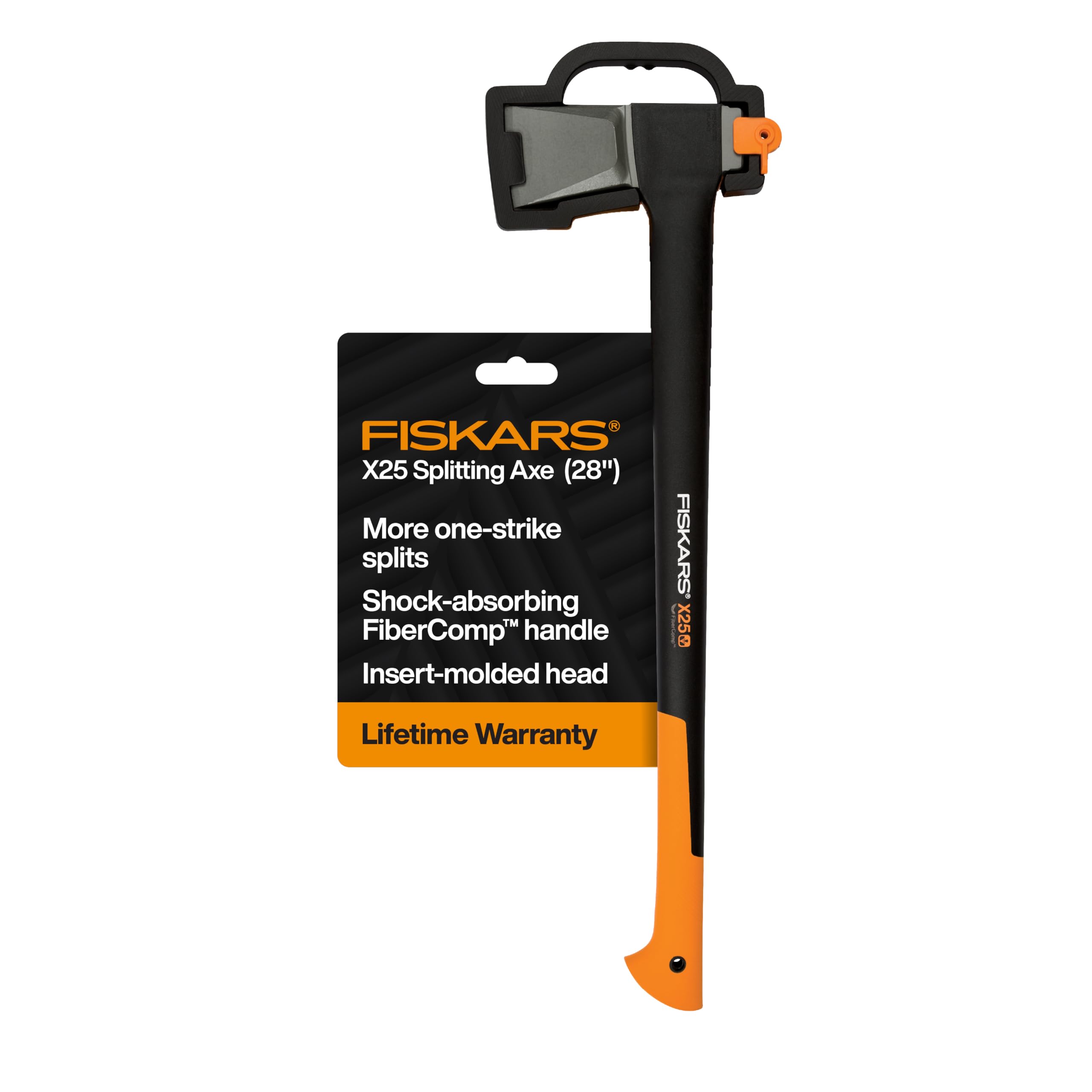
1. Fiskars X25 Splitting Axe 28″, Wood Splitting Axe for Medium to Large Logs
Our pick — over 4.5★ from 550+ verified ratings; the strongest balance of quality and price.
The firewood workhorse that turns a stack of big rounds into a winter’s worth of splits.
If your job is processing firewood from medium to large logs, this is the axe to start with. The 28-inch handle gives you real leverage and swing speed, and the advanced bevel convex blade geometry is shaped to add power on the way in and release more easily on the way out. That means fewer stuck heads and fewer re-swings. Buyers report it “splits 24\”-36\” rounds easily” — exactly the woodpile scenario this tool was built for. It is also the most proven pick here, holding a 4.8-star score across 500+ ratings.
What wins people over is the sheer consistency of the quality — it is the single most-praised trait in the feedback, ahead of raw splitting performance. The shock-absorbing FiberComp handle (a composite that is stronger than steel, per the maker, and absorbs the jolt of impact) is a big part of that, plus a rust-resistant forged head and a protective sheath in the box. A lifetime warranty backs it. One buyer with field experience on this very tool sums it up as a “lightweight, sturdy workhorse,” and that balance is why it tops the list.
Here is the honest trade-off: ergonomics is the one area where opinions split. A reviewer or two noted some hand vibration early on, though that same owner traced the trouble to their gloves, not the axe. It also runs shorter than a dedicated heavy maul, so if you are splitting the largest diameter rounds all day, a heavier maul is the better tool. For most households burning firewood, the 28-inch Fiskars X25 is the easiest win — proven, light enough to swing for a long session, and sharp from the start.
Where it wins
- 28-inch handle for leverage and portability
- Bevel convex blade geometry adds power and eases removal
- Shock-absorbing FiberComp handle fights fatigue
- Rust-resistant forged head, sheath included, lifetime warranty
Points to weigh
- Ergonomics draw mixed feedback on hand vibration
- Shorter than a big dedicated maul for the largest rounds
Grab this one for: firewood splitting on medium to large logs, and camper or motorhome kits where a compact 28-inch axe fits.
Look elsewhere for: you only ever make kindling at a campsite, where a 13.5-inch hatchet like the WICING will serve you better.
2. DWFKHT 15.7″ Hand-Forged Hatchet with Leather Sheath
A hand-forged camp hatchet that reads far pricier than its shelf tag suggests.
For bushcrafters, carvers, and campers who want a do-it-all hatchet without paying custom-shop money, this 15.7-inch, 2.5-pound forged head is a smart middle path. The head is crafted from high-carbon steel and shaped through forging and quenching (heat-treatment that hardens the metal), and the beech wood handle is built for a natural grip that cuts fatigue over a long session. It weighs 2.5 pounds against the WICING’s 2.1 pounds, and its 4.13-inch blade beats the DWFKHT’s own… no — the WICING’s 4.13-inch edge tops the Estwing’s 3.25-inch blade on reach for limb work. The craftsmanship and looks are what shoppers notice first here — the metal arrives well finished and the Norse bearded-axe profile draws genuine compliments.
What wins people over most is the overall build quality, with the appearance and craftsmanship close behind. A buyer with decades of field experience called it a “fine quality tool,” and others note the blade gets very hard through the quench. That hardness is the point of the 1065 steel — it means the edge stands up to dry hardwoods without folding. You get a leather sheath in the box, which makes it easy to sling in a backpack or tool bag.
Consistency is the honest caveat. Sharpness and durability both draw split opinions — most owners find it plenty sharp from the start, but a few report a dull edge or an early failure. Those are the outliers, not the pattern on a tool that most buyers rate very highly. If you want a hand-forged hatchet with real character for camp chores, carving, and garden cleanup, this is the value pick — just budget a few minutes to touch up the edge the way any fine carbon-steel tool rewards.
Why it earns its spot: a genuinely hand-forged 1065 high-carbon head in a 2.5-pound package with a beech handle and leather sheath — the kind of stuff that usually lives at a much higher tier.
Fair warning: edge quality from the start varies from unit to unit, so plan to give it a quick honing tune-up before serious work.
Made for: the bushcrafter or camper who wants forged character and a compact 15.7-inch carry without the boutique price.
Steer clear if: you refuse to touch up an edge yourself and want a razor out of the wrapper, every time.
3. WICING 13.5 Inch Hatchet, 1065 Carbon Steel with Beech Handle
The small, well-balanced hatchet that slips into a day bag and swings without tiring you out.
At just 13.5 inches and 2.1 pounds, this is the easiest hatchet in the whole lineup to throw in a pack and forget about until you need it. The shorter 13.5-inch frame is half the length of the Fiskars X25’s 28-inch handle, so it stows where a full splitting axe never will. The 4.13-inch blade edges out the Estwing’s 3.25-inch cutting edge, giving it a little more bite for a tool this size. Poplar tasks — splitting small logs, chopping firewood, clearing branches — are exactly its lane.
The value-for-money story is the strongest thing going for it, and buyers clearly feel it. The beech wood handle is built for controlled swings and reduced fatigue, and the head is a 1065 carbon steel forging through the same quenching process as the DWFKHT above. You get a leather sheath in the box, and the finish looks handsome enough that it doubles as a gift. Owners describe it as sturdy and easy to use for kindling, garden limbs, and small projects.
Now the fit note. Quality, sharpness, and durability draw mixed feedback on this one — some owners find it excellent and ready to work, while a few report a dull edge or a handle issue. Same story as any budget-priced hand tool: expectations rise, and the occasional unit misses. Treat it as a compact work hatchet for light jobs, keep it dry, and it will earn its keep. If you want a small, well-priced hatchet for camping and garden cleanup rather than daily heavy chopping, this one fits the bill.
The appeal: a 2.1-pound, 13.5-inch carbon steel hatchet with a beech handle and sheath, priced to be an easy yes.
The catch: edge and handle consistency vary, so a quick inspection on arrival is worth the two minutes.
Reach for it if: you want a pack-friendly 13.5-inch hatchet for kindling, branches, and small woodwork at a budget-friendly tier.
Pass it by if: you are splitting large rounds all season and need the shoulder of a 28-inch splitting axe.
4. ESTWING Sportsman’s Axe, 14″ Black Leather Grip Hatchet, E24ASEA

Fewer moving parts, fewer worries — a single piece of steel you can hand down.
You get a hatchet that will not fall apart: the Estwing is forged from one solid piece of American steel, so there is no head-to-handle joint to work loose, no wedge to fail, no glue to let go. That 1.8-pound build with a 3.25-inch blade is the lightest full hatchet here, and it has earned one of the strongest track records in the lineup at 4.7 stars across 800+ ratings. For campers who want a tool that survives being tossed in a truck bed, that all-steel construction is the whole argument.
The appearance is what most people comment on — the hand-sanded, lacquered genuine leather grip gives it a look that stands out in a pile of plastic and paint. The 3.25-inch blade handles limbs and kindling at the campsite, and the hardened poll drives tent stakes. The ballistic nylon sheath includes a belt loop, so you can carry it on your hip with quick access, and the 4-inch cutting edge arrives hand-sharpened from the start.
Durability and sharpness are the split-opinion categories, so hear it honestly: the steel holds up well for most owners and stays sharp with care, but a few report edge chipping after several uses. The recurring gripe is small — a couple of stubborn stickers on the handle that are annoying to peel off cleanly. Size-wise, at 14 inches this is a one-handed hatchet, so it is a limb-and-kindling tool, not a log splitter. For most campsite and fireplace jobs, the one-piece Estwing is the buy-it-once-and-forget-it pick.
The core value: a one-piece steel construction that removes the weak joint entirely, plus a genuine leather grip and a belt-loop sheath.
The one blemish: stickers on the handle are a hassle to remove cleanly, and a few owners see edge chipping with heavy use.
Best for: truck campers and firepit owners who want a rugged 14-inch hatchet with no joint to break.
Not the pick if: you want a two-handed splitter for big rounds or a carbon-steel edge you plan to sharpen often.
5. Fiskars Pro IsoCore 2.5 lb Splitting Maul, 14″ Wood Splitter Axe

Short, heavy, and single-minded — this maul exists to make small logs surrender in one swing.
If you have ever fought with a hatchet trying to make kindling, this tool is the fix. Its 14.13-inch handle and 6-pound head form a compact maul (a short, heavy tool for driving into logs with a flick rather than a big overhead swing) that backs up the splitting power of a full axe in a fraction of the length. Owners mention it “yields wedge or kindling per strike” on oak logs — one hit, no sticking, no wrestling the head back out. It is rated 4.8 stars across 300+ ratings, matching the top Fiskars axe on score.
The shock-absorbing handle is the engineering highlight. Fiskars’ IsoCore system absorbs strike shock and vibration, and the maker claims it transfers about half the shock of a standard tool. A textured non-slip grip adds control and helps prevent the overstrike damage that breaks handles. The head is rust-resistant and riveted in place for durability through sustained use. Compared with a standard hatchet, this maul is the safer, more effective route to neat pile of kindling — it splits instead of glancing.
The trade-off is weight. At 6 pounds this is the heaviest pick on the list, and the weight draws genuinely mixed feedback — some owners call it perfectly balanced, others find it heavy for long sessions. It is also a single-purpose tool; you are not carving with this or carrying it up a trail. For firepit owners and anyone who burns a lot of firewood, that focus is the point. The large back head even serves as a wedge for driving tent stakes.
What you are buying: a 6-pound, 14-inch maul with IsoCore shock-absorbing handle technology and a riveted, rust-resistant head.
What to accept: 6 pounds on a short handle tires the arm, and the blade sometimes needs a honing before it bites deep.
The right tool for: firewood users who want fast kindling and one-strike splits on small logs.
Wrong job for: backpacking or carving work, where its 6-pound heft becomes a burden instead of a help.
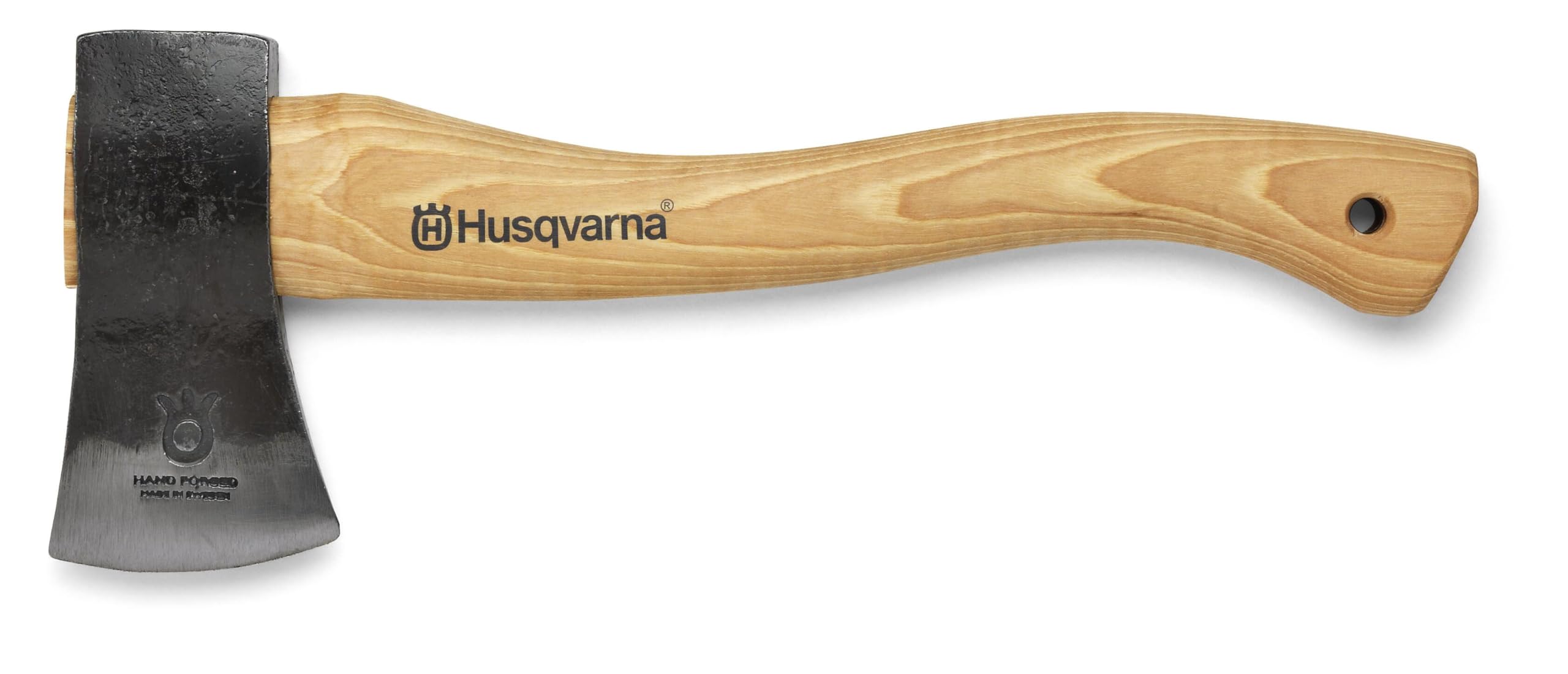
6. Husqvarna Hatchet, Small Axe with Leather Sheath and Hickory Handle
A Swedish-forged hand axe that rewards the owner who is willing to give it a little finish work.
You get a premium 1.32-pound hand-forged head out of Sweden, paired with a hickory handle and a leather sheath, all at a price that undercuts most forged-Swedish rivals. That is why fans of hand-forged Swedish steel keep coming back to this one. It tops the lineup on quality praise, with durability right behind — that head is the kind of steel you maintain for years rather than replace. At 14.97 inches this is a true one-handed tool for light wood cutting, camp chores, and garden work.
What buyers highlight again and again is the steel itself: it takes an edge and holds it, doesn’t chip or roll in normal use, and feels higher quality than the price suggests. One owner who put it through a multi-day camping trip reported no nicks after heavy use, and it only needed a touch-up at the end. The hickory handle has good grain and sits firmly attached, and the leather blade cover has a metal snap. At 1.32 pounds on a 14.97-inch handle, it swings one-handed for campsite chores and small projects.
Here is the honest follow-up question: will it arrive ready to work? Often, no — many buyers find the edge needs a quick sharpening on arrival, and some sand and oil the handle to bring it to its full look. That is normal for a forged-boutique axe, and the payoff is a tool that feels like it should cost far more. If you enjoy a bit of finishing work and want heirloom-grade Swedish steel, this is worth the extra step. If you want grab-and-go sharpness, look at the ready-to-use Estwing instead.
What makes it special
- Premium 1.32-pound hand-forged Swedish steel head
- Hickory handle with a firm, well-grained fit
- Leather sheath with metal snap included
- Made in Sweden, built for one-handed camp and garden cut
Before you commit
- Frequently arrives needing a sharpening and handle oiling
- Small hand-forging details mean character, not sterile perfection
Pick this one for: the owner who wants hand-forged Swedish character and does not mind a bit of tuning.
Keep shopping if: you need the tool sharp and ready the second it arrives, without any fuss.
7. Husqvarna Wood Splitting Axe S2800

A 5-pound splitting head built to throw once and hear the log crack open.
This is the sheet’s heavyweight splitter for firewood duty. A premium 5-pound steel head rides on a 28-inch blade length, and that mass is what lets it split big rounds with authority rather than nibbling at them. The head is coated to improve cutting and flow through the wood, and the fiberglass composite handle means no wood to maintain — no oiling, no checking, no split grain to worry about. It holds a 4.8-star score across 170+ ratings, matching the Fiskars X25 at the top on satisfaction.
Sturdiness is the trait owners love most, with durability right behind it. One feedback theme stands out: a 70-year-old owner said she can still swing it, which says a lot about the balance for a tool this heavy. The head stays sharp, and the weight distribution is dialed so the head does the work instead of your back. A lifetime warranty backs the 5-pound head and fiberglass handle, so woodpile regulars keep it for decades.
The honest caveat: heavier than expected is a real comment, and the weight is the most common thing buyers flag. It is also at the top of the price range here — a household that only burns a couple of cords a year might not need this much tool. But for the dedicated firewood processor who wants one durable, weatherproof splitter to keep for life, that power is exactly what you are paying for.
The upgrade argument: 5 pounds of coated steel on a weatherproof fiberglass handle, designed purely for splitting larger firewood.
Weigh this: it is genuinely heavy and priced at the higher end, so it rewards the committed firewood user more than the occasional camper.
Best suited to: serious firewood work where a 5-pound head and 28-inch length earn their keep.
Overkill for: light camp kindling, where a smaller hatchet does the job with less weight to haul.
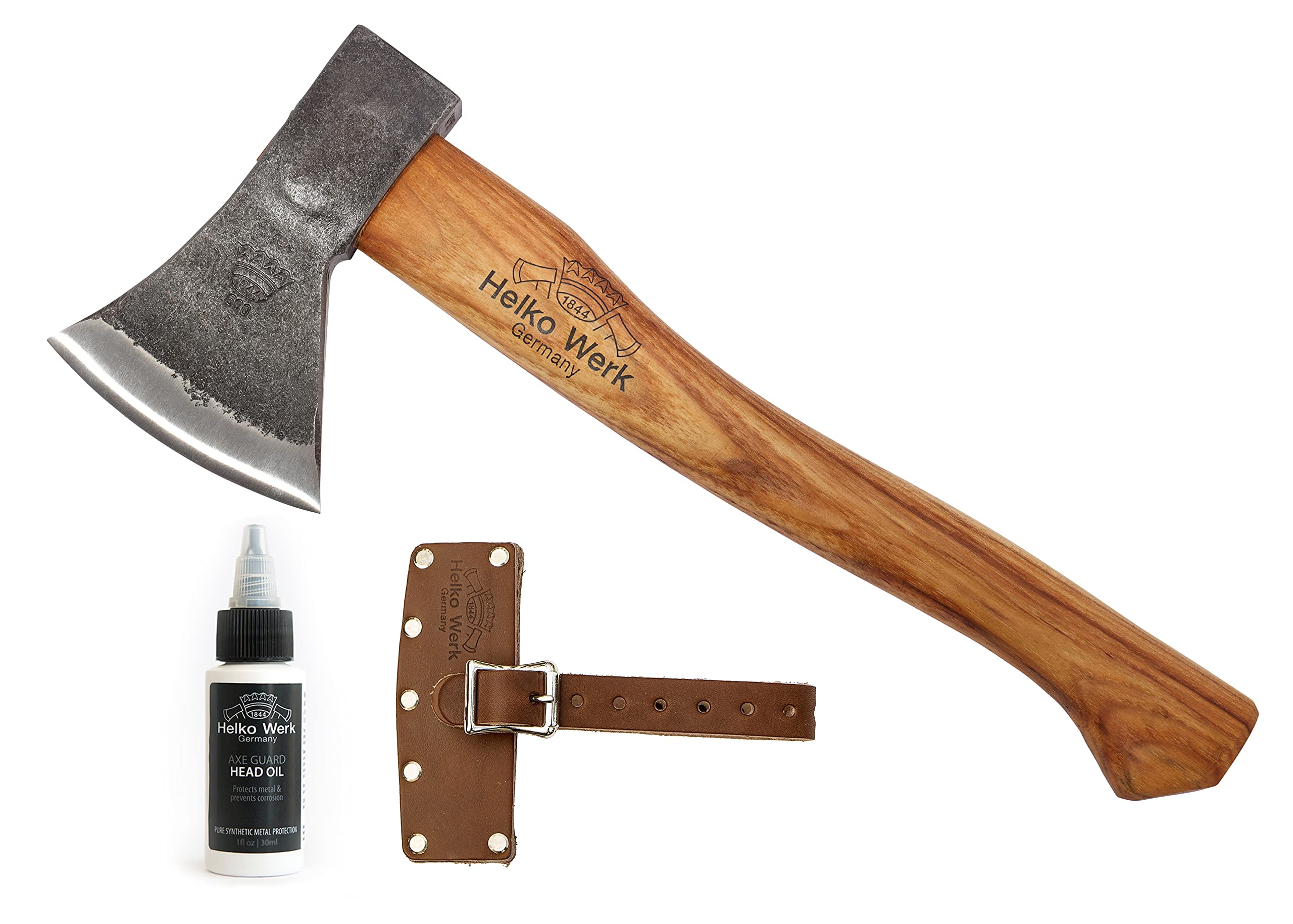
8. 1844 Helko Werk Germany Traditional Rheinlander Hatchet (11326)
Hand-forged in Germany, this is the sharpness champion of the whole lineup.
Owners praise this hatchet most for its sharpness, and the head explains why: it is open-face drop forged individually by hand from German C50 high carbon steel, hardened to a 53-56 HRC range (a hardness scale where higher numbers mean a longer-wearing edge). In a 1-1/4 pound head on a 14-inch handle, that is a fine-cutting machine — limbing branches, carving, and making kindling are its specialty. The Rheinland pattern is a traditional German wide-bit blade, and the hand-finished Grade A American hickory handle is sanded to 150 grit and oiled with boiled linseed oil.
Value for money is the second thing buyers rave about, which is unusual at this end of the market. It arrives with a full-grain vegetable-tanned leather sheath and a 1oz Axe Guard oil to keep the steel rust-free. Owners describe it as beautifully made, perfectly balanced, and fully the equal of pricier Scandinavian axes. The handle design is comfortable when you choke up on it for feather sticks, and it fits a bushcraft pack. At 53-56 HRC, the edge holds up to years of limbing and carving.
Durability draws some mixed feedback, and a small number of units arrive less perfect than the price tag promises — an occasional rough grind or a handle gap that a few minutes of honing and sanding fixes right up. Helko’s customer service has a strong reputation for making things right when it counts. If you want a German-forged precision carver and value a keen edge above all, this is the pick for you.
The headliner: a hand-drop-forged German C50 carbon steel head at 53-56 HRC, paired with a Grade A American hickory handle and full-grain leather sheath.
The small print: durability feedback is mixed and a rare unit needs a grind touch-up, so buy it as a fine tool you will care for.
Suits the buyer who: wants a Germany-made fine-cutting hatchet for limbing, carving, and feather sticks.
Skip it for: heavy log-splitting duty, where a taller axe with a heavier head does the work better.
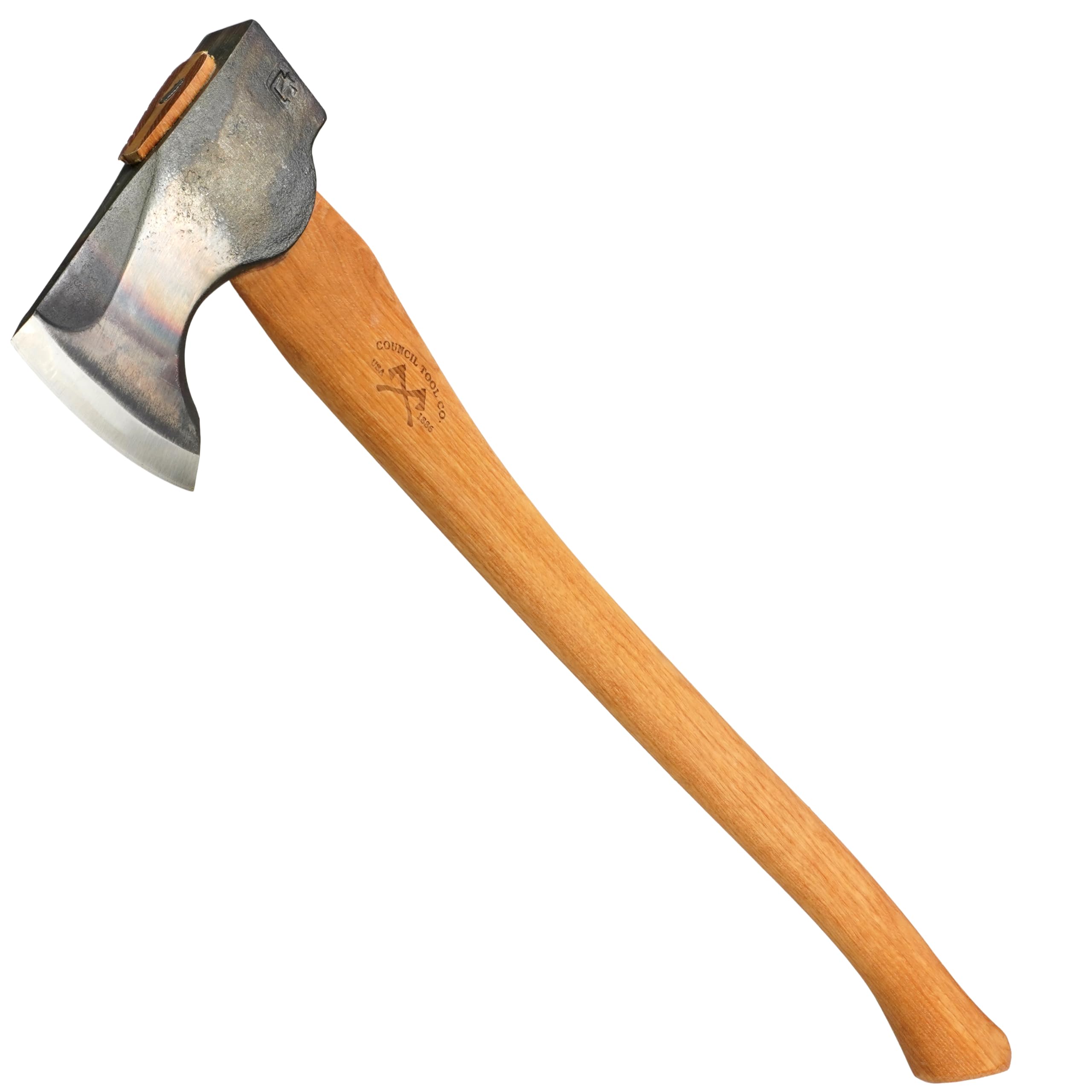
9. COUNCIL TOOL 2 lb Wood-Craft Pack Axe, 24″ Curved Handle, Made in USA
One tool for chopping, splitting, carving, and even hammering — the American jack-of-all-trades.
You get the most flexible tool on the list, and the specs prove it. The 2-pound head is forged from 5160 steel and heat-treated to an Rc 51-63 range (a hardness spread tuned for both edge-holding and shock resistance), and the hardened poll (the flat back of the head) adds hammer duty for driving stakes and pegs. That combination means the axis of “chopping, splitting, carving, shaving, and fire-starting” is covered by one packable tool. The curved Grade A American hickory handle is hung proud with wood and steel wedge for a secure fit. Quality is the most-praised thing about it, with its hand-sharpened edge a close second.
At a 2-pound head and 24-inch handle, this hits harder than a hatchet but stays light enough for hatchet-style work — owners describe it as punching above its weight class. It arrives razor sharp from the start, holds an edge well through hardwood use, and comes with a welted leather sheath to protect both the blade and you. The curved handle design is comfortable for choked-up detail work, and the hand-sharpened edge takes a fine edge.
Be straightforward: this is a premium tool at a premium tier, and it is not always perfect on arrival. Some customers note needing an edge touch-up or a drop of oil on the handle, and a few find the finish falls short of the price. Council Tool’s customer service has a strong record of resolving those cases fast. If your goal is one American-made pack axe that handles nearly every camp task, this is the versatile buy — just plan on giving the handle a drink of oil and the edge a few passes.
Why it’s the Swiss Army knife of the list
- 5160 steel head, Rc 51-63, built for chopping and splitting
- Hardened poll doubles as a hammer for tent stakes
- Welded leather sheath and 2 lb head on a 24-inch hickory handle
- Made in the USA with a hand-sharpened edge
What to expect
- Often needs an edge touch-up and handle oiling on arrival
- Premium tier, and finish can vary unit to unit
The one to grab for: a single do-all pack axe for bushcraft, camping, and fire-starting tasks.
Look past it if: you want pure splitting power, where the heavier Husqvarna S2800 leaves it behind.
Understanding the Specs
Handle Length and Head Weight
These two numbers work as a team, and the balance between them decides what a tool is good at. A long handle around 28 inches gives you leverage and swing speed for splitting larger firewood, while a short handle near 13 to 16 inches keeps a hatchet packable and controllable with one hand. A heavier head hits harder and splits bigger rounds but tires your arm faster, which is why a 5 or 6-pound head suits a woodpile but a 1.3 to 2.5-pound head suits a backpack. Match the pair to your job, not to a single number.
Blade Steel and Edge Hardness
The steel grade decides how sharp a tool will get and how long it stays that way. Carbon grades like 1065, German C50 high carbon steel, and 5160 are valued for taking an edge and holding it under hard use. Hardness is measured on the HRC scale, where higher numbers mean a longer-wearing edge but a slightly more brittle one — many fine hatchets sit in the 53-56 HRC range. Choose a harder edge for fine cutting work and a slightly softer, tougher edge for pounding through knots.
FAQ
Should I buy a splitting axe or a hatchet for firewood?
What does it mean if a hatchet arrives needing sharpening?
Is a heavier head always better for splitting?
Hickory handle or fiberglass handle — which lasts longer?
Can I use a hatchet for carving and kindling as well as chopping?
Do carbon steel axes rust easily?
What is a “hanging” and why does grain alignment matter on a wood handle?
Are axes and hatchets safe for beginners to use around a campsite?
Why do some axes have a hardened back on the head?
What is IsoCore shock control technology?
Final Thoughts: The Verdict
For most households processing firewood, the winner is the Fiskars X25 Splitting Axe — its 28-inch handle and bevel convex blade geometry make it the most proven splitter here, holding a 4.8-star score that matches the best in the lineup. If making kindling and one-strike splits on small logs is your main job, grab the Fiskars Pro IsoCore Maul, whose shock-absorbing handle takes the sting out of repeated hits. And for a one-handed camp and garden companion with genuine hand-forged Swedish character, the Husqvarna Hatchet is the one to reach for. There is a reason the Fiskars X25 and the Husqvarna S2800 both sit at 4.8 stars with hundreds of ratings between them — the crowd keeps confirming what the specs promise, which makes either an easy one to commit to right now.
How We Picked
We do not accept paid placement. Every pick is matched to a real buyer and a real use-case; we do not hands-on test units.
Sources & Methodology
Specifications: manufacturer listings and product documentation. Review insights: verified customer reviews, as of September 2026. Pricing: not shown on this page (it changes often); check the current price via the retailer link.
As an Amazon Associate, Gadgets Feed earns from qualifying purchases. This does not affect which products we feature.