
Whether you are reviving a Ryzen 3000 system or building a fresh mid-range rig, the B550 chipset remains the sweet spot for AM4. It gives you PCIe 4.0 for your graphics card and primary SSD, broad CPU support, and genuine upgrade potential—all without the premium attached to X570. The challenge is sifting through dozens of boards to find the one that actually delivers stable power, modern connectivity, and a BIOS that does not fight you.
I’m Min — the co-founder and writer behind Gadgets Feed. After many hours of cross-referencing technical spec sheets, parsing real user reports on power-phase stability, and comparing BIOS flashback features across the current B550 lineup, this guide cuts through the noise to name the boards that earn a spot in your case.
This guide focuses exclusively on the b350 plus motherboard, the value-focused chipset that pairs well with Ryzen 5000 processors and offers a balanced feature set for budget-conscious builders.
How To Choose The Best B350 Plus Motherboard
Selecting the right B550 board comes down to balancing power delivery, connectivity, and BIOS features. Here are the critical factors to evaluate before you click buy.
VRM Design and Power Phase Count
The voltage regulator module (VRM) directly determines how cleanly your CPU receives power. Look for boards with at least a 5+3 phase design if you plan to run a Ryzen 7 or 9. Higher phase counts with DrMOS components handle sustained loads better and reduce thermal throttling during extended gaming sessions.
PCIe 4.0 Lane Allocation
B550 officially supports PCIe 4.0 on the primary x16 slot and one M.2 slot. Check how your chosen board splits these lanes—some boards share bandwidth between the second M.2 and secondary PCIe slots, which can limit your expansion options if you need multiple NVMe drives.
BIOS Flashback and Q-Flash Plus
Ryzen 5000-series CPUs require a specific BIOS version on many B550 boards. Models with BIOS flashback or Q-Flash Plus let you update the firmware using only a USB drive and a power supply, no CPU or RAM required. This feature is essential if you are buying a board that might have sat on a warehouse shelf with an older BIOS.
Quick Comparison
On smaller screens, swipe sideways to see the full table.
| Model | Category | Best For | Key Spec | Amazon |
|---|---|---|---|---|
| MSI MPG B550 Gaming Plus V1 | ATX Gaming | High-end gaming builds | DDR4 up to 4400 MHz OC | Amazon |
| GIGABYTE B550 Eagle WIFI6 | ATX Premium | Balanced power with built-in WiFi 6 | 10+3 Power Phase VRM | Amazon |
| GIGABYTE B550M AORUS Elite AX | mATX Premium | WiFi 6E and compact builds | WiFi 6E + Bluetooth 5.3 | Amazon |
| ASUS Prime B550-PLUS AC-HES | ATX Mid-Range | Reliable 8+1 power with WiFi 5 | 8+1 DrMOS Power Stages | Amazon |
| ASRock AMD B550 PG Riptide | ATX Value | High memory OC and budget builds | OC DDR4 up to 4933 MHz | Amazon |
| ASUS Prime B550M-A WiFi II | mATX WiFi | WiFi 6 with mATX form factor | WiFi 6 (802.11ax) | Amazon |
| GIGABYTE B550M K | mATX Budget | Entry-level upgrades | 3+3 Power Phase Design | Amazon |
In‑Depth Reviews
1. MSI MPG B550 Gaming Plus V1

The MPG B550 Gaming Plus V1 brings an extended heatsink with a 7W/mk choke thermal pad and 2oz thickened copper PCB, which keeps VRM temperatures under control even with a Ryzen 9 under full load. Its dual-channel DDR4 support reaches 4400 MHz overclocked, so memory-sensitive workloads and high-refresh-rate gaming both benefit from tighter timings.
M.2 Shield Frozr covers the primary Gen4 slot to prevent thermal throttling on fast NVMe drives. The built-in I/O shield simplifies installation, while Mystic Light RGB headers (16.8 million colors) allow full lighting sync without extra controllers. You get seven USB ports on the rear plus a USB-C connector for modern peripherals.
One notable tradeoff is the lack of onboard WiFi—this board requires a wired Ethernet connection or a separate adapter. Reviewers mention that the BIOS may need an update for Ryzen 5600X out of the box. The box includes two SATA cables and NVMe screws, though some units omit the sticker kit. Overclocking capabilities are solid for a mid-range board, with stable power delivery for both gaming and editing builds.
Why it’s great
- Extended VRM heatsink with 7W/mk thermal pad handles high-core CPUs
- Dual M.2 slots with Shield Frozr prevent NVMe throttling
- Plenty of connectivity including USB-C and 7 rear USB ports
Good to know
- No built-in WiFi; must use Ethernet or add a card
- May require a BIOS update for Ryzen 5000-series CPUs
- Some accessory items like stickers may be missing from the box
2. GIGABYTE B550 Eagle WIFI6
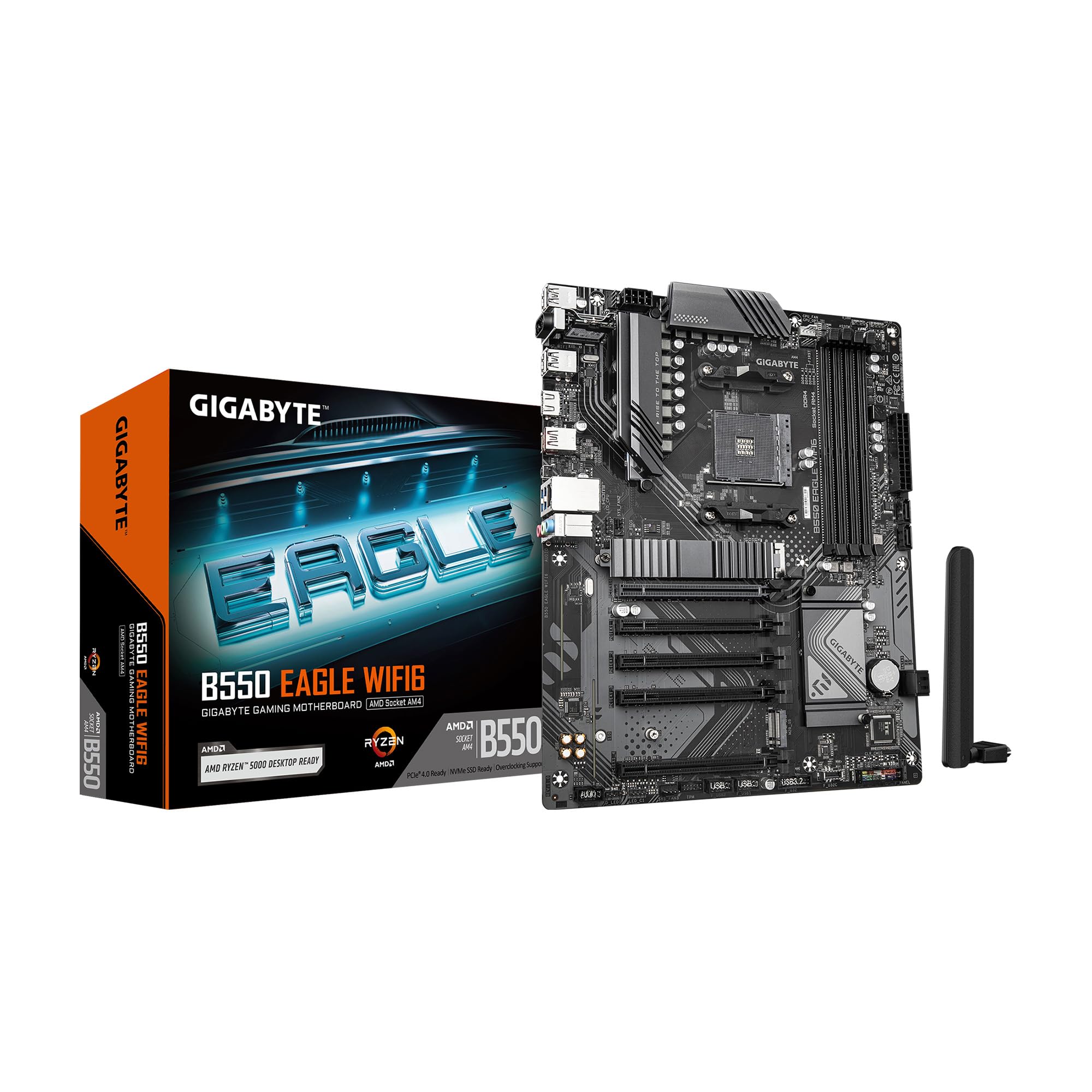
The B550 Eagle WIFI6 stands out in the B550 lineup with its digital twin 10+3 phase VRM, which delivers exceptionally clean power for Ryzen 7 and Ryzen 9 processors. Enlarged heatsinks paired with 5 W/mk thermal pads keep those VRMs cool under sustained loads, making this board a strong candidate for CPU-heavy rendering or all-day gaming sessions.
Built-in WiFi 6 provides fast, stable wireless connectivity right out of the box—no need to purchase a separate adapter. The board also includes PCIe EZ-Latch for tool-free GPU removal and Q-Flash Plus for BIOS updates without a CPU installed. Dual M.2 slots (one Gen4, one Gen3) give you flexible NVMe storage options, and the rear USB-C port accommodates modern peripherals.
Some users note that the PCIe EZ-Latch mechanism can feel stiff initially, and the I/O shield cutout for Q-Flash Plus may require minor filing for perfect alignment. The number of USB ports is adequate but not generous—most users fill them quickly. WiFi and Bluetooth driver installation is not automatic on first boot, so you will need a separate download. Despite these quirks, the build quality and stable performance earn consistent praise.
Why it’s great
- 10+3 phase VRM provides top-tier power delivery for Ryzen 9
- Integrated WiFi 6 eliminates need for a separate network card
- Q-Flash Plus enables BIOS updates without CPU or RAM
Good to know
- PCIe EZ-Latch can feel stiff and requires deliberate force
- Limited number of USB ports for heavy peripheral users
- WiFi/BT drivers must be installed manually after first boot
3. GIGABYTE B550M AORUS Elite AX

The B550M AORUS Elite AX packs WiFi 6E (6 GHz band) and Bluetooth 5.3 into a compact mATX form factor, making it one of the most future-proof B550 boards for small-factor builds. Its pure digital 5+3 power phase design with premium chokes handles Ryzen 7 processors comfortably, and the enlarged MOSFET heatsink prevents thermal throttling in tight cases with limited airflow.
Q-Flash Plus allows BIOS updates using only a power supply and USB drive—critical for Ryzen 5000 compatibility. The board has two M.2 slots (one PCIe 4.0, one PCIe 3.0), four DDR4 DIMM slots supporting up to 128 GB, and dual ARGB headers for lighting synchronization. The integrated I/O shield speeds up installation and gives the rear ports a clean look.
One missing feature is front-panel USB-C, which some modern cases require. The front panel I/O headers have sparse labeling, which can slow down the build process. Users have reported that entering BIOS via Del/F12 may not work on some units—you might need to use the Windows UEFI firmware menu instead. A BIOS update is also necessary for proper undervolt support with CPUs like the 5800X3D. The onboard WiFi 6E performance, however, delivers excellent range and throughput.
Why it’s great
- WiFi 6E and Bluetooth 5.3 built-in for wireless excellence
- Q-Flash Plus works without CPU or RAM installed
- Compact mATX size fits small cases without sacrificing features
Good to know
- No front-panel USB-C header for many modern cases
- Front panel I/O pins have minimal labeling
- May require Windows UEFI path to enter BIOS
4. ASUS Prime B550-PLUS AC-HES

The Prime B550-PLUS AC-HES delivers an 8+1 DrMOS power stage configuration that provides consistent voltage regulation across all Ryzen 5000-series chips. ASUS uses LANGuard, DRAM overcurrent protection, and stainless-steel rear I/O as part of its 5X Protection III suite, so this board emphasizes long-term reliability over flashy extras.
Connectivity includes dual M.2 slots (one PCIe 4.0), WiFi 5, 1 Gb Ethernet, rear USB 3.2 Gen 2 Type-A and Type-C, plus front-panel USB 3.2 Gen 1 Type-C. The Aura Sync RGB header and Addressable Gen 2 header allow full lighting customization. OptiMem memory trace layout supports DDR4 up to 4866 MHz OC, which is generous for this price tier.
Some users reported that the first unit arrived with no video output, although Amazon replacement resolved the issue. The board has six SATA ports, an uncommon count that benefits home arcade builds or multi-drive storage setups. The layout is spacious with adequate clearance around CPU sockets, making installation in standard ATX cases easy. A few buyers note that the WiFi 5 is a generation behind modern 6E standards, but for general browsing and streaming, it performs smoothly.
Why it’s great
- 8+1 DrMOS power stages provide robust voltage regulation
- Six SATA ports for enthusiasts needing multiple drives
- OptiMem memory trace supports high OC DDR4 speeds
Good to know
- WiFi 5 is outdated compared to WiFi 6E competitors
- Some units may arrive DOA requiring replacement
- BIOS flashback feature is not included
5. ASRock AMD B550 PG Riptide

The PG Riptide pushes memory performance further than most in its class, supporting DDR4 speeds up to 4733+ MHz (OC) with an 8-phase Digi Power design and DrMOS. This makes it a strong choice for builders who want to squeeze every last frame from tightly binned memory kits. The board also features a Hyper M.2 slot running at PCIe Gen4 x4 for blazing-fast NVMe storage.
Rear I/O is generous with nine USB ports total, including two USB 3.2 Gen2 (Type-A and Type-C). The dedicated M.2 Key E slot allows you to add your own WiFi module—users commonly fit Intel AX200 cards for WiFi 6. Graphics outputs include HDMI and DisplayPort, making it compatible with Ryzen APUs. The Nahimic audio suite and Realtek ALC897 codec provide clear sound for gaming headsets.
Not all experiences are positive: there are reports of factory-corrupted BIOS that fail to recognize any AMD CPU, with no way to force-flash. This issue is documented across multiple user accounts and repair shops. The board also lacks integrated WiFi, so you will need to buy an M.2 WiFi card separately. When it works, the PG Riptide offers exceptional memory overclocking bandwidth and a strong feature set at a competitive price point.
Why it’s great
- 8-phase Digi Power design with DrMOS for stable CPU power
- Supports DDR4 OC up to 4933 MHz for high-end memory kits
- Nine rear USB ports including Type-C Gen2
Good to know
- No onboard WiFi; requires separate M.2 WiFi card
- Some units ship with corrupted BIOS that bricks the board
- No BIOS flashback to recover from a bad flash
6. ASUS Prime B550M-A WiFi II

The Prime B550M-A WiFi II is a micro-ATX board that integrates WiFi 6 (802.11ax) and Bluetooth directly, saving you from buying a separate adapter. It includes a VRM heatsink, PCH heatsink, and Fan Xpert 2 utility for efficient thermal management in smaller cases. The board supports PCIe 4.0 on the primary x16 slot and one of the two M.2 slots.
ASUS OptiMem technology allows memory kits to run at higher DDR4 frequencies (up to 4866 MHz OC) with lower voltage, improving overall system responsiveness. HDMI 2.1 output supports 4K at 60Hz for APU-based builds or secondary displays. The board includes ASUS 5X Protection III with LANGuard and SafeSlot Core for long-term durability.
One reported defect involves a USB port with an electrical short that causes instant power-off when any device is plugged in. The graphics port may block access to the first PCIe slot on some GPU models. Only one USB 3.0 bus is available, and there is no USB-C front-panel connector. Despite these flaws, the integrated WiFi 6 performance is excellent, delivering 500-800 Mbps in real-world use, and the BIOS is clean and easy to navigate.
Why it’s great
- Integrated WiFi 6 provides fast wireless without extra hardware
- HDMI 2.1 supports 4K at 60Hz for iGPU builds
- User-friendly BIOS with straightforward XMP setup
Good to know
- Potential USB port short defect reported on some units
- No front USB-C header for modern cases
- Graphics port may physically block PCIe slot access on some GPUs
7. GIGABYTE B550M K

The B550M K is GIGABYTE’s entry-level B550 offering, featuring a 3+3 digital VRM design that adequately powers Ryzen 5 and lower-end Ryzen 7 chips without breaking a sweat. It supports four DDR4 DIMMs up to 128 GB and offers two PCIe M.2 slots—one Gen4 and one Gen3—giving you excellent NVMe flexibility for the price.
The chipset heatsink provides sufficient thermal dissipation for most builds, and the four USB 3.2 Gen 1 rear ports cover basic peripheral needs. The board uses a standard 24-pin ATX power connector and fits Micro-ATX cases with a compact footprint. Multiple customers have successfully upgraded from A320 boards and report immediate stability improvements.
The most notable omission is the lack of an M.2 heatsink, which can lead to thermal throttling on fast NVMe drives under sustained writes. The M.2 retention design uses a plastic clip that some users have accidentally snapped during installation. There is no built-in WiFi or Bluetooth, and the board lacks BIOS flashback for CPU-less updates. For cost-sensitive builds pairing a Ryzen 5 with a modest GPU, however, this board delivers solid value without major stability issues.
Why it’s great
- Two M.2 slots with one PCIe 4.0 for fast NVMe storage
- Supports up to 128GB DDR4 across 4 DIMMs
- Very affordable entry point into B550 platform
Good to know
- No M.2 heatsink can cause NVMe thermal throttling
- Plastic M.2 clip is fragile and prone to breaking
- No built-in WiFi or BIOS flashback support
FAQ
Do I need a BIOS update for my B550 board to work with Ryzen 5000 processors?
Is B550 worth it over a cheaper B450 motherboard?
How many M.2 slots do I need for a typical gaming build?
Final Thoughts: The Verdict
For most users, the b350 plus motherboard winner is the MSI MPG B550 Gaming Plus V1 because it combines a robust VRM, intuitive BIOS, and all the essential connectivity without unnecessary extras that drive up the price. If you want built-in WiFi 6 and an easier install process, grab the GIGABYTE B550 Eagle WIFI6. And for a compact build that still delivers WiFi 6E and premium VRM performance, nothing beats the GIGABYTE B550M AORUS Elite AX.