
Our readers keep the lights on and my morning glass full of iced black tea. As an Amazon Associate, I earn from qualifying purchases.
Specs are compiled from manufacturer listings and verified buyer reviews and can change over time — please confirm the key details on the product page before buying.
Finding a baby toy that actually holds attention longer than the cardboard box it came in feels like a small miracle. The secret is not more lights or louder sounds — it is matching the toy to exactly where your child is developmentally. This guide walks you through seven real contenders, from a simple first rattle to an activity jumper that turns bouncing into bilingual learning, to help you pick the one that fits your baby’s current stage.
I’m Min — the founder and writer behind Gadgets Feed. This guide is built by comparing the manufacturers’ published specifications and the patterns across verified customer reviews, so you get each pick’s real strengths and trade-offs instead of marketing spin.
This roundup of the best baby activity toys has a match for every stage and parenting style, if you need a quiet travel companion, a fine motor skills workout, or an all-in-one play station that grows with your child.
Quick Picks
- HELLOWOOD Wooden Activity Cube — Best Overall
- Baby Einstein Neptune’s Ocean Discovery Activity Jumper — Full-Body Fun
- hahaland Baby Sensory Toys – 16 PCS Fruit & Veg Set — Best Sensory Set
- LeapFrog Learning Friends 100 Words Book — Bilingual Power
- HarVow LED Busy Board — Travel Champion
- Youuys Baby Tissue Box Toy — Pull & Play
- Manhattan Toy Winkel Rattle & Sensory Teether Toy — Newborn Essential
How To Choose The Best Baby Activity Toys
The best activity toy for your baby fits their current motor skill stage and holds their attention without overwhelming them. The biggest mistake is buying based on the age range on the box alone — a 12-month-old who is already pulling to stand needs different stimulation than one still working on sitting independently. Focus on three things: the type of sensory input (visual, auditory, tactile), whether the toy encourages a specific skill like grasping or sorting, and how portable it is for your daily routine.
Match the Toy to the Motor Milestone
From 6 to 12 months, babies are developing their pincer grasp (using thumb and forefinger to pick things up) and hand-eye coordination. Look for toys that are lightweight (under 0.5 pounds), have easy-to-grab parts like rings or soft tabs, and offer varied textures. A toy like the Manhattan Toy Winkel, at 3 ounces, is designed specifically for tiny hands that are still figuring out how to hold and transfer objects. After 12 months, activities that involve cause and effect — pressing a button to trigger a sound, sliding a switch to turn on a light — become more engaging and help build cognitive connections.
Sensory Variety Without Overload
A good activity toy engages at least two senses. Crinkle paper provides auditory (hearing) and tactile (touch) feedback, a soft rattle offers gentle sound without being startling, and bright, contrasting colors draw visual attention. But too many sounds or flashing lights at once can overstimulate a young baby. The best toys, like the hahaland fruit set, layer textures and sounds subtly — a crinkle inside one piece, a soft rattle in another — so the baby discovers them one at a time.
Portability and Practicality
If you are traveling or eating out, a toy that fits in a diaper bag and does not require batteries is a lifesaver. Soft cloth toys and compact wooden boards (like the HarVow LED board at 6.7 x 5.3 inches) are easy to pack. For home use, a larger station like the Baby Einstein jumper can anchor playtime, but it takes up floor space. Also check how easy a toy is to clean — machine-washable or surface-wipe options save you from scrubbing mashed banana out of crevices.
Quick Comparison
| Model | Best For | Weight | Play Modes | Age Range | Amazon |
|---|---|---|---|---|---|
| HELLOWOOD Activity Cube | All-in-one learning & play | 3.3 lbs | 8 activities | 12–36 months | $27.99Amazon |
| Baby Einstein Jumper | Active bouncing & full-body play | — | 360-degree swivel + 4 height positions | 6 months+ | $99.99Amazon |
| hahaland Fruit & Veg Set | Imaginative sensory sorting | — | 16 pieces + crinkle/rattle textures | 6–36 months | $29.99$33.29Amazon |
| LeapFrog 100 Words Book | Bilingual vocabulary building | 1.5 lbs | 100+ words, songs, bilingual | 18+ months | $19.90$24.99Amazon |
| HarVow LED Busy Board | Quiet, screen-free travel play | 0.74 lbs | 13 switches + 24 LEDs | 12–36 months | $19.99$21.99Amazon |
| Youuys Tissue Box Toy | First pull-and-play discovery | 0.2 lbs | 12 scarves + 3 crinkle tissues | 6–18 months | $16.99Amazon |
| Manhattan Toy Winkel | Newborn teething & grasping | 3 oz | Rattle + teether loops | Newborn + | $18.00Amazon |
In‑Depth Reviews
1. HELLOWOOD Wooden Activity Cube
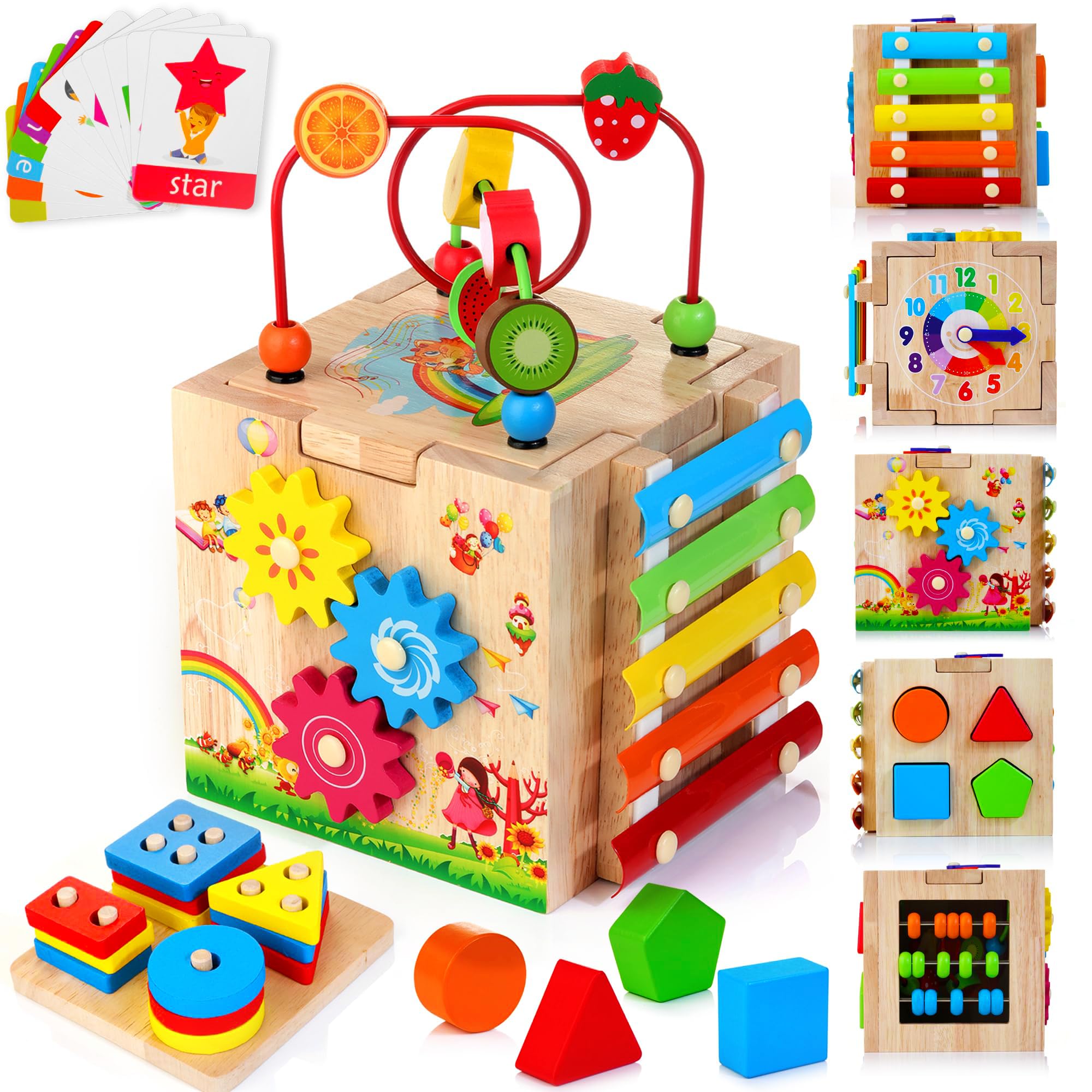
Eight different play stations on one rotating wooden cube that keeps growing with your toddler.
This is the toy that anchors your playroom for years. It gives you a bead maze, a baby xylophone, a learning clock, a shape sorter, an abacus (a counting frame with sliding beads), spinning gears, sorting and stacking blocks, and word cards — all in one 8.66 x 7.36 x 7.52 inch frame. At 3.3 pounds, it is solid enough to stay put while a wobbly toddler leans on it, but the detachable top flips and fits inside the base for storage or travel. Unlike the lighter plastic options, buyers report the wood feels sturdy and the non-toxic paint (a finish that is safe if chewed) has held up through months of daily chewing and banging. The xylophone side alone gives you an audio experience you do not get from the purely visual LED board or silent soft toys on this list.
The only real trade-off is that the clock function is not very useful until closer to age 3, as one reviewer noted, but the remaining seven activities keep a 12-month-old busy. It is 8.66 inches wide — noticeably more compact than a full jumper station like the Baby Einstein, but significantly heavier than the HarVow busy board at 0.74 pounds. That heft is a feature: it means the cube does not slide around when your child pulls on the bead maze.
What keeps them coming back
- Eight distinct play modes let a child rotate between activities without getting bored.
- Solid natural wood construction with smooth, splinter-free edges — safer and more durable than plastic alternatives.
- Detachable top doubles as a travel tray and fits back inside the base for quick cleanup.
The honest limitations
- At 3.3 lbs, it is not a toy you toss in a diaper bag — it stays at home or in the play area.
- The learning clock side is largely decorative for children under 2 years old.
Reach for this if: you want one central play station that grows with your child from first birthday through age 3 and covers fine motor, audio, and cognitive skills without needing batteries.
Look elsewhere if: you need something compact enough for a stroller or car seat — the HarVow LED board or Youuys tissue box are far more portable.
2. Baby Einstein Neptune’s Ocean Discovery Activity Jumper

A bouncing, spinning ocean-themed station that burns energy while teaching numbers and colors in three languages.
If your baby has discovered the joy of jumping, this is the activity toy that channels that energy. The seat swivels a full 360 degrees, so your child can reach the electronic sea turtle station, the ocean-themed toys, and the rattle-filled activities without you having to spin the whole unit. It supports up to 25 pounds and has four adjustable height positions — owners mention they started on the lowest setting around 6 months and moved up as their baby grew. Unlike the static HELLOWOOD cube or the flat LED busy board, this jumper engages the whole body: the bouncing motion strengthens legs while the hands explore the toy tray. The electronic turtle introduces numbers and colors in English, Spanish, and French, which is a feature none of the other seven picks offer.
The catch is size. This is a full activity center that takes up noticeable floor space, and you cannot pack it for a trip. Assembly is straightforward but time-consuming, and one reviewer warned that the toy attachments can be fiddly to secure. Compared to the portable options like the Youuys tissue box (0.2 lbs) or the Manhattan Toy Winkel (3 oz), this is a commitment — but for daily indoor play, buyers consistently say their babies stay entertained for long stretches and that the sturdy frame has held up to rough use without tipping.
Strongest for active babies: The 360-degree swivel and four height positions mean the jumper adapts as your child grows, and the bilingual (English/Spanish/French) electronic turtle gives it an educational edge that no other pick in this roundup matches.
The real trade-off: At its full footprint, this jumper requires a dedicated corner of the living room — it is the opposite of a grab-and-go travel toy.
Best suited for: parents of a 6-month-old or older who has started bouncing and needs a contained, engaging space to burn energy safely while also picking up early language concepts.
Not ideal if: you live in a small apartment or need a toy that can be moved between rooms easily — a compact wooden option like the HELLOWOOD cube will serve you better.
3. hahaland Baby Sensory Toys – 16 PCS Fruit & Veg Set
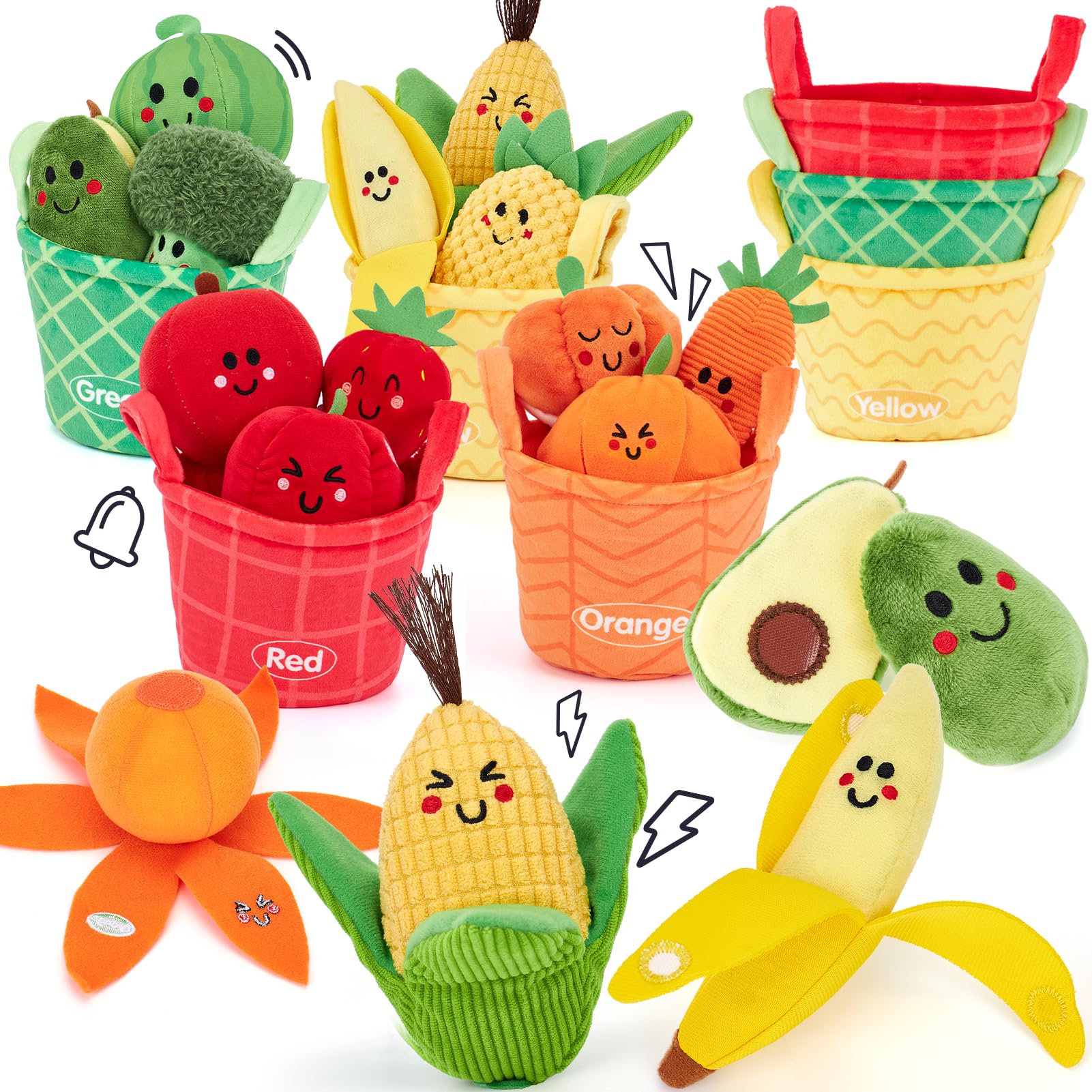
Sixteen plush fruits and veggies, each with its own sound and texture, that teach sorting without a single screen.
This set reimagines the classic food toy by giving each piece a distinct sensory personality. The corn is crinkly, the orange has a soft bell inside, and the banana features a peel that stays attached. Unlike the simple pull-and-play Youuys tissue box, this set offers a wider variety of actions. The pieces range from a 1.77-inch pineapple to a 5.12-inch banana, all sized for little hands to grab, squeeze, and shake. The set also includes four colored baskets — 3.54 x 3.74 inches each — so your child can start sorting by color, which introduces an early cognitive challenge that the simple pull-and-play Youuys tissue box does not offer. Unlike the LeapFrog book, which needs batteries and button presses, this set is purely tactile and works anywhere, from the play mat to the bathtub side.
The baskets are on the small side — one reviewer with an 11-month-old noted they work anyway — but the overall quality is high. The plush fabric (a soft cloth material) has held up to washing and the pieces are lightweight enough for a baby to toss around safely. Compared to the Manhattan Toy Winkel, which targets newborns with a single grasping action, this set scales from 6 months (shaking and mouthing) to 18 months (sorting and imaginative play), making it one of the longest-lasting options per dollar on this list.
Why it wins for sensory play
- Each of the 16 pieces offers a different sensory input (crinkle, rattle, varied texture) — no two feel or sound alike, which sustains curiosity.
- The four-color basket system adds a sorting game that extends the toy’s usefulness into the second year.
- Made from soft, easily washable plush fabric with no sharp edges or detachable small parts.
The small downsides
- The baskets are a bit small for storing all 16 pieces neatly.
- No batteries or electronics, so it does not offer the cause-and-effect feedback of the LeapFrog book or the HarVow LED board.
Choose this for: a baby 6 months or older who is ready to explore textures and sounds through hands-on play, and for parents who want a screen-free set that transitions from sensory exploration to color sorting and pretend play.
Pass if: your child is already past 18 months and prefers more structured learning activities like electronic books or puzzle boards.
4. LeapFrog Learning Friends 100 Words Book

Touch the page and hear the word, the sound effect, and a fun fact — in both English and Spanish.
This electronic book turns passive reading into an interactive experience. Turtle, Tiger, and Monkey guide your child through categories like pets, animals, food, colors, and opposites. Each page has touch-sensitive spots that play the word, a related sound effect, and a short fun fact, so a tap on the dog picture says “dog” and then barks. The light-up star button plays the Learning Friends theme song and your child’s “My Favorite Word.” At 1.5 pounds and 9.17 x 9.37 x 1.89 inches, it is significantly larger and heavier than the Youuys tissue box (0.2 lbs) or the Manhattan Toy Winkel (3 oz), but that heft comes from the durable plastic construction that customers note has survived multiple drops and still works. The bilingual mode (a feature that speaks in two languages) is the standout feature here — unlike the English-only sound effects on the HELLOWOOD cube, this book teaches vocabulary in two languages.
It requires 2 AA batteries (included for demo), and reviewers warn that the batteries drain faster if left on — so use the auto-shutoff feature. The age recommendation starts at 18 months, which is older than the 6-month entry for the hahaland set or the Manhattan Toy Winkel. Younger babies who still mouth everything may not be ready for this, but for a toddler who is starting to talk, it is a focused language tool that the other picks do not replicate.
Best for early talkers: The bilingual (English/Spanish) word playback with sound effects and fun facts gives a toddler a head start on vocabulary that no rattle or plush toy can match.
The honest limit: At 18+ months minimum, it is not suitable for younger babies — and the battery dependency means it is not a grab-and-go toy for the diaper bag unless you carry spares.
Pick this if: you are raising a bilingual child or want to introduce a second language early, and your toddler is past the mouthing stage and ready for interactive page-turning.
skip it if: your child is under 18 months or prefers active gross-motor play — the Baby Einstein jumper or HELLOWOOD cube will engage them more physically.
5. HarVow LED Busy Board
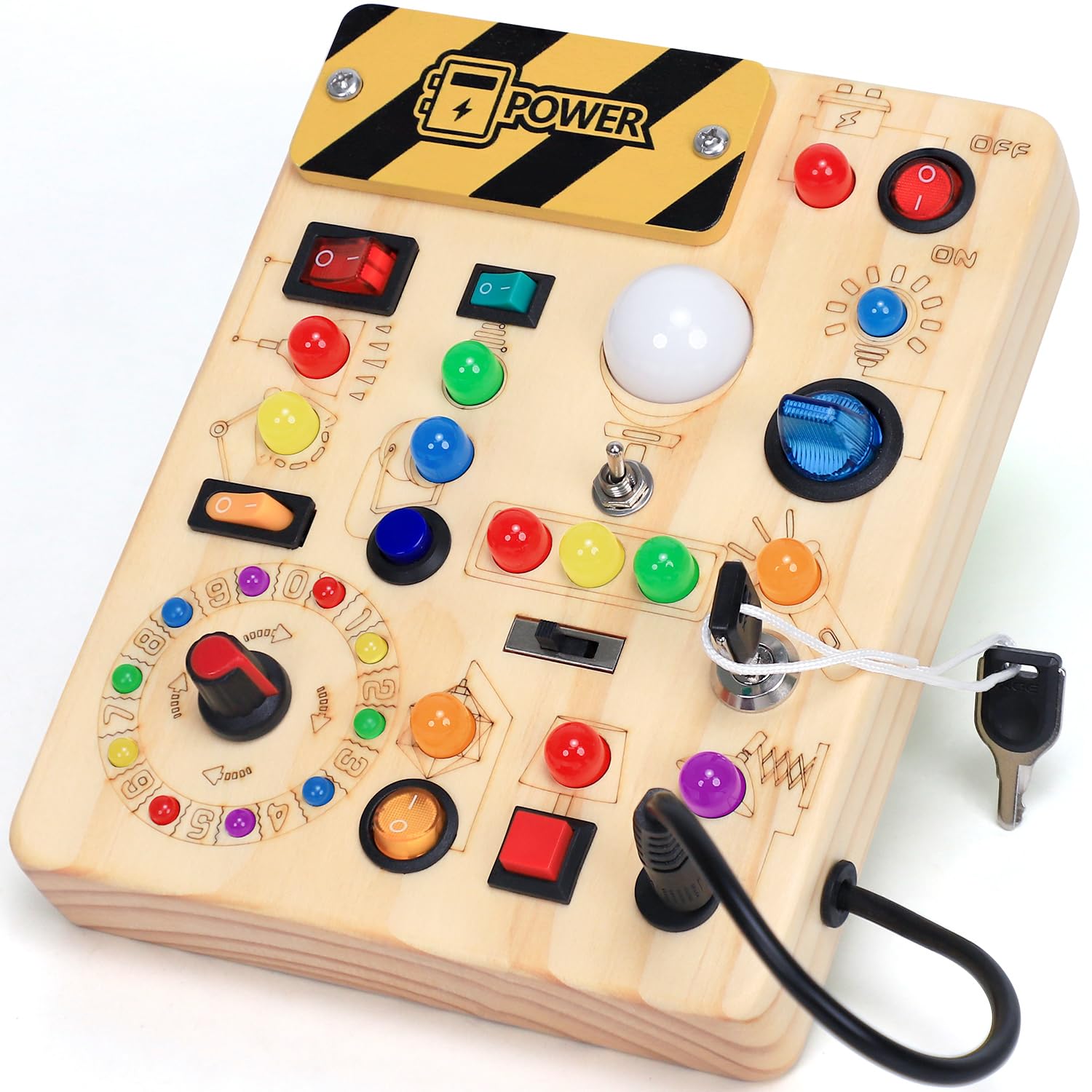
A palm-sized wooden board with real switches and colored lights — no noise, no screens, just cause and effect.
This is the quiet hero of travel toys. At 6.7 x 5.3 x 1.1 inches and just 0.74 pounds, the HarVow board is compact enough to slide into a stroller pocket or a carry-on bag. It features 13 different switches (toggles, dials, push buttons, keys) that control 24 LEDs (light-emitting diodes, or small colored lights) in various colors and patterns. A master switch lets you turn the whole board off with one click to save battery. Reviewers point out that the battery life is surprisingly long even if the toy is left on, which is a common worry with children’s electronics. The backside is engraved with A-Z letters and 0-9 numbers, so it doubles as a pre-writing recognition tool. Compared to the Youuys tissue box, which relies on pulling and stuffing, this board teaches a more complex skill: understanding that a specific action (sliding this switch up) produces a specific reaction (that particular light turns on).
The main limitation is that it has no strap or clip for attaching to a stroller or bag, as one reviewer pointed out. For car rides, you will want to hold it or secure it. Also, it uses 2 AAA batteries (not included). But for a screen-free, silent toy that keeps a toddler engaged on a plane or in a restaurant, this is tough to top — the only other pick this portable is the Manhattan Toy Winkel, which offers a far simpler single action (grasping and chewing).
Why it is unbeatable for travel
- At 0.74 pounds and 6.7 x 5.3 inches, it is the most portable option with active cause-and-effect play.
- No noise — the lights are the only feedback, so it is restaurant- and airplane-friendly without annoying other people.
- Engraved letters and numbers on the back add a literacy layer that grows with the child beyond the basic switch-flipping phase.
The one thing missing
- No strap or clip for attaching to a stroller, diaper bag, or car seat headrest.
- Requires 2 AAA batteries not included in the box.
Grab this for: frequent travel, restaurant outings, or any situation where you need a silent, compact toy that teaches cause and effect without a screen.
Not for: a baby under 12 months who is still putting everything in their mouth — the small switches could be a choking hazard for non-chewers.
6. Youuys Baby Tissue Box Toy

A cloth cube that replaces the real tissue box — same pulling fun, zero waste and no mess.
If your baby is obsessed with pulling tissues from the start (and whose baby is not), this is the toy that saves your sanity. The cloth cube comes with 12 soft, colorful scarves and 3 crinkle-textured tissues that make a crackling sound when squeezed. The repetitive action of pulling them out and, eventually, stuffing them back in is a powerful workout for developing hand-eye coordination and fine motor skills — the same foundational skills that the Manhattan Toy Winkel builds through grasping, but with a more complex in-and-out motion. At just 0.2 pounds, it is, like the 3-ounce Winkel, and significantly more portable than the 1.5-pound LeapFrog book. The entire toy is made from soft, non-toxic cotton with reinforced stitching and a soft, shatter-proof mirror on the front.
The cloth construction means the box does not stay perfectly squared off during play — it collapses a bit, which some parents find disappointing. But that softness is also the feature that makes it safe for a baby to hold and chew on independently. Unlike the wooden HarVow board or the HELLOWOOD cube, there are no hard edges or battery compartments. This is the purest “first toy” on the list: simple, soft, and deeply satisfying for a baby figuring out how their hands work.
What makes it a hit
- 12 colorful scarves plus 3 crinkle tissues — more pieces than most pull-and-play toys, extending the playtime.
- Soft, non-toxic cotton construction with no hard parts or sharp edges.
- At 0.2 pounds, it is the lightest toy in this roundup and packs flat in a diaper bag.
The honest catch
- The cloth box loses its shape during play and does not stay squared off — it looks a bit floppy.
- The fabric pieces could be thicker; some buyers noted they might not survive aggressive chewing from a heavy teether (a baby who bites down hard on things).
Perfect for: babies 6 to 18 months who are in the “pull everything out” phase, and for parents who want a lightweight, soft travel toy that encourages fine motor skills without batteries.
Not the right pick if: your child is past 18 months and needs more structured learning — at that point, the LeapFrog book or the HELLOWOOD cube offers more cognitive depth.
7. Manhattan Toy Winkel Rattle & Sensory Teether Toy

The classic looped teether and rattle that has been the first “grab” for babies for over 25 years.
Some toys earn their spot through sheer longevity, and the Winkel is one of them. It is a maze of soft, continuous BPA-free polyurethane tubes arranged in a looped cube shape with a gentle rattle in the center. At just 3 ounces and 5.02 x 4.04 x 3.54 inches, it is smaller and lighter than every other pick here except the Youuys tissue box — but unlike that cloth toy, the Winkel doubles as a teether (an object for a baby to chew on while teething). You can refrigerate it for extra gum relief, and the open-loop design means even a newborn who has not yet learned to grasp can hook it with their whole hand. Buyers with multiple children say it is the one toy that all three of their kids loved at the teething stage, and that the lightweight design made it easy for little hands to grab and hold onto even before they were sitting up. Compared to the heavy 1.5-pound LeapFrog book, this is a toy a 3-month-old can actually manipulate independently.
The trade-off is simplicity. The Winkel offers one primary action — grasping, shaking, and chewing — while the hahaland fruit set or the HELLOWOOD cube layer multiple skill levels on top of that. It is also surface-wash only, so you cannot submerge it in water for a deep clean. But for a baby under 6 months who is just starting to bat at objects and find their mouth, this is the most appropriate developmental tool in the roundup. The other picks either start at 6 months or require sitting and fine motor skills that a newborn simply does not have yet.
The newborn advantage
- At 3 oz, it is the lightest option suitable for newborns — the only pick safety-rated from birth.
- The continuous looped design makes it easy for uncoordinated hands to grab and hold.
- BPA-free (contains no bisphenol A, a chemical often used in plastics) and refrigerator-safe for teething relief.
The simplicity limit
- Only one play mode (grasp/shake/chew) — it does not scale up with the child past the teething phase.
- Surface wash only; do not submerge in water for cleaning.
Buy this for: a newborn through 6 months as the very first activity toy — it teaches grasping, provides teething relief, and is small enough for the diaper bag.
Swap it out when: your baby reaches 6 months and needs more variety — the hahaland fruit set or the Youuys tissue box will offer richer sensory exploration.
Understanding the Specs
Weight and Portability
The weight of a toy determines whether your baby can lift it independently and whether it goes in the diaper bag. A toy like the Manhattan Toy Winkel at 3 ounces is light enough for a newborn to bat at. The Youuys tissue box at 0.2 pounds is even lighter and packs flat. On the other end, the HELLOWOOD cube at 3.3 pounds is a stay-at-home station. For travel, look for anything under 1 pound — the HarVow LED board at 0.74 pounds is the balance for car rides and restaurants.
Age Range and Stage Fit
The age range on the box is a guideline based on safety and skill level. A toy rated for “newborn” (like the Winkel) has no small parts and focuses on gross grasping (using the whole hand). A toy rated for “6 months+” (like the hahaland set) assumes the baby can sit with support and use both hands. A toy rated for “18 months+” (like the LeapFrog book) expects the child to have enough finger dexterity to press small buttons and the attention span for structured content. Buying a toy rated too old can frustrate a baby; buying one rated too young will bore them quickly.
Play Modes and Longevity
A toy that offers multiple play modes — like the HELLOWOOD cube with eight activities — stays relevant longer because the child can rotate between them as their skills develop. A single-action toy like the Winkel is perfect for a narrow window (3-8 months) but will be outgrown. The hahaland fruit set bridges this well: at 6 months it is about textures and sounds, and at 18 months it becomes a sorting and pretend-play game. The more modes a toy has, the more months of use you will get before it ends up in the donation pile.
Material and Safety
Babies explore with their mouths, so material matters. Soft cloth toys (Youuys, hahaland) are gentle on gums but can collect dirt and need washing. Solid wood (HELLOWOOD, HarVow) is durable and splinter-free if well-sanded, but can be heavy. BPA-free plastic (Manhattan Toy Winkel) is lightweight and easy to clean but may not survive aggressive chewing as well as silicone. Check for certifications like CPC (Children’s Product Certificate) or compliance with CPSIA (Consumer Product Safety Improvement Act) — the Youuys and Manhattan Toy explicitly state they meet these standards.
FAQ
What is the best baby activity toy for a 6-month-old?
Are LED light toys safe for babies’ eyes?
How do I clean a cloth baby activity toy like the Youuys tissue box?
What is the difference between a Montessori toy and a regular baby toy?
Which baby activity toy is best for travel?
How many pieces should a sensory toy set have to keep a baby engaged?
Is the Baby Einstein jumper worth the floor space?
Can a 12-month-old use the LeapFrog 100 Words Book?
Which baby activity toy teaches the most skills?
How do I stop my baby from getting bored with the same activity toy?
Final Thoughts: The Verdict
If you want one dependable pick, the baby activity toys winner is the HELLOWOOD Wooden Activity Cube because it packs eight different play modes into one sturdy wooden frame that grows with your child from 12 months through age 3. If you want a full-body workout and bilingual learning in one station, grab the Baby Einstein Neptune’s Ocean Discovery Jumper. And for the most portable, screen-free option that teaches cause and effect during travel, the HarVow LED Busy Board is the standout travel pick.
How We Picked
We do not accept paid placement. Every pick is matched to a real buyer and a real use-case; we do not hands-on test units.
Sources & Methodology
Specifications: manufacturer listings and product documentation. Review insights: verified customer reviews, as of July 2026. Pricing: not shown on this page (it changes often); check the current price via the retailer link.
As an Amazon Associate, Gadgets Feed earns from qualifying purchases. This does not affect which products we feature.
Product prices and availability are accurate as of the date/time indicated and are subject to change. Any price and availability information displayed on Amazon at the time of purchase will apply to the purchase of this product. As an Amazon Associate I earn from qualifying purchases.
CERTAIN CONTENT THAT APPEARS ON THIS SITE COMES FROM AMAZON. THIS CONTENT IS PROVIDED "AS IS" AND IS SUBJECT TO CHANGE OR REMOVAL AT ANY TIME.
Amazon and the Amazon logo are trademarks of Amazon.com, Inc. or its affiliates.