
Our readers keep the lights on and my morning glass full of iced black tea. As an Amazon Associate, I earn from qualifying purchases.
Specs are compiled from manufacturer listings and verified buyer reviews and can change over time — please confirm the key details on the product page before buying.
A toddler who falls asleep on a climb turns into dead weight, and that is the moment a proper hiking carrier earns its place. A great trail day and a miserable one come down to whether the frame, hip belt and harness put your child’s weight on your legs instead of your neck. Every pick below is a real structured carrier with a load-bearing frame (a stiff frame that carries the weight) and a backpack harness (shoulder straps like a rucksack), and each one fits a slightly different family.
I’m Min — the founder and writer behind Gadgets Feed. This guide is built by comparing the manufacturers’ published specifications and the patterns across verified customer reviews, so you get each pick’s real strengths and trade-offs instead of marketing spin.
Some carriers hold your child up high enough to see the trail. One folds flat into the car boot. Another lets you pop the seat off and wear it as a plain daypack. The list below narrows the whole field down to the baby carrier for hiking that suits the way your family actually walks.
Our Picks at a Glance


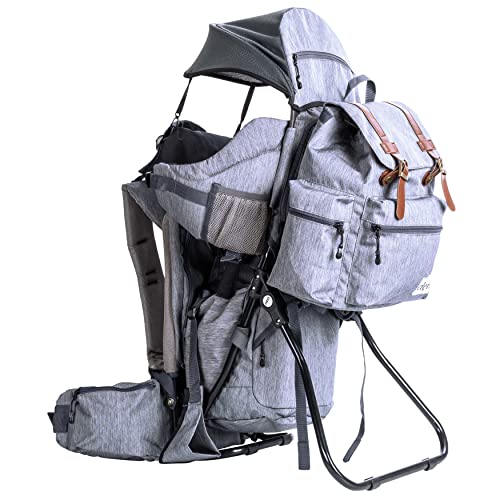
How To Choose The Best Baby Carrier For Hiking
Most people buy their first hiking carrier by looking at the child’s seat. The seat matters, but it is not what decides whether you can finish the walk. Start with the part that touches you: the frame and the hip belt. A frame carries the load downward and a hip belt parks it on the bones of your pelvis, which is how you walk uphill for an hour without your shoulders burning. Padding alone does not do that job.
Weight limits and how long the carrier will last you
Look for two different numbers and do not confuse them. The child limit is the largest passenger the seat is built for — some carriers take a toddler up to 48.5 pounds, others stop at 40 pounds or 42 pounds. The total limit includes the child plus your gear. If you plan to keep using the carrier past the toddler years, the higher child figure buys you more seasons of use.
The seat, the harness and the child’s comfort
A five-point harness (two shoulder straps, two hip straps and a strap between the legs) holds a wriggling child in place better than a three-point one. An adjustable seat lets you raise the base as your child grows, keeping their head above the top of the frame so they can see out. Foot stirrups matter too: they stop little legs dangling and give your child something to push against on a long descent.
Canopy, ventilation and weather
A sun canopy is the difference between a happy passenger and a squinting, overheating one. Some canopies are rated UPF 50+ for sun protection, some are simply a fabric hood, and a few carriers bundle a separate rain cover as well. Ventilation works from two sides: a mesh back panel keeps your own back from turning into a swamp, and a child seat that opens up in warm weather does the same for your passenger.
Storage you can actually reach
Trail storage is not about carrying more — it is about not stopping. Waist-belt pockets let you grab a snack or your phone without swinging the carrier off your back. An insulated pocket keeps a bottle cool on a hot walk. A large compartment under the seat swallows nappies, wipes and a spare layer, and a handful of carriers include a changing pad so you can deal with a nappy on a rock without improvising.
Folding, loading and sharing between parents
Two small features make a big daily difference. A kickstand lets you stand the carrier upright on the ground so you can lift your child in and out without a second adult holding it. An adjustable torso or suspension system lets a taller and a shorter parent swap the same carrier comfortably — worth checking if two people will share the walking.
Quick Comparison
| Model | Best For | Carrier Weight | Child Weight Limit | Signature Feature | Amazon |
|---|---|---|---|---|---|
| Osprey Poco Child Carrier Backpack★ Best Overall | Overall trail companion | 3.49 kg | 48.5 pounds | Built-in deployable sunshade | Amazon |
| ClevrPlus Canyonero Camping Baby BackpackBudget Champion | Budget all-weather hiking | 6.5 pounds | 42 lbs | Sun canopy plus rain cover | Amazon |
| ClevrPlus Urban Explorer Child CarrierMost Versatile | City-to-trail versatility | 7.2 pounds | 42 lbs | Removable mini backpack | Amazon |
| besrey Toddler Hiking Backpack Carrier | Shoulder-friendly weight spread | — | 44 lbs | Detachable sunshade | Amazon |
| Chicco SmartSupport Frame Backpack | Lightweight aluminium frame | — | — | Built-in kickstand | Amazon |
| OE Shoulder Hiking Carrier | Folding travel carrier | 4.4 Lbs with backpack | 45 Lbs | Folds flat, detachable 40 L backpack | Amazon |
| WIPHA Lightweight Hiking Baby Carrier | Hot-weather ventilation | — | 40 lbs | Oversized mesh back panel | Amazon |
| Hiking Baby Carrier Backpack – Toddler & Child Carrier | Long-mileage day hikes | — | — | Insulated bottle pocket | Amazon |
| WIPHA Toddler Hiking Carrier, Sand | Family hikes with a hip belt | — | 40 lbs (child plus gear) | UPF 50+ sunshade | Amazon |
| Kelty Journey Signature Child Carrier | Sharing between parents | 7.1 pounds | — | PerfectFIT suspension | Amazon |
| Kelty Journey PerfectFIT ELITE | Frequent little explorers | 8.3 pounds | 40 pounds | Zip-away dirty compartment | Amazon |
In‑Depth Reviews
1. Osprey Poco Child Carrier Backpack
Our pick — 4.5+★ from 800+ verified ratings; the strongest balance of quality and price.
The carrier that lets a child sleep through the climb and still gives you room for the sandwiches.
The Poco’s headline number is its 48.5-pound maximum weight recommendation. That is the highest child limit on this list, so it outlasts a 40- or 42-pound carrier by seasons. The deluxe child cockpit adds a Double Halo harness (two interlocking safety loops holding the child in) plus adjustable and removable foot stirrups, so a growing toddler stays settled instead of sliding around.
Parent-side comfort is where it pulls ahead. The padding is thick enough that children nod off in it, and a drool pad sits where a sleepy face lands — removable and washable, so a soggy cheek does not mean washing the whole carrier. Hand-wash only is the price of that fabric, and it is the one chore you will repeat. Cord loops and mesh pockets put a toy or a dummy within the child’s own reach, which buys you quiet kilometres.
What wins people over is the build. Owners praise the build more than any other feature, and the harness feels equally solid on the trail. The sunshade stores away and deploys when the tree cover runs out, giving UV protection without a separate hood to lose. It closes on a buckle, the shell is nylon, and the All Mighty Guarantee backs the frame. The honest catch is the adjustability — that is the one area people disagree about, so spend a few minutes dialling in the torso and strap lengths before your first real walk.
Where the Poco pulls ahead
- 48.5 pounds of child capacity — the highest limit in this lineup
- Built-in sunshade stores in the pack and deploys in seconds
- Removable, washable drool pad plus a Double Halo child harness
- Cord loops and mesh pockets keep toys and dummies reachable from the seat
What to weigh first
- Hand wash only — no machine cycle for the fabric
- Strap and torso adjustability is the mixed point in owner feedback
- At 3.49 kg it is one of the heavier shells here
Worth the stretch if: you want one carrier that will still fit your child at the top of the weight range and has a canopy built in rather than clipped on.
Reconsider if: you want to throw the carrier in the washing machine — this one asks for hand washing.
2. ClevrPlus Canyonero Camping Baby Backpack
Two weather covers, a folding frame and a weight that stays off your mind on the uphill.
For a first hiking carrier, the Canyonero is the one that covers the most ground for the least commitment. It weighs 6.5 pounds against the Urban Explorer’s 7.2 pounds further down this list, and its one-piece frame arrives already built, so there is no assembly evening before a Saturday walk. A five-point harness, flexible straps and foot stirrups lock a toddler in place, and the seat adjusts to suit children from 9 to 48 months, up to 42 pounds.
Weather is handled in both directions: a sun canopy for the glare and a rain cover for the drizzle, both in the box. The waistband extends to roughly 60 inches, which is generous enough for a tall parent or a jacket-heavy winter walk. Storage is the surprise — an insulated back pocket keeps snacks or a bottle cool, and the main compartments swallow a changing pad, nappies and a spare jumper. As owners put it, it can hold three sandwiches and an ice pack.
Quality is the headline in owner feedback, with comfort right behind it, and both are earned at this level. Extended hikes are the use-case it was designed around; the padded straps, hip belt and lumbar padding all push weight into the belt rather than the shoulders. Fit is the one area where opinions split — a few find the seat sizing tighter than expected — so check your child’s weight against the 42-pound ceiling before you commit.
The all-weather argument: a sun canopy and a rain cover in the same box means one purchase covers a bright morning and an afternoon shower, which is rarer than it should be at this tier.
The folding bonus: the one-piece frame means no assembly from the start — you unbox it and head out, which is exactly what a first-time buyer wants.
The smart first buy: a family testing whether hiking with a carrier suits them, who wants weather protection built in rather than bought later.
Look further up if: you need a higher child weight ceiling than 42 pounds or a machine-washable body.
3. ClevrPlus Urban Explorer Child Carrier
One carrier that splits into two bags, so the walk to the trailhead is not a relay.
A removable mini backpack is the feature that makes the Urban Explorer different from every other carrier here. It clips onto the carrier for extra capacity, then comes off as a small pack that is genuinely small enough for a toddler to wear. That turns a single all-in-one carrier into a two-person setup: the child carries their own snacks, the adult carries the child. Size is the thing owners praise most, and it is easy to see why — this carrier takes children from 9 to 48 months at up to 42 pounds.
The frame story matches the Canyonero: a one-piece design that arrives built, with 5-point seat belts, flexible straps and stirrups. A washable drool pad, padded straps, a hip belt and lumbar padding handle the long miles, and the waistband reaches roughly 60 inches. The weights differ, though — this one is 7.2 pounds to the Canyonero’s 6.5 pounds — so if you are counting grams on every climb, the smaller sibling is the lighter pack.
It brings a sun canopy and a rain cover as well, and the canopy earns its keep on open ridges. Hydration pack storage is the other practical win, letting you carry water on your back and sip without stopping. Stability is the mixed note — a handful of owners find it less planted on rough ground when fully loaded — so tighten the straps and keep the heavy items low. For mountain walking with a stocked pack, buyers report it is great for hiking mountains.
Reach for this if: you want one carrier that also works as a daypack when the child wants to walk, and you plan to cover both city paths and hill trails.
Pass it over if: you want the absolute lowest carrying weight — 7.2 pounds here against 6.5 pounds for the Canyonero.
4. besrey Toddler Hiking Backpack Carrier
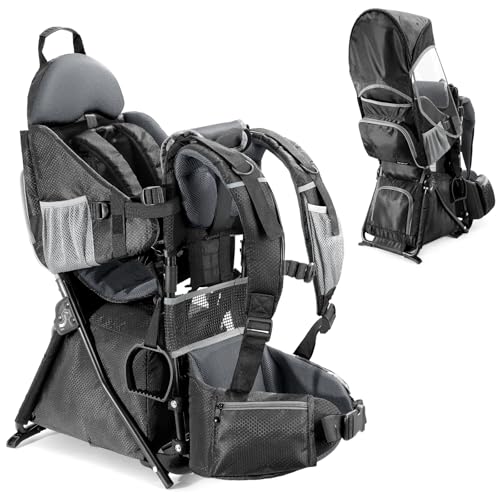
Padded shoulder straps and a wide waist belt that split the load instead of stacking it on your neck.
The besrey earns its spot on where the weight goes. Padded shoulder straps and a broad waist belt spread your child’s weight across both contact points, so your legs do the work instead of your spine. The buckles adjust broadly enough to fit parents of very different shapes. Owners mention the weight sits high on the back and that the carrier doesn’t hurt their back — which lines up with the way the harness is laid out.
Its capacity is a genuine surprise from a smaller brand: the seat takes a child anywhere from 16 lbs to a maximum of 44 lbs, counting the child, the gear and the carrier together. That 44-pound ceiling beats the 40-to-42-pound limits of several better-known carriers here, so it fits a growing toddler longer. The upgraded nylon and polyester fabric resists fading and deformation and handles rain without soaking through.
The three-point harness uses super-soft material, and a detachable sunshade covers sun, wind and light rain. Storage is better thought-out than expected: a large pocket with deep compartments, side zips on the waist belt and a storage bag for packing it down. A washable drool pad keeps the seat clean. Security is the one mixed note — a few parents want a more locked-in hold from the harness — so take time with the straps on the first fitting. Getting the child on and off without help is a repeated positive.
Carrying mechanics: a waist belt plus padded shoulders plus buckles that fit many body shapes — the three things that decide whether an hour on a hillside feels like work or punishment.
The one to pressure-test: the harness runs three points rather than five, so check the hold on your child before a long outing.
A strong fit for you if: your priority is even weight distribution and a 44-pound child limit, and you want water-resistant fabric for a damp climate.
Worth a second look if: you would rather have a five-point harness than a three-point one.
5. Chicco SmartSupport Lightweight Frame Backpack Baby Carrier

The one you can lift with one hand and load without a second adult holding the frame.
A lightweight aluminium frame is the whole pitch here, and it delivers on the practical side first. The carrier holds its own shape, so getting a toddler in and out is a single-person job rather than a two-person balancing act. A built-in kickstand does the rest of that work: stand the carrier on the ground, seat the child, lift it onto your back. A two-position height-adjustable seat with a padded backrest grows with your child, and a five-point harness keeps them in place.
The parent harness gets the same attention. Padded shoulder and waist straps adjust to fit, and 3D breathable mesh across the lumbar, back and the straps moves air where you sweat hardest — useful on a climb when the sun is on your back. An adjustable 50+ rated canopy is a step up from a plain fabric hood, and two small pockets handle the essentials. The aluminium frame is the stand-out build detail, and quality is the strongest theme in owner feedback, with the carrier reading as sturdy rather than flimsy.
Comfort is where this one splits opinion. Some parents find it simple to throw on and go; others say it is very uncomfortable on the shoulders over distance. Sun protection gets consistent praise, with shade from both sun and rain noted.
Day-trip, not expedition: aluminium keeps the shell light and the kickstand removes the loading struggle, which makes this the carrier you grab for a half-day out rather than a long haul.
Spend time on the straps: comfort on the shoulders is the recurring split in feedback, so fit it empty before you load it.
Made for you if: you carry solo, want a light aluminium frame and love the idea of a kickstand so you never fumble the lift.
skip it if: you want the larger storage compartments of the heavier carriers further down this list.
6. OE Shoulder Hiking Carrier For Child and Toddler

Folds down to the size of a laptop bag and still has a forty-litre pack attached.
Portability is this carrier’s whole reason for existing, and the numbers back it up. Fully folded it measures 22 by 14 by 6 inches, small enough to tuck in a car boot or a suitcase. The aluminium and stainless steel frame comes with a detachable 40 L backpack, so one of you can wear the child while the other takes the pack, or you can leave the pack behind entirely. Unit weight is 4.4 lbs with the backpack and 3.4 lbs without it.
It carries up to 45 Lbs (or 20 kg) of child, up to 45 inches tall, and the waist fits up to 50 inches — so a big toddler still rides. A hip support takes the weight off your shoulders. Your child sits in a natural sitting position with a view over your head rather than into your back, and owners consistently like being able to see everything together. The waterproof polyester shell and EPE foam padding (a firm foam that holds its shape) hold up to weather. A sunshade tucks into a pocket in the backrest, and its strings adjust the height.
For a day hike with a child who wants to be carried part of the way, this is the one that stows when they would rather walk. Shoulder comfort, durability and stability all draw a mixed reaction — the lighter shell and the foldable build trade some support compared with a rigid full-frame carrier. So keep the total weight inside the 45-pound limit and adjust the hip support carefully. Hydration pack compatibility (a sleeve for a water bladder) is a useful extra if you already carry one.
The travel-friendly answer: a folding carrier for families who hike on holiday and cannot spare luggage space for a rigid frame.
The trade you accept: folding means less rigid support than a full-frame carrier, so pack light and set the hip belt properly.
7. WIPHA Hiking Baby Carrier Backpack

An oversized mesh panel that keeps your back cool even when the trail is sweating for you.
If you hike in heat, this is the carrier to look at first. The backrest has been reworked so an oversized net replaces fabric across your back, and frame suspension keeps a gap between the pack and your spine so air can move. That is the single most useful thing here on a July climb. The aluminium frame is described as ultra-light, the fabric is waterproof and tear-resistant, and the 26L compartment under the seat swallows the day’s supplies. Mesh bottle bags and a storage pocket sit on both sides of the waistband.
Your child gets their own climate control. The backrest is zippered with mesh inside, so you can unzip it when it is hot and zip it back up when the wind picks up — one seat that works in both weathers. A three-point safety harness (two shoulder straps and a crotch strap), an adjustable ergonomic seat and a foot pedal keep a passenger from 6 months to 4 years (16lbs to 40lbs) comfortable and secure. Secure locks on the buckles at both sides add confidence.
It folds flat like a laptop, which is unusual for a framed carrier and makes it easy to store in a car or a hall cupboard. A detachable canopy stows in the back bag. Comfort is the most-praised element, and the weight sitting high is the detail owners single out — customers note carrying a 40-pound toddler without pain. Support and weight distribution are where opinions split, so get the wide padded waist belt tight and let the belt take the load rather than the shoulder straps.
The summer answer: a bare mesh back plus a zip-open child’s seat is a two-part ventilation system, and few carriers here offer either half.
Load it low and tighten the belt: comfort draws praise, but support and weight distribution are mixed, so the waist belt does the real work.
Built for warm trails: a family hiking in hot, humid conditions who wants air moving on both backs.
Think twice if: you need a higher child ceiling than 40 lbs or a five-point harness instead of three.
8. Hiking Baby Carrier Backpack – Toddler & Child Carrier
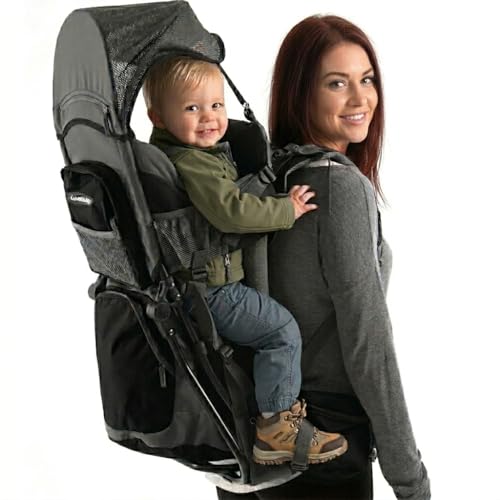
A load-bearing belt and ripstop shell built for the five-mile day, not the loop round the park.
This carrier is set up for distance. The belt is load bearing, the straps are heavily padded, and the harness is height adjustable, which together put a toddler’s weight on your hips rather than your shoulders. Reviewers point out covering 3-5 miles comfortably in it. The passenger rides in a padded cocoon held by safety straps and stirrups, with a removable sun visor overhead — a build that lands squarely in the “hiking day out” bracket.
The material choice tells the same story. The main body is waterproof Ripstop Polyester, a woven fabric that resists tearing, so a scrape against a rock or a hedge does not open a hole. A foldable nappy pad is included, giving you a clean surface for a change in the open. Storage is thoughtful: mesh pockets, easy-access pockets for a phone, and an insulated pocket for a bottle so a drink stays cool while you climb.
Quality is what owners talk about most, with value for money second, and both point to a carrier that feels built rather than assembled. Durability is the split point — most say it holds up beautifully, but a few report a chest strap giving way — so check the buckle tension regularly if you are loading it heavily. The toddler seat accommodates different ages and weights on the same harness.
Why distance walkers like it
- Load-bearing belt plus heavily padded straps for longer days
- Waterproof Ripstop Polyester main body resists tearing
- Insulated bottle pocket and easy-access phone pockets
- Foldable nappy pad included for changes outdoors
Check before you load up
- Durability draws a mixed response, with some chest strap failures reported
- Heavier duty build means it is not the lightest pack here
The mileage pick: you plan multi-mile day hikes and want a load-bearing belt plus insulated storage for the whole trip.
Look elsewhere if: you want a foldable frame for tight storage — this one is built as a fixed pack.
9. WIPHA Toddler Hiking Carrier, Sand
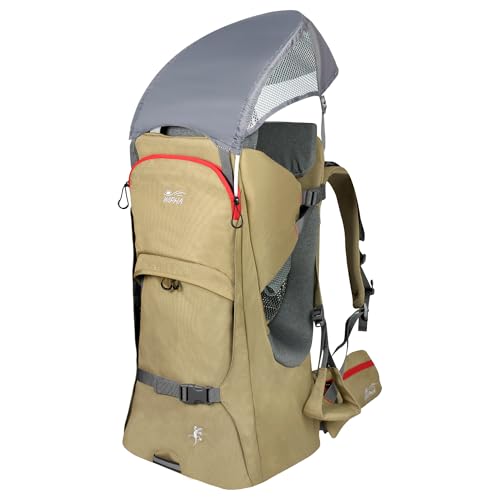
A weight-distribution system that shifts the load down to your hips and leaves your back alone.
The maker claims the weight-distribution system puts 90% of the load — up to 40 lbs of child plus gear — onto your hips. That is the correct place for it. The shoulder straps are adjustable, the waist belt is wide, and 3D breathable mesh padding lines the back panel, which makes it a natural fit for a long walk rather than a loop around the park. An aircraft-grade aluminium frame gives the structure its stability while keeping it light, and the hinges inside the rear storage bag let it fold flat for the car.
Your child sits in a five-point harness (two shoulder, two hip and one crotch strap) on an adjustable seat that covers 6 months to 4 years. The sunshade carries a UPF 50+ rating (a standard measure of how much UV passes through the fabric), so arms and face stay shaded on bright days. The padding is removable for cleaning. Storage is designed as a nappy-bag replacement: a large under-seat compartment for nappies, wipes and a change of clothes, an insulated thermal pocket that keeps milk or snacks at temperature, and two quick-access waist pouches for keys and phone.
The maker states the seat is TUV-certified for durability, material safety and load bearing. Comfort is the most consistent positive, with children sleeping well in it during everything from yard work to family hikes. Ease of use is where feedback divides — some find it simple, while others report the shoulder straps sliding off — so take time to set the harness before a long outing. Weight is also a mixed point, since it is not the lightest carrier here.
Where the load goes: a wide waist belt and a hip transfer system means your neck and shoulders are not carrying the child — the hips are.
The one to adjust carefully: shoulder straps sliding is the recurring issue, so set the sternum strap and belt height deliberately.
Choose this one if: you want the load on your hips, a UPF 50+ canopy and enough storage to leave the changing bag at home.
Not for you if: you need to swap the carrier between very different body types frequently, given the strap-slide comments.
10. Kelty Journey Signature Child Carrier

Suspension that swings from a tall dad’s torso to a shorter mum’s in under a minute.
Torso length is the spec that gets ignored until two parents share one carrier and the second person cannot get comfortable. The PerfectFIT Suspension System adjusts to different torso lengths quickly, with no extra attachments, so the same pack fits both adults. The weight comes in at 7.1 pounds, and the adjustable suspension keeps that load balanced on the move. Multiple grab handles make lifting and setting the carrier down a one-hand job.
Child security is well covered: a five-point safety harness, a padded aluminium roll cage, a wide seat base and adjustable foot stirrups. The roll cage is the structural bar that keeps the seat rigid around your child if the pack tips, and the wide base means a bigger sibling still fits. An integrated sunshade covers the passenger when the trail opens up. A large zippered pocket with internal stretch storage holds layers and toys, and zippered hip-belt pockets keep snacks, water and a phone within reach.
Adjustability gets consistent praise, while the real question for buyers is whether it fits their height — most report a perfect fit, but some note it sits too big by about 2 inches. If you are at the shorter end of the range, budget time to test the torso setting. Care is simple: wipe clean with a damp towel and dry thoroughly before you store it. Comfort over long hikes and light weight are both recurring themes.
The sharing argument
- PerfectFIT suspension adjusts quickly to different torso lengths
- Padded aluminium roll cage plus a 5-point harness and stirrups
- Zippered hip-belt pockets keep snacks and a phone reachable
- Multiple grab handles for one-hand lifting
The fit question to check
- Some shorter wearers find it too big by about 2 inches
- At 7.1 pounds it sits in the heavier half of this lineup
The two-parent pack: a couple who will alternate carries on long hikes and need one suspension setting that suits both.
The one risk to check: torso fit for shorter wearers — try the torso adjustment settings before a long route.
11. Kelty Journey PerfectFIT ELITE Child Carrier

A zip-away dirty compartment so a muddy toddler does not end up against your day bag.
The Elite is the Signature above with the extras loaded on. It has the PerfectFIT suspension for quick torso adjustment, load lifters, a waistbelt and sternum straps that spread your child’s weight evenly, and a fold-out aluminium kickstand so loading and unloading is a one-person job. A five-point safety harness and an aluminium roll cage frame add stability. The maximum weight recommendation is 40 pounds, which is where the two Kelty models differ — the Signature does not publish one.
What separates it from the Signature, item for item: a zippered dirty compartment to keep soiled clothes apart, side stretch mesh pockets, two hip-belt pockets and an integrated sunshade with a pull-out design that owners single out as effective. The main zippered pocket has room for food, drink and a souvenir or two. There is 26L of storage capacity (about a large daypack’s worth), and the internal seat mirrors a child’s natural resting position, with somewhere to stretch their feet. The wide seat means a larger sibling can hitch a ride, though it takes one rider at a time.
Size draws the most praise, with storage a close second. Durability and adjustability both come up as strengths, and the seat is described as easy to adjust as a child grows. The carrier weighs 8.3 pounds — the heaviest on this list — so it suits a family that heads out often and wants every feature on board. However, that same extra bulk is what you are lugging uphill, which is the honest trade for the dirty compartment and the extra pockets. Storage and portability both earn their place if you are hiking with a toddler.
The extras are real, not decoration: a dirty compartment, mesh side pockets, hip-belt pockets and a pull-out sunshade — every one of those is a feature you touch on a hot, grubby day out.
The weight you accept: 8.3 pounds is the heaviest shell in this lineup, so the extras cost you on the climb.
For frequent explorers: a family hiking most weekends that wants every storage option and does not mind the heaviest pack here.
Not the first pick if: you are weight-counting for long climbs — the 8.3-pound frame is the premium price of the feature set.
Understanding the Specs
Carrier weight vs. child weight limit
These are two different numbers and both matter. Carrier weight is what you lift empty — 3.4 lbs on the OE without its backpack, 8.3 pounds on the Kelty Elite with every feature on board. Child weight limit is the largest passenger the harness and frame are built to hold, and it decides how many seasons you get. A 48.5-pound ceiling keeps working through the toddler years; a 40-pound ceiling is fine for a lighter child but retires sooner. Do not add your gear to the child figure unless the maker says the limit covers the whole load.
Frames, harnesses and stirrups
A hiking carrier uses a rigid frame — aluminium, stainless steel or a padded roll cage — so the child sits in a held shape rather than being squashed against you. The harness is the set of straps keeping them in: a five-point harness holds across both shoulders, both hips and between the legs; a three-point holds across the shoulders and the seat only. Footstirrups give a child somewhere to push, which steadies the ride on a descent.
Canopies and sun protection ratings
A sun canopy is a hood that covers the child’s head and shoulders, and it is the single most useful accessory on an exposed ridge. Some are rated UPF 50+, which is a fabric rating for how much ultraviolet light gets through — higher is better. Others are plain fabric or a detachable hood you store in a pocket when the trees close in. If you hike in changeable weather, look for a carrier that includes a rain cover as well, so one purchase covers a bright morning and a wet afternoon.
Hip belts, torso adjustment and load transfer
The hip belt is the wide strap that wraps your pelvis, and it is what turns a child’s weight into something your legs carry rather than your neck. A waistbelt that reaches roughly 60 inches will fit a tall parent or a winter jacket; some carriers also adjust for torso length so two adults of different heights can share the same pack. Load lifters and sternum straps fine-tune where the weight sits. If a carrier only pads the shoulders and skips the hip belt, you will feel it on the first real climb.
FAQ
What age can a child ride in a hiking carrier?
How much weight can a hiking carrier hold?
Can one hiking carrier fit both parents?
Is a hiking carrier safe for a sleeping toddler?
Do hiking carriers fold for storage and travel?
How do I clean a hiking carrier?
What is the difference between a hiking carrier and a soft baby carrier?
Is a sun canopy or a rain cover more important?
How much storage do I need for a day hike?
Can a hiking carrier be used as a regular backpack?
Final Thoughts: The Verdict
For most families, the strongest pick among these baby carrier for hiking options is the Osprey Poco Child Carrier Backpack. It pairs the highest child limit here — 48.5 pounds — with a built-in deployable sunshade and a washable drool pad. That combination keeps both of you happy when the weather turns or the climb is long. If you want to share the load between two parents and need an adjustable torso system, reach for the Kelty Journey Signature. And for hot, humid trails where ventilation is everything, the WIPHA Lightweight Hiking Baby Carrier is the one that keeps air moving on both backs. Take a beat to check your child’s weight against the limit — that is the one number that decides how many seasons you get out of your pick.
How We Picked
We do not accept paid placement. Every pick is matched to a real buyer and a real use-case; we do not hands-on test units.
Sources & Methodology
Specifications: manufacturer listings and product documentation. Review insights: verified customer reviews, as of November 2026. Pricing: not shown on this page (it changes often); check the current price via the retailer link.
As an Amazon Associate, Gadgets Feed earns from qualifying purchases. This does not affect which products we feature.