
Our readers keep the lights on and my morning glass full of iced black tea. As an Amazon Associate, I earn from qualifying purchases.
Specs are compiled from manufacturer listings and verified buyer reviews and can change over time — please confirm the key details on the product page before buying.
You want your baby protected from sunburn, but you also worry about harsh chemicals on delicate skin and a thick white paste that makes your toddler look like a ghost. You do not have to sacrifice protection for a formula that rubs in. These picks are ranked by what real families report after months of beach days, pool sessions, and daily park trips.
I’m Min — the founder and writer behind Gadgets Feed. This guide is built by comparing the manufacturers’ published specifications and the patterns across verified customer reviews, so you get each pick’s real strengths and trade-offs instead of marketing spin.
Every option here uses zinc oxide or titanium dioxide rather than chemical filters, and each one is judged on how it handles the two things that matter most with a wiggly child: coverage and ease of application. baby mineral sunscreen choices range from roll-ons to sprays to sticks, and the right one depends entirely on your routine.
Our Picks at a Glance

How To Choose The Best Baby Mineral Sunscreen
Mineral sunscreens use either zinc oxide or titanium dioxide as the active ingredient. These minerals sit on top of the skin and physically reflect UV rays, which is why they are the go-to for babies and for anyone with sensitive skin. The trade-off is texture: minerals are naturally thicker than chemical sunscreens, so how well a formula spreads is often the deciding factor for parents.
Match the format to your child’s patience
A roll-on glides on fast for a wiggly toddler but can be harder to rub in evenly. A spray covers large areas like legs and backs quickly but usually needs a good rub afterward. A stick is great for tiny zones like the face, ears, and nose, and older kids can even apply it themselves. Lotions offer the most even coverage but take the longest to work in.
Check the water-resistance window
The label tells you exactly how long the protection lasts during swimming or heavy sweating — 40 minutes versus 80 minutes is a real difference on a long beach day. Reapplication after towel drying is non-negotiable no matter which number you see.
Look beyond the SPF number
SPF 30 blocks about 97% of UVB rays, and SPF 50 blocks about 98%. The bigger variation between products is the formula quality: a smooth, non-greasy base means you will actually apply enough to get the labeled protection, while a thick paste often gets rubbed on too thinly.
Quick Comparison
| Model | Best For | Active Ingredient | SPF Level | Water Resistance | Amazon |
|---|---|---|---|---|---|
| Sun Bum Baby Bum Roll-On★ Best Overall | Fast application on wiggly kids | Zinc Oxide | SPF 50 | 80 minutes | Amazon |
| Thinkbaby Mineral LotionBest Value | Clean ingredients on sensitive skin | Clear Zinc Oxide | SPF 30 | 80 minutes | Amazon |
| Coppertone Kids StickKid-Friendly Pick | Face touch-ups kids can apply | Zinc Oxide | SPF 50 | 80 minutes | Amazon |
| Coppertone Pure & Simple Set | Full body plus face in one buy | Zinc Oxide | SPF 50 | 80 minutes | Amazon |
| Eucerin Baby Lotion | Moisturizing non-greasy daily wear | Zinc Oxide | SPF 50 | — | Amazon |
| Babo Botanicals Spray | Quick full-body coverage | Zinc | SPF 30 | 80 minutes | Amazon |
| Raw Elements Stick | Organic formula with 25% zinc | Non-Nano Zinc Oxide | SPF 30+ | 80 minutes | Amazon |
| California Baby Lotion | Allergy-prone and eczema skin | Titanium Dioxide | SPF 30+ | 80 minutes | Amazon |
| Raw Love Baby Lotion | Newborns from 0-6 months | Non-Nano Zinc Oxide | SPF 35+ | 40 minutes | Amazon |
In-Depth Reviews
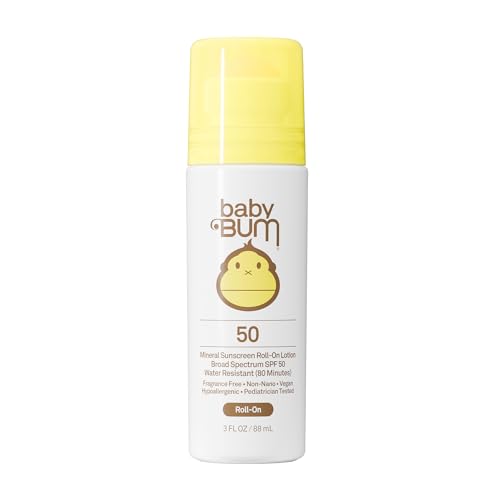
1. Sun Bum Baby Bum Mineral SPF 50 Roll-On
Our pick — over 4.5★ from 850+ verified ratings; the strongest balance of quality and price.
This roll-on glides on in seconds, turning sunscreen application from a wrestling match into a quick swipe.
Parents report this is the easiest sunscreen they have used on young kids, and the reason is the format: a roll-on ball that glides over skin without the squeeze-and-spread dance of a bottle. The SPF 50 mineral formula relies on zinc oxide and adds coconut oil, shea butter, and cocoa butter to keep baby skin hydrated while it protects.
It is water resistant for 80 minutes of swimming or sweating, and it is vegan, cruelty-free, and free of parabens, sulfates, silicones, and phthalates. The banana scent and monkey logo genuinely help with the “let me put this on you” battle — kids think it is fun.
Buyers report it survived a full Hawaiian vacation with zero burns, gliding on smoothly with no clumps. The honest trade-off is a noticeable white cast on the skin and a small 3 oz container that runs out fast with daily use — but the effort saved on a squirmy toddler makes it worth it. Unlike the stick options that only cover the face, this roll-on handles arms, legs, and backs in quick passes.
Why It Wins
- Roll-on means no spray mist to inhale and no squeeze bottle mess
- SPF 50 with broad spectrum UVA/UVB protection
- Plant-based moisturizers keep skin soft while protecting
Where It Compromises
- Leaves a white cast even after rubbing in
- Small container limits value for full-body daily use
The 4.7-star crowd favorite: this is the pick for parents who want fast, fuss-free application on a child who will not sit still.
Think twice if: you want a single product for the whole beach day — the 3 oz size means you will repurchase quickly.
2. Thinkbaby Mineral Baby Sunscreen SPF 30
This lotion wins over research-driven parents with a genuinely clean ingredient list.
This lotion is for the parent who has done deep research on what to put on a baby’s skin. It uses clear zinc oxide for SPF 30 protection and skips PABA, parabens, phthalates, BPA, oxybenzone, avobenzone, petroleum, gluten, and dairy — a checklist that wins trust fast with cautious families.
Application divides opinion more than any other pick here. Some report it absorbs easily and leaves no white cast at all, while others — as buyers put it — call it “paint” that is thick and leaves a heavy white layer. Both can be true: it blends well when you take time, but it is not a quick rub.
At 4.23 ounces it packs more product than the roll-on above, and the 80-minute water resistance handles pool time well. The strongest vote of confidence came from a family that wore it all day at Disney and reported nobody burned.
Who it fits: parents who prioritize a squeaky-clean ingredient list over speed of application, and who do not mind spending a minute working the lotion in.
The trade-off: thickness varies batch to batch in reports, and a small number of families saw redness — patch test first on truly reactive skin.
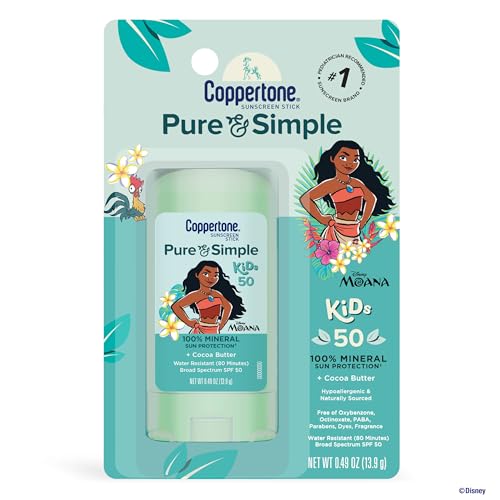
3. Coppertone Pure and Simple Kids Mineral Stick SPF 50
This compact stick lets a 6-year-old apply sunscreen to their own face independently.
The genius of this pick is independence: parents report that kids as young as 3 or 6 can swipe it on their own face, ears, and nose without help. The Disney Moana packaging makes it feel like a treat rather than a chore, and the fragrance-free, hypoallergenic formula is gentle enough for sensitive skin.
At 0.49 ounces it is dramatically smaller than the lotion bottles on this list — a 6.1x capacity gap versus the 3 oz roll-on above — so treat it as a face touch-up tool rather than full-body coverage. Owners mention 1.5 hours of swimming with no burn, and the cocoa butter in the formula keeps it from feeling harsh.
This one is a paste that takes effort to rub in and leaves a white residue, but parents love it so much they ask the brand for a larger version. For a quick face reapplication mid-day, it is tough to top.
Reach for it if: you want a travel-friendly stick for the face that your child can apply solo and you can toss in a diaper bag.
The catch: the compact size draws the most mixed opinions — some find it too small for the price, so pair it with a lotion for the body.
4. Coppertone Pure and Simple Baby Sunscreen Set
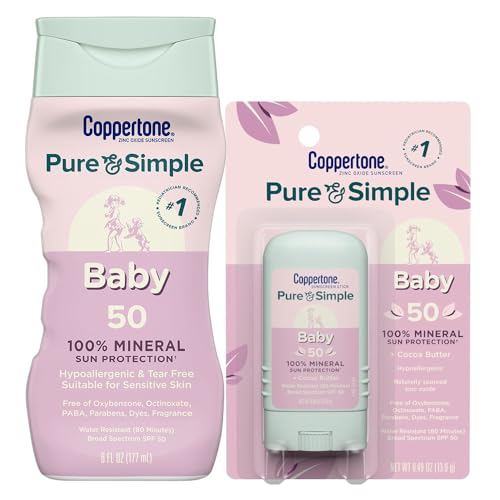
This two-piece set covers both body and face in one purchase.
This set pairs a 6 fluid ounce bottle of SPF 50 lotion for the body with a 0.49 ounce SPF 50 stick for the face, so you are never caught without the right format. The formula is made with 100% naturally sourced zinc oxide and is free of fragrance, oxybenzone, octinoxate, PABA, parabens, dyes, and phthalates — and the lotion is tear-free, which matters when it runs into little eyes.
Parents highlight the face stick as the standout piece, gliding on smoothly with minimal rubbing needed — a big improvement over last year’s drier version. The lotion is non-greasy and blends out with only a slight white cast, and families with 1.5-year-olds report no irritation or red spots.
Buyers suggest checking the expiration date when it arrives, since the bundle is sometimes fresher than individual bottles. On value, having both formats covered in one buy is the smart play for a first-time mineral sunscreen parent, and the 80-minute water resistance holds up in the pool.
What the Set Gives You
- Lotion covers the body, stick handles face touch-ups
- 100% naturally sourced zinc oxide in both
- Tear-free lotion for the inevitable eye-zone contact
Before You Buy
- Both parts need rubbing in to avoid white residue
- Check the expiration date on arrival since the set can sit in storage
The smart first buy: it covers every zone with two formats so you learn what works for your child before committing to a big bottle.
Look elsewhere if: you already own a body lotion and only need a face stick — the single stick above is cheaper.
5. Eucerin Sun Sensitive Mineral Baby Lotion SPF 50

This dermatologist-developed lotion is gentle enough that parents often use it on their own sensitive skin.
This one earns its place on texture alone: parents describe it as smooth, moisturizing, and non-oily, spreading easily across a toddler’s arms and face. The SPF 50 zinc oxide formula is developed with dermatologists, tear-free, fragrance-free, hypoallergenic, and contains no oil, dyes, parabens, PABA, phthalates, oxybenzone, or octinoxate.
A significant number of adults report buying this baby sunscreen for themselves because it is the only mineral formula that does not trigger breakouts on sensitive skin. The phrase “a little goes a long way” comes up repeatedly, which makes the 4 oz tube stretch further than its size suggests.
The 4 oz tube holds nearly the same volume as the Thinkbaby bottle above at 4 ounces, but the Eucerin base feels lighter and spreads more easily, so the white cast ends up milder than the thicker lotions. Families with truly reactive skin report it works wonders without irritation, and there is no intense scent to trigger a toddler’s nose.
Grab it if: your child’s skin reacts to heavier mineral pastes and you want a smooth, moisturizing lotion that doubles as an adult sunscreen.
Know this: it still leaves a slightly whiter finish than a chemical sunscreen, though customers note it is “not too white.”
6. Babo Botanicals Sensitive Baby Mineral Spray SPF 30

This non-aerosol spray covers a squirmy toddler’s entire body in seconds.
When your baby will not hold still for lotion, a spray is the escape hatch — and this one skips the aerosol canister, so there is no chemical propellant and no harsh mist to inhale. The zinc-based SPF 30 formula is fragrance-free, dermatologist-tested, and free of gluten, soy, dairy, peanut, almond, and walnut, making it among the most allergy-conscious sprays available.
Parents of fair-skinned kids report no burns even on the blondest children, and the formula rubs in without a sticky film. At 8 ounces it is the largest container on this list, giving you more coverage per purchase than the 3 oz roll-on above. The 80-minute water and sweat resistance holds up through pool sessions.
The honest downsides: it sprays thick and needs a real rub-down afterward, and opinions split on the nozzle — some find it sprays nicely, while a few report clogging. There is also a slight white layer left behind, though it is less than heavier lotions. For covering a full body fast, this is the format that wins.
The Upside
- 8 oz bottle covers a full body many times over
- Non-aerosol design means no propellant mist
- Rubs in without a white sticky film
The Trade-Off
- The spray comes out thick and requires extra rubbing
- Nozzle clogging is the most-discussed frustration
Choose it if: you need to sunscreen a whole child quickly and prefer an allergy-friendly formula with real coverage.
Pass if: you want a set-and-forget application — this one still demands a solid rub-in pass.
7. Raw Elements Baby & Kids SPF 30 Organic Stick

This 25% non-nano zinc stick offers zero-waste sun protection that eco-conscious families trust.
This is the highest zinc concentration on the list, with an active ingredient of 25% non-nano zinc oxide delivering SPF 30+ broad-spectrum coverage. The formula pairs organic calendula, chamomile, sunflower, and coconut to moisturize while protecting, and it is soy-free, gluten-free, and nut-free with no synthetic chemicals.
For the plastic-averse family, the packaging is recyclable and the formula is reef-safe, cruelty-free, and non-GMO. Parents report it goes on smoothly with very little product needed, stays put in water, and never stings the eyes — a huge win for face application. A tiny amount covers a lot, which helps justify the premium price point.
The texture is balmy and slightly oily, and opinions split on the effort to rub it in — it comes out of the tin thick. Some parents have found the trick: applying with a kabuki brush gives even coverage without the greasy feel. It has a mild organic scent that some describe as unusual but not unpleasant.
Best for: families who want maximum zinc (25%) and a certified organic, zero-waste formula they can use on faces without eye-sting drama.
Weigh this: it is premium-priced and balmier than lotions, so patience with rubbing is required.
8. California Baby Super Sensitive SPF 30+ Sunscreen

This titanium dioxide lotion has protected allergy-prone kids for over a decade.
This is the pick for the child who reacts to everything. The active ingredient is titanium dioxide (non-nano), a mineral filter that blocks both UVA and UVB rays, and the formula is allergy-tested and free of common allergens including gluten, soy, sesame, oat, dairy, peanuts, and tree nuts (except coconut). It is unscented, hypoallergenic, and pediatrician-recommended for babies 6-12 months and older.
Parents describe protection that lasts all day — one beach test in Florida with a wiggly toddler produced no burns and no allergic reactions. The formula is a physical barrier that does not absorb into the bloodstream the way chemical sunscreens do, which is exactly what parents with eczema-prone kids are looking for.
The consistent trade-off across a decade of reviews is texture: it is thick and requires extra rubbing time, staying white on the skin until fully worked in. It can transfer onto clothes, though it washes out. For a family that needs bulletproof allergy safety over convenience, this is the trusted stand-by.
Reach for it if: you need a fragrance-free, allergen-free formula for eczema or allergy-prone skin that genuinely lasts a full day.
Be ready for: the thick texture and the extra rubbing it demands — the price of that allergy safety.
9. Raw Love Baby Sunscreen SPF 35+
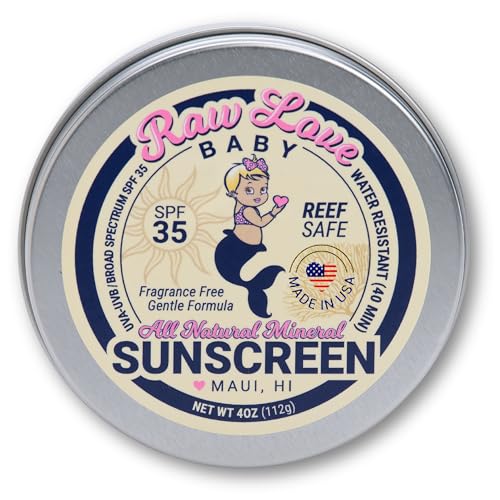
The only pick on this list explicitly labeled for the newborn stage, from 0-6 months and up.
For parents of a tiny baby, the age window on the label is the whole game. This one is explicitly safe for 0-6 months, 12-24 months, 24-48 months, and older, making it the most newborn-friendly option here. The SPF 35+ formula uses non-nano zinc oxide blended with organic coconut oil, shea butter, beeswax, jojoba oil, and vitamin E — ingredients simple enough that parents feel good about them.
Buyers describe a pleasant, natural scent, and note it is much easier to smooth on than thicker sunscreens they had tried. It is reef-safe, plastic-free in a tin container that is carry-on friendly for travel, and biodegradable. The 4 oz tin holds a solid amount for a newborn’s early months.
The honest limits: it is water-resistant for 40 minutes — half the 80-minute window of most other picks — so beach days need more frequent reapplication. It also takes elbow grease to rub in fully, and a hairy adult found it leaves a white cast. For a newborn who is only briefly in sun, the 40-minute window is rarely a real problem.
Why Parents Pick It
- Plastic-free tin is carry-on friendly and reef-safe
- Simple, clean ingredient list with organic butters and oils
The Limits
- Water resistance stops at 40 minutes, so reapply often
- Takes real effort to rub in completely
Choose it if: you have a newborn or young infant and want a clean-ingredient sunscreen with an explicit 0-6 month label.
Look elsewhere if: you are planning long pool days — the 40-minute water window will have you reapplying constantly.
Understanding the Specs
SPF Level and What It Really Does
SPF, or Sun Protection Factor, measures how well a sunscreen blocks UVB rays — the ones that cause sunburn. SPF 30 blocks roughly 97% of UVB rays, while SPF 50 blocks about 98%. The difference between 30 and 50 sounds tiny, but for a baby’s delicate skin, that extra 1% can matter on a long, bright day. What matters more than the number is applying a generous layer and reapplying on schedule.
Water Resistance: 40 vs 80 Minutes
This number tells you how long the sunscreen stays effective while your child is swimming or sweating. An 80-minute rating means one application covers nearly an hour and a half of pool time, while a 40-minute rating cuts that in half. Either way, you must reapply immediately after towel drying, because the towel wipes off the protection along with the water.
The White Cast Explained
Mineral sunscreens leave a whitish film on skin because zinc oxide and titanium dioxide are physical blockers — they sit on top of the skin to reflect rays. The thicker the formula, the more visible the cast. “Clear zinc” is ground into finer particles to reduce whiteness, while non-nano zinc keeps larger particles for safety but shows up more on the skin.
Format: Roll-On vs Spray vs Stick
Each format solves a different problem. Roll-ons glide fast over limbs but need a rub-in pass. Sprays cover large areas quickly but come out thick and can clog. Sticks are precise for faces and ears, and older kids can apply them alone. Lotions give the most even coverage but take the longest. Match the format to how patient your child is feeling that day.
FAQ
At what age can I use mineral sunscreen on my baby?
What is the difference between zinc oxide and titanium dioxide?
Is a higher SPF always better for my baby?
How often do I need to reapply sunscreen on my baby?
How do I get rid of the white cast from mineral sunscreen?
Which is better for a wiggly toddler: roll-on, spray, or stick?
Are these sunscreens safe for the ocean and reefs?
Can my baby with eczema or allergies use these?
Final Thoughts: The Verdict
For most families, the best baby mineral sunscreen is the Sun Bum Baby Bum Roll-On because it removes the biggest daily fight: getting a wiggly child to sit still for application. If you want the cleanest possible ingredient list and do not mind a thicker rub, the Thinkbaby Lotion is the trusted value pick. And for the fastest full-body coverage on a beach day, reach for the Babo Botanicals Spray. All three protect with mineral filters — the only real question is which format your child will tolerate long enough to get the job done.
How We Picked
We do not accept paid placement. Every pick is matched to a real buyer and a real use-case; we do not hands-on test units.
Sources & Methodology
Specifications: manufacturer listings and product documentation. Review insights: verified customer reviews, as of August 2026. Pricing: not shown on this page (it changes often); check the current price via the retailer link.
As an Amazon Associate, Gadgets Feed earns from qualifying purchases. This does not affect which products we feature.