
Our readers keep the lights on and my morning glass full of iced black tea. As an Amazon Associate, I earn from qualifying purchases.
Specs are compiled from manufacturer listings and verified buyer reviews and can change over time — please confirm the key details on the product page before buying.
You want a toy that survives the patio and actually holds your baby’s attention past the first afternoon. Two things decide that in this category: whether it works without batteries, and whether the moving parts are built for a child who still mouths everything. The picks below cover both, from a squishy sensory garden to a 3-foot beginner slide that folds flat for storage.
I’m Min — the founder and writer behind Gadgets Feed. This guide is built by comparing the manufacturers’ published specifications and the patterns across verified customer reviews, so you get each pick’s real strengths and trade-offs instead of marketing spin.
Start with the age band and the power source, because those two filters remove most of the wrong choices instantly. Every pick here is rated for indoor and outdoor use and lands in the 18-month-and-up range or lower, which tells you how much supervision each one needs. Here are the strongest picks in baby outdoor toys.
Our Picks at a Glance


How To Choose The Best Baby Outdoor Toys
A toy that lives outside gets dropped on paving, dragged through grass, and chewed on by a child with no teeth yet. That combination rules out plenty of toys that look fine on a shelf. Four filters do almost all the work.
Power source: batteries or nothing at all
Mechanical toys make their own sound and motion from the child’s push or pull, so they never die mid-afternoon and never need a screwdriver to open a battery door. The Little Tikes mower runs entirely on mechanical sound — beads pop as it rolls and a pull cord produces the engine noise. Battery toys like the Fisher-Price lantern add lights and songs, but they need cells to do it. Neither is wrong; just know which one you are signing up to maintain.
Age band and what it tells you about supervision
A 6-months-and-up rating usually means the toy is meant for a baby sitting or lying down, reaching and grabbing — the hahaland garden sits in that bracket. An 18-months-and-up rating means the child is walking and pushing, which brings tipping and falling into play. The Little Tikes slide and the mower both start at 18 months for exactly that reason. Match the band to what your child can physically do today, not what they will do next summer.
Storage footprint before you buy
Outdoor toys get big fast. A pop-up tunnel with a steel spring frame collapses flat and ships with a carry bag; a folding slide drops down without tools. The tunnel at 70.87 inches long is the biggest item on this list, so check whether it folds to something that fits behind a door. The balance bikes and the inflatable hopper take up floor space year-round, so those are the ones to think about hardest.
Safety markings worth checking
ASTM certification on a fabric toy means it has been tested against a published safety standard — the tunnel and the Bobike balance bike both carry that reference in their listings. The balance bikes also list a 135° steering limit, a physical stop that keeps the front wheel from swinging far enough to tip the child sideways. Those design details matter more outdoors, where the ground is uneven.
Quick Comparison
| Model | Best For | Age Range | Power Source | Indoor/Outdoor | Amazon |
|---|---|---|---|---|---|
| hahaland Sensory Garden Plush★ Best Overall | Sit-and-touch sensory play | 6 months – 3 years | Mechanical (squeaker, rattle, crinkle) | Indoor, Outdoor | Amazon |
| Fisher-Price Laugh and Learn LanternCamp Play Pick | Pretend camp play with lights and songs | 6 months – 3 years | Batteries (lights and music) | Indoor, Outdoor | Amazon |
| Kids Play Tunnel (Rainbow)Longest Crawl Run | Long crawl runs for bigger toddlers | 36 months – 10 years | None (pop-up frame) | Indoor, Outdoor | Amazon |
| Tiny Land Play Tunnel | Small-yard crawling with mesh airflow | 36 months – 10 years | None (pop-up frame) | Indoor, Outdoor | Amazon |
| Little Tikes Gas ‘n Go Mower | Walkers who want to push something | 18 months – 8 years | Mechanical (no batteries) | Indoor, Outdoor | Amazon |
| Little Tikes First Slide | First real climbing and sliding | 18 months – 6 years | None | Indoor, Outdoor | Amazon |
| Bouncy Pals Cow Hopper | Active bouncing energy burn | 18 months and up | None (air-inflated) | Indoor, Outdoor | Amazon |
| Bobike Baby Balance Bike | Early balance and steering practice | 12 – 36 months | None | Indoor, Outdoor | Amazon |
| Doselie Light-Up Balance Bike | Glowing wheels plus music on the move | 12 – 24 months | Glow wheels (self-powered), batteries for headlight | Indoor, Outdoor | Amazon |
In‑Depth Reviews
1. hahaland Baby Toys 6-12 Months Sensory Garden Plush
Our pick — 4.5+★ from 850+ verified ratings; the strongest balance of quality and price.
Eleven soft pieces that make noise, crinkle, and show a face back — no batteries anywhere.
It arrives as an 11-piece garden — plush flowers, fruit, and vegetables — and each one hides a different payoff: a squeaker, a rattle, crinkle fabric, or rich texture. A baby-safe mirror lets your child spot their own face, and each plush piece wears a friendly expression to match.
The carrying box does more work than it first appears to. It holds every piece tidy, the farm lid flips over into a play scene, and there is no compression packaging to fight through — you open the box and play. At 0.42 kg for the whole set, it slips into a diaper bag or a car seat pocket without weighing you down. Compare that to the Tiny Land tunnel at 0.86 kg, and you get a sense of how genuinely light this one is. At 0.42 kg, it goes to a park or a grandmother’s patio without weighing down the diaper bag.
What wins people over is how often the 11 plush pieces come back out of the toy bin. The farm theme and the mirrored faces keep a 6-month-old busy, and because the pieces are plush with no small parts, you are not chasing loose bits across the grass. The honest catch is a fabric toy outdoors: grass, dirt, and damp will find their way into plush, and this one is not a hose-off item. Treat it as a picnic-blanket toy, not a sandbox toy, and it will last.
Where it earns its place
- 11 separate pieces, each with its own sound or texture, so the novelty rotates
- 0.42 kg for the full set — light enough to carry to the park
- Storage box doubles as a play scene, with no compression packaging
- No small parts and no batteries — nothing to lose, nothing to replace
What to plan around
- Plush fabric does not clean up well from mud or sand
- Rated 6 months to 3 years, so it ages out sooner than the ride-on picks
- The crinkle is audible — great for the baby, less great on a car ride
Best fit: babies from 6 months who are reaching, grabbing, and mouthing everything — and parents who want zero battery maintenance.
Look elsewhere if: you need something that survives a wet sandbox; a wipe-clean plastic toy suits that better.
2. Fisher-Price Laugh and Learn Camping Fun Lantern
A pretend lantern small enough to carry one-handed and loud enough to become the car-ride favorite.
This one is 9.45 inches tall and 1.1 pounds — small enough for a toddler to hook a finger through the handle and haul it around the yard. It has two modes. Lights Only gives you multiple color options with no sound, which is the mode to use when you want a calm evening on the patio. Learning Mode adds music and phrases that introduce colors, opposites, counting, and animals.
The hands-on part is what keeps it in rotation. Spin the dial or press down on the pop-up top and the lights and music fire. That is a cause-and-effect loop a baby can repeat hundreds of times without getting bored, and it builds the same fine-motor grip a child needs for turning pages and stacking blocks. The songs match the camping theme, and the take-along handle is why it gets carried from room to yard and back.
Because it is motorized, it lives or dies by its batteries — the one maintenance chore here that the plush garden next to it never asks for. It also makes noise on demand, and the pop-up top invites repeated bashing, so expect the volume to be a background feature of your afternoons rather than a treat.
Where it shines: the two-mode switch is the smartest thing here — lights-only for quiet play, full learning mode when you want the child occupied and engaged.
Worth knowing: at 4.82 x 4.86 x 9.45 inches it is a compact handheld, not a floor toy, so it works best as a carry-along rather than a centerpiece.
Buy it when: you want one small toy that travels well and teaches colors and counting without a screen.
Think twice if: you are avoiding battery toys or you want something silent for a shared outdoor space.
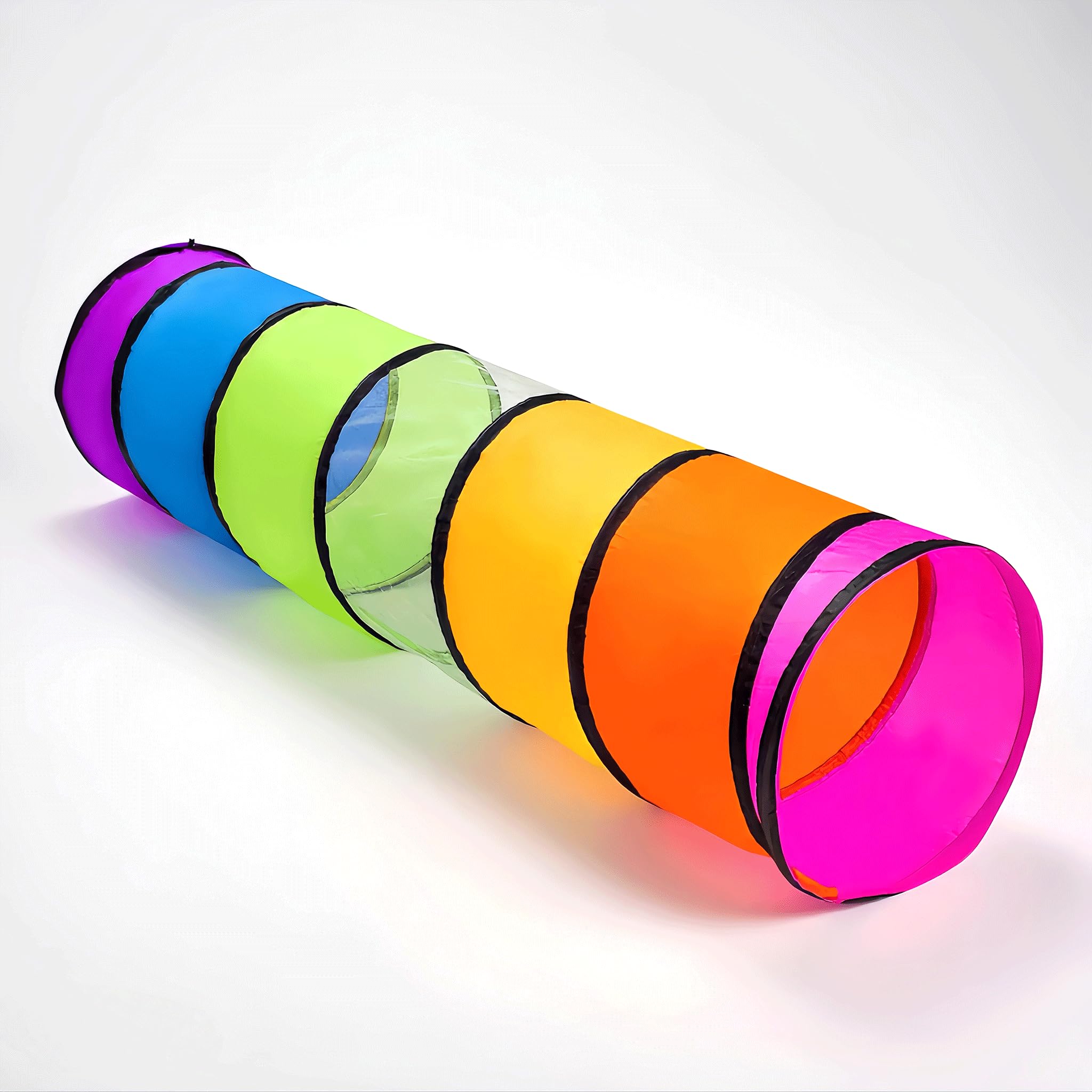
3. Kids Play Tunnel for Toddlers, Pop Up Crawl Through Tunnel (Rainbow)
Nearly six feet of rainbow tube — long enough for an adult to crawl through after a toddler.
At 70.87 inches long, this is the longest tunnel here by a wide margin, and it is sized so a grown-up can follow a child in. Compare it to the Fisher-Price lantern at 9.45 inches tall and the scale gap is obvious — this is a yard toy, not a shelf toy. The steel spring frame means it springs into shape the moment you pull it from the bag, and it folds flat again when playtime ends.
The fabric is a polycotton blend with rounded corners and reinforced stitching, and the listing states ASTM certification and a hypoallergenic material. It bends into different shapes, so it can run straight across a lawn or curve around a tree. Crawling through it works the motor skills and the direction judgment a toddler is building right now, and hiding inside it adds a chase game on top. The same tube works for cats and dogs, which is why so many of these end up doing double duty.
The practical catch is storage and grip. A 70.87-inch tube takes real floor space while it is open, and spring-loaded fabric wants to snap back while you fold it — the fold takes a couple of tries the first time. It is also the biggest item on this list, so it suits a yard or a long hallway far better than a small apartment.
The case for this tunnel
- 70.87 inches long — a genuine crawl-through, not a short pop-up
- Pops into shape from the bag and folds flat after play
- Bends into curved and straight runs to fit the space
- Works for toddlers and pets alike
What you give up
- The longest footprint on this list while open
- Spring frame takes a couple of attempts to fold the first time
- Rated 36 months and up, so it is not a baby-stage toy
Made for: backyards and long hallways where a toddler can burn energy crawling and chasing.
Not the one for: a baby under three, or a room where you cannot spare six feet of floor.
4. Tiny Land Kids Play Tunnel with Storage Bag

Mesh panels on the sides so a crawling toddler stays cool and you can see them the whole way through.
Your child stays cool and visible inside this tunnel, because breathable mesh (a see-through fabric that lets air pass) runs along the sides of a 68 x 18 inch tunnel. On a warm afternoon, a crawling child does not end up in a stuffy tube, and you can spot them through the fabric instead of guessing. The shell is a peach-skin polyester, soft to the touch. A steel alloy spring frame (a metal coil that holds the shape) pops open on its own and folds back compact. A carry bag comes in the box.
Against the rainbow tunnel, this one is shorter — 69 inches of length versus the other’s 70.87 — but considerably lighter at 0.86 kg, and the mesh makes it the better choice for hot days. The blue color with star detailing is the quieter-looking design of the two tunnels, so it can stay set up in a living room. ASTM certification is listed here too.
Two things get mixed reactions, so size them honestly before you buy. The tunnel size suits babies and toddlers under three very well. The foldability is genuinely quick once you learn the motion, but the snap-back on a spring frame catches people out the first time, so keep your face clear when it collapses. This is a fair-value pop-up tunnel rather than a heavy-duty one. That suits backyard play, but not a permanent outdoor fixture in the rain.
Why the mesh matters: ventilation is the difference between a tunnel a toddler happily crawls through on a July afternoon and one that gets abandoned after one pass.
The trade-off: thin pop-up fabric keeps the weight at 0.86 kg, so this is a bring-it-out, put-it-away toy rather than something that stays pitched outside.
Reach for this if: you want a lighter, cooler tunnel that looks tidy enough to leave set up indoors.
Go a different way if: you need the longest possible crawl run or a tunnel rated for older kids.
5. Little Tikes Gas ‘n Go Mower

Push it and the beads pop, pull the cord and it roars — and it never needs a single battery.
Everything this mower does, it does mechanically. Push it across the grass and beads pop inside. Pull the cord and you get an engine sound. There is a clicking key and a moveable throttle, plus a removable plastic gas can that comes out and goes back in — the kind of small errand a toddler will repeat for twenty minutes. Nothing here runs on cells, so there is no battery door, no dying song, and no mid-afternoon stop.
That makes it a natural fit for 18-month-olds learning to push and walk. At 1.88 kg it has enough substance to feel like a real push-toy without being heavy enough to fight, and the 18-months-and-up rating lines up with the stage where a child wants to push something around a patio. Little Tikes builds this in plastic, and the reviews back the durability — it is the kind of toy that gets handed down rather than replaced.
Two honest notes. The engine sound is mechanical and loud enough that some households find it a lot, and the size splits opinion — some find it perfectly scaled for a two-year-old, others expect a bigger mower. Neither is a flaw exactly; it is a question of your patio and your patience. If you want a quiet toy, this is not it.
Why it keeps earning patio time
- Zero batteries — beads, pull cord, key, and throttle all run mechanically
- 1.88 kg gives beginning walkers something stable to push
- Removable gas can adds a repeatable little task
- Plastic build rated 18 months to 8 years, so it grows with the child
Before you commit
- The engine sound is loud and repetitive
- Size draws split reactions — small for some two-year-olds
- One fixed shape, so it takes floor or patio space year-round
The right call for: a walking toddler who wants to push something around while you garden, with no batteries to feed.
Pass on it if: noise is a deal for your household or you expect a mower sized closer to a real one.
6. Little Tikes First Slide
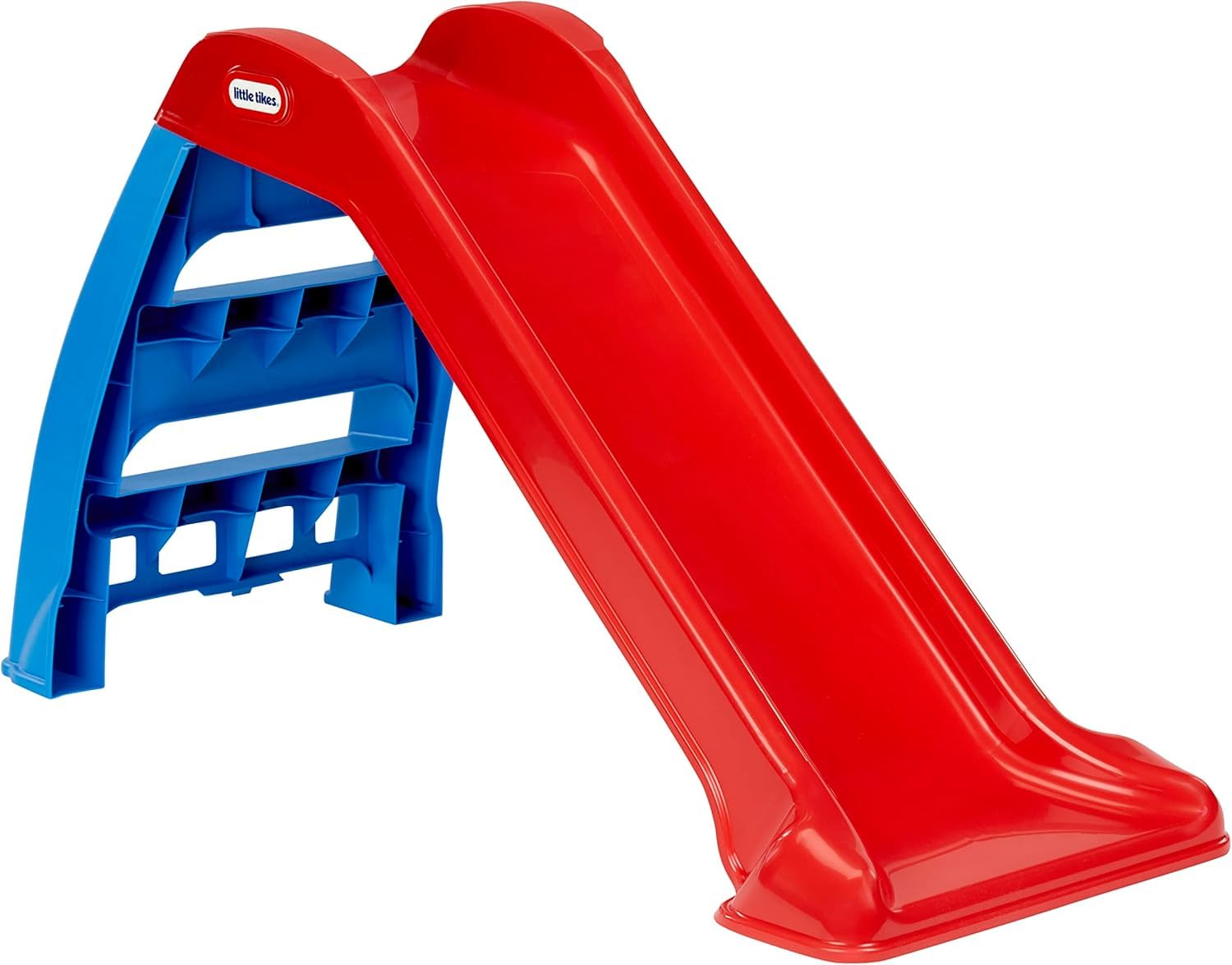
A three-foot beginner slide that folds flat with no tools and holds up to 60 pounds.
The numbers that decide this one are the slide length and the weight rating. It runs 38 inches of slide on a frame measuring 39 L x 18 W x 23 H inches, holds up to 60 pounds, and is rated 18 months to 6 years. That is a genuine beginner’s slide — low enough that a toddler can climb the steps alone, and wide enough at 18 inches that two small children can share the base without shoving.
Setup is the second reason it works. Assembly needs no tools, and it folds down flat for storage when the yard is done for the day — a real advantage for anyone with a small patio or a shared garden. It is built in the USA from plastic by Little Tikes, and it switches between indoor and outdoor use without complaint, so a rainy afternoon just moves the slide into the living room.
The recurring gripe, and the thing to watch, is the handles — they do not always stay seated in place, and a couple of owners have found the stability less solid than they wanted on uneven ground. Neither is a reason to rule it out; put it on level grass or a flat patio and it behaves. What wins people over is that a toddler actually slides down it — the first-slide confidence is the whole point, and the 23-inch height lets a small child climb and slide alone.
The practical read: 60 pounds of capacity over an 18-months-to-6-years band means one slide covers several years of a child’s growth, not one summer.
Set it up right: level ground keeps the base planted; the folding mechanism is the reason it can live indoors as easily as out.
Suits you if: you want a first climbing challenge your toddler can conquer alone, and you need it to fold away afterward.
Probably not if: your yard is sloped — the handle-seating and stability are the two things that get flagged.
7. Bouncy Pals Toddler Cow Hopper Toy

Grab the long ears, hop, and let the plush cover take the abuse.
Bouncing is the oldest toddler workout there is, and this inflatable hopper is built around it. It is an air-filled toy under a removable plush cover, 16 x 10 x 19 inches and 3 pounds, rated for 18 months and up. Inflating it takes about a minute: pop out the white air stopper, push in the pump tip, fill until the cover sits taut, and press the stopper back. The long ears double as handlebars.
Two details make it worth the space. The plush cover lifts off for washing, which is the difference between a toy that survives a muddy yard and one that does not. And the air-filled body shrugs off the kind of landing a toddler delivers — it is the toy that absorbs the abuse rather than the child. Eight animal styles are offered, including zebra, unicorn, fox, and dragon, so it can be picked to match a nursery or a mood.
The compromise is that it is a bouncer: it needs a firm, flat surface to hop well, and on soft grass or gravel it gets wobbly and the hopping stops being fun. It also takes up floor space between sessions and adds a pump to your life, though the one-minute inflation is genuinely quick. As a birthday or holiday present, the removable washable cover lands well with parents.
What makes it work
- Removable plush cover washes clean after outdoor play
- Inflates in about a minute and deflates flat for storage
- 3 pounds of air-filled body that soaks up toddler landings
- Eight animal styles to choose from
Where it falls short
- Needs a firm, flat surface — soft grass makes it wobbly
- Requires a pump you may not already own
- One rider at a time, so it is not a share toy for siblings
Go for it when: you want an outdoor energy burner that handles a muddy landing and cleans up afterward.
Not for you if: your yard is all soft grass or gravel — bouncers need something solid underfoot.
8. Bobike Baby Balance Bike

Four closed wheels and a 135° steering stop — the training-wheels version of a balance bike.
Most balance bikes put a child on two wheels and let them figure it out. This one takes a gentler route: four closed, non-slip wheels, a strong steel frame, and a 135° steering limit designed to stop a side fall or a foot caught in the wheel. It is rated 12 to 36 months, so it catches children before they are ready for a two-wheeler, and it is certified to ASTM F963-11 and EN71.
Assembly takes a few minutes with the included tool kit, and no sophisticated tools are needed — the frame arrives essentially ready to bolt together. The closed-wheel design is the safety story in one detail: no spokes, no gaps for a foot, nothing to catch. It is meant for paved roads and unpaved trails, and it works inside a house as easily as out, with an adult guiding the first rides.
The trade-off is age span. At 12 to 36 months this is a short window compared to a slide that runs to six years, and once a child outgrows it, it goes to the next toddler rather than staying in the family. It is also a first-bike tool rather than a thrill ride — the focus is balance and steering, so a child who wants speed will outgrow it fast. For the confidence-building stage, though, the four-wheel footprint removes the fear entirely.
Why the four-wheel layout works: the closed wheels and 135° steering limit mean the bike will not tip sideways the way a two-wheeler can, so a first-timer gets moving without a wobble.
The size of the offering: perfect for that 12-to-36-month window, then ready to hand down.
Pick this for: a one-to-three-year-old taking their first balance steps on pavement or a flat patio.
Skip it when: your child is already past three or already riding two wheels — this is a starting point, not a progression.
9. Doselie Baby Balance Bike with Glow Wheels

Four wheels that light up as they roll — no batteries needed for the glow, just motion.
The wheels on this bike make their own light. As they rotate, the four colorful wheels light up, with no extra energy supply required — the rolling does the work. A headlight on the front adds a bit of evening visibility, though that part does need batteries. It is rated for 12 to 24 months, so it catches the very first riders.
The sound side adds a second layer. Five songs and five cute animal sounds sit on a tail button, and the music is there to coax a reluctant baby into moving. Combined with the motion, it is a bike that pulls a child forward rather than waiting for them to decide. Safety details are built in too: a 135° turning limit stops side falls, the low center of gravity and self-balancing design fight tipping, and the wide grippy tires stay planted. Assembly takes four steps, with a self-locking buckle and screws that double-lock the wheels.
Where this one gives ground to the Bobike is the age ceiling — 12 to 24 months is a narrower window than the Bobike’s 12 to 36, and the music-and-light package is aimed at the youngest riders. If your child is already confident on a ride-on, the glowing wheels will feel like a step back rather than forward. But for a first birthday present meant to get a 12-month-old moving, the glow wheels and five songs do real work.
What earns its attention
- Self-powered glow wheels — the rolling motion makes the light
- Five songs and five animal sounds to get a reluctant rider moving
- 135° steering limit and low center of gravity fight tipping
- Four-step assembly with double-locking wheel screws
Where it holds back
- Rated 12 to 24 months — a short riding window
- The headlight needs batteries even though the wheels do not
- Five songs on a tail button is a lot of repetition for parents
Made for: a first birthday gift for a baby who needs coaxing to move — the glow and songs do the encouraging.
Be honest about: the 24-month ceiling; a two-year-old will be ready for the Bobike’s longer 36-month range.
Understanding the Specs
Age band (what it actually tells you)
The age range on the box is a rough guide to what a child can physically do, not a rule. A 6-month-to-3-year rating means the toy is built for a baby who sits, reaches, and mouths — the hahaland garden and the Fisher-Price lantern both fit that. An 18-months-and-up rating means walking and pushing, which brings tipping into play. Check the band against your child’s stage today, because a toy a toddler cannot use yet just takes up space.
Power source (mechanical vs battery)
A mechanical toy makes its own sound and motion from the child’s action — beads that pop when pushed, a pull cord that roars, crinkle fabric that responds to a squeeze. Nothing runs out. A battery toy lights up and plays songs, but needs cells and a screwdriver to change them, and the glow on the Doselie wheels is a nice middle case: self-powered by rotation, with only the headlight needing batteries.
Safety certifications on the label
ASTM certification (a published US safety standard the toy has been tested against) tells you the toy met a known benchmark, and both the tunnel and the Bobike balance bike reference it. The Bobike also lists EN71, the European equivalent. On moving toys, look for physical limits too. A 135° steering stop on a balance bike keeps the bars from swinging too far. Closed wheels with no spokes keep a foot from catching. A weight rating on a slide tells you how much it holds. All three help keep a child from tipping or catching a foot.
Storage and footprint
A pop-up tunnel with a steel spring frame folds flat and ships with a bag; the Little Tikes slide drops down without tools. Those two fold away. The mower, the hopper, and both balance bikes hold their shape all year, so they take permanent floor or patio space. Measure the spot before you commit, and think about whether the toy lives inside, outside, or gets carried to the park — that decides whether weight and a carry bag matter.
FAQ
Can I use a fabric play tunnel on wet grass?
What age can a baby start using a balance bike?
Do the glow wheels on a balance bike need batteries?
How long does the Little Tikes slide take to set up?
Is a mechanical push mower better than a battery-powered toy?
Can a toddler use the cow hopper on grass?
What does the 135 degree steering limit actually do?
How do I clean plush outdoor toys like the sensory garden?
How much weight can a beginner toddler slide hold?
Do I need a pump for the inflatable hopper?
Final Thoughts: The Verdict
For most families, the winner is the hahaland Sensory Garden because it needs no batteries, fits a 6-month-old’s hands today, and travels at 0.42 kg without dragging a bag down. If your priority is a toddler burning energy in the yard, the Little Tikes First Slide gives you a 3-foot slide that folds flat and holds up to 60 pounds. And for a first birthday gift that gets a baby moving, reach for the Doselie balance bike with its self-powered glow wheels.
One last nudge: the strongest-rated pick on this list is the Fisher-Price lantern. Grab it if you want lights and songs in a toy small enough to carry, and just keep batteries on hand.
How We Picked
We do not accept paid placement. Every pick is matched to a real buyer and a real use-case; we do not hands-on test units.
Sources & Methodology
Specifications: manufacturer listings and product documentation. Review insights: verified customer reviews, as of November 2026. Pricing: not shown on this page (it changes often); check the current price via the retailer link.
As an Amazon Associate, Gadgets Feed earns from qualifying purchases. This does not affect which products we feature.