
Our readers keep the lights on and my morning glass full of iced black tea. As an Amazon Associate, I earn from qualifying purchases.
Specs are compiled from manufacturer listings and verified buyer reviews and can change over time — please confirm the key details on the product page before buying.
A baby oxygen monitor tracks blood oxygen and pulse rate while your little one sleeps, turning anxious guesswork into a clear number on a screen. A baby oxygen monitor — a device that tracks blood oxygen and pulse rate while your little one sleeps or rests — turns that guesswork into a number on a screen. Below are six picks for home use, ranging from simple fingertip spot-checkers to a full wearable sock system, each matched to how you actually plan to use it.
I’m Min — the founder and writer behind Gadgets Feed. This guide is built by comparing the manufacturers’ published specifications and the patterns across verified customer reviews, so you get each pick’s real strengths and trade-offs instead of marketing spin.
If you are weighing options for your nursery bag, this honest rundown of the best baby oxygen monitor options separates true 24/7 wearables from bedside spot-check tools.
Our Picks at a Glance
How To Choose The Best Baby Oxygen Monitor
Before you pick a brand, decide how you will use it: do you need a quick check now and then, or something that watches all night? A fingertip pulse oximeter (a small clip that measures oxygen in your blood) gives you a single reading when you put it on. A wearable or a handheld with a wrap probe can track for hours and sound an alarm if oxygen or pulse drops. That one choice cuts your options in half.
Look at the probe, not just the screen
Babies do not have adult-sized fingers, and most fingertip clips cannot grip them. For infants, you want a soft wrap probe that goes around a toe or foot, or you need a fingertip model explicitly designed for smaller digits. Several pediatric models even suggest measuring the big toe for children under two, since the blood flow and fit are more reliable there.
Decide when you will rely on the alarm
A spot-check monitor helps you feel better at a single moment. But if you want reassurance through the night — or while your child sleeps with a cold — you want continuous monitoring with adjustable alarms. Check that the alarm can be muted or set to your own thresholds, because some parents want quiet visual alerts rather than a loud beep beside the crib.
Quick Comparison
| Model | Best For | Probe Style | SpO2 Range | Key Feature | Amazon |
|---|---|---|---|---|---|
| Pediatric OLED Fingertip★ Best Overall | Quick checks on small fingers | Fingertip clip | 70-100% | Battery compartment lock | Amazon |
| YOUYME Handheld WrapBest Value | Full-family monitoring | Soft wrap probe | 0-100% | Respiration rate tracking | Amazon |
| YOUYME Continuous HD | Overnight home checks | Wrap sensor | 70-100% | Large 2.4-inch screen | Amazon |
| Manhero Overnight Pro | Trend tracking with dual probes | Wrap + finger probes | 70-100% | 500 record data storage | Amazon |
| Manhero Overnight Fingertip | Whole family overnight use | Fingertip sensor | 70-99% | 9-level adjustable brightness | Amazon |
| Owlet Dream Sock | Continuous smart alerts on your phone | Wearable fabric sock | — | Phone + base station alerts | Amazon |
In‑Depth Reviews
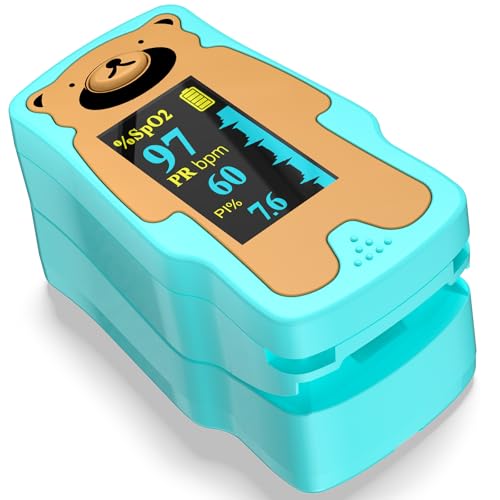
1. Pediatric Pulse Oximeter, OLED Display Fingertip
Our pick — over 4★ from 100+ verified ratings; the strongest balance of quality and price.
A child-proof fingertip clip for asthma-wary parents who want fast spot-checks on small digits.
Made for children over age two, it fits smaller fingers, and the brand suggests measuring the big toe for children aged one to two for the most accurate result. The intelligent algorithm — the software that translates the light signal into a number — is tuned to children’s blood flow, so readings come in as little as 3 seconds. When the finger is removed, it shuts down on its own 10 seconds later, which spares the batteries (rated for 12 months on two included AAA cells).
Parents praise its child-friendly design and the included carrying bag for portability., with several noting it is a great pick for kids with asthma who need regular checks. One household even bought it after COVID swept through a family of seven. The standout safety touch is the battery compartment with four locking positions — a real detail that stops little hands from popping it open and reaching the batteries.
The honest catch: this is a spot-check tool, not a wearable, and the mixed owner feedback on the alarm function suggests you should verify the clip’s fit on your child before relying on continuous features. The functionality reviews are split — some units simply fail to read or refuse to turn off without battery removal.
Best at: Lightning-fast fingertip checks with a spring-clip that stays put and an OLED readout that shows SpO2, pulse rate, and pulse intensity.
Needs care: Quality control appears inconsistent, so test yours right away and know the return process before you need it.
Reach for this if: you want an inexpensive, portable spot-checker for a toddler or older child with smaller fingers and a need for frequent readings.
Look elsewhere if: you need all-night continuous alerts — this is a clip-on check, not a sleep monitor, and a defective unit would need a quick return.
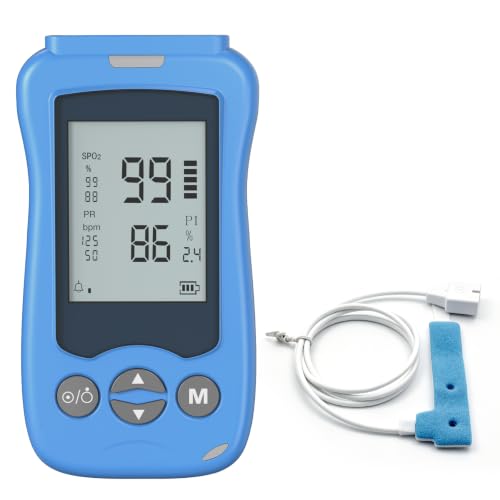
2. YOUYME Handheld Fingertip Pulse Oximeter with Soft Wrap Probe
A mom-proven handheld with a separate wrap sensor that tracks breathing rate along with oxygen and pulse.
Parents report feeling reassured and at ease with this device during their baby’s illnesses. — one mom called it “a must have” that reassures her every time her baby is sick, and she praised how simple it is to use and read. The separate soft wrap probe (a padded band that goes around the foot) fits tiny feet better than a fingertip clip. It measures oxygen saturation (SpO2, the percentage of oxygen in your blood) from 0-100% with a tolerance of ±2%, and pulse rate from 25-250 bpm (beats per minute), so you get accurate numbers even on a restless infant.
It goes beyond most rivals by also measuring respiration rate — the number of breaths per minute — which is a useful extra during a respiratory illness. The 2.4-inch HD LCD screen stays readable in low light, and the alarm can be fully muted while lights and text still flash for quiet nighttime checks. It runs on AAA batteries, matching the portable intent of the design.
The honest trade-offs are physical. The wired Velcro fingertip sensor has about a 2-foot cable and there is no belt clip, which makes it fiddly for quick checks while you move around. Several owners say it is best for a calm, seated child or one with limited mobility, not a wiggly toddler mid-play.
What wins over parents
- Separate wrap probe fits tiny toes far better than a rigid clip
- Adds respiration rate — a metric most fingertip units skip
- Audio can be muted while visual alerts stay on for quiet nights
Who it fights with
- The wired sensor and its ~2-foot cable are awkward for active spot-checks
- Build quality has drawn sharp criticism, including a battery cover that falls off
Best for: a parent who wants one handheld unit that works for baby, toddler, and adult checks, with breathing rate included in the readout.
Consider twice if: you need constant on-the-go spot-checks; the cable-free fingertip style above is easier to grab in a hurry.
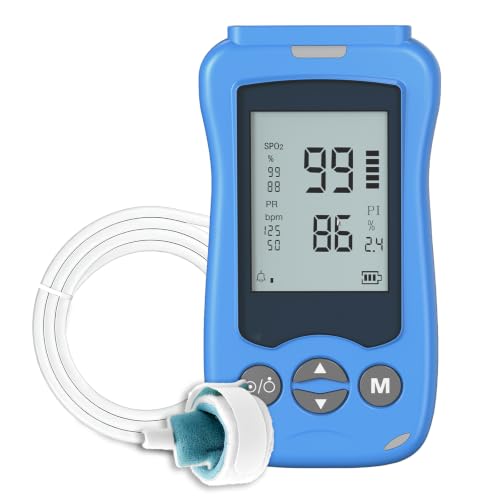
3. Portable Handheld Pulse Oximeter for Home Use
A medical-grade handheld that shines as a first-aid-kit staple for the whole family.
This sibling to the unit above shares the YOUYME handheld DNA: a wrap sensor that reads in 8-10 seconds, a large 2.4-inch HD display, and customizable limits for both SpO2 and heart rate. What earns it the home-essential spot is how owners describe it — a handy item for a household first-aid kit that fits infants through adults, with readings that match what a doctor’s office shows.
Continuous monitoring through the night is the draw here, with bright visual alerts, an adjustable audio alarm, and on-screen text prompts when a reading goes out of range. The audio side can be muted while the visual and text warnings keep working, which is the quiet-monitoring feature that matters beside a sleeping baby. It runs on 3 AAA batteries.
The recurring criticism is that the wrap probe is flimsy and tricky to manage one-handed, and the manual can be confusing until you figure it out. It is best as an assisted-use device — a parent or caregiver positioning the sensor — rather than something a child self-applies.
Why it earns a kit slot: stable, repeatable readings that owners trust against clinical results, in a durable plastic body with a screen large enough to read across a room.
How it behaves: Expect a learning curve — once the wrap position and controls click, the alarm setup becomes straightforward.
Reach for this if: you want a single reliable monitor for the medicine cabinet that covers everyone from the newborn up to grandparents.
Think twice if: you will only ever need a quick clip-on reading; the wrap sensor adds setup time a simple fingertip model skips.
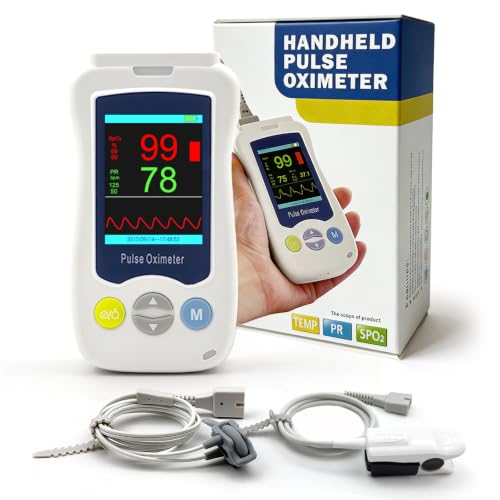
4. Manhero Overnight Pulse Oximeter with 500 Data Storage
The trend-tracker that stores 500 records and logs 24 full hours of overnight oxygen data.
Where most monitors show you a number and forget it, this Manhero unit remembers. It holds 500 spot-check records plus 24 hours of overnight logs — enough to spot a pattern across nights rather than a single reading. The accuracy is tight at ±1% for SpO2 readings across a 70-100% range, which is the kind of tolerance parents cite when they trust a device for ongoing care.
It ships with two specialized probes — one for adults and one for infants — so the same base unit covers the nursery and the parents. The infant probe sits against the foot with an adjustable strap designed to stay put even during restless sleep, and there is a secure strap for older users too. Power comes from 3 AAA batteries, though you can also plug it in directly for long overnight sessions.
The caveats are practical. Buyers report the 3 AAA batteries last only 6-7 hours on low brightness, and the unit loses the date when you swap batteries. One parent found the infant foot probe slides off a restless baby’s foot, so the strap fit is worth testing on your own child before you depend on it.
Standout trait: the 24-hour overnight log with adjustable safe SpO2 levels turns a single anxious night into a view of the whole week’s trends.
Watch out: battery appetite is real — keep spares nearby or run it wired for all-night use.
Best for: families who want to document oxygen trends over multiple nights and share that history with a pediatrician.
Not ideal if: your baby thrashes in sleep; the foot strap may need frequent re-securing to hold its position.
5. Manhero Continuous Pulse Oximeter Fingertip
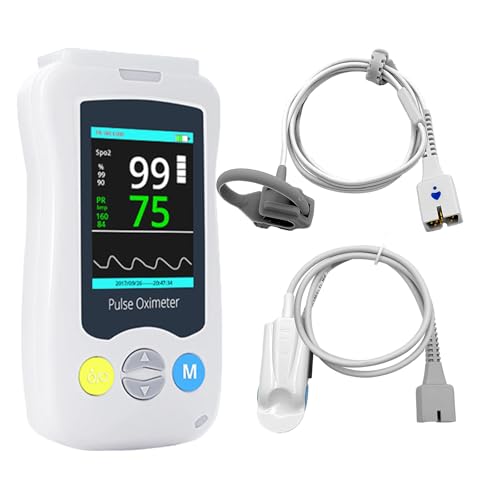
A 9-level brightness dial that keeps the numbers sharp in daylight and soft at night.
The screen is the story here. A 2.4-inch HD display with 9 brightness levels means you can read the SpO2 and heart rate clearly under strong daylight and dim it so it does not flood the nursery at 2 a.m. It is the flexible power supply, though, that makes it a true overnight companion — AAA batteries for portability, or a data cable for continuous all-night use without worrying about drain.
Sized for the whole family, it suits adults and children from 0 to 18 months, with a snug continuous-monitoring sensor designed to minimize measurement error. Accuracy lands at 2% for SpO2 across a 70-99% range and 1 bpm for heart rate across 30-240 bpm. If oxygen drops below 90% or heart rate falls under 50 bpm, an audible alarm fires immediately — and you can set your own thresholds freely.
The biggest frustration in the owner feedback is battery life, with several noting the batteries run flat after about 24 hours of use. The unit also needs your own micro USB cord for wired power, and at least one unit arrived without the promised accessories. The 500-set storage is a genuine plus for tracking trends over time.
Best at: giving a clear, adjustable readout at any hour, backed by 500 records of stored data for trend analysis.
Plan for: heavy battery use — owners consistently report running through the 3 AAA cells within about a day of continuous operation.
Reach for this if: you need a bright, readable screen in varied lighting and plan to keep it plugged in most nights.
Look elsewhere if: you want a self-contained wireless unit; this one leans on a cable for practical all-night use.
6. Owlet Dream Sock Smart Baby Monitor

The sock that texts you — a 16-hour wearable that pings your phone when oxygen or pulse leaves the safe zone.
This works unlike any device above: a fabric sock wraps around your baby’s foot and tracks pulse and oxygen nonstop, then alerts both a Base Station (a small bedside receiver) and your phone the moment readings leave the zones you set. It fits healthy infants 1-18 months (6-30 lbs), and It held the #1 best-selling smart baby monitor spot in the US for Jan-Dec 2025, according to Circana. The sock’s battery lasts 16 hours, so it covers a full night’s sleep.
Owners mention getting 2-3 hours of solid rest between feedings, confident the phone will alert them only when needed.: parents report getting 2-3 hours of solid rest between feedings, confident the phone will wake them only when their baby truly needs help. Hundreds of reviewers praise its durable build and the confidence it provides. The sock itself is nylon and spandex, and a common owner tip is to pull a loose stretchy sock over the Owlet to keep it snug all night.
Where it stumbles is connectivity and alarms. The app works flawlessly for some and refuses to connect for others — one family spent two months unable to pair the sock at all. False alarms are the other recurring theme, usually triggered by placement or movement rather than a real dip. Data is secured with 256-bit encryption and elliptic curve authentication., and it connects via Bluetooth and 2.4 GHz Wi-Fi only, not 5 GHz.
The legacy it owns
- Real-time pulse and oxygen alerts pushed to your phone from anywhere
- Predictive Sleep Technology helps map wake windows and daily rhythm
- Comfortable fabric sock with a 16-hour battery per charge
The friction to expect
- Connectivity is the sore spot — the base losing Wi-Fi and app pairings stalling are recurring reports
- False alarms from sensor placement can rattle a nervous new parent
Best for: parents who want the fullest picture — continuous oxygen, pulse, and sleep trends delivered to a phone with no bedside screen to watch.
Think twice if: you are not comfortable troubleshooting Wi-Fi and app setup; when the connection fails, the device is essentially idle.
Understanding the Specs
SpO2 Range and Accuracy
SpO2 is the percentage of oxygen in your baby’s blood. Most pediatric monitors measure a range of 70-100%, and accuracy is shown as a tolerance like ±1% or ±2% — the smaller the number, the tighter the reading. For home reassurance, ±2% is acceptable, while ±1% matters more if you are tracking a known condition over many nights.
Continuous vs. Spot-Check
A spot-check monitor shows a reading only at the moment you clip it on. Continuous monitoring tracks for hours and can alarm if oxygen or pulse goes outside a range you set. If you want overnight reassurance, choose continuous with adjustable alarms — that is the feature worth paying for. If you only need to check a sick toddler every so often, a spot-check device will do the job.
FAQ
How is a baby oxygen monitor different from an adult fingertip pulse oximeter?
Can I use a pulse oximeter on a newborn baby?
Where is the best place to put a pulse oximeter sensor on a baby?
Will a baby oxygen monitor wake me up if something is wrong?
What is a false alarm and why do baby monitors trigger them?
How long do baby oxygen monitor batteries last?
Is a wearable sock monitor better than a handheld pulse oximeter for nighttime?
Do baby oxygen monitors need Wi-Fi to work?
Final Thoughts: The Verdict
For most people, the baby oxygen monitor winner is the Amemo Pediatric Fingertip Pulse Oximeter because it delivers fast, affordable spot-checks in a child-safe design that suits small fingers. If you want a single device that tracks the whole family — baby, kids, and adults — with breathing rate included, grab the YOUYME Handheld with Soft Wrap Probe. And for parents who want continuous alerts without watching a screen, the Owlet Dream Sock is the one to reach for, knowing its connectivity quirks are part of the deal.
How We Picked
We do not accept paid placement. Every pick is matched to a real buyer and a real use-case; we do not hands-on test units.
Sources & Methodology
Specifications: manufacturer listings and product documentation. Review insights: verified customer reviews, as of September 2026. Pricing: not shown on this page (it changes often); check the current price via the retailer link.
As an Amazon Associate, Gadgets Feed earns from qualifying purchases. This does not affect which products we feature.