
Our readers keep the lights on and my morning glass full of iced black tea. As an Amazon Associate, I earn from qualifying purchases.
Specs are compiled from manufacturer listings and verified buyer reviews and can change over time — please confirm the key details on the product page before buying.
Your baby does not need a fancy toothbrush. They need one soft enough that they will actually let you near their gums, and small enough that they can hold it themselves. The picks below split into two clear jobs: a silicone gum massager for the toothless months, and a real bristle brush for when that first tooth breaks through.
I’m Min — the founder and writer behind Gadgets Feed. This guide is built by comparing the manufacturers’ published specifications and the patterns across verified customer reviews, so you get each pick’s real strengths and trade-offs instead of marketing spin.
The differences come down to bristle softness, head size, and handle grip — the three specs that decide whether brushing becomes a fight. Here is how each baby toothbrush below handles that job.
Our Picks at a Glance


How To Choose The Best Baby Toothbrush
The mistake most parents make is buying one brush and expecting it to cover eighteen months of a changing mouth. It cannot. A baby with no teeth needs a soft surface to chew on. A toddler with a mouthful of molars needs actual bristles that reach between them. Buy for the stage your child is in right now, not the one eighteen months out.
Match the brush to the mouth, not the birthday
Count the teeth in front of you rather than checking the calendar. A gum-only mouth does fine with a silicone massager, which is why haakaa builds its 360° brush for babies 6 months and up with little to no teeth. Once that first front tooth appears, you want real bristles — the Brilliant brush names 4 to 24 months, when front teeth first emerge, as its window. If the teeth are already in, look for a toddler brush such as the RADIUS Totz, aimed at 18 months and older.
Softness is the spec that decides everything
A stiff bristle turns brushing into a wrestling match your baby will remember at the next attempt. Look for the words “extra soft” on the package, and look for a bristle count high enough that each tip is thin. The RADIUS Totz lists 4,500 soft, vegetable-derived bristles. The Brilliant brush lists 24,000+ round-tip bristles — round tips being a shape that slides over gum tissue instead of poking it. Neither number tells you softness on its own, but a high count of fine tips usually means a gentler scrub.
Handle size is a real buying decision
A brush your toddler cannot grip is a brush you will always hold for them. The RADIUS Totz uses a tapered handle built for small hands, and the Tom’s of Maine kids brush adds a built-in thumb rest so little fingers have somewhere to sit. The Ubbi set goes further and stages the handle: the toddler brush in that kit has an ergonomic handle made for small hands, while the earlier stage adds a removable choke guard to prevent gagging.
Safety extras worth paying attention to
Three little features separate a thoughtful brush from a generic one. A choke guard stops the brush going too far back — the Ubbi stage-two brush has a removable one. A suction base keeps the brush standing upright instead of face-down on the sink; both the haakaa and the SEAGO electric brush have one. And color-changing bristles tell you when to swap the brush — the Ubbi stage-three toddler brush signals replacement that way. For materials, look for BPA-free labeling: RADIUS, Tom’s of Maine, Ubbi, and haakaa all state it.
Quick Comparison
| Model | Best For | Stated Age Range | Bristle Type | Pack Size | Amazon |
|---|---|---|---|---|---|
| RADIUS Totz Brush★ Best Overall | Everyday toddler brushing | 18 months & up | 4,500 soft vegetable-derived bristles | 3 | Amazon |
| haakaa 360° SiliconeFirst Tooth Pick | Toothless gum soothing | 6 months+ | 100% food-grade silicone | 1 | Amazon |
| Ubbi Grow with Me Set | One kit across all stages | Finger brush through toddler | 3-stage (silicone to soft bristle) | 3 brushes | Amazon |
| Tom’s of Maine Kids 4 Pack | Stocking up in one buy | 2 and up | Extra soft, multi-height, dye-free | 4 | Amazon |
| SEAGO Electric SG-513 | Kids who resist brushing | 6 months to 4 years | Oscillating, 4 soft heads included | 1 + 4 heads | Amazon |
| Dr. Noah Bamboo 4 Pack | Plastic-free households | 0 to 4 years | Plant-based soft bristles | 4 | Amazon |
| Brilliant Oral Care 3 Pack | Hard-to-reach back gums | 4 to 24 months | 24,000+ round-tip bristles | 3 | Amazon |
In‑Depth Reviews
1. RADIUS Children’s Toothbrush, Totz Brush, Extra Soft Bristles
Our pick — 4.5+★ from 4,000+ verified ratings; the strongest balance of quality and price.
The crowd favorite for everyday toddler brushing, with a bristle count that earns its soft reputation.
If your toddler already has a mouthful of teeth and you just want a brush that survives daily use, this is the one to start with. The RADIUS Totz packs 4,500 soft, vegetable-derived bristles onto its head — a fine-tipped scrub that covers the tooth surface without scraping the gum line. It is aimed at children 18 months and older, so it suits the stage where your child wants to hold the brush themselves rather than have you do everything.
That self-brushing ambition is exactly what the handle is built for. RADIUS tapered the handle after feedback from children and parents, so it sits comfortably in a small fist and stays there. The brush is made in the USA, is BPA-free, latex-free and phthalate-free, and is accepted by the American Dental Association — a real external check rather than a self-awarded badge. The handle itself is 100% recyclable.
What wins people over is the bristle softness — it is the trait the review pages return to most often, and the reason parents keep reordering for kids who flinch at firmer brushes. The honest trade-off is durability: some owners find the brush holds up well, others report it coming apart after a single day of use, and the value-for-money picture is genuinely split. Treat the head gently during teething and you will get good life out of it. This is the safe default for most households — 4.5+ stars across 4,000+ ratings backs that up.
Where it earns its keep
- 4,500 soft vegetable-derived bristles cover teeth without scraping gums
- ADA-accepted, BPA-free, latex-free and phthalate-free construction
- Tapered handle shaped around how small hands actually grip
What to keep in mind
- Durability is genuinely mixed — some brushes break down quickly
- Value opinions are split, so buy a pack rather than a single brush
- Aimed at 18 months and up, so not a first-tooth brush
Reach for it if: your toddler is past their first birthday, has teeth, and wants to hold the brush themselves.
Look past it if: you are buying for a gum-only mouth under 18 months — start with a silicone massager instead.
2. haakaa 360° Silicone Baby Toothbrush
For the toothless stage: a chewy silicone brush your baby can gnaw instead of fight.
Before there are teeth, there is nothing for bristles to scrub — but there is a lot of gum to soothe. The haakaa 360° brush is made entirely from 100% food-grade silicone, with soft silicone bristles arranged to clean from all angles. It is BPA, PVC, and phthalate-free, which matters most in this stage because everything that goes in a six-month-old’s mouth gets chewed hard. The brush is designed for babies 6 months and up with little to no teeth.
That chewing is not a flaw in the design — it is the design. The food-grade silicone is soft enough to gnaw on while it massages tender gums, so brushing time doubles as teething relief. The 360° bristle layout means you do not have to be precise about angle when your baby is squirming; it cleans whichever way it lands. A suction base lets it stand upright on the counter instead of lying bristles-down in the sink.
Effectiveness is what the reviews circle back to — it does the job as a beginner brush on little teeth and gums, and it rinses clean easily because there is nowhere for residue to hide in solid silicone. What swings it is the combination of teething relief and a genuinely easy clean-up. For a first brush before that first tooth, this is a low-risk way to get your baby used to something in their mouth.
The case for silicone: one molded piece means nothing to break apart, nothing to trap water, and nothing sharp. For a baby whose idea of brushing is chewing, that construction is the point rather than a compromise.
The catch: silicone bristles do not scrub the way fine nylon tips do once real teeth arrive. This is a stage-one tool, not a long-term brush — plan to move on when the teeth come in.
Best suited to: the 6-to-12-month window when gums are sore and teeth are scarce.
Skip if: your child already has several teeth that need real bristle action between them.
3. Ubbi Grow with Me Toothbrush Training Set

Three brushes that walk a baby from sore gums to independent brushing without a gap in between.
Rather than buying a brush, outgrowing it, and buying another, this kit stages the whole journey. Stage one is a 100% platinum silicone finger brush with 360-degree silicone bristles and a travel case — the soft chewable entry point for a teething baby. Stage two is a handheld silicone training brush with 360-degree bristles and a removable choke guard to prevent gagging, plus its own case and a stand for upright storage.
Stage three is the one that matters longest: a toddler brush with an ergonomic handle made for small hands and ultra-soft, color-changing bristles that signal when it is time for a replacement. That color-change cue is a small thing that solves a real problem — knowing when to throw a brush away without guessing. Every piece in the kit is BPA-free and PVC-free.
Here is the physical reality compared with the compact silicone brushes on this list: at 3.84 ounces and 5.75 inches tall, this set is a much bulkier package than the 0.32-ounce, 0.5-inch-high RADIUS Totz. That is the point of a kit — it holds three brushes plus cases and stands rather than one slim stick. It is not a brush you tuck in a pocket; it is the whole drawer organized in one buy.
Why the staging works: the choke guard on stage two and the color-changing bristles on stage three are the two features you cannot easily add later. They come built in here.
Size reality check: this is a multi-piece set with cases and stands, so it takes up real drawer space — measure before you assume it fits a small bathroom caddy.
Go this route if: you want one purchase that covers the next two years and do not want to think about stages again.
Think twice if: you already own a good finger brush and only need a toddler brush now — you would be paying for duplicates.
4. Tom’s of Maine Kids Toddler Toothbrush, Extra Soft, 4 Pack
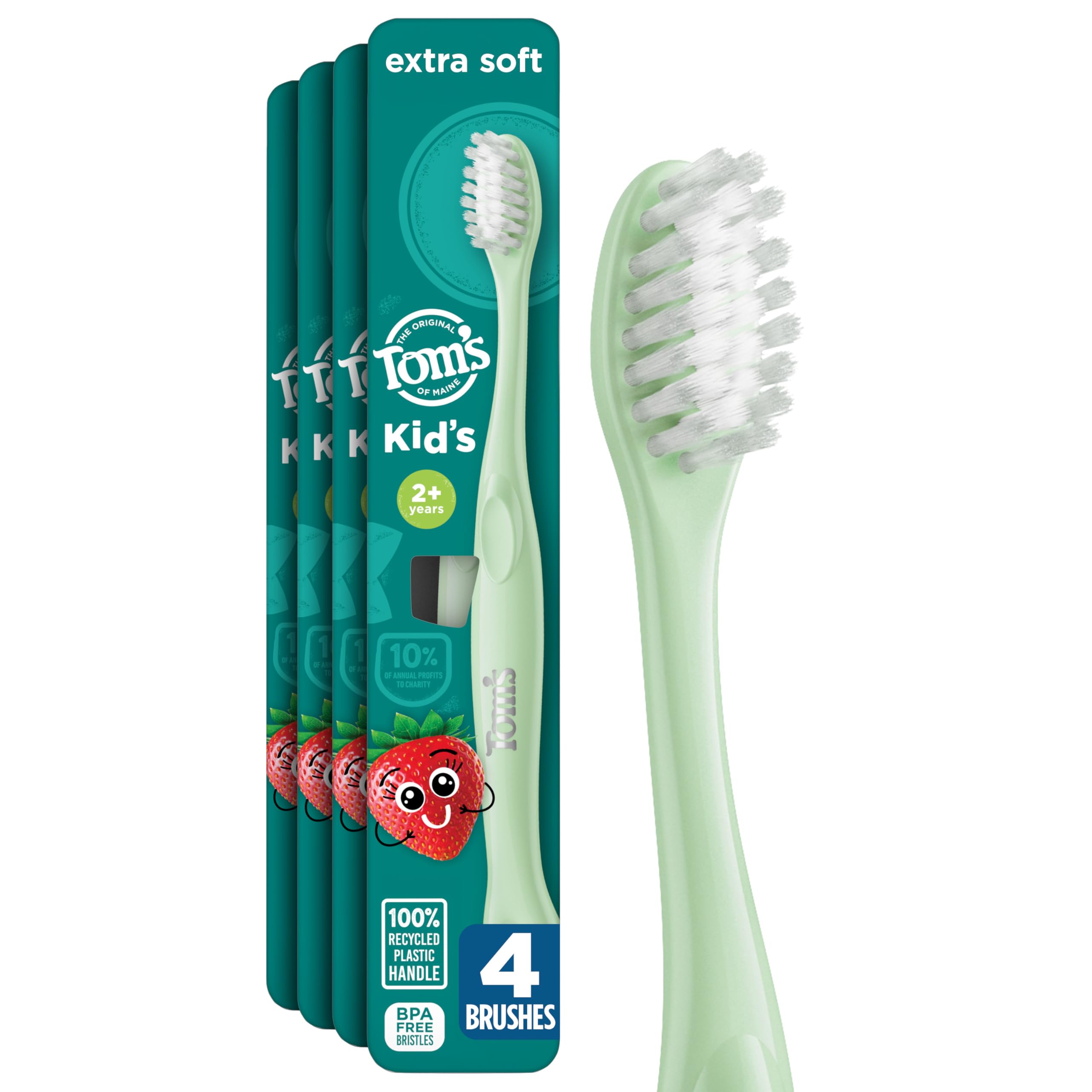
Four brushes in one buy, for the household that keeps losing them behind the sink.
Toddler toothbrushes disappear. They get dropped, chewed past usefulness, and left at grandparents’ houses. This pack deals with that by simply giving you four — all extra soft, all BPA-free, and all dye-free, so there is no color bleed concern near a small mouth. The bristles are multi-height, which is the detail that matters for a mixed mouth: taller bristles reach the gaps while shorter ones work the flat surfaces, covering both baby teeth and any adult teeth already coming through.
The handle has a built-in thumb rest, a small ledge that gives little fingers somewhere definite to sit. It is a modest feature until you watch a two-year-old try to hold a plain cylindrical brush — the rest stops the hand sliding down toward the bristles. The whole thing is made from 100% recycled plastic, over 95% of it recovered from PET bottles, which is a concrete sourcing claim rather than a vague eco nod. It is designed for children aged 2 and up.
Compared with the single-brush picks here, this is the pack-size play: four brushes to the RADIUS Totz’s three, and a wider footprint at 4.8 inches across the package versus the RADIUS brush’s 0.75-inch width. That is packaging bulk, not brush bulk — four handles take space. If you want to stop thinking about replacements for a while, four at once is the practical answer.
What you get for the outlay
- Four brushes in one purchase — no mid-week scramble when one goes missing
- Multi-height extra soft bristles handle mixed baby and adult teeth
- Built-in thumb rest keeps small hands from sliding toward the bristles
- Made from 100% recycled plastic, over 95% from recovered PET bottles
The honest limits
- Designed for ages 2 and up, so it is not a first-tooth brush
- Four green brushes means no variety if your toddler has a color preference
Worth it for: parents of a two-year-old who want a drawer full of spares and one less errand to run.
Not the one for: a baby still under two with only front teeth just appearing.
5. SEAGO Toddler Electric Toothbrush, SG-513

A penguin-shaped electric brush that turns brushing into something a toddler wants to do.
Manual brushing depends on your child holding still and you reaching every surface. This brush does more of the work: it oscillates up to 17,000 times per minute, with gentle vibrations that remove plaque better than a conventional manual toothbrush, according to the maker. Four mini soft brush heads are included, sized for the mouth of a child aged 6 months to 4 years. That is a wide window — one handle covering a baby’s first teeth through to preschool.
The smart timer is the feature that quietly fixes brushing habits. The brush pauses every 30 seconds across a total 2-minute cycle, so children learn the full routine rather than a hurried swipe. Buyers report it turns off automatically after 2 minutes — a set-and-done cycle rather than a stopwatch. A soft LED light lets you see into the mouth to check for problems without shining anything harsh at a child’s eyes, and the IPX7 waterproof rating means it can go in the bath or shower with no worry. It runs on an AAA battery, which is not included.
Durability is the honest question mark. Plenty of owners find it holds up, but a recurring report is the unit breaking off quickly — so treat the handle as something to be looked after, not thrown in a bag. If your toddler fights a manual brush and a buzzing penguin gets them to open up, that trade is usually worth making. At 4.13 inches long, it sits well within small hands.
The feature that earns its place: that 30-second pause makes a two-minute brush feel like a game rather than a chore, and the automatic shut-off means you are not the one enforcing the clock.
The risk to weigh: durability reports are split, so this suits a child who will use it gently under supervision rather than one who chews the handle.
The right call if: a manual brush has become a nightly battle and a novelty-shaped electric one might end it.
Hold off if: your child is rough with their brushes — this one rewards careful handling.
6. Dr. Noah Microplastic-Free Bamboo Baby Toothbrush, 4 Pack
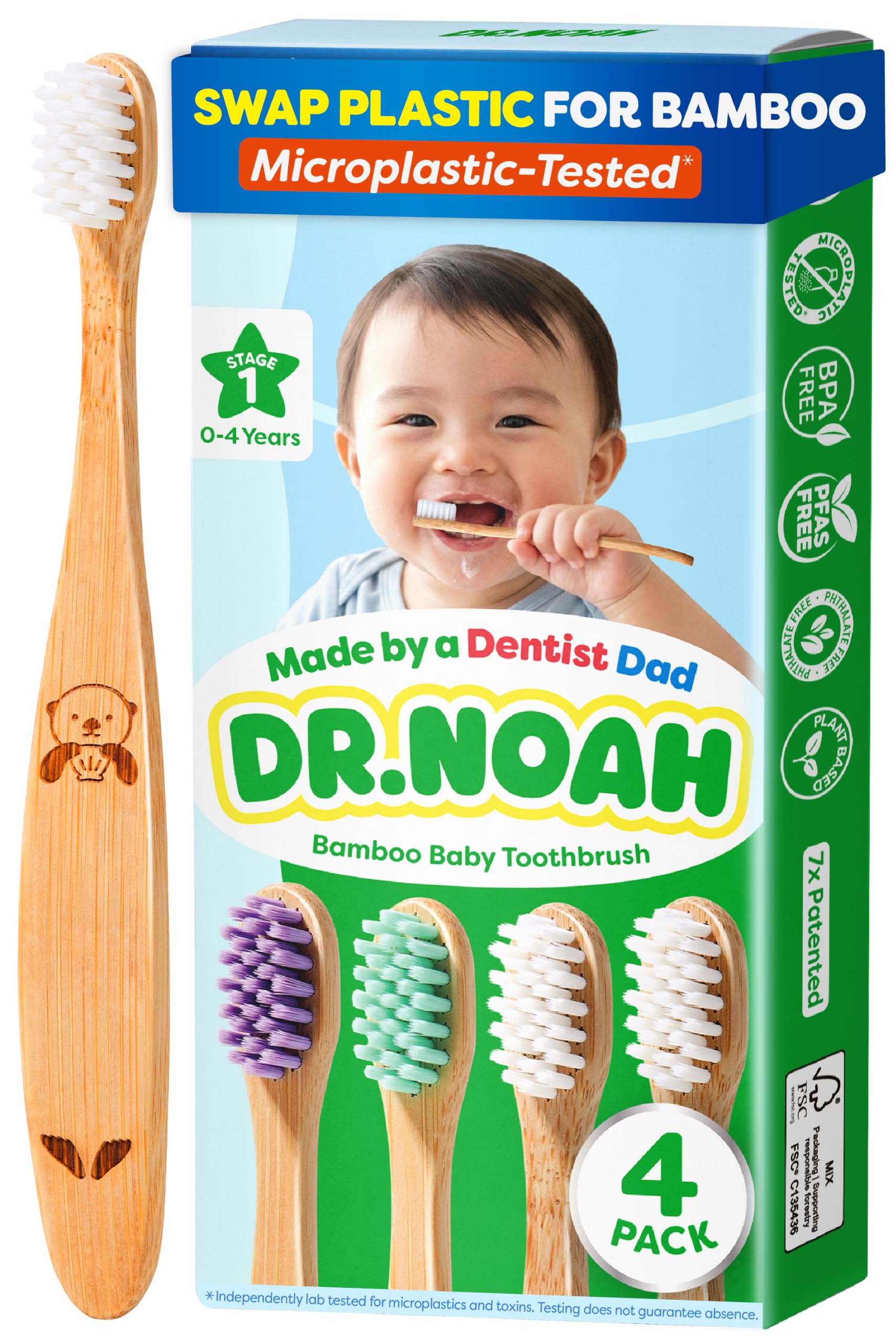
The one for parents who started thinking about what is in the plastic, not just what is on it.
Most baby brushes are plastic, and plastic can flake. This one is built around avoiding that entirely: a plastic-free bamboo handle and plant-based bristles, with the maker stating the materials were independently lab-tested and microplastics were not detected. It is positioned as a safer alternative to silicone and plastic baby brushes. For a parent who has read one too many things about microplastics, that framing is the whole reason to consider it.
In a four-pack, this is the plastic-free play: four brushes to the RADIUS Totz’s three. Size is the other thing that lands well — the head and handle are proportioned for little ones, and the handle is easy to grip, so a toddler can take over holding it. Quality is the trait that carries the reputation here, with softness close behind. The trade-off is that bamboo needs a rinse-and-dry routine rather than sitting wet in a cup — natural material rewards a little care.
Who this is built for: the household already cutting plastic out of the kitchen, the bathroom, and the toy box. The bamboo handle is a genuine material swap, not a green label on the same plastic stick.
What it asks of you: bamboo is a natural material, so it wants to be dried after use rather than left soaking. A small habit change for the material payoff.
Pick this one for: a plastic-free household that wants a brush covering newborn through age 4 in a single shape.
Choose differently if: you want a fully silicone chew brush for the earliest gum-only months — bamboo bristles are for actual teeth.
7. Brilliant Oral Care Baby Toothbrush, Round Head, 3 Pack

The round head cleans top and bottom at once, which matters when your baby will not hold still.
Brushing a wriggling baby is a targeting problem. This brush solves it with a 360° round head that cleans teeth, tongue, gums, cheeks, and the hard-to-reach places in one pass. Round tips are the shape detail that matters — they slide across gum tissue rather than poking it, and the volume of fine bristles means more coverage from any angle.
The brush is created for children aged 4 months to 2 years, when front teeth first emerge, and can be used with or without toothpaste, with parental assistance. The round head does something a flat brush cannot — it cleans the top and bottom teeth simultaneously, which is exactly what you need when your baby clamps their jaw shut mid-brush. A patented design dries quickly, so it is not sitting damp between uses, and it packs well for travel.
Considered alongside the RADIUS Totz, the two split the job neatly: the RADIUS brush is aimed at 18 months and up, this one at 4 to 24 months — so the Brilliant covers the front-teeth stage the RADIUS brush starts too late for. The honest trade-off shows up in durability and cleaning: some owners find the bristles fray easily, and a few find the dense head harder to rinse clean. Softness, though, does not cause irritation — that is the consistent note. This is the brush for the earliest teeth, not the final one.
The simultaneous-clean advantage: one pass scrubs both rows of front teeth, so a briefly cooperative baby still gets a full clean before they decide they are done.
The upkeep note: a dense thicket of bristles holds onto residue — rinse it thoroughly under running water and let it dry head-up between uses.
Made for: the 4-to-24-month front-teeth stage, especially a baby who clamps down mid-brush.
Pass on it if: your child is well into toddlerhood and needs a brush that reaches between back molars.
Understanding the Specs
Bristle softness and count
Bristle softness is the spec that decides whether your baby tolerates brushing at all. On a package, “extra soft” is the label to look for, and a high bristle count usually means finer, gentler tips — the RADIUS Totz lists 4,500 soft vegetable-derived bristles, the Brilliant brush 24,000+ round-tip bristles. Round-tip is a shape worth noticing: rounded ends glide over gum tissue instead of poking it, so a baby with tender gums is less likely to pull away. Neither number guarantees a comfortable brush on its own, but more, finer tips generally mean a gentler scrub across the tooth surface.
Head shape and cleaning angle
A flat bristle head cleans where you point it; a 360° round head cleans from whichever side lands against the tooth. That round design is why the Brilliant brush can work the top and bottom teeth in the same pass — useful when a baby shuts their mouth mid-brush. A standard flat head such as the RADIUS Totz gives you more control and reaches between teeth a round head cannot. Pick the round head for a baby who will not cooperate, and a flat head for a toddler learning to brush properly.
Age windows and stage design
Every brush here states a target age, and those numbers are the fastest way to sort the list. A silicone massager such as the haakaa is built for 6 months and up with little to no teeth. The Brilliant brush covers 4 to 24 months for front teeth. The RADIUS Totz and Tom’s of Maine brushes start at 18 months and 2 years respectively. The Ubbi set and the Dr. Noah brush aim to span multiple stages. Buying outside your child’s stage usually means either a brush too firm for the gums or too soft for the teeth.
Handles, guards, and safety extras
A brush your toddler can grip themselves is one you do not have to hold for them. Look for a tapered handle, a thumb rest, or an ergonomic shape built for small hands — the RADIUS and Tom’s of Maine brushes each take a different approach to that grip problem. Then look at the safety details: a removable choke guard, as on the Ubbi stage-two brush, stops the brush going too far back, and a suction base keeps it standing upright instead of face-down on the sink. BPA-free labeling appears across RADIUS, Tom’s of Maine, Ubbi, and haakaa, and is worth checking on any brush you buy.
FAQ
When should I switch from a silicone gum brush to a bristle toothbrush?
Is a 360° round head toothbrush better than a regular flat one?
How often should I replace a baby toothbrush?
Do I need toothpaste with a silicone gum brush?
Are electric toothbrushes safe for a baby under one?
What does BPA-free actually mean on a baby toothbrush?
Will a baby toothbrush help with teething pain?
Is bamboo a good material for a baby toothbrush?
How do I get a toddler to brush their own teeth?
Can I use the same toothbrush from newborn to preschool?
Final Thoughts: The Verdict
For most households, the baby toothbrush that covers the widest ground is the RADIUS Totz Brush — the soft bristle count does the gentle work, the tapered handle fits a toddler’s grip, and the ADA acceptance is a real external check. If your baby is still in the gum-only months, the haakaa 360° Silicone brush is the one to start with, because a chewy silicone surface is what that stage actually needs. And if brushing has turned into a nightly standoff, the SEAGO electric brush with its 2-minute timer and automatic shut-off is the pick that removes the argument.
How We Picked
We do not accept paid placement. Every pick is matched to a real buyer and a real use-case; we do not hands-on test units.
Sources & Methodology
Specifications: manufacturer listings and product documentation. Review insights: verified customer reviews, as of November 2026. Pricing: not shown on this page (it changes often); check the current price via the retailer link.
As an Amazon Associate, Gadgets Feed earns from qualifying purchases. This does not affect which products we feature.