
Our readers keep the lights on and my morning glass full of iced black tea. As an Amazon Associate, I earn from qualifying purchases.
Specs are compiled from manufacturer listings and verified buyer reviews and can change over time — please confirm the key details on the product page before buying.
Your lower back does not have to take the brunt of a heavy squat. The right belt keeps your spine neutral so your legs and glutes do the work, not your discs. This guide skips the marketing to six picks that genuinely hold up, with the real specs — thickness, width, material — that tell you which one fits your training style.
I’m Min — the founder and writer behind Gadgets Feed. This guide is built by comparing the manufacturers’ published specifications and the patterns across verified customer reviews, so you get each pick’s real strengths and trade-offs instead of marketing spin.
By the time you finish reading, you will know exactly why thickness, width, and material decide whether a back belt for lifting actually helps your squat or just gets in the way.
Our Picks at a Glance
How To Choose The Best Back Belt For Lifting
Most beginners grab the cheapest or coolest-looking belt and wonder why it digs in, slips, or offers zero support under a heavy bar. The real differentiators are measurable — thickness, width, material, and buckle type. Here is what to look for so your first belt is also your last.
Belt Thickness — The Balance Between Support and Flexibility
Thicker does not automatically mean better. A 10mm to 13mm belt is rigid, giving you a rock-solid wall to push your abs against — ideal for max-effort squats and deadlifts. A 5mm to 7mm belt is more flexible, allowing you to breathe deeper during high-rep sets or Olympic lifts like cleans and snatches. For general gym work, 7mm to 9mm is the balance: enough support for heavy singles without restricting your warm-up mobility.
Width — How It Sits on Your Torso
A standard width is 4 inches all around or tapered from 4 inches down to about 2 inches in the front. A 4-inch uniform width pushes evenly against your entire abdomen and lower back. A tapered shape leaves more room for your ribcage when you hinge forward, common for deadlifting. A 4.5-inch belt covers more of your back but can be too tall for shorter-torso lifters, digging into your ribs when you sit into a squat.
Material — Leather vs Foam vs Nylon
Genuine leather is the gold standard for longevity — it gradually molds to your body’s shape over months and holds consistent tension under hundreds of pounds. Foam or nylon belts are softer, lighter, and more comfortable for a full workday of standing or repeated bending, but they compress over time and do not give the same rigid feedback during a one-rep max. If you are lifting heavy at the gym three times a week, choose leather. If you need all-day wear at a warehouse job, foam or nylon works.
Buckle and Closure System
Double-prong roller buckles are the most secure — you click into a hole, wrap the lever down, and the belt does not shift even during heavy depth on a squat. Single-prong buckles are fine for moderate weights but can slip if you move laterally. Hook-and-loop (velcro) closures are the quickest to take on and off but lose grip strength as the fibers wear. There is a reason every powerlifting federation competition requires a roller buckle belt.
Quick Comparison
| Model | Best For | Thickness | Width | Material | Amazon | |
|---|---|---|---|---|---|---|
| Sparthos Back Support★ Best Overall | All-day back support at work | 0.15″ | Variable | Polyester | $29.97$38.67Amazon | |
| Iron Bull Strength 7mmTop Performer | Heavy powerlifting (IPF-approved) | 7mm | 4″ to 2″ tapered | A-Grade Leather | $59.95Amazon | |
| GurZinn 9mm Leather | High-volume squatting | 9mm | 4″ | Double-sided Leather | $31.99Amazon | |
| Beast Power Gear 4″ | Entry-level barbell training | 5mm | 4″ | Faux Leather | from $39.90Amazon | |
| Fitgriff Classic | Deadlifting with a tapered cut | 5mm | 4″ | 100% Cowhide Leather | $34.99Amazon | |
| Harbinger Foam Belt | All-purpose gym and CrossFit | 4.5″ | 4.5″ | Foam Blend | $26.25$29.99Amazon |
In‑Depth Reviews
1. Sparthos Back Support Belt
Our pick — over 4★ from 67,500+ verified ratings; the strongest balance of quality and price.
The nearly-invisible brace that treats warehouse lifting and gym lifting as the same problem.
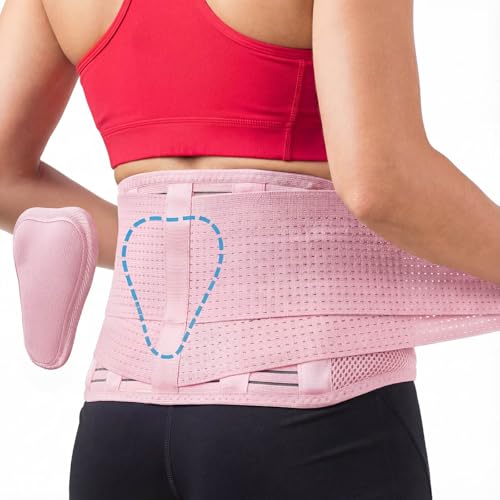
Sparthos is a different category of back belt — a medical-style brace with a polyester body and an adjustable lumbar pad (a padded section that presses against your lower back), not a rigid leather powerlifting belt. It is 0.15 inches thick, versus the Harbinger foam belt at 4.5 inches, making it nearly invisible under clothes. The design includes firm vertical support stays that prevent the belt from rolling up when you bend or stretch, and the hook-and-loop closure allows quick adjustments on the fly. With a 4.4/5 rating from 67,585 reviews, it is by far the most-reviewed product here, which signals broad satisfaction for its intended use case: immediate relief during work tasks like walking, bending, and stretching.
Where leather belts are designed to help you lift more weight, the Sparthos is designed to help you hurt less throughout the day. It works for herniated discs (a torn spinal disc), sciatica (nerve pain running down the leg), and general lower back soreness, and it is breathable enough to wear under a shirt during an eight-hour shift. One owner reported it saved them from taking time off work for a bulging disc — they could bend and load boxes without sharp pain. The small size fits a 31-38 inch waist, and the pink color option is hard to miss, though it also comes in standard colors.
The fundamental limit is that this is a support brace, not a competition lifting belt. It will not give you the rigid wall to push your abs against during a heavy squat — the 0.15-inch thickness compresses immediately under load. For barbell training at 200-plus pounds, the absence of structural rigidity means your core still has to do all the stabilizing work on its own. This is the belt to grab for a day of moving furniture or a full shift on a warehouse floor, not for a deadlift PR attempt.
Daily wear relief: The adjustable lumbar pad and breathable fabric make this the most comfortable option to wear all day under any clothes.
Use this for: back pain management during work shifts, long walks, or light studio gym sessions where you are not pulling more than 135 pounds.
Skip this for: any barbell lift over 185 pounds or any powerlifting competition — it simply does not have the structural support a leather belt provides.
2. Iron Bull Strength 7mm Leather Weight Lifting Belt
Competition-legal support that bends just enough for Olympic lifts.
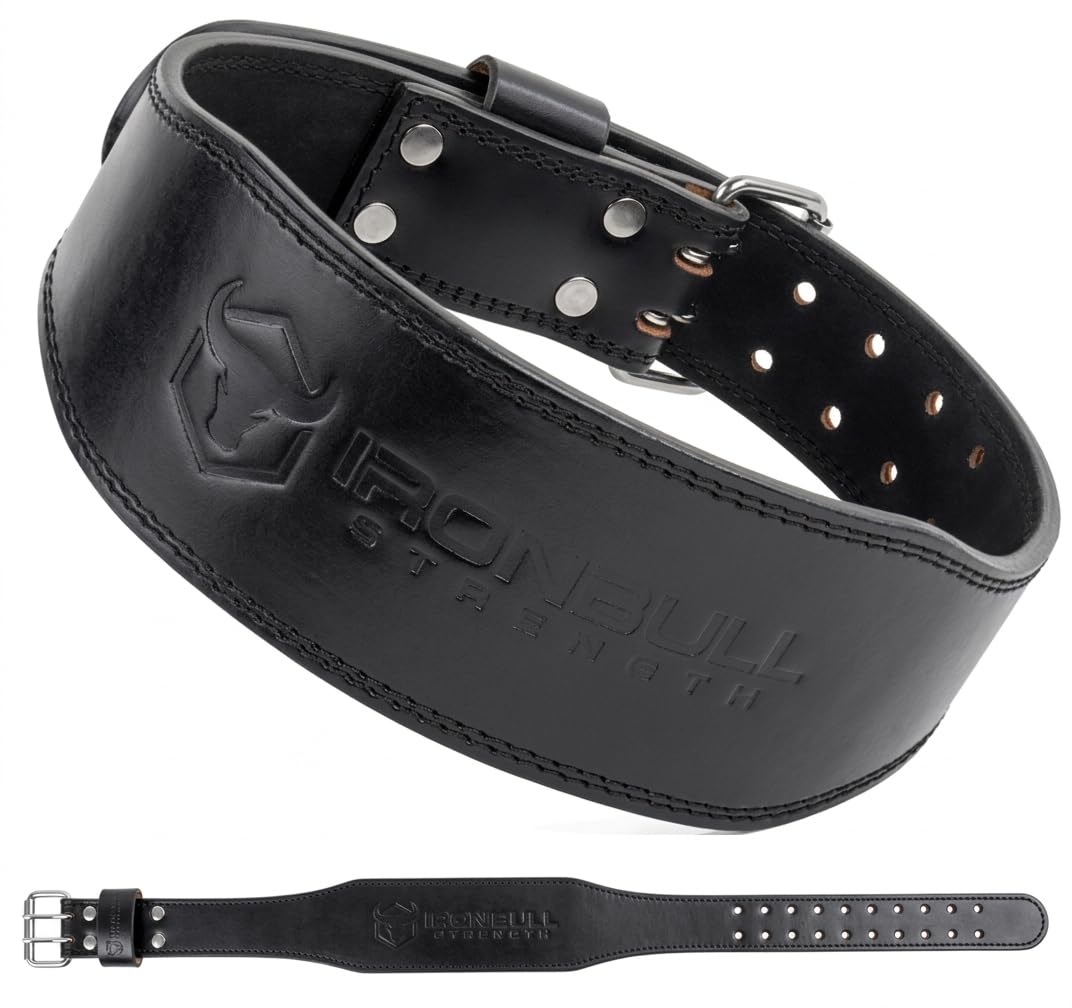
If you compete or train for serious numbers, this belt earns its spot as the top performer because its 7mm thickness is stiffer than the 5mm Beast Power Gear but more bendable than the 9mm GurZinn for your warm-ups. The belt is made from genuine A-grade leather with a 7mm thickness throughout — single pieces, not scraps glued together — so the support is even across your whole back. The width tapers from 4 inches down to 2 inches in the front, which frees up room for your ribcage when you hinge forward on a deadlift or clean. That tapered cut also makes it lighter and less disruptive on front squats than a uniform 4-inch block, as a 4.5/5 rating from 878 buyers backs up.
Buyers report the double roller steel buckle with black coating clicks in firmly and does not budge under 400-plus-pound loads. One reviewer noted the 7mm thickness was the perfect middle-ground — stiff enough for a one-rep max squat but not so rigid that it digs in during lighter warm-up sets. The belt is competition-approved for IPF (International Powerlifting Federation), USAP, USPA, IPL, USAW, and IWF certifications, so you will never be told to take it off on the platform.
The only real trade-off is sizing — at a 40-inch waist circumference in Large, you must measure your true waist with a tape measure, not guess from your pants size. If you order the wrong size, the lifetime warranty against manufacturing defects has you covered, but you will save the hassle by checking the chart first.
Why it leads the pack
- 7mm A-grade leather holds its shape and molds over time
- Tapered 4-to-2-inch front gives deadlift breathing room
- IPF-approved — legal in every major powerlifting federation
- Double roller buckle is extremely secure under max loads
What to watch for
- Sizing is precise and not based on pants size — measure your waist carefully
- It is a premium investment compared to foam belts under
Grab this if: you squat or deadlift twice your body weight and want a belt that is legal on any competition platform.
skip it if: your training is mostly high-rep, cardio-based, or you just need all-day work support — a 7mm leather belt is overkill for those scenarios.
3. GurZinn 9mm Leather Fitness Weight Lifting Belt

Squat-specific rigidity that gives you a wall to push against.
At 9 millimeters thick, this is the stiffest belt on this list — and that is exactly the point for lifters who want maximum feedback (the sensation of the belt telling your body where the tension is) during loaded squats. The belt uses double-sided genuine leather reinforced with top stitching, so it resists tearing even under repeated high-intensity use. The width is a uniform 4 inches all around, which pushes evenly against your abdomen and lower back to create a consistent wall for bracing. With a 4.6/5 rating from 745 buyers, it has the highest overall satisfaction in the group.
Unlike the thinner 5mm leather models from Beast Power Gear or Fitgriff, this GurZinn belt gives you noticeably more rigidity. The 10 adjustment holes use 6 stainless steel rivets, and the double reinforcement technology means the buckle does not stretch the leather out over time. Owners mention it has almost no break-in period — it is comfortable from the first session, unlike some stiffer 10mm to 13mm belts that need weeks of wear. The sponge pad inside adds a layer of comfort that prevents the rough leather edge from digging into your hips during a deep squat.
The obvious trade-off is flexibility. At 9mm thick and 4 inches wide, it is not ideal for Olympic lifts like cleans or snatches where you need to move your torso through a full range of motion quickly. The belt measures 38 inches in length, at 38 inches versus the Harbinger foam belt at 28 inches, so taller lifters may prefer the extra wrap. If you are between sizes, order the smaller option — the leather stretches slightly in the first month.
Maximum support: This is the stiffest pick here for lifters who want a rigid wall to push against during squats and heavy pendlay rows.
Reach for this if: you are a squatter who wants the most feedback from your belt and hate the flex of thinner leather models.
Look elsewhere if: you do Olympic weightlifting or CrossFit metcons — the 9mm thickness will hinder your overhead mobility.
4. Beast Power Gear 4″ Leather Weight Lifting Belt
Affordable leather with the double-prong buckle experience.
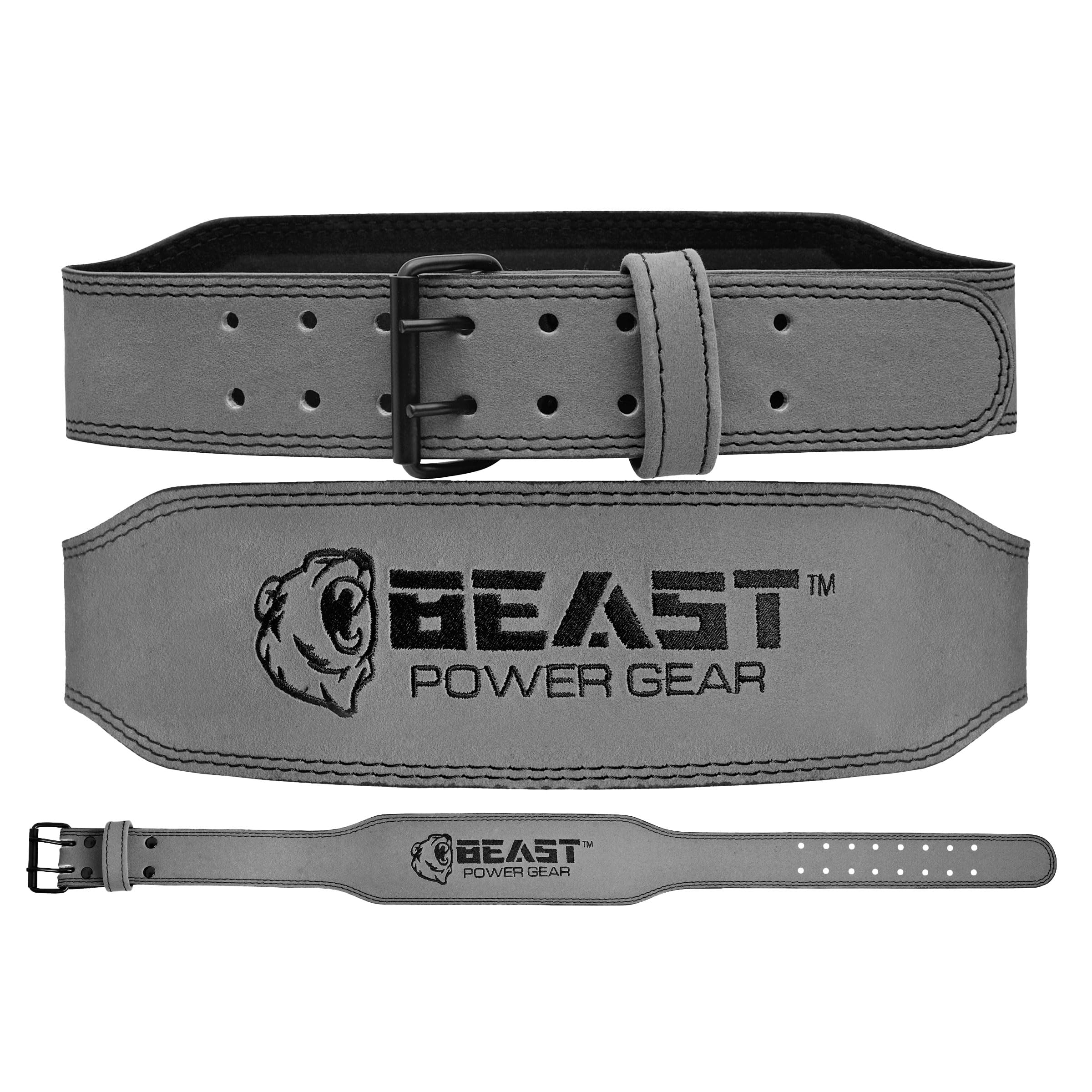
This is where you get the classic double-prong steel buckle and 4-inch width for under — a rare combination in a market flooded with velcro gym belts. The belt uses 6mm thick foam-padded leather (5mm actual leather core) and measures 4 inches wide to distribute pressure evenly across your lower back. It is designed specifically for squats, deadlifts, and overhead presses, with a double-prong roller buckle that makes hole-to-hole adjustments quick between sets. At 4.3/5 from 728 ratings, buyers generally find it reliable for intermediate lifting.
Compared directly to the Harbinger foam belt, this Beast Power Gear belt is thinner at 5mm vs 4.5 inches, but the leather composition gives it a different kind of rigid feedback. The foam padding on the inside stops the leather from cutting into your hip bones, which is a common complaint with stiffer, more expensive leather belts. Customers note that the sizing runs slightly large, so if you are between an M and L, the smaller fit tends to work better once the leather settles.
The catch is durability over the long haul. The faux leather surface can show wear and peeling after about a year of heavy use, especially in the hole area where the buckle prongs push through. For twice-a-week training it is fine, but five-times-a-week heavy work will fatigue it faster than the Iron Bull or Fitgriff full-leather models. The 28-inch length is also shorter than the GurZinn’s 38-inch length, which means larger waist sizes may run out of adjustment room.
What earns its value
- Double-prong steel buckle at a budget-friendly price point
- Foam padding prevents the hip-dig common on bare leather belts
- 4-inch width covers the entire lower back evenly
Where it cuts corners
- Faux leather surface may peel with very frequent heavy use
- Sizing runs a little large — check measurements, not pant size
Right for: gym-goers who want their first leather buckle belt for squats and deadlifts without spending more than they did on their gym bag.
Not right for: daily heavy trainers who need a belt that lasts multiple years — spend up for the 7mm Iron Bull instead.
5. Fitgriff Classic Weight Lifting Belt

Deadlift-focused cowhide that molds to your body, not against it.
The 5mm thickness of this belt is the key reason deadlift specialists pick it over the 9mm GurZinn — the thinner leather lets you hinge deeper into a conventional deadlift start position without the belt pressing into your ribcage. Fitgriff leans into the classic powerlifting look with a 4-inch black leather belt that uses 100% premium cowhide — no fillers, no synthetic core. The construction is three layers thick at 5mm, giving it a balance of durability and flexibility that works for deadlifts without being so stiff that you fight it during your warm-up. It comes with a 2-year guarantee, which is the strongest warranty in this lineup besides the Iron Bull’s lifetime coverage. At 4.4/5 from 763 ratings, buyers consistently praise the genuine feel and the way the leather molds to the body over the first few weeks.
The tapered double-prong roller buckle is the key feature here — it lets you micro-adjust tension without unthreading the whole belt. The belt measures 29.53 inches in length and 3.94 inches width, making it slightly narrower than a full 4-inch model, which some shorter-torso lifters actually prefer. One buyer mentioned the belt arrived with a slight leather smell (typical of new genuine leather) and that it softened noticeably after two weeks of use. The included instruction sheet explains how to boost intra-abdominal pressure, which is useful for beginners learning how to brace.
The downside is that at 5mm thickness, it is a middle-weight option. It does not give the same rigid feedback as a 7mm or 9mm belt during a max-effort squat. Lifters who train for competition strength may find it flexes slightly under 400-plus-pound loads, where the Iron Bull 7mm stays completely immovable. It is also a fixed 4-inch width rather than tapered, so overhead lifters may feel it bump their ribcage during snatches.
Best for deadlift specialists: The 5mm cowhide flexes just enough to let you hinge deep while still giving you a wall to push your belly against.
Choose this if: you want a genuine leather belt with a warranty longer than most electronics come with, and you prefer a classic uniform 4-inch width.
Pass if: you are a competitive powerlifter who needs the rigidity of a 7mm-plus belt or a tapered front cut for cleans and jerks.
6. Harbinger Weightlifting Belt, Foam, 4.5″

The widest coverage here, built for circuits, not max attempts.
Harbinger’s foam belt is the outlier here — a 4.5-inch wide foam construction with a low-profile steel roller buckle, built for lifters who want core support without the bulk of a leather block. The foam is a blend of PP, PE, and nylon (plus a small percentage of iron for the buckle structure), which makes it flexible enough to wear through an entire circuit without restricting your breathing. At 4.5 inches wide, it covers more back surface area than any 4-inch leather belt here, which helps distribute pressure across a broader area of your lower spine. With a 4.4/5 rating from 629 buyers, it is well-regarded for general gym use.
Unlike the 5mm leather belts from Beast Power Gear and Fitgriff, this foam belt compresses more under load — you feel it give a little when you brace hard, which some lifters find comfortable and others find less reassuring. The hook-and-loop fastener plus the steel roller buckle gives you both quick on-off convenience and a secure lock mid-set. Reviewers point out it is a popular choice for CrossFit and circuit training because it does not bruise your ribs when you transition from squats to push jerks. The belt also meets IWF competition standards, so it is technically allowed in some competitions, though most serious powerlifters still prefer leather.
The durability trade-off is real. Foam belts compress over time — after about six months of heavy use, the material loses some of its original rigidity. Shoppers say that the velcro also loses grip strength if exposed to chalk and sweat without cleaning. If you train heavy in a powerlifting club 4 times a week, the leather options above will outlast this foam belt several times over. But if you are mixing CrossFit, general strength, and dumbbell work, the Harbinger foam gives you 4.5 inches of support without the weight or noise of leather.
What works
- 4.5-inch width is the widest here, spreading support across more of your lower back
- Foam construction is silent and flexible — ideal for circuits that mix various lifts
- Low-profile buckle does not dig into your stomach during front squats
What wears over time
- Foam compresses after months of heavy use, losing its original stiffness
- Velcro closure needs regular cleaning to maintain grip when chalk and sweat accumulate
Perfect for: the CrossFitter, circuit trainer, or intermediate lifter who moves through deadlifts, rows, overhead presses, and ab work in one session and wants a belt that stays comfortable the entire time.
Not for: the dedicated powerlifter chasing a 500-plus pound deadlift — the foam compress under that kind of load reduces the feedback you need.
Understanding the Specs
Belt Thickness (Why 5mm vs 9mm vs 7mm Matters)
Thickness is the single biggest predictor of how much feedback the belt gives you during a squat or deadlift. A 5mm belt like the Beast Power Gear or Fitgriff flexes slightly when you brace, making it comfortable for high-rep sets and general training. A 7mm belt like the Iron Bull is the balance for most heavy lifters — stiff enough to push against hard but not so rigid that you struggle to get into position. A 9mm belt like the GurZinn is the stiffest of this group, giving you maximum feedback for heavy singles but trading off flexibility for overhead lifts. Thicker always means more support and less range of motion.
Belt Width (How Much of Your Torso It Covers)
Width determines where on your body the belt sits and how much surface area it supports. A 4-inch uniform width covers the entire width of your lower back and abdomen and is the most common standard for both leather and fabric belts — every leather model here except the Harbinger uses a 4-inch width. A 4.5-inch width like the Harbinger extends higher up your back, which creates more surface area for pressure distribution but can dig into your ribs if you have a shorter torso. A tapered belt (4 inches tapering to 2 inches at the front, like the Iron Bull) leaves room for your ribcage and diaphragm when you hinge forward into a deadlift or clean position.
FAQ
Will a thick leather belt work for everyday back pain or warehouse work?
How do I know if I need a 4-inch or 4.5-inch wide belt?
What is the difference between a single-prong and double-prong buckle?
Can I use a back belt for Olympic lifting like cleans and snatches?
How tight should a lifting belt be during a set?
Will a back belt prevent spine injuries during deadlifts?
How do I clean and maintain a leather lifting belt?
Is a velcro closure belt (hook and loop) less durable than a buckle belt?
How do I measure my waist correctly for a belt?
What is the difference between a “back brace” and a “weightlifting belt”?
Final Thoughts: The Verdict
Across the board, the back belt for lifting winner is the Iron Bull Strength 7mm because its A-grade leather, IPF-approved certification, and versatile 7mm thickness give you a strong balance of rigidity and flexibility for almost every lift. If you want the stiffest wall to push against for heavy squats, grab the GurZinn 9mm. And for all-day back support at work or in the gym, the standout is the comfort of the Sparthos Back Support Belt.
How We Picked
We do not accept paid placement. Every pick is matched to a real buyer and a real use-case; we do not hands-on test units.
Sources & Methodology
Specifications: manufacturer listings and product documentation. Review insights: verified customer reviews, as of July 2026. Pricing: not shown on this page (it changes often); check the current price via the retailer link.
As an Amazon Associate, Gadgets Feed earns from qualifying purchases. This does not affect which products we feature.
Related Guides
Product prices and availability are accurate as of the date/time indicated and are subject to change. Any price and availability information displayed on Amazon at the time of purchase will apply to the purchase of this product. As an Amazon Associate I earn from qualifying purchases.
CERTAIN CONTENT THAT APPEARS ON THIS SITE COMES FROM AMAZON. THIS CONTENT IS PROVIDED "AS IS" AND IS SUBJECT TO CHANGE OR REMOVAL AT ANY TIME.
Amazon and the Amazon logo are trademarks of Amazon.com, Inc. or its affiliates.