
Our readers keep the lights on and my morning glass full of iced black tea. As an Amazon Associate, I earn from qualifying purchases.
Specs are compiled from manufacturer listings and verified buyer reviews and can change over time — please confirm the key details on the product page before buying.
You ride after dark or in grey weather, and your only safety net is a red light on the back of your bike. But some rear lights die mid-ride, others dim when you need them most, and a few rattle off on a bump. So which one actually earns a spot on your seatpost?
I’m Min — the founder and writer behind Gadgets Feed. This guide is built by comparing the manufacturers’ published specifications and the patterns across verified customer reviews, so you get each pick’s real strengths and trade-offs instead of marketing spin.
We break down lumens (a measure of total light output), battery life, mounting flexibility, and smart features to help you pick the best back bicycle light for your commute, trail ride, or night loop.
Quick Picks
- MagicShine SEEMEE 300 — Top Performer
- Cygolite Hotshot 100 — Commuter King
- ROCKBROS Bike Tail Light (Brake Sensing) — Smart Value
- DARKBEAM Bike Tail Light with LED Display — Feature Dense
- Planet Bike Grateful Red — Reliable Classic
- Planet Bike Superflash — Budget Champ
How To Choose The Best Back Bicycle Light
Picking the right rear taillight is simple once you know the few specs that matter. Focus on these three areas and you will filter out the duds fast.
Brightness vs. Visibility
A light that is 500 lumens (a unit of total visible light output) but only shines straight back is less useful than a 13-lumen light that throws red in all directions. Look for designs that mention wide-angle coverage — 260-degree (three-quarters of a circle) visibility is excellent — or have secondary optics (lenses or reflectors) that cast light sideways. Drivers approaching from an angle need to see you long before they are directly behind you.
Battery Life and Charging
Check the runtime on the flashing mode you will actually use, not the dimmest eco setting. A light that claims 150 hours in Superflash mode is very different from one that manages 50 hours on a steady pulse. USB-C (a universal, reversible charging port) recharging is increasingly common and convenient — you can top it up at your desk or from a power bank — but some proven models still run on AAA batteries and go for months between swaps.
Mount Security and Water Resistance
Nothing ends a ride faster than a taillight bouncing off on a pothole. A rubber O-ring mount is fine for smooth pavement, but for gravel or trails you want a hard bracket that clicks into place. For weather, an IPX5 (can withstand water jets from any direction) or IPX6 (can handle heavy rain or powerful spray) rating means the light handles heavy rain without blinking; IPX3 (protected against light rain and splashes) is fine for splashes but not a downpour.
Quick Comparison
| Model | Best For | Max Lumens | Battery Life (Max) | IP Rating | Amazon |
|---|---|---|---|---|---|
| MagicShine SEEMEE 300 | Night riders needing 260° visibility | 300 | 200 hrs (ECO) | IPX6 | $43.99$59.99Amazon |
| Cygolite Hotshot 100 | Daytime commuters on busy roads | 100 | 270 hrs | IP64 | $38.17Amazon |
| ROCKBROS Brake Sensing | Riders wanting smart auto on/off | — | 50 hrs | IPX6 | $25.99Amazon |
| DARKBEAM LED Display | Budget buyers who want a battery gauge | 500 | 38 hrs | IP55 | $12.99Amazon |
| Planet Bike Grateful Red | Reliability with a built-in reflector | 13 | 150 hrs (Superflash) | IPX3 | $19.99Amazon |
| Planet Bike Superflash | Ultra-long battery between changes | 7 | 100 hrs (Superflash) | IPX5 | $24.95Amazon |
In‑Depth Reviews
1. MagicShine SEEMEE 300

The brightest wide-angle taillight here, with a 3000-meter (about 1.86 mile) visibility range that practically dares traffic to miss you.
You want cars approaching from the side to see you well before they are directly behind your wheel. The MagicShine SEEMEE 300 delivers that with a combined maximum output of 300 lumens and a special OptiTracing lens system (precision optics that spread light broadly) that throws red across 260 degrees of the road behind you. An ambient light sensor (a sensor that reads surrounding brightness) automatically adjusts the output, so your light is bright in daylight and dimmer at night to avoid blinding others. The built-in motion sensor fires a brighter beam when it detects braking, which is a safety boost that the Cygolite Hotshot 100 lacks. The SEEMEE 300 reaches a max visibility distance of 3000 meters (roughly 1.86 miles), enough for highway-adjacent roads.
Runtimes stretch up to 200 hours on ECO mode from the 1600 mAh (milliamp-hour, a measure of battery capacity) battery, and the USB-C port fully recharges in about 2 hours. The IPX6 waterproof rating (heavy-rain resistance) and one-piece aluminum housing give it a tough, premium feel. Buyers report the battery “lasts a long, long, long time” — one reviewer noted it held up for 500 miles before needing a charge. The catch is the mount: it only fits angled seat tubes, so you cannot easily put it on a rack or vertical post, and some riders had to build a custom bracket.
What makes it shine
- 260-degree visibility catches traffic from all angles, not just straight behind you
- Smart brake sensor automatically brightens when you slow down
- USB-C charging is fast and convenient for topping up at a desk or power bank
Where it stumbles
- The mount only works on seat tubes — no rack or vertical post option from the start
- Battery indicator shows green above 20%, making it tricky to gauge if a long ride is safe
Grab it for: Riders who commute in heavy traffic and want the widest possible safety cone of red light behind them.
Look elsewhere if: You need to mount the light on a rear rack, trunk bag, or any vertical tube without jury-rigging a bracket.
2. Cygolite Hotshot 100

A 100-lumen rear light that is bright enough for daytime use and still runs for 270 hours on one charge — that is about 11 days straight.
Cygolite has been a trusted American bicycle light brand since 1991, and the Hotshot 100 shows why. It puts out 100 lumens with six distinct modes including two designed specifically for daytime riding — “Daylighting” fires powerful flashes to punch through bright sunlight, while “Steady Pulse” keeps a steady beam that pulses so drivers can judge your distance. You can even tune the flash speed yourself, which is a rare feature for dialing in exactly how attention-grabbing you want the strobe to be.
The battery life is the real headline: up to 270 hours on a single charge, which for most commuters means charging once a month or less. The IP64 rating (protection against splashing water and dust) covers the daily commute in all weather. Owners mention it is visible from over 500 feet in daylight and about half a mile at night — that is better nighttime range than the 13-lumen Planet Bike Grateful Red. Several mention it has survived 7 to 10 years of regular use. One caveat: the 100-lumen model lacks a hard clip for seat bags, so if you plan to attach it to a bag you may want the 200-lumen version.
Why it lasts
- 270-hour max runtime means you recharge rarely, not every few rides
- Daylighting mode is specifically tuned to be visible in bright sun, not just at dusk
- Tunable flash speed lets you pick the exact strobe pattern that feels safest
The trade-off
- No hard clip for seat bags — bag riders will need the pricier Hotshot 200 model
- Recharges via Mini USB, not the more universal USB-C
Best suited for: Daily commuters on sunny roads who want a “low-maintenance” light that only needs charging every few weeks.
skip it if: You prefer a USB-C charging port or plan to clip the light to a backpack or pannier bag.
3. ROCKBROS Bike Tail Light (Brake Sensing)

A 53-gram (about 1.9 ounces) smart light that wakes up when you move and flashes brighter when you brake — less than the cost of a lunch out.
Compared to the 24-gram DARKBEAM below, the ROCKBROS is 53 grams — that extra heft comes from a premium aluminum alloy body that feels tough in hand rather than cheap plastic. The smart sensor technology detects deceleration and fires a high-intensity flash for 5 seconds whenever you brake, alerting anyone behind you — a feature missing from the simpler Planet Bike Superflash. Motion and light sensors also auto-turn the light off after 30 seconds of stillness, then reignite when you start moving again — which means you never accidentally leave it draining battery in the garage.
The 400mAh Li-ion battery delivers up to 50 hours of runtime on a full charge, and the four blue breathing lights on the power indicator each represent 25% battery capacity so you know exactly when to recharge. Its IPX6 waterproof rating is higher than the IPX3 rating of the Planet Bike Grateful Red, meaning it can handle heavy rain without issue. Buyers praise the durable build — one buyer mentioned it survived over 1500 miles of gravel and trails. A few note the clamp can feel slightly loose on thinner seat rails, easily fixed with a wrap of tape.
Smart features that work
- Brake sensor automatically blasts a 5-second high-intensity flash when you slow down
- Auto on/off via motion and light sensors means you never forget to turn it off
- Aluminum alloy build feels durable compared to plastic rivals
Minor quirks
- The clamp mount can be slightly loose on thinner seat rails and may need a small shim
- Battery indicator is not perfectly linear — it can show two dots then die sooner than expected
Perfect for: Riders who want a rugged, aluminum-bodied light with automatic brake response and motion-activated on/off for low-maintenance daily use.
Not ideal for: Ultralight road bikers who count every gram — the 53-gram weight is notably heavier than some plastic alternatives.
4. DARKBEAM Bike Tail Light with LED Display
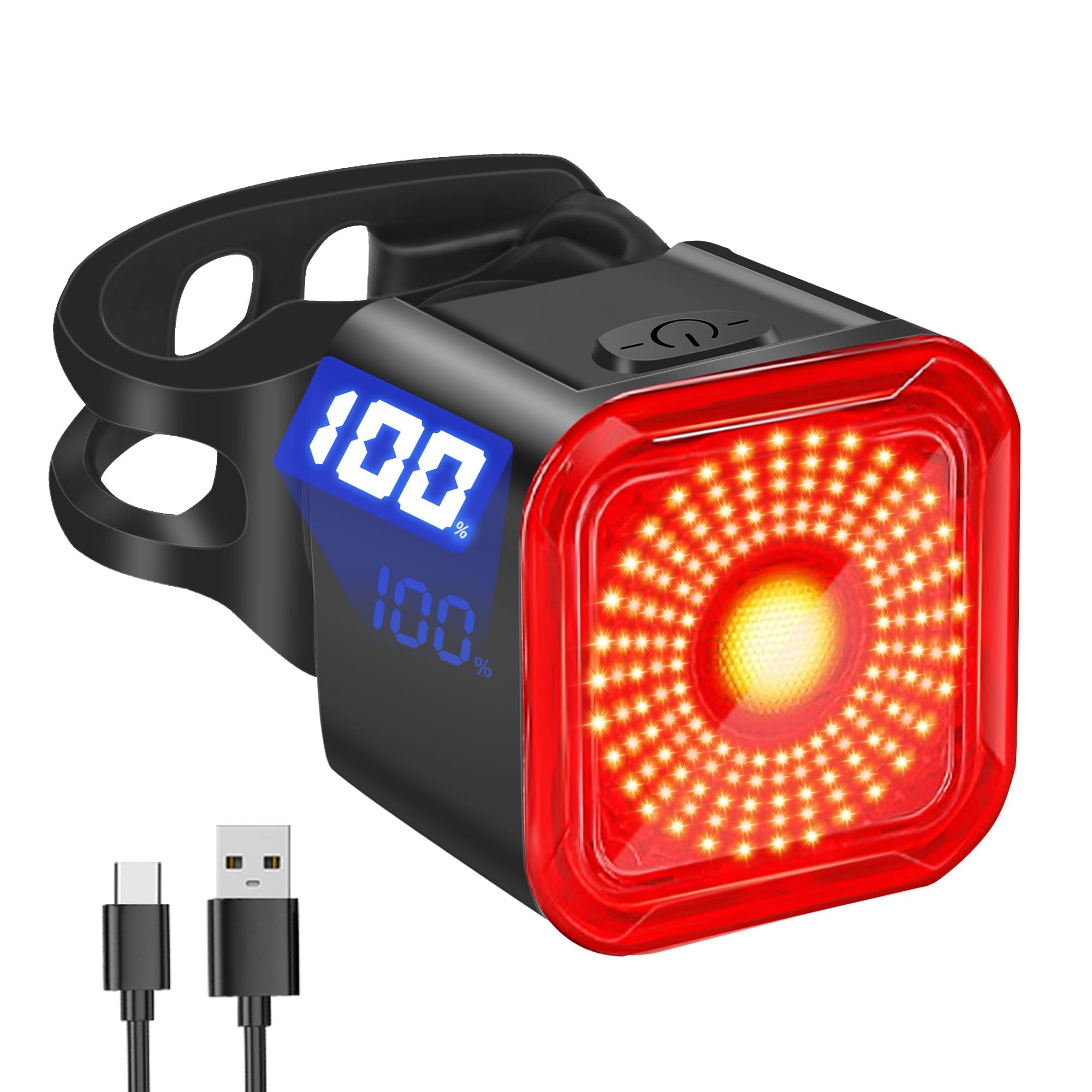
A compact 24-gram light with a real-time digital battery gauge — you never have to guess how much charge is left.
At just 24 grams (0.85 ounces) and 1.26 x 1.26 x 1.18 inches, the DARKBEAM is the lightest and most compact option here — at 24 grams versus the ROCKBROS 53 grams — yet it claims to punch out 500 lumens, enormously brighter than the 7-lumen Planet Bike Superflash. The unique selling point is the LED display screen on the back that shows your exact battery level in real time, so you never get caught with a dead light mid-ride. It offers 6 memory modes (stay on, flash, breathing, single flash, burst flash, heartbeat) and remembers the last mode you used so you don’t have to cycle through every time.
An intelligent brake sensor automatically boosts brightness when it detects rapid deceleration, and a sleep mode engages after 30 seconds of stillness to save power. The IP55 rating (dust and low-pressure water jets) handles rain well — less protection than the IPX6 of the MagicShine SEEMEE 300, but fine for most weather. USB-C charging makes topping up from any USB device simple. Customers note the “excellent battery life (56% after 2 months of nightly use)” and one reviewer ran it on flash mode for a 7+ hour ride and still had 65% charge left. A few comment that it is not bright enough for daytime visibility and that the steady mode is not at full output.
Standout features
- LED screen shows exact battery percentage — no more guessing if you need to charge
- Ultra-compact at 0.85 oz and 1.26 inches, fits in any pocket or pouch
- USB-C charging is modern and universal for quick top-ups
Watch out for
- Daytime visibility is limited — the display and light are hard to see in bright sunlight
- No steady full-output mode available; the brightest steady setting is not 500 lumens
Choose this if: You want a tiny, ultra-light rear light with a battery readout you can glance at before heading out the door.
Pass on it if: You ride mostly in daylight and need a light that cuts through bright sun as well as it does at night.
5. Planet Bike Grateful Red
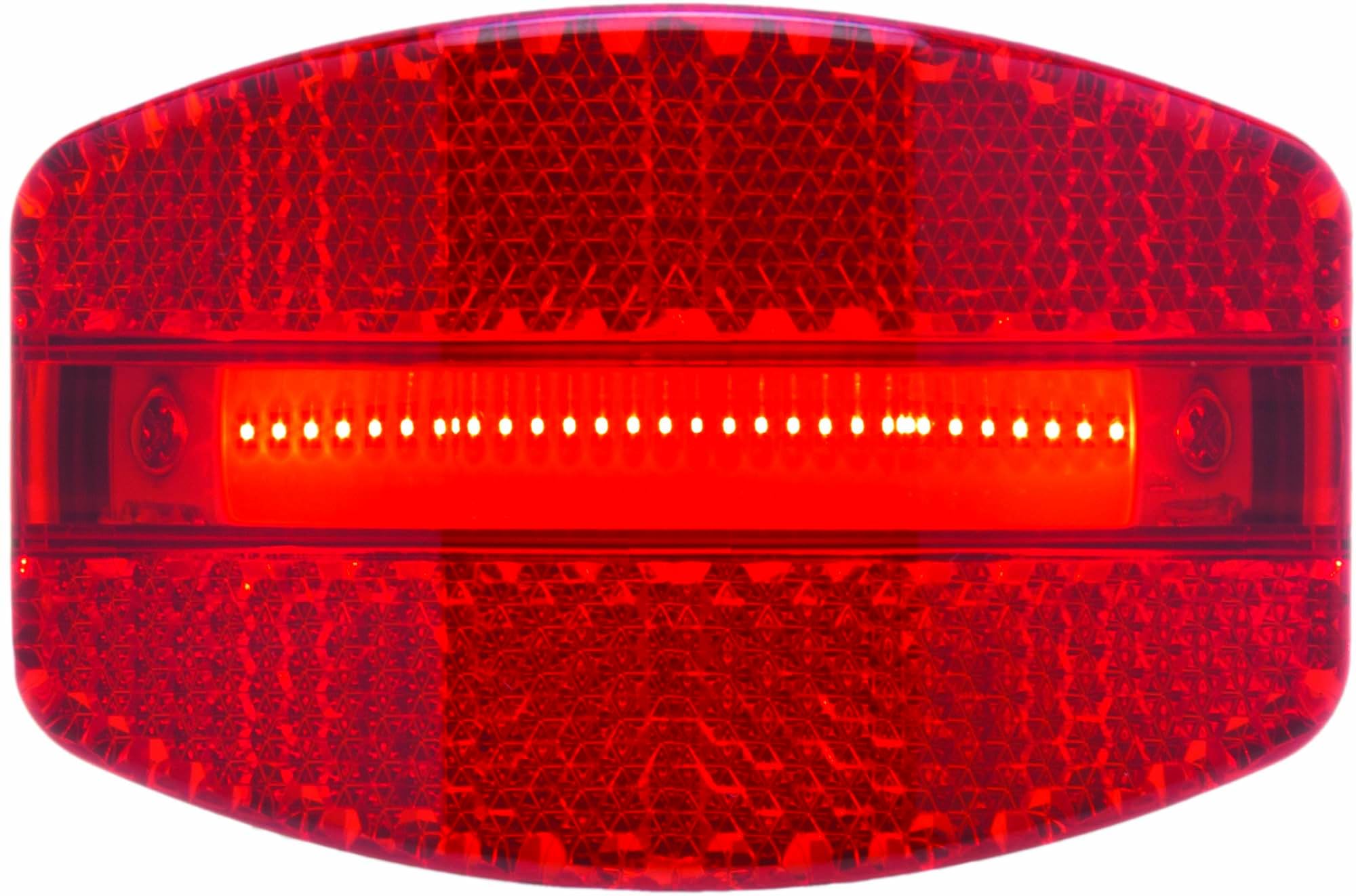
A 13-lumen taillight with a built-in reflector that keeps working even when the batteries die — a true backup.
The Grateful Red uses 28 LED microchips to produce 13 lumens of light, but its real a neat extra is that it doubles as a certified reflector when the light is switched off — so even with dead AAA batteries you still have passive visibility. Three modes give you flexibility: 26 hours on steady at 13 lumens, 45 hours on courtesy (4-11 lumens pulsing), and up to 150 hours on Superflash at 13 lumens. That 150-hour Superflash run time is 50 hours longer than the 100-hour Superflash on the Planet Bike Superflash model.
At 3.04 ounces it is 0.32 ounces lighter than the 3.36-ounce Superflash, and the included mounts (rear rack, seat post, and a clip mount) offer more mounting flexibility than the MagicShine SEEMEE 300 which only fits seat tubes. The IPX3 rating (protection from light rain and splashes) is more limited than the IPX6-rated ROCKBROS or MagicShine, so it is better for fair-weather riders. Buyers call it “reliable” and note it “fails slowly” as batteries drain rather than abruptly going dark. One reviewer pairs it with a Blackburn 2’FER and says the Grateful Red pulse is “highly visible from a mile away.”
Built-in safety
- Doubles as a certified reflector when the light is off — a true backup visibility layer
- Runs on 2 AAA batteries with up to 150 hours in Superflash mode
- Includes multiple mounts (rack, seat post, clip) for flexible placement
Limitations
- IPX3 rating is only splash-proof — not suitable for heavy rain or submersing
- No auto-off function, so you have to remember to switch it off manually
Great for: Casual riders who want a dead-simple, battery-operated light that still reflects light even when it is off.
Not for: Wet-weather commuters or anyone who needs USB recharging convenience rather than swapping AAA cells.
6. Planet Bike Superflash

A proven 7-lumen tail light that riders have trusted for over a decade and through multiple bike swaps — and it runs on AAA batteries for months.
At 7 lumens the Superflash is the dimmest light on this list, but lumen count tells only part of the story — the 1/2-watt Blaze LED combined with 2 eXtreme LEDs creates a strobe pattern that punches impressively far down the road, and buyers consistently call it “very bright for daylight” and “visible in bright sunlight.” The battery life is legendary: 60 hours on steady at 7 lumens and up to 100 hours on Superflash at the same 7 lumens. One owner reported running it for 24 hours of actual use over 11 months (10 minutes three times per week) without ever swapping batteries.
The IPX5 rating (water jets from any direction) is a step above the Grateful Red’s IPX3, making it notably better for rainy conditions than that sibling model. It comes with seat post, seat stay, and clip mounts for flexible installation, and at 3.36 ounces it is solid but not heavy. The bayonet-style mount is easy to swap between bikes — one customer observed using it across 7 different bikes. The two modes (steady and Superflash) are simple, but the lack of a low-battery indicator means it can go dark without warning once the AAA cells deplete — a trade-off for that low price.
What loyal fans love
- Wildly long battery life — one buyer got 11 months of commuting out of a single set of batteries
- Strobe is surprisingly bright for 7 lumens and cuts through direct sunlight
- IPX5 is properly weather-resistant for rainy commutes
Honest downsides
- No battery indicator — the light just dies when the AAA cells run out
- Only two light modes: steady and Superflash; no pulsing or daytime-specific pattern
Ideal for: Budget-conscious riders who want a no-fuss, battery-operated rear light that can go months between changes and still be seen in daylight.
Not for: Riders who want USB rechargeability, multiple flash patterns, or a battery gauge to predict when the light will cut out.
Understanding the Specs
Lumens — Not the Whole Story
Lumens measure the total light output from a source, but for a rear bike light, how that light is directed matters more than raw brightness. A 500-lumen light focused in a narrow beam is less useful than a 13-lumen light with optics that spread red across a wide angle. Look for lights that specifically advertise beam pattern or side visibility — 180 to 260-degree coverage is ideal for catching drivers approaching from the side.
IP Ratings Explained
An IP rating tells you how well the light resists dust and water. The first digit is for solid particles (like dust), the second is for liquids. For a back bicycle light, IPX3 means it can handle light rain and splashes, IPX5 can take water jets from any direction, and IPX6 can handle heavy rain or even powerful water spray. If you ride year-round in wet weather, aim for at least IPX5 — IPX3 lights are fine for occasional use but may fail in a downpour.
FAQ
How many lumens do I really need for a rear bike light?
Is USB-C charging important for a bike tail light?
Will a back bicycle light fit any seat post?
How long does a rechargeable bike tail light battery last before it needs replacing?
What does a brake sensor on a bike light actually do?
Can I mount a back bicycle light on my helmet or backpack?
What is the difference between steady mode and flash mode for battery life?
Is a brighter tail light always better for safety?
Final Thoughts: The Verdict
For most riders, the best back bicycle light overall is the MagicShine SEEMEE 300 because it combines the longest all-around protection with 260° visibility, smart brake and ambient light sensors, and a tough aluminum body. If you want the absolute best battery life — 270 hours between charges — grab the Cygolite Hotshot 100. And for a budget-friendly workhorse that has been road-proven for over a decade, the Planet Bike Superflash is still a reliable choice.
How We Picked
We do not accept paid placement. Every pick is matched to a real buyer and a real use-case; we do not hands-on test units.
Sources & Methodology
Specifications: manufacturer listings and product documentation. Review insights: verified customer reviews, as of July 2026. Pricing: not shown on this page (it changes often); check the current price via the retailer link.
As an Amazon Associate, Gadgets Feed earns from qualifying purchases. This does not affect which products we feature.
Related Guides
Product prices and availability are accurate as of the date/time indicated and are subject to change. Any price and availability information displayed on Amazon at the time of purchase will apply to the purchase of this product. As an Amazon Associate I earn from qualifying purchases.
CERTAIN CONTENT THAT APPEARS ON THIS SITE COMES FROM AMAZON. THIS CONTENT IS PROVIDED "AS IS" AND IS SUBJECT TO CHANGE OR REMOVAL AT ANY TIME.
Amazon and the Amazon logo are trademarks of Amazon.com, Inc. or its affiliates.