
Our readers keep the lights on and my morning glass full of iced black tea. As an Amazon Associate, I earn from qualifying purchases.
Specs are compiled from manufacturer listings and verified buyer reviews and can change over time — please confirm the key details on the product page before buying.
If you have spinal stenosis, you need a brace that takes pressure off your nerves by supporting your lower back while you sit or stand. The Rakiie Lower Back Brace for Women is the strongest all-round pick for most people. The wrong brace squeezes your spine instead of bracing it from the sides, and it stops helping the moment you sit down. Below are the eight braces worth your time, sorted by who they genuinely fit and what each one actually does.
I’m Min — the founder and writer behind Gadgets Feed. This guide is built by comparing the manufacturers’ published specifications and the patterns across verified customer reviews, so you get each pick’s real strengths and trade-offs instead of marketing spin.
Start with your waist measurement and your daily routine, then match those to a brace’s support style. A soft elastic belt with flexible stays suits everyday walking and desk work, while a rigid, pulley-tightened brace suits lifting and heavier support needs. The picks below cover both ends of that scale so you can find the right one for your back.
Our Picks at a Glance
How To Choose The Best Back Brace For Spinal Stenosis
Spinal stenosis narrows the space around the nerves in your lower spine, and for most people the pinch gets worse when they stand or walk and eases when they sit and lean forward. That detail changes everything about how you pick a brace. You are not just looking for something tight and warm — you want support that holds your lumbar curve in a position that keeps pressure off the nerves.
Support style matters more than strap count
A brace holds your lower back in one of two ways: with vertical stays that run up the back panel, or with side plates that brace you from the left and right without pressing on the spine itself. The Rakiie 7-stay design and the FEATOL 5-stay belt use the first approach, while the SOLOEVER H-shaped bionic support uses the second. Neither is automatically better — the stay style tends to feel firmer against the spine, while side-wrap styles tend to avoid pressing directly on a tender spot. If your discomfort is worst right on the bone, a side-wrap design is often the gentler place to start.
Measure your waist at the navel, not your pants size
Every sizing chart in this category is built on your actual waist circumference at the navel, so measure there with a soft tape before you order. FEATOL lists its fit in seven bands from 25.6 to 65 inches, and Rakiie’s 7-stay brace splits its sizes from S at 27.6–33.5 inches up to XXL at 51.2–62.9 inches. Both makers warn that if your measurement lands at the top of a band, you should step up a size. The single most common complaint across these braces is not quality — it is ordering too small, so give yourself room.
Think about what you will be doing while you wear it
A rigid, tightly tensioned brace is excellent for lifting and heavy tasks, but several buyers find that the same firmness is too much when driving. Softer mesh-and-gel designs suit long desk days and can sit discreetly under clothing. Match the brace to your day: if you are mostly seated, lean toward breathable fabric and side-wrap support. If you are lifting or on your feet, a stay-reinforced belt earns its keep.
Quick Comparison
| Model | Best For | Support System | Adjustment | Fabric & Weight | Amazon |
|---|---|---|---|---|---|
| Rakiie Lower Back Brace for Women (9X)★ Best Overall | All-day seated support for women | 4 bars + 2 springs + 2 PP strips + 1 spine bar | 2 straps, 4 bands | 3D mesh knit, 0.49 kg | Amazon |
| SOLOEVER Back Brace with Bionic Support SystemTop Performer | Long wear without rib squeeze | H-shaped bionic side-wrap, 8 straps | 8 straps, 2 modes | 4D knit, 12-hole air mesh | Amazon |
| Sparthos Back BraceBudget Champion | Everyday walking and work | Vertical stays + lumbar pad | Double-layer straps | Breathable mesh, 408 g | Amazon |
| Rakiie Back Brace Lumbar Support (7 Stays) | Fast on-and-off plus quick mobility | 4 alloy stays + 2 springs + 1 plate | Dual straps + pulley | 4-way stretch, 0.38 kg | Amazon |
| Aspen Lumbar Support Back Brace | Localized compression control | Rigid inelastic shell | Patented 4:1 pulley | Nylon, 12.32 oz | Amazon |
| FEATOL Back Brace with 5 Stays | Wide sizing range | 3 aluminum stays + 2 support plates | Dual-tension straps | Mesh panels, 1.16 lb | Amazon |
| LSO Back Brace with Decompression Plate | Propped-up sitting support with an arch | Bionic decompression arch plate | Pulley + finger tabs | —, 1.17 lb | Amazon |
| BraceAbility LSO Back Brace | Post-surgery and plus-size support | Removable rigid back panel | Dual pull-tension straps | Rigid panel, ~3 lb | Amazon |
In‑Depth Reviews
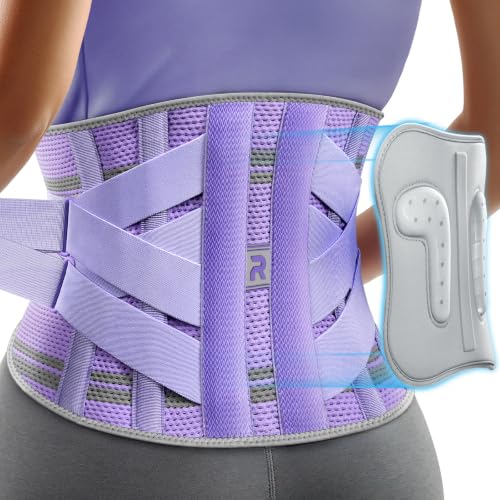
1. Rakiie Lower Back Brace for Women, 9X Support System, Purple M
Our pick — 4.5★ from 500+ verified ratings; the strongest balance of quality and price.
The women’s brace that makes a desk chair stop feeling like a punishment
If your lower back tightens every afternoon at your desk, this is the brace to reach for first. Rakiie built it around the female waist-to-hip shape, and the support comes from nine separate components: four memory aluminum bars, two elastic springs, two PP strips, and one spine-guiding bar. That means the firmness is spread across the whole lower back instead of digging into one spot. A built-in 3D contouring gel pad sits against your back to spread that pressure and keep the panel from biting in.
What wins people over is the fit. The dual straps and four compression bands let you dial tension in small steps so you get even pressure across the lower back, and the reinforced hook-and-loop fasteners are tested to hold through more than 3,000 opens and closes. The fabric is a light 3D mesh knit at 0.49 kg, so it can sit under clothing without announcing itself. The included detachable extension strap stretches the size range further, which is a real comfort if you are between sizes or sharing the brace at home. One owner put it plainly when she said the brace was the most comfortable she had worn, with no sweating, pinching, or riding up.
Here is the honest catch: the same firm shape that supports you standing can feel rigid once you sit down and drive. A 5’5″, 145 lb buyer in a size M found it fit fine standing but wanted more length when seated, and called it too rigid for driving. So buy the extension strap to advantage and size up if you spend long hours in a car seat. For desk work, walking, and chores, though, this is the brace that keeps the support where you put it.
What holds up well
- Nine support components including four memory aluminum bars spread the firmness evenly and keep the shape tailored to the female waist rather than a straight belt
- The 3D gel pad sits soft against your back, and the 3D mesh knit stays breathable through long days
- Fasteners rated for over 3,000 openings and closings, so the tension you set stays where you set it
- Extension strap widens the size range and helps family members share one brace
Where it asks something back
- Rigid enough that driving or slouching in a car seat can feel stiff by the end of the trip
- Some buyers find the correct size runs snug when seated, so measuring at the navel and sizing up is worth it
- Hand wash and air dry keep it in shape, so it needs a little care
- Purple only, and the mesh finish picks up lint over time
Reach for this if: you want targeted lumbar support that stays put through a desk day, chores, or a walk, and you value a tailored women’s fit.
Think twice if: you spend most of the day seated in a vehicle, where a more flexible belt will feel kinder than this firm build.
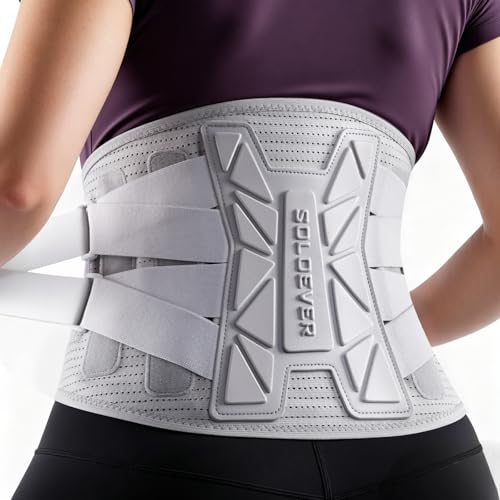
2. Back Brace for Women Men Lower Back Pain Relief with Bionic Support System
The brace that braces your back from the sides instead of pressing on the spine
Most belts in this category push straight down on your lower spine. This SOLOEVER design does the opposite. Its H-shaped bionic support wraps around the sides of your lumbar area so the stabilising force comes from the left and right, and the center avoids direct contact with the spine itself. If your sorest spot is right on the bone and you want it left alone, this is the shape to look for. It also skips rib-cage compression, so it targets the lumbar zone without squeezing your chest.
Eight straps and two compression modes are the selling point here. Eight adjustable straps give you two distinct compression modes — a soothing setting for lighter support and a strong pressure setting when you need more. The fabric is 4D knitting finished with 12-hole air mesh, which is built to move air so you do not end up damp under the panel. A dog groomer who has to bend and reach all day said the brace helped a lot for the awkward positions she works in, which is exactly the case a side-wrap design is made for.
The trade-off is sizing. The closures hold firm without loosening as you move, but the cut runs snug, and a 4.4-star brace with hundreds of reviews can still produce fit misses depending on your body. One reviewer noted that if they bought again they would order a size bigger. The recurring fit note is the one thing to plan around here — measure your waist and lean toward the larger size if you are between bands.
Why it lands here: the H-shaped side-wrap keeps the spine clear while still delivering real lumbar support, and the two compression modes let you shift from gentle to firm as your day changes.
What to plan for: with eight straps to route and a snug cut, expect a minute of fussing during the first few wears while you learn where each strap likes to sit.
Depend on it for: putting the pressure on the sides of your back rather than the middle, and for jobs that keep you bending and reaching.
Steer clear if: you want a simple one-strap belt you can throw on without thinking about adjustment — this one asks you to tune it.
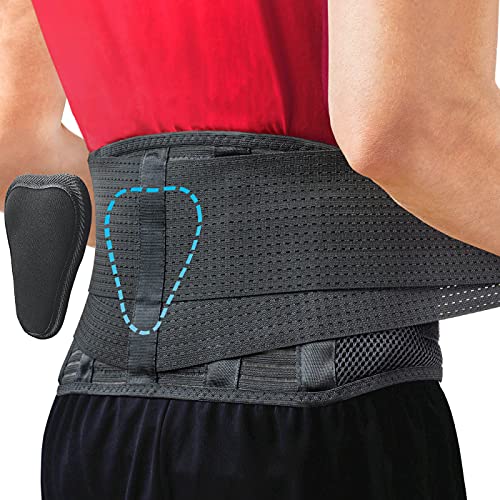
3. Sparthos Back Brace for Women & Men, Sciatica, Lower Back Pain – Black-L
The everyday workhorse: vertical stays and a lumbar pad that keep supporting without fuss
A removable lumbar pad and vertical stays deliver no-frills support that stays put. A removable lumbar pad gives you extra compression at the base of your back, and vertical support stays run up the back panel to keep the brace from rolling down as you move. That non-rolling behavior is what makes a brace survive a full workday. It is a hook-and-loop closure with double-layer straps, so you set your tension once and it stays there through walking and light lifting.
The fabric and weight suit all-day wear: breathable nylon-plastic construction at 408 g, thin enough at 0.15 inches to sit under clothes without bulging. An adjustable fit combined with the lumbar pad makes it a favorite for work and heavy tasks, and buyers routinely compare it to more expensive options and come back satisfied. It also holds up — one buyer who struggled with severe gluteus medius pain said the belt helped quite a bit and was easy to adjust for adequate support.
There is a firmness note to weigh before you commit. A few owners find it keeps you warm during long walks and a little stiff when you need to bend over, so if you prize total flexibility over firm bracing, the support style of the SOLOEVER above may suit you better. For walking, standing, and general work, though, it delivers the sturdy feel this category is built for — and its size run covers from a small 5’7″ wearer up through larger frames, so measure first.
The honest read: no-frills support that stays put — the lumbar pad does the targeted work while the stays stop the panel from rolling.
One thing that tires you: long walks can get warm under the panel, and bending feels less free than with a softer side-wrap design.
Pick it if: you want durable, low-profile support for work, lifting, and daily walking at a friendly tier.
Look elsewhere if: your priority is maximum flexibility when bending forward — a stretchier design will feel better.
4. Rakiie Back Brace Lumbar Support for Lower Back with 7 Stays

Seven stays of firm support you can pull on in about ten seconds
This Rakiie build runs its own course. Where the women’s version above leans on a nine-part layout, this unisex belt uses seven: four memory alloy stays, two spring strips, and one bionic lumbar plate that fits the natural curve of your lower back. The result is stable reinforcement that spreads firmness along the spine. A detachable 3D pad adds cushioning and compression right at the core, which is where the support needs to land when you are working or lifting.
What keeps this one practical is the speed. The dual compression straps and pulley system let you snap it on in about ten seconds using the waist velcro and side mini-straps, and the tighter you pull the side straps the firmer the hold. The 4-way stretch fabric and 3D knitting keep it breathable and flexible, and the touch fastener is tested to hold through more than 3,000 uses. Support is the thing owners praise most here — it consistently lands as a comfortable, no-nonsense belt for lower back relief at work.
Two sizing notes worth knowing. The unisex chart runs from S at 27.6–33.5 inches up to XXL at 51.2–62.9 inches, and the maker suggests going one size up if your waist sits at the top of a band. A 72-year-old buyer at a 38–40 inch waist found the medium too small and moved to a large, so treat the top of the chart with respect. The payoff is a belt that lets you move freely while it holds your lower back steady.
Working in its favor
- Seven support points — four alloy stays plus two springs plus a lumbar plate give broad, even reinforcement
- Ten-second on and off through the waist velcro and side mini-straps makes quick breaks easy
- 4-way stretch and 3D knitting keep it flexible and breathable through long shifts
- Touch fasteners rated for over 3,000 uses for a lasting grip
Points to weigh
- Sizing runs on the tighter side at the top of each band, so a size up is often the safer call
- The unisex cut does not follow a women’s waist curve the way the women’s Rakiie does
- Extra force comes with extra tension, so get the strap tension dialed before a full day of wear
- Touch-fastener tabs can snag delicate tops if you are not careful
Made for: anyone who wants firm lumbar support they can slip on and off in seconds between tasks.
Not the pick if: you need a women’s-specific cut, or your waist measurement sits right at the top of the size chart.
5. ASPEN Lumbar Support Back Brace, Patented Pulley System with Targeted Compression, Pain Relief for Men & Women, Large, 36″-42″

The inelastic brace that lets you tighten the bottom and the top independently
The Aspen is the brace for people who want to control exactly where the pressure sits. Its patented 4:1 pulley system lets you tighten the top and the bottom of the brace separately, so you can dial more compression into one zone than the other without needing much grip strength. The yellow-pages detail that matters: the material is inelastic, meaning it does not stretch, so the support acts more like an external frame against your lower back than a soft band that gives with movement.
The nylon fabric is breathable and free of neoprene smell, so it stays wearable under clothing for long stretches. It is a low-profile design in six sizes, and buyers repeatedly say the pulley system outperforms the simpler belts they have tried and that the brace hugs the lower back. Its inelastic shell and 4:1 pulley give it a firmer, more clinical hold than the mesh belts here.
Two warnings before you buy. First, it runs small — size up if you are near a boundary, because you can always tighten a larger brace but cannot loosen a too-small one. Second, the inelastic shell has almost no give, which is a gift for lifting but a poor fit for cardio or lots of bending. If your day is heavy, focused work, this is the tightest hold in the lineup; if you need stretch and give for movement, look to the mesh designs above instead.
Where the money goes: a mechanical pulley that puts leverage in your hands — one pull creates tight, localized compression, and the two tabs let you tune top and bottom on their own.
The one I would caution you on: order a size up — the inelastic build leaves little room to grow into a brace that is already snug.
Suits you most when: you lift, garden, or travel and want firm, non-stretch support you can tune zone by zone.
Skip this one if: you expect a soft, stretchy feel or want to wear it for aerobic activity — it holds steady, it does not flex.
6. FEATOL Back Brace for Lower Back Men Women, 5-Stays Lumbar Support Belt, L
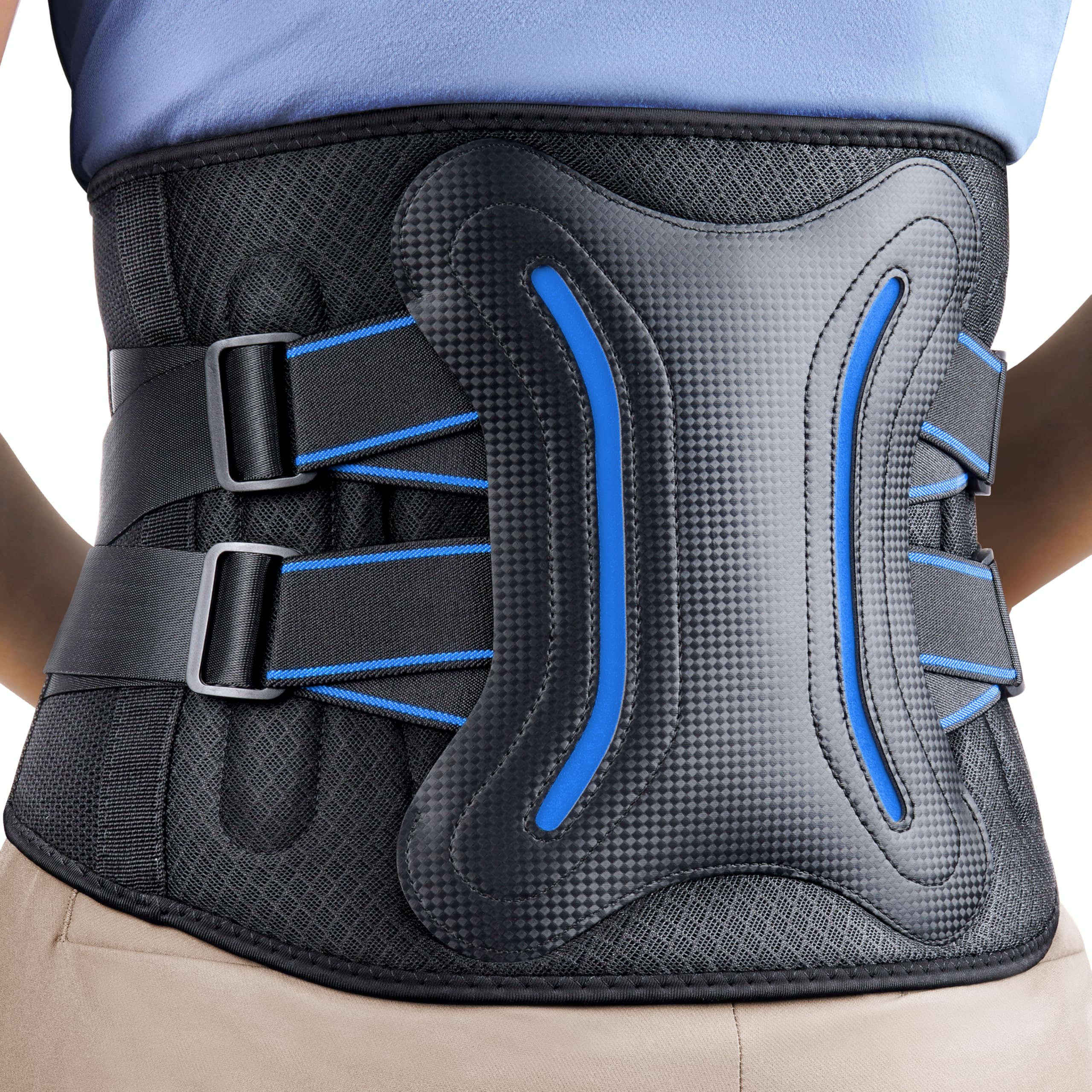
The belt that guards against rolling, so the support never ends up bunched in one spot
FEATOL’s design answers the complaint that other belts roll down and bunch up as the day wears on. Three memory-aluminum stays and two support plates deliver 360 degrees of stability, and the arrangement is the clever part: a central stay aligns with your spine while the lateral stays keep the panel from rolling or bunching when you sit. That means the support stays where you put it instead of migrating up your back. It comes in a very wide size run — from 25.6 inches all the way to 65 inches — so it is the easiest pick to fit across different body types.
Two tension settings keep it versatile. The dual-tension straps let you stay loose for general walking and cinch down tighter for lifting, and the mesh panels vent heat so you are not swampy after an hour of wear. It weighs 1.16 pounds and is thin enough to disappear under a loose layer. Owners praise the hand loop and quick application, which make it go on almost as fast as it comes off.
Here is the fair caveat: at 1.16 pounds with five firm stays and two plates, this is a bulkier belt than the stretch fabrics, and it can feel heavy and warm under tightly fitted clothing during extended wear. Size L is cut for a 36-inch waist. If you favor a light mesh build, one of the Rakiie braces above is a better match. But if what you want is dependable support that resists rolling and fits almost any waist, this belt earns its place.
Standout detail: the central-plus-lateral stay layout is directly aimed at the roll-and-bunch problem, and the seven-band sizing makes it the safest bet for a fit without guesswork.
The one to get if: you are hard to fit or you are fed up with belts that migrate during the day.
Give it a miss if: you want the lightest possible wear under slim clothing — the firm stays and plates add real heft.
7. LSO Back Brace with Maximum Decompression Plate(L/XL fit belly 33.75-47″)

A brace with a built-in arch that changes the way your lower back sits
This is the most specialized pick in the list, and the one whose name matches this category most directly. Its centerpiece is a bionic decompression plate that fits an adjustable arch to the lumbar area, and you can change how much arch you get across three settings — the biggest arch stretches the lumbar to 26 degrees, a lower arch shifts to sacroiliac protection, and removing the arch turns it into a general preventive belt. The idea is to support the L1 to S1 vertebrae and stabilize the lower back rather than simply wrapping it.
The pulley system here is built for people with limited grip strength. Finger tabs let you pull the brace tight without a strong hand, which is a genuine help for anyone whose hands tire easily. Abdominal support comes from an adjustable extension velcro piece and a removable soft plastic plate, making it a fit for post-surgical bodies and heavier frames. Its sizing is measured at the belly button: S/M fits 23.5 to 33.75 inches, L/XL fits 33.75 to 47 inches, and 2XL/3XL fits 47 to 59 inches.
The caveats are real but narrow. The price sits in the higher tier, and like any pulley-equipped arch brace, durability depends on gentle handling — the pulley and plate do not want to be yanked. One buyer tried this belt on a neurosurgeon’s recommendation and reported it helped. If you want an arch that changes how your lumbar is supported rather than just how tightly it is wrapped, this is the design built for exactly that.
Why it stands out: the adjustable 26-degree arch is a genuinely different mechanic from plain compression — it props the lumbar curve rather than only squeezing the back.
Handle with care: the pulley parts reward slow, deliberate use, so this is not a brace to rip on and off.
Best matched to: a specific vertebral-stabilization need where an adjustable lumbar arch and low-effort pulley tightening matter most.
Consider a different path if: you want a no-fuss everyday belt or your budget leans toward the mid-tier picks above.
8. BraceAbility LSO Back Brace for Women and Men – Medical-Grade Lumbar Brace for Herniated Disc, Sciatica, Spinal Stenosis, Spondylolisthesis, Post-Surgery Recovery, Hot and Cold Therapy (L)

The full-coverage option that adds a hot and cold pack to rigid lumbar bracing
This is the most structured brace in the lineup and the one built for the longest recovery stretch. It stabilizes the spine from the T9 vertebra through the lumbosacral junction for a broad band of support, and the removable abdominal and back panels let you dial how rigid it feels. Easy-grip hand loops mean most wearers can put it on and take it off alone, which matters when you do not want to depend on someone else to get dressed. It also stretches to cover plus-size frames up to a 68-inch waist, with a non-slip fit across body types.
The bonus feature nobody else in this list offers is the included reusable hot and cold therapy gel pack, which slides into the built-in back pocket. You get either heat or cold from the same brace, depending on what you want that day. The closure is hook-and-loop, and the whole build is aimed at firm, structured stabilization rather than flexible everyday comfort. Comfort lands as a strong point here — a buyer who had been in a full-immobilization brace for a broken back called this a great next-step brace to stop the spine from bending while it healed.
Now the honest part: this brace weighs about 4 ounces and runs a rigid panel around 3 pounds in hand, so it is noticeably heavy and it is designed for average to tall torso lengths. A shorter-waisted wearer found the front panel too long and the fit awkward, and the maker advises sizing down if you are between sizes. If you have a short torso or want light daily wear, the FEATOL or Rakiie picks fit better. If you are working through a surgery recovery with a hard need for firm, full-coverage stabilization and a temperature pack, this is the one built for the job.
Where it earns its keep
- Stabilizes the spine from T9 through the lumbosacral junction for full lower-spine coverage
- Removable rigid panels let you set how firm the brace feels, and it stretches to a 68-inch waist
- Includes a reusable hot and cold therapy gel pack that slots into the built-in back pocket
- Easy-grip hand loops so most people can apply it independently
Where it pushes back
- Heavy rigid build that is designed for average to tall torsos, so it can feel long in the front on shorter frames
- Premium tier and the most expensive of the group
- Hand wash and air dry only, no machine washing
- The firm structure suits upright work rather than lounging or lying down
The heavy-duty answer: choose this when full, rigid, spine-wide stabilization over a recovery period is exactly the point.
Consider the mid-range instead if: you have a short torso, want something light for daily wear, or do not need the gel pack.
Understanding the Specs
Support System (stays and plates)
The support system is the rigid skeleton inside the brace: the vertical stays, spring strips, and plates that hold your lumbar curve in place. A brace with four memory aluminum bars and a spine-guiding bar, like the Rakiie 9X, spreads firmness evenly along the back. A brace with a single removable arch plate, like the LSO, proposes one specific shape instead. More support points spread the reinforcement more evenly across your lower back, while a rigid, non-stretch shell like the Aspen holds tighter and stiffer than a flexible one.
Closure and adjustability
Closures come in two flavors: hook-and-loop (the velcro-style fasteners most guides use) and mechanical pulley systems. Hook-and-loop is fast and simple and works for everyday wear; a pulley system uses finger tabs and leverage so you can create tight, localized compression without strong grip. The Aspen 4:1 pulley and the LSO finger-tab pulley fall into that second camp. Also look at whether the brace lets you tighten the top and bottom separately — that independent control is what turns a general belt into a brace that targets one specific zone.
FAQ
Will a back brace help with spinal stenosis when I am sitting or standing?
Should I buy a rigid back brace or a soft one?
How do I measure my waist to order the right size?
Can I wear a back brace for spinal stenosis all day?
Why does my brace feel tight standing but loose when I sit?
Is a pulley-system back brace better than a velcro one?
What is the difference between an LSO brace and a lumbar belt?
Do I need a low-profile brace that hides under clothing?
How long will a back brace hold up with daily use?
Will a back brace fit me if I have a larger frame?
Final Thoughts: The Verdict
For most people looking for the best back brace for spinal stenosis, the Rakiie Lower Back Brace for Women is the winner — its nine-part support system spreads firmness evenly, the gel pad keeps it comfortable, and the dual straps let you set the tension where your back needs it. If what you want is side-wrap support that leaves your spine alone, reach for the SOLOEVER with its H-shaped bionic design and two compression modes. And if you need full rigid spine-wide stabilization through a recovery period, the BraceAbility LSO, with its rigid panels and included hot and cold gel pack, is the one built for the job. The one nudge worth making: the Rakiie women’s brace sits near the top of the bunch for overall satisfaction, so if your day is mostly seated or on your feet, it is the safest first pick to try.
How We Picked
We do not accept paid placement. Every pick is matched to a real buyer and a real use-case; we do not hands-on test units.
Sources & Methodology
Specifications: manufacturer listings and product documentation. Review insights: verified customer reviews, as of September 2026. Pricing: not shown on this page (it changes often); check the current price via the retailer link.
As an Amazon Associate, Gadgets Feed earns from qualifying purchases. This does not affect which products we feature.