
Our readers keep the lights on and my morning glass full of iced black tea. As an Amazon Associate, I earn from qualifying purchases.
Specs are compiled from manufacturer listings and verified buyer reviews and can change over time — please confirm the key details on the product page before buying.
If your lower back stiffens every time you stand up from a desk chair, a back decompression table is the piece of home equipment that actually targets that feeling. It stretches your spine lengthwise, taking loading pressure off the discs so the muscles around them can unwind. What matters most is matching the design to your body and your mobility — an inversion table tips you backward at an angle, while a flat traction table stretches you horizontally with no head-down position at all. Get that match right and five or ten minutes a day becomes a routine you keep.
I’m Min — the founder and writer behind Gadgets Feed. This guide is built by comparing the manufacturers’ published specifications and the patterns across verified customer reviews, so you get each pick’s real strengths and trade-offs instead of marketing spin.
You will see which models are certified, which ones come mostly pre-built, and which designs suit stiff hips or a weak grip. The most important thing I learned researching the best back decompression table is that match matters far more than brand name: an adjustable-length flat bench with an airbag cushion and a quiet crank often fits a smaller home far better than a full inversion machine. So before you buy, check your ceiling clearance, your floor space, and whether you can comfortably get down onto a low bench.
Our Picks at a Glance
How To Choose The Best Back Decompression Table
The two families of machine you will see here work on the same principle — lengthen the spine to take load off the discs — but they feel completely different to use. An inversion table rotates you backward on a pivot, so gravity does the pulling. A flat traction table keeps you lying down and pulls lengthwise with a hand crank or a motor. Picking the wrong family is the most common reason a machine gets abandoned within a month.
Inversion versus flat traction: which suits you
Inversion tables like the Teeter models rely on you tipping past horizontal, with secure ankle holders taking your full body weight. That works well if your ankles tolerate it and you want to control the angle with your own arm movement. Flat tables keep you horizontal, so your ankles carry nothing and your head never goes below your heart. If you have trouble getting up off the floor, a flat bench set very low is a genuine obstacle — several buyers mention exactly that. Check the seat height before you commit.
The specs that decide whether you will actually use it
Height range comes first: a machine rated for a narrower band than your own height will never fit right, and adjusting it every session gets old fast. Look for an adjustable-length crank with numbered settings so you can dial the length to your body once and repeat it. Weight rating tells you how much load the frame is built to hold, and a frame rated well above your own weight tends to feel steadier under you.
Then look at how the thing is pulled. A manual crank costs less and needs no power outlet, but you have to physically wind it while lying down. An electric linear motor does the pulling at the tap of a button, which matters a lot if gripping and turning a handle is painful. On inversion tables, the ankle holder design is the comfort make-or-break — wrap-around cups and an easy-reach lock handle make solo sessions far simpler. Assembly and manual quality are the other recurring theme: a clear manual and a labelled parts bag save an afternoon of frustration, and a badly translated one can leave you guessing.
Quick Comparison
| Model | Best For | Type | Weight Capacity | Height Range | Amazon |
|---|---|---|---|---|---|
| Teeter FitSpine X1 Inversion Table★ Best Overall | Full-body inversion with certified safety | Inversion | 300 pounds | 4 ft 8 in – 6 ft 6 in | Amazon |
| HARISON Inversion Table for Back Pain ReliefTop Performer | Heavier users wanting sturdy inversion | Inversion | 350 pounds | — | Amazon |
| Teeter FitSpine X2 Inversion TableEasy-Reach Pick | Easy-reach ankle lock and daily routine | Inversion | 300 pounds | 4 ft 8 in – 6 ft 6 in | Amazon |
| Spinal Decompression Machine (HOTMUZ) | Flat motorized traction at home | Electric flat traction | — | — | Amazon |
| Decompression Table Lumba Traction Device | No-cranking motorized stretch | Electric flat traction | — | — | Amazon |
| Spine Decompression Table Back Stretcher (DGRGRHBV) | Compact roller-stored flat bench | Manual flat traction | — | 59 in – 74.8 in | Amazon |
| Lumbar Decompression Table by Lumbar Bench Pro | Full-body stretch on a budget | Manual flat traction | — | 4.75 ft – 6.07 ft | Amazon |
| Electric Decompression Table for Neck & Back | Push-button stretch with no cranking | Electric flat traction | 440 pounds | — | Amazon |
| Home Lumbar Traction Table 220Lbs | Entry-level adjustable-length stretching | Manual flat traction | 220 pounds | 59 in – 74.8 in | Amazon |
In‑Depth Reviews
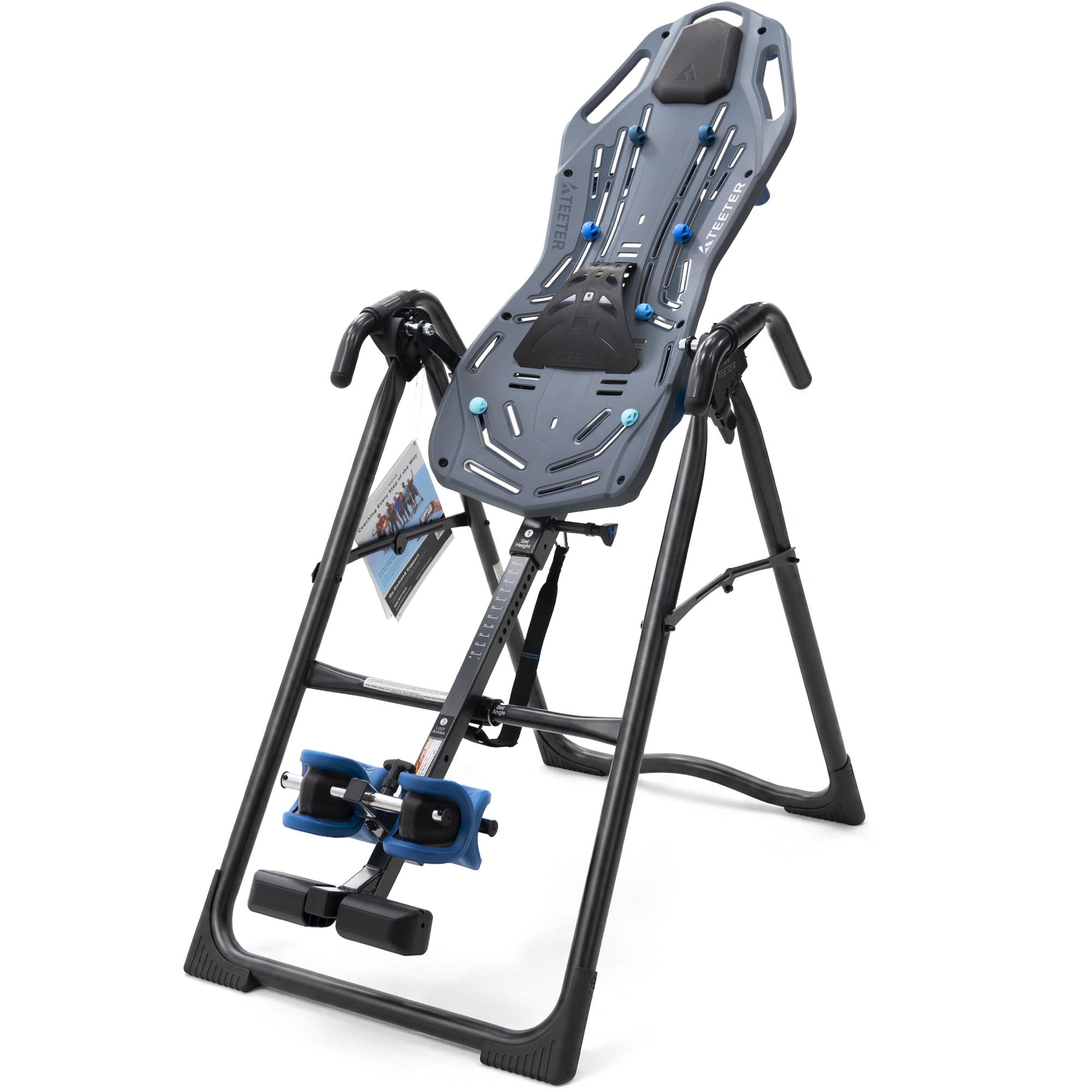
1. Teeter FitSpine X1 Inversion Table
Our pick — over 4.5★ from 900+ verified ratings; the strongest balance of quality and price.
The certified workhorse that holds 300 pounds and adjusts to your height
The FitSpine X1 is the table to beat if you want the widest margin of safety built in. It is certified to 300 pounds and rated to fit anyone from 4 ft 8 in to 6 ft 6 in — a band that covers most adults, tall or short. That 300-pound rating also gives it a real edge over the Home Lumbar Traction Table at 220 pounds, so a heavier user gets noticeably more headroom on the frame.
What wins people over here is the stretching itself. The backrest lets your body slide as you rotate, and the patented suspension system uses 8 floating points so the surface gives with you rather than fighting you. Eight acupressure nodes sit in varied heights to press into tight spots, and a lumbar bridge with an adjustable arch focuses the pull on your lower back. You control the rotation with your own arm movement, preset your maximum angle with the angle tether, or take it out for a full lock-out.
The honest catch is the learning curve. Getting on, finding your balance point, and settling in takes a few attempts, and the rocking motion feels unfamiliar at first. Owners describe starting with short, shallow sessions and working up slowly rather than diving straight into a steep angle. Assembly is straightforward with the BILT app guiding you through it, and the frame folds flat for storage without taking it apart. After the first week, most owners settle into a five-minute session.
Teeter spine flex hinge
- Certified to 300 pounds and rated for 4 ft 8 in to 6 ft 6 in — covers most adults in one frame.
- 8-point floating suspension and 8 acupressure nodes add give and trigger-point pressure.
- Heat-treated steel frame, UL Safety Certified, and a 5-Year Full Warranty back it up.
- Free Teeter Move app with guided sessions, no subscription.
footrests need adjusting
- The rocking motion and getting on take a few sessions to feel natural.
- It takes up floor space when set up, and it is heavy to shift if you are already sore.
suits best: anyone who wants a certified, adjustable inversion table and is happy easing into shallow sessions first.
think twice if: you need zero weight on your ankles at any point — a flat traction bench is the better fit.
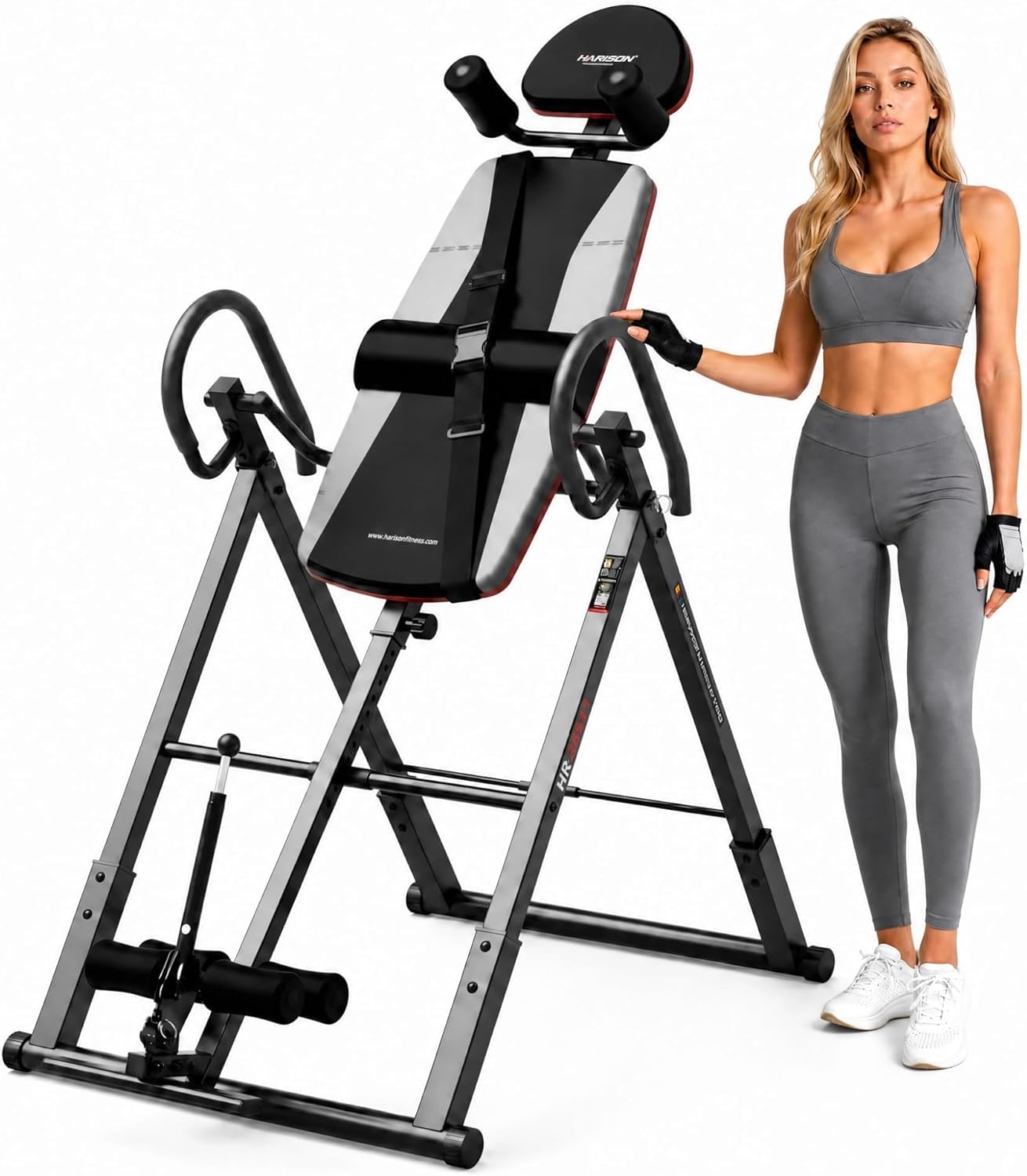
2. HARISON Inversion Table for Back Pain Relief
The high-capacity frame built for bigger bodies and full vertical inversion
If you are a heavier user, the number that matters here is 350 pounds. That is the highest weight capacity on this list, and compared with the 300-pound Teeter FitSpine X1 it leaves a wider margin between your own weight and the frame’s limit — which is exactly what a sturdy feel under you depends on.
Four side pins let you lock in 20, 90, 130, or 180 degrees, so you can start shallow and build up to full vertical. Safety comes in four layers: a belt, ankle immobilizers, and shoulder support, with ergonomic ankle holders shaped so your ankles are not crushed or pinched while inverted. The frame is alloy steel, and it arrives 80 percent pre-assembled, so most people finish the job in well under an hour with the included tools.
Sturdiness is the quality owners talk about most, and it carries over to bigger bodies — one 290-pound user reported no instability at all and effective decompression from the very first session. Memory foam on the backrest adds comfort. The recurring notes are practical rather than serious: the height adjustment is based on body mass rather than actual height, so a taller lighter user may need to reposition it, and full vertical inversion puts pressure on the ankles unless you pad them. The 180-degree setting is also the one aspect buyers feel most mixed about, so shallow angles are where most people settle.
sturdy steel frame: alloy steel frame, a 350-pound rating, and a 1-year warranty make this the pick for anyone who wants a machine that will not flex under them. It also comes with a 30-day trial, so you can test whether inversion suits you at all before committing.
made for: heavier users and anyone chasing full vertical inversion with four separate safety restraints.
less ideal if: you only ever want a light backward stretch — the extra capacity is wasted if you never invert past horizontal.
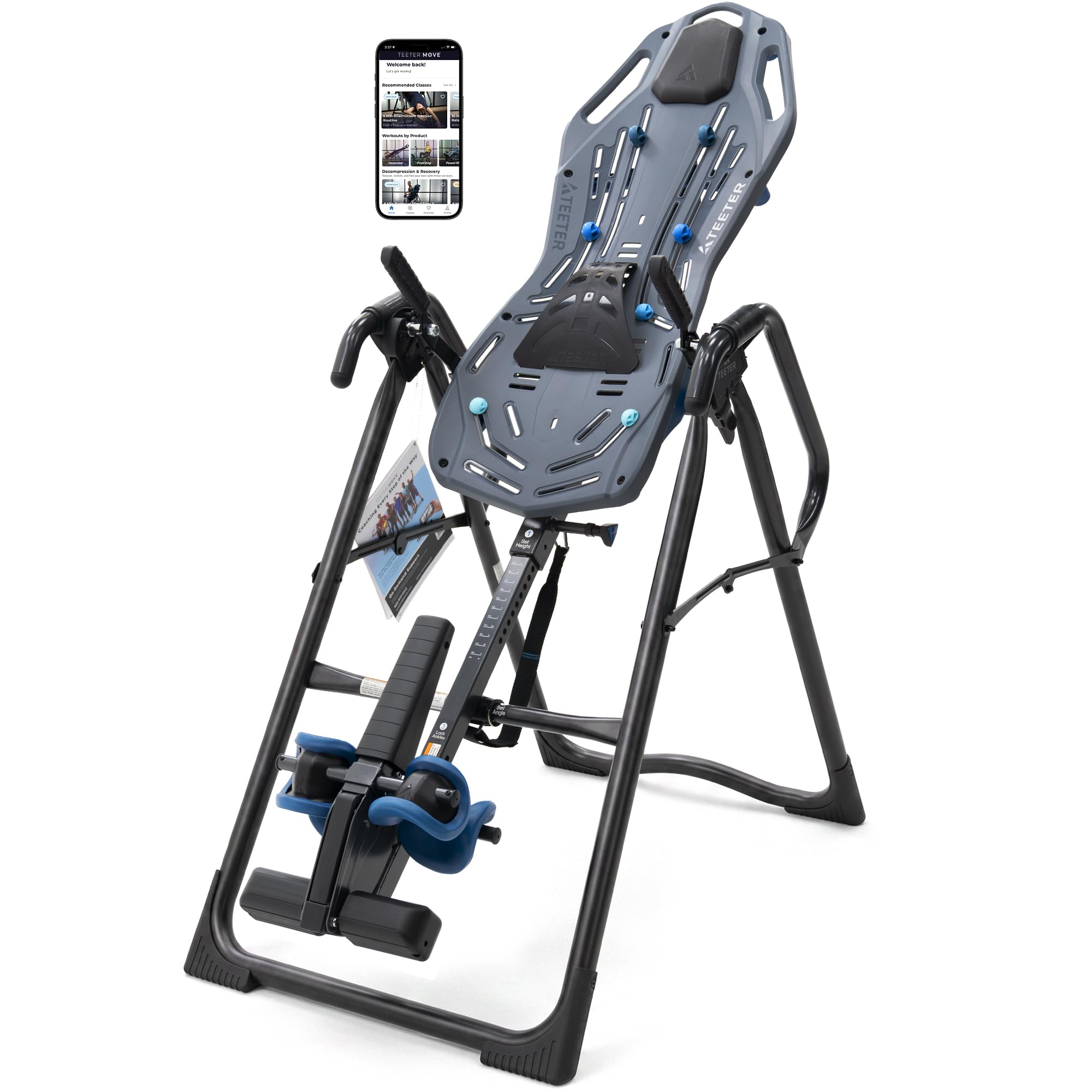
3. Teeter FitSpine X2 Inversion Table
The X1’s stretch, with an extended handle that locks your ankles without a wrestle
Same FitSpine backrest, same 8-point floating suspension, same 8 acupressure nodes and adjustable lumbar bridge as the X1 — the X2’s one big change is the extended ankle lock handle. That longer lever makes it far easier to secure your own feet without a helper or an awkward reach, and it is the upgrade Teeter owners themselves tend to point newcomers toward.
Everything else is the proven Teeter formula: heat-treated steel frame, UL Safety Certified, rated to 300 pounds and built for 4 ft 8 in to 6 ft 6 in. Your ankles sit in patented wrap-around cups on an easy-dial, 2-position foot platform, and rotation is controlled with your own arm movement. The angle tether presets your maximum tilt, or you can pull it for full lock-out. The free Teeter Move app adds guided audio and video sessions with no subscription, and the BILT app walks you through assembly.
What stands out in owner feedback is the routine it creates: a few minutes twice a day, easy to set up, and noticeable relief from the compression that builds up over a long sitting day. One careful note — the table is a solid 65 pounds, and it folds for storage but takes a deliberate hand to move, so find its permanent spot before you assemble it and a short tumble can be costly to anything below it.
easy answer for: solo users who want Teeter’s certified build with the friendlier ankle latch.
consider X1 instead if: the standard ankle lock is fine for you and you would rather not pick the heavier 65-pound frame.
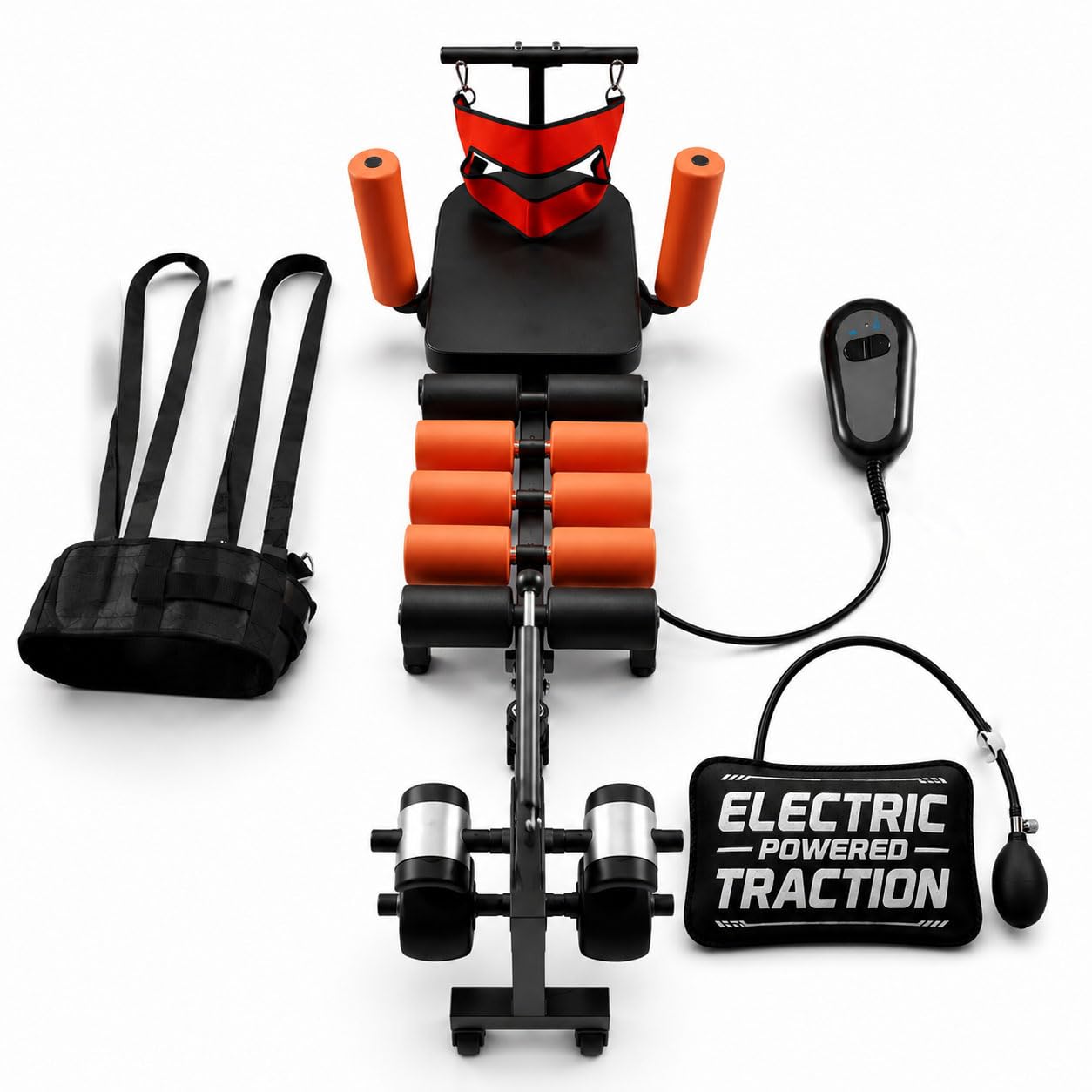
4. Spinal Decompression Machine Decompression Table for Back Pain Relief
A motor does the pulling, so you never crank a handle while your back is already aching
This is the flat-table answer to the inversion machines: you lie horizontally, strap in, and a high-torque electric linear motor supplies steady, non-pulsating traction at the tap of a button. That matters if winding a manual crank is painful for you, and it also keeps your head level — no blood rushing downward and no full body weight hanging on your ankles the way an inversion table does.
Adjustable shoulder and leg supports with soft sponge rollers hold you in place, and the backboard is shaped to follow your spine’s natural curve. It handles both lower-back and neck work, though not at the same time. The frame is reinforced steel with foam and PVC components, and it comes with a push-pull motor, an air bag, a bench frame, a sponge roller, and a strap. Assembly takes a real afternoon — roughly two hours on a first build — so set that time aside.
The honest trade-off is that this design asks you to get down onto the floor and back up again. Owners with good mobility take to it; for someone whose back is in a bad state right now, that climb down and back up is the moment to think hardest about. Instructions are the other recurring friction point — the printed guide leaves gaps, and owners do better with the videos. And the foam padding is firm, so a pillow under the knees or lower back helps.
reach for this if: you want steady motorized stretch, no ankle loading, and you can comfortably get down to a floor-level bench.
look elsewhere if: getting up from the floor is the hard part of your day — a raised, self-powered design suits that better.
5. Decompression Table Lumba Traction Device Back Spinal Stretcher Machine
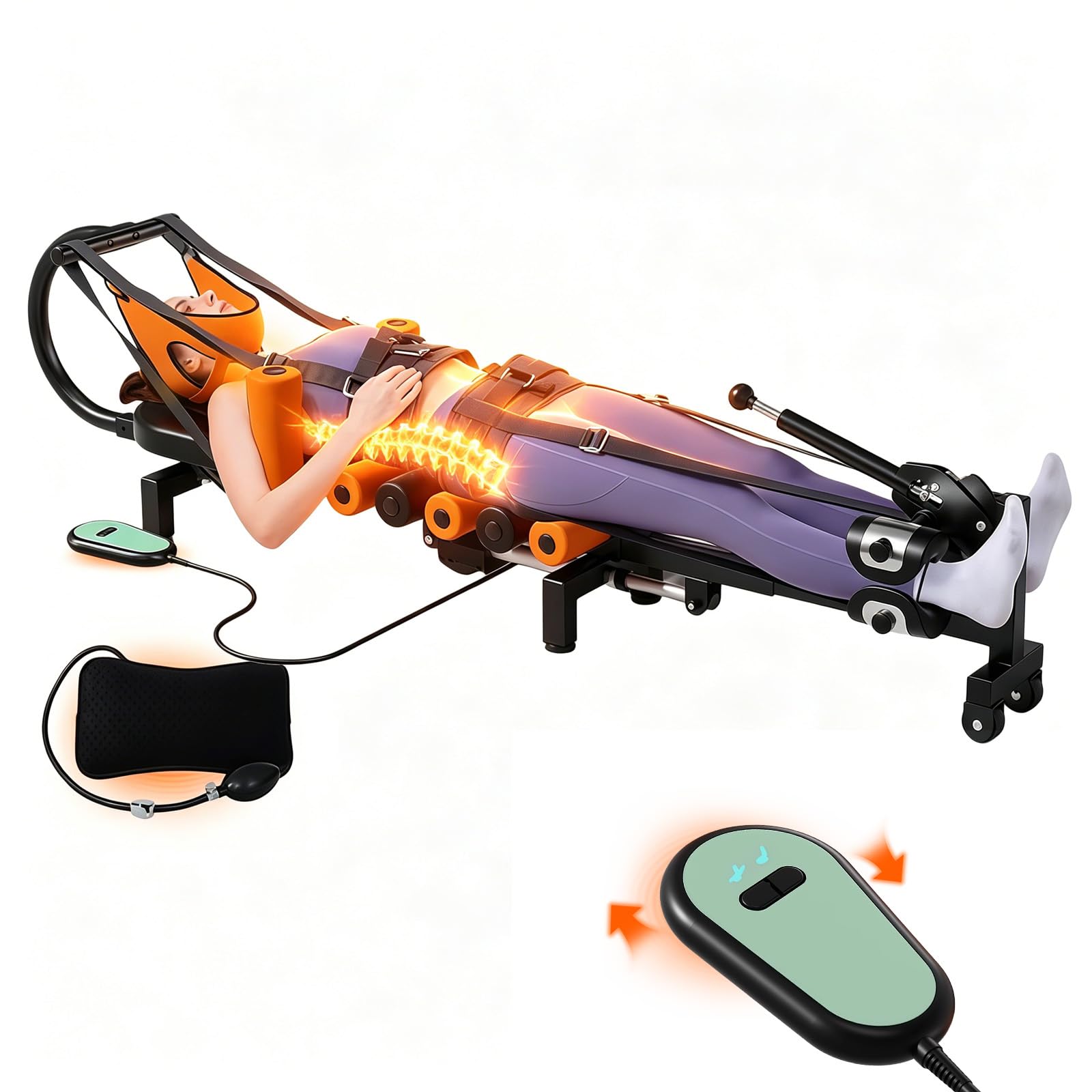
Press a button, get a steady stretch — and never pump a lever to unwind your own back
The pitch behind this table is simple: a manual crank makes you work against your own sore back, so this one swaps it for a motorized linear drive that applies smooth, non-pulsating traction on demand. Lying flat also sidesteps the two things inversion gets criticized for most — head-down pressure on the eyes and full body weight hanging on the ankles. Adjustable shoulder and leg supports with soft sponge rollers keep you from sliding during the pull.
It covers both lower-back and neck traction in one frame, which is the feature buyers call out when they describe skipping clinic visits and doing a session at home instead. The flat-lying posture is the main draw for anyone who finds inversion uncomfortable or intimidating, and the reinforced steel build is meant for everyday home use.
The clear weak spot is the paperwork that comes in the box. Assembly directions and usage guidance both leave buyers frustrated, and owners are notably split on how easy the build actually is. If you buy this, plan to lean on the assembly guidance you can find and treat the first setup as a patient afternoon. Beyond that, the practical notes are the same as any flat bench: firm padding benefits from a pillow, and you need to be able to get down to floor level and up again.
lumbar traction focus: you are paying for the motor and the flat-lying posture. That combination is genuinely hard to find if cranking a handle is off the table for you.
neck support basic: the instructions are the weakest part of the package, so budget an unhurried setup and lean on video guidance when the paper version runs out.
choose it when: motorized, no-crank decompression and a horizontal posture are your two must-haves.
pass it up when: you want a table that goes together in minutes with a clear manual — the setup here is the trade-off.
6. Spine Decompression Table Back Stretcher (DGRGRHBV)

Rolls away between sessions, so a spare bedroom stays a spare bedroom
When floor space is the blocker, this is the design that solves it. Built-in rollers let you wheel it between bedroom, gym, and office, and tuck it out of the way when it is not in use. It also skips inversion entirely — an inflatable lumbar airbag cushions your lower back while a manual crank stretches you lengthwise along a steel base.
Nine adjustable length settings run from 59 inches to 74.8 inches, which covers a wide spread of body heights, and the curved handles give you something to hold as you stretch and retract. The sponge cushioning sits over the steel base, and aimed at desk workers, the full-body mode targets neck, shoulders, and waist together rather than just the low back. Because your head stays level throughout, there is no head-down pressure and no load on your ankles.
The honest caveat is that the delivered experience is uneven. The length range is genuinely useful, but subtle adjustments can shift to a position that feels firm rather than cushioned at first, and the supplied instructions are the weakest part of the package — photos tend to explain the build better than the translated text. Buyers who persist describe noticeable relief after ten to fifteen minutes, so it is a machine for someone willing to tune the setup to their own body rather than a plug-in-and-go fix.
great fit for: small homes and desk workers who want a movable airbag stretch bench with no head-down tilt.
not the one if: you want a machine that feels perfect on the first session — it rewards patient tuning.
7. Lumbar Decompression Table with Cervical Traction by Lumbar Bench Pro

A bench that stretches neck, back, waist, and legs together in one 15-minute set
This one is built around a short daily routine: a recommended 15 minutes on the bench, stretching your neck, back, waist, and legs at the same time. You lie down, secure yourself, and rotate a handle to dial the stretch intensity up or down — no motor involved, just controlled mechanical pull along a metal frame that tucks under a bed or into a corner when you are done.
The adjustability is the thoughtful part. It fits users from 4.75 feet to 6.07 feet, with foot support adjustable between 20.8 inches and 23.6 inches and head support between 19.7 inches and 22.8 inches. That range means a household with very different heights can share one bench, and it ships as a single unit with a 1-year manufacturer warranty.
The big practical warning is a solo-use problem, not a build problem. The crank handle sits in a spot that is genuinely hard to reach once you are lying strapped in, so this machine works far better with a second person turning it. Owners who use it with help describe a comfortable stretch that stores away neatly; owners who try to run it alone run into the reach. If you live by yourself, that is the detail to weigh before buying, because most of the frustration in the feedback traces back to operating it single-handed.
cervical traction combo: the four-way height adjustment across 4.75 ft to 6.07 ft means one bench genuinely stretches different-sized bodies without compromise.
bulky footprint: the lever is awkward to reach once you are set in position, so going solo makes it harder — a second set of hands transforms the experience.
pick it if: a partner or family member can help you operate the crank for a shared 15-minute stretch routine.
reconsider if: you want to run it entirely on your own, because the handle placement works against solo sessions.
8. Electric Decompression Table for Neck & Back
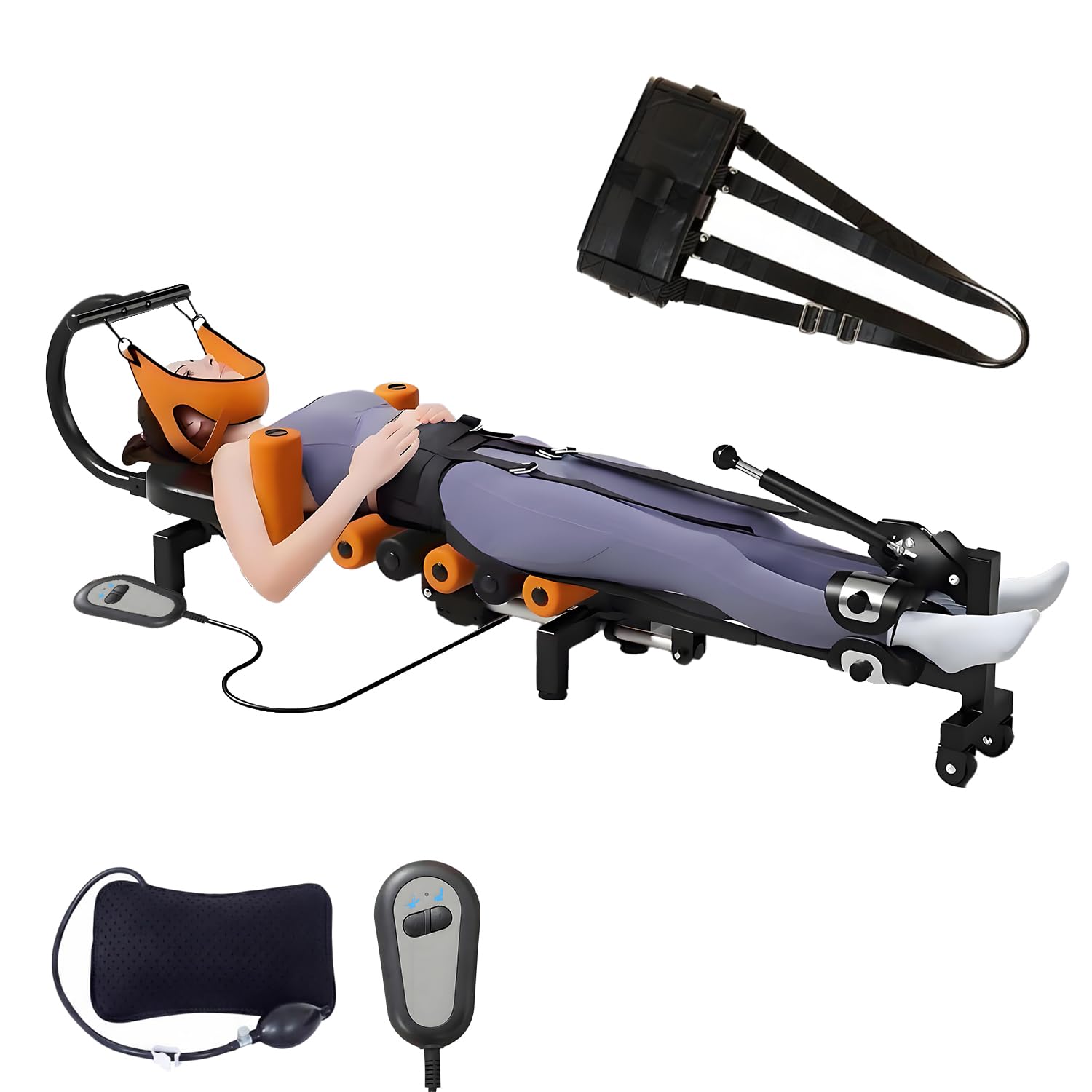
The 440-pound frame built for anyone who lacks the grip to crank a handle
Start with the standout number: 440 pounds is the highest weight capacity on this list by a wide margin. The frame is heavy-duty steel and rated at 33.1 pounds itself, with a footprint of 83.86 x 12.21 x 20.08 inches — a long bench you lie flat on rather than tip backward. A high-torque linear motor supplies the pull at the tap of a button, so no hand-cranking, and since you stay horizontal there is no head-down rush and no full body weight hanging on your ankles.
Adjustable shoulder and leg supports with soft sponge rollers hold you steady during the pull, and the setup is pitched at both lumbar and cervical work in one machine. The no-hang design is the core of the sales case here: it takes inversion entirely off the table for people who would find going upside down uncomfortable or unwise.
Two things temper the picture. Assembly instructions are basic and buyers routinely ask for a better manual, so watch the installation video before you begin. And the foot holds are the single most divisive detail — for most users they simply secure the feet, but the wrong body shape against those holds can put strain somewhere you did not want it. If the foot-hold geometry suits you, the effect is a straightforward, effective stretch for your lower back.
strong match for: larger or less mobile users who want push-button traction and the biggest weight rating here.
test fit first if: your build may press hard against the foot holds — that geometry is the one thing worth confirming before you commit.
9. Home Lumbar Traction Table 220Lbs
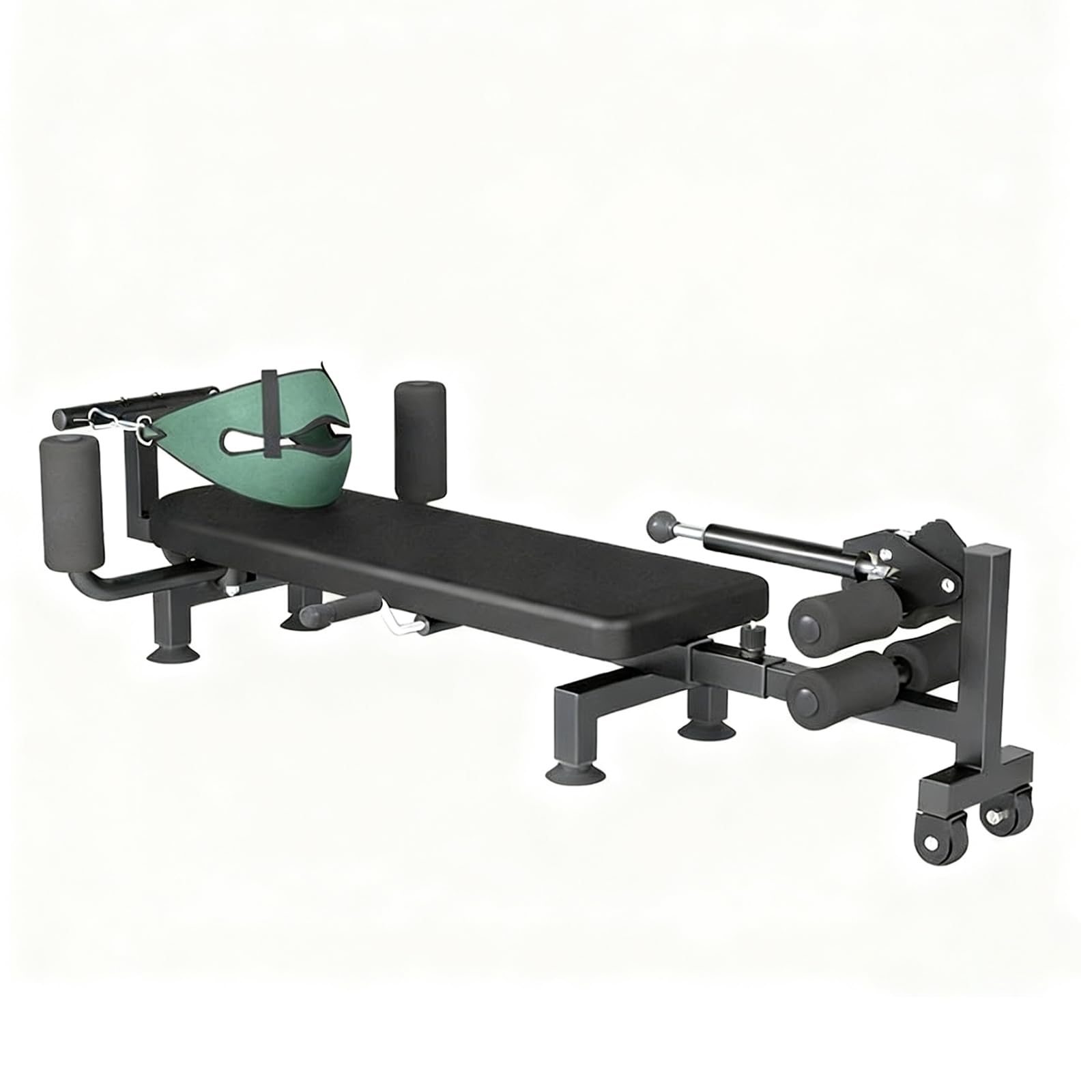
Budget-friendly full-body stretching, with a length dial you set once and forget
This is the entry point to the flat-table family: a steel-based bench with a foam cushion layer, an inflatable airbag supporting your lumbar spine, and a nine-position adjustment button to set the length before you lie down. If the fit feels off once you are on it, a manual crank lets you fine-tune without getting up. Length spans 59 inches to 74.8 inches, the same window as several pricier flat benches, and two rollers on the base make it easy to tuck away. It targets full-body stretching with the neck and lumbar modes run separately.
The build quality is where this budget pick earns its keep — that is the part buyers highlight, the steel base and cushion layer holding up as a solid piece of kit for the money. Get the height dialed in and the airbag adjusted, and it delivers the lengthwise stretch you would pay much more for elsewhere.
Two caveats belong on the table. First, the working height is very low to the floor, so getting down and back up is a real consideration — it suits younger, more flexible users far better than anyone with limited mobility, and one user simply could not get down to it. Second, the instructions leave a lot to be desired; the safety guidance is thin and the assembly text is hard to follow, so treat the manual as a starting point and be careful with any neck-strap setup until you are confident with it. The gentle stretching itself, though, wins people over — the sense of your spine lengthening is exactly what a decompression table is for.
best entry pick for: budget-conscious, mobile users who want a low-cost adjustable-length stretcher with a solid base.
skip this one if: getting to floor level is difficult for you — the low working height is the barrier here.
Understanding the Specs
Weight capacity
This is the maximum user weight the frame is built to hold, and it tells you how much margin sits between you and the machine’s limit. A table rated to 300 pounds — like the Teeter FitSpine X1 — carries a lighter user with plenty of headroom, while a 440-pound rating on an electric flat bench is the widest margin here. A higher rating also tends to mean a beefier frame that feels steadier when you are on it. Always check this before you buy: it is not a suggestion, it is the ceiling.
Height and length adjustment
Decompression works only if the machine fits your body, so look at the height range, not the photo. Inversion tables like the Teeter models are rated from 4 ft 8 in to 6 ft 6 in, while flat benches use an adjustable-length crank — a nine-position dial with a manual crank appears on several picks here, spanning 59 inches to 74.8 inches. Set the length once, and you avoid re-fitting it every session. If your height falls outside the stated band, the stretch will never sit right, so match this figure to your own measurements first.
FAQ
Will an inversion table fit me if I am over six feet tall?
What is the difference between an inversion table and a decompression table?
How much weight can the sturdiest decompression tables support?
Do I need another person to operate a decompression table?
Can I do neck traction and lower back traction at the same time?
How long is a typical decompression session?
Do I have to assemble the whole thing myself?
How much floor space does a decompression table need?
Is a flat floor-level bench suitable for older users?
What should I check before buying a decompression table online?
Final Thoughts: The Verdict
The back decompression table that suits the most people is the Teeter FitSpine X1 — a certified 300-pound inversion frame rated for 4 ft 8 in to 6 ft 6 in, with a suspension backrest and acupressure nodes that make the stretch feel natural. If you want the widest weight margin, the HARISON at 350 pounds is the sturdiest pick for bigger bodies. If you cannot get down to floor level or want no ankle load at all, the HOTMUZ flat traction machine keeps you horizontal and does the pulling with a motor instead of a crank. And if you simply want a low-cost way to start stretching, the entry-level Home Lumbar Traction Table delivers full-body stretch on a solid steel base — provided you are comfortable working down at floor height.
One honest nudge: if you are between two picks, match the machine to the way you will actually use it. Choose by how you get on and off it, whether you have a helper for a crank, and whether you can lie flat or want the angle of an inversion table. That fit decision keeps the table in your routine instead of gathering dust.
How We Picked
We do not accept paid placement. Every pick is matched to a real buyer and a real use-case; we do not hands-on test units.
Sources & Methodology
Specifications: manufacturer listings and product documentation. Review insights: verified customer reviews, as of September 2026. Pricing: not shown on this page (it changes often); check the current price via the retailer link.
As an Amazon Associate, Gadgets Feed earns from qualifying purchases. This does not affect which products we feature.