
That knot between your shoulder blades that no amount of stretching can touch — the one that radiates tension into your neck and skull — demands a tool with surgical precision, not a foam roller’s blunt force. A proper back massage ball isolates a single trigger point and applies sustained, targeted pressure that mimics a therapist’s elbow, collapsing the adhesions in your fascia that keep muscles locked in spasm. The wrong choice — a ball that is too soft, too large, or too slippery — simply rolls off the knot and leaves you frustrated on the floor.
I’m Min — the co-founder and writer behind Gadgets Feed. I’ve spent hundreds of hours cross-referencing surface material durometers, sphere diameters, and vibration motor specifications to separate the tools that actually release the rhomboids and levator scapulae from those that just look good on a gym shelf.
Whether you need a peanut-shape that brackets the spine or a vibrating sphere that shakes apart paraspinal tightness, this guide isolates the single best tool for your specific back pain pattern — your complete resource for finding the best back massage ball for real, lasting relief.
How To Choose The Best Back Massage Ball
Selecting a back massage ball is less about brand and more about matching the ball’s physical behavior to your specific muscle tightness pattern. Sphere diameter, durometer hardness, surface texture, and the presence of vibration define whether the tool helps or hurts. Here is the framework for making that decision.
Single Sphere vs. Peanut Dual-Ball vs. Vibrating Unit
A single 2.5-inch sphere offers the widest range of motion against a wall or floor and is the most portable option — it works well for glutes, hamstrings, and the central erector spinae. A peanut-shaped dual-ball, typically 5 to 6.5 inches long, is purpose-built for the spine: the two spheres straddle the vertebrae, allowing pressure to sink into the multifidus and rotatores without crushing bone. A vibrating unit adds rapid oscillation (typically 2,500 to 4,000 RPM) that shakes apart fascial adhesion and desensitizes the local nervous system, making it the most effective choice for chronic, nerve-involved tightness like sciatica or thoracic outlet syndrome.
Durometer and Surface Material
Firmness is measured by the Shore durometer scale — a hard lacrosse-ball density (sometimes labeled “extra firm”) feels like solid rubber with almost no deformation and is ideal for deep glute and hip work, but can bruise the ribs or thoracic spine if used aggressively. Medium-density silicone or EVA foam (the most common material for peanut rollers) provides a balance of compression and grip — the silicone textured surface keeps the ball from sliding off the target spot during a breath-hold. Ultra-soft foam balls are only useful for light mobilisation or as a first-timer introduction; they lack the compressive force to break a chronic knot.
Diameter and Portability
A 2.5-inch to 2.75-inch sphere is the universal sweet spot: small enough to isolate the suboccipital triangle at the base of the skull and the levator scapulae under the trapezius, yet large enough to distribute pressure over the gluteus medius. Balls under 2 inches (like a standard lacrosse ball) can feel too sharp on bony areas. Peanut units between 5 and 7 inches long are still small enough to toss into a weekender bag. Vibrating balls add 9 to 12 ounces of weight and an internal motor, so they trade some portability for therapeutic power.
Quick Comparison
On smaller screens, swipe sideways to see the full table.
| Model | Category | Best For | Key Spec | Amazon |
|---|---|---|---|---|
| Vulken Vibrating Massage Ball | Vibrating | Hands-free back knots with adjustable strap | 4 speeds up to 4000 RPM; 3.75 inch sphere | Amazon |
| LifePro 4-Speed Vibrating Peanut | Vibrating Peanut | Spine-friendly dual-ball with 4 vibration levels | 2–4 hour battery; contoured silicone peanut | Amazon |
| Rolling With It Vibrating Peanut | Vibrating Peanut | Dual-sphere deep tissue for hard-to-reach areas | 6.75 inch peanut; ribbed silicone surface | Amazon |
| RAD Original Peanut Massage Ball | Non-Vibrating Peanut | Thoracic spine release and paravertebral precision | Medium-density silicone; 6 x 2.5 x 2.5 inches | Amazon |
| Plyopic Deep Tissue Massage Ball Set | Variety Kit | Multi-tool kit for full-body self-massage | Set of 4: lacrosse, spiky, peanut, 5” foam roller | Amazon |
| TriggerPoint Foam Massage Ball (Extra Firm) | Non-Vibrating Sphere | Aggressive deep-tissue compression for glutes and calves | 2.6 inch extra-firm foam sphere | Amazon |
| GoFit GoBall Trigger Point Ball | Non-Vibrating Sphere | Lightweight, budget-friendly starter ball | 2.7 inch dense foam; weighs 1.41 ounces | Amazon |
In‑Depth Reviews
1. Vulken Vibrating Massage Ball
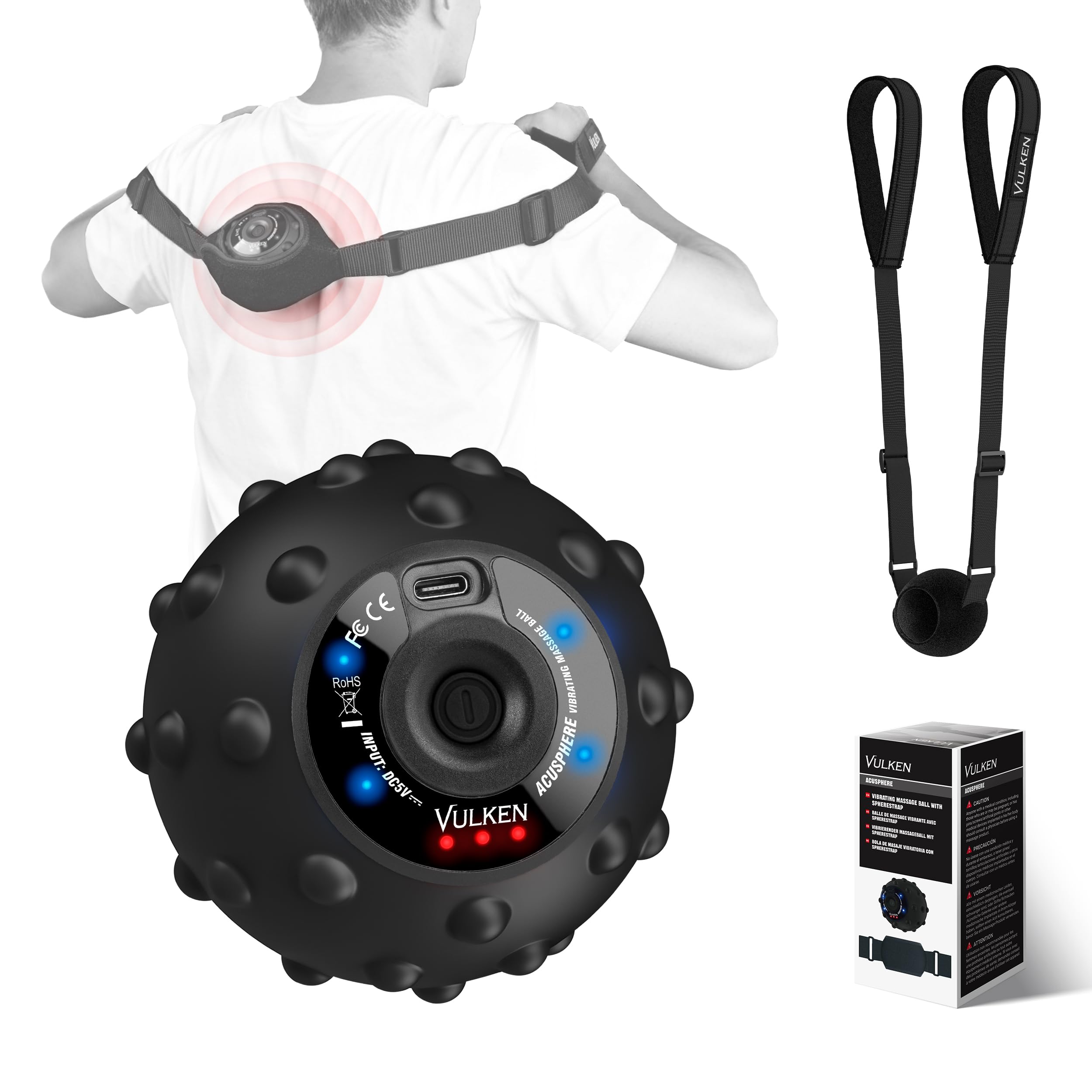
The Vulken solves the single biggest frustration with back massage balls: reaching the rhomboids and mid-trapezius without lying on a hard floor. Its 19.7 to 27-inch adjustable Strap wraps around a chair or door handle, letting you lean into the 3.75-inch sphere and target knots between the shoulder blades while sitting at a desk — a use case that no static peanut ball or lacrosse ball can match.
The motor pushes up to 4,000 RPM across Low, Medium, Pulsating, and High modes, with an upgraded recessed button that prevents accidental mode changes when you apply body weight. On High, the vibration penetrates deep into the levator scapulae and infraspinatus, shaking loose adhesions that standard static pressure cannot release. Users report it outperforms TENS units for pushing out chronic trigger points, and the 1.5-hour battery holds for multiple sessions.
The 10-minute auto-shutoff can interrupt a session when you lie on the ball — the strap mitigates this by letting you position the ball without full weight bearing. At 0.66 pound and 3.75 inches, it is the most portable deep-tissue solution for the upper back on this list.
Why it’s great
- Adjustable strap unlocks hands-free upper back targeting — no other ball on this list offers this.
- Recessed button prevents mode-switching mid-pressure.
Good to know
- 10-minute auto-shutoff requires restarting during longer sessions.
- Vibration at highest setting may feel intense for new users on bony areas.
2. LifePro 4-Speed Vibrating Massage Ball (Peanut)
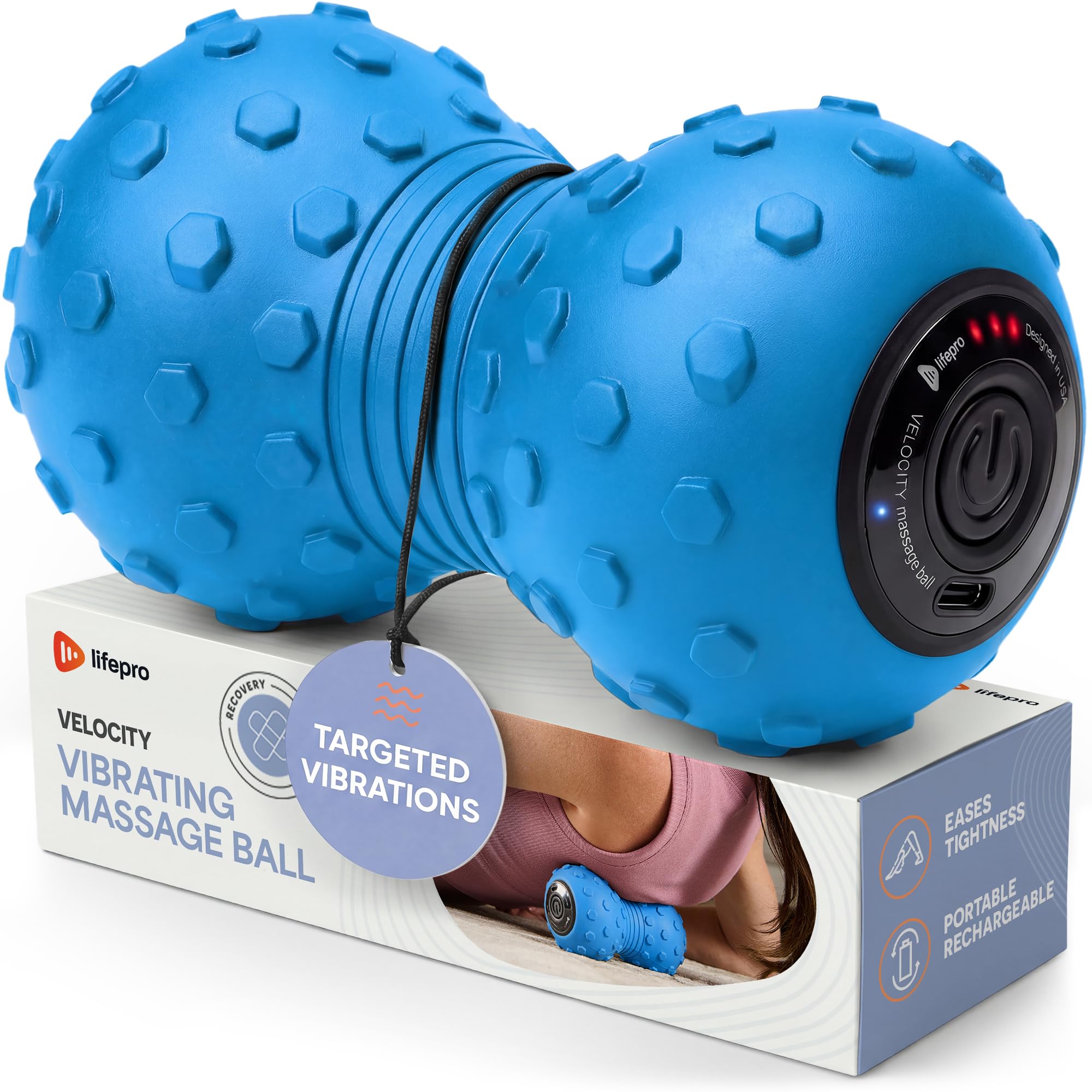
The LifePro peanut marries the dual-sphere architecture of a RAD roller with a 4-speed vibration motor, creating a tool that simultaneously brackets the spine and shakes the paraspinal muscles. The contoured ridged silicone surface grips the skin without sliding, and the 6.5-inch length allows the spheres to land on either side of the thoracic or lumbar vertebrae while the motor oscillates at adjustable intensity.
Users managing fibromyalgia, sciatica, and neuropathy report that the combination of the peanut shape and vibration provides relief that neither a standard foam roller nor a single vibrating ball can achieve. The four vibration levels (Pulse, Low, Medium, High) allow a progression from gentle skin desensitization to aggressive deep-tissue work on the glutes and piriformis. The battery lasts between 2 and 4 hours, which supports multiple sessions per charge.
Some units have shown inconsistent motor behavior — power button delays and reduced intensity on the third setting — suggesting a quality control variance at the manufacturing level. The lifetime replacement warranty from the seller mitigates this risk, but it is a factor to consider when investing in a premium vibrating tool.
Why it’s great
- Peanut shape with vibration targets the spine directly without crushing bone.
- 4 speed settings plus pulse mode suit multiple pain conditions.
Good to know
- Some batches have experienced motor and button inconsistencies.
- Heavier than single-sphere options at 1.5 pounds.
3. Rolling With It Vibrating Peanut Massage Ball

This 6.75-inch peanut massager stands out for its ribbed silicone surface — unlike smooth plastic or hard knobby projections that dig into bone, the textured silicone provides a therapeutic grip that does not slip during pressure. The dual spheres are spaced 2.5 inches apart, which fits the typical distance between the spinous processes of the thoracic spine, allowing the vibration to sink into the multifidus directly.
The 4-speed motor is robust enough to shake the entire unit at its highest setting, and users report battery life exceeding 6 hours on moderate intensity — the longest runtime on this list. The 10-minute auto-shutoff is a safety feature, and the LED indicators for battery and intensity level add clarity. The unit bears 145 pounds of pressure without distortion, so it works for heavier body weights against a wall or floor.
The consistent feedback across reviews is that the ribbed surface delivers a therapeutic sensation that smooth peanut balls lack, but the firmness of the silicone may feel too hard for users who prefer a softer, more forgiving tool. The included carry bag and lifetime customer support add long-term value.
Why it’s great
- Ribbed silicone surface provides grip and therapeutic texture without slipping.
- Exceptional battery life at 6+ hours on moderate intensity.
Good to know
- Silicone firmness may feel too hard for users with bony frames.
- 10-minute auto-shutoff interrupts longer sessions.
4. RAD Original Peanut Massage Ball

The RAD Original Peanut is the gold-standard non-vibrating tool for thoracic spine release. Its medium-density silicone is firm enough to sink into the erector spinae and rhomboids without the sharp bone-on-rubber feeling of a lacrosse ball. The 2.5-inch sphere diameter on each lobe is precisely sized to bracket the spinous processes, making it the best choice for anyone with mid-back stiffness from desk posture or a pinched nerve.
Users report dramatic relief — one reviewer noted 70% lower back pain reduction from an 8-month pinched nerve after just two sessions using the 90-90 leg position for pressure modulation. The silicone texture grips the skin, preventing the ball from sliding off the target muscle during deep breathing. Over 20 documented use positions make it versatile for the psoas, suboccipital, and even the arches of the feet.
The medium density is a deliberate compromise: it will not deform as much as a foam ball, but it does not deliver the bone-crushing pressure of an extra-firm style. Some users with muscular frames find the 2.5-inch lobes too small to cover the glutes effectively — the XL version addresses this. The silicone picks up lint and dust, requiring occasional rinsing.
Why it’s great
- Perfect dual-sphere geometry for safe, precise spinal release.
- Medium-density silicone balances rigidity with tissue-safe compression.
Good to know
- Silicone surface attracts dust and hair — needs regular cleaning.
- Standard size may feel small for larger body frames.
5. Plyopic Deep Tissue Massage Ball Set

The Plyopic set solves the problem of not knowing which ball density you need by giving you four distinct tools in one bag: a 2-inch firm lacrosse ball for deep glute work, a 3.5-inch spiky ball for surface circulation, a 3-inch dual peanut for spinal bracketing, and a 5-inch foam roller for broader soft-tissue flushing. This variety allows you to experiment with different compression forces without buying separate products.
The materials range from EVA foam (the 5-inch roller, which offers moderate compression) to PVC and silicone (the smaller balls, which provide firmer, less deformable pressure). The lacrosse ball in the set matches the hardness of an actual lacrosse ball, so it is capable of deep piriformis and hip work, but it can feel aggressive on the thoracic spine without a shirt barrier.
The portability is a mixed benefit — the carrying bag holds all four pieces, but the 5-inch roller adds bulk that makes the set less pocketable than a single sphere. For travelers who need only one tool, this set may be excessive, but for home use where you want to address multiple muscle groups across a recovery week, it is the most comprehensive entry point.
Why it’s great
- Four-ball variety lets you match density and shape to each muscle group.
- Includes a 5-inch foam roller for broader myofascial release.
Good to know
- Set is bulkier than a single ball for travel or gym bag carry.
- Lacrosse ball density can be too firm for sensitive thoracic areas.
6. TriggerPoint Foam Massage Ball (Extra Firm)

This 2.6-inch extra-firm foam ball is designed for one specific job: aggressive, deep-tissue compression on small, dense muscle groups like the piriformis, calves, and pecs. The foam surface provides more friction than a standard lacrosse ball, reducing slip during leg and buttock work, and the foam is easier to clean than cloth-covered alternatives. It is the go-to tool for anyone treating piriformis syndrome or chronic hamstring tightness.
The “extra firm” designation is not marketing — reviewers consistently describe it as rock hard with almost zero give, which means it applies focused pressure that can feel painful on the first use but delivers results on chronic adhesions that softer foam balls cannot touch. One user noted that it is the only tool that successfully relieved their sciatic pain after trying tennis balls and standard foam rollers.
The limitation is its specificity: this ball is too hard for the suboccipital triangle, the ribs, or any area where bone sits close to the surface. It works best against a wall or carpeted floor (hardwood floors allow it to flatten and lose effectiveness). The foam surface also picks up debris and requires periodic washing.
Why it’s great
- Extra-firm density delivers unmatched deep-tissue compression for glutes and piriformis.
- Foam surface is hygienic and easy to clean.
Good to know
- Too hard for thoracic spine, ribs, or suboccipital use.
- Loses structure on hard flooring — requires carpet or mat.
7. GoFit GoBall Trigger Point Massage Ball

The GoFit GoBall is the entry-level gateway to trigger point therapy. At 2.7 inches and only 1.41 ounces, it is the lightest ball on this list — nearly weightless in a bag but surprisingly effective when pressed against a wall or floor. The dense foam construction holds its shape through repeated use, and its diameter is large enough to cover the glutes and hamstrings while remaining precise enough for the upper trapezius.
Reviewers consistently compare it favorably to lacrosse balls, noting that its slightly wider surface distributes pressure more comfortably over large muscles like the gluteus maximus without the sharp pinpoint feel of a 1.5-inch sphere. One user with chronic Achilles tightness reported it outperformed both tennis balls and foam rollers for calf release. The ball glides smoothly on skin when moved deliberately, mimicking an oil massage effect without the mess.
The primary durability concern is that the foam outer casing can eventually separate from the inner core under heavy daily use — one review noted splitting after 5 nights per week of aggressive pressure. For light to moderate users, this is not a concern, but heavy users who bear full body weight on the ball daily may need to replace it every few months.
Why it’s great
- Extremely lightweight and portable — disappears into any bag.
- Firm foam provides reliable trigger point pressure at a low cost.
Good to know
- Foam shell can separate from core with aggressive daily use.
- Not firm enough for deep glute work in larger individuals.
FAQ
Can I use a back massage ball on my neck or suboccipital area?
How do I clean a silicone or foam massage ball?
What is the difference between a lacrosse ball and a back massage ball?
Final Thoughts: The Verdict
For most users, the best back massage ball winner is the Vulken Vibrating Massage Ball because its adjustable strap unlocks hands-free upper back targeting that no static ball can replicate, and its 4-speed vibration motor penetrates chronic trigger points that standard pressure cannot touch. If you want precise spinal release without vibration, grab the RAD Original Peanut Massage Ball — the dual-sphere silicone design is the safest, most effective non-vibrating tool for bracketing the vertebrae. And for deep glute and hamstring compression on a budget, nothing beats the TriggerPoint Foam Massage Ball (Extra Firm) — just avoid it on the thoracic spine.