
Back probing a weather-pack connector without breaking the seal or damaging the terminal requires a tool that combines a razor-thin needle profile with the right bend angle. Most generic test leads force you to jam a multimeter probe against a wire from an awkward position, risking a bent pin or a false reading. A dedicated back probe kit eliminates that frustration entirely by providing purpose-built pins that slide into the connector’s wire side, letting you read live voltage without stripping insulation or pulling the harness apart.
I’m Min — the co-founder and writer behind Gadgets Feed. I’ve spent countless hours analyzing automotive diagnostic tool specifications, comparing connector compatibility, and reading real technician feedback to pinpoint which back probe kits actually deliver reliable readings without compromising build quality.
Whether you’re diagnosing a no-start condition on a modern ECU or tracing a parasitic draw on an older system, the right set of probes makes the job faster and safer. This guide breaks down the best performing back probe kit options for both professional mechanics and serious DIYers who need consistent, accurate results.
How To Choose The Best Back Probe Kit
Not all back probe kits are built the same. A kit that shines on a Ford fuel injector might be useless inside a Japanese engine bay connector with ultra-tight terminal spacing. Here are the specific criteria you need to evaluate before clicking buy.
Probe Angle Variety
A kit that includes only straight probes will fail as soon as you hit a connector recessed into a firewall or tucked under an intake manifold. Look for a mix of straight, 90-degree, and 135-degree angles. This coverage lets you reach pins oriented in any direction without bending the needle or damaging the connector housing.
Needle Gauge and Material
The needle diameter determines which wire gauges you can safely back-probe. A 0.07mm tip is ideal for modern weather-pack connectors with small gauge wires, while a slightly thicker needle (around 0.040 inch) works with larger power wires. Stainless steel construction resists corrosion and keeps consistent electrical contact over hundreds of uses.
Included Accessories
A complete kit should include banana-to-alligator clip test leads, wire-piercing probes for when you need to test mid-wire, and at least five color-coded back probe pins. The color coding saves significant time when tracking multiple circuits simultaneously. Also check whether the kit includes a storage case — loose probes in a toolbox drawer get lost quickly.
Quick Comparison
On smaller screens, swipe sideways to see the full table.
| Model | Category | Best For | Key Spec | Amazon |
|---|---|---|---|---|
| Goupchn 25PCS Kit | Multimeter Lead Set | Versatile bench & automotive work | CAT III 1000V / 10A rating | Amazon |
| Kawish 30pcs Kit | Comprehensive Diagnostic | ECU and sensor back probing | 0.07mm needle, 3 probe angles | Amazon |
| Sedovnou 31PCS Kit | Value Pack | General automotive diagnostic | 0.07mm stainless steel probe | Amazon |
| Power Probe PPTK0003 | Piercing Probe | Wire piercing on 8AWG–28AWG | Self-centering, 4mm banana plugs | Amazon |
| Lisle 64900 | Specialty Probes | Connector back probing with small pins | 0.027″ and 0.040″ wire compatibility | Amazon |
| Thexton THE490 | Basic Pin Set | Tight-space probing on a budget | 20-pack color-coded pins | Amazon |
In‑Depth Reviews
1. Goupchn 25PCS Silicone Multimeter Test Leads Kit

The Goupchn kit stands apart because it’s not just a back probe set — it’s a complete multimeter accessory system that includes 12 wire-piercing probes, two high-voltage test hook clips, alligator clips, and even a test tweezer. The silicone leads are noticeably more flexible than standard PVC, which makes a real difference when you’re routing test wires around a cramped engine bay. The CAT III 1000V and CAT IV 600V safety rating gives you the headroom to work on hybrid vehicle high-voltage systems without worrying about insulation breakdown.
The banana plug design is fully modular: you pop the probe tip into the 4mm socket and instantly switch to an alligator clip or test hook. That modularity saves time when moving from back-probing a sensor connector to testing a fuse box. I appreciate that the included storage box keeps all 25 pieces organized, something many budget kits skip entirely. A few technicians mention the test lead length is roughly 2 feet, which feels short for reaching from the driver seat to a rear oxygen sensor — but for under-hood work and bench testing, it’s completely adequate.
Users report that the resistance and signal integrity match Fluke-branded leads, which is high praise given the price difference. The flexible silicone insulation also resists cracking in cold weather, a common failure point on cheaper leads. For anyone who wants one kit that handles both standard multimeter tasks and dedicated back probing, this is the most versatile option available.
Why it’s great
- CAT III 1000V rating provides a genuine safety margin for high-voltage automotive systems
- Silicone-insulated pure copper wire stays flexible in cold environments and resists cracking
- Modular 4mm banana plug system allows instant switching between probes, clips, and hooks
Good to know
- The test leads are only about 2 feet long, which may be short for rear-engine or chassis-mounted diagnostic work
2. Kawish 30pcs Back Probe Kit
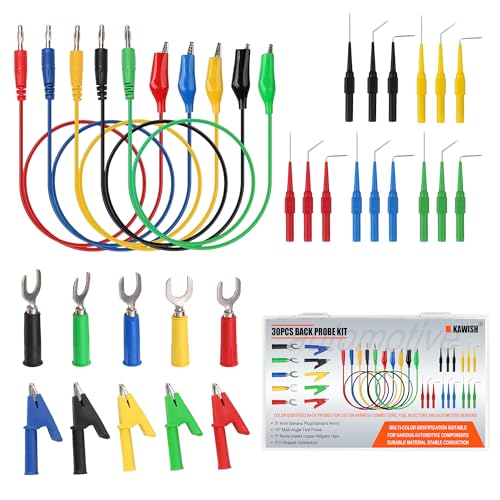
The Kawish kit delivers 15 multi-angle test probes with straight, 90°, and 135° configurations, making it one of the most complete angle-coverage options at this price tier. Each needle measures 0.07mm, which is thin enough to slide into the wire side of a modern weather-pack connector without breaking the terminal seal. The set also includes five nickel-plated copper alligator clips and five U-shaped connectors, giving you several ways to connect to your multimeter or oscilloscope.
One specific feature that stands out is the non-damaging back probe design. The precision tips allow safe electrical testing without piercing the wire insulation, which is critical when you’re diagnosing a vehicle under warranty or working on a harness that you can’t afford to compromise. The probes are made from rust-resistant stainless steel, and the color-coded leads simplify the process of tracking multiple circuits during a complex diagnostic routine. Several user reviews confirm that the kit works well for reading ECM signals and testing fuel injector circuits.
A few users note that the kit is too short for general-purpose breadboard work, but that’s by design — this is a dedicated automotive diagnostic tool. The build quality is solid, with reviews praising the heavy-gauge wire and stable connections. If you’re looking for a ready-to-go package that covers almost every back-probing scenario from the start, the Kawish kit offers the best piece count and angle variety without climbing into a higher price bracket.
Why it’s great
- Includes 15 probes across straight, 90°, and 135° angles for maximum connector compatibility
- 0.07mm stainless steel needle is thin enough for tight terminals without damaging seals
- Color-coded leads help quickly distinguish circuits during multi-point testing
Good to know
- Probes are purposely short, optimized for automotive connectors rather than breadboard or lab use
3. Sedovnou 31PCS Back Probe Kit
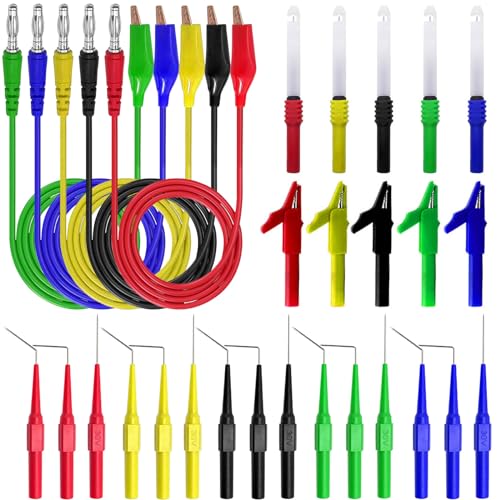
The Sedovnou kit packs 31 pieces into a single box, including 15 back probe pins, five banana-to-alligator clip test wires, five wire-piercing probes, and five nickel-plated copper alligator clips. This is the highest piece count in the comparison, and every component serves a distinct purpose. The back probe pins come in five colors and three angles (90°, 135°, and straight), giving you enough variety to handle connectors in deep recesses or tight side-by-side positions without cross-contamination.
One of the most impressive details reported by users is the build quality. Multiple reviews describe the wire as real copper with proper soldering to functional square clips — not the crimped hair-size wire found on ultra-cheap kits. The wire-piercing probes are especially well thought out: you insert the wire into a white plastic guide, then push the probe in to pierce the insulation without cutting or damaging the conductor. This is a huge time saver when you’re checking continuity along a long harness run.
The kit is rated for up to 30 volts, which covers the standard 12V and 24V automotive electrical systems without any safety concern. Applications range from BMW diagnostics to fuel injector testing, and the feedback is consistent: this kit matches the performance of tool-truck brands at a fraction of the price. If you need one kit that does everything from connector back-probing to inline wire piercing without extra purchases, this is the most well-rounded package available.
Why it’s great
- 31-piece set includes back probes, wire-piercing probes, alligator clips, and test leads for full coverage
- Real copper wire with properly soldered connections delivers consistent resistance readings
- Wire-piercing probes use a plastic guide that pierces insulation without damaging the conductor
Good to know
- Rated for up to 30V, so it’s suitable for automotive use but not designed for high-voltage residential circuits
4. Power Probe PPTK0003 Piercing Probe Kit
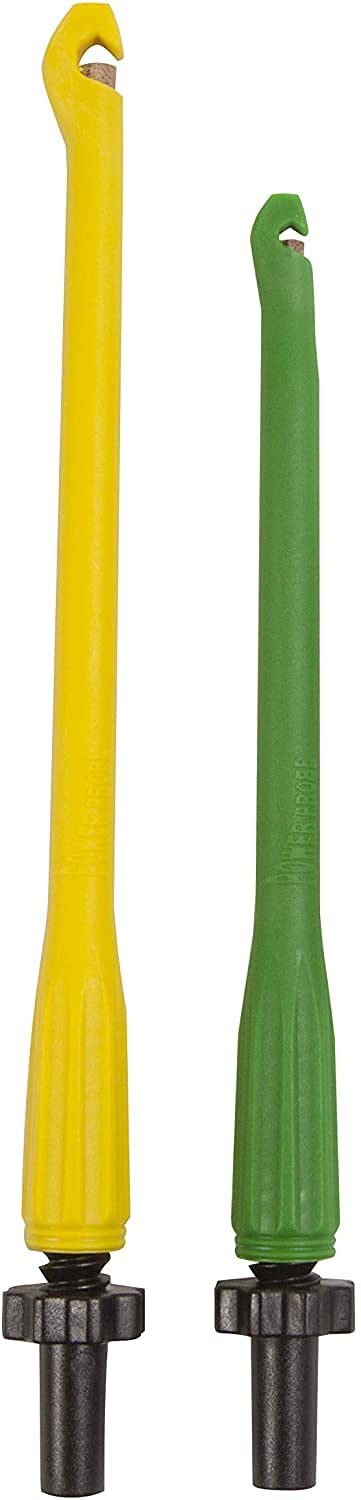
The Power Probe Piercing Probe Kit is a focused two-probe set designed for one specific job: piercing wire insulation cleanly and consistently. It includes a large and small piercing probe, both with self-centering mechanisms that guide the needle directly through the middle of the wire. This is a massive advantage over generic piercing probes that tend to wander off-center, which can nick the conductor strands and create a weak point in the wire. The self-centering feature ensures that each puncture is clean and centered, maintaining the wire’s structural integrity.
Both probes accept wire gauges from 8AWG all the way down to 28AWG, covering the vast majority of automotive and industrial wiring. The 4mm banana plug connectors make them compatible with any standard multimeter, oscilloscope, or power probe tool. Users who have tried competing brands often report that the self-centering mechanism wears out after a few uses, but the Power Probe version maintains its accuracy even after months of frequent use. This is the kind of tool that professional automotive electricians keep in their daily carry kit.
The kit’s main limitation is that it does not include traditional back probe pins or alligator clips — it’s strictly a wire-piercing solution. That makes it an excellent complement to a broader back probe kit rather than a standalone replacement. For scenarios where you need to tap into a wire mid-harness without cutting or stripping, the PPTK0003 is the most reliable tool available. Build quality is exceptional, and the price aligns closely with what you’d pay on a tool truck.
Why it’s great
- Self-centering mechanism consistently pierces the center of the wire, avoiding conductor damage
- Large and small probes cover wire gauges from 8AWG to 28AWG
- 4mm banana plugs work directly with any standard multimeter or power probe tool
Good to know
- No traditional back probe pins or alligator clips included — this is a specialized piercing-only tool set
5. Lisle 64900 17-Piece Back Probe and Alligator Clip Set

The Lisle 64900 focuses on providing probes with two specific wire-size compatibility groups: probes designed for 0.027-inch wire and a separate set for 0.040-inch wire. This dual-size approach is rare in a single kit and makes a real difference when you’re working across different connector generations. European connectors often use thinner pins, while older domestic and Japanese connectors tend toward the thicker side. Having probes sized specifically for each ensures a snug fit that stays in place without constant finger pressure.
The kit includes three color-coded sets: red, green, and yellow probes for the 0.027-inch wires, and blue and black probes for the 0.040-inch wires. Each color includes straight, 45-degree, and 90-degree angle options, giving you 15 probes total plus two black alligator clips. Users frequently mention that the probes are noticeably smaller and more delicate than the larger Lisle 65150 tips, which makes them ideal for probing tight connector cavities without spreading the plastic housing. The compact size also means you can stack probes side by side on adjacent pins without interference.
Some users note that the kit doesn’t include a storage case, so you’ll need to find your own organization solution. One review flagged a single probe with a slightly higher-than-expected resistance (around 1 ohm), which suggests that individual quality control can vary. However, the vast majority of feedback highlights the excellent value and the unique dual-size probe selection. If you regularly troubleshoot connectors with mixed pin sizes, the Lisle 64900 is the most targeted solution.
Why it’s great
- Dual-size probes (0.027″ and 0.040″) match specific connector wire gauges for a secure fit
- 15 color-coded probes with straight, 45°, and 90° angles cover most connector orientations
- Compact tip profile allows side-by-side probing on adjacent terminals without spreading
Good to know
- No storage case included — probes may get lost if not organized separately
6. Thexton THE490 Back Probe Kit

The Thexton THE490 is a no-frills kit that gives you 20 color-coded back probe pins designed for reaching into tight spaces where standard multimeter probes won’t fit. The pins are noticeably smaller than typical aftermarket probes, which makes them effective on modern densely-packed connectors. The color coding across 20 pins allows you to keep track of multiple test points during a single diagnostic session, which is a genuine productivity boost when mapping out a complex circuit.
However, the kit has some notable drawbacks that keep it from competing with more complete sets. Multiple users report that the product images show a compartmentalized carrying case, but the actual kit arrives without any case at all. The alligator clip sheaths on the included leads also tend to slide off easily, which is frustrating when you’re trying to maintain a connection in a vibrating engine compartment. The probes themselves are functional and do the job, but the overall package feels like a basic accessory rather than a comprehensive diagnostic tool.
For the price, the THE490 works as an affordable way to add dedicated back probing capability to your toolbox if you already own test leads and alligator clips. It’s a good supplement for a mechanic who just needs extra small pins for one specific job. But if you’re building a diagnostic kit from scratch, you’ll likely find the value proposition of multi-piece kits like the Sedovnou or Kawish to be much stronger.
Why it’s great
- 20 color-coded pins help track multiple test points simultaneously
- Small probe size fits into tight connector cavities inaccessible to standard multimeter leads
Good to know
- No storage case included despite being shown in product images; alligator clip sheaths slide off easily
7. Linkhood 31PCS Back Probe Kit

The Linkhood 31PCS kit mirrors the same component breakdown as the Sedovnou set: 15 back probe pins, five banana-to-alligator clip test wires, five wire-piercing probes, and five nickel-plated copper alligator clips. The probe set includes straight, 90°, and 135° angles in five colors, with a 0.07mm stainless steel needle that’s compatible with tight automotive connectors. The wire-piercing probes use the same plastic guide design that lets you pierce insulation without stripping the wire, which is ideal for making temporary test points along a harness.
User reviews from professional BMW mechanics praise the kit for matching the performance of tool-truck brands costing significantly more. The alligator clips have a maximum opening of 15mm, which is enough to grab most battery terminals and ground points. The operating voltage is rated up to 30V, so it’s perfectly suited for 12V and 24V automotive systems. The wire quality is reported as solid, with proper gauge wire that doesn’t feel brittle or undersized.
The main complaint is that the storage box feels a bit cheap and doesn’t latch securely, which can lead to spilled probes when the box is jostled in a toolbox drawer. For the price, though, this is a minor inconvenience. If you’re on a tight budget and need a complete back probe kit that doesn’t cut corners on the number of components, the Linkhood set delivers functional reliability. Just plan to store the probes in a separate case or zip pouch for long-term organization.
Why it’s great
- 31-piece set provides full coverage for back probing, wire piercing, and alligator clip connections
- 0.07mm stainless steel needle works easily with modern weather-pack connectors
- Wire-piercing probes allow insulation-free testing without stripping or cutting the wire
Good to know
- Included storage box feels flimsy and may not securely hold all pieces during transport
FAQ
What is the difference between a back probe pin and a wire-piercing probe?
How do I know which gauge of wire my back probe kit supports?
Can I use a back probe kit with any multimeter?
Final Thoughts: The Verdict
For most users, the best back probe kit winner is the Sedovnou 31PCS Kit because it combines the highest piece count with genuine copper-wire construction and a proven track record among professional mechanics. If you want the flexibility of a complete multimeter accessory system with CAT III 1000V safety rating, grab the Goupchn 25PCS Kit. And for a technician who frequently needs to pierce wires cleanly without damage, nothing beats the Power Probe PPTK0003 self-centering piercing probes.