
Lower back pain that nags through every sit-stand transition and sciatica that shoots down your leg are signals from a spine under constant compression. A dedicated back stretcher machine tackles this by creating targeted traction that separates vertebrae, decompresses discs, and releases muscle tension without requiring a trip to the chiropractor’s office.
I’m Min — the co-founder and writer behind Gadgets Feed. I’ve spent countless hours dissecting the mechanical differences between passive foam wedges and dynamic airbag systems, cross-referencing customer satisfaction data with material quality to separate what genuinely decompresses from what merely cushions.
Whether you’re dealing with a herniated disc, spinal stenosis, or simple daily stiffness, finding the right best back stretcher machine means understanding traction force, adjustability, and build quality before you commit.
How To Choose The Best Back Stretcher Machine
A back stretcher machine is not a one-size-fits-all product. The right choice depends on where your pain lives, how much adjustability you need, and whether you want passive stretching or active, powered traction. The three factors below separate a useful device from one that collects dust.
Traction Type: Passive vs. Dynamic vs. Active
Passive foam stretchers rely on your body weight to create a gentle curve stretch — they’re quiet and cost-effective but offer no adjustable tension. Dynamic airbag systems inflate and deflate to mimic the rhythm of a physical therapist’s hands, providing variable decompression. Active metal-frame machines with adjustable seats let you control how far your spine extends, which is critical for rehabbing specific conditions like herniated discs or sciatica.
Height Range and Body Compatibility
Many full-body stretching mats limit usage to people between 5’1″ and 6’0″. A machine that is too short will overstretch your neck or fail to reach your lumbar curve, while one that is too long can leave your legs dangling without support. Always check the recommended height range against your own measurements — the most effective traction happens when your spine aligns exactly with the device’s curvature points.
Extra Therapy Layers: Heat, Electric Stimulation, and Modes
Traction alone can solve mechanical compression, but adding heat relaxes muscle fascia, vibration loosens knots, and electrotherapy (TENS/EMS) interrupts pain signals. Devices with multiple therapy modes let you customize a session to match your current pain level. However, more features also mean more complexity — if you want a simple daily stretch without fiddling with remote controls, a manual foam or metal-frame device may serve you better.
Quick Comparison
On smaller screens, swipe sideways to see the full table.
| Model | Category | Best For | Key Spec | Amazon |
|---|---|---|---|---|
| Nitrofit Limber Pro | Premium | Adjustable full-body stretching | 50.5″ steel frame, adjustable sliding seat | Amazon |
| Comrelax 3D Stretching Mat | Premium | Multi-direction body stretching with heat | 3D traction up/down, twist, curve, heat to 149°F | Amazon |
| Airbags Stretching Mat (Sotion) | Premium | Airbag-based gentle traction with heat | 22 inner airbags, 4 modes, 3 heat levels | Amazon |
| Tianfucen Electric Traction | Mid-Range | Powered lumbar decompression with electrotherapy | Dynamic airbag, 20-level EMS, heat to 131°F | Amazon |
| True Back TBR170 | Mid-Range | FDA-registered manual traction | 23.5″ portable frame, 4 pounds | Amazon |
| Lo-Bak TRAX | Mid-Range | Non-powered professional-grade traction | 2.5 lbs, patented metal frame, adjustable | Amazon |
| RESTCLOUD Foam Stretcher | Budget | Entry-level passive C-curve stretching | 1.8 lbs, memory foam, 16 massage bars | Amazon |
In‑Depth Reviews
1. Nitrofit Limber Pro Adjustable Seat Stretch Machine

The Nitrofit Limber Pro is a purpose-built stretch station that replaces the one-size-fits-all problem with a patented adjustable and lockable seat. This means you can dial in the exact seat position that aligns your hips, spine, and hamstrings for controlled, deep stretching — a critical detail for anyone rehabbing a herniated disc or working through sciatica. The steel frame supports up to 56 pounds of unit weight, and the built-in wheels make it easy to roll out of the way after your session.
The removable slant board mounted at the front targets calf flexibility, which is often overlooked in lower back recovery programs — tight calves pull on the hamstrings, which then pull on the pelvis, worsening lumbar strain. The large instructional placard mounted on the handlebar shows nine illustrated stretches, and a QR code links to bonus video demonstrations. Dual-grip handles with safety straps let you lean into the stretch without losing balance.
Customers consistently report that this machine resolves back pain within a week of daily use, and many compare its build quality favorably to commercial Precor units at half the cost. The only noted downsides are that the knee pad edge can be uncomfortable during leg stretches — a foam roller taped on solves this — and the initial assembly requires drilling if a welded nut is misaligned, though this appears to be an occasional quality-control issue rather than the norm.
Why it’s great
- Adjustable seat ensures proper spinal alignment for users from 5’2″ to 6’2″
- Removable calf stretch board targets the entire posterior chain
- Steel frame with built-in wheels for easy relocation
Good to know
- Knee pad edge can dig in during certain leg stretches
- Assembly may require drilling if stabilizer nut is misaligned
- Weighs 56 pounds — not a portable device
2. Comrelax 3D Body Stretching & Lumbar Traction Mat
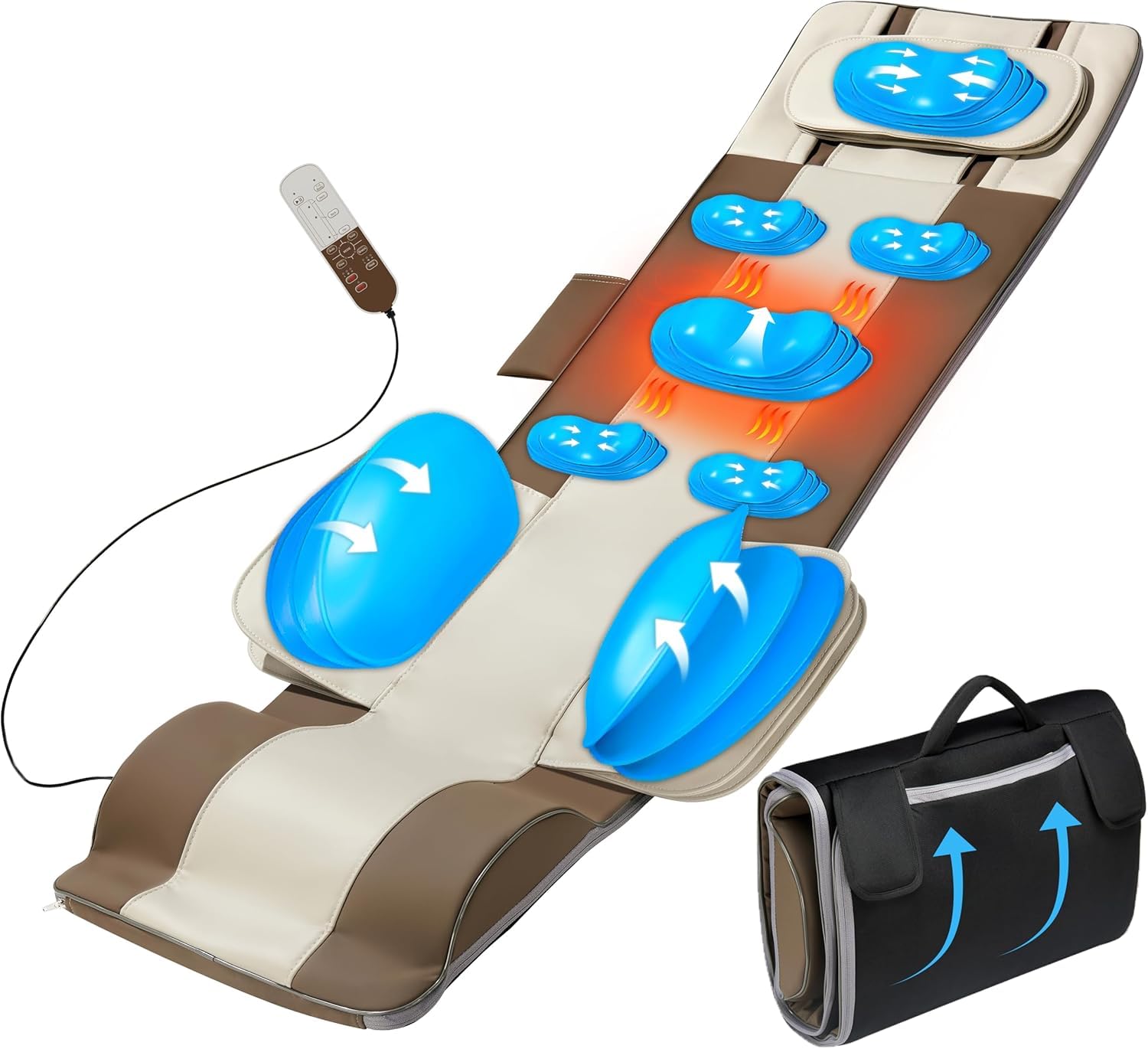
The Comrelax mat shifts the stretching paradigm away from shiatsu and vibration and into 3D mechanical movement — it traction up and down, curves your spine, and twists left and right simultaneously. This multi-axis approach is particularly effective for desk workers whose spines have adapted to a single seated posture all day. The back section includes optional heating with three levels reaching up to 149°F, which helps relax the deep paraspinal muscles before the stretch engages them.
Four program modes (Auto, Stretch, Twist, Flow) and three intensity settings give you granular control, and the handheld remote makes switching mid-session easy. The unit is designed for use on a bed, sofa, or floor — but not on chairs or recliners, as the frame needs a flat surface to articulate correctly. The foldable design with a handle keeps it at 10 pounds, making it the most portable full-body option among premium picks.
Users praise the quiet operation and gentle feel compared to roller massagers, though the stretching motion is distinct from conventional massage — it stretches rather than kneads, which can be surprising if you expect deep-tissue pressure. Customers over 6’0″ note that their feet overhang the end of the mat, so the 5’1″ to 6’0″ height limit is a hard constraint.
Why it’s great
- Three-axis movement (up/down, curve, twist) for comprehensive spinal decompression
- Three-level heating up to 149°F for muscle relaxation before stretching
- Quiet operation at 10 pounds with foldable design
Good to know
- Strict height limit of 6’0″ — taller users will have feet overhang
- Not designed for use on chairs or recliners
- Stretching sensation is distinct from deep-tissue massage — may not suit everyone
3. Full Body Massage Mat with Airbags Stretching & Heating (Sotion HY-8639)

Instead of mechanical arms or foam blocks, the Sotion mat uses 22 internal airbags that inflate and deflate to create a stretching, twisting, and traction sequence across your neck, back, waist, hips, and legs. The airbag approach is inherently quieter and gentler than roller-based systems, making it a strong choice for users who find shiatsu painful or vibration jarring. The lumbar airbags also provide a focused traction lift that supports the lower back during the decompression phase.
Four modes (Auto, Stretch, Twist, Flow) and three intensity levels let you build up gradually, and the back heating function offers three levels from 115°F to 149°F. The PU leather cover is easy to wipe clean and feels durable against skin. The foldable design with Velcro straps and a carrying handle keeps the 10-pound unit compact for storage, though the height range is tighter than the Comrelax — it fits users from 5’1″ to 5’9″.
Customers recovering from injury report that the mat bridges the gap between chiropractor visits, and the three-year warranty provides peace of mind for a device with moving airbags. Some users note that the calf and thigh airbags feel too light for meaningful compression, and the neck alignment can cause discomfort if the pillow isn’t positioned exactly right. Beginners should start at low intensity to avoid neck strain from the twisting motion.
Why it’s great
- 22 airbags provide quiet, gentle stretching across the entire body
- Lumbar airbags offer targeted traction and lift for lower back decompression
- Three-year warranty and 30-day money-back guarantee
Good to know
- Height limit of 5’9″ — taller users are excluded
- Leg massage pressure may feel too light for some users
- Neck alignment requires careful adjustment to avoid discomfort
4. Tianfucen Electric Lumbar Traction Device

The dual intelligent airbags apply and release traction in a rhythmic cycle, which mimics the manual mobilization techniques used in physical therapy. The EMS function is particularly useful for interrupting the pain-spasm cycle that tightens muscles around an injured disc.
This device is strictly for the lower back — it does not stretch the neck, legs, or hips. The controller screen lets you adjust each therapy independently or combine them, but the manufacturer explicitly warns that users must start at the lowest time and height settings and consult a doctor if they have contraindications like osteoporosis, diabetes, spinal stenosis, or a history of lumbar surgery. The unit includes a power adapter, LED controller, and base plate.
Positive reviews highlight that the combination of traction, heat, and EMS eliminated sciatica symptoms and pinched nerve pain in the leg within weeks. However, shipping issues have been reported — some international customers received a US plug instead of a UK plug, and the return process requires printing facilities. The device also requires a gradual ramp-up period; jumping to high intensity on the first use can be uncomfortable.
Why it’s great
- Combines dynamic airbag traction, 20-level EMS, heat, and vibration in one device
- Rhythmic decompression mimics physical therapy mobilization
- Significantly cheaper than clinical decompression sessions
Good to know
- Strictly for lower back — no neck or leg stretching
- Contraindicated for osteoporosis, diabetes, spinal stenosis, and post-surgery
- Some units ship with US plug only — check regional compatibility
5. True Back TBR170 Original Traction Device

The True Back is an FDA-registered, manual traction device that has been on the market since 2008 — a testament to its durability and effectiveness. It does not rely on electricity, airbags, or foam; instead, you position the curved metal frame under your back and use your body weight and subtle adjustments to create traction along the entire spine. The device measures 23.5 x 10.75 x 4 inches and weighs just 4 pounds, making it the most portable option that still provides genuine spinal decompression.
The learning curve is real — users are advised to start with pillows for support and gradually reduce them as the spine adapts. The included DVD guides you through proper positioning, and the manufacturer warns against falling asleep on the device. Many long-term users report that consistent use (1–3 times per day for a few minutes) resets spinal alignment, relieves nerve impingement in the arms and legs, and dramatically improves posture over weeks.
The primary complaint involves comfort at the contact points — several users with higher body weight (above 220 lbs) report needing to add foam padding under the ledges to prevent pressure points. The device also requires more active participation than passive foam or automated units; you control the intensity by shifting your position. For anyone willing to invest a few minutes daily into active traction, the True Back delivers clinical-grade results without a prescription.
Why it’s great
- FDA-registered for safety and medical-grade traction
- Portable at 4 pounds — fits in carry-on luggage
- Proven long-term effectiveness for bulging discs and spinal stenosis
Good to know
- Requires active positioning and a learning curve — not passive
- Comfort padding may need modification for heavier users
- No heat, vibration, or electric features — purely mechanical traction
6. Lo-Bak TRAX by EZ-Bak Lumbar Spine Stretcher

The Lo-Bak TRAX is a non-powered, professional-grade traction device that targets the lumbar spine without the bulk of a full-body frame. At 2.5 pounds, it’s light enough to slip into a carry-on bag, yet the patented metal frame and adjustable pads provide a level of decompression that competes with table-based traction. The mechanism works by arching the lower back over the curve, using gravity and your own relaxation to gently separate the lumbar vertebrae.
Each unit ships with an instructional manual, an instructional DVD, and a bonus stretch DVD, which is helpful because the traction requires proper hydration and a cooldown routine — users report that drinking water and applying heat post-session helps flush toxins released by the decompression. The device is designed for both home and professional use, and it specifically targets conditions like sciatica, scoliosis, spinal stenosis, and herniated discs.
Customer feedback is overwhelmingly positive for minor-to-moderate pain — users with bone spurs, sciatica, and general lower back stiffness report significant improvement within days. However, the device lacks the adjustability of pricier models; some users find the pad positions fixed and wish for more customization. A small number of units have shipped with visible scratches or missing padding, though the manufacturer’s customer service resolves replacement requests.
Why it’s great
- Ultra-portable at 2.5 pounds — fits in standard luggage
- Patented design delivers professional-grade lumbar decompression without power
- Includes instructional DVD and bonus stretch video for correct technique
Good to know
- Limited adjustability — pad positions are fixed
- Requires post-session hydration and heat for optimal results
- Quality control issues reported with scratched or used-looking units
7. RESTCLOUD Back Stretcher Cushion

The RESTCLOUD Back Stretcher is a foam-based passive stretcher that uses the natural C-curve of your spine to provide a consistent, gentle stretch without the need for batteries, remotes, or assembly. It’s made from polyurethane foam that behaves similarly to advanced memory foam — it compresses under body weight for comfort while maintaining its structural shape for effective stretching. The surface includes 8 massage nodes and 16 massage bars that align along the muscles on either side of the spine to enhance blood circulation during the stretch.
At 1.8 pounds and dimensions of 12.6 x 12.4 x 4 inches, it’s the smallest and lightest device in this guide, making it ideal for office use, travel, or as a first step into spinal stretching without a significant investment. The intensity is adjustable by removing the flexible massage ball from the C-opening — leaving it in provides deeper traction, while removing it reduces the stretch force for beginners or those with acute pain. Users report that the initial 5-minute sessions can feel intense (some describe slight breathing difficulty), but the body adapts within a week.
The foam material is firm rather than plush — this is by design, as a soft foam would collapse under pressure and fail to create the necessary arch. Users with spinal stenosis, sciatica, and general lower back pain report daily use leads to noticeable improvement in posture and pain reduction within two weeks. The foam is not machine-washable, but spot cleaning with a damp cloth is straightforward.
Why it’s great
- Entry-level price point with effective passive C-curve stretching
- 8 massage nodes and 16 bars stimulate blood flow along the spine
- Adjustable intensity by removing the massage ball
Good to know
- Firm foam may feel uncomfortable for the first week of use
- Not suitable for users who need adjustable or powered traction
- Foam cannot be machine washed — spot clean only
FAQ
Can a back stretcher machine fix a herniated disc?
How long should I use a back stretcher machine each session?
Who should not use a back stretcher machine?
Will a back stretcher machine help with sciatica pain?
Final Thoughts: The Verdict
For most users, the best back stretcher machine winner is the Nitrofit Limber Pro because its adjustable sliding seat ensures proper spinal alignment for a wide range of body types, and the removable calf slant board extends the stretch beyond just the back. If you want a portable full-body stretching mat with heat and multi-axis movement, grab the Comrelax 3D Stretching Mat. And for a budget-friendly entry point that still delivers genuine passive traction, nothing beats the RESTCLOUD Foam Stretcher.