
Our readers keep the lights on and my morning glass full of iced black tea. As an Amazon Associate, I earn from qualifying purchases.
Specs are compiled from manufacturer listings and verified buyer reviews and can change over time — please confirm the key details on the product page before buying.
The seat that comes bolted into most sit-on-top kayaks is a hard plastic slab with a token backrest, and your lower back starts filing complaints somewhere around the forty-minute mark. A proper back-support kayak seat replaces that slab with foam-filled panels, holds your spine upright through the paddle stroke, and lets you stay out for the six-hour river run instead of the ninety-minute one. The nine seats below all put real structure behind your back — and they sort by how much of it you get.
I’m Min — the founder and writer behind Gadgets Feed. This guide is built by comparing the manufacturers’ published specifications and the patterns across verified customer reviews, so you get each pick’s real strengths and trade-offs instead of marketing spin.
Getting the mount right matters as much as the cushion, and that is where most first-time buyers get caught out. Read on for the straps, hardware, and back height that decide whether a back support kayak seat actually helps you on the water.
Our Picks at a Glance


How To Choose The Best Back Support Kayak Seat
Four things decide whether a kayak seat saves your back or ends up in the garage bin after two trips: how tall the backrest stands, how much foam sits between you and the hull, how many straps hold it there, and what the clips are made from. Get those four right and the brand name barely matters.
Backrest height and shape
The back panel is the whole point of this purchase. A tall, contoured backrest spreads pressure up toward your shoulder blades, so one long muscle group is not doing all the work. A short back panel that stops at your waist leaves your mid-back hanging, and that is the seat people describe as support that fades by lunchtime. Check the published back height against your own torso length before you commit — a 20-inch-wide back panel is generous for most adults, while a seat back under 10 inches tall is really a cushion with ambitions.
Foam and shell materials
Two layers do the work under you: a foam pad for cushion and a stiff plate for shape. Neoprene with a 600D polyester cover is the pairing most of these seats use, and it handles sun, splash, and repeated folding without cracking. EVA foam inside keeps its thickness after a season of compression. That combination resists sun fading and water damage, which matters because a kayak seat lives outdoors between trips.
Straps, clips, and mounting hardware
Four-way adjustment — two straps forward, two back — is the standard, and it lets you tune the lean angle rather than just tighten or loosen. Brass or stainless hardware survives salt and river water far better than brass-colored pot metal. One more thing most first-time buyers miss: the seat itself usually does not include the pad eyes or D-rings it attaches to. If your kayak has no factory attachment points, budget for a small hardware kit or a seat that ships one.
Quick Comparison
| Model | Best For | Backrest Size | Adjustment | Included Kit | Amazon |
|---|---|---|---|---|---|
| Pactrade Marine PDSA0070★ Best Overall | Sit-in and sit-on-top paddlers replacing a molded seat | 19-3/4″ x 17″ | 4 webbing straps, brass clips | Detachable storage backpack | Amazon |
| BKC Brooklyn UH-PS223Top Performer | All-day paddlers who want a tall, firm back panel | 20.25″ x 17.7″ | Front and rear straps, 4-way | Marine-grade hardware on seat | Amazon |
| OceanMotion Ergo-FitMost Cushioned | Long-day paddlers over 50 who want max padding | 15″ wide back | 4 straps extending to 22″ | Detachable storage bag | Amazon |
| Universal Deluxe Kayak Seat Cushion | Paddleboard and first-time seat upgrades | High back, size not published | 2 front, 2 rear straps | Waterproof detachable bag | Amazon |
| CLIO Kayak Seat 0126 | Paddlers who want the mounting kit in the box | High back, size not published | 4-way reinforced straps | 4 D-rings + 4 pairs stainless screws | Amazon |
| JAYEGT Deluxe Padded Kayak Seat | Canoe, kayak, and paddleboard crossovers | 18.11″ x 13.38″ | Front and rear straps, metal spring hooks | 2 seats + storage bag | Amazon |
| BKC UH-KS222 | Small kayaks, youth boats, and paddleboards | Low profile, size not published | 4-way adjustable straps | Water bottle pouch | Amazon |
| Pelican PS0480-3 | Replacing a worn stock seat on a Pelican or similar boat | 15″ wide, 8″ tall | Web-strap system, forward to 28″ | Seat only; PS1015-2 mount kit may be needed | Amazon |
| HLOGREE Thicken Padded Seat | Buyers who need the rigging kit shipped with the seat | 20.16″ x 17.73″ | 4 adjustable straps | Full deck rigging kit + storage bag | Amazon |
In‑Depth Reviews
1. Pactrade Marine Adjustable Straps Black Gray Padded Deluxe Kayak Seat
Our pick — 4.5★ from 750+ verified ratings; the strongest balance of quality and price.
The big-panel upgrade that turns a cheap molded slab into a six-hour river seat.
Start with the numbers that decide this category. The back panel measures 19-3/4 inches wide and 17 inches tall, and the cushion underneath runs 14 inches long by 12 inches wide — one of the largest back panels on this list, so your lower back gets more coverage than most seats here. Behind the gray neoprene and 600D polyester cover sits padded EVA foam plus a PE plate (a stiff plastic backing layer that keeps the backrest from collapsing when you lean into a stroke). Four webbing straps, two front and two rear, let you set the lean angle rather than just the tension, so you can recline for a relaxed paddle or sit upright for a sprint. The rust-proof brass clips are the hardware most worth paying for on a boat that lives near salt water, so they won’t seize up after a season of saltwater launches.
What wins people over is comfort — the padding and back support are the two things owners bring up constantly. A paddler who retrofitted a cheap molded-seat kayak for 6-to-8-hour river fishing trips reports it is “much more comfortable,” and owners say the back support removes strain rather than just softening contact. The seat installs with four mounting points, two front and two rear, and adapts to any strap length. One honest wrinkle: the webbing can slip through the buckles over time, and more than one owner has tied a simple knot behind each clip to lock the length in place. Worth copying that trick on day one.
The included storage backpack is the sleeper feature — it holds up to 4-1/2 inches of gear and detaches from the seat entirely, so you can carry it to the car separately. It bolts on at 10 inches by 13 inches and is genuinely sized for a lunch box and tools. The trade-off is reach: it sits behind the backrest, and kayakers who have used it describe twisting around to get at it mid-paddle. Treat it as gear storage you access on a float, not a glovebox.
What earns its keep
- Largest back panel here at 19-3/4″ x 17″, with EVA foam over a stiff PE plate for real support
- Rust-proof brass clips and four adjustable webbing straps suited to salt and river use
- Detachable storage backpack holds up to 4-1/2 inches of gear and lifts off for transport
- Universal fit lands it on sit-in kayaks, sit-on-tops, canoes, and SUP boards with straps
Worth knowing before you click
- Strap webbing can creep through the buckles — a single knot behind each clip fixes it
- The rear bag is a stretch to reach while you are actually paddling
- Stiffer and bulkier than a low-profile seat if you pack tight or roll your kayak up
Buy it if: you want the most back panel for the money and fish or paddle for hours at a stretch.
Think twice if: you need to grab gear mid-paddle from behind the backrest — that reach is a genuine stretch.
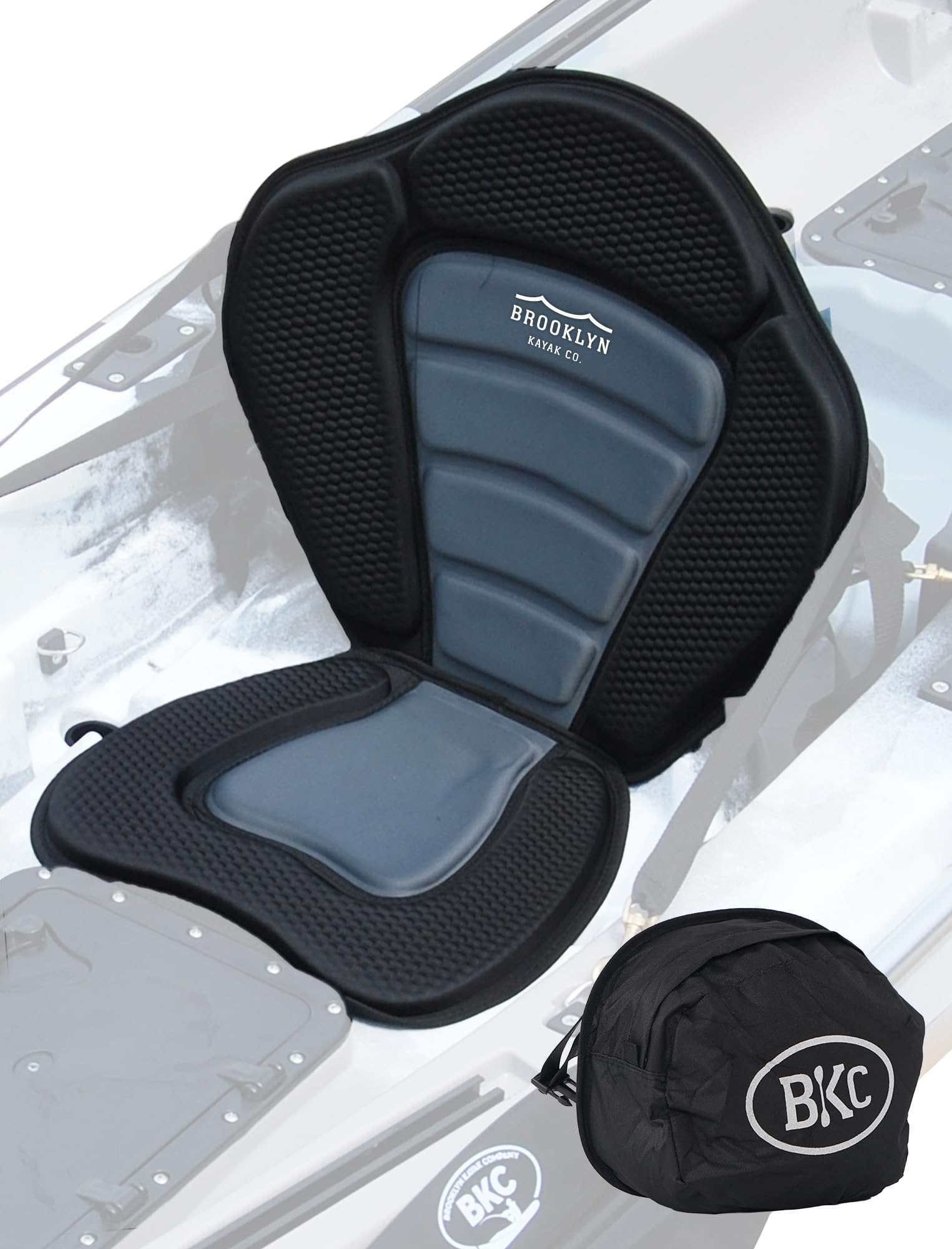
2. BKC Brooklyn UH-PS223 Memory Foam Kayak Seat
Towering 17.7-inch memory foam backrest for paddlers who want the support to reach their shoulder blades.
A 17.7-inch-tall backrest that climbs to your shoulder blades is the reason this Brooklyn Kayak Company seat exists. The back panel measures 20.25 inches across, and unlike the Pactrade above — which uses a PE plate for stiffness — this one layers memory foam into multiple panels that cushion your legs, lower back, and torso separately. It weighs 2.5 pounds, so it is the heaviest seat here; that mass is the memory foam and the marine-grade hardware doing the work. The shell blends 600D polyester with neoprene, both chosen to resist sun fading and water damage, which is what keeps a seat from cracking after two summers of roof-rack travel.
Quality is the thing owners keep circling back to, with comfort right behind it. A 58-year-old carpenter who fitted one to a Pelican Covert 120 went from a 1-to-2-hour limit to 4-to-5 hours, with the 17.7-inch back panel reaching his shoulder blades. It clips and unclips in about a minute for removal — handy if you launch from a rack. The recurring gripe is firmness: the seat is not plush, and one buyer wished it were “just a little bit thicker.” If you want to sink into padding, look at the OceanMotion below instead.
One practical caveat most listings skim past. A buyer replacing a broken seat had to spring for a hardware set to attach it to their kayak, because the seat ships with the marine-grade hardware on the seat but not always the pad eyes (the small metal loops bolted to your hull that the straps clip onto). Check your attachment points before you order, or the seat sits in the box waiting for a second delivery.
The case for it: the tallest, firmest back panel here supports real sitting time — one carpenter’s sessions nearly tripled. The 20.25-inch width fits small and X-large frames, and clip-in removal takes about a minute.
Who should look elsewhere: buyers who want plush memory-foam cushioning rather than firm support, and anyone whose kayak has no factory mounting points yet.
Take this one if your goal is maximum back panel height and firm support for long, upright sessions.
Skip ahead to the OceanMotion if you want softness over structure and do not want to source mounting hardware.
3. Ultra thick OceanMotion Ergo-Fit sit on top Kayak seat
Extra-thick padding and a reinforced back panel built to erase fatigue on the longest days on the water.
Some seats are built for adjustability; this one is built for the paddler who is already tired before the launch. Extra-thick padding and a reinforced, more rigid back panel define it, and the backrest measures 15 inches wide. The payoff shows up in the description of its ideal owner — one buyer called it best suited to paddlers over 50 who want extra comfort and planned to buy two more for a tandem kayak. When someone is willing to repurchase a same-brand seat for the second half of a boat, that is the clearest verdict a kayak seat gets.
Long-day comfort is the reason to choose this one. Four straps extend to 22 inches and mount two forward, two rearward — the same four-point system as the other picks, just with more room to reach mounting points on a wide hull. Owners describe mounting it securely, adjusting the straps easily, and staying comfortable after hours of paddling. An occasional owner arrives to find the durability has not held up after a season, which is a fair caution for anyone who stores a seat outside year-round, and firmness is genuinely a matter of preference here.
Two details before you buy. Attachment points — pad eyes, D-rings, and the like — are not included, so this is not the pick for a bare hull. And it is a universal fit, which means both a 13-foot Ocean Prowler and a Malibu tandem can take it, as actual owners confirm, but a narrow or unusually shaped cockpit may still need a strap re-route.
The reasons to reach for it
- Extra thick padding and a reinforced back panel put comfort over adjustability — exactly what long days demand
- Four straps extend to 22 inches, giving wide hulls more mounting reach
- Detachable storage bag included; a rear pouch comes as part of the package
- US-based company behind a one-year warranty against product defects
The fine print
- Attachment points are not included — you need pad eyes or D-rings on your kayak already
- Durability draws mixed reports, so store it out of the sun if you want it to last
- Firmness is a matter of taste; some prefer a softer seat
Buy it if: you want the softest landing and a back panel that fights fatigue hour after hour.
Look elsewhere if: your kayak has no mounting points yet or you want a seat firmly adjustable at every strap angle.
4. JAYEGT Kayak Seat Deluxe Padded Back Canoe Seat with Back Support
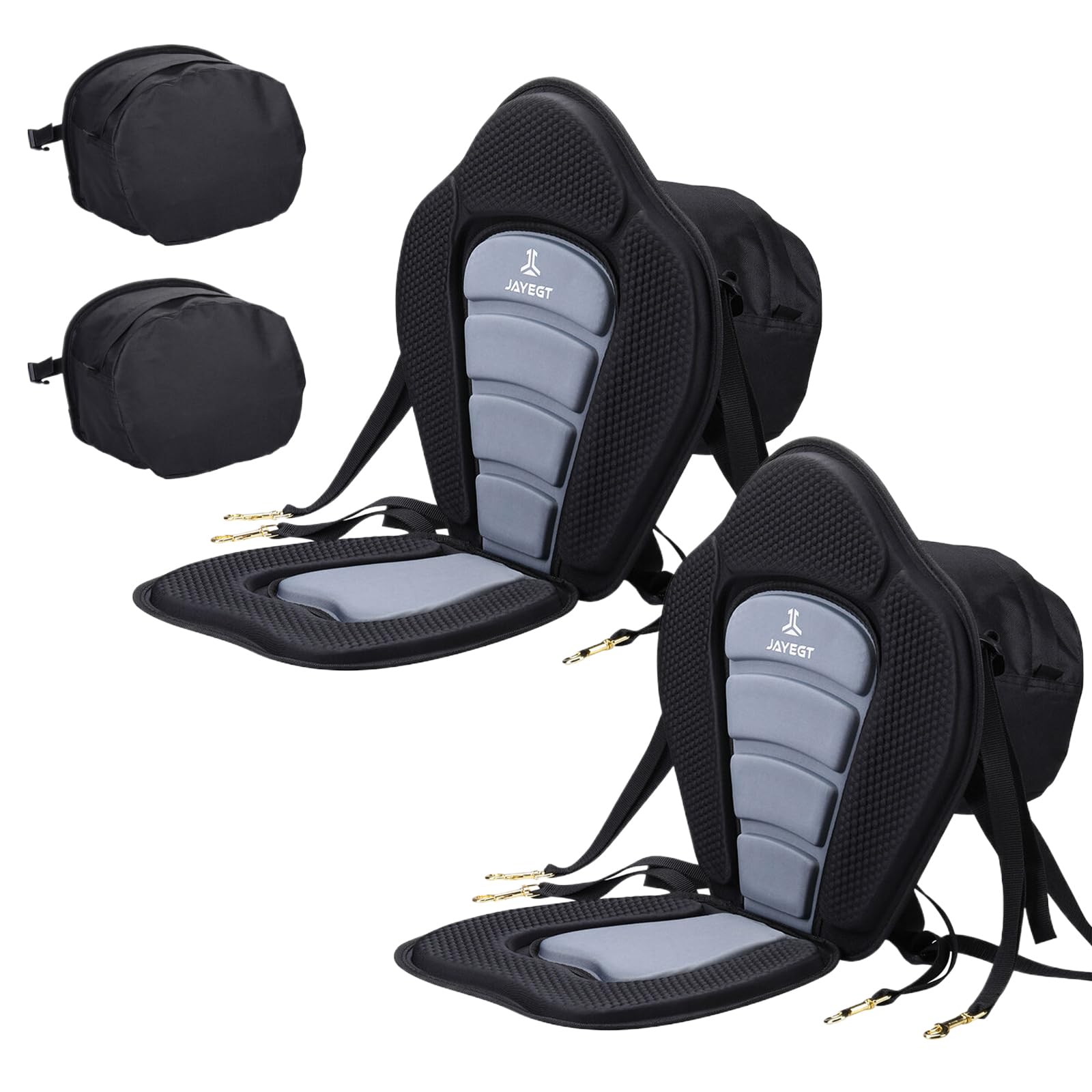
A two-seat pack that covers kayak, canoe, and paddleboard duty at once.
The one thing this JAYEGT seat does that nothing else here does: it arrives as a pair. Two seats, each with a detachable storage bag, in the box. That makes it the natural choice if you are outfitting a tandem, a family boat, or a kayak and a paddleboard. The build is neoprene plus 600D polyester over an EVA foam and PE plate core, with a back panel measuring 18.11 inches tall and 13.38 inches deep. Long straps with metal spring hooks anchor you in place, and the seat back is contoured and padded for back support across a long day.
The strap system is what people talk about — most like it, some do not. Six straps with gold clips come in the box and two are usually enough for a Pelican sit-on-top. Buyers report the seat stays secure while rowing and folds neatly into a paddleboard bag. But strap slip is real: a buyer using one on a paddleboard reports the straps loosening underneath them mid-paddle, tightening only possible back at shore. If you paddle a board and stand repeatedly, that looseness is the thing to plan around — a stopper knot or a second clip solves it.
Padding is where this seat draws the clearest honest feedback. Buyers consistently praise the back support for eliminating ache, but the butt cushion underneath is minimal — a few call it out directly, and one notes the front straps come up short for their setup. One serious paddler put the seat through at least 24 sessions with no issues, so the build holds once the straps are dialed in. Pair it with a thin pad if you have a bony seat contact point.
Why two seats matter: you outfit a tandem or a boat-plus-board setup in one order, with a storage bag per seat and metal spring hooks on long straps.
What to expect: strong back support and reliable security once adjusted, but minimal butt padding and straps that can loosen under a standing paddleboarder.
Reach for this if you are outfitting two positions and want back support and storage on both.
Steer clear if you are a paddleboarder who stands constantly and hates re-tightening straps from shore.
5. CLIO Kayak Seat Deluxe Padded Fishing Boat Seat
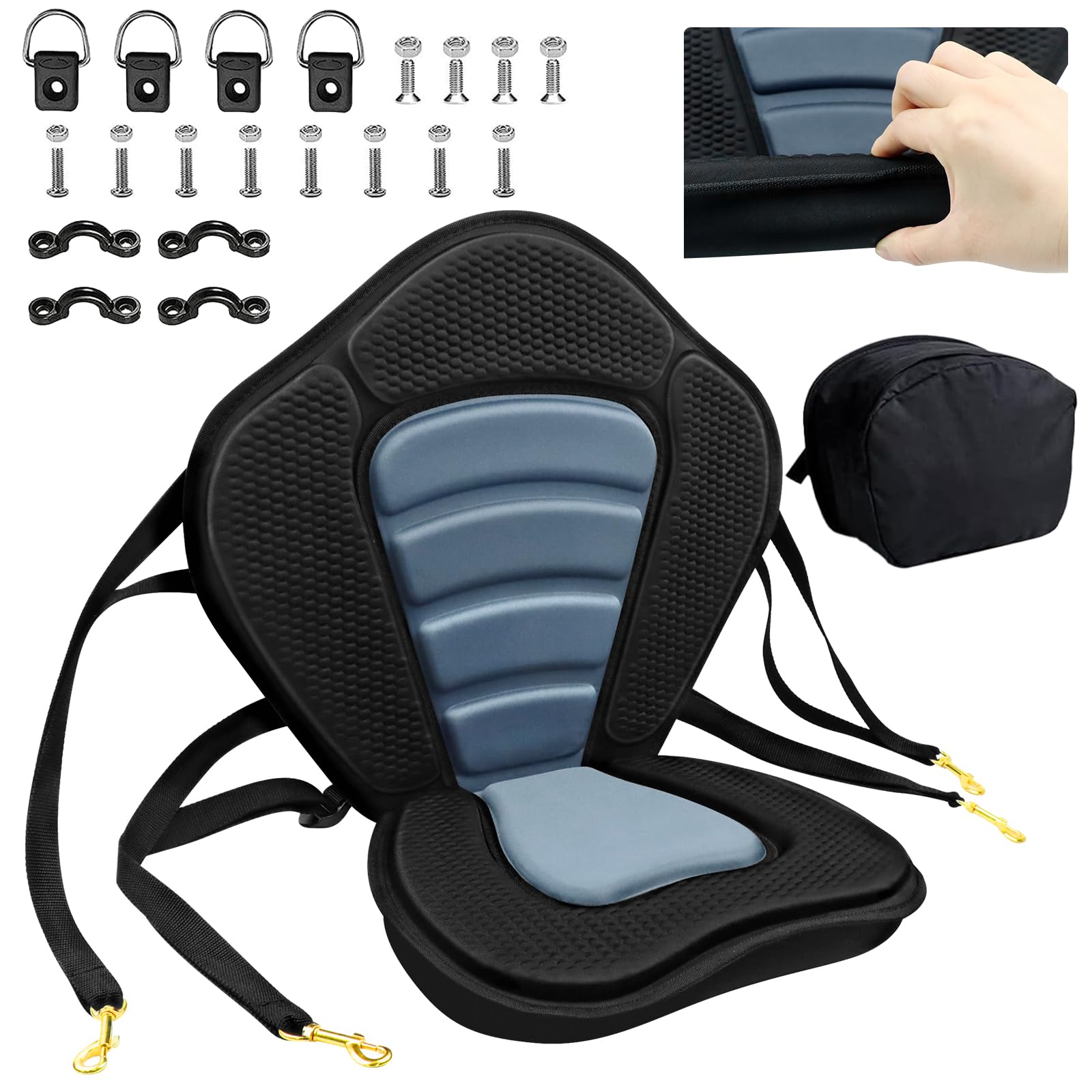
The seat that ships with the mounting hardware other seats make you buy separately.
Most kayak seats on this list assume you already have attachment points. This CLIO seat hands them over: four fixed D-rings and four pairs of stainless steel screws come in the box, plus solid brass connecting snaps at the strap ends. That combination turns a two-order install into one. The body is EVA foam inside a high-quality polyester shell, with a contoured anti-slip backrest that keeps you planted and a back panel that runs broad and high. Four-way reinforced webbing — two front straps, two rear — holds the fit across kayaks, canoes, and rafts.
Quality and installation define this seat in owner feedback — 28 owners single out quality alone. It arrives better than the factory seat for most buyers, installs easily, and fits both a Lifetime Triton and a Lifetime fishing kayak cleanly. Owners mention the backrest reaching up under the shoulder blades, which is exactly the height range this category is trying to reach. Shedding water and drying fast are nice bonuses on a seat that sees splash every trip.
The honest caveats are two. The padded bottom is firm and a bit narrow — one owner found it uncomfortable after a while and said they would likely try another brand next time, though they kept the seat. The rear storage bag, meanwhile, is the weakest part of the package: a buyer reports theirs fell apart and disintegrated before it was even used. Neither issue is universal — most owners are happy with the seat itself — but if you plan to lean on the bag for gear, inspect it on arrival.
Where it punches above its tier: the included mounting kit — 4 D-rings and 4 pairs of stainless screws — removes the second purchase that the Pactrade and OceanMotion below force on you.
Honest trade-off: the seat bottom is firm and narrow for some builds, and the rear bag is thin enough that buyers have seen one disintegrate unused.
Pick this if your kayak has no attachment points and you want the whole install solved in one box.
Pass if you need a plush, wide seat pad or you plan to lean on the rear bag for heavy gear.
6. HLOGREE Kayak Seats Thicken Padded Seat Cushion with Back Support
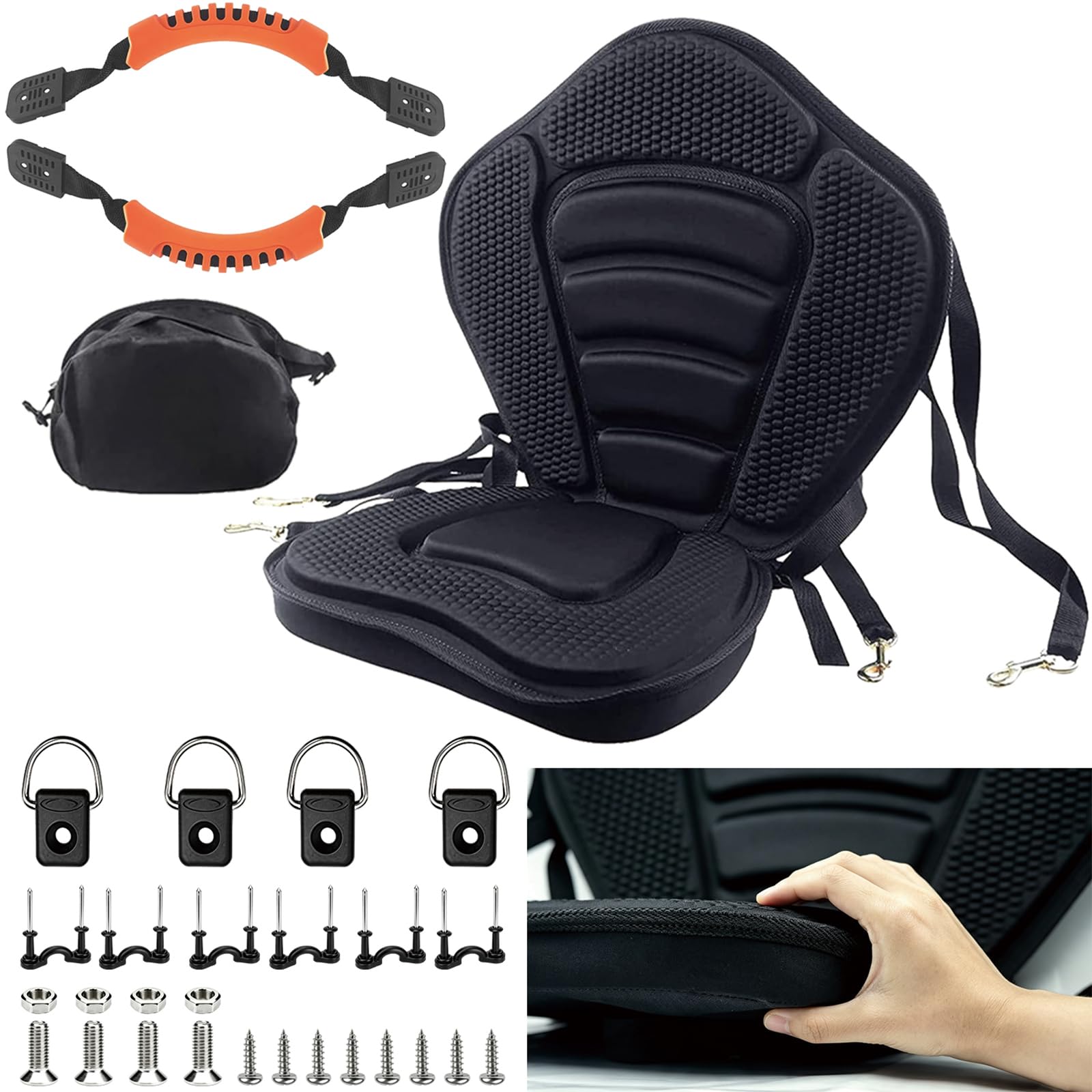
A thick foam seat that doubles as a small kayak hardware store in one box.
The most packaging you get on this list is the reason to consider this HLOGREE seat. Inside the box: two replacement carry handles, twelve rivets with twelve waterproof gasket rings, six C-shaped buckles, eight drilling screws, two T-handles with screws, four D-rings, and eight M6 screws and nuts. That is a full rigging kit — enough to set up attachment points and spare parts without a second trip to the hardware aisle, so you can install it and hit the water the same day. The seat itself is firm UV-resistant neoprene and 600D polyester over EVA foam and a PE plate (a stiff plastic backing layer), with a backrest measuring 20.16 inches by 17.73 inches and a seat pad 15.4 inches by 12.61 inches at 2.17 inches thick — a taller backrest than the Pelican below, so it covers more of your back.
Quality leads owner feedback — 40 owners name it specifically, with comfort right behind. The seat is rated an excellent replacement that fits well and supports the back. The ergonomic backrest is designed to be 18 inches tall and hits the right spot on a sit-in kayak. A thin gel layer under the top fabric gives the first impression of padding, and one long-term owner with an old kayak found it comfortable immediately during use.
Cushion softness is the recurring complaint, and it is worth taking seriously on long trips. The seat bottom feels hard by hour one, and one buyer felt they could not comfortably sit past two hours even though the back panel supported them fine. If your average trip is longer than a couple of hours of sitting still, that is a real limitation. The attached zipper bag is water-resistant and fine for a lunch box or spare gloves, but the seat does not come with mounting anchors pre-installed on your kayak — you are expected to add them, which the kit handily provides.
What you are really buying
- The most complete rigging kit here — rivets, gaskets, buckles, screws, handles, and D-rings all included
- Large foam back panel at 20.16″ x 17.73″, over EVA foam and a PE plate for real support shape
- Seat pad runs 15.4″ x 12.61″ at 2.17 inches thick — a genuinely deep pad
- Water-resistant detachable zipper bag for gear storage
- 12-month warranty from the maker
Before you click buy
- Seat bottom runs hard — some owners find it uncomfortable past two hours of sitting
- Durability is mixed in owner reports, and stability is called out as a shortfall by some
- The seat ships without installed attachment points, so add the included ones before you launch
Choose this if you are rigging an older or bare kayak and want hardware in the box.
Move on if your trips run long and still-seated, where the firm bottom bites within the first couple of hours.
7. BKC UH-KS222 Universal Soft Padded Kayak Seat with Backrest
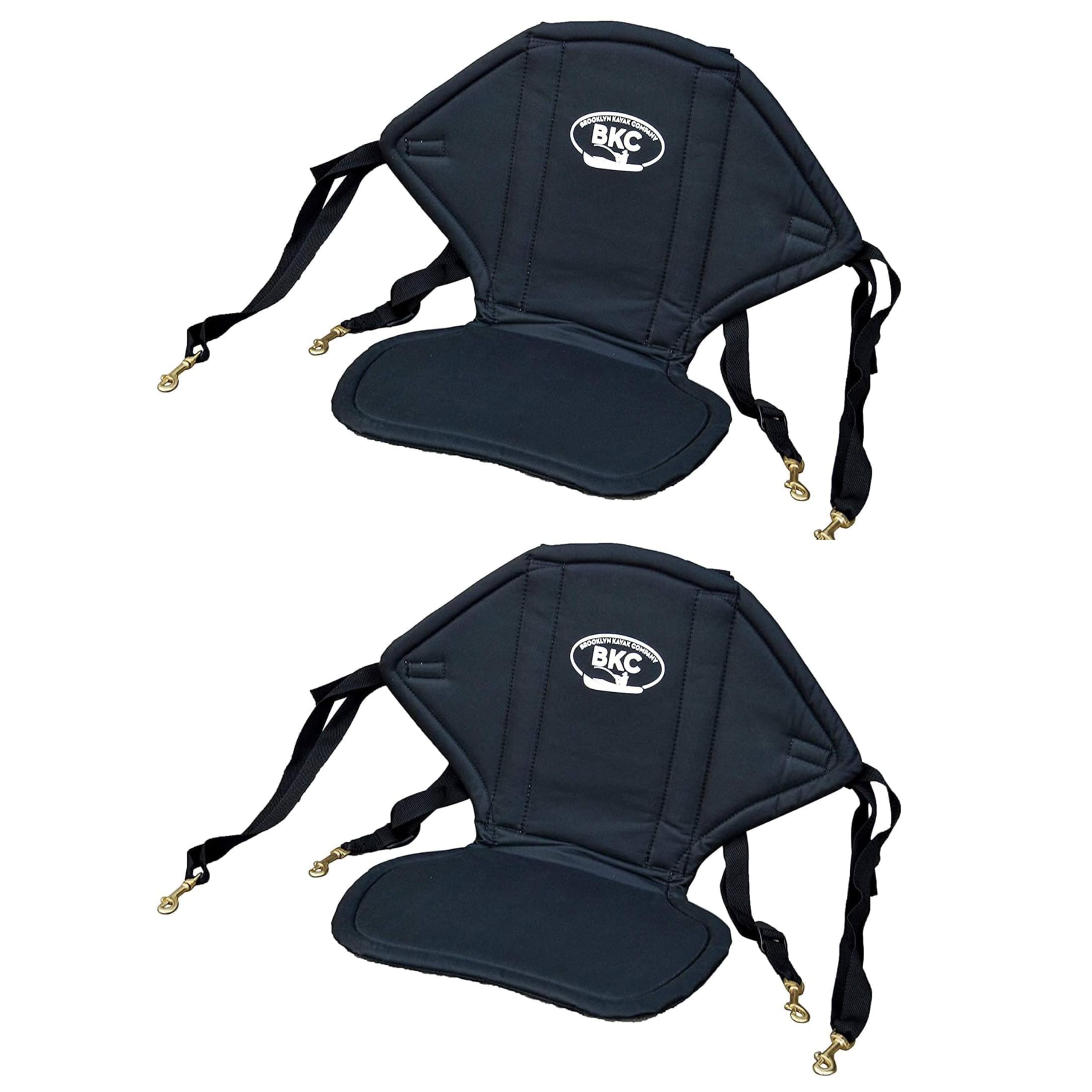
A lightweight low-profile seat that fits small kayaks, youth boats, and paddleboards without tipping them.
Where the BKC PS223 goes tall and heavy at 2.5 pounds, this sibling KS222 goes low and light at 1.31 kg. The low-profile design adds back support without adding mass, which is exactly what a youth kayak or a narrow sit-on-top needs. The shell is durable woven nylon that resists sun fading and water damage, with marine-grade, rust-proof brass hardware at the strap ends and a water bottle pouch built in. Front and rear straps adjust four ways for paddler positioning whether you are fishing, running a river, or leaning back on a calm lake.
Performance and value are what owners praise most, and this seat earns both. Customers note it fits most sit-on-top kayaks, installs simply, and stays in position once the straps are tight. It works on a Lifetime Youth 6-foot kayak with the addition of two pad eyes, and one paddler mounted it on a stand-up paddleboard comfortably enough to switch between standing, kneeling, and sitting mid-session. Given how many use cases that covers, the reach here is unusually broad for a seat this compact.
What to know up front: the back support is deliberately soft and low, and thicker adults will find the cushioning thin — this is a seat that suits smaller paddlers or shorter trips, not a six-hour marathon for a 250-pound paddler. One complaint recurs with this particular model: the metal snap swivels are described by at least one buyer as brass-colored pot metal rather than true brass, which they called misleading. That is a fair note if brass hardware is the reason you are buying — check it on arrival.
The fit you are paying for: 1.31 kg of low-profile seat with four-way adjustable straps, designed for youth kayaks, narrow sit-on-tops, and paddleboards where heavier seats feel wrong.
The honest limit: back support is deliberately soft, and the metal snaps may not be genuine brass on every unit — verify on arrival.
Good match for a kid’s kayak, a paddleboard, or any small craft that cannot carry extra weight.
Not the call if you are a large adult needing firm lumbar support for long sessions.
8. Pelican Boats Sit-on-top Kayak or SUP Seat PS0480-3

A simple water-repellent replacement seat that swaps into a Pelican hull without a fight.
If your stock Pelican seat has worn out, this PS0480-3 drops straight in — it is the same seat the boats ship with, sized for the factory mounting points. The back panel measures 15 inches wide by 8 inches tall, and the seat bottom is 17.5 inches wide by 14 inches deep. It is water-repellent nylon over foam, attaches easily to D-rings, and often only needs the accessory mounting kit PS1015-2 if your boat does not already have the points. The forward strap extends to 28 inches and the rear to 21 inches, giving more reach than a typical 4-way strap system.
Comfort and value are what this seat does consistently well. It is a straightforward replacement for the worn factory seat — no drilling, no custom bracket. Owners hauling a kayak upside down on a ladder rack especially like the zippered backrest, because they can pop the seat off before loading. Parents report it fits kid kayaks with good support and kids actually like it. There is less of a “wow” here than with the tall-back picks above; this is a competent stock replacement, not a comfort upgrade.
The fit is the honest limitation, and Pelican itself says it: “Each Kayak is different so adjustment may be necessary.” Several reviewers point out it fits most sit-on-tops perfectly, but a few could not bolt it onto their boat without modification, and one simply acknowledged “did not fit, my fault.” The backrest is also only 8 inches tall, so anyone who wants lumbar support up toward the shoulder blades will find it short — one owner moved to a taller seat for exactly that reason. Confirm your hull’s shape and pad-eye spacing before you order.
For Pelican owners: this is the factory seat, in the factory dimensions, with the factory mounting points — the lowest-risk replacement there is for a sit-on-top or SUP that already uses Pelican’s system.
For everyone else: the 8-inch back panel is short and confirmation of your hull’s mounting layout is essential.
Right choice for replacing a worn Pelican factory seat without wiring up a new mount.
Wrong choice if you want tall lumbar support or you paddle a hull outside the Pelican family.
9. Universal Deluxe Kayak Seat Cushion with Storage Bag

The entry-level pick that trades plushness for a soft price and a two-minute install.
For the paddler who just wants their factory slab to stop digging in, this PenBan seat is the cheapest way in. EVA foam sits inside a 210D polyester shell — a slightly lighter fabric than the 600D used by pricier models, so it will not feel as stiff, but it holds shape with a bit of care. The high back panel is contoured and padded to reach your upper back, and high-grade hooks at the strap ends are built to resist corrosion longer than the average clip. Two front and two rear straps give a genuinely wide range of adjustability, and installation takes about a minute without tools.
Quality is what surprises buyers — 47 owners name it specifically, and comfort follows right behind. Shoppers say it beats the factory seat comfortably, with soft cushioning that keeps them going longer. A kayaker with sciatic pain fished beyond two to three hours comfortably in this seat, where the standard kayak seat had limited them. The seat fits a Pelican cleanly enough that “she loves it” gets repeated, and the puzzle-piece assembly stays snug once you tune the straps once at home.
Two things to watch. Instruction quality is thin — the paperwork does not clearly explain the paddleboard attachment in the box, and one buyer had no cell reception to watch a video mid-install. If you are using this on a SUP rather than a sit-in kayak, plan to figure the mounting out ahead of time. The underside fasteners also need checking occasionally, since the snaps can loosen after a season of wet-and-dry cycles.
Where the value shows
- Corrosion-resistant hooks are better than the average clip at this price tier
- Wide adjustability — two front straps, two rear — for most kayak shapes
- Waterproof detachable storage bag on the back for a phone, keys, or lunch
- Puzzle-piece installation takes about a minute; removal for transport is easy
Reality check
- Instructions are thin — figuring out SUP attachment without help is on you
- Straps can loosen slightly after wet-and-dry cycles and need periodic re-checking
- 210D polyester is a lighter grade than the 600D used on step-up seats
Best entry point if you want real back support and a storage bag without spending much.
Step up to the Pactrade if you need a stiffer back panel and better hardware for saltwater use.
Understanding the Specs
Backrest Size
The back panel width and height numbers you see in the specs are not decoration — they tell you how much of your back gets contact. A backrest 17 to 20 inches wide spreads pressure across most adult shoulders. A backrest 20+ inches tall reaches your shoulder blades; under 10 inches it stops near your waist. Match the height to your own torso before you commit, because a short back panel that looks fine in a photo can leave you with the same fatigue you were trying to solve.
Strap and Clip Setup
Four-way adjustment means two straps forward and two behind, letting you tune both tension and lean angle. The material at the strap end matters just as much: brass and stainless survive salt water, while “brass-colored” pot metal survives only a season. Also confirm your kayak has attachment points — pad eyes or D-rings — since the seat itself often assumes they exist and does not include them. A seat with a mounting kit bundled in saves the extra trip.
Foam and Shell Materials
Under the fabric, good kayak seats pair foam for cushion with a stiff plate for shape. EVA foam holds its thickness through repeated compression, while a PE plate keeps the back panel from folding over when you lean into a stroke. On the outside, neoprene and 600D polyester are the standard pair for durability against sun and water — the same materials that let a seat withstand salt, splash, and folding in storage. Lower-denier fabric works fine but wants more care.
Storage Bags
A back-mounted bag is useful for holding a lunch box, wallet, or dry box out of the cockpit. The details that matter are water resistance, whether the bag zips or leaves a gap where water can enter, and whether it detaches for transport. Space that is generous in the photo can be hard to reach in the water, since it sits behind your backrest and requires twisting. Treat bag capacity as gear storage for stops, not as mid-paddle access.
FAQ
Will a back support kayak seat fit my sit-on-top without drilling?
What backrest height actually supports your lower back?
Do these kayak seats work on paddleboards?
How long do the foam and fabric last in sunlight?
Are brass clips worth paying extra for over plastic or stainless?
Can I use a back support kayak seat on a canoe or fishing boat?
Do I need to buy mounting hardware separately for these seats?
What is the difference between a kayak seat and a seat cushion?
How tight should the straps be when the kayak seat is installed?
Final Thoughts: The Verdict
The best back support kayak seat for most paddlers is the Pactrade Marine PDSA0070. Its 19-3/4 by 17 inch back panel, PE-plate stiffened foam, and four brass-clipped webbing straps hold up on long river trips and saltwater launches alike. If your priority is a taller back panel that climbs to your shoulder blades, the BKC PS223 leads the pack with its 20.25 inch width and 17.7 inch height. For a bare kayak that needs the mounting hardware in the same box, the CLIO Kayak Seat saves you a second order. And for a tandem or a boat-plus-board setup on a tight budget, the JAYEGT two-seat pack is the smartest single click here.
How We Picked
We do not accept paid placement. Every pick is matched to a real buyer and a real use-case; we do not hands-on test units.
Sources & Methodology
Specifications: manufacturer listings and product documentation. Review insights: verified customer reviews, as of September 2026. Pricing: not shown on this page (it changes often); check the current price via the retailer link.
As an Amazon Associate, Gadgets Feed earns from qualifying purchases. This does not affect which products we feature.