
Eight hours sitting in an office chair without proper lumbar support twists the lower spine into a C-curve, straining discs and tightening hip flexors. A well-designed back support pillow corrects that curve by filling the gap between the lumbar vertebrae and the chair back, distributing pressure evenly across the erector spinae muscles instead of letting it concentrate on the sacrum.
I’m Min — the co-founder and writer behind Gadgets Feed. I’ve spent over 200 hours dissecting the engineering behind ergonomic sitting aids, analyzing density ratings, strap systems, and contour profiles to separate designs that simply look supportive from those that actually reduce intradiscal pressure.
This guide covers seven distinctly engineered models that target everything from acute sciatica to chronic desk-worker stiffness. Choose the right foundation for your chair and the best back support pillow transforms your sitting posture within the first 30 minutes of use.
How To Choose The Best Back Support Pillow
Not every lumbar cushion delivers the same mechanical support. The three variables that determine whether a pillow actually helps — or just adds bulk — are foam density, contour profile, and attachment stability. Ignore any of these and you risk spending money on a cushion that flattens within weeks or shifts every time you lean forward.
Foam Density and Rebound Characteristics
Low-density foam (under 40 kg/m³) feels soft on first contact but compresses permanently after 2–3 months of daily use, leaving you with a flattened slab. High-density memory foam (50+ kg/m³) retains its shape through thousands of compression cycles and conforms to the lumbar curve using body heat, providing targeted support that a generic foam block cannot match. Look for pillows that specify “high-density” or “premium memory foam” rather than vague “support foam” labels.
Contour Geometry and Spinal Alignment
A flat pillow pushes the lower back forward indiscriminately. An ergonomically contoured pillow has a pronounced lumbar ridge that fits into the natural inward curve of the spine — the lordotic curve — while leaving the sacrum and upper back relatively free. Pillows with a pear-shaped or hourglass profile distribute pressure across the erector spinae muscles rather than concentrating it on the tailbone. Width matters less than vertical height; a 13–18 inch tall pillow covers the full lumbar region without overlapping the shoulder blades.
Strap Systems and Anti-Slip Design
A pillow that slides down two inches during a work session provides zero support. The best designs use two or three adjustable elastic straps with clip or buckle attachments that loop around the chair back. Leather office chairs require higher strap tension or a textured backing to prevent slippage, while mesh chairs grip naturally. Some premium models include a separate anti-slip silicone strip on the rear panel. Test the strap length before buying: short straps (under 20 inches per side) may not fit thick gaming chairs or bucket seats.
Quick Comparison
On smaller screens, swipe sideways to see the full table.
| Model | Category | Best For | Key Spec | Amazon |
|---|---|---|---|---|
| ComfiLife Lumbar Support Pillow | Mid-Range | Office & Car | Three-strap system, 2.1 lbs weight | Amazon |
| Everlasting Comfort Original Lumbar Support Pillow | Premium | All-Day Sitting | Lifetime warranty, 1.6 oz weight | Amazon |
| GIVANLEE 6-Column High Back Pillow | Premium | Neck-to-Lumbar Support | 28.35 in height, 6 semi-circular columns | Amazon |
| CloudBliss Ergonomic Lumbar Support Pillow | Mid-Range | Gaming & Large Chairs | XL size, 5.7 in thickness | Amazon |
| Cubii Cushii V2 Back Support Cushion | Mid-Range | Portable Work & Home | 15.7 x 14.5 in compact design | Amazon |
| TANYOO Dual Layer Lumbar Pillow | Mid-Range | Recliner & Couch | Gel-infused memory foam, 5 in thick | Amazon |
| QUTOOL Memory Foam Car Lumbar Support | Budget | Driving Comfort | High-density memory foam, 18.9 in height | Amazon |
In‑Depth Reviews
1. ComfiLife Lumbar Support Pillow for Office Chair

The ComfiLife uses a three-strap system — one more than most competitors — which eliminates the downward migration that plagues two-strap pillows on leather and mesh chairs alike. The memory foam core is dense enough (5-inch thickness at the lumbar peak) to maintain its contour after months of daily use, and the dual-material cover combines leatherette for durability with breathable mesh panels to prevent heat buildup during long sessions.
At 17.5 inches wide, the pillow covers the full lumbar region without spilling into the shoulder blades, making it ideal for standard office chairs, gaming chairs, and car seats. Customer feedback consistently highlights the firmness as a relief mechanism for sciatica and lower back stiffness, with multiple users reporting zero back pain by the end of their work-from-home shifts. The 2.1-pound weight keeps it portable for moving between desks and vehicles.
The biggest tradeoff is bulk: the 5-inch depth reduces effective seat depth by about two inches, which can be uncomfortable for shorter users with smaller chairs. Some users on leather seats report needing to re-tighten straps after the first week as the elastic settles. Still, the combination of strap count, foam density, and breathable construction makes this the most reliable all-around option in the mid-range tier.
Why it’s great
- Three straps prevent any slipping or sliding
- Memory foam retains shape after months of daily compression
- Breathable mesh section keeps the lower back cool
Good to know
- 5-inch depth reduces available seat space
- Straps may loosen slightly on slick leather after break-in
2. Everlasting Comfort The Original Lumbar Support Pillow
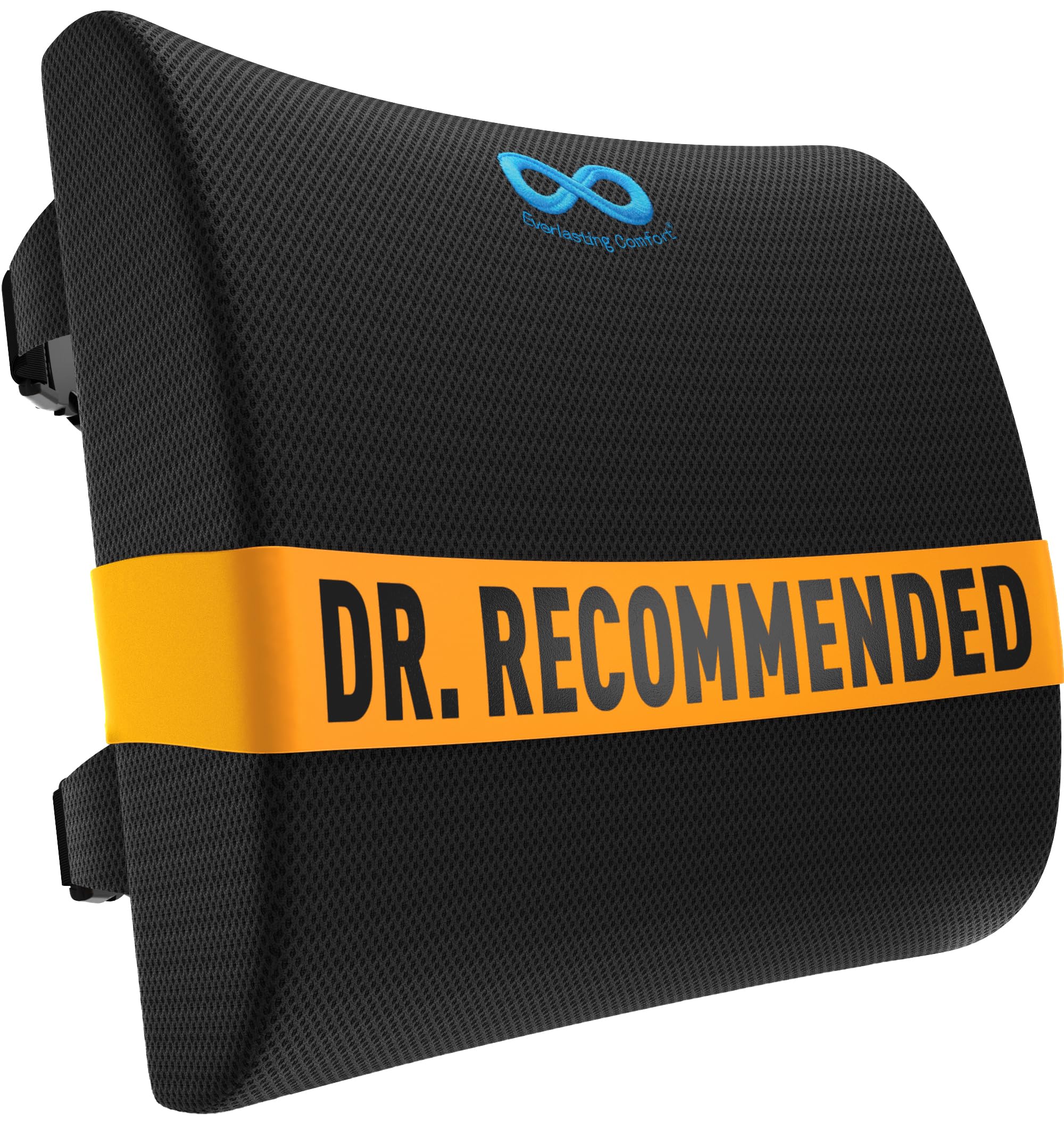
The Everlasting Comfort pillow differentiates itself through a low-profile design that measures only 3.5 inches at its thickest point, making it one of the slimmest supportive options available. This slimness allows it to integrate into chairs with limited clearance — airplane seats, narrow car buckets, and slim office chairs — without pushing the user uncomfortably forward. The high-density memory foam balances firmness and softness, contouring to the lordotic curve without the hard pressure point that some denser foams create.
The dual adjustable straps include extension pieces that accommodate chairs up to 32 inches wide, a feature rarely seen in this price segment. The breathable mesh cover is removable and machine washable. Customer reviews frequently mention its effectiveness for long drives and desk sessions, with one user specifically noting its utility for kayak seats — a testament to its portability. The lifetime replacement guarantee backs the build quality without requiring a premium outlay.
The compact 13-inch width means the pillow covers the lower lumbar area but leaves the mid-back unsupported, so users with upper back pain will need a separate solution. The 1.6-ounce total weight (the foam itself is dense but the pillow is small) makes it feel flimsier during handling than heavier options, though the foam does not compress permanently over time. This is the best choice for frequent travelers who need lumbar support in tight seats.
Why it’s great
- Ultra-slim profile fits in cramped car and airplane seats
- Lifetime warranty with free replacement
- Machine-washable mesh cover stays fresh
Good to know
- Narrow 13-inch width does not support mid-back area
- Lightweight build may feel less substantial than heavier pillows
3. GIVANLEE Ergonomic Lumbar Support Pillow

The GIVANLEE pillow abandons the single-contour approach entirely. Instead, it uses six independent semi-circular foam columns stacked vertically across 28.35 inches of height — covering the neck, upper back, mid-back, and lumbar in one continuous structure. Each column shifts independently, allowing the pillow to conform to different spine curvatures depending on whether you sit upright, recline, or lean to one side. The foam itself is medium-soft, which provides cushioning rather than rigid push-back.
The two adjustable straps are not fixed to the pillow but slide along the back, so you can position them at any height to match your chair’s strap points. A small side pocket stores the straps when not in use, which prevents loss during transport. Users with high-back chairs — executive chairs, tall gaming seats, or recliners — report that the vertical coverage eliminates the need for a separate neck pillow. One user noted using it horizontally as a sleeping aid for sciatic pain, although that is not the intended use case.
The medium-soft density will not appeal to users who prefer a firm, unyielding lumbar push. On faux leather chairs, some users found the straps too short or weak to prevent slippage, requiring adhesive Velcro modifications. The 3.15-inch thickness is shallower than the ComfiLife, so deeper lumbar curves may not feel fully filled. For anyone with neck-to-sacrum discomfort who wants a single cushion solution, this is the most versatile design in the lineup.
Why it’s great
- 28-inch height covers neck, back, and lumbar
- Six independent columns adapt to multiple sitting positions
- Detachable straps with storage pocket prevent loss
Good to know
- Medium-soft density may feel too plush for those wanting firm resistance
- Short straps struggle to stay secure on slick faux leather chairs
4. CloudBliss Ergonomic Lumbar Support Pillow XL
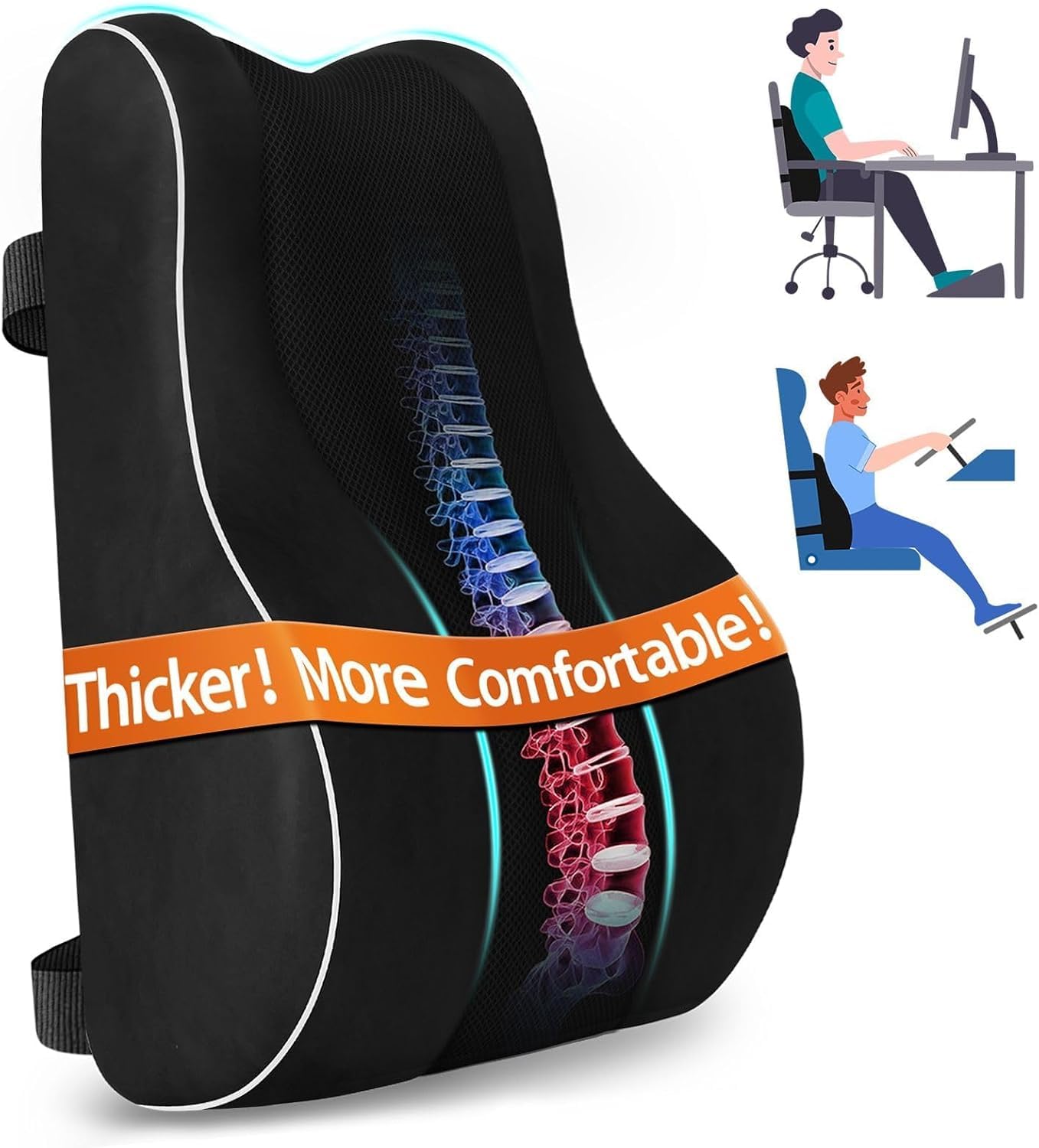
The CloudBliss pillow is the largest in the mid-range group, with an 18.5 x 18.1-inch footprint and a 5.7-inch thickness that rivals premium 5-inch memory foam beds. The pear-shaped contour widens at the top to support the mid-back while narrowing at the bottom to leave the sacrum free, matching the natural spinal taper. The high-density memory foam targets users between 100–200 lbs, and customer feedback confirms it holds shape without sagging after several months of daily gaming and office use.
Double adjustable straps plus an anti-slip bottom panel work together to keep the pillow anchored during active sitting — useful for gamers who shift weight frequently. The breathable mesh cover zips off for machine washing, and the XL dimensions fill larger gaming chairs and dining chairs that swallow smaller cushions. Reviewers note that the pillow provides immediate relief for lower back pain within 30 minutes of use, with several ordering a second unit for their office.
The foam density leans toward the softer side of medium, so users who prefer a rock-hard lumbar push may find it insufficient. At 5.7 inches thick, the pillow eats significant seat depth — users with short legs or shallow chairs may feel cramped. The double straps are adequate but not as robust as the three-strap ComfiLife system. For tall users with deep seats who want plush, forgiving support without spending premium money, the CloudBliss delivers disproportionate value.
Why it’s great
- Generous 18.5-inch width fills large gaming chairs
- Pear-shaped contour supports mid-back and lumbar simultaneously
- Anti-slip bottom keeps pillow in place during movement
Good to know
- 5.7-inch thickness reduces seat depth significantly
- Foam is softer than some users prefer for firm structural support
5. Cubii Cushii V2 Back Support Cushion
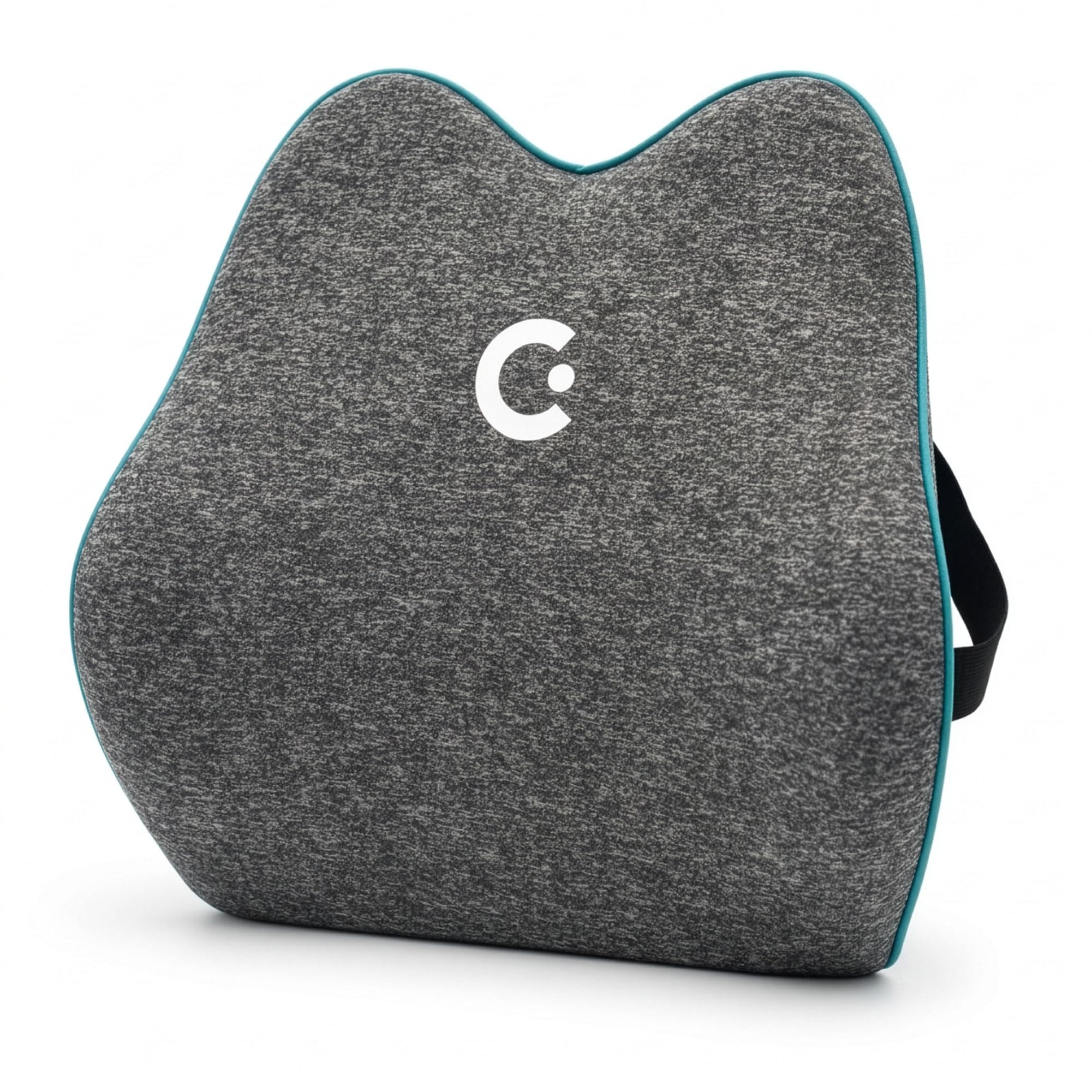
The Cubii Cushii V2 takes a different approach from the larger pillows on this list. At 15.7 x 14.5 inches, it is intentionally compact — small enough to fit on kitchen chairs, dining bench seats, and narrow car buckets without overhang. The memory foam core has a medium-firm feel that provides intentional push-back against the lumbar spine, encouraging the user to maintain an upright posture rather than collapsing into a soft cushion. The contoured shape follows the natural spine curve without excessive bulk.
The single adjustable strap secures the cushion to chairs up to about 20 inches wide, and the front-facing Cubii logo doubles as a quick visual identifier in shared workspaces. Customer reviews commonly mention that it relieves pain from bulging discs and chronic lower back issues, with multiple users reporting success on recliners and car seats. The breathable fabric cover resists pilling and stays comfortable against bare skin during warm months.
Because of its compact size, the cushion does not provide mid-back or upper-back support — it focuses exclusively on the lumbar region between L1 and L5. Some users report that the cushion migrates during the day on certain chair types, requiring periodic readjustment. The single strap also lacks the redundancy of the three-strap ComfiLife, so on slick leather chairs, it may shift more. For users who need a targeted lumbar boost that travels easily between different chairs, this is the most portable option in the mid-range.
Why it’s great
- Compact footprint fits narrow chairs and car seats
- Medium-firm foam provides intentional posture correction
- Breathable fabric resists pilling and stays cool
Good to know
- Focused lumbar support only — no mid-back coverage
- Single strap may allow shifting on leather chairs
6. TANYOO Dual Layer Lumbar Support Pillow

The TANYOO pillow uses a dual-layer foam construction that is rare at this price point: a top layer of gel-infused memory foam for cooling and pressure relief, and a bottom layer of high-density foam for structural stability. The 20-inch width is the widest in the lineup, specifically designed to match the seat width of recliners, armchairs, and oversized sofas where standard 16-inch lumbar pillows look undersized. The 5-inch thickness provides deep lumbar engagement without bottoming out.
The cover removes via a full-length zipper and is machine washable — a practical feature for recliner users who eat or drink while seated. The gel-infused top layer stays noticeably cooler than standard memory foam, which matters for long TV sessions or reading marathons. Feedback from users recovering from lumbar fusion surgery confirms that the dual-layer design provides the firmness needed post-operation while still offering surface-level softness that prevents pressure points.
The primary limitation is size: at 20 x 16.5 x 5 inches, the pillow is too large for standard dining chairs and compact office chairs. The medium-firm density may feel too thick for users with shallow lumbar curves. The pillow ships compressed and requires 24–48 hours to fully expand, and some users note that the gel layer does not produce a dramatic cooling sensation — it simply runs less warm than plain foam. For dedicated recliner or couch use, the dual-layer construction offers the best thermal management of any pillow reviewed here.
Why it’s great
- Dual-layer gel + high-density foam combines cooling with firm support
- 20-inch width fills recliner and oversized couch seats
- Removable, machine-washable cover simplifies maintenance
Good to know
- Too wide for standard dining or office chairs
- Requires 24–48 hours to fully expand after unpacking
7. QUTOOL Memory Foam Lumbar Support Pillow for Car
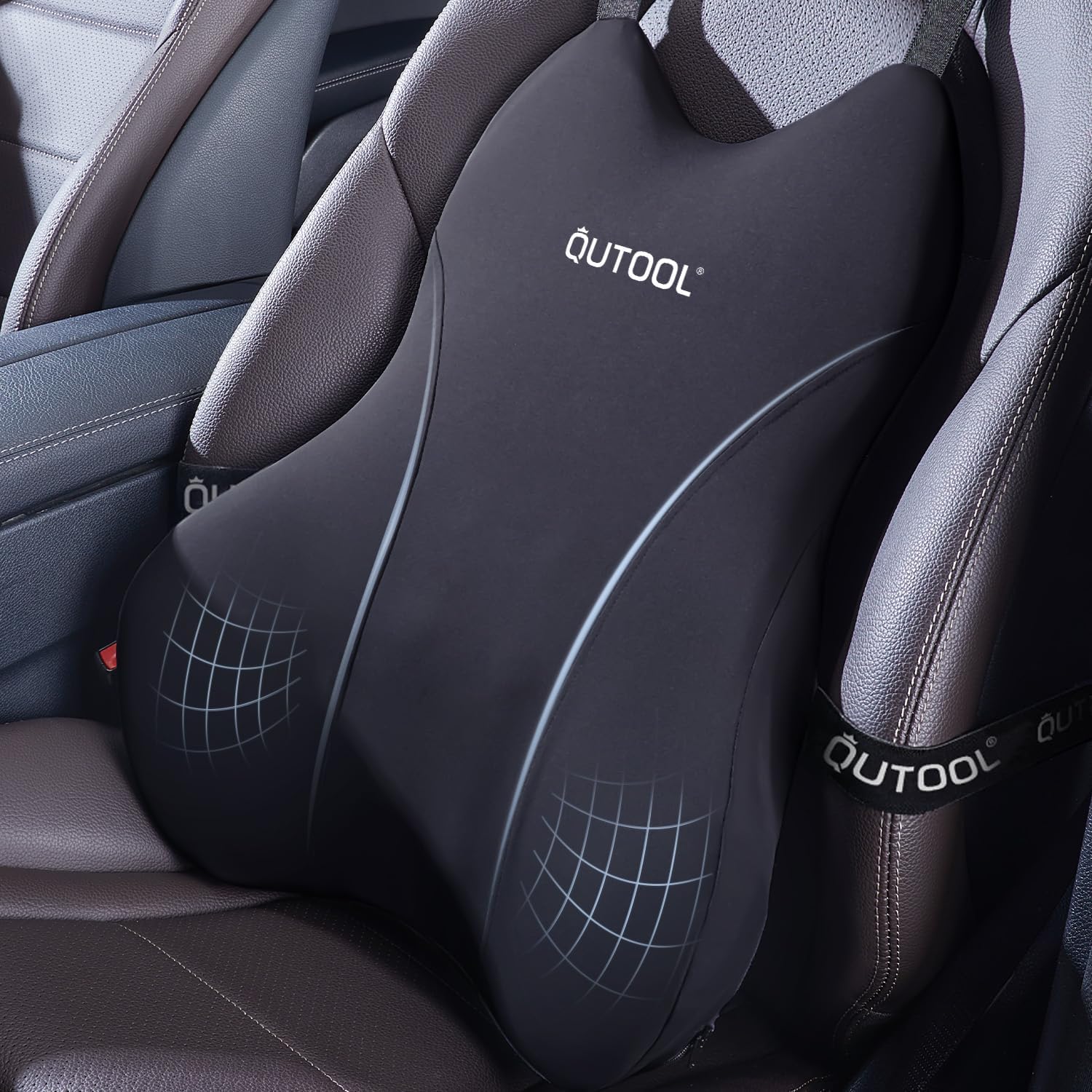
The QUTOOL pillow targets the specific geometry of car seats, which differ from office chairs in seat angle, lumbar curvature, and strap attachment points. The high-density memory foam has a slow rebound characteristic — it compresses under body heat and molds to the individual spine over 30–60 seconds, then returns to shape when you stand up. At 18.9 inches tall, it covers the full upper-to-lower lumbar region, and the 3.1-inch thickness provides support without encroaching excessively on seat depth.
The two adjustable shoulder straps wrap around the headrest posts or seatback, keeping the pillow securely positioned during acceleration and braking. The smooth-touch cover is removable and machine washable, and the OEKO-TEX certification means the foam contains no harmful chemical residues — relevant for users with chemical sensitivities. Customers driving SUVs, trucks, and sedans consistently report that the pillow eliminates lower back strain during commutes exceeding one hour, with many ordering a second unit for their office chair.
The car-specific design limits its effectiveness on office chairs: the angled strap positioning does not align well with flat chair backs, and the 3.1-inch depth is shallower than office-focused pillows, so some users feel insufficient lumbar fill on desk chairs. The slow-rebound foam can feel firmer in cold weather until body heat softens it. For dedicated driving use, the QUTOOL is the most precisely tuned car lumbar support in this price bracket.
Why it’s great
- Slow-rebound memory foam molds to individual spine shape
- OEKO-TEX certified foam is free from harmful chemicals
- Designed specifically for car seat strap geometry
Good to know
- Angled straps do not secure well on flat office chair backs
- Foam feels firmer in cold temperatures until warmed by body heat
FAQ
Does a back support pillow help with sciatica or just lower back pain?
How thick should a lumbar pillow be for someone who is 5’4″?
Can a back support pillow fix rounded shoulders from desk work?
How long does a memory foam lumbar pillow typically last before losing support?
Final Thoughts: The Verdict
For most users, the best back support pillow winner is the ComfiLife Lumbar Support Pillow because its three-strap system eliminates the slippage that ruins cheaper designs while the dense memory foam holds its shape through months of daily compression. If you need a slim profile for traveling between car and office, grab the Everlasting Comfort Original Lumbar Support Pillow. And for full spine coverage from neck to sacrum on a high-back chair, nothing beats the GIVANLEE 6-Column High Back Pillow.