
Our readers keep the lights on and my morning glass full of iced black tea. As an Amazon Associate, I earn from qualifying purchases.
Specs are compiled from manufacturer listings and verified buyer reviews and can change over time — please confirm the key details on the product page before buying.
Once you leave the resort boundary, your safety depends entirely on your own gear and decisions. You need three layers of protection: dry clothing, an avalanche beacon for companion rescue, and a PLB to call for outside help. This guide covers the avalanche transceivers, personal locator beacons, airbag packs, and bibs that manage that risk.
I’m Min — the founder and writer behind Gadgets Feed. This guide is built by comparing the manufacturers’ published specifications and the patterns across verified customer reviews, so you get each pick’s real strengths and trade-offs instead of marketing spin.
We break down the avalanche rescue electronics that matter most, from simple two-antenna beacons to pro-level transceivers with extended range, so you can confidently choose your next piece of backcountry snowboarding gear.
Our Picks at a Glance

How To Choose The Best Backcountry Snowboarding Gear
Your backcountry setup is a coordinated system, not a single purchase. You need three different kinds of electronics working together: a beacon to find a buried partner, a locator beacon to alert rescue services if you are lost or injured, and an airbag to help you stay on the surface during a slide. On top of that, your clothing needs to manage sweat and snow all day.
Understand the three different rescue electronics
An avalanche transceiver (often just called a beacon) both transmits and receives. When you are riding, it sends a signal; if your partner gets buried, you switch yours to search mode and follow the signal to find them. A personal locator beacon (PLB) does something completely different—it sends a distress signal to government Search and Rescue satellites, and it is for calling for outside help when you cannot self-rescue. An airbag pack is your third layer, deploying a large balloon to keep you near the surface of a slide.
Prioritize your budget by risk, not by wants
The beacon is non-negotiable—it is your primary tool for a companion rescue, and survival time is measured in minutes. The transceiver should get your biggest share of budget, followed by a shovel and probe, then a PLB for solo days, and finally an airbag pack if you ride steep terrain regularly. If funds are tight, a solid simple beacon beats a fancy one with a thin budget elsewhere.
Check the fit of your clothing and pack
Ill-fitting avalanche gear hampers movement and comfort on the skin track. Bibs that are too short in the torso or too long in the leg will hamper your movement when you are traversing. A pack that does not fit your back length will be uncomfortable on the skin track. Always check the specific sizing and fit details, because a regular-torso bib does not work for a long-torso rider.
Quick Comparison
| Model | Best For | Type | Key Range | Weight | Amazon |
|---|---|---|---|---|---|
| ACR ResQLink 400 Kit★ Best Overall | Complete Rescue Kit | PLB Survival Kit | — | — | Amazon |
| Flylow Baker BibBest Value | All-Day Wet Snow | Shell Bib | 20K Waterproofing | — | Amazon |
| McMurdo FastFind 220Compact Pick | Compact Solo Rescue | PLB | — | — | Amazon |
| BCA Tracker S | Simple First Beacon | Avalanche Beacon | — | — | Amazon |
| Mammut Barryvox S | Fast Search, Wider Range | Avalanche Beacon | 70 m digital | — | Amazon |
| BCA Tracker 3 | Proven 3-Antenna Beacon | Avalanche Beacon | 50 m | 7.6 oz / 215 g | Amazon |
| ACR ResQLink View | Confirmed Signal Delivery | PLB with RLS | — | 5.28 oz | Amazon |
| Osprey Soelden Pro 32L | Airbag + 32L Storage | Airbag Pack | — | — | Amazon |
| Deuter Alproof 30L SL | Women’s Airbag Pack | Airbag Pack | — | — | Amazon |
In‑Depth Reviews
1. ACR ResQLink 400 Survival Kit
Our pick — over 4.5★ from 100+ verified ratings; the strongest balance of quality and price.
The do-everything rescue box that gives you GPS, strobe, and signaling tools in one case.
This is not just a beacon—it is a full survival kit. The set includes the ResQLink PLB, a C-Strobe H2O rescue light (a waterproof LED strobe visible day or night), a loud whistle, and a signal mirror for reflecting sunlight over long distances. You also get a RapidDitch drybag to keep it all dry, which means the whole kit packs into one organized bundle instead of loose gear rattling in your pack.
Emergency use is what buyers praise most here, and the construction follows close behind. Buyers report that offshore workers treat it as essential as a life jacket, with one stating plainly: “I work offshore in the oilfield and I’m doing a job in Mexico.” The 5-year warranty covers the electronics, and the instructions are easy enough to follow for a first-time user. At 11 x 4 x 7.5 inches for the whole kit, it is a compact block to slip into a pack’s main compartment.
The main trade-off is the premium price—you pay for the complete kit, not a bare-bones beacon. If you only need a single signaling device and already own a separate strobe and whistle, you can save money with a standalone PLB. But for someone building a backcountry kit from scratch, the included extras make it the most complete safety bundle in this list.
Everything In One Box
- Includes PLB, waterproof strobe, whistle, and signal mirror
- Drybag keeps all components protected from moisture
- Rated for emergency use by offshore and marine owners
Think Twice If
- Premium price compared to a solo beacon
- Kit dimensions are bulkier than a pocket-sized PLB
- You already own a separate strobe and whistle
Reach for it when: you want a complete rescue kit ready to grab on the way out the door.
Consider a solo unit if: pack weight is critical and you carry only the bare minimum.
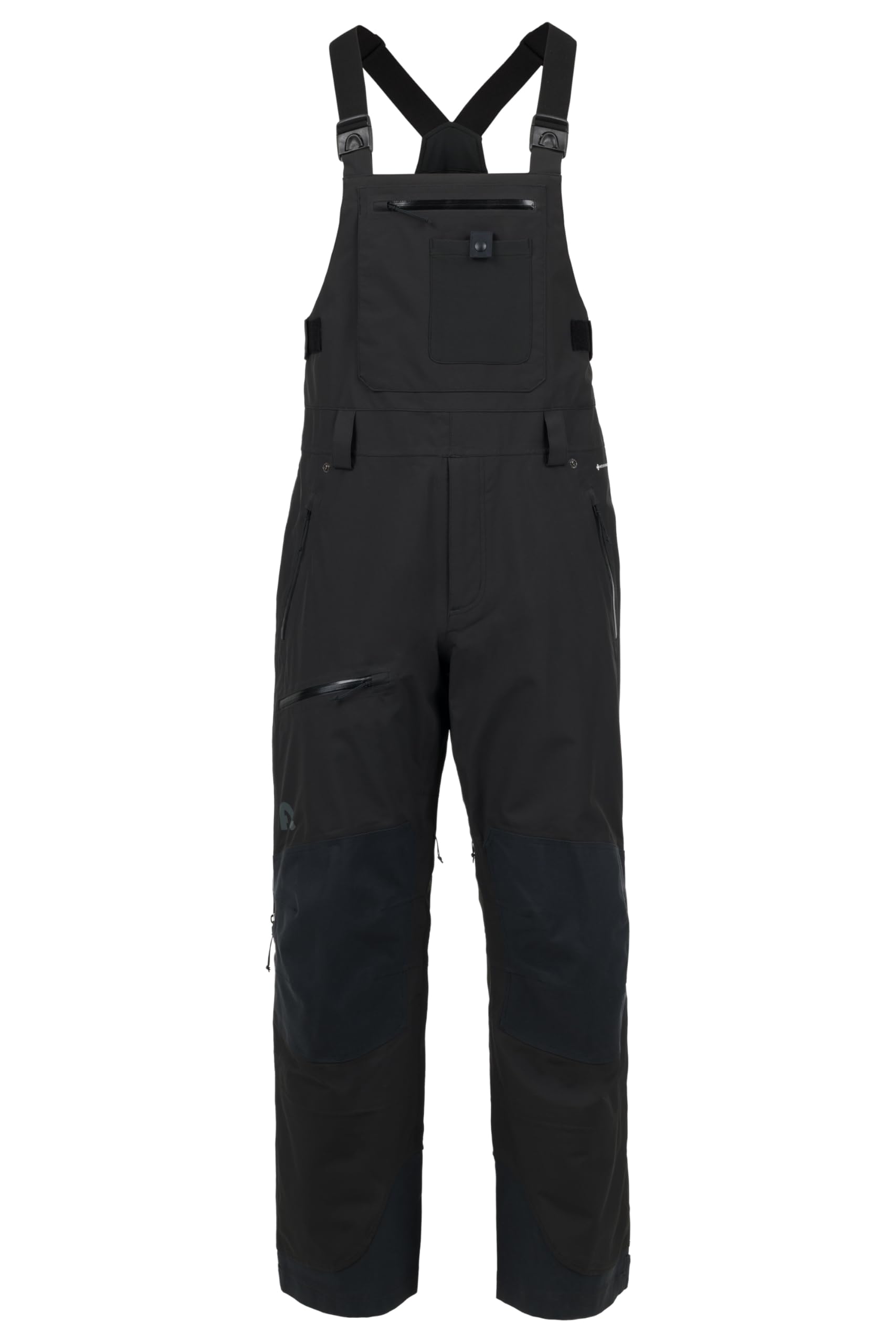
2. Flylow Men’s Baker Waterproof Ski Bib Pants
A burly shell bib with serious 20K waterproofing that handles powder and spring slush alike.
These bibs are built for all-condition riding—powder days and warm spring slush both. The 100% polyester shell carries a sturdy 20K waterproof rating with fully taped seams, which means water stays out while sweat can still escape. That combination is the difference between a dry day and a soaked, freezing one.
The single large zippered bib pocket plus a smaller ski-pass pocket solves a real daily problem—where to put your phone, keys, and pass without losing them in a deep powder fall. Articulated knees give you full mobility for skinning and side-hilling, and the inner and outer thigh ventilation zips open when you are working hard on the climb. Boot gaiters keep snow out of your boots, and reinforced knees and cuffs handle the wear of regular use.
A 5’6 to 5’7 male around 190 pounds reports the large fits great through the chest and hips, but notes the critical caveat: these bibs come in short, regular, and tall lengths, and you have to pick the right one—length is not adjustable. Buyers consistently say the fit is comfortable and true to size, with several calling it the best-fitting bib they tried versus other brands. One rider summed it up as “an essential piece of my skiing gear.”
Daily Dryness: The 20K rating with fully taped seams is the standout—the thing everyone raves about is staying dry through full days of wet snow.
Grab these if: you ride in wet maritime snow or spend long days in the backcountry where staying dry is survival.
Look elsewhere if: you need a specific custom inseam—choose your length variant carefully before ordering.
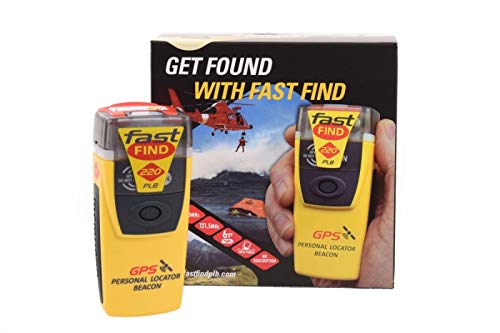
3. McMurdo FastFind 220 PLB
A no-frills, straight-up panic button that lives in your pocket until you truly need it.
At 4.33 x 1.18 x 4.33 inches, this PLB is dramatically smaller than the ACR ResQLink 400 kit above — a roughly 2.5x size gap that matters when you are counting every ounce in your pack. It is a pure emergency device: no texting, no calling, no subscriptions—just deploy the antenna, pull the anti-tamper seal, and press the ON button. That simplicity is exactly what people praise most.
Owners mention the most compelling real-world proof of its value: “I was able to activate when I had a stroke in the Cascade mountains by myself with my eyesight and physical coordination were very impaired.” That story shows the device can be operated one-handed under severe duress, which is the ultimate test for any safety tool. It is pre-programmed for US registration, so the initial point of contact is US Search and Rescue.
The trade-off is that you only get the beacon itself—no strobe, whistle, or drybag included. It also relies on a 1-day battery average life in the spec sheet, which reflects that this is not a continuous-use tracker; it sits dormant until you need it. The battery lasts for the single emergency activation, which is its entire purpose.
Pure Simplicity: This is a “no nonsense” device, as owners put it—a single-button rescue tool with no subscription fees and very little pack space required.
Best for: solo riders and splitboarders who want the smallest possible rescue device that just works.
Not for: anyone who wants extra signaling gear like a strobe or mirror included in the purchase.
4. BCA Tracker S Avalanche Beacon

The “simple is fast” beacon that gets first-timers searching confidently without a steep learning curve.
BCA’s whole design philosophy here is “Simplicity is Speed”—a beacon that is easy to operate under stress is worth more than one packed with features you will fumble with in an avalanche. The Tracker S is the beacon that backcountry instructors recommend to people just getting into the sport, and it comes with the harness and batteries included, so it is ready to wear from the start.
Buyers describe it as “very high quality” and “simple to use for a first time user,” with one owner buying four of them for their whole group. It weighs in at 165 g, which is light enough to forget you are wearing it, and the 5-year warranty covers you for the long haul. The philosophy resonates with riders who want to focus on their avi course rather than decoding a complicated interface.
What you give up is the extended search range and advanced features of pricier beacons—this is a straightforward 2-antenna unit. That makes it a perfect first beacon, but serious riders tackling complex multi-burial scenarios will eventually outgrow it. Think of it as your entry ticket to the backcountry, not your forever beacon.
First Beacon Fit: This is the one people buying for their whole crew pick—simple, reliable, and easy enough for a “dumb-dumb” to use, as one owner put it.
Start here if: you are new to backcountry riding and want a beacon that won’t slow you down while you learn.
Move up if: you regularly ride steep terrain and need extended range and multiple-burial features.
5. Mammut Barryvox S Avalanche Beacon

The beacon that extends its digital reach to 70 meters and pushes analog search out to 95 meters for faster finds.
The defining number here is the 70-meter digital receiving range—a meaningful step up from the BCA Tracker 3’s 50 meters below. That extra distance means you can start picking up a buried partner’s signal earlier, which matters because the survival window is measured in minutes. The Barryvox S also offers an extended analog search range up to 95 m with a 100 m search strip width, giving experienced searchers more flexibility in tricky signal environments.
What wins people over is the ease of operation under stress. Customers note it is the “fastest/easiest operation under stress,” and one owner noted the crucial difference: a search-time advantage of under 10 minutes can be the difference between life and death. The circular receiving field means the X and Y antennas pick up signals nearly identically, so you do not waste time rotating the beacon hunting for the strongest signal.
The battery situation is a genuine plus—it runs on 3 AAA batteries and is lithium-enabled, which reduces leakage risk and performs better in cold temperatures, giving you up to 350 hours of SEND time. The honest caveat: firmware updates reportedly require a service technician rather than a simple home update, and there have been recall notices for the related Barryvox S2 switch misalignment. Check your serial number and stay current with any service bulletins.
The Search Advantage
- 70 m digital and 95 m analog receiving range
- 350 hours of SEND battery life on lithium cells
- Fast, easy operation rated highly under stress
The Fine Print
- Firmware updates need a service technician
- Check for switch misalignment recalls
- Premium price for the extended range
Pick this if: you want the widest digital search range in this lineup and prioritize finding partners fast.
Think twice if: you dislike the idea of taking your beacon to a shop for firmware updates.
6. Backcountry Access Tracker 3

The crowd favorite that shrank 20% versus its predecessor while keeping the proven 3-antenna design.
Ease of use is what people praise most about this beacon—it is “simple to turn on even with gloves,” which is a daily-ride feature that matters as much as range. The Tracker 3 is 20% smaller and lighter than the Tracker 2, yet it keeps the 3-antenna array and no-nonsense multiple-burial searching that backcountry riders rely on. At 7.6 ounces / 215 grams with batteries, you genuinely do not notice it strapped to your chest.
Reliability is the second-most-talked-about aspect, with owners noting the version 3 signal suppression works much better than previous iterations. The bright red LEDs are visible even in daylight, so you can glance down and confirm your beacon is transmitting. Battery life is excellent: at least 1 hour of search mode after 200 hours in transmit, or roughly 250 hours in transmit-only. The 457 kHz frequency is the industry standard across all beacons, so it works with your partners’ units.
The 50-meter range is the honest limitation here—it trails the Mammut Barryvox S’s 70 meters above. But for most riders, 50 meters covers the realistic search area of a single slide, and the simplicity and proven reliability make this the beacon many owners describe as “the best transceiver on the market.” It is the reference point that other beacons are measured against.
Reference Standard: The thing everyone raves about is how easy it is to use with gloves on, backed by the reliability of a 3-antenna design that riders have trusted for years.
Reach for it if: you want a proven, glove-friendly beacon with a huge base of satisfied owners.
Choose the Mammut if: you need the extra 20 meters of digital range for searching larger debris fields.
7. ACR ResQLink View RLS

The rescue beacon that confirms your distress signal was received, so you know help is coming.
This is the most advanced PLB in the lineup, and its defining feature is Return Link Service (RLS)—a confirmation that Search and Rescue has actually received your emergency signal. That is a massive psychological comfort when you are injured and alone; instead of wondering if your signal went through, you get a positive confirmation. The digital display and infrared strobe make it easy to verify the device is armed and operational.
At just 5.28 ounces, it is remarkably light for the capabilities packed in. It needs no subscription, gives you a 5-year battery life, and provides 28+ hours of operational life on a single emergency activation. It works with GPS, Galileo GNSS, and MEOSAR satellite systems for true global coverage, and the built-in buoyancy plus multifunction clip system means you can attach it to a PFD or pack strap without extra hardware.
The cost is the trade-off—this premium device adds RLS confirmation over the standard ResQLink at a higher price. For a splitboarder heading deep into remote ranges for multi-day tours, that price buys genuine confidence. One buyer summed it up as “light weight, quality product,” and noted that the “no subscription required” feature is a major selling point.
Confirmation Factor: The Return Link Service is the standout feature—you get proof your SOS reached rescue services, which is worth the premium when you are hurt and alone.
Worth the premium for: solo backcountry skiers and remote tourers who want confirmation their distress call went through.
Skip if: you are on a budget and can accept a beacon without RLS confirmation.
8. Osprey Soelden Pro 32L with E2 Airbag

A 32-liter airbag pack that carries a full touring load and deploys an electronic avalanche airbag on demand.
The heart of this pack is the Alpride E2 electronic avalanche airbag system—a lightweight, reliable option that deploys fast and produces high air pressure to help keep you near the surface of a slide. The 32L capacity means you can fit a full day of touring gear: shovel, probe, layers, food, and water. It is a serious commitment to bringing the full safety picture with you.
The pack is loaded with smart storage. A large front-panel J-zip opens to a dedicated avalanche safety kit pocket with shovel handle and probe sleeves, so your rescue gear is exactly where you expect it in an emergency. The main compartment has a U-zip opening with an internal organization pocket and a GPS/Radio pocket with mic harness webbing. You can carry a 16-inch MacBook Pro and accessories, as one owner noted, making it versatile for travel days.
The honest trade-offs are real. One buyer had to return it because it lacks a hydration sleeve and a hole for a hydration tube—a surprising omission for a ski touring pack. Another reported the waist belt clip broke after 5 uses. The pack has a dual-position stow-away helmet carry and fits skis A-frame or diagonal, plus a vertical front panel snowboard carry. It is well-built with great zippers, but the hydration gap and reported clip issue are worth knowing before you commit.
Carry Everything
- Electronic Alpride E2 airbag system deploys fast
- 32L capacity with dedicated avalanche tool pocket
- A-frame or diagonal ski carry, vertical board carry
Know Before You Buy
- No hydration sleeve or tube hole included
- Waist belt clip reported to break after a few uses
- Wait for deployment
Choose this if: you want a full 32L touring pack with an electronic airbag and don’t plan to use a hydration bladder.
Pass on it if: you need to carry a hydration reservoir—you will need to add a separate solution.
9. Deuter Women’s Alproof 30L SL
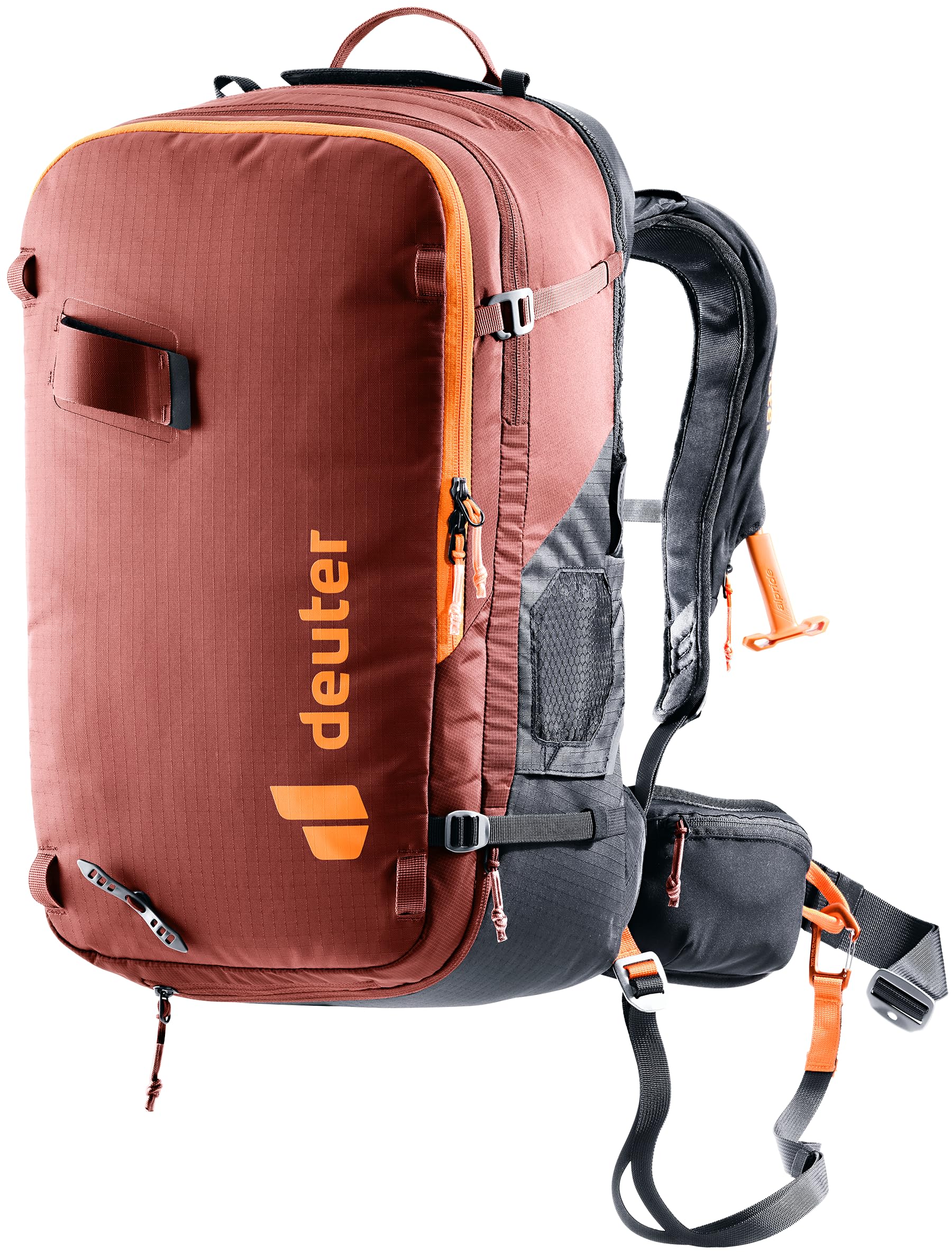
A women’s-specific airbag pack that pairs the same E2 electronic system with a better hydration solution.
Deuter’s Alproof 30L SL takes the same Alpride E2 electronic airbag system as the Osprey above and wraps it in a women’s-specific fit. The SL designation means shorter shoulder straps and a torso length tuned for women, with padded hip fins and gear loops that keep the pack locked in place no matter how aggressive your riding gets. The waist belt, adjustable sternum strap, and leg safety strap work together to prevent shifting.
The key advantage over the Osprey is hydration compatibility—this pack is designed for a Deuter 3.0-liter Streamer Reservoir, with insulated hydration tube sleeves on both shoulder straps so you can route your water from either side. That directly answers the biggest complaint about the Osprey. The safety compartment includes a zippered valuables pocket with a key clip and fleece-lined pockets for goggles, so your essentials stay organized and scratch-free.
The body fabric is snow-resistant on the back system and abrasion-resistant, water-repellent, and PFC-free throughout. Two modular gear straps handle diagonal ski and snowboard attachment. The trade-off is the premium price—this is the most expensive item in this guide, and the women’s-specific fit means it is not suitable for a male rider, just as the Osprey’s men’s fit is not ideal for a woman. It is a long-term investment in your safety.
Hydration Solved: The insulated tube sleeves on both straps fix the biggest gap in the Osprey, making this the better choice for riders who want to sip water on the skin track.
Best for: women riders who want a properly fitted airbag pack with built-in hydration support.
Not for: men looking for a unisex fit, or anyone on a tight budget given the premium price point.
Understanding the Specs
Avalanche Beacon Range
The search range is the maximum distance at which your beacon can detect a buried partner’s signal. A 50-meter range like the BCA Tracker 3 covers most single-slide scenarios, while the Mammut Barryvox S’s 70-meter digital range gives you earlier detection across larger debris fields. A wider range means you can start searching sooner, which matters because survival odds drop sharply after the first 15 minutes.
Waterproofing Ratings on Bibs
The waterproof rating (measured in millimeters) tells you how much water pressure the fabric can handle before soaking through. A 20K rating like the Flylow Baker means 20,000 millimeters of water column resistance—that is substantial protection for deep powder and wet spring conditions. The breathability rating works the other direction, letting sweat escape so you don’t overheat on the climb.
Return Link Service (RLS)
Return Link Service is a confirmation mechanism built into newer PLBs like the ACR ResQLink View. When you activate the beacon, it sends a distress signal to satellites, and the device then receives a confirmation that Search and Rescue has acknowledged your alert. This two-way verification is the difference between hoping your signal went through and knowing it did—a critical feature when you are alone and injured.
Airbag System Types
Avalanche airbag packs use either compressed gas cartridges or an electronic fan system. The Alpride E2 system in the Osprey and Deuter packs is electronic, using a high-speed fan to inflate the airbag rapidly. Electronic systems are generally lighter and easier to repack than gas canisters, and they can be deployed multiple times on a single charge, making them popular for touring where weight matters.
FAQ
What is the difference between a PLB and an avalanche beacon?
Why is beacon search range important for backcountry riding?
Does a personal locator beacon require a subscription?
Can I use a PLB instead of an avalanche beacon?
How does an avalanche airbag pack help you survive a slide?
What does a 20K waterproof rating mean on ski bibs?
How long does a PLB battery last?
What is Return Link Service on a PLB?
Final Thoughts: The Verdict
For most buyers, the backcountry snowboarding gear winner is the ACR ResQLink 400 Survival Kit because it covers your rescue signaling needs in one complete box—GPS beacon, strobe, whistle, mirror, and drybag all included and ready to grab. If you want a wider search range for finding buried partners, grab the Mammut Barryvox S with its 70-meter digital range. And for a full-day protection layer that keeps you dry in wet snow, the Flylow Baker Bib with 20K waterproofing is the one to reach for.
How We Picked
We do not accept paid placement. Every pick is matched to a real buyer and a real use-case; we do not hands-on test units.
Sources & Methodology
Specifications: manufacturer listings and product documentation. Review insights: verified customer reviews, as of August 2026. Pricing: not shown on this page (it changes often); check the current price via the retailer link.
As an Amazon Associate, Gadgets Feed earns from qualifying purchases. This does not affect which products we feature.