
That crystal-clear mountain stream you’re staring at might look drinkable, but it’s likely carrying Giardia, Cryptosporidium, and a load of bacteria that can ruin a multi-day trek in hours. A backcountry water filter isn’t a luxury item — it’s the single piece of gear that determines whether you stay hydrated and healthy or end up evacuated with a serious intestinal infection. The choice between a squeeze filter, a gravity system, a pump, or a straw-style purifier comes down to your trip style, group size, and how much weight you’re willing to carry for reliable protection.
I’m Min — the co-founder and writer behind Gadgets Feed. I analyze dozens of product specifications and thousands of user reports to identify which filters actually perform in the field versus which ones look good on paper but clog after a single use.
This guide cuts through the marketing to focus on flow rate, filter lifespan, weight, and real-world durability so you can confidently pick the right backcountry water filter for your next adventure without getting sick or wasting money.
How To Choose The Best Backcountry Water Filter
Picking the right filter for the backcountry isn’t about brand loyalty — it’s about understanding the logistics of your water sources and how much time you’re willing to spend filtering. A solo ultralight hiker has completely different needs than a group basecamping for a week, and the wrong system can turn a simple water break into a frustrating chore.
Flow Rate and Group Size
Flow rate is measured in liters per minute (LPM) and directly dictates how long you’ll be standing around. A 1 LPM squeeze filter works fine for one person, but if you’re filtering for a group of four, a 3 LPM gravity system cuts your camp chore time by more than half. Pay attention to whether the rated flow is under squeeze, gravity, or pump pressure — some filters advertise high rates that are only achievable with a hard squeeze.
Filter Lifespan and Field Maintenance
Filter life is measured in total liters before replacement, ranging from 1,000 liters to a staggering 100,000 gallons on the Sawyer Squeeze. But longer life means nothing if you can’t backflush in the field to restore flow. Filters with easy shake-to-clean or syringe backflushing mechanisms save you from carrying a clogged brick on day three of a week-long hike. Replaceable elements on pump-style filters add weight but extend the life of the whole system.
Weight and Packability vs. Protection Level
Every ounce matters on a multi-day carry. Straw-style filters like the LifeStraw weigh next to nothing but require you to drink directly from the source, making them impractical for filling water bottles or cooking. Squeeze and gravity systems offer the best balance of weight, capacity, and versatility for most backpackers. Pump filters provide the highest level of protection (including viruses with added tablets) but come with a significant weight penalty that only makes sense for extended trips or questionable international water sources.
Quick Comparison
On smaller screens, swipe sideways to see the full table.
| Model | Category | Best For | Key Spec | Amazon |
|---|---|---|---|---|
| Platypus Quickdraw | Squeeze Filter | Ultralight solo hikers | 2.4 oz · 3 LPM squeeze | Amazon |
| Katadyn BeFree Gravity 3L | Gravity System | Groups and basecamps | 6.4 oz · 2 LPM gravity | Amazon |
| GRAYL UltraPress | Press Purifier | Global travel and viruses | 12.5 oz · 10 sec per 500ml | Amazon |
| MSR TrailShot | Squeeze/Pump Hybrid | Trail runners and bikers | 5 oz · 1 LPM squeeze | Amazon |
| Sawyer Squeeze System | Squeeze Filter | Thru-hikers and durability | ~6 oz · 100,000 gal life | Amazon |
| LifeStraw Personal | Straw Filter | Emergency kits and travel | 0.1 lb · 4,000 L capacity | Amazon |
| MSR MiniWorks EX | Pump Purifier | Extended expeditions | 16 oz · 1 LPM pump | Amazon |
In‑Depth Reviews
1. Platypus Quickdraw Ultralight Backpacking Water Filter
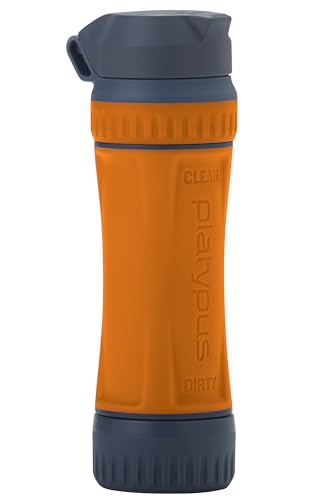
The Platypus Quickdraw has effectively ended the debate around the best squeeze filter for ultralight backpackers. At just 69 grams (2.4 ounces), it shaves nearly an ounce off the Sawyer Squeeze while delivering a measured 3 liters per minute when squeezed and 1.75 LPM under gravity — flow rates that consistently outperform the competition in real-world testing. The 28mm thread pattern on the dirty side means it screws directly onto Smartwater bottles, CNOC bags, and standard soda bottles without needing an adapter.
The shake-to-clean maintenance is a genuine field advantage — you don’t need to carry a syringe or any extra tool to restore flow when it slows. Backflushing is equally simple, requiring only the included ConnectCap. The filter is individually tested to NSF and EPA P231 standards, removing 99.9999% of bacteria and 99.9% of protozoa, with a 1,000-liter lifespan that covers multiple seasons of hard use.
Long-term users report that while the initial flow is faster than the Sawyer Squeeze, it does slow more quickly between cleanings, so you’ll want to backflush regularly. The soft-touch housing stays grippy when wet and resists picking up dirt, and the attached DrinkCap seals securely for direct drinking. For solo hikers and fast-packers who prioritize weight without sacrificing flow speed, this is the current reference standard.
Why it’s great
- Class-leading 2.4 oz weight saves critical ounces over competitors
- 3 LPM squeeze flow rate is among the fastest available
- Tool-free shake-to-clean maintenance in the field
- Universal 28mm thread fits wide range of bottles
- Individually tested to NSF/EPA P231 standards
Good to know
- Flow slows faster between cleanings compared to Sawyer Squeeze
- No included dirty water bag — requires compatible bottle
- 1,000L lifespan is shorter than the Sawyer’s 100,000-gallon rating
2. Katadyn BeFree Gravity Water Filter 3L

The Katadyn BeFree Gravity 3L solves the biggest pain point of squeeze filters — you don’t have to stand there squeezing. Fill the 3-liter TPU bag, hang it from a tree branch or tent pole, and let gravity do the work at up to 2 liters per minute. That works out to filling a Nalgene in under 20 seconds and a full 3L batch in about 90 seconds, making it the most efficient option for solo trips and small groups alike.
The 0.1-micron EZ-Clean hollow fiber filter removes bacteria and protozoa with a 1,000-liter capacity, and cleaning is as simple as shaking or swishing the filter in water — no tools, no disassembly, no syringe. At 6.4 ounces, it’s lighter than most 1-liter squeeze setups while holding three times the water. The bag packs flat when empty and rolls up small enough to fit in a backpack side pocket.
The main durability concern is the TPU bag itself — several users report punctures if the bag is handled roughly around sharp rocks or crammed into a pack without protection. The fill method requires scooping water since there’s no rear opening, which can be awkward at shallow sources. But for campsite water management and group trips where hands-free operation matters, the BeFree has the best weight-to-capacity ratio of any gravity system available.
Why it’s great
- Hands-free gravity operation at 2 LPM
- Only 6.4 oz for a 3-liter system
- Easy swish-to-clean filter maintenance
- Rolls up small and packs flat
- Fills a Nalgene in under 20 seconds
Good to know
- TPU bag is prone to puncture if not handled carefully
- No rear opening makes filling from shallow water sources difficult
- 1,000L filter lifespan is mid-range
3. GRAYL UltraPress 16.9 oz Water Purifier & Filter Bottle
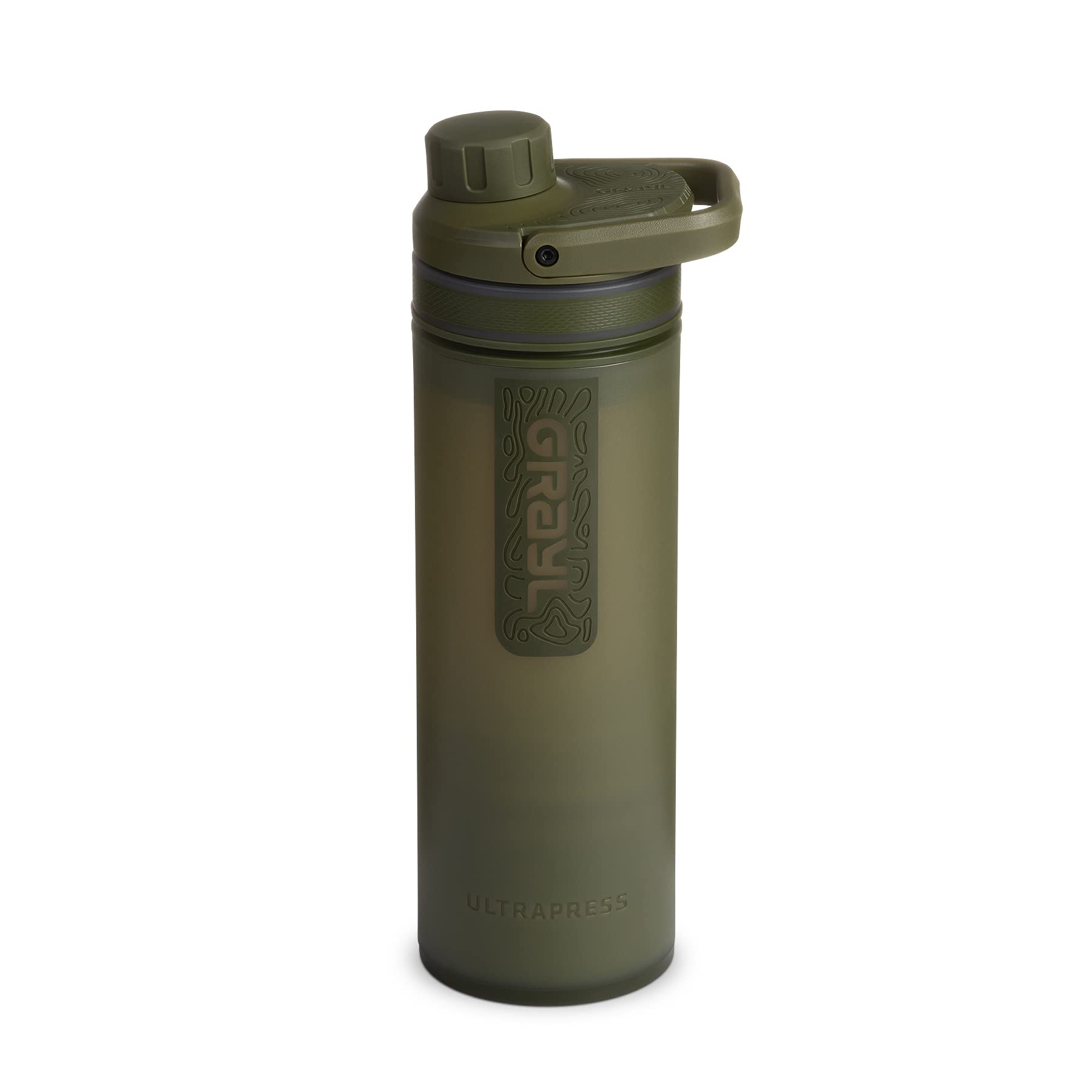
The GRAYL UltraPress is the only product in this lineup that qualifies as a true purifier rather than just a filter, meaning it removes viruses (99.9% for rotavirus, norovirus, hepatitis A) in addition to bacteria, protozoa, microplastics, VOCs, PFAS, and heavy metals. The OnePress mechanism is remarkably simple — fill the 16.9 oz (500ml) outer cup from any source, press the inner chamber down into the outer cup, and in roughly 10 seconds you have clean water ready to drink.
This speed and protection level come at a weight cost of 12.5 ounces, which is heavy compared to squeeze or gravity systems. But for international travel where tap water may contain viruses, or for areas with agricultural runoff carrying chemical contaminants, the UltraPress offers a level of protection that no 2-ounce filter can match. The replaceable cartridge handles up to 300 uses (about 65 gallons) before needing a swap.
The drinking cap is not attached to the bottle, which is a significant design oversight — it’s easy to lose on a trail or in a hotel room. The bottle is also tall enough that it doesn’t fit standard car cup holders. But for the specific use case of global travel where you need guaranteed removal of every pathogen class in under 15 seconds, there isn’t a faster or more complete solution at this size.
Why it’s great
- Full virus, bacteria, and protozoa removal in one step
- Purifies 500ml in about 10 seconds — fastest in class
- Removes PFAS, VOCs, heavy metals, and chemicals
- No hoses, pumps, batteries, or waiting time required
- Compact integrated bottle format for one-handed operation
Good to know
- Heavier than squeeze and gravity systems at 12.5 oz
- Drinking cap is loose and easy to lose
- Cartridge needs replacement after ~65 gallons
4. MSR TrailShot Ultralight Backpacking and Camping Squeeze Water Filter

The MSR TrailShot occupies a unique space as a hybrid between a squeeze filter and a pump — it uses a one-handed squeeze action that draws water through a 15-inch tube from the source, filtering it directly into a bottle or hydration bladder at about 1 liter per minute. This design eliminates the need to carry a separate dirty water bag, and it keeps the intake submerged while you keep your hands and gear dry.
Weighing just 5 ounces and measuring 6 x 2.4 inches, it’s compact enough to fit in a hip belt pocket for trail runners and mountain bikers. The hollow fiber technology removes 99.9999% of bacteria and 99.9% of protozoa, with a 2,000-liter filter lifespan. Backflushing is straightforward using the included syringe, and there’s no need to disassemble anything in the field.
The short hose is the main ergonomic limitation — you need to crouch down to the water source to use it, which gets old on rocky banks. The rubber tube is also somewhat fragile and prone to kinking if packed carelessly. But for solo hikers who want the convenience of pumping into their existing water bottles without an extra dirty bag, the TrailShot is an elegant middle ground that avoids the worst compromises of both categories.
Why it’s great
- No dirty water bag required — pumps directly from source to bottle
- Compact 5 oz design fits in a hip belt pocket
- 2,000-liter filter lifespan is double the Katadyn BeFree
- Easy backflush with included syringe
- One-handed operation keeps hands dry
Good to know
- Short hose requires crouching at water source
- 1 LPM flow is slower than squeeze alternatives
- Rubber tube is fragile and prone to kinking
5. Sawyer Squeeze Water Filtration System

The Sawyer Squeeze has been the thru-hiker’s gold standard for years, and the current version improves on the original with a CNOC 2-liter TPU bladder that replaces the notoriously stiff and hard-to-fill Sawyer bags. The hollow fiber membrane is rated for an absurd 100,000 gallons — effectively a lifetime filter for most backpackers — and the fiber walls are thicker than typical hollow fiber membranes, allowing more aggressive backwashing without damage.
The system weighs under 6 ounces complete and can be used in three configurations: squeeze directly into a bottle, inline as a gravity system, or connected to a hydration bladder. Every unit is individually tested three times before leaving the factory, and the filtration removes 100% of microplastics in addition to bacteria and protozoa. The included syringe and cleaning coupling make field maintenance simple and effective.
The flow rate is slower than the Platypus Quickdraw out of the box, particularly with the first few uses, though regular backwashing improves it. The new CNOC bag is a major upgrade, but the wide-mouth opening requires a specific scooping motion that some users find awkward. For anyone planning a long-distance thru-hike where filter failure isn’t an option, the Sawyer Squeeze’s proven reliability and near-infinite lifespan are unmatched.
Why it’s great
- 100,000-gallon filter lifespan is effectively permanent
- Three configuration modes: squeeze, gravity, inline
- Thicker fiber walls allow aggressive backwashing
- Individually tested three times before shipping
- Includes CNOC 2L TPU bladder — major upgrade from old bags
Good to know
- Initial flow rate is slower than Platypus Quickdraw
- Wide-mouth CNOC bag requires specific scooping technique
- Syringe backflush is more involved than shake-to-clean
6. LifeStraw Personal Water Filter

The LifeStraw Personal is the most widely recognized backcountry water filter on the market, and its primary strength is simplicity — you put the straw directly into the water source and sip. The microfiltration membrane removes 99.999999% of waterborne bacteria, 99.999% of parasites, and microplastics down to 1 micron, with a 4,000-liter capacity per unit. At barely a tenth of a pound, it’s the lightest option in this guide by a wide margin.
This filter is best understood as a personal emergency tool rather than a primary camp water system. It’s ideal for day hikes where you might encounter an unexpected water source, survival kits, and international travel in areas with unsafe tap water. The 4-pack format provides redundancy for families or group emergency kits, and the lifetime warranty (with proper care) means you buy it once.
The obvious limitation is that you can’t fill a water bottle or cook with it — you must drink directly from the source, which means getting into a prone position at the water’s edge. The plastic taste is mentioned by some users, though it doesn’t affect safety. It also doesn’t remove viruses, so it’s not suitable for regions with viral contamination. For its intended role as an ultralight emergency backup that lives in your pack or glovebox, the LifeStraw is the right tool.
Why it’s great
- Extremely lightweight at 0.1 lb per unit
- 4,000-liter capacity with proper maintenance
- Removes microplastics down to 1 micron
- No moving parts, hoses, or pumping required
- Donates safe water to school children with every purchase
Good to know
- Cannot fill bottles or hydration bladders — direct drink only
- Does not remove viruses
- Some users report a plastic taste
7. MSR MiniWorks EX Backcountry Water Purifier System

The MSR MiniWorks EX is the only pump-style purifier in this roundup, and it exists for a specific reason: virus protection with no batteries or waiting. The ceramic and carbon cartridge removes bacteria (99.9999%), protozoa (99.9%), and organic compounds, and the included 50 Aquatabs provide chemical virus kill when needed, making this a true purifier system. The pump delivers 1 liter per minute and threads onto wide-mouth Nalgene bottles and hydration bladders.
At 16 ounces, it’s the heaviest filter here by a significant margin, but the trade-off is a replaceable filter element and exceptional durability — one user reported their pump survived a 50-foot drop that shattered the ceramic element but left the housing functional. The carbon core improves water taste noticeably, and the PFAS-free DWR storage bag keeps everything dry. The lifetime warranty adds long-term value for committed backpackers.
The pumping action is simply slower than modern squeeze and gravity systems for high-volume use. Filling a 6-liter water cache takes about 6 minutes of continuous pumping, which is a workout. The ceramic element is also fragile if dropped on rocks. But for expedition-length trips where you need guaranteed virus protection, mechanical reliability, and the ability to filter from shallow puddles where squeeze bags can’t submerge, the MiniWorks EX remains the right tool.
Why it’s great
- True purifier — removes viruses with included Aquatabs
- Replaceable ceramic and carbon cartridge improves taste
- Extremely durable construction with lifetime warranty
- Pumps directly into wide-mouth bottles and bladders
- Can filter from shallow water sources where gravity bags can’t
Good to know
- Heavy at 16 oz — over 6x the weight of the Quickdraw
- Slow 1 LPM pumping speed for large volumes
- Ceramic element is fragile and can shatter if dropped
FAQ
Can I use a backcountry water filter on snowmelt or glacial runoff?
How do I store my filter between trips to prevent mold growth?
Why does my squeeze filter’s flow rate drop so fast after just a few uses?
Final Thoughts: The Verdict
For most users, the backcountry water filter winner is the Platypus Quickdraw because it combines the lightest weight in its class with the fastest squeeze flow rate and tool-free cleaning. If you want a gravity system for group trips, grab the Katadyn BeFree Gravity 3L. And for international travel requiring full virus protection, nothing beats the GRAYL UltraPress.