
Water finds its way through every unsealed seam, screw hole, and corner in a wet-area tile installation. A proper waterproofing membrane—installed over a cement backer board—is the only reliable method to stop moisture from reaching your wall cavity, preventing structural rot and mold growth behind the tile you just spent days setting.
I’m Min — the co-founder and writer behind Gadgets Feed. I have spent countless hours analyzing technical data sheets, measuring thickness tolerances, comparing peel-adhesion values, and reading hundreds of verified customer installations to separate the membranes that actually bond and seal from those that delaminate under humidity.
Whether you are tiling a steam shower or a simple tub surround, choosing the right backer board for shower waterproofing system determines whether your build lasts twenty years or fails in twenty months. Let’s break down the options.
How To Choose The Best Backer Board For Shower Membrane
Selecting a waterproofing membrane for your shower backer board is not a one-size-fits-all decision. Your choice depends on the substrate material, the complexity of the shower geometry (curbs, niches, benches), your skill level with thin-set mortar, and the local building code requirements for vapor retarders.
Sheet Membrane vs. Liquid-Applied Membrane
Sheet membranes like Schluter Kerdi provide a consistent, factory-controlled thickness (8 mils) with no risk of pinholes or thin spots—critical for shower pans. Liquid-applied membranes such as RedGard allow you to paint on waterproofing in complex corners and around drains, but require strict attention to dry-film thickness (typically 30–40 wet mils to achieve 15–20 dry mils). Builders mixing both systems often use liquid on the pan and sheet on the walls.
Thickness and Crack Isolation
The mil rating (1 mil = 0.001 inch) directly correlates with crack-bridging ability. A 20-mil membrane bridges hairline substrate cracks up to 1/8 inch; a 24-mil membrane handles slightly larger movement. Thicker membranes also resist puncture from dropped tools or heavy tile during installation. Laticrete’s anti-fracture fabric, for example, is engineered to isolate cracks up to 1/8 inch from transferring through to the tile.
Fiber Adhesion and Mortar Compatibility
The non-woven polypropylene fleece on both sides of a sheet membrane is what anchors it in thin-set mortar. Low-quality fleece can separate from the polyethylene core, causing the membrane to delaminate under shear stress. Always check that the fleece is mechanically bonded, not just heat-laminated, to the core. Rough-surface membranes also improve bond strength with modified thin-set for vertical wall applications.
Quick Comparison
On smaller screens, swipe sideways to see the full table.
| Model | Category | Best For | Key Spec | Amazon |
|---|---|---|---|---|
| Schluter Kerdi 200 | Sheet Membrane | Long-term reliability | 8 mil thick PEVA core | Amazon |
| RedGard 1 Gal | Liquid | Complex corners & niches | 30–40 wet mil application | Amazon |
| Laticrete Anti-Fracture Fabric | Reinforcement Fabric | Seam & joint reinforcement | Crack isolation up to 1/8″ | Amazon |
| MAXWAVE 150 Ft Roll | Sheet Membrane | Large floor coverage | 20 mil (0.51 mm) thickness | Amazon |
| Upgraded Membrane 371 Sq Ft | Sheet Membrane | Whole-room waterproofing | 23.6 mil (0.6 mm) thickness | Amazon |
| Membrane Band 108 Sq Ft | Sheet Membrane | Pre-marked grid cutting | 24 mil (0.6 mm) thickness | Amazon |
| JIANBENKJ 108 Sq Ft | Sheet Membrane | Budget-friendly alternative | 23.6 mil (0.6 mm) thickness | Amazon |
In‑Depth Reviews
1. Schluter Kerdi 200 Waterproofing Membrane

Schluter Kerdi 200 is the industry benchmark for sheet-applied shower waterproofing. Its modified PEVA core with non-woven polypropylene fleece on both sides creates a mechanical bond with thin-set mortar—no curing time needed before tiling. At 8 mils, it is thinner than budget alternatives, but the engineered fleece adhesion and consistent factory thickness eliminate the risk of pinhole leaks that haunt liquid applications.
Multiple verified installers report tile removal is extremely difficult after Kerdi cures, confirming the bond strength. The membrane is lightweight at 6.6 pounds for 108 square feet, flexible enough to fold into corners, and carries a 10-year limited warranty when installed per the Schluter handbook. The major trade-off is installation learning curve—thin-set must be combed evenly and the membrane rolled firmly to avoid air pockets.
For steam showers and shower pans, Kerdi remains the gold standard because of its vapor-retardant rating. Users who applied liquid membrane to a bathtub and Kerdi to a stand-up shower uniformly prefer Kerdi for the pan. If you are building a high-use shower and want zero moisture penetration for decades, this is the membrane to spec.
Why it’s great
- Proven track record with thousands of successful installations
- No cure time before tiling—thin-set directly onto the membrane
- 10-year limited warranty when installed per guidelines
Good to know
- Requires careful technique to avoid air pockets under the sheet
- Premium price relative to generic alternatives
- Thinner than generic membranes (8 mil vs 20-24 mil)
2. Custom Building Products RedGard 1 Gal

RedGard is the most widely available liquid-applied waterproofing membrane at big-box stores, and for good reason. It brushes or rolls onto cement backer board, plywood, and even plastic flange edges, curing into a flexible, rubber-like film that beads water on contact. One gallon covers roughly 35-40 square feet at two coats, but you need three coats for vertical shower walls to meet code.
Users consistently report RedGard outperforms sheet membrane systems in terms of ease of application around complex geometries—shower niches, curb returns, and drain flanges. The liquid seeps into screw holes and seams automatically, eliminating the need for separate seam tape if you apply thick enough. After curing, the film feels like the rubberized coating on tool handles—tough and elastic.
The critical downside is dry-film thickness measurement. Most failures occur when builders apply only two thin coats, leaving pinholes. The manufacturer recommends 30-40 wet mils to achieve 15-20 dry mils, which requires a wet-film gauge. For a shower floor, many professionals double the thickness in corners. If you are willing to follow the drying and thickness guidelines, RedGard offers mid-range cost with premium-level performance.
Why it’s great
- Paints onto any shape—niches, curbs, flanges, screws
- Self-seals minor seams and fastener holes without tape
- Easy to inspect and re-coat thin spots before tiling
Good to know
- Requires wet-film gauge to avoid pinhole failures
- Stains clothing permanently—wear disposable coveralls
- Longer project time due to 2-4 hour dry times between coats
3. Laticrete Waterproofing Anti-Fracture Fabric Membrane Roll

This isn’t a standalone waterproofing membrane—it is a reinforcement fabric designed to be embedded into liquid-applied membranes like RedGard, Laticrete Hydro Ban, or Mapei AquaDefense. The 37.5-square-foot roll (6 inches wide by 75 feet long) covers every seam, corner, and change-of-plane in a standard shower. Its crack-isolation technology prevents substrate cracks up to 1/8 inch from transferring through to the tile.
Verified buyers report using it on every shower build, embedding it in the wet liquid membrane at seams, screw holes, and wall-to-floor junctions. The uniform fiberglass weave saturates fully with liquid membrane when correctly applied, creating a monolithic waterproof layer. Some users note the fabric thickness has changed in recent rolls—the newer material is denser, requiring more liquid membrane to fully wet out the center.
The Laticrete fabric builds up slightly higher than competitor cloths, which means you may need to feather the edges to avoid a visible ridge under tile. However, for gap-spanning applications—like a shower floor with cracks wider than 1/16 inch—this fabric with Hydro Ban is the most reliable field-tested solution. It bends and molds easily around inside and outside corners without creasing.
Why it’s great
- Bridges cracks up to 1/8 inch in the substrate
- Works universally with any liquid elastomeric membrane
- Easy to cut with scissors and molds around corners
Good to know
- Newer roll material is denser; needs more liquid to saturate
- Not a standalone waterproofing—requires liquid membrane
- Leaves slight build-up ridge at seams
4. Upgraded Waterproof Membrane Thickened 371 Sq Ft
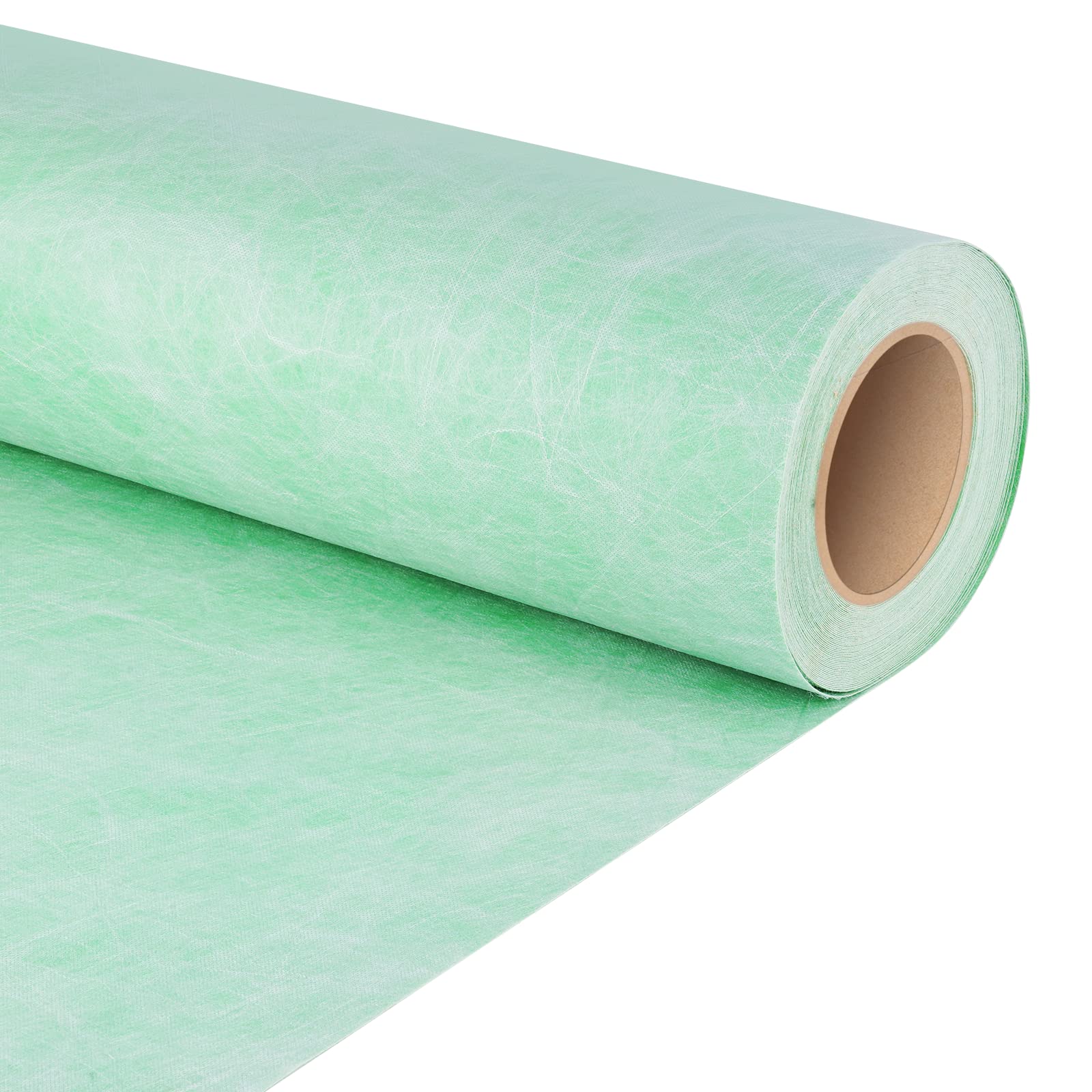
This Meticuloso-branded roll delivers 371 square feet of 23.6-mil polypropylene membrane—enough to cover an entire master bathroom floor, walls, and curb in one purchase. The green polyethylene core is sandwiched between non-woven fleece layers for mortar adhesion. At 30.4 pounds, the roll is substantial but manageable; users confirm it is heavy-duty enough for walk-in shower pans.
Verified buyers consistently compare this membrane to Schluter Kerdi at a fraction of the cost. The thicker 0.6 mm material provides more puncture resistance during tile installation than the thinner 8-mil Kerdi. Users report the membrane holds creases well for corners, adheres firmly to thin-set mortar, and sheds fibers only if overworked with the trowel. The 3.77-foot width is wider than Kerdi’s standard 3.3 feet, meaning fewer seams on large floors.
The main trade-off is weight and handling—a 30-pound roll is awkward for one person to manage on a ladder or in a small bathroom. Some users noted the fibers can separate if the membrane is aggressively troweled, so installers should use a light touch when embedding it in mortar. For whole-room waterproofing on a budget, this roll provides the best coverage per dollar of any sheet membrane in the roundup.
Why it’s great
- Enormous coverage—371 sq ft suits large master bathrooms
- Thick 23.6 mil material resists puncture during tile work
- Wider 3.77 ft width reduces seam count on floors
Good to know
- 30-pound roll requires two-person handling on walls
- Fibers can separate if overworked with the trowel
- Thicker material is harder to fold into tight corners
5. MAXWAVE Waterproof Underlayment 212 Sq Ft
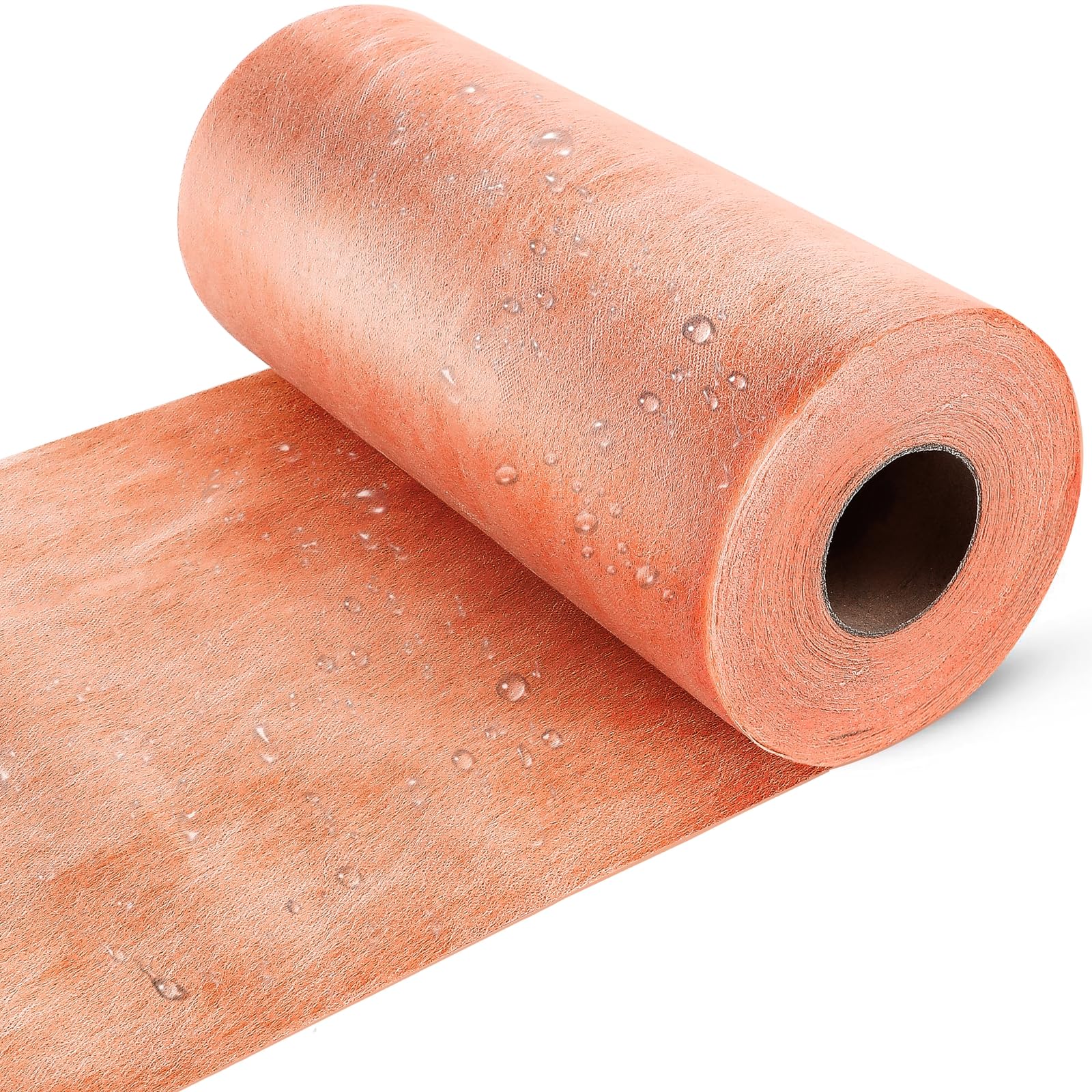
MAXWAVE’s 150-foot roll provides 212 square feet of 20-mil (0.51 mm) high-density polyethylene membrane reinforced with non-woven polypropylene on both sides. The orangish color distinguishes it from competitor membranes, and the rough surface texture is designed to maximize thin-set mortar grab. Users report the material cuts cleanly with scissors and folds without cracking—critical for inside corners and curb transitions.
Verified buyers on bathroom remodels praise the value proposition, noting the quality matches big-box sheet membranes at a lower price point. The membrane serves as both a waterproof barrier and a vapor retarder, making it code-compliant for steam shower enclosures. One user layered three sections in a converted deck space with no delamination or water wicking after heavy rain.
The 17-inch width is narrower than other rolls (most competitors offer 3.3-foot widths), which means more seams per square foot. For large floor areas, the extra seaming may slow installation. However, the narrower width makes the roll lighter (6.89 pounds) and easier for a single DIYer to handle on walls. If you are tiling a small shower floor and want an easy-to-manage roll, this is a fine choice.
Why it’s great
- Lightweight at 6.89 pounds—easy for one-person wall installation
- Rough surface provides excellent thin-set mortar bond
- Vapor retarder rating suitable for steam rooms
Good to know
- 17-inch width creates more seams than wider rolls
- 20 mil is thinner than premium 23-24 mil options
- Some sections may need 2-3 layers for full crack isolation
6. Membrane Band 108 Sq Ft with Pre-Marked Grid
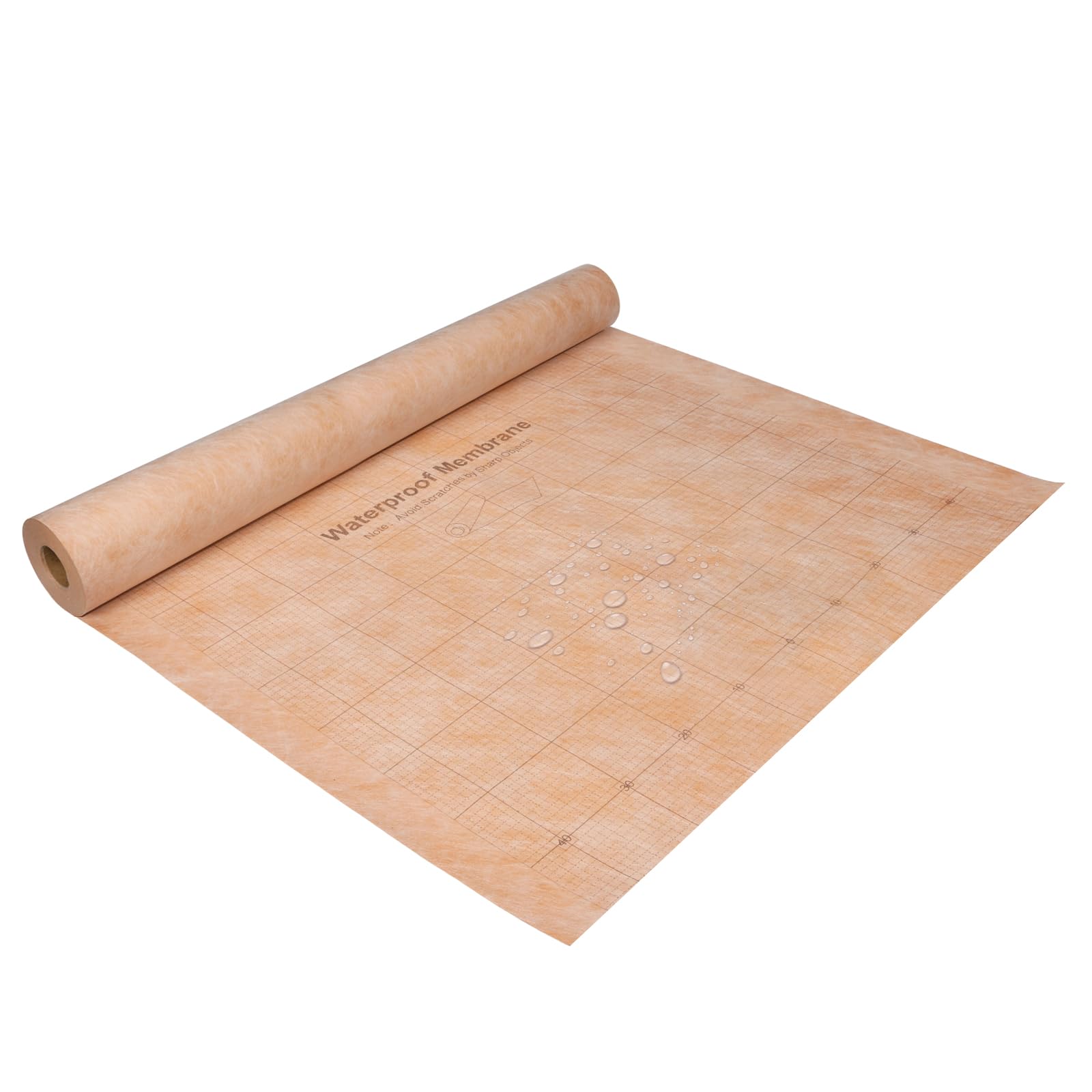
This LXVOOEE membrane introduces a pre-marked grid printed on the polyethylene surface, enabling straight cuts without measuring or square edges. At 24 mils (0.6 mm), it is among the thickest sheet membranes available—providing superior puncture resistance and crack-bridging capability. The three-layer construction (PE core sandwiched between non-woven polyethylene layers) is designed to stop water migration even under continuous hydrostatic pressure.
Verified users confirm the 5-inch width is accurate with clean edges, the material cannot be torn by hand (must be cut with scissors), and water beads on the surface without absorption. The grid pattern also serves a secondary purpose: it helps slurry catch firmly during thin-set application, reducing the risk of mortar skimming over the membrane rather than bonding through the fleece. One reviewer successfully installed it in a snow-season exterior application, confirming its freeze-thaw resilience.
The primary drawback is the lack of self-adhesive layer—this is a mortar-embedded membrane, not a peel-and-stick product. You must apply a layer of thin-set, embed the membrane, then apply a second layer of thin-set before tiling. The 3.3-foot by 33-foot size covers 108 square feet, sufficient for a standard tub surround but tight for a large walk-in shower with a bench and niche.
Why it’s great
- Pre-marked grid eliminates measuring for straight cuts
- Thickest membrane at 24 mil for maximum puncture resistance
- Grid surface improves thin-set mortar mechanical bond
Good to know
- Requires two layers of thin-set (embed + tile bond)
- 108 sq ft may not cover large showers with benches
- No self-adhesive—mortar must be mixed fresh
7. JIANBENKJ Waterproof Membrane 108 Sq Ft
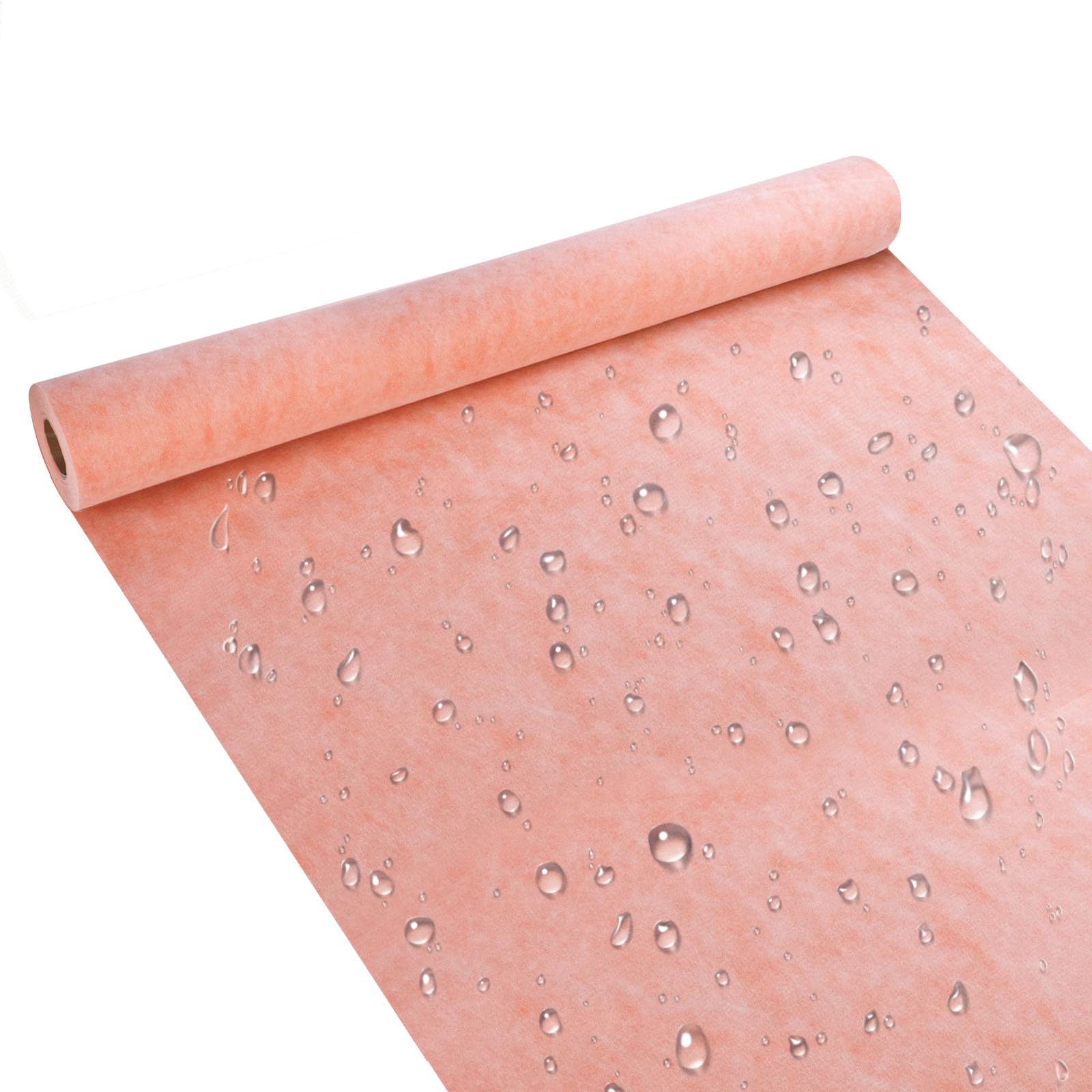
JIANBENKJ’s 3.3-foot by 33-foot roll offers 23.6 mils of high-density polyethylene waterproofing at a price point that undercuts both Schluter Kerdi and RedGard by a significant margin. The orange membrane features a non-woven fiber layer specially processed to resist pilling and clumping when mortar is applied—a common failure mode in low-cost alternatives where the fleece separates from the polyethylene core.
Multiple verified buyers directly compare this membrane to name-brand alternatives, reporting identical performance in shower floor, wall, and curb installations. The 23.6-mil thickness matches premium competitors, and users confirm the material does not delaminate when troweled aggressively. The 8.08-pound roll weight is manageable, and the membrane cuts cleanly with scissors or a utility knife for complex curb and niche shapes.
The main compromise is the fleece-to-core bond consistency. While most users report no issues, a single reviewer noted that the fabric layer is too thick and dense, preventing the liquid membrane from fully saturating the center—causing it to rip loose under stretch. For steam shower applications where vapor permeance is critical, paying extra for Schluter Kerdi or RedGard may provide more peace of mind. For standard residential tub surrounds and shower walls, this membrane delivers excellent value.
Why it’s great
- Budget-friendly price comparable to much lower-quality alternatives
- 23.6 mil thickness matches premium membrane specs
- Fleece resists pilling when applied with thin-set mortar
Good to know
- Some rolls may have dense fleece that resists liquid saturation
- Not rated for steam shower vapor retarder applications
- Bond consistency varies between production batches
FAQ
Can I use sheet membrane over existing drywall in a shower?
How many coats of RedGard do I need for a shower floor?
Does a thicker membrane mean better waterproofing?
Can I install tile directly on backer board without any membrane?
What is the difference between uncoupling membrane and waterproofing membrane?
Final Thoughts: The Verdict
For most users, the backer board for shower winner is the Schluter Kerdi 200 because its field-proven fleece bond, vapor retarder rating, and zero-cure-time installation provide the highest reliability in wet environments. If you want paint-on convenience for complex corner work, grab the RedGard 1 Gal. And for whole-room coverage on a budget, nothing beats the coverage-per-dollar of the Upgraded 371 Sq Ft Membrane.