
Our readers keep the lights on and my morning glass full of iced black tea. As an Amazon Associate, I earn from qualifying purchases.
Specs are compiled from manufacturer listings and verified buyer reviews and can change over time — please confirm the key details on the product page before buying.
Fastening cement board is a gritty job, and the right screw is the difference between a clean install and a frustrating afternoon of stripped heads and snapped bits. The single most important choice you will make is the drive type — a deep T-25 Torx slot grips the bit and resists cam-out (the bit slipping out of the head) far better than a Phillips. This guide breaks down the seven best backer board screws for metal studs, wood studs, and collated drivers, so you can match the fastener to your exact job.
I’m Min — the founder and writer behind Gadgets Feed. This guide is built by comparing the manufacturers’ published specifications and the patterns across verified customer reviews, so you get each pick’s real strengths and trade-offs instead of marketing spin.
You will learn which drive type, point style, and corrosion coating actually matter, and how to match the right backer board screws to your project for a flush, rust-resistant hold every time.
Our Picks at a Glance

How To Choose The Best Backer Board Screws
Choosing the right screw starts with knowing what you are fastening to. Cement board needs a screw that pierces the dense material without pre-drilling, then bites securely into the framing beneath — whether that is wood or light-gauge metal studs.
Match the Point to the Stud
A sharp-point screw is designed for wood framing, where the tip finds the grain and starts cleanly without “walking” across the board. A drill point tip, by contrast, is built to cut through a metal stud, so no pilot hole is needed. Using the wrong point type means either a screw that struggles to penetrate steel or one that bites too aggressively into softer wood.
Choose the Drive That Won’t Strip
The drive system is the head shape your driver bit fits into. Torx (star-shaped) and square drives grip better than Phillips and are far less likely to cam out under the high torque cement board demands. A deep, well-formed slot keeps the bit seated, which protects both the screw and your patience on a long install.
Look at the Coating for Wet Areas
Cement board is common in bathrooms and showers, so corrosion resistance matters. Look for coatings like ceramic or epoxy that protect the steel from moisture and rust. An uncoated or plain steel screw may start to corrode in a damp environment, which compromises the hold over time.
Quick Comparison
| Model | Best For | Drive Type | Length | Pack Size | Amazon |
|---|---|---|---|---|---|
| Jake Sales #10×1-5/8 Drill Point★ Best Overall | Metal studs, outdoor kitchens | T-25 Torx | 1-5/8″ | 129 | Amazon |
| SENCO Duraspin #8×1-1/4 CollatedFastest Install | Collated screw guns, big floors | Square | 1-1/4″ | 1000 | Amazon |
| Rock-On #9×1-1/4 Star Drive | General cement board, one-handed drive | T-25 Star | 1-1/4″ | 750 | Amazon |
| Power Pro #9×1-1/4 Wafer-Head | Wood or metal studs, wet areas | Star | 1-1/4″ | 925 | Amazon |
| Hard-to-Find Fastener #8×1-1/4 Phillips | Ceramic fiber board, durock | Phillips | 1-1/4″ | 838 | Amazon |
| Jake Sales #10×1-5/8 Drill Point 5 lb | Big metal-stud jobs | T-25 Torx | 1-5/8″ | 645 | Amazon |
| Jake Sales #10×1-1/4 Sharp Point 5,000 ct | Wood studs, high-volume pro work | T-25 Torx | 1-1/4″ | 5000 | Amazon |
In‑Depth Reviews
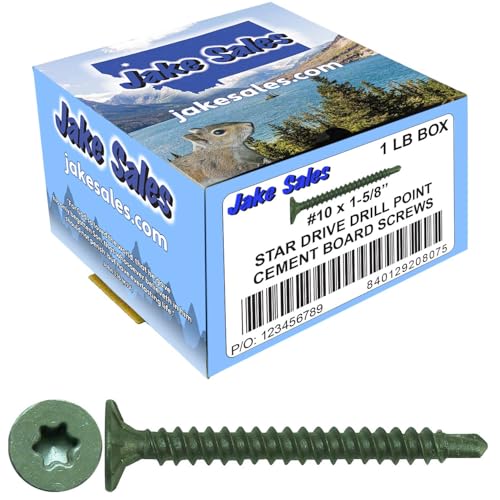
1. Jake Sales #10×1-5/8 Cement Board Torx Screws
Our pick — over 4.5★ from 100+ verified ratings; the strongest balance of quality and price.
The metal-stud specialist that refuses to snap, even on stubborn outdoor framing.
When your framing is steel, not wood, this screw saves you a step: the drill point tip cuts into a metal stud directly, so you skip pre-drilling and pilot holes — just hold the board and drive. It is a #10 diameter screw at 1-5/8″ length, giving you more bite and holding power in lighter-gauge metal than a thinner #8 screw. Compare it to the 0.16-inch diameter of the SENCO #8 below; this one is a beefier 0.19 inches, so it grips tighter in thin steel studs.
The heat-treated alloy steel gets a ceramic coating (a protective layer that resists rust), so it holds up in damp tile areas. As you drive it, the cutting nibs under the flat head countersink the screw flush with the surface, leaving a clean, level base for tile. Buyers report running several hundred of these across various cement board installs without a single one snapping, and the deep Torx slot (a six-point star drive) keeps the bit engaged even in the toughest pulls — the drive reliability is what everyone raves about.
One honest note: a few screws on steel tubing needed a pre-drilled start, so very hard or thick metal can still fight the tip. For a 1-pound box holding about 129 screws, this is a project-sized buy rather than a full-house supply, but the performance on metal studs justifies the premium position.
Why Contractors Trust It
- Drill point tip cuts into metal studs with no pre-drilling needed
- Ceramic coating and heat-treated steel resist corrosion and snapping
- Cutting nibs under the head countersink flush for a level tile base
Who Should Look Elsewhere
- Some very hard steel tubing still required a pre-drilled pilot hole
- 129-screw count suits smaller projects, not whole-house installs
Grab it for: metal-stud framing where you want a corrosion-resistant screw that drives flush without a pilot hole.
Think twice if: your job is massive — the count runs out fast, and bigger boxes are the smarter buy.
2. SENCO Duraspin #8×1-1/4 Collated Cement Board Screw
Collated strips that turn a full sheet of backer board into a ninety-second job.
If you have ever hand-loaded a screw one at a time across a whole floor, this collated strip format (screws linked together in strips) is a revelation. The strips feed through a Duraspin D600-AC screw gun, and the numbers back up the speed: a pro timing a sheet of Hardibacker on the floor got it down in about 90 seconds, putting 12 sheets down with a little more than half a bucket of screws. You stop fumbling for fasteners and just keep driving.
This is a #8 x 1-1/4″ screw with a square socket drive — a shape that grips the bit and resists stripping well. It comes in a 1,000-count box, and at a 0.16-inch diameter it is noticeably slimmer than the 0.19-inch Jake Sales #10 above, so it is lighter-duty and best suited to floors and underlayment rather than heavy metal-stud work. Owners running it through their SENCO guns report zero feed problems and call the speed the standout win.
The one thing to note is the drive compatibility: these are built for a collated screw gun, not a standard drill, so this pick only makes sense if you own or are buying that tool. The uncoated steel finish also means it is not the first choice for a wet shower wall — dry floors and underlayment are its home turf.
Speed champion: a 1,000-count collated box that a Duraspin gun feeds cleanly, cutting install time to seconds per sheet.
Best fit: floor underlayment and dry areas where a screw gun already sits in your kit.
3. Rock-On #9 x 1-1/4″ Serrated Head Star Drive Screws

A 750-count box with a serrated head that seats flush without cracking the board.
For general cement board work on wood framing, this is the value balance. The serrated under-head design lets the screw seat flush while spreading pressure, so it does not crack the dense board. The star drive with a T-25 bit enables a one-handed install — no second hand needed to steady a slipping bit. The serrated hi-low thread and sharp point grab immediately, so the screw starts picking up the moment it touches the board.
The Climacoat corrosion-resistant finish (a protective coating over a zinc base) makes it a solid pick for damp tile areas. You get 750 screws per pack, a strong mid-count buy between the small 129-count Jake Sales box and the giant 5,000-count pro box below. Owners mention using it on cement board and even on a recycled glass greenhouse project, with no head stripping or breakage — the quality comments win people over consistently.
The catch is the length: at 1-1/4″, it is a general-purpose size rather than a deep-bite fastener, so very thick board stacks or heavy metal studs call for something longer. For a standard one-layer backer board install on wood, though, this is a dependable, corrosion-protected workhorse that leaves your bit intact.
Why it wins: a flush-seating serrated head and corrosion-resistant Climacoat finish at a 750-screw count make this the balanced mid-range pick.
Who it suits: one-layer board on wood studs where you want value without giving up corrosion protection.
4. Power Pro Gray Wafer-Head Cement Board Screws
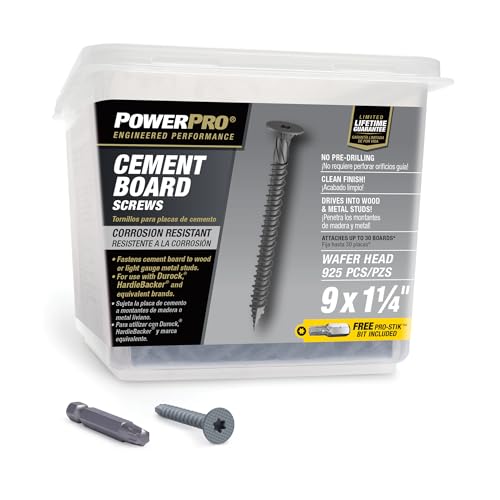
A broad wafer head that spreads pressure so it will not crack your board in wet zones.
This one is engineered specifically for the damp, humid areas where cement board lives — bathrooms, showers, and kitchens. The gray epoxy coating over carbon steel resists rust and moisture, and the broad wafer head sits flush while spreading load so it will not crack the board under pressure. The Type 17 self-drilling point pierces dense cement board and light-gauge metal without pre-drilling, and the dual-lead serrated thread cuts in fast and pulls the screw down for a firm hold.
From the Hillman family, this 925-piece pack is a generous supply for tile backer work on either wood or light metal studs. The star drive engages well with the right bit, and customers note it self-tapping into hardie soffit better than other screws they tried, holding like a champ once seated. The thing that earns the premium label is the combination of the epoxy moisture barrier and the crack-preventing wafer head.
There is a real inconsistency to flag: the product is described with a T-25 star drive, yet a couple of owners found the slots running at T-20 size, which snapped their bits. Treat the drive size as something to verify on your first screw before committing to a full run, and use the right bit for a smooth install.
Damp-area specialist: the epoxy coating and crack-spreading wafer head make it purpose-built for showers and floors.
Check first: confirm the star drive is the T-25 size it claims before driving a full box.
5. Hard-to-Find Fastener Phillips Self-Piercing Cement Board Screws
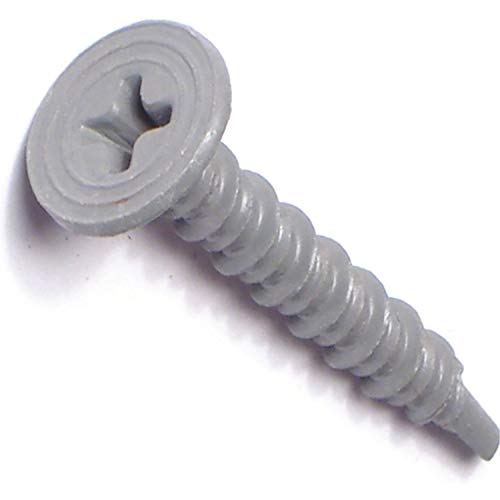
A flat Phillips head with a wide face that holds cement board firmly on the surface.
This #8 x 1-1/4″ screw belongs on a drill or impact driver, and its fine grey ceramic coating protects against rust in high-moisture environments. The real standout is the large flat head — reviewers point out the wide face holds the cement board securely, which is exactly what you want before tiling over the top. The self-piercing sharp tip creates its own pilot hole, so you skip the pre-drilling step on most installations.
Owners using it on DuROCK and cement fiber board report solid quality, though one practical tip keeps coming up: locate your stud before driving, because the screw needs something solid to grab into. The pack holds 838 screws, a comfortable middle-ground supply for bathroom and kitchen projects. The grey ceramic coating over a zinc exterior gives it a corrosion-resistant edge for wet areas.
The trade-off is the drive type. Phillips heads are more prone to cam-out under torque than a Torx or square drive, and one owner found it did not fully countersink on its own — it seated about halfway. If you prefer the cam-out resistance and flush seating of a star drive, the Rock-On or Jake Sales picks above handle that better.
What Holds It Up
- Large flat head spreads the hold across the cement board surface
- Grey ceramic coating resists rust in damp tile zones
- Self-piercing tip skips the pilot hole on most boards
What To Know
- Phillips drive is more prone to cam-out than a Torx or square slot
- Some boards need a stud located first — the screw needs solid material to bite
Choose it for: a large-head, corrosion-coated screw when you are driving with a standard drill on wood studs.
skip it if: you want a cam-out-proof drive or a screw that countersinks fully on its own.
6. Jake Sales #10×1-5/8 Drill Point Torx Screws, 5 lb
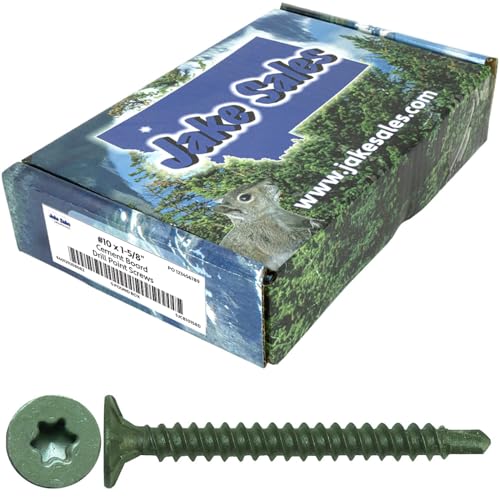
The same trusted Jake Sales drill point in a 5-pound box for bigger metal-stud jobs.
It shares the defining traits of the top pick: a drill point tip that cuts into metal studs with no pre-drilling, heat-treated alloy steel with a ceramic coating for corrosion resistance, and cutting nibs under the head that countersink flush for a clean tile base.
The #10 diameter at 1-5/8″ length gives strong bite into light-gauge steel, and the T-25 Torx head holds the bit through tough pulls. Shoppers say the screws hold backer board very secure, with good quality for the price — the functionality wins people over.
There are two honest caveats from the review pages. One owner using USG Durock found the coarse threads bit into the board and pulled it up, making holes instead of clean seats — that points to very hard boards needing a gentler drive or a different thread. And a couple of boxes arrived without the driver bit some buyers expected, so check the box before you clear the bit drawer.
Bulk advantage: a 645-screw box that spreads the drill-point performance across a full project.
Watch for: coarse threads on very hard board can pull the material — drive firmly and consider pre-drilling stubborn spots.
7. Jake Sales #10×1-1/4 Sharp Point Torx Screws, 5,000 ct
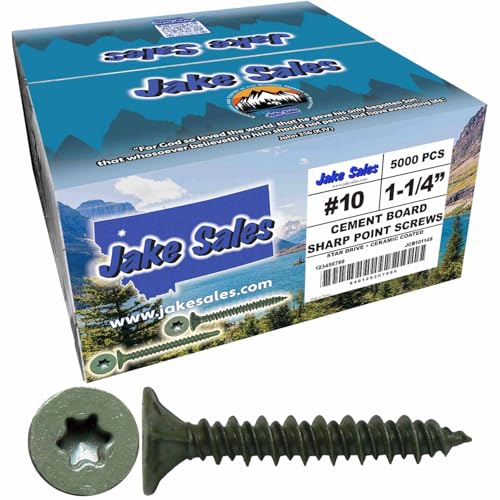
A 5,000-screw full box for remodellers who burn through fasteners every few months.
This is the professional’s restock, bought by a bathroom remodeller who orders it every three months because the job volume is constant. The defining difference from the drill-point Jake Sales screws above is the sharp point, which is built for wood studs — it starts quick without walking across the board, and no pre-drilling is necessary. The ceramic coating is also ACQ compatible, meaning it is safe to use with ACQ-treated lumber, which is a real advantage for outdoor or ground-contact framing.
At 5,000 screws, this is the highest-count box in this guide, clearly aimed at tradespeople running full remodels rather than weekend DIYers. The heat-treated alloy steel and corrosion resistance carry over, and the cutting nibs under the countersunk head seat flush as you drive. Buyers report fast shipping and a company that stands behind the product when issues arise.
The honest trade-off is value perception rather than performance. A few buyers feel the screws run pricier than comparable bulk options elsewhere, even with the strong service. If you are a homeowner needing a few hundred screws, a smaller box gets the same quality without the big spend.
Built for pros: a 5,000-count box with an ACQ-compatible, sharp-point design that suits constant wood-stud work.
Best match: remodellers and contractors who restock every few months, not one-off DIY projects.
Understanding the Specs
Drive Type: Torx vs Square vs Phillips
The drive is the shape in the screw head that your bit fits into. A T-25 Torx (star-shaped) slot grips the bit on six points, so it resists cam-out — the bit slipping and rounding the head — far better than a Phillips cross. Square drives work similarly well. Phillips is common and fine for light work, but under the high torque of cement board, a star or square drive saves you stripped heads and broken bits.
Point Style: Sharp vs Drill Point
The point decides what framing the screw can enter. A sharp point is meant for wood studs — it starts cleanly and bites the grain without walking. A drill point tip is built to cut through a metal stud, so you can drive into steel framing without pre-drilling. Match the point to your stud type, and the screw does the work; mismatch it, and you fight the fastener the whole way.
Corrosion Coating
The coating is the layer protecting the steel from moisture, and it matters because cement board is common in showers, bathrooms, and floors. Ceramic and epoxy coatings resist rust and corrosion in damp environments, keeping the hold secure over years. Plain uncoated steel is cheaper but starts to corrode in a wet area, so it is better suited to dry floors.
Length and Count
Length determines how deep the screw reaches into the framing. A 1-1/4″ screw suits standard one-layer board on wood or light metal, while a 1-5/8″ screw gives extra bite for thicker stacks or heavier studs. Count is pure math for your crew size — a 129-screw box suits a small project, while a 5,000-count box only makes sense for pros who restock regularly.
FAQ
Can I use these screws on both wood and metal studs?
What is the difference between a T-25 Torx and a Phillips drive?
Do I need to pre-drill with backer board screws?
Why does the corrosion coating matter for backer board screws?
What does a wafer head do differently from a flat head?
Will these screws countersink flush with the board?
What length backer board screw should I use?
Can I use a standard drill to drive these screws?
How many backer board screws do I need for a project?
Are these screws safe to use with treated lumber?
Final Thoughts: The Verdict
If you want one dependable pick, the backer board screws winner is the Jake Sales #10×1-5/8 Drill Point because it combines a cam-out-proof T-25 drive, a corrosion-resistant ceramic coating, and a drill point that powers into metal studs without pre-drilling. If you need speed across a whole floor, grab the SENCO Duraspin collated 1,000-count box for a screw gun. And if you are a pro restocking constantly for wood-stud remodels, the Jake Sales 5,000-count sharp point box is the ACQ-compatible bulk buy to reach for.
How We Picked
We do not accept paid placement. Every pick is matched to a real buyer and a real use-case; we do not hands-on test units.
Sources & Methodology
Specifications: manufacturer listings and product documentation. Review insights: verified customer reviews, as of August 2026. Pricing: not shown on this page (it changes often); check the current price via the retailer link.
As an Amazon Associate, Gadgets Feed earns from qualifying purchases. This does not affect which products we feature.