
Our readers keep the lights on and my morning glass full of iced black tea. As an Amazon Associate, I earn from qualifying purchases.
Specs are compiled from manufacturer listings and verified buyer reviews and can change over time — please confirm the key details on the product page before buying.
If you test backflow assemblies for a living, you already know the drill: a gauge that drifts halfway through the season means a failed recertification, a second trip to the same building, and an afternoon you will not get back. The three kits here solve that in different ways — one is a made-in-the-USA five-valve workhorse with a year-long calibration certificate, one is a lighter analog setup built around a familiar Watts body, and one swaps the dial for a backlit digital screen that reads 0.1 psi. What matters most is how each kit handles the two numbers that decide pass or fail: the pressure differential and the line pressure you record beside it.
I’m Min — the founder and writer behind Gadgets Feed. This guide is built by comparing the manufacturers’ published specifications and the patterns across verified customer reviews, so you get each pick’s real strengths and trade-offs instead of marketing spin.
You want a kit that arrives with a valid calibration certificate, hoses that seal on the first hand-tight, and fittings that cover the assembly sizes on your route, which is exactly what separates a usable backflow test kit from a box of parts.
Our Picks at a Glance

How To Choose The Best Backflow Test Kit
A backflow test kit is not a general-purpose pressure gauge. It is a calibrated instrument you use to prove, in writing, that a preventer assembly is holding — and the numbers you record have to survive an inspector’s review. That changes what you should look at first.
Start With The Certificate, Not The Case
A laminated gauge calibration certificate is the paperwork that says your readings are traceable to a known standard. The BAC-FLO-5 ships with one that is valid for a full year, which is the practical reason a working tester cares about this line item: an expired certificate turns a completed test into a redo. Waterproof and full-page field procedures belong in the same breath, because the reference sheet you carry into a mechanical room has to survive a wet floor.
Count The Valves And The Adaptable Threads
Five-valve layouts give you separate paths for high side, low side, and bleed, so you can vent a line without losing the reading you already took. Equally important is the adapter range. A set covering 1/4 through 3/4 NPT lets one kit fit the different assembly sizes you meet across a route instead of forcing you back to the truck for a different fitting.
Decide Between A Needle And A Screen
Analog gauges reward a steady hand — they show you the needle’s direction of travel at a glance, and there is nothing to charge or update. Digital kits trade that for a backlit display, a capture button that stores readings while you are interrupted, and a rate-of-change graph that tells you the moment a value has stabilized. Pick based on how your route actually runs: long stretches of solo testing favor a simple dial, while interrupted jobs on busy sites favor digital capture.
Quick Comparison
| Model | Best For | Weight | Dimensions | Gauge Type | Amazon |
|---|---|---|---|---|---|
| BAC-FLO-5 Backflow Test Kit★ Best Overall | Full-route field testing | 11 pounds | 18.5 x 9.75 x 9 inches | Analog, laminated calibration cert | Amazon |
| Watts TK9A Backflow Test Kit Upgrade | Compact analog backup kit | 5.5 pounds | 12 x 9 x 5 inches | Analog with extra line pressure gauge | Amazon |
| Arbiter Backflow Mako MK5 Digital | Digitally recorded readings | 4.4 pounds | 9 x 7.25 x 2.5 inches | Digital, 0.1 psi accuracy | Amazon |
In‑Depth Reviews
1. BAC-FLO-5 Backflow Test Kit
Our pick — over 4.5★ from 40+ verified ratings; the strongest balance of quality and price.
The five-valve kit that ships with a year-long calibration certificate and holds its tolerances through a full season of testing.
This is the one built for a full day of route work rather than occasional use. The body is glass reinforced engineered thermoplastic with brass and 316 stainless steel in the working parts, and the whole case runs 18.5 by 9.75 by 9 inches at 11 pounds. On a route where the kit rides in and out of mechanical rooms all day, that heft is the price of a five-valve manifold, a clear schedule 40 PVC sight tube with a built-in swivel connection, and a brass bleed off valve assembly with full flow capability.
What owners keep coming back to is the gauge itself. The recurring theme in the feedback is longevity under real abuse — one long-run report describes a year and roughly 1,000 backflow preventer tests with only scuffs to show for it, still recertifying well within tolerances. Handle the needle valves gently and they hold up; that is the one habit this kit asks of you. If you want the reassurance in fewer words, buyers report: “After 1+ year and ~1000 backflow preventer tests, unit survived minor bangs with only scuffs.”
Compared with the Arbiter Mako MK5 Digital above, this kit is far heavier — 11 pounds against 4.4 — and roughly twice the bulk at 18.5 x 9.75 x 9 inches versus 9 x 7.25 x 2.5 inches. What that buys you is a laminated gauge calibration certificate valid for a full year from the start, high pressure color-coded hoses with 90 micron removable brass filters, a 1/4-3/4 NPT brass fitting adapter set for testing any size assembly, and a laminated waterproof full page field procedures sheet. The 6-in-1 stubby screwdriver tucked in for tight spaces is the kind of detail you only appreciate mid-test.
Where it earns its keep
- Five-valve layout with a full-flow brass bleed off valve assembly, so you can vent without losing your recorded reading
- Laminated calibration certificate valid for a full year, plus waterproof full page field procedures in the case
- 1/4-3/4 NPT brass adapter set covers the assembly sizes you meet across a normal route
- Five-year manufacturer warranty
What to plan around
- At 11 pounds it is a load to carry up ladders and stairs compared with a compact digital gauge
- Analog needles reward careful handling — treat the valves gently and they stay true
- The 18.5 x 9.75 x 9 inch case takes real space in a packed service vehicle
Reach for this if: you run a steady route and want a certified, accessory-complete kit that goes straight to work on day one.
Think twice if: you are working off a ladder or in crawl spaces all day, where the compact Mako MK5 will be easier on your shoulder.
2. Watts TK9A Backflow Test Kit Upgrade with Line Pressure Gauge and Adapters
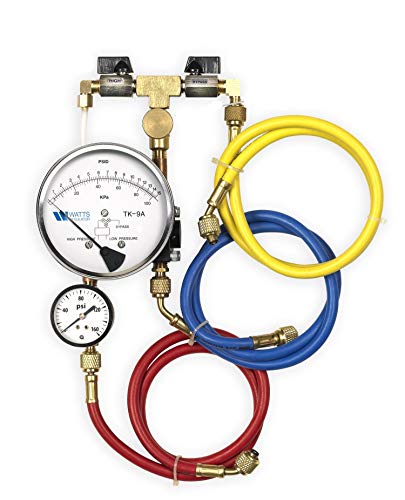
A seven-piece analog kit in a 12 x 9 x 5 inch polycarbonate case that weighs 5.5 pounds.
The TK-9A Upgrade is the kit you grab when your main set is already loaded in the truck and you need a second gauge on the shelf. It arrives as a seven-piece setup — the premium edition of the Watts TK-9A body with an extra line pressure gauge and adapters bundled in. Everything lives in a polycarbonate case at 12 x 9 x 5 inches, and the whole thing weighs 5.5 pounds.
Day-to-day, this is the lightest analog option here. Line pressure readings sit right beside the differential work, so you are not swapping a second gauge onto the assembly mid-test. The general theme in the feedback is that it shows up matching the listing photo and goes to work without fuss — the recurring phrase from testers is a straightforward “Works great. I have preformed 6 backflow tests with this device and have not had any issues.”
Where this kit asks for care is at the small clear hose connection on the left side, which is the fitting that shows up most in longer-term problem reports, including one owner whose set began weeping there inside the first year. If you swap to sturdier hoses down the line, the gauge body itself is not the issue. Set against the BAC-FLO-5 below it in weight and price, this is the lighter analog alternative; set against the Arbiter above, it keeps real gauges and a physical dial but gives up the backlit screen and 0.1 psi digital accuracy.
The honest read: A compact, complete analog kit with a second line pressure gauge included — useful as a backup or a first kit for a tester who does not want to carry the bigger five-valve case.
The one to watch: Inspect the small clear hose fitting on the left side on arrival and check it periodically; that connection is where this kit has historically needed attention.
Suits: testers who want analog gauges and an extra line pressure reading in a case they can carry one-handed.
Pass on it if: you need digital capture, a backlit readout, or a five-year manufacturer warranty.
3. Arbiter Backflow Mako MK5 Digital 5-Valve Backflow Test Kit with Hoses & Soft Case
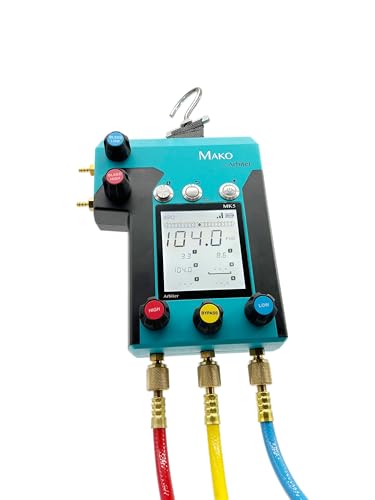
The 0.1 psi digital kit that stores each differential reading at the press of a capture button.
Start with the accuracy figure, because it is the reason this kit exists: 0.1 psi within its calibrated range of 0 to 15 psi. A small pressure shift is exactly what separates a pass from a fail on a differential test, and the digital display resolves readings at that level. The screen is backlit, so it holds up in a dark mechanical room or in direct sun, and it reads the same from any angle — you do not have to crouch to line up a needle. Power comes from a battery rather than a pump or a cord.
The features aimed at interruption are what make it pleasant on a busy site. A capture button stores your readings during a test, so pausing to answer a call no longer means starting the procedure over. A rate of change graph shows how quickly a value is moving and the moment it stabilizes. An attached swivel hook lets you hang the gauge on a pipe or ladder and stows neatly on the back of the unit. Hoses are more flexible than a standard set, which helps in tight closets. All wetted components are made from food-safe, potable water safe materials, and the assembly is all brass in a hard shell case. Arbiter states it is the only backflow test kit certified by the USC FCCCHR, a maker claim rather than a third-party endorsement.
At 4.4 pounds and 9 x 7.25 x 2.5 inches, it is the smallest and lightest kit in this group — versus the BAC-FLO-5 at 11 pounds and 18.5 x 9.75 x 9 inches. The trade-off to know before you buy is refresh speed: the display updates at roughly a 1-second interval, which testers describe as making the air inlet opening value a scramble to catch. Software costs money too — the companion app runs a per-report charge, with a lower rate in bulk, and it is not recognized in every water district. The flex case and hose storage draw more criticism than the instrument inside, and the hose feels lighter than the field-grade yellow hoses some testers upgrade to.
Why digital wins here
- 0.1 psi accuracy in a 0-15 psi calibrated range, with a backlit display that reads the same from any angle
- Capture button stores readings mid-test, so interruptions do not force a restart
- Rate of change graph tells you when a value has stabilized instead of making you guess
- Swivel hook hangs on a pipe or ladder; flexible hoses reach into tight spots
Before you commit
- About a 1-second display refresh, which makes catching the air inlet opening value harder
- App reports carry a per-report cost, and some water districts do not accept the app
- Soft case and hose storage are the weakest parts of the package; many testers swap the hoses
Built for: testers who want readings recorded automatically, in the smallest case of the three, and can live with a softer storage setup.
Buy the analog instead if: a slow display refresh on the air inlet opening value would cost you more time than the capture button saves.
Understanding the Specs
Differential Pressure And PSI Accuracy
Differential pressure is the difference your gauge measures across the check valves — it is the number that decides whether an assembly passes. A digital kit such as the Mako MK5 resolves that to 0.1 psi inside a 0 to 15 psi calibrated range, while analog kits rely on a needle and a printed dial. Tighter resolution generally makes a marginal reading easier to record cleanly, but only if the display keeps up with how fast the value is moving.
Certificates, Adapters, And Hose Threads
A calibration certificate documents that your gauge was checked against a known standard, and its validity window is what keeps your paperwork current — the BAC-FLO-5 ships with one valid for a full year. Adapters are the other half of usability: a 1/4-3/4 NPT brass fitting set lets one kit thread onto different assembly sizes without a trip back to the truck. Hoses matter too, since a small clear hose connection or a push fitting is where leaks tend to start.
FAQ
What makes a backflow test kit different from a regular pressure gauge?
How long is the calibration certificate valid?
Will one adapter set fit every backflow assembly I test?
Is a digital backflow gauge more accurate than an analog one?
Do digital backflow kits require a subscription or app fee?
How much does a backflow test kit weigh, and does it matter?
What is the clear sight tube used for on a five-valve kit?
Are the wetted parts safe to use on drinking water lines?
How often do the hoses or fittings on these kits need replacing?
How should I handle the needle valves on an analog backflow gauge?
Final Thoughts: The Verdict
For most testers, the backflow test kit that earns the slot at the top is the BAC-FLO-5 Backflow Test Kit, because it shows up with a five-valve manifold, a laminated calibration certificate valid for a full year, a 1/4-3/4 NPT adapter set, and a five-year manufacturer warranty — the whole package a working route needs without adding anything. It is also the heaviest of the three at 11 pounds, so if you work off ladders and want a kit that disappears on your shoulder, the Arbiter Backflow Mako MK5 Digital is the one to reach for, at 4.4 pounds with 0.1 psi accuracy and a capture button. And if you simply want a compact analog second set with an extra line pressure gauge in the case, the Watts TK9A Upgrade covers that job at 5.5 pounds.
How We Picked
We do not accept paid placement. Every pick is matched to a real buyer and a real use-case; we do not hands-on test units.
Sources & Methodology
Specifications: manufacturer listings and product documentation. Review insights: verified customer reviews, as of September 2026. Pricing: not shown on this page (it changes often); check the current price via the retailer link.
As an Amazon Associate, Gadgets Feed earns from qualifying purchases. This does not affect which products we feature.