
Our readers keep the lights on and my morning glass full of iced black tea. As an Amazon Associate, I earn from qualifying purchases.
Specs are compiled from manufacturer listings and verified buyer reviews and can change over time — please confirm the key details on the product page before buying.
A day on the trail should be about the views, not a sore back or a fussy toddler strapped to you. The right backpack baby carrier turns a heavy, wobbly burden into a balanced extension of your body — letting you move freely while your little one naps or takes in the scenery. But the wrong one twists your posture, digs into your hips, and cuts the hike short.
I’m Min — the founder and writer behind Gadgets Feed. This guide is built by comparing the manufacturers’ published specifications and the patterns across verified customer reviews, so you get each pick’s real strengths and trade-offs instead of marketing spin.
We break down seven of the best models on the market, from budget-friendly frames to premium suspension systems, to help you choose the best backpack baby carrier for your family’s next outdoor adventure.
Our Picks at a Glance

How To Choose The Best Backpack Baby Carrier
A backpack baby carrier is a big purchase, and the specs can get confusing fast. Here is what you actually need to look at to avoid a back-breaking mistake.
Weight of the Carrier
The carrier itself adds weight before your child is even in it. You want the lightest model that still offers a sturdy frame. Every extra pound on your back is multiplied by the miles you walk, so a difference of one pound can feel like ten after a few hours on the trail.
Suspension and Fit
The suspension system is the most important feature. A good suspension system — padded shoulder straps, a contoured hip belt (a thick, padded belt that sits on your hips, not your waist, to put the weight on your strong leg muscles), and a supportive back panel — transfers the load from your shoulders to your hips. Look for adjustability in the torso length (the distance from your shoulders to your hips) if more than one adult will wear the pack.
Weight and Height Limits
Manufacturers state a maximum weight (usually in pounds) and sometimes a maximum height (in inches) for the child. This tells you the upper safety limit for the carrier. A higher limit — around 40-50 lbs — means the pack will last longer as your child grows, but it often comes with a heavier frame.
Quick Comparison
| Model | Best For | Weight | Max Child Weight | Frame Material | Amazon |
|---|---|---|---|---|---|
| ClevrPlus Canyonero★ Best Overall | Best Value | 6.5 lb | 42 lbs | — | Amazon |
| Osprey Poco LTTop Performer | Ultralight Travel | 5.56 lb | 50 lbs | Stainless Steel | Amazon |
| Deuter Kid Comfort | Long-Distance Hiking | 7.12 lb (3230 g) | 48.5 lbs (22 kg) | Aluminum | Amazon |
| Kelty Journey Signature | Two-Caregiver Families | 7.13 lb | 40 lbs | Aluminum | Amazon |
| OE Shoulder Hiking Carrier | Lightest Frame | 4.4 lb | 45 lbs | Aluminum + Stainless Steel | Amazon |
| Chicco SmartSupport | Everyday Versatility | — | — | Aluminum | Amazon |
| besrey Toddler Hiking Backpack | Budget Lightweight | 5.5 lb | 44 lbs | — | Amazon |
In‑Depth Reviews
1. ClevrPlus Canyonero Camping Baby Backpack Hiking Kid Toddler Child Carrier
Our pick — over 4.5★ from 950+ verified ratings; the strongest balance of quality and price.
The one-pack kit that includes almost everything you need to hit the trail.
The ClevrPlus Canyonero is the value king of this comparison because it bundles the most extras without inflating the price. It includes a rain cover, a sun canopy, and a baby changing pad — items that cost extra or are missing from many competitors. Weighing 6.5 pounds, it is a middleweight option — at 6.5 lb versus the besrey’s 5.5 lb but still lighter than the Deuter or Kelty. The “One-Piece Frame Design” means no assembly is needed; you unfold it and go. It fits children from 9 to 48 months, up to 42 lbs, with an adjustable seat that adapts to your child’s height.
The storage is generous: an insulated back pocket for cool snacks or bottles, plus spacious compartments for the included changing pad, diapers, wipes, and your own phone and keys. Compared to the OE carrier, which is 4.4 pounds but has a different design focus, the ClevrPlus is heavier but comes fully loaded. Reviewers at a 4.7-star average (from 957 ratings) consistently praise the comfort of the padded straps, hip belt, and lumbar padding. One reviewer noted that the waistband extends to approximately 60 inches, making it among the most accommodating fits for larger parents. The sun canopy and rain cover mean you are ready for changing weather without needing to buy accessories later.
Why It Wins
- Includes rain cover, sun canopy, and changing pad from the start
- 6.5 lb weight is a good balance of features and portability
- Waistband extends to roughly 60 inches, fitting a wide range of parents
Keep In Mind
- At 6.5 lb, it is at 6.5 lb versus the besrey’s 5.5 lb and the OE’s 4.4 lb
- Max child weight of 42 lbs is lower than the Osprey’s 50 lbs
Top pick for most families: The best all-around value with a complete accessory set, solid comfort, and a 4.7-star rating from nearly 1,000 buyers. Not for: ultra-light purists who will strip every ounce; look at the OE or Osprey instead.
2. Osprey Poco LT Lightweight Child Carrier Backpack
The ultralight champion that folds flat enough for airport security bins.
You want a carrier that does not weigh you down before your child climbs in, and the Osprey Poco LT delivers that with a stainless steel frame that weighs only 5.56 pounds. Its frame locks securely for hiking, then folds flat for storage or travel — making it easy to pack in the trunk or check at the gate. At 5.56 pounds, it is one of the lightest premium options here, tied closely with the besrey (5.5 lb) but carrying a much higher max child weight of 50 pounds, which is the highest limit in our lineup. That means this pack can serve you from the first steps well into the preschool years.
Ventilation is a standout feature. The AirScape backpanel uses deep ridged foam covered in breathable mesh (a spongy material with air channels that pushes warm air away from your back) to keep you cooler on long climbs. The integrated sunshade carries a UPF 50 rating (a fabric standard that blocks about 98% of the sun’s UV rays), so your child gets serious sun protection without a separate accessory. Buyers report that the torso adjustment of 6 inches (15 cm) makes it genuinely easy to switch between caregivers of different heights, something the fixed-frame models struggle with.
Hike-ready design: A 5.56-pound pack that carries 50 pounds, folds for storage, and keeps both you and your toddler cool and shaded on sunny trails.
Reach for this if: you value a lightweight, packable frame and want the highest child weight limit for the longest use. Look elsewhere if: you need a massive storage volume — this one prioritizes a slim profile over bulk gear capacity.
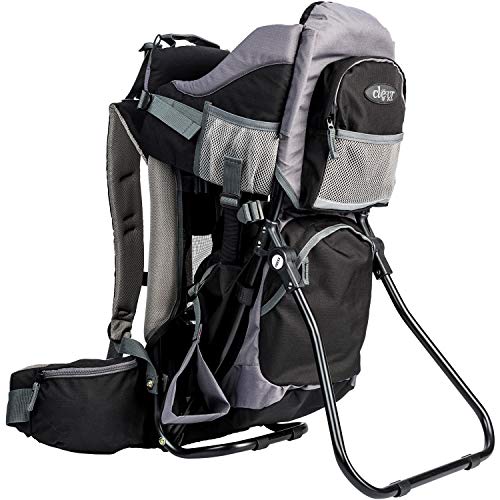
3. Deuter Kid Comfort Child Carrier and Backpack

The German-engineered pack built for all-day comfort and serious trail miles.
Deuter has been making hiking gear for decades, and the Kid Comfort shows that experience. With a 14-liter storage volume (the main compartment space for gear, separate from the child seat area), it carries more than any other model in this roundup — you can pack layers, snacks, and a full diaper kit without overflowing. The adjustable back length ranges from 17.3 to 22.8 inches, which is the widest range here, letting it fit taller parents who often get pinched by one-size-fits-all frames. It handles a recommended load of 19.8 to 52.9 pounds, which comfortably covers an average toddler plus gear.
Buyers consistently rate this pack 4.8 out of 5 stars, with 331 reviews, many praising how the load transfer system shifts weight from the shoulders to the hips. The aluminum frame is sturdy but does come at a weight of 3230 grams (about 7.12 pounds), which is at 7.12 lb versus the Osprey Poco LT’s 5.56 lb. That is the trade-off for extra storage and a more sturdy suspension — you feel the weight at the start of the day but appreciate the support by mile five. The integrated sunshade and 5-point harness (a five-strap system — two shoulders, two hips, one crotch — that keeps a child securely seated) are standard but well-executed.
Endurance choice: The largest gear capacity and widest back-length adjustment make this the go-to for taller parents planning full-day hikes.
Best for: serious day hikers who need to carry substantial gear along with their child. skip it if: you prioritize the lightest possible carry weight and short trips.
4. Kelty Journey Signature Child Carrier Backpack

The adjustable suspension that actually fits both mom and dad without tools.
Kelty’s PerfectFIT Suspension System is the headline feature here, and it lives up to the name. With a simple turn of a dial, the torso length adjusts to fit different body shapes — so if you and your partner share the carrier, each of you gets a custom fit without fiddling with straps for ten minutes. The padded aluminum roll cage wraps around your child, adding side-impact protection that many budget carriers skip. At 7.13 pounds, the Journey Signature is the heaviest model in our comparison, tied with the Deuter at 7.12 lbs, but the trade-off is a plush, supportive ride for longer distances.
The seat base is wide with adjustable foot stirrups that mirror a child’s natural sitting position, which owners mention keeps toddlers comfortable enough to nap on the move. The integrated sunshade deploys quickly for sun protection, and the multiple grab handles make it easy to lift and set the pack down without straining. It maxes out at 40 pounds for the child, which is lower than the Osprey’s 50-pound limit, so it might not last as long for rapidly growing toddlers. Storage is generous with a large zippered pocket and zippered hip belt pockets (small pouches on the padded belt so you can reach snacks and your phone without stopping).
What Wins
- PerfectFIT suspension adjusts quickly between different-sized caregivers
- Padded aluminum roll cage adds side-impact safety
- Wide seat and foot stirrups keep toddlers comfortable
What To Consider
- At 7.13 lb, it is the heaviest carrier in the comparison
- Max child weight of 40 lbs is lower than the Osprey Poco LT’s 50 lbs
Grab this when: two adults of different builds will share the carrier on a regular basis. Pass on it if: you need the highest weight limit for a bigger toddler.
5. OE Shoulder Hiking Carrier For Child and Toddler

The featherweight that doubles as a regular daypack when your toddler walks.
The OE Shoulder Hiking Carrier stands out with a bare-bones frame weight of just 4.4 pounds — that is at 4.4 lb versus the ClevrPlus Canyonero’s 6.5 lb and the Kelty’s 7.13 lb. Its aluminum and stainless steel frame folds down to a compact 22 by 14 by 6 inches, letting you stash it in the trunk or hang it in a closet. The cleverest detail is the detachable 40-liter backpack (a large separate bag that clips off the frame). When your child is walking on their own, you unclip the backpack and wear it like a normal daypack, leaving the empty frame at home. That is a versatility none of the other carriers here offer.
It carries up to 45 pounds and fits a child up to 45 inches tall, with a waist size that extends to 50 inches (127 cm) to accommodate a wider range of parents. The sunshade is tucked into a pocket in the backrest and adjusts with strings. Customers note that the minimalist design keeps things simple, but the trade-off is less padding and suspension compared to the pricier Deuter or Osprey — it is ideal for shorter day hikes rather than all-day epics.
Two-in-one design: At 4.4 pounds with a detachable 40L backpack, it is the lightest and most packable carrier that also works as a regular daypack.
Pick this for: day hikers and travelers who want the lightest possible carrier that still works as a normal backpack. Avoid it for: long, full-day treks where maximum lumbar support and padding are non-negotiable.
6. Chicco SmartSupport Aluminum Frame Backpack Carrier

A trusted baby brand’s spin on a hiking carrier for zoo days and light trails.
Chicco is a household name in baby gear, and the SmartSupport brings that reliability to the backpack carrier category. Its lightweight aluminum frame is designed for more than just hiking — it is equally suited for navigating a crowded zoo or a farmers’ market, where quick on-and-off loading matters. The built-in kickstand lets you set the pack down on the ground without tilting or balancing, which is a huge convenience when you are loading your child at the trailhead or parking lot. None of the other carriers here list a kickstand as a standard feature, so this gives Chicco an edge in everyday usability.
The seat adjusts to two height positions with a padded backrest, accommodating a growing toddler, and the 5-point harness keeps them snug. The parent-side comfort comes from padded ergonomic shoulder and waist straps with 3D breathable mesh (a honeycomb-like fabric layer that promotes air circulation) on the lumbar area to reduce sweat buildup. The canopy is rated at 50+ UPF (a fabric sun-protection rating where 50+ means it blocks at least 98% of UVB rays), matching the Osprey’s protection.
Best Bits
- Built-in kickstand for hands-free loading and unloading
- Lightweight aluminum frame suited for everyday use
- UPF 50+ canopy matches premium models for sun protection
Trade-offs
- Storage is limited to two small pockets
- Only two seat-height positions, less adjustability than some rivals
Reach for this if: you want a versatile carrier for mixed use — not just hiking but also city trips and errands. pass on it if: you need generous gear storage for long days away from the car.
7. besrey Baby Backpack Carrier, Toddler Hiking Backpack

A lightweight contender that undercuts premium models by a significant margin.
At just 5.5 pounds, the besrey is at 5.5 lb versus the ClevrPlus’s 6.5 lb and within striking distance of the ultra-premium Osprey Poco LT. It supports a child from 16 lbs up to 44 lbs, giving it a usable range that covers most of the toddler years. The foldable frame is a nice touch for storage, and the detachable sunshade offers protection from rain and wind — not just sun — which is a practical plus for unpredictable weather. Reviewers point out that the padding on the shoulder straps and waist belt is comfortable for shorter hikes, and the multiple pockets (including zippered ones on the waist belt) keep small items accessible.
Where it pulls back is in the suspension depth. The besrey uses a solid frame with a 5-point harness and flexible stirrups, but it lacks the advanced load-transfer engineering of the Deuter or Kelty. It is a solid value pick that does the job while staying affordable. Compared to the ClevrPlus, which is heavier but offers a rain cover and a changing pad, the besrey focuses purely on keeping the weight low — a different priority for different hikers.
Lightweight value: At 5.5 pounds with an 44-lb max child weight, it is one of the lightest carriers that still offers a full suite of pockets and a sunshade.
Best for: budget-conscious families who want a lightweight carrier for day trips without paying premium prices. Consider another if: you need maximum lumbar support or are carrying heavy gear alongside your child.
Understanding the Specs
Weight of the Carrier
This is the weight of the empty backpack itself, measured in pounds. A lighter pack (under 5.5 pounds) is easier to carry for long distances and when your child is not riding. Heavier packs (over 7 pounds) often have more padding and storage capacity but can tire you out faster. Every pound on your back matters on a multi-mile hike.
Maximum Child Weight
This is the heaviest child the carrier is designed to safely support, measured in pounds. A higher limit (like 50 pounds) means the carrier will last longer as your child grows. A lower limit (around 40 pounds) might mean buying a new carrier sooner. Always check this number against your child’s current and projected weight.
FAQ
What is the difference between a backpack baby carrier and a soft front carrier?
At what age can I start using a backpack carrier for my baby?
How do I clean a backpack baby carrier?
Can I use a backpack carrier for a newborn?
How important is an adjustable torso length?
What is a kickstand and why would I need one?
Is a UPF-rated sunshade worth paying extra for?
What is the difference between an aluminum and stainless steel frame?
Can I use any backpack carrier while jogging or trail running?
How long does a backpack baby carrier typically last?
Final Thoughts: The Verdict
For most families, the ClevrPlus Canyonero earns the top spot because it bundles a rain cover, sun canopy, and changing pad — accessories you would pay extra for on other models — while still holding a 4.7-star rating from nearly 1,000 buyers. If you want the lightest possible carry with the highest child weight limit of 50 pounds, grab the Osprey Poco LT. And for all-day hikes with substantial gear capacity and a suspension that fits taller parents, the Deuter Kid Comfort is the best backpack baby carrier for serious trail miles.
How We Picked
We do not accept paid placement. Every pick is matched to a real buyer and a real use-case; we do not hands-on test units.
Sources & Methodology
Specifications: manufacturer listings and product documentation. Review insights: verified customer reviews, as of July 2026. Pricing: not shown on this page (it changes often); check the current price via the retailer link.
As an Amazon Associate, Gadgets Feed earns from qualifying purchases. This does not affect which products we feature.