
Our readers keep the lights on and my morning glass full of iced black tea. As an Amazon Associate, I earn from qualifying purchases.
Specs are compiled from manufacturer listings and verified buyer reviews and can change over time — please confirm the key details on the product page before buying.
When you need real power where there’s no outlet—out on a trail, at a shoot, or on a jobsite—a backpack battery pack delivers it. The trade-off is that most powerful units are heavy, so your choice really depends on how much juice you need versus how much weight your back can take.
I’m Min — the founder and writer behind Gadgets Feed. This guide is built by comparing the manufacturers’ published specifications and the patterns across verified customer reviews, so you get each pick’s real strengths and trade-offs instead of marketing spin.
We put the top wearable power stations side-by-side so you can see which one fits your gear. This breakdown of the best backpack battery pack options helps you match capacity, weight, and charging speed to your real daily carry.
Our Picks at a Glance

How To Choose The Best Backpack Battery Pack
Your first decision is what you’re powering. A photographer charging a drone and a contractor running a leaf blower need completely different machines, so match the pack to your heaviest load before you worry about anything else.
Match the wattage to your gear
The continuous wattage tells you what the pack can actually run. A 300-watt unit comfortably powers laptops, cameras, and small appliances, while a 700-watt pack can handle bigger loads like mini-fridges or power tools. Check the wattage draw of your biggest device and leave headroom.
Capacity decides the runtime
Measured in watt-hours (Wh), this is the total energy stored. A 268.8Wh pack can keep a phone charged for days, but a 512Wh pack stretches to run refrigerators or medical devices for hours. More Wh means more weight, so it’s a direct trade-off.
Solar input for off-grid top-ups
If you plan to recharge in the field, check the solar input wattage. A 350W input can fully charge a pack in about 2 hours in direct sun, while a slower 120W input takes closer to 3 hours. Faster solar means less time waiting under the sun.
Comfort and carrying system
A fully loaded pack can weigh a lot, so the harness matters. Look for a padded support system and a load rating that matches your gear. A 66 lbs load capacity with an ergonomic frame is noticeably easier on your shoulders than a basic strap setup.
Quick Comparison
| Model | Best For | Capacity | Power Output | Solar Input | Amazon |
|---|---|---|---|---|---|
| BLUETTI Handsfree 2★ Best Overall | Heavy gear, drones & medical | 512Wh | 700W | 350W | Amazon |
| Voltaic Converter | Travel & daily commutes | Battery pack | USB devices | 3.5 hr phone charge | Amazon |
| BLUETTI Handsfree 1 | Day trips & grab-and-go | 268.8Wh | 300W | 120W | Amazon |
| Makita PDC01 | Makita tool owners | 4x LXT batteries | 36V tools | — | Amazon |
In‑Depth Reviews
1. BLUETTI Handsfree 2 Portable Power Station
The heavyweight champ that carries a full studio and keeps life-support gear running..
This is the pick when your load is serious and your back is willing. It pairs a 512Wh power station with a 60L backpack, and the 700W AC outlet means you can run real appliances, not just phones. The pack charges up to 5 devices at once through its 2 USB-C and 2 USB-A ports, plus the main AC socket, so a full camera kit stays powered on location.
What makes it special is the solar speed. A 350W solar input fully charges the unit in about 2 hours, and the system intelligently stops and resumes charging as clouds pass so you waste less sun. The IPX4 water resistance and 66 lbs load capacity make it a genuine outdoor tool, not a commuter bag. The 180° opening gives you full access to the 60L main compartment.
The honest trade-off is weight. At 16.5 pounds before your gear, the pack is heavy—buyers report the whole setup runs around 20 lbs total. But for an ADA user, that weight translated to extending portable oxygen from 2 to 6+ hours—a life-changing trade-off for users who need reliable backup power.. Photographers report carrying a drone, camera, laptop, and tools under 60 lbs loaded with excellent balance.
What the owners love
- 700W output runs heavy gear like drones and appliances
- 2-hour full solar recharge at 350W input
- 60L backpack with 66 lbs load capacity and MOLLE system
What to know before you buy
- 16.5 pounds empty means a heavy carry all day
- Unit ships in separate boxes from different locations
Reach for this if: you carry heavy gear like drones, cameras, or need backup power for medical devices where nothing else will do.
Look elsewhere if: you need a light daily bag—this one earns its keep but demands your shoulders.
2. Voltaic Systems Converter Solar Backpack Charger

The featherweight that turns a sunny sidewalk into a charging station..
This is the pack for travelers who want a safety net, not a power plant. At 2.4 pounds it’s a fraction of the weight—a 6.9x gap compared to the BLUETTI Handsfree 2’s 16.5 pounds—making it a carry-on friendly companion. The 20L padded bag fits a 15″ laptop and up to 10″ tablets in a dedicated sleeve, so it doubles as your everyday commuter pack.
The included V25 power bank stores energy so you can charge even when clouds roll in. The monocrystalline solar cells charge most smartphones completely in 3.5 hours in direct sunlight, and the panel is efficient enough that owners mention solid charging even on cloudy days. It’s built to power anything that charges from USB, from iPhones to GoPro cameras.
Storage is what wins people over—the main compartment plus interior pockets, a laptop sleeve, and front and side pockets keep things organized for 2-3 day trips. Customers note it saves them constantly on travel when a phone or computer charge is needed, and it clears airport security without issues. The recurring gripe is the zippers, which some find tight and prone to breaking, so treat them gently.
Smart balance: You get a real solar panel, a replaceable battery, and a comfortable 20L pack in a light 2.4-pound frame—ideal for evacuation kits or daily commutes.
The catch: Charging performance gets mixed feedback from owners, so treat the solar as a top-up, not a primary source.
3. BLUETTI Handsfree 1 Portable Power Station

The grab-and-go day bag that packs a 300W punch and holds a full emergency kit..
Think of this as the little sibling to the Handsfree 2, with a 268.8Wh capacity and a 300W AC outlet that powers laptops, cameras, and small gear. It still charges 5 devices at once through 2 USB-C and 2 USB-A ports, and the 42L backpack keeps a dedicated compartment for photography gear. The 300W output is a step down from the Handsfree 2’s 700W—a 2.3x gap—so it’s for lighter loads.
Solar charging tops it up in 3 hours at 120W, or 6 hours at 60W, which is slower than the Handsfree 2’s 350W input—a 2.9x gap in speed. The unit hits 80% of charge in 45 minutes from the wall, and the system automatically pauses and resumes charging for efficiency. The weatherproof IPX4 rating and 66 lbs load capacity with the ErgoBLUE support system carry over from the bigger model.
Buyers find it larger and heavier than expected at 9.5 pounds, but that weight buys serious versatility. It’s been praised as an ideal grab-and-go day bag for medical emergencies, holding extensive supplies—medical gear, 2 computers, water, clothes, and tools—for 1-3 days. The main downside owners note is that it lacks a solar charger in the box, so you’ll buy that separately.
Versatile carry: A 42L pack with a solid 268.8Wh station is a strong middle ground for campers and photographers who want power without the 16.5-pound frame of the bigger BLUETTI.
Honest note: It’s still a mini generator on your back—buyers call it heavy—and the solar panel is an extra purchase.
4. Makita PDC01 Portable Backpack Power Supply
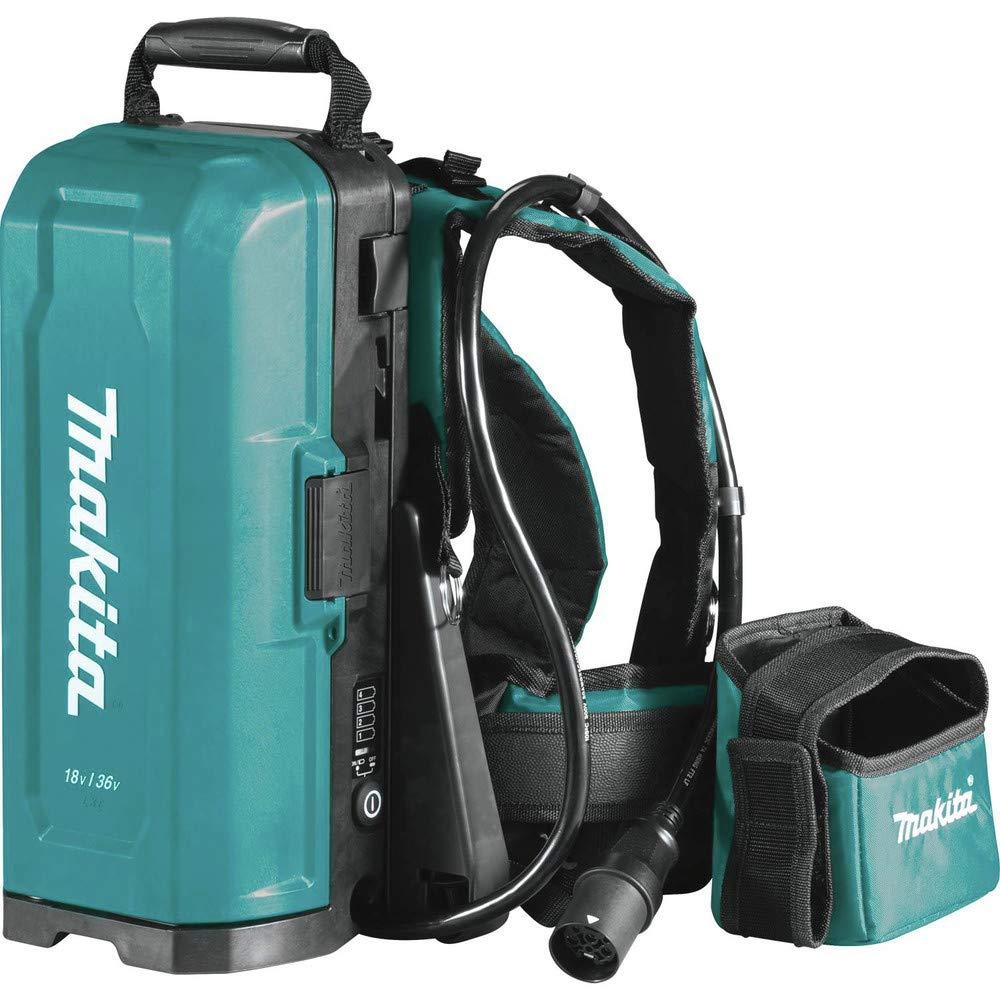
The jobsite workhorse that doubles your cordless tool runtime without the strain..
This is a different animal entirely—it’s built for Makita cordless tools, not USB devices. The backpack holds four Lithium-Ion batteries that deliver up to 4X the run time when used with Makita LXT 18V products, and up to 2X the run time with LXT X2 (36V) tools. An included 18V X2 adapter lets you plug in, while an 18V adapter is sold separately.
The payoff is real for yard work. Reviewers point out a blower combo exceeding 650 CFM runs without fatigue, and the backpack design reduces strain—helpful for users with elbow tendonitis who need to reduce arm strain during extended tool use.. One owner notes it doubles run time on a blower for leaf cleanup, and the detachable battery box makes it easier to remove the weight when you stop. The cord clips can be brittle in cold weather, so treat them with care.
The catch is compatibility. This pack doesn’t charge batteries natively and works best with newer 36V tools. But if you’re already invested in the LXT system, an optional cable lets you run XGT 40V tools using your LXT batteries, saving money. It’s a smart upgrade for anyone who owns Makita gear and wants to stop swapping batteries mid-task.
Why owners make the switch
- Up to 4X run time on LXT 18V tools
- Backpack design cuts arm and shoulder fatigue
- Works with 36V tools via included adapter
Who this misses
- Requires Makita batteries—not included
- Compatibility limited to newer 36V tools
- Plastic cord clips can crack in the cold
Grab this if: you’re a Makita owner tired of swapping batteries on a blower, saw, or trimmer.
Pass it by if: you need to charge phones or cameras—this one only powers tools.
Understanding the Specs
Watt-Hours (Wh)
This is the total energy your pack stores, like the size of a fuel tank. A 268.8Wh pack runs a laptop for several hours, while 512Wh doubles that. More Wh means heavier weight, so pick the smallest number that covers your daily gear.
Wattage Output (W)
The continuous wattage tells you what the pack can actually run. A 300W outlet handles laptops and cameras, while 700W runs bigger appliances like mini-fridges. Check the wattage draw of your largest device before buying.
Solar Input
This is how fast the pack recharges from a solar panel. A 350W input fills a pack in about 2 hours of direct sun, while a 120W input takes closer to 3 hours. Faster solar means less time waiting in the sun.
Battery Chemistry
LiFePO4 (lithium iron phosphate) batteries deliver long cycle life and stable performance, making them ideal for repeated outdoor charging.. They weigh more than standard lithium-ion but endure years of outdoor use and temperature swings without degrading..
FAQ
Can a backpack battery pack power a laptop?
How heavy is a backpack battery pack?
Will a solar backpack charge my phone in cloudy weather?
Can I take a backpack battery pack on a plane?
What is the difference between the BLUETTI Handsfree 1 and Handsfree 2?
Does the Makita PDC01 include batteries?
How long does it take to recharge a backpack battery pack?
Can a battery backpack power a drone or camera?
Final Thoughts: The Verdict
If you want one dependable pick, the backpack battery pack winner is the BLUETTI Handsfree 2 because it pairs the largest 512Wh capacity with the fastest 350W solar input and a roomy 60L pack. If you want a light travel companion, grab the Voltaic Converter at 2.4 pounds. And for Makita tool owners, the Makita PDC01 is the one to reach for.
How We Picked
We do not accept paid placement. Every pick is matched to a real buyer and a real use-case; we do not hands-on test units.
Sources & Methodology
Specifications: manufacturer listings and product documentation. Review insights: verified customer reviews, as of August 2026. Pricing: not shown on this page (it changes often); check the current price via the retailer link.
As an Amazon Associate, Gadgets Feed earns from qualifying purchases. This does not affect which products we feature.