
Our readers keep the lights on and my morning glass full of iced black tea. As an Amazon Associate, I earn from qualifying purchases.
Specs are compiled from manufacturer listings and verified buyer reviews and can change over time — please confirm the key details on the product page before buying.
A bug-out bag is not a gym duffel or a weekend suitcase. It is a single piece of kit meant to carry everything you need to leave home on foot and not come back for three days. If the frame digs into your shoulders on mile three, or the main compartment runs out of room before the first aid kit goes in, the whole plan falls apart. The right pack balances capacity with a carry system that disappears on your back.
I’m Min — the founder and writer behind Gadgets Feed. This guide is built by comparing the manufacturers’ published specifications and the patterns across verified customer reviews, so you get each pick’s real strengths and trade-offs instead of marketing spin.
The seven packs below are the ones worth considering for your backpack for bug out bag foundation, each chosen for a different balance of capacity, durability, and comfort under load.
Our Picks at a Glance

How To Choose The Best Backpack For Bug Out Bag
A bug-out bag pack is different from a hiking pack because it prioritizes rugged construction, modular attachment points, and rapid-access compartments. You are not just carrying a sleeping bag and food — you are carrying a multi-tool, radio, medical pouch, water filter, spare ammunition, and maybe an extra layer. That changes what matters.
Capacity: The 50L to 70L balance
A 40-liter pack forces you to leave essentials behind. A 75-liter pack tempts you to overpack and ruin your mobility. The vast majority of three-day bug-out loadouts fit comfortably in the 50-to-70-liter range. That is enough for a sleep system, a change of clothes, a first-aid kit, food for 72 hours, a water bladder, and a small tool roll — with room left for a rain shell on top.
The Frame: Internal vs. No Frame
An internal frame transfers the weight of the load from your shoulders down to your hips, where your body is built to carry it. A frameless pack above 30 pounds will pull you backward and grind into your collarbones within a mile. Every serious bug-out pack on this list uses an internal frame or a rigid suspension. Do not skip this spec.
MOLLE: The Modular Attachment System
MOLLE webbing (rows of heavy-duty nylon stitched onto the pack) lets you clip on pouches, radio holsters, water bottle carriers, or a sleeping pad without sewing or drilling. A pack covered in MOLLE is future-proof: you can reconfigure it as your gear changes. Look for webbing on the front panel and the hip belt for the most utility.
Quick Comparison
| Model | Best For | Capacity | Weight | Dimensions (HxWxD) | Amazon |
|---|---|---|---|---|---|
| Tasmanian Tiger Raid MKIII★ Best Overall | Overall Rugged Comfort | 52 L | — | 26″ x 13″ x 9″ | Amazon |
| Kelty Redwing Tactical 50Lightweight Performer | Balanced Lightweight Build | 50 L | 4.06 lb | 12″ x 26″ x 16″ | Amazon |
| Osprey Rook 65L | Ventilation & Load Transfer | 65 L | 3.7 lb | 29.5″ x 15″ x 16.1″ | Amazon |
| First Tactical Specialist 3-Day | Professional Tactical Loadout | 56 L | — | 22″ x 13″ x 8.5″ | Amazon |
| LA Police Gear Atlas 72H | Spacious Storage for the Price | ~62 L (est.) | — | 24″ x 19″ x 10″ | Amazon |
| XMILPAX Large Military 70L | Maximum Capacity on a Budget | ~80 L | 7 lb | 30″ x 13″ x 11″ | Amazon |
| Mardingtop 50L | Entry-Level Price, Solid Build | 50 L | 3.9 lb | 28.3″ x 11.4″ x 9.1″ | Amazon |
In‑Depth Reviews
1. Tasmanian Tiger Raid Tactical Backpack MKIII – 52L
Our pick — over 4.5★ from 650+ verified ratings; the strongest balance of quality and price.
The pack that owners say is barely noticeable on a 6-mile ruck.
The stand-out feature here is the V2 Plus Carrying System, which lets you adjust the back length for a personalized fit — a rarity on tactical packs. That adjustability, combined with a height-adjustable chest belt and a padded hip belt, is what makes a fully loaded 52-liter bag feel manageable over distance. Buyers report it is “very comfortable on 6-mile rucks; barely noticeable on back.” That kind of feedback, from someone sized at 6’4″, tells you the torso-length range is generous.
The build uses Cordura fabric, an internal aluminum frame to support the load, and a hydration bladder port for hands-free water access. The MOLLE system covers the exterior, so you can attach extra pouches without opening the main compartment. The detachable hip strap converts into a Warrior Belt for a separate carry option. The Tasmanian Tiger stands 26 inches tall versus the Mardingtop’s 28.3 inches in height, but the quality of the suspension system means you can actually use all that space without pain.
The recurring trade-off? Some owners wish it were 15 liters larger for a full mobile loadout, and the excess strap length from the adjustment system needs trimming. But for a 52-liter pack that carries like it is barely there, this is the one the crowd favors.
What wins owners over
- Adjustable torso length for a custom fit across different heights.
- Internal aluminum frame transfers load to hips for long-distance comfort.
- Cordura fabric with water resistance holds up after years of use.
The honest caveat
- At 52 liters some users need a larger main compartment for gear-heavy missions.
- Excess strap webbing requires trimming or securing to avoid flapping.
Reach for this if: you want a premium carry system that makes a heavy load feel light over long miles, and you value adjustable fit over raw capacity.
Look elsewhere if: your loadout requires more than 60 liters of internal space — you will be strapping gear to the outside from day one.
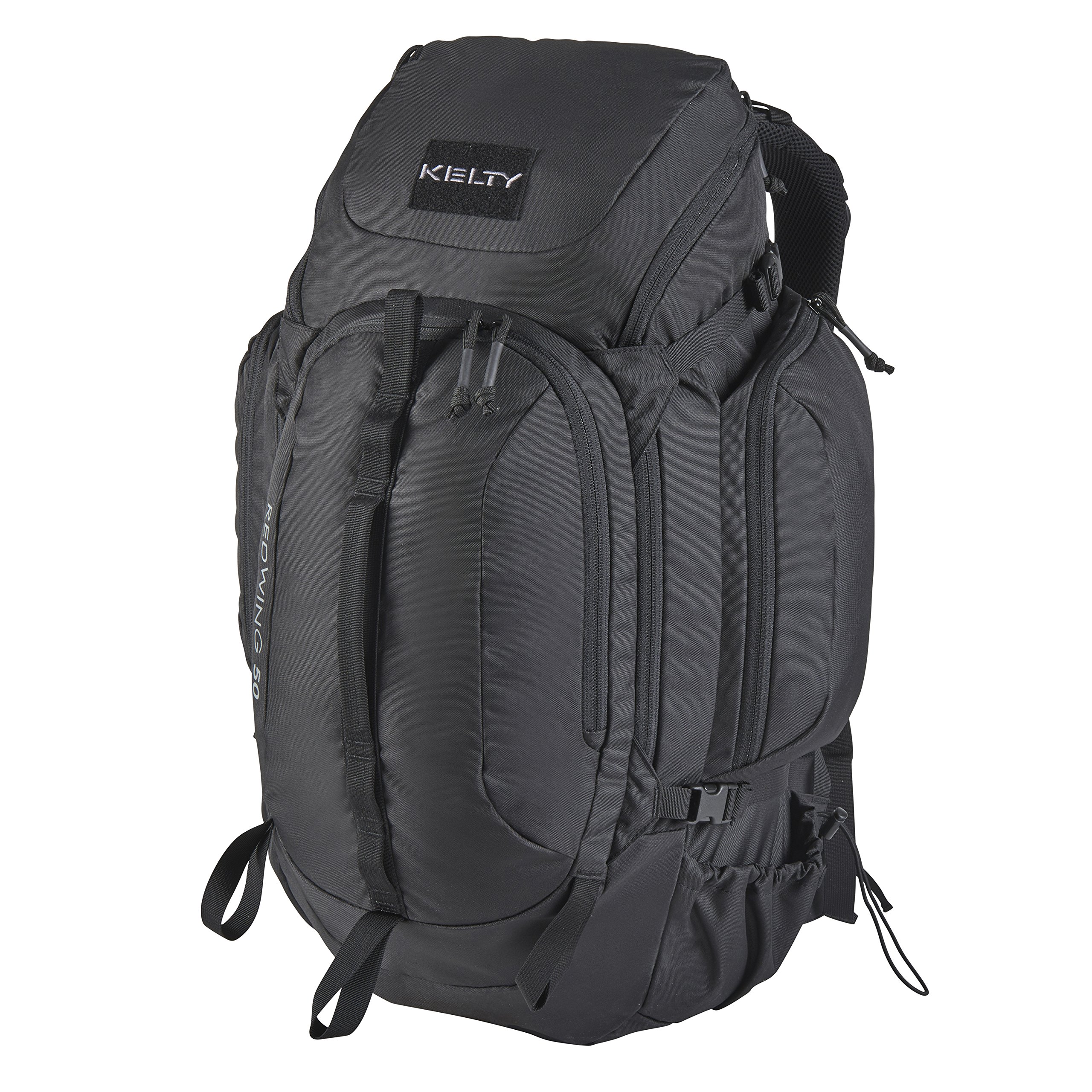
2. Kelty Redwing Tactical Backpack 50L
A military-spec pack that weighs just over four pounds empty.
Kelty built this to meet military specifications, and the build quality shows in the seams, zippers, and fabric. The Redwing weighs 4.06 pounds, which puts it in the lightweight end of the tactical pack world, yet it still carries an internal frame with aluminum stays. The Dynamic AirFlow back panel keeps your back from turning into a sweat trap — especially useful if you are moving fast through warm terrain.
The hybrid-loading U-zipper design lets you open the main compartment like a suitcase for easy packing, while the side water bottle pockets are deep enough to hold Nalgenes or even a rifle buttstock. There is a removable waist belt, compression straps, and a top stash pocket for small essentials. At 50 liters, it is the same class as the Mardingtop but nearly a pound heavier due to the tougher construction. The pass-through side pocket design gets a lot of praise from owners who carry trekking poles or an axe.
The honest downside is the fit: the suspension system works well for many, but owners note it lacks the fine-tuned adjustability of pricier packs. It is not an ultralight backpack, but it is described as “trail-tough.”
The quick read: A tough, well-organized 50-liter pack that rides light for its build quality. Best if you want a military-spec pack without the heavy price tag and you do not need a fully adjustable torso length.
Choose it for: a lightweight tactical pack with smart access and strong construction that works for hiking, range days, and travel.
skip it if: you need a perfectly custom torso fit — the adjustment range here is good but not as deep as the Tasmanian Tiger.
3. Osprey Rook 65L Men’s Backpacking Backpack

The 65-liter pack that breathes — literally — under a 35-pound load.
The Osprey Rook uses an AirSpeed suspension system with a tensioned mesh backpanel that sits away from your spine, creating airflow that cuts down on sweat. The LightWire frame transfers the load to the hip belt, so your shoulders do not take the brunt. At 3.7 pounds, it is lighter than the Kelty despite holding 15 more liters of gear. The integrated, stowable rain cover is built into its own pocket, so you never forget it.
Owners mention it handles loads up to 35 pounds comfortably, with one owner logging a 26-mile day under 30 pounds without issues. The zippered sleeping bag compartment with a floating divider keeps your sleep system separate from the rest of your gear. It is compatible with the Osprey Daylite system for a detachable daypack. The 65-liter capacity gives you a full 13 more liters than the Tasmanian Tiger, which matters if you carry a bulky sleeping bag and a tent.
The main trade-off is the lack of MOLLE webbing — this is a pure backpacking pack, not a tactical rig. There is no large mesh front pocket, and the back access is limited. If you need to attach pouches externally, you will need to use the compression straps instead.
What stands out
- Mesh backpanel keeps your back cool even on hot hikes with a full load.
- Built-in rain cover is always with the pack, never left behind.
- 65L capacity with a weight of only 3.7 pounds is an excellent ratio.
What it lacks
- No MOLLE webbing for external pouches — a true backpacking design.
- No back-panel access; you load from the top and the sleeping bag compartment.
Best for: hikers and preppers who prioritize load comfort and ventilation over modular attachment points. The 65L capacity is ideal for longer trips.
Not for: anyone who needs to clip on tactical pouches or prefers a military-style layout.
4. First Tactical Specialist 3-Day Backpack 56L
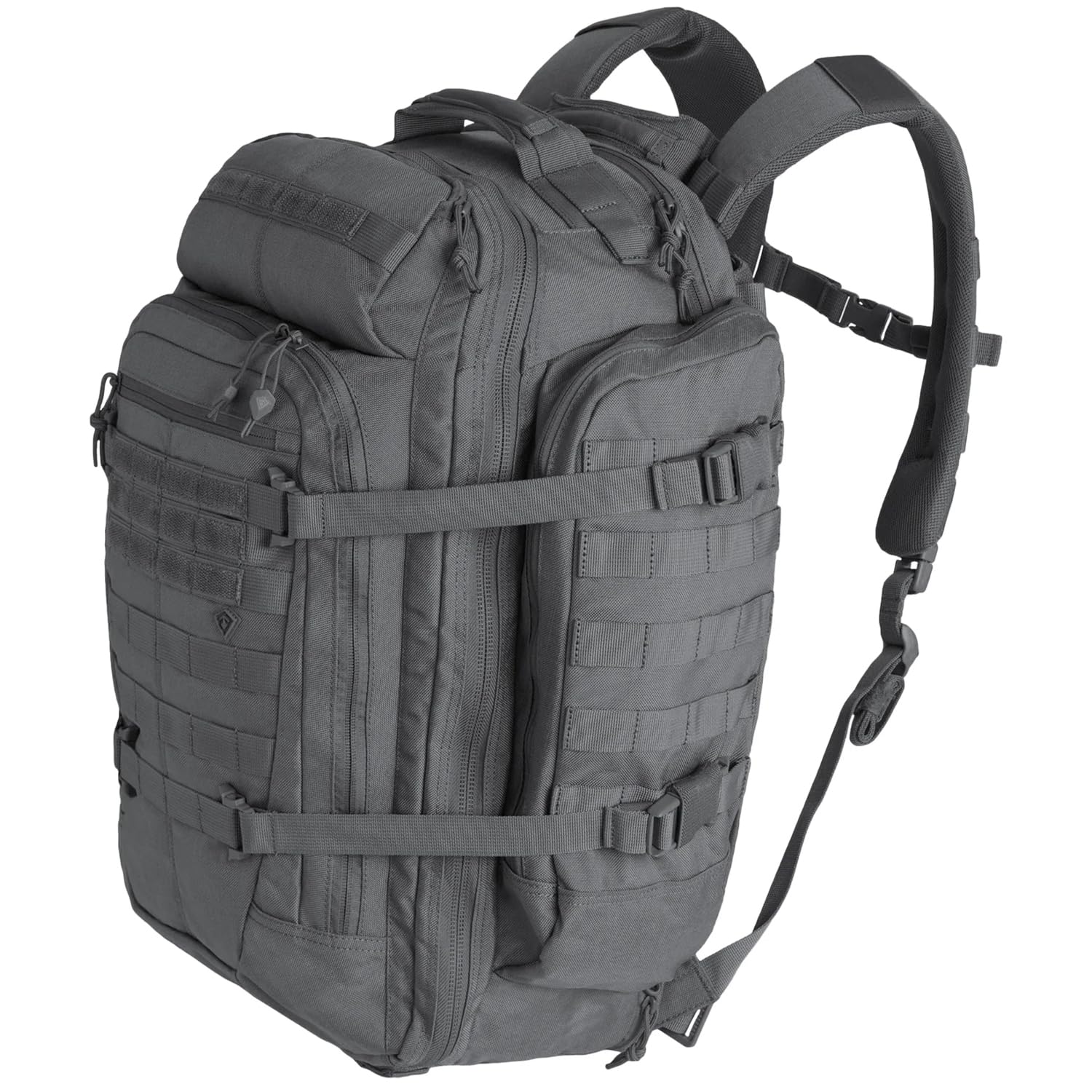
A 56-liter pack designed by professionals for demanding, real-world use.
You get a full hook-and-loop back panel (a Velcro-like surface) inside the main compartment of the First Tactical Specialist 3-Day, so you can attach organizer panels or pouches exactly where you want them. Its 56-liter capacity fits a three-day loadout. Owners describe the side pockets as “massive” — big enough for two laptops or a hydration bladder and a radio.
The outer fabric is heavy-duty nylon, and the zippers are built to handle hard use. Owners note it outperforms 5.11 bags in thoughtful design. The main compartment has adjustable dividers, and one owner reports it fits a mid-tower desktop PC. The 22-inch height and 8.5-inch depth make it more compact vertically than the Kelty, so it sits lower on your back.
The big miss is the lack of a hip belt (a padded strap that transfers weight to your hips) — unusual for a pack this size. Some owners also note the back padding netting feels less sturdy than the rest of the bag. If you plan to carry heavy loads for miles, you will want to buy a separate hip belt.
The pro take: A highly functional 56-liter pack with the best internal organization of any bag here. Bring your own hip belt for long-distance rucking.
Pick this for: a professional-grade tactical bag with incredible internal organization and expandable side pockets. Great for vehicle-based or base-camp bug-out setups.
Think twice if: you plan to ruck heavy loads over 5+ miles — the missing waist strap will be missed.
5. LA Police Gear Atlas 72 Hour Tactical Backpack
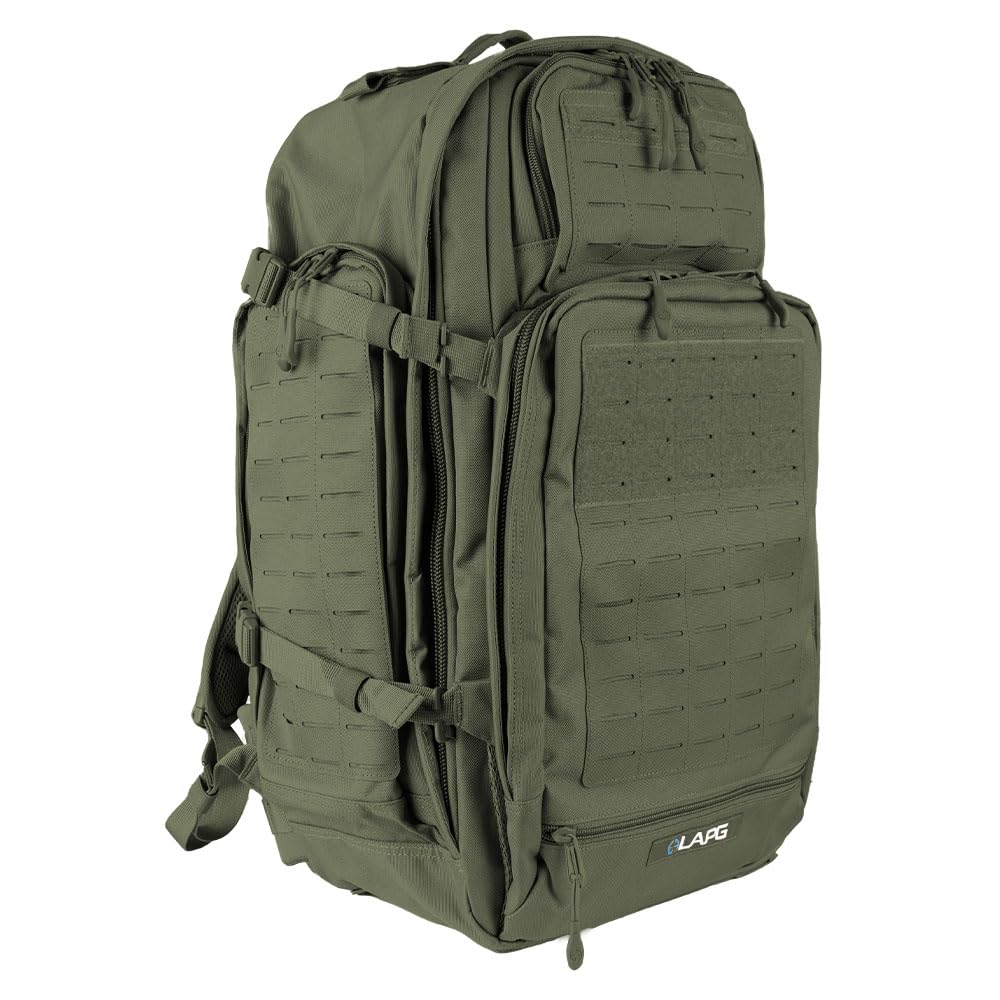
A 900-denier pack that swallows gear without swallowing your budget.
The Atlas is built from 900D polyester, which is a heavy, abrasion-resistant fabric that can take a beating on rocks and concrete. It stands 24 inches tall, 19 inches wide, and 10 inches deep, giving it a broad internal volume that can swallow clothing, gear, and even a 17-inch laptop. The interior is loop-lined for attaching hook-backed pouches, so you can set up your own organization system.
The laser-cut MOLLE on the front panel is lightweight and low-profile, though some owners note it feels thinner than traditional webbing. The shoulder strap system is built to work with a separate tactical chest pack for CCW or small-item carry. The padded back has a removable backplate for extra structure. Owners consistently praise how much gear fits inside and the value for the money.
Honest complaints center on the zippers: the pulls can break under heavy use, and water can get in through the zipper track in heavy rain. The pack is also heavy when empty due to the dense fabric. For the price, though, the sheer storage space is tough to top.
Why it earns its spot
- Massive main compartment fits two sets of clothes, gear, and a 17-inch laptop.
- 900D polyester fabric resists abrasion and heavy use.
- Loop-lined interior lets you customize organization with hook-backed pouches.
Where it cuts corners
- Zipper pulls can fail early — consider replacing with paracord pulls.
- Not fully weatherproof; water can enter through the zipper track in sustained rain.
Reach for it if: you need maximum internal volume for a low price, and you plan to organize gear with hook-backed panels inside the main compartment.
Avoid it if: you need fully waterproof zippers or a lightweight pack — this one is heavy and the zippers are a weak point.
6. XMILPAX Large Military Backpack 70L

An 80-liter behemoth that covers your back from sleeping bag to radio.
This pack from XMILPAX uses 1,000-denier polyester fabric — the same weight class used by high-end tactical brands — and covers the entire exterior in MOLLE webbing, including on the hip belt. The main compartment is top-loading with a heavy-duty zipper, and there are two front pockets, two side zippered pockets, a bottom pocket, and a lid compartment. Total usable capacity is advertised at about 80 liters, making it the largest pack in this comparison by a significant margin.
It has an adjustable foam-padded internal frame, padded hip belt, load lifter straps, and a lumbar pad. Owners describe it as comfortable for a 6’1″ hiker with excellent padding and smooth zippers. The semi-rigid frame helps keep the load high and tight against your back. At 7 pounds empty, it is the heaviest pack here, but that weight is necessary to support such a large capacity with 1000D fabric.
There are some trade-offs. The MOLLE webbing is very tightly woven and may not accept standard clips — one owner found only C-clips work. There is no dedicated hydration sleeve or tube port, which is a notable omission for a bug-out pack. Some owners also report the waterproofing is limited, though a rain fly is included.
The verdict: An enormous, rugged pack for the prepper who needs to carry everything, including bulky cold-weather gear. Bring your own hydration system and be ready for a heavy empty weight.
Best for: car-based bug-out setups, base camps, or winter loadouts where 80 liters of capacity is non-negotiable.
Not for: lightweight backpackers or anyone who needs a hydration sleeve integrated into the pack.
7. Mardingtop 50L Hiking Backpack
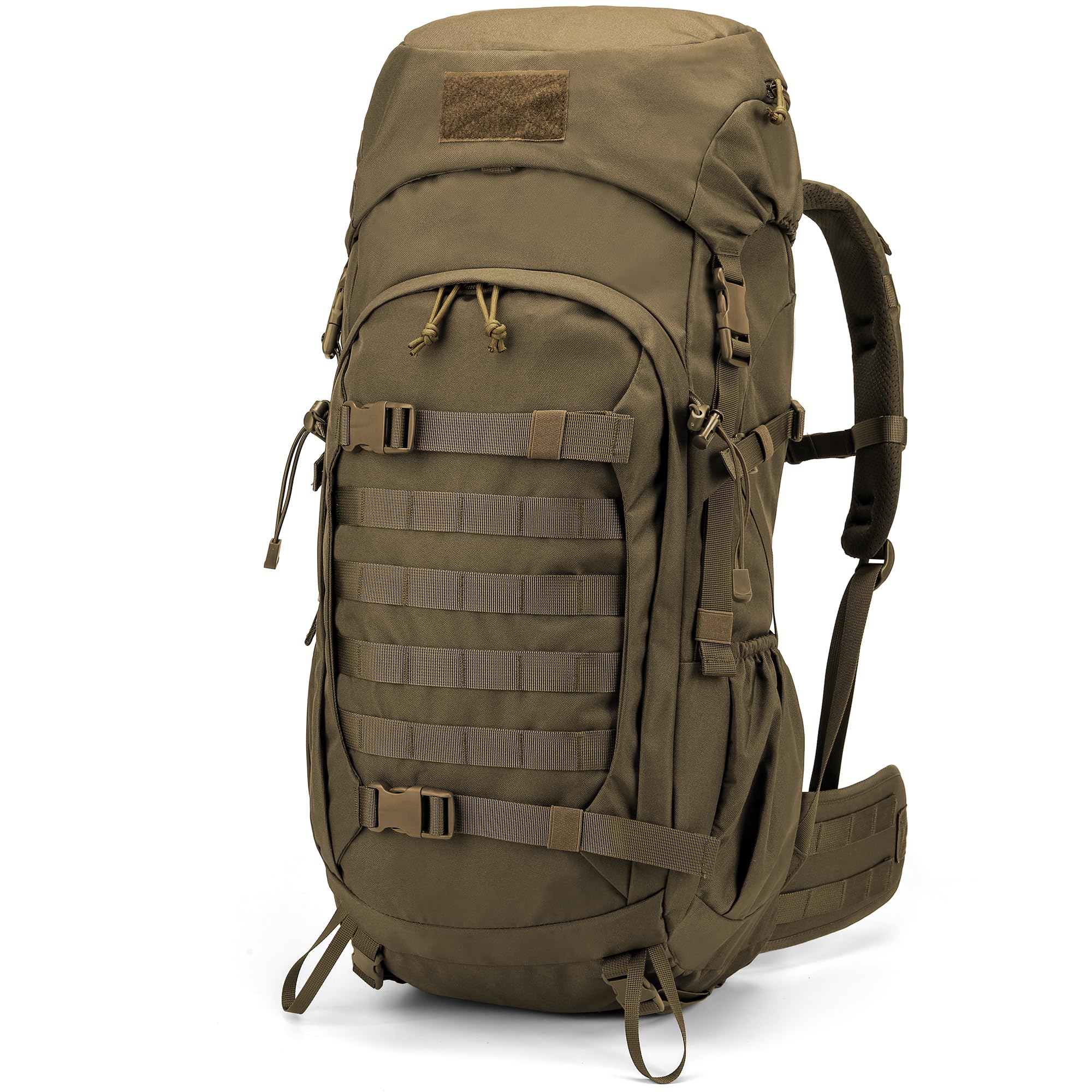
A 50-liter pack that proves a bug-out bag does not have to cost a fortune.
The Mardingtop 50L is the entry-level contender in this list, and it earns its place with genuine strengths. It is made from 600D polyester — a step down from the 1000D used on premium packs, but still tough enough for moderate use. All the buckles and zippers are YKK brand, which is a reliable industry standard. The pack includes a rain cover, a hydration compartment that fits a 5-liter bladder or a 15.6-inch laptop, and MOLLE webbing on the front.
It has an adjustable padded sternum strap and hip belt, and a breathable mesh back panel. At 3.9 pounds, it is lighter than the XMILPAX and comparable to the Kelty. Owners say it is comfortable enough for a 6-mile ruck and holds a full change of clothes, a sleeping bag, and cooking gear. The front zippered access opens the main compartment like a suitcase, making packing much easier than a top-loader.
The compromise shows in the details. The back panel gets hot quickly despite the mesh design — customers note it is not as breathable as advertised. The buckles on the compression straps can slip under heavy tension, and some owners find the main compartment lacks enough small pockets for organized storage. The durability is mixed: the pack holds up well for moderate use, but some reviewers point out the fabric eventually rips after heavy abuse.
Why it works
- Incredible value for a pack with MOLLE, rain cover, and hydration compatibility.
- YKK zippers and buckles provide reliable hardware at this price point.
- Light enough at 3.9 pounds for most three-day loadouts.
Where you feel the price
- Back panel runs hot during extended marches — airflow is limited.
- Buckles can slip under heavy load; replacement may be needed.
Reach for it if: you need a functional bug-out pack on a strict budget and you are willing to accept a few corners cut in breathability and fabric weight.
Spend more if: you plan to ruck 10+ miles regularly or need a pack that will survive years of heavy abuse without fabric failure.
Understanding the Specs
Internal Frame vs. No Frame
An internal frame is a rigid structure inside the pack that transfers the weight of your load from your shoulders to your hips. If you carry more than 30 pounds, a frame keeps the pack stable and prevents it from sagging away from your back. Every pack on this list uses an internal frame or a rigid suspension system. Without one, the bag will pull you backward and cause shoulder pain within a mile.
MOLLE Webbing
MOLLE (Modular Lightweight Load-carrying Equipment) is a grid of heavy-duty nylon webbing stitched onto the pack that lets you attach pouches, holsters, and gear without sewing or extra straps. A pack with full MOLLE coverage on the front and hip belt is the most future-proof — you can add or remove pockets as your loadout changes. Laser-cut MOLLE is a lighter, lower-profile version but can feel less sturdy than traditional sewn webbing.
FAQ
Is a 50-liter pack big enough for a three-day bug-out bag?
Can I use a hiking backpack as a bug-out bag?
What does the hip belt do?
Should I get a pack with a hydration sleeve?
What is MOLLE webbing used for?
How do I know if a pack fits my torso length?
Is a heavier pack always more durable?
Can I take a bug-out bag on an airplane?
What is the difference between a 3-day pack and a bug-out bag?
Do I need a pack with a built-in rain cover?
Final Thoughts: The Verdict
For the majority of shoppers, the backpack for bug out bag winner is the Tasmanian Tiger Raid MKIII because the V2 Plus Carrying System (a frame and harness design) makes a fully loaded 52-liter pack feel like a much lighter load — and that comfort is what keeps you moving when distance matters. If you want the best ventilation and a larger 65-liter capacity, grab the Osprey Rook. And for a budget-friendly starting point that still includes MOLLE and a rain cover, the Mardingtop 50L is the one to reach for.
How We Picked
We do not accept paid placement. Every pick is matched to a real buyer and a real use-case; we do not hands-on test units.
Sources & Methodology
Specifications: manufacturer listings and product documentation. Review insights: verified customer reviews, as of July 2026. Pricing: not shown on this page (it changes often); check the current price via the retailer link.
As an Amazon Associate, Gadgets Feed earns from qualifying purchases. This does not affect which products we feature.