
Balancing heavy camera gear with hiking essentials in a single, well-organized pack is the central challenge for outdoor photographers. A bag that protects your investment while distributing weight comfortably over miles of uneven terrain requires specific design trade-offs that a standard technical pack or a camera insert alone cannot solve.
I’m Min — the co-founder and writer behind Gadgets Feed. I’ve spent hundreds of hours researching the technical specifications, real-world durability tests, and compartment layouts that define the best dual-purpose options for photographers who refuse to leave the trail.
This guide breaks down the critical specs and designs you need to evaluate when choosing the right backpack for camera and hiking so your gear stays safe and your back stays happy.
How To Choose The Best Backpack For Camera And Hiking
Selecting a pack that works on both a muddy trail and a city street means prioritizing access, protection, and weight distribution in equal measure. The wrong choice leads to a sore neck, wet gear, or a frustrating shuffle every time you need to swap a lens.
Access Method: Rear vs. Top vs. Side
The way you reach your camera defines the pack’s usability. Rear-panel access (clamshell opening against your back) lets you set the bag down on a muddy surface without dirtying the opening flap and keeps your gear secure from pickpockets. Top-loading packs are faster but force you to dig. Side-access flaps offer quick draws without removing the pack entirely — ideal for catching a shot mid-hike.
Expandable Capacity and Volume Management
A 22L main compartment that expands to 27L or 25L that stretches to 33L is the difference between a day hike and a summit attempt with extra layers. The expansion zone is usually in the front or the roll-top section. Look for packs that add at least 4-5L without bulging awkwardly, so your jacket and food don’t compress your camera compartment.
Harness System and Weight Transfer
When your kit weighs 15-20 lbs, standard shoulder straps will dig in after two miles. A proper hiking-grade pack needs a padded hip belt that transfers the load to your hips, adjustable sternum straps, and a breathable back panel with air channels. Removable hip belts are a bonus for city use, but don’t sacrifice padding for versatility.
Quick Comparison
On smaller screens, swipe sideways to see the full table.
| Model | Category | Best For | Key Spec | Amazon |
|---|---|---|---|---|
| PGYTECH OneMo 2 25L-33L | Premium | Max gear loadout + trail comfort | Expandable 38L total; 3.79 lb body | Amazon |
| Thule Aspect DSLR | Premium | Drone+DSLR combo on long hikes | Removable padded hip belt; 15.6” laptop | Amazon |
| Lowepro Fastpack BP250AW III | Mid-Range | Compact travel + day hiking | 25L capacity; 15” laptop compartment | Amazon |
| K&F CONCEPT Professional | Mid-Range | Versatile 50:50 to 20:80 split | Expandable 25L; 1.78 kg weight | Amazon |
| Lowepro Flipside Trek BP 250 AW | Mid-Range | Secure back-access on trail | ActiveZone suspension; tablet sleeve | Amazon |
| Besnfoto Roll Top | Budget | Value-conscious all-weather hiking | 27.5” height; 7 removable dividers | Amazon |
| RaLeno Expandable 22L+5L | Budget | Dual quick-access + budget entry point | 27L expandable; dual side/front access | Amazon |
In‑Depth Reviews
1. PGYTECH OneMo 2 25L-33L Camera Backpack

The PGYTECH OneMo 2 offers the most thoughtful expansion system in this class, starting at 25L and stretching to 33L via a V-shape or H-shape zipper, complemented by a detachable 3.5L camera bag that brings total capacity to a whopping 38L. The clamshell rear opening exposes your entire camera layout at once, and dual side-access doors let you grab a body without dropping the pack on wet ground. YKK zippers, a PU anti-splash exterior, and a dedicated rain cover ensure this bag survives anything from a coastal mist to a downpour.
Tested loads of 38 lbs across five weeks of urban and trail use showed no strain on the S-shaped shoulder straps or the detachable waist belt, thanks to the ergonomic arc-shaped back panel with ventilation ridges. The internal divider system uses extensive Velcro for rock-solid customization, and smart touches like battery charge-status sliders and a separate padded bag for a second camera body make it feel purpose-built for working photographers. The included child bag doubles as a standalone shoulder bag for quick shoots.
One minor irritation: the laptop sleeve hook can come undone under heavy load, though a simple extra button fixes it. At 3.79 lb for the mother bag alone, this is not a featherweight, but the load transfer and stabilizer straps make it feel lighter on the trail than the scale suggests. For photographers carrying two full-frame bodies, five lenses, a 16” laptop, and trail essentials, this is the most complete hiking camera pack available.
Why it’s great
- Massive 38L total capacity with removable child bag
- Clamshell rear + dual side access for trail speed
- YKK zippers and anti-splash PU exterior
Good to know
- Mother bag alone weighs 3.79 lb
- Laptop sleeve hook can slip under heavy load
- Looks like a camera backpack to observers
2. Thule Aspect DSLR Camera Bag Backpack

Thule’s Aspect is built like a piece of Scandinavian mountaineering equipment — the 100% nylon fabric, reinforced stitching, and air-mesh back panel feel indestructible from the first wear. The adjustable, removable padded hip belt makes this one of the few camera packs that genuinely works as a hiking pack first and a camera bag second. The main compartment is customizable enough to swallow a full-frame DSLR plus a DJI Mavic Pro (up to 260x240x130 mm) with room for filters, batteries, and a cleaning kit.
The top compartment opens separately and swallows a second body like a Canon 80D with battery grip, plus snacks or a puffy vest. The side pockets are generous enough for a tripod on one side and a water bottle on the other, and the dedicated 15.6” laptop sleeve with an iPad pocket keeps your tech separate from grit and dust. The internal Velcro dividers are substantial but stiff, requiring some fiddling to reconfigure on the trail.
Some users note that the camera compartment only opens from one end, making initial pad layout slightly awkward, and the bag’s 3+ lb weight adds up when fully loaded. But for photographers who regularly hike 5+ miles with a drone and a full lens set, the Thule Aspect’s protective structure and comfortable load transfer justify the premium price bracket. The tripod clip is included and stows neatly against the center.
Why it’s great
- Removable hip belt for true hiking load transfer
- Fits large drone + full-frame camera + laptop
- Superior nylon build and air-mesh panel
Good to know
- Camera compartment opens from only one end
- Velcro dividers are stiff to adjust mid-trail
- Heavy at over 3 lb empty
3. Lowepro Fastpack BP250AW III Backpack

Lowepro’s Fastpack BP250AW III is the Goldilocks option for day hikers who need a clean line between photography gear and personal items. The 25L design separates the main camera compartment from a top personal compartment, so you aren’t digging through socks to find an SD card. The side access flap lets you retrieve a body one-handed — a feature that users consistently praise as the deciding factor over other mid-range packs.
The removable dividers are stiff and versatile, accommodating a telephoto zoom with a body attached, two spare lenses, and accessories without the interior feeling cramped. A padded 15” laptop sleeve with fleece-lined pockets for sunglasses or a phone adds daily-carry utility. The rigid build keeps its shape even half-empty, and the waist-belt helps stabilize the load during short scrambles under 6 miles.
The tripod lashing system is the weakest link — it works for a lightweight travel tripod but feels insecure with a larger carbon-fiber model. The bag also gets heavy fast if you overpack the personal compartment, so disciplined packing is required for longer hikes. For photographers who want a single solution for commuting, air travel, and weekend day hikes, the Fastpack BP250AW III delivers exceptional balance at a mid-tier price.
Why it’s great
- Separate top personal compartment keeps layers dry
- Side access for one-handed camera retrieval
- Fits under airplane seat with 15” laptop
Good to know
- Tripod lashing is not secure for large tripods
- Gets heavy quickly when overpacked
- Not ideal for hikes over 6 miles
4. K&F CONCEPT Professional Camera Backpack

The K&F CONCEPT Professional introduces a clever Magic Chamber system that shifts from a 50:50 to a 20:80 split between camera and personal storage via a push-pull design. This means you can start the day with equal room for a body and a jacket, then expand the camera side when you add a second lens. The front pouch adds roughly 4L for filters, batteries, or a small drone without interfering with the main compartment layout.
Hidden support fibers in the structure resist compression from external loads, making this one of the more protective bags in the mid-range tier. The top and side openings give dual access points, and the dedicated 16” laptop sleeve is padded and independent from the camera section. The included rain cover adds peace of mind for unpredictable weather, and the overall weight of 1.78 kg is reasonable for the protection level.
The large K&F branding on the front is a complaint among users who prefer a low-profile look on the trail — it signals “expensive gear inside” to anyone nearby. The Velcro dividers are functional but not as secure as premium bags, and the top compartment lacks Velcro fabric for securing smaller items. For a versatile, adaptable pack that can morph from gear hauler to daypack, the K&F CONCEPT is a strong mid-range contender.
Why it’s great
- Magic Chamber adapts 50:50 to 20:80 split
- Expandable front pouch adds 4L storage
- Hidden support fibers resist compression
Good to know
- Large logo makes it look like a camera bag
- Top compartment lacks Velcro for small items
- Dividers are not as secure as premium models
5. Lowepro Flipside Trek BP 250 AW Backpack

Lowepro’s Flipside Trek philosophy is pure trail safety: you swing the pack around to your front and access the main camera compartment through a rear-panel opening, so you never set the bag down in mud or snow. This design also prevents theft on crowded trails and keeps the harness straps clean when you lay the bag on its back. The ActiveZone suspension system with a padded hip belt transfers the load effectively, making this a legit hiking pack for all-day treks.
The split compartment layout keeps your camera gear on the bottom and personal items on the top, and the CradleFit tablet sleeve in the back pocket protects a 7.9” tablet or small notebook. The bag is compact enough for day hikes with a Fuji XT-3 or a Sony a7II plus four lenses, and users report comfortable wear even with loads approaching 15 lb. The discreet grey/dark green styling looks like a normal hiking pack, not a gear showcase.
The tapered shape wastes some space when packing rectangular items like a lunch box or a hardback book, and the side pockets are too tight for standard 32 oz Nalgene bottles — stick to 16-20 oz bottles or short filters. The waist straps are chunky and non-removable, which is fine on the trail but annoying on the subway. For photographers who prioritize security and comfort on technical terrain, the Flipside Trek is a focused, reliable choice.
Why it’s great
- Rear lumbar access keeps pack off wet ground
- Discreet hiking-pack appearance
- Comfortable ActiveZone suspension system
Good to know
- Side pockets too tight for 32 oz water bottles
- Tapered shape wastes space for rectangular items
- Waist straps are chunky and non-removable
6. Besnfoto Camera Backpack Roll Top
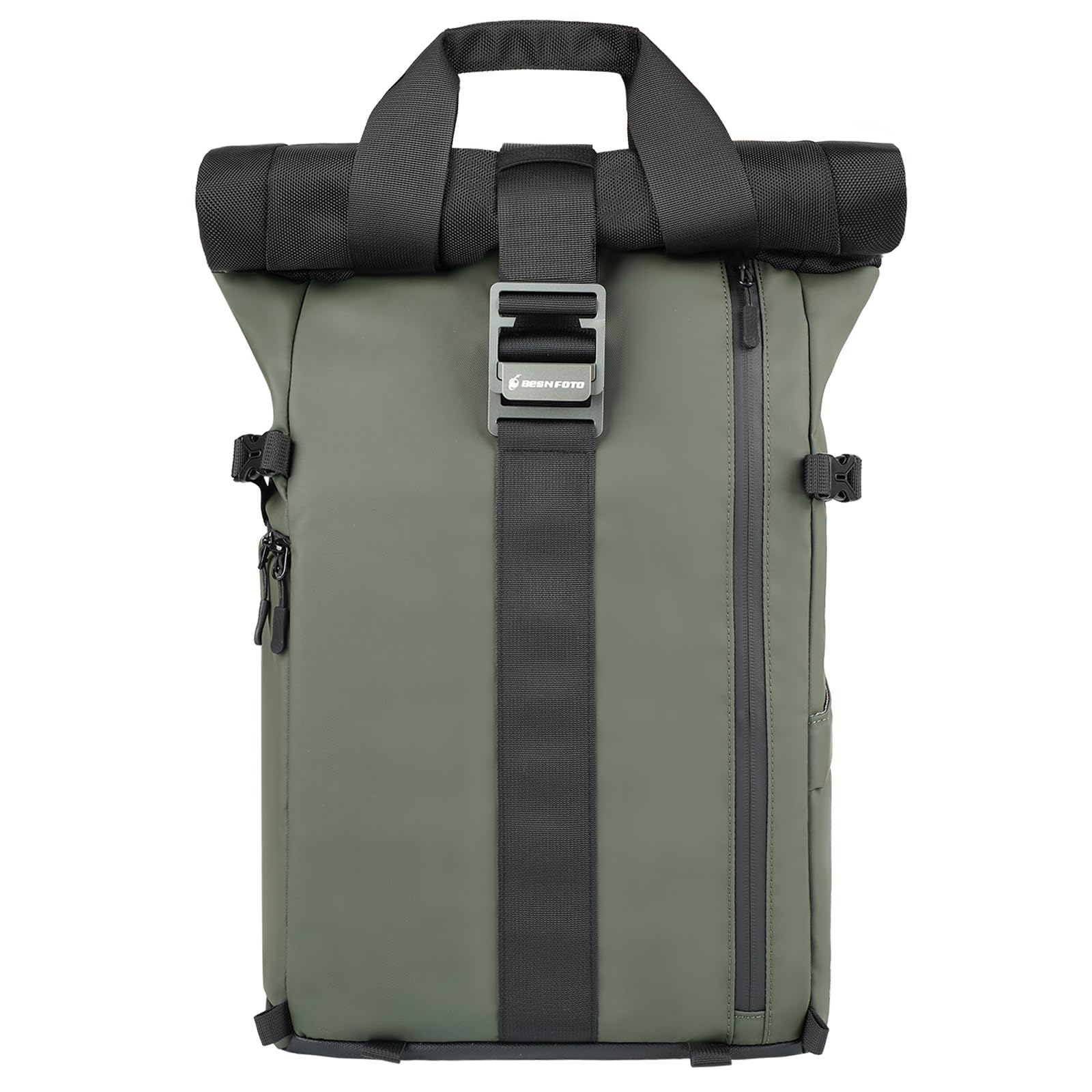
The Besnfoto Roll Top proves that a budget-friendly pack can still deliver serious hiking utility. The exterior is made from water-repellent tarpaulin nylon that wipes clean easily, and the included rain cover adds another layer for downpours. The roll-top closure adds 4-6L of variable space for a sweater, jacket, or extra water, and the zipper-sealed roll section keeps it secure even when fully expanded.
Inside, seven removable padded dividers allow deep customization, and the camera compartment is spacious enough for a DSLR with a battery grip plus three lenses or a drone with its controller. The side tripod holder uses sturdy straps, and the front accessory loops can carry a longboard, yoga mat, or camp chair. The padded shoulder straps are 2.95” wide with a breathable back panel, and the waist belt helps stabilize the load on uneven terrain.
Some users report that after 3+ years of daily use, the Velcro handles lose rigidity and some mesh pockets show wear — but for the price, the durability is impressive. The camera insert sits deep in the bag, requiring a small filler item to prevent gear from rattling if the bag isn’t full. For hikers who need a rugged, weatherproof pack without a premium investment, the Besnfoto offers insane bang for the buck, especially with the roll-top expansion.
Why it’s great
- Waterproof tarpaulin exterior with rain cover
- Roll-top adds 4-6L variable space
- 7 removable dividers for deep customization
Good to know
- Velcro handles may lose rigidity over years
- Camera compartment deep, needs filler
- Not theft-deterrent with front accessory loops
7. RaLeno Camera Backpack 22L+5L

The RaLeno Camera Backpack is the budget-conscious entry point that doesn’t cut corners on the features that matter most on the trail. Starting at 22L and expanding to 27L via a front zipper, it fits a DSLR, 3-5 lenses, and a DJI drone without breaking a sweat. The rigid-shell front and anti-slip bottom pads provide impact protection that rivals packs at twice the price, and the high-density waterproof fabric with sealed zippers keeps gear dry in sustained rain.
The dual quick-access system is the standout feature: a side-access door lets you snatch your camera without removing the pack, and a front essentials pocket makes grabbing a phone or passport instant. The upgraded EVA padding dividers are lint-free and include 3 fixed straps plus 8 total dividers for infinite layout options. The S-shaped shoulder straps with an adjustable chest buckle and 3D air-mesh back panel provide genuine comfort for all-day wear, and the luggage strap makes airport transit painless.
The triangular shape wastes some internal volume when packing rectangular gear — you’ll lose a few liters of efficiency compared to a boxier design. The laptop compartment for a 15” MacBook feels thin when the bag is stuffed, potentially putting tension on the screen. For photographers assembling their first dedicated hiking camera kit on a tight budget, the RaLeno delivers a remarkable quality-to-price ratio that punches well above its tier.
Why it’s great
- Dual front and side quick-access openings
- Rigid-shell front and anti-slip bottom pads
- 27L expandable capacity from 22L base
Good to know
- Triangular shape wastes space with rectangular gear
- Laptop compartment feels thin when fully loaded
- Tripod straps have questionable bottom stitching
FAQ
Is a rear-panel access bag safer than a top-loading bag for hiking?
What is the maximum comfortable weight for a camera hiking backpack?
Should I prioritize a dedicated tripod holder or external lashing loops?
Final Thoughts: The Verdict
For most users, the backpack for camera and hiking winner is the PGYTECH OneMo 2 25L-33L because it marries a massive 38L total capacity with a comfortable hiking harness and smart organizational features like battery sliders and a detachable child bag. If you need a true hiking-first pack with a removable hip belt and drone storage, grab the Thule Aspect DSLR. And for the budget-conscious trail shooter who refuses to compromise on weather protection or expansion, nothing beats the Besnfoto Roll Top.