
A poorly fitted hiking backpack can turn an epic trail into a painful ordeal, shifting every pound of gear directly onto your shoulders and lower back. The difference between a rewarding summit and a miserable trudge often comes down to one decision: the pack’s suspension system and how it transfers weight to your hips.
I’m Min — the co-founder and writer behind Gadgets Feed. I’ve spent countless hours analyzing internal frame designs, load lifter angles, and hip belt padding geometries to separate marketing fluff from real trail performance.
Whether you’re planning a weekend expedition or a week-long trek, finding the right best backpack for hiking and camping depends on matching pack volume, frame rigidity, and torso adjustability to your specific build and load.
How To Choose The Best Backpack For Hiking And Camping
Selecting the right pack is about more than just capacity—fit and suspension are the real differentiators. A 65L pack with a poor frame will feel heavier than a 50L pack with proper load transfer. Prioritize torso adjustability, hip belt quality, and frame rigidity before volume.
Torso Length & Hip Belt Fit
The most common mistake is buying a pack based on height alone. Torso length—measured from the C7 vertebra to your iliac crest—determines where the hip belt sits. A belt that rides too low forces weight onto your shoulders; one that sits too high chafes your ribs. Look for packs with adjustable torso systems, typically ranging from 16 to 22 inches.
Volume & Trip Duration
Overnight trips generally need 40-50L of volume, while multi-day treks require 55-75L. A 44L pack is ideal for fast-and-light weekend missions, but a 65L pack offers flexibility for longer expeditions, especially when carrying bulky gear like a tent or sleeping bag. Remember that a pack with expansion capability—like a floating lid or extension collar—adds versatility without locking you into a single size.
Suspension & Ventilation
The frame transfers load from the pack to your hips. Tensioned mesh back panels (like Osprey’s AirSpeed) keep your back dry by creating an air gap, while foam contact panels (like Deuter’s Aircontact) offer more direct load transfer. For heavy loads over rough terrain, a stiffer frame with load lifter straps is essential to keep the pack stable and prevent sway.
Quick Comparison
On smaller screens, swipe sideways to see the full table.
| Model | Category | Best For | Key Spec | Amazon |
|---|---|---|---|---|
| Osprey Stratos 44L | Premium | Vented day & weekend hikes | 3.64 lb / AirSpeed mesh back | Amazon |
| Deuter Aircontact Lite 50+10 | Premium | Long-distance lightweight trekking | 3.6 lb / Vari Quick adjust | Amazon |
| Deuter Futura Air Trek 60+10 | Premium | Ventilated multi-day trips | Aircomfort mesh / spring steel frame | Amazon |
| Osprey Rook 65L | Mid-Range | Balanced all-rounder | 3.7 lb / AirSpeed suspension | Amazon |
| Teton 65L Explorer | Mid-Range | Entry-level multi-day comfort | Multi-position torso / foam lumbar | Amazon |
| Mardingtop 65L+10L | Budget | Modular military-style builds | MOLLE webbing / removable pouches | Amazon |
| Mardingtop 60L Military | Budget | Value-focused beginners | YKK zippers / expandable to 75L | Amazon |
In‑Depth Reviews
1. Osprey Stratos 44L Men’s Hiking Backpack
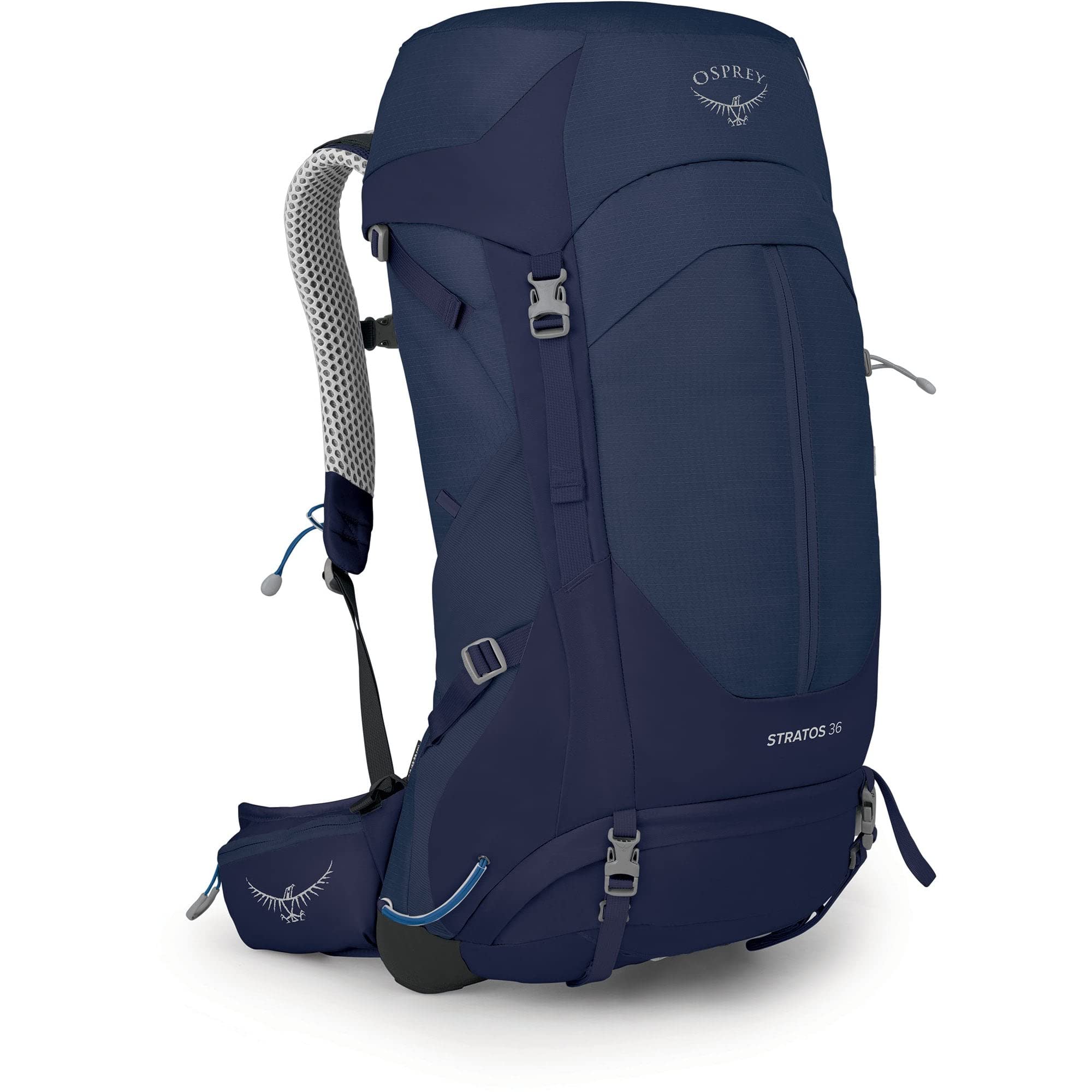
The Stratos 44L strikes an almost perfect balance between ventilation and load control. Its tensioned AirSpeed mesh back panel creates a significant air gap, which keeps your back noticeably drier compared to foam-contact designs. The adjustable injection-molded suspension extends the torso fit range, accommodating taller hikers who often struggle with medium-frame packs.
At 3.64 pounds, this pack is lightweight enough for fast day hikes yet spacious enough for a three-season weekend. The integrated rain cover stows neatly in its own pocket, and the top-loading design with a drawcord closure keeps the main compartment secure. Hip belt pockets are wide enough for a smartphone, and the dual ice-axe loops handle trekking poles cleanly.
Where the Stratos truly shines is on warm-weather routes where sweat management is critical. The rigid frame does limit how much you can overstuff it—this is a pack designed for disciplined packing rather than brute-force volume. For hikers who prioritize a dry back and a stable, adjustable fit, this is the premium pick to beat.
Why it’s great
- Outstanding AirSpeed ventilation reduces back sweat significantly
- Adjustable torso fits a wide range of body types
- Included rain cover is integrated and easy to deploy
Good to know
- Rigid frame prevents overstuffing; not for bulk gear
- 44L is tight for multi-week trips without ultralight gear
2. Deuter Aircontact Lite 50 + 10L Backpack
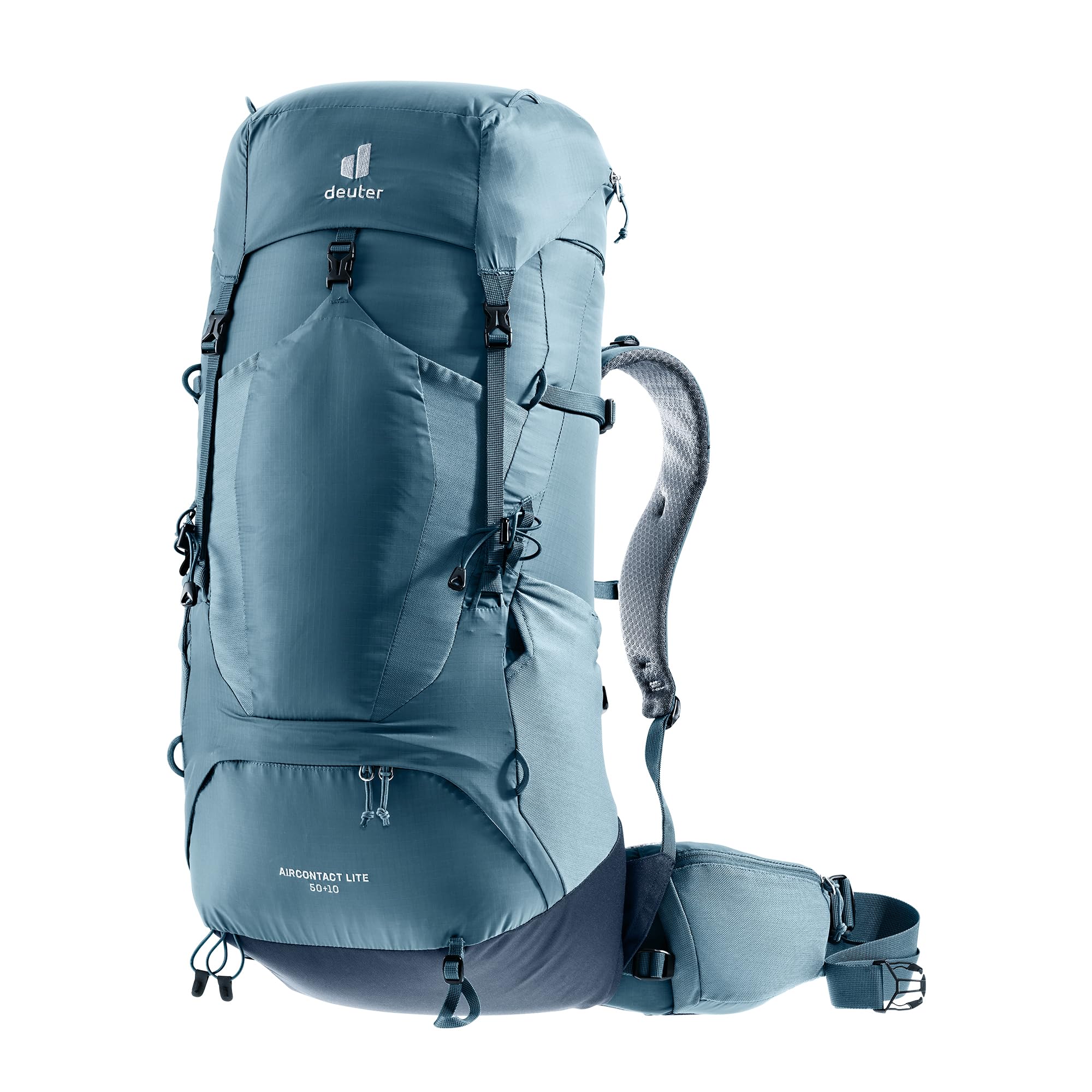
Deuter’s Aircontact Lite system uses hollow-chamber foam that breathes through a pumping effect created with every stride, rather than relying on a simple mesh overlay. This design keeps the load close to your center of gravity, which translates to better balance on uneven terrain. The Vari Quick adjustment mechanism allows rapid changes to effective back length without removing the pack.
The 50+10L capacity—a fixed main body with a height-adjustable lid that expands—offers genuine versatility for trips ranging from three days to a full week. The lightweight X-frame provides surprisingly good load transfer up to about 40 pounds, and the removable lid can be converted into a summit pack. Four compression straps on each side keep the load stable even when the pack isn’t full.
It’s worth noting that this pack does not include a rain cover, which is an odd omission at this price point. The hip fins are ergonomically shaped and padded, though the pull-forward system takes a few uses to master. Long-distance hikers who value light weight and a body-hugging fit over maximum ventilation will find this pack hard to beat.
Why it’s great
- Vari Quick torso adjustment works easily and stays put
- Hollow-chamber foam back panel breathes during active motion
- Expandable lid adds 10L without adding frame weight
Good to know
- No rain cover included at this premium price point
- Pull-forward hip fin adjusters take practice to tighten evenly
3. Deuter Futura Air Trek 60 + 10 Backpack

If your priority is keeping your back bone-dry on hot, sweaty ascents, the Futura Air Trek’s Aircomfort suspension is the gold standard among premium packs. The tensioned mesh sits several inches off your back, creating a continuous channel for airflow. The permanently elastic spring steel frame provides enough structure to handle heavy loads without the rigidity that limits packability.
With a 60+10L volume, this pack is built for serious multi-day backcountry trips. The VariSlide system allows precise torso length adjustment, and the pivoting shoulder straps adapt naturally to the width and angle of your shoulders. The separate bottom compartment with its own zippered access makes organizing a sleeping bag easy, and the front stash pocket is ideal for a wet jacket or shelter.
At a medium weight class, this pack is not the lightest option on the list, but it’s built to survive years of hard use. The bellows side pockets expand to fit 1L water bottles securely, and the load lifter straps integrate smoothly with the frame. Users with broad shoulders and taller torsos consistently report excellent fit without pressure points.
Why it’s great
- Aircomfort mesh creates maximum back ventilation
- Spring steel frame provides durable structure without excess weight
- Separate bottom compartment with zipper access for sleeping bag
Good to know
- Medium weight class; lighter options exist for ultralight trips
- Bellows side pockets are stiff when new
4. Osprey Rook 65L Men’s Backpacking Backpack

The Rook 65L brings Osprey’s renowned AirSpeed suspension to a mid-tier price point without cutting corners on the frame. The tensioned mesh back panel and LightWire frame work together to keep weight off your shoulders and transfer it efficiently to the hip belt. At 3.7 pounds, it’s impressively light for a 65-liter pack, making it a strong contender for anyone who wants one pack to do everything from weekend trips to week-long treks.
Angled water bottle pockets allow for one-handed access while walking, and the zippered sleeping bag compartment with a floating divider keeps your gear organized. The integrated rain cover stows in its own dedicated pocket, so you never have to scramble for it in sudden downpours. The Rook is also Daylite compatible, meaning you can attach Osprey’s smaller daypack for summit scrambles.
The trade-off for the competitive price is a simpler feature set—there’s no outer mesh pocket or rear access panel. The hip belt, while padded, is less sculpted than the high-end Osprey models. Still, for hikers who prioritize a ventilated back panel and a proven suspension system without spending top dollar, the Rook delivers exceptional performance per pound.
Why it’s great
- AirSpeed suspension keeps back dry at a mid-range price
- Lightweight for its 65L capacity at just 3.7 lb
- Integrated rain cover with dedicated stow pocket
Good to know
- No external mesh pocket for wet gear
- Hip belt padding is less contoured than premium Osprey models
5. Teton 65L Explorer Internal Frame Backpack
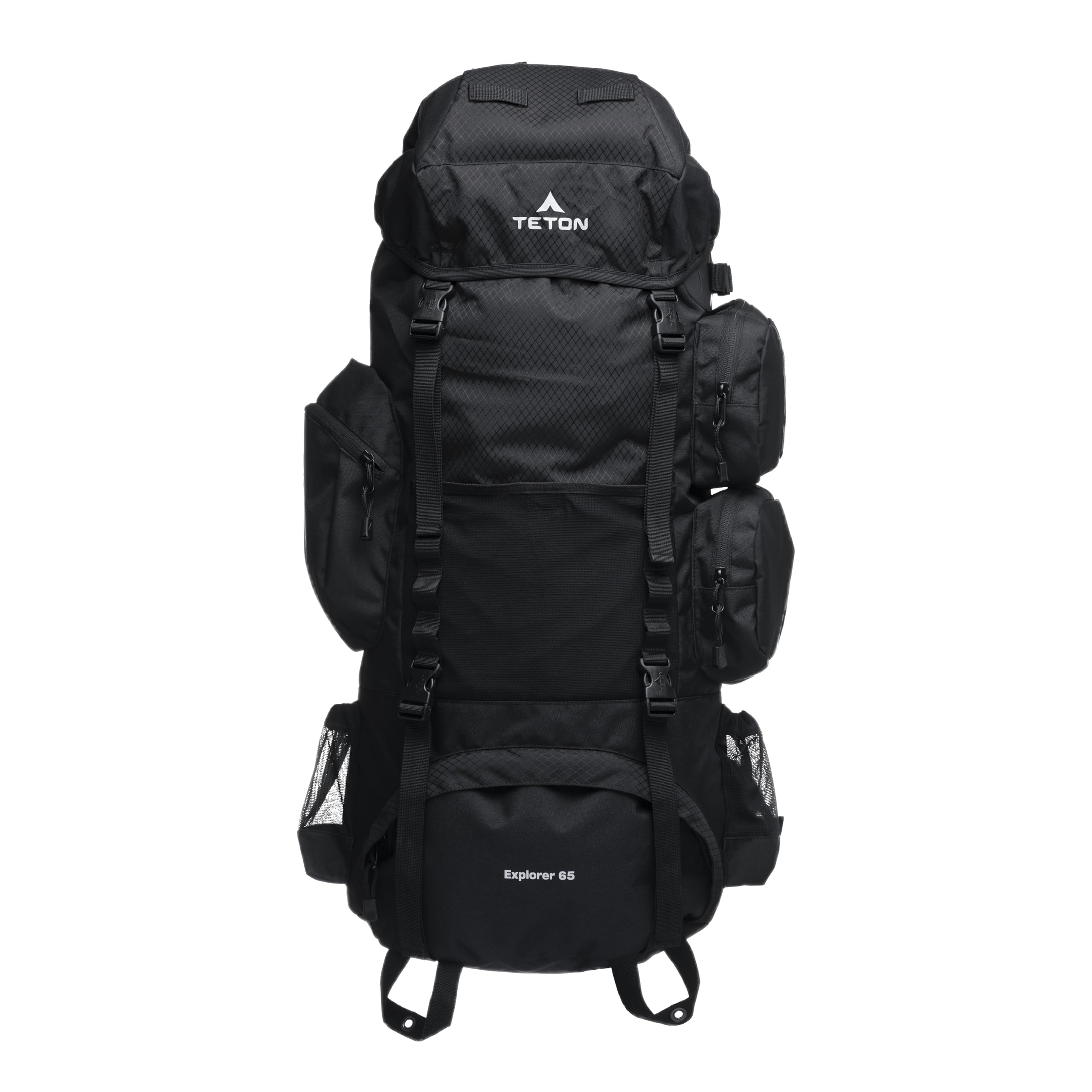
The Teton Explorer is the pack that proves you don’t need a premium budget to get a comfortable, fully featured multi-day backpack. Its multi-position torso adjustment system uses a ladder-style mechanism that accommodates medium and tall hikers effectively, and the open-cell foam lumbar pad provides solid cushioning for loads up to about 40 pounds. The 65L main compartment plus a large sleeping bag section give you ample room for a tent, pad, and bag.
What really sets this pack apart at its tier is the sheer number of thoughtful inclusions: an integrated rain cover, multi-directional compression straps, and spacious external pockets. The side mesh pockets are the main limitation—they are too small for standard 32 oz Nalgene bottles. Hikers who carry wide water bottles may need to swap them for slim 16 oz alternatives or bladders.
The 600D polyurethane lining resists abrasion well, and the stitching across the major seams is clean and consistent. While the zippers can feel slightly stiff when new, they loosen up after a few trips. For beginners or occasional backpackers who want a reliable, comfortable pack without over-investing, the Explorer is a standout choice.
Why it’s great
- Adjustable torso fits medium to tall hikers effectively
- Integrated rain cover and multiple compression straps included
- Durable 600D polyurethane lining resists trail abrasion
Good to know
- Side mesh pockets are too small for wide water bottles
- Zippers can feel stiff during initial break-in period
6. Mardingtop 65L+10L Internal Frame Backpack
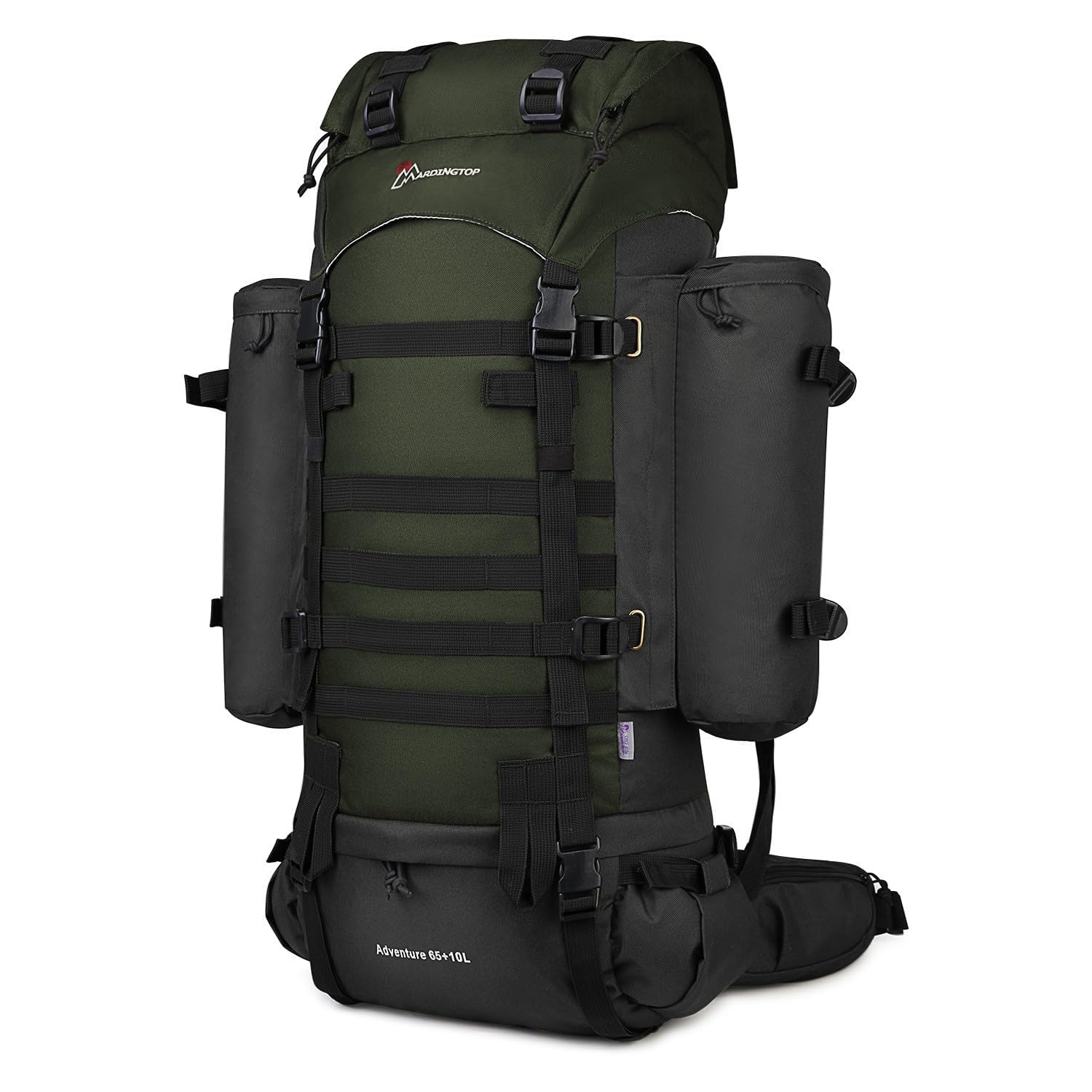
The Mardingtop 65L+10L pack takes a military-style approach to budget hiking gear, offering a modular platform with PALS webbing that lets you attach pouches and accessories. The main body uses a heavy-duty fabric that feels more substantial than its price suggests, and the internal drawstring compartment helps organize loose gear. The removable side pouches attach via Velcro, zippers, and strap loops—a triple-secure system that prevents loss on rough trails.
Durability is the strong suit here: several users report five years of heavy use with no structural failures. The rain cover is included and works well, though the elastic edge tends to loosen over time. The waist belt, while functional, lacks the padding density of mid-range packs, so loads above 40 pounds will cause chafing on longer distances. The shoulder straps also tend to slip under extreme weight, requiring periodic readjustment.
For hikers who like to customize their carry system—adding extra pouches for electronics, tools, or first-aid kits—the MOLLE grid is genuinely useful. The 65L main volume expands to 75L with the extension collar, giving you room for bulky winter gear. Just be realistic about the load limit: this pack is best suited for loads under 50 pounds over moderate terrain.
Why it’s great
- Full MOLLE platform allows extensive modular customization
- Triple-secured side pouches (Velcro, zipper, strap)
- Expandable from 65L to 75L for winter gear
Good to know
- Hip belt lacks padding density for loads over 40 lb
- Shoulder straps tend to slip under heavy weight
7. Mardingtop 60L Military Internal Frame Backpack
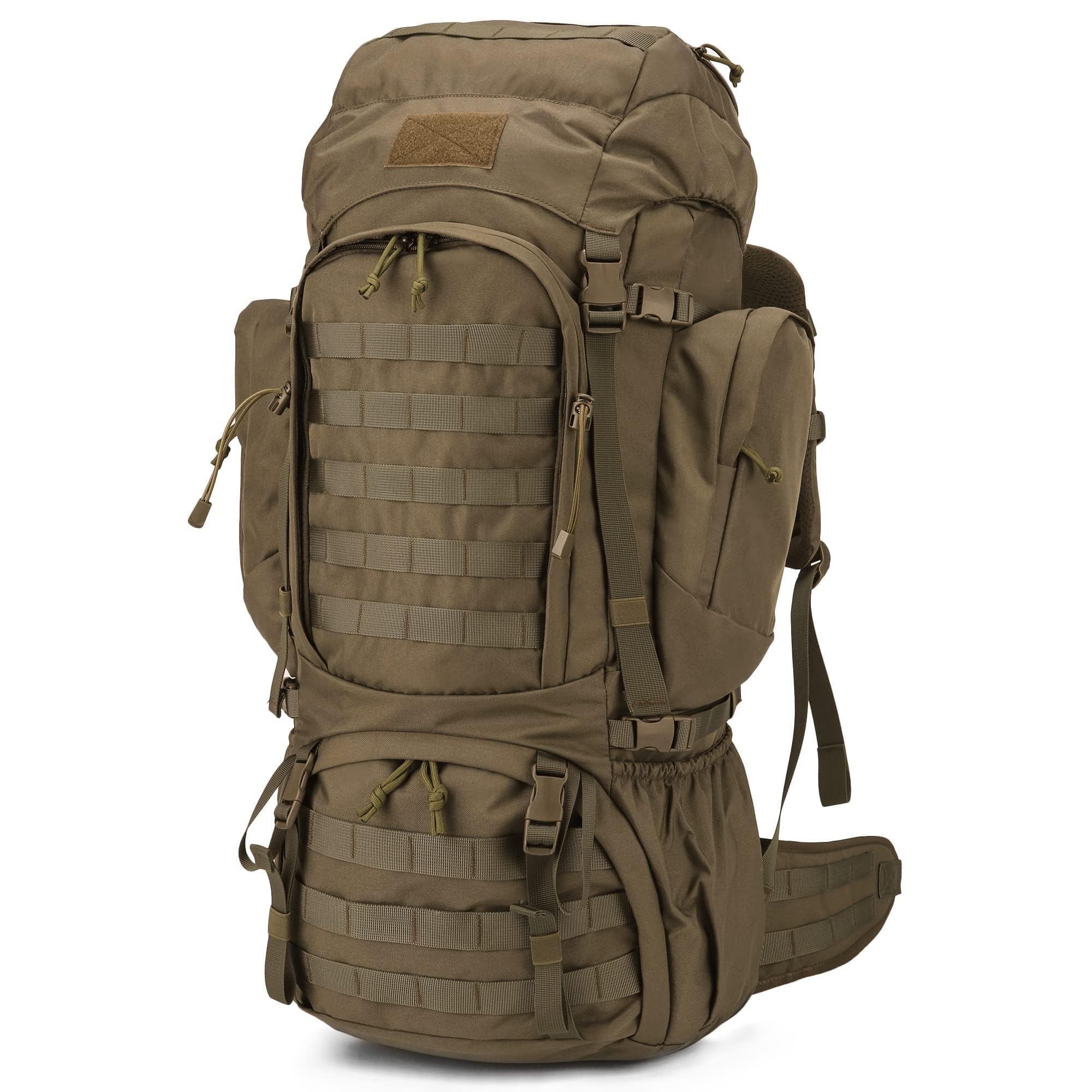
The Mardingtop 60L Military pack is the definition of value engineering done right. It uses genuine YKK zippers across all compartments—a detail that immediately sets it apart from other entry-level packs where zippers are the first failure point. The 60L main body can expand to 75L using the extension collar, and the integrated MOLLE system provides attachment points for add-on pouches. The material strikes a smart balance between lightweight carry and tear resistance, using a 600D-grade fabric that won’t add unnecessary ounces.
Organization is surprisingly good for the price: the main compartment has an internal drawstring closure, a dedicated hydration sleeve, and a sleeping bag compartment with a divider. The rain cover is included and comes with four tie-down loops, though the elastic hem is thin and may need reinforcement over time. The hip belt is the pack’s weakest link—it lacks foam density and can cause chafing on long days with loads above 45 pounds.
Where this pack really wins is for beginners or budget-conscious hikers who need a reliable, feature-rich platform for moderate loads. The MOLLE system allows future upgrades—you can add padded hip belt pouches or shoulder strap pockets as needed. For short woodland trips or weekend outings where weight stays under 50 pounds, this is the most cost-effective durable option available.
Why it’s great
- Genuine YKK zippers provide reliable, long-lasting closure
- Expandable from 60L to 75L for flexible packing
- MOLLE webbing allows future customization and upgrades
Good to know
- Hip belt padding is thin and may cause chafing at high loads
- Rain cover elastic hem is cheap and may loosen early
FAQ
What size backpack do I need for a 3-day hiking trip?
How do I measure my torso length for a backpack?
Should I get a pack with a separate sleeping bag compartment?
Is a built-in rain cover necessary for a hiking backpack?
Why do some backpacking packs come without a frame?
Final Thoughts: The Verdict
For most users, the best backpack for hiking and camping winner is the Osprey Stratos 44L because it combines exceptional back ventilation with a precise, adjustable fit that works for a wide range of torsos and trip lengths. If you need the extra volume for multi-day expeditions without sacrificing ventilation, grab the Deuter Futura Air Trek 60+10. And for the budget-conscious hiker who wants reliable YKK zippers and a modular platform, nothing beats the Mardingtop 60L Military.