
Our readers keep the lights on and my morning glass full of iced black tea. As an Amazon Associate, I earn from qualifying purchases.
Specs are compiled from manufacturer listings and verified buyer reviews and can change over time — please confirm the key details on the product page before buying.
You need to clear a downed limb on the trail, process firewood at camp, or trim branches on a bushcraft outing — and you want a tool that fits inside a pack without rattling against everything else. A good backpack saw turns a ten-minute chore into a quick, clean cut, unlike a hatchet. This guide reviews nine top backpack saws, from ultra-light pocket chain saws to heavy-duty folding blades for four-inch logs, to help you choose the right one.
I’m Min — the founder and writer behind Gadgets Feed. This guide is built by comparing the manufacturers’ published specifications and the patterns across verified customer reviews, so you get each pick’s real strengths and trade-offs instead of marketing spin.
Whether you are a weekend hiker, a hardcore bushcrafter, or a hunter who needs to break down game in the field, the right backpack saw will make every cut feel easy while saving precious space and weight in your gear. The crowd favorite, a tiny Japanese-made pull saw with a near-perfect rating, packs impressive performance into eight ounces.
Our Picks at a Glance


How To Choose The Best Backpack Saw
Choosing the right backpack saw depends on what you cut, how far you carry it, and how often you want to sharpen the blade. A heavy bow saw is overkill for clearing wrist-thick branches on a day hike, while a tiny pocket saw will frustrate you when breaking down a season’s firewood. Here is what to look for.
Blade Length and Cut Capacity
Blade length directly determines the thickest branch or log you can slice through. A saw with a 4.4-inch blade is great for small limbs and processing game, while a 15-inch blade handles logs up to four or five inches in diameter. Shorter blades pack smaller and weigh less — fine for trail clearing — while longer blades give you real firewood power at camp. Match the length to the wood you actually encounter, not the hypothetical monster log.
Tooth Design and Cutting Direction
Most folding backpack saws use a pull-cut stroke — the teeth are angled to bite only when you pull, not when you push. This keeps the blade under tension and prevents buckling, especially with thin blades. Pay attention to the teeth per inch (TPI): 7 TPI is aggressive for green wood and fast cuts, while finer teeth (8 or more TPI) leave a smoother finish but cut slower. Some saws like the Bahco cut on both strokes, which can speed up work on wrist-sized wood.
Weight and Packability
Every ounce counts in a backpack. A lightweight folding saw can be as light as 2.5 ounces or as heavy as 16 ounces for a full-size model with a rubber handle. Pocket chain saws pack into a tiny pouch but require two hands and a bit of technique. Folding bow saws offer the best of both worlds — a rigid frame that folds flat — but they are heavier. Decide whether you prioritize a featherlight addition to an emergency kit or a tool you will use daily at a base camp.
Quick Comparison
| Model | Best For | Blade Length | Weight | Cut Capacity | Amazon |
|---|---|---|---|---|---|
| Silky PocketBoy 130mm★ Best Overall | Trail maintenance & pack camping | 5 inches | 8 oz | 2.6 inches | Amazon |
| SOG Folding SawBest Value | Budget backpacking | 7.5 inches | 5.9 oz | 5 inches+ | Amazon |
| Outdoor Edge Flip N’ ZipBest for Hunting | Hunting & game processing | 4.4 inches | 2.5 oz | Bone & small wood | Amazon |
| Craft911 Folding Camping Saw | Heavy-duty pruning & bushcraft | 14 inches | — | 4 inches+ | Amazon |
| CAMPNDOOR Pocket Chainsaw | Emergency survival & firewood | 36 inches | 8 oz | 10-12 inches | Amazon |
| Bahco Laplander 396 | Bushcraft & classic camping | 7.5 inches | 7.76 oz | 4 inches | Amazon |
| Sven-Saw 15″ Folding Saw | Camp firewood processing | 15 inches | 10.6 oz | 4-5 inches | Amazon |
| Gerber Freescape Camp Saw | Compact all-around camp saw | 12 inches | 16 oz | 6 inches | Amazon |
| Silky Gomboy 240mm Outback | Premium bushcraft & trail work | 9.5 inches | 10.08 oz | 4.7 inches | Amazon |
In‑Depth Reviews
1. Silky PocketBoy 130mm Curved Blade
Our pick — over 4.5★ from 800+ verified ratings; the strongest balance of quality and price.
A 5.1-inch pull saw that punches well above its tiny size.
This saw earns its top spot for its cutting speed. The curved blade uses pull-cut technology — you only cut when you pull, not when you push — That 5-inch (130mm) blade with 6.8 teeth per inch and a 1.4mm thickness can slice through branches up to 2.6 inches thick without binding. The secret is impulse hardening, a process that heats and instantly hardens each tooth, keeping them sharp longer than non-hardened teeth. The result is a saw that buyers call “light weight and short, but solid” — a tool that vanishes into a cargo pocket yet handles years of work in tropical rainforests without rusting.
At 8 ounces, the PocketBoy is heavier than the lighter folding saws in this list, but the weight comes from a genuinely overbuilt feel. Owners have used it hard for years and report it simply does not rust and stays sharp. The hard plastic belt case keeps the blade safe in your pack. The consensus is that quality and cutting performance are the top reasons to buy this — and after thousands of happy owners, it is easy to see why.
compact curved blade
- Fastest cutting speed among comparable pocket saws — the curved pull blade makes short work of 2-inch branches
- Impulse-hardened teeth stay sharp longer than standard blades, meaning fewer sharpenings on long trips
- Compact dimensions (7″ x 2.2″ x 0.98″H) slide into a cargo pocket or pack side pocket easily
small grip
- Cut capacity limited to 2.6 inches — not for splitting firewood logs or large diameter branches
- Price is higher than many budget saws, and the value-for-money aspect is considered mixed by some buyers
pocket-friendly: you want the fastest, most reliable pocket saw for trail clearing, camp chores, and pruning — and you value a tool that simply works every time for years.
limited reach: you need to cut logs larger than 2.5 inches in diameter or you are on a strict budget; a larger folding saw or pocket chain saw will serve you better.
2. SOG Knives Folding Saw
A 7.5-inch blade that cuts through roots and 4-inch trees with surprisingly little effort.
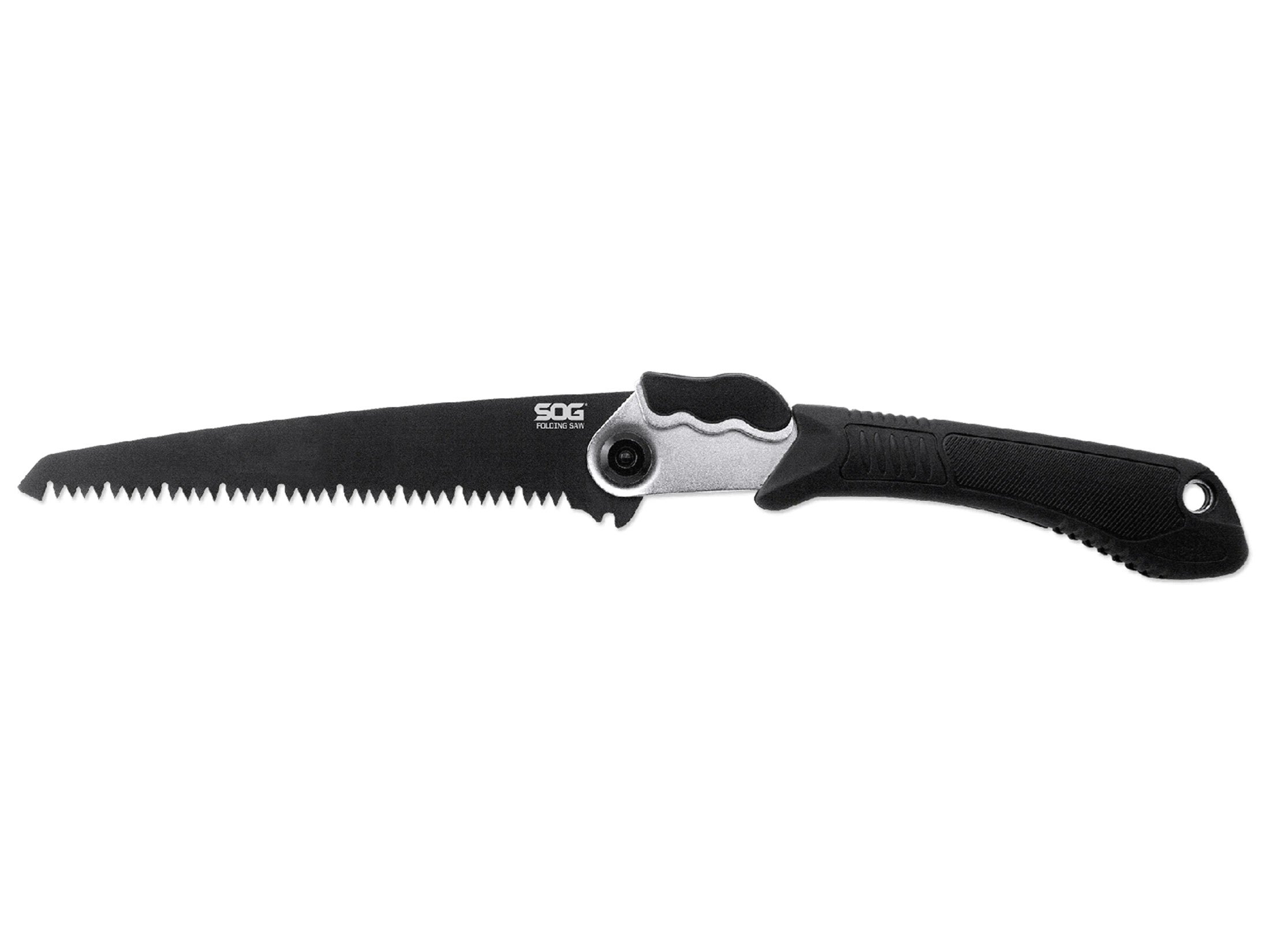
The SOG Folding Saw is the budget-friendly workhorse of this list. At 7.5 inches of blade length, it is compared to the Outdoor Edge Flip N’ Zip’s 4.4 inches, giving you serious reach for thicker limbs and logs without a huge weight penalty — it weighs only 5.9 ounces. The high carbon steel blade is differentially tempered (hardened at the teeth, softer in the body for flexibility) and coated with black powder for rust resistance. The total length when open is 17.25 inches, which gives you good leverage. Reviewers report it cuts through roots and 4-inch trees with minimal effort, and the soft TPR (thermoplastic rubber) handle stays comfortable during longer sawing sessions.
The catch is the blade locking mechanism. While portability and sharpness get the most praise, blade locking is a mixed topic — some owners find the lock works well, but others report it does not stay locked reliably, and the rubber on the lock can come unglued. The blade quality is also mixed: many find it sharp and effective, while a smaller group note it feels cheap and the thin blade can bend or snap if abused. For the price, you get a lot of saw for your money, and it is easily among the most popular budget picks in the category by sheer volume.
locking blade safety: the hiker or camper who wants a full-size 7.5-inch blade at a low cost and is willing to check the locking mechanism occasionally. Not for someone who needs bombproof construction and will saw hard against the grain every day.
3. Outdoor Edge Flip N’ Zip Saw
A 4.4-inch saw that weighs next to nothing but tears through bone and wood.
At just 2.5 ounces and with a compact folded size of 4.72 x 3.94 x 2.76 inches, the Outdoor Edge Flip N’ Zip is one of the lightest and most packable saws in this lineup. The 4.4-inch 65Mn spring-steel blade uses a triple-ground tooth pattern designed to cut aggressively through bone, wood, and tough hide. The 6061-T6 aluminum handle is anodized bright orange for visibility (hard to lose) and textured for grip even in wet conditions. The lock-back safety mechanism holds the blade firmly during heavy sawing. Buyers report it is “sturdy, 70g (80g with case)” and cuts deer leg bone quickly after a short learning curve, making it a staple for elk hunters and anyone who processes game in the field.
The trade-off is that this saw is specialized: it is excellent for small limbs, saplings, and bone, but it is not for large trees or heavy firewood processing. The included nylon sheath is noted by some as flimsy compared to the saw itself. Durability also gets mixed feedback — a minority of owners have experienced it breaking under heavy use. But for its intended role (game processing and light brush clearing), it is a near-perfect tool that draws high marks across the board for quality and performance.
quick blade change: you hunt and need a compact bone saw that disappears in a pack, or you want the absolute lightest saw for minimal-impact trail work. short handle: you plan to cut lots of firewood or thick logs — the 4.4-inch blade will frustrate you on anything over 3 inches.
4. Craft911 Folding Camping Saw 14-Inch
A 14-inch heavy-duty saw for the bushcrafter who needs real cutting power.
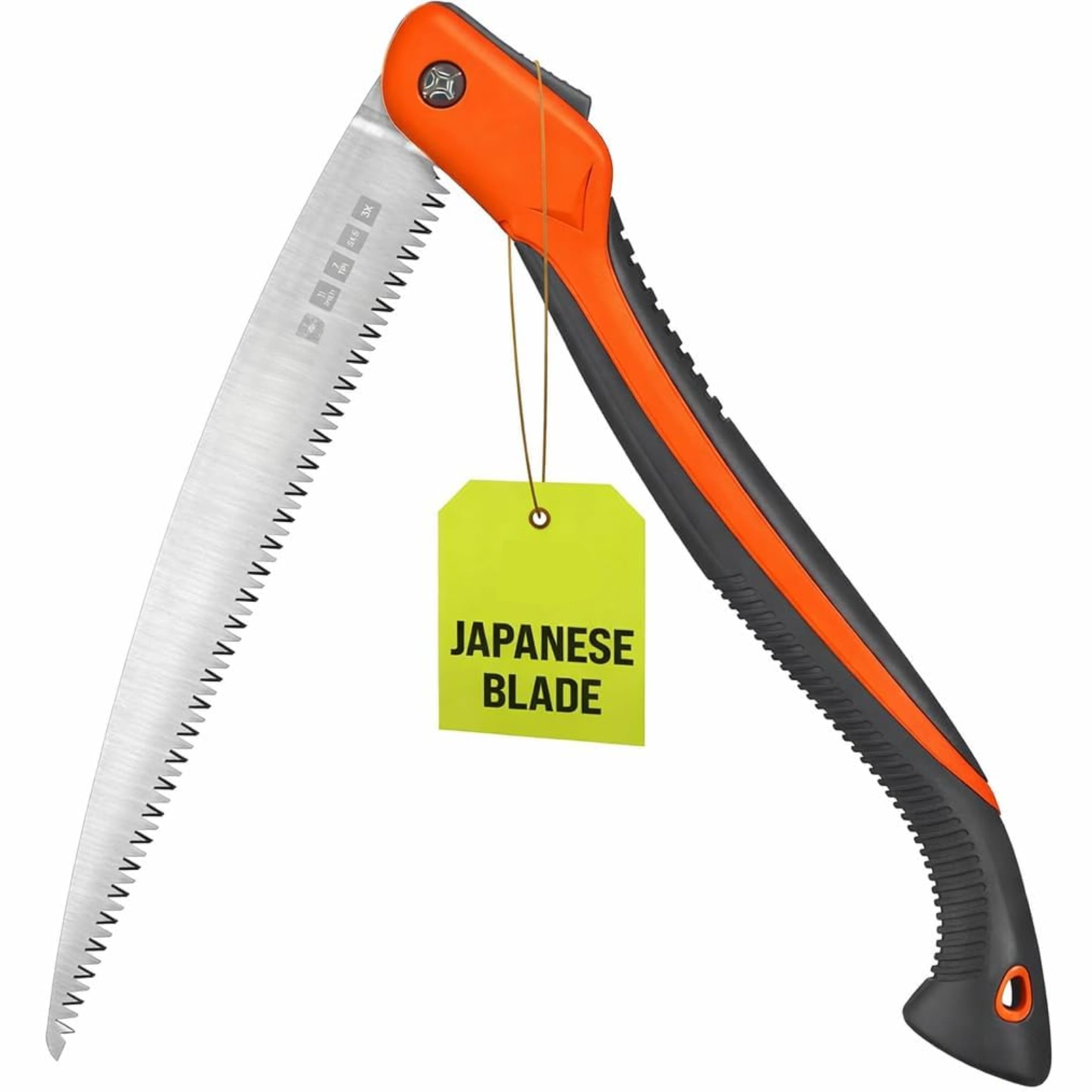
This saw brings a 14-inch SK5 high-carbon steel blade with triple-cut razor teeth at 7 TPI (teeth per inch) to the party. The extra length gives you impressive leverage and cut capacity — owners say it handles limbs up to 4 inches in diameter cleanly. The ergonomic TPU (thermoplastic polyurethane) handle is non-slip and comfortable even during extended sessions, reducing hand fatigue. The folding design locks securely in place with a blade safety lock and open up button. When folded, the whole package measures 14.57 x 2.36 x 0.98 inches, which is not the most compact but still fits in a tool bag or backpack side pocket.
The recurring note from owners is that stiffness in the folding action can be a minor issue at first, and the blade may need more frequent sharpening than premium alternatives. There is also a mention that the blade can pinch inside the cut on thicker branches; it is best used on narrow or medium branches where you can open the kerf (the width of the cut) to prevent binding. For the price, you get a very capable saw that outperforms pricier rivals for tree trimming, bushcraft, and camping wood cutting.
long cutting stroke: the budget-minded bushcrafter or gardener who needs real 14-inch cutting power without spending premium money. heavy frame: ultralight backpackers — the 14-inch length and TPU handle add bulk and weight that a smaller folding saw avoids.
5. CAMPNDOOR Pocket Chainsaw

A 36-inch chain you pull by hand that cuts faster than most folding saws.
This is not a folding saw — it is a flexible 36-inch chain saw with two nylon handles that you pull back and forth by hand. The 65Mn manganese steel is tested to 4000 Newtons (the company claims only a 988+ pound person could break it), so it is extremely tough. The blade has 48 “Tiger Claw” teeth alternating with 48 “Clog-Clearing Bulldozer” teeth — a Faster Cut & Clear design that prevents binding. Owners say it cuts 4-8 inch dry limbs in under 30 seconds and is effective up to 10-12 inches. It coils into a tiny bundle that fits in a tactical belt pouch, making it the most packable option for serious cutting power. At 8 ounces, it matches the Silky PocketBoy for weight but offers far more cut capacity.
This saw requires two hands and a bit of technique — you need to saw from the lean side to avoid pinching the chain. It will not replace a folding saw for precise pruning, but for emergency firewood, trail clearing in the backcountry, or bikepacking where every cubic inch counts, it is tough to top. The storage bag and paracord handles are high quality, and the lifetime warranty backs it up. Performance and portability are the standout aspects that win owners over.
chain-style cutting: you need the maximum cutting capacity for the minimum pack space — this is the best emergency saw for survival kits and backcountry trips. awkward tension: you need a one-handed pruning tool for precise cuts; a folding saw is much easier to control for small branches.
6. Bahco Laplander 396

A 7.5-inch folding saw that cuts on both strokes — a classic bushcraft companion.
The Bahco Laplander is a time-tested design that bushcrafters have relied on for years. Its 7.5-inch high-speed steel blade is sharpened with 53 teeth (roughly 7 TPI) and cuts wood on both the forward and pull strokes — a distinct advantage over pull-only saws like the Silky PocketBoy, which only cuts on the pull. The two-component plastic handle has a leather strap for wrist security, and the lock engages both when open and closed (double lock-out and lock-in). It weighs about 7.76 ounces (0.22 kg), making it slightly heavier than the SOG but still very packable.
Owners rave about the durability — one accidentally left it outside under a bush for two months, and it looked brand new. The Laplander handles wrist-sized wood faster than an axe and is considered a classic addition to any bushcraft haversack. The locking system is simple and reliable. The main limitation is the 7.5-inch blade: it is fast for small to medium cutting but struggles with logs over 4 inches. For the price, it is among the most dependable tools in this list, with a rating that matches the Silky PocketBoy.
comfort hold: you want a proven classic for bushcraft and camping — the dual-stroke cutting speeds up work on wrist-sized wood and the build quality is legendary. thin steel: heavy firewood processing or anyone needing a blade longer than 7.5 inches.
7. Sven-Saw 15″ Folding Saw
A legendary 15-inch folding bow saw made in the USA for 60 years.
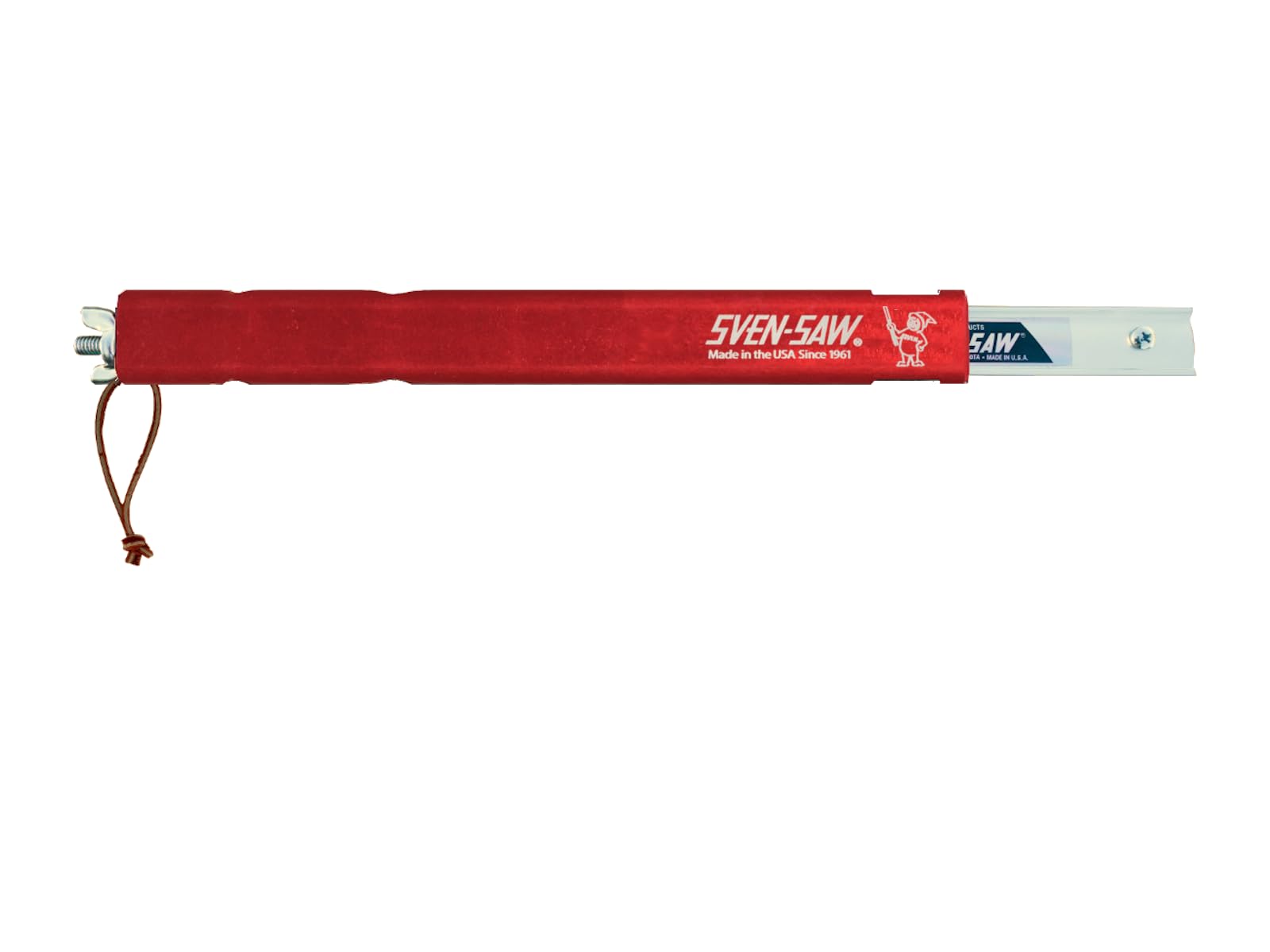
The Sven-Saw is the heavy hitter of this list. At 15 inches of blade and 10.6 ounces, it is designed to process camp firewood, not just clear trails. The all-metal construction uses a hardened steel blade and an aluminum alloy frame, all made in the United States for six decades. The bow design (blade tensioned by a wingnut) keeps the blade rigid for efficient cutting — owners say it slices through logs up to 4 or 5 inches in diameter like a light saber. When folded, the blade tucks into the protective frame, so it carries safely down to 17.38 x 1.5 x 0.62 inches. The high-visibility red color means you are less likely to leave it behind at camp.
The main drawbacks are that replacement blades cost nearly as much as a new saw, and the exposed metal tube ends can wear holes in a backpack over time — a protective sleeve is recommended. At 10.6 ounces, it is heavier than the 16-ounce Gerber below but carries lighter than many bow saws, thanks to the tubular frame. It is the go-to for anyone who spends real time at camp cutting firewood and wants a no-nonsense tool that will outlast them.
big cuts: you need to process firewood at camp regularly and want a lightweight, proven saw that takes up minimal space. pack space: you only need a trail-clearing tool for small branches — a 5-inch pocket saw is much more packable.
8. Gerber Freescape Camp Saw
A 12-inch bow saw that folds flat and fits in a 5.5-inch package.
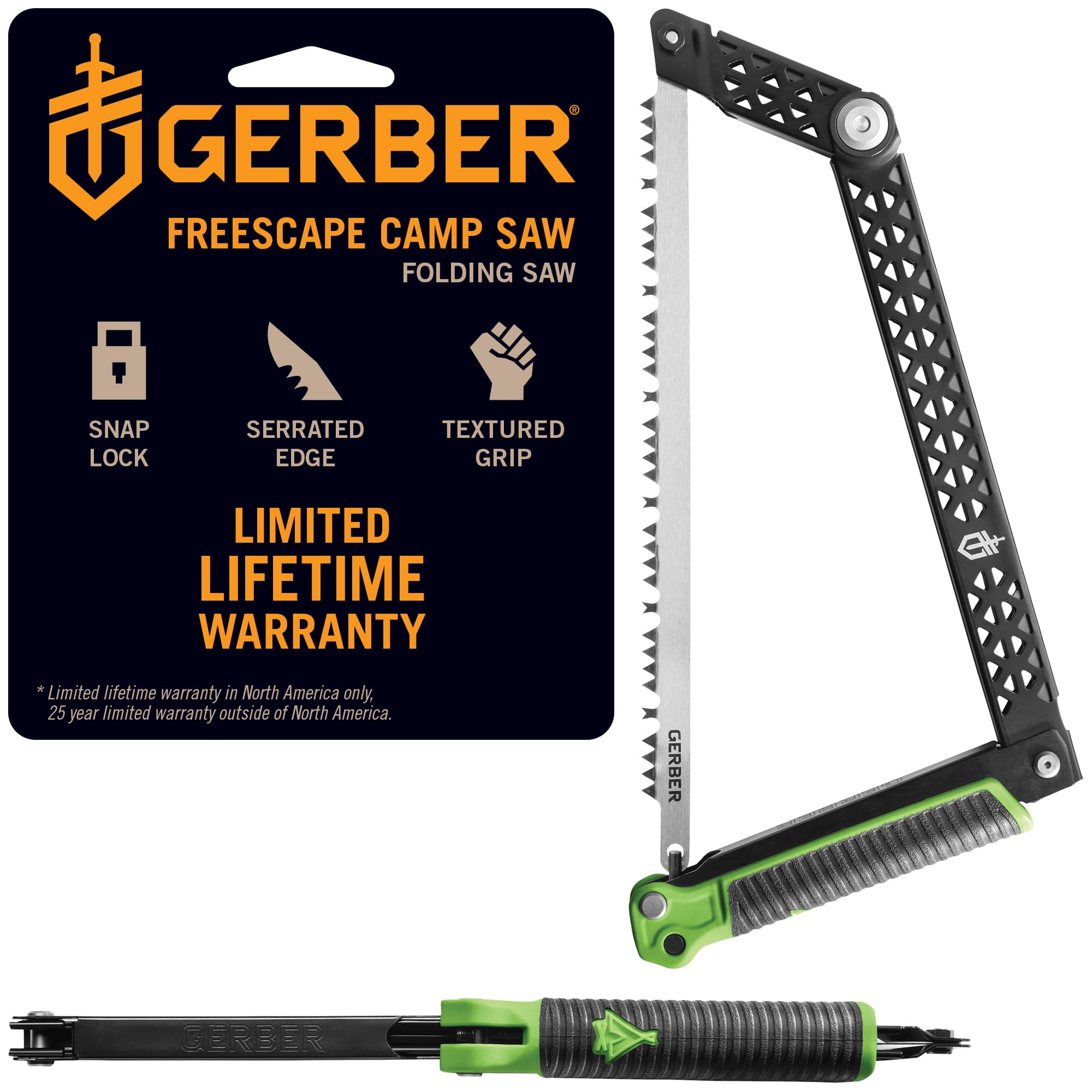
The Gerber Freescape solves a classic problem: bow saws are efficient but bulky. This design uses four pivot points so the 12-inch blade folds completely flat while staying assembled — no loose parts to lose. The folded dimensions are 5.5 x 1.2 x 17 inches, which slides into the side pocket of most backpacks. The textured rubber handle provides a secure grip even in wet conditions, and the bright green accents make it easy to spot among your gear. Owners say it cuts through 8-inch trees in roughly 7 minutes and handles tasks up to 6 inches in diameter without much effort.
At 16 ounces, this is the heaviest saw in the lineup. The design is clever but has some longevity concerns — the folding mechanism may wear over time, and some owners note the included blade has too few teeth per inch, making strokes feel high-effort compared to other bow saws. Still, Gerber quality is solid, and for a compact camp saw that disappears into a pack, it is one of the best compromises available. The portability and build quality win most owners over.
one-hand open: the backpacker who needs a real bow saw but cannot carry a full-size one. The fold-flat design stores better than any competing bow saw. blade wobble: ultralight hikers — 16 ounces is heavy, and the Sven-Saw offers more cutting length for 5 ounces less.
9. Silky Gomboy 240mm Outback Edition

A 9.5-inch premium pull saw that cuts 4.7-inch wood like hot knife through butter.
The Silky Gomboy is the bigger brother to the PocketBoy, and it brings serious cutting power to the premium end of the spectrum. The 240mm (9.5-inch) curved blade uses Japanese Mirai-Me cutting technology — four distinct cutting angles along the blade for rip-cutting, cross-cutting, and slant cutting that leave a smooth finish every time. The arbor composite handle is designed for excellent grip in wet, cold, and game-processing conditions, and the blade folds down safely for carry. Impulse hardening is applied here too, meaning the teeth last up to three times longer than non-hardened teeth. The cut capacity is 4.7 inches, so it handles everything from trail maintenance to camp firewood without breaking a sweat.
The price is the biggest hurdle — it is the most expensive saw in this list. While most owners find it worth the extra money, the value-for-money aspect is mixed, and a small number report the blade breaking under extreme use. The 10.08-ounce weight is reasonable for its length, and the custom carrying case is a nice touch. For anyone who wants the best possible folding saw and is willing to pay for it, the Gomboy is the top choice. As a reviewer said, “It’s a Silky. That says it all!”
smooth pull: you want a premium folding saw that can handle 4-inch-plus logs with the same silky speed as the PocketBoy handles 2-inch branches — the Gomboy is the definitive bushcraft companion.
budget strain: your budget stops below premium-tier pricing, or you only need to cut small wood and do not need the extra blade length.
Understanding the Specs
Pull-Cut vs Push-Cut
Most folding backpack saws (especially Japanese-designed ones like the Silky and Bahco) cut on the pull stroke. This means the teeth engage when you draw the blade toward you, not when you push it away. Pull-cutting keeps the thin blade under tension, which prevents buckling and allows for a thinner, sharper blade that slices faster. Push-cut saws (like some bow saws) cut on forward motion and can handle thicker blades but require more effort to keep the blade on track. For backpacking, pull-cut is almost always the preferred choice because it gives the fastest cut with the least effort and the lightest blade.
Tooth Geometry and TPI
Teeth per inch (TPI) tells you how aggressive the saw is. A lower TPI (like 5-7) means longer, more aggressive teeth that remove material fast — ideal for green wood and rough cuts. A higher TPI (8-10) gives a finer finish and is better for dry wood or precision work. Curved blades (like the Silky PocketBoy and Gomboy) typically cut faster than straight blades of the same TPI because the curve concentrates cutting pressure on fewer teeth. Triple-ground or “triple-cut” teeth (found on the Craft911 and Outdoor Edge) have three bevels for cutting on each stroke, offering a good balance of speed and finish for a backpack saw.
FAQ
What is the best blade length for a backpack saw?
How do I keep my folding saw sharp on the trail?
Can I use a backpack saw for processing game?
What is the weight difference between a pocket chain saw and a folding saw?
How do I prevent a folding saw from locking up or getting stuck?
Is a bow saw better than a folding saw for backpacking?
What does “impulse hardening” mean for a saw blade?
How do I safely store a folding backpack saw?
What is the difference between a “pocket” saw and a “backpack” saw?
Can I use a saw like the SOG Folding Saw for tree pruning at home?
Final Thoughts: The Verdict
For most buyers, the backpack saw winner is the Silky PocketBoy 130mm because it offers the fastest cutting speed in the most packable form, backed by impulse-hardened teeth that stay sharp three times longer than standard blades — all at 8 ounces with a near-perfect reputation. If you want a budget-friendly option with a longer blade, the SOG Folding Saw offers serious 7.5-inch cutting power at a fraction of the cost. And for the hunter who needs a featherweight bone saw that disappears in a pack, the Outdoor Edge Flip N’ Zip at just 2.5 ounces is the one to reach for. A quality backpack saw quickly becomes an genuinely useful tool for any woods outing.
How We Picked
We do not accept paid placement. Every pick is matched to a real buyer and a real use-case; we do not hands-on test units.
Sources & Methodology
Specifications: manufacturer listings and product documentation. Review insights: verified customer reviews, as of July 2026. Pricing: not shown on this page (it changes often); check the current price via the retailer link.
As an Amazon Associate, Gadgets Feed earns from qualifying purchases. This does not affect which products we feature.