
Our readers keep the lights on and my morning glass full of iced black tea. As an Amazon Associate, I earn from qualifying purchases.
Specs are compiled from manufacturer listings and verified buyer reviews and can change over time — please confirm the key details on the product page before buying.
If you spray a large lawn, garden, or fence line, you know the real chore isn’t the spraying — it’s the constant hand-pumping to keep pressure up. A backpack spray gun replaces that arm-ache with a battery-powered pump that delivers steady spray until the tank is empty. You strap it on, flip a switch, and work continuously without re-pressurizing every few minutes.
I’m Min — the founder and writer behind Gadgets Feed. This guide is built by comparing the manufacturers’ published specifications and the patterns across verified customer reviews, so you get each pick’s real strengths and trade-offs instead of marketing spin.
This guide breaks down the best backpack spray gun options by pressure, battery life, and tank capacity, helping you choose the one that actually fits how much you spray.
Our Picks at a Glance
How To Choose The Best Backpack Spray Gun
Picking the right battery-powered backpack sprayer means matching a few key specs to your actual workload. Here is what matters most.
Tank Capacity and Your Property Size
Bigger tanks mean fewer refill trips, but they also get heavier. A 4-gallon tank filled with liquid weighs over 30 pounds. If you have a quarter-acre lawn, a 4-gallon sprayer will likely cover it in one go. For larger properties or commercial use, a 5.3-gallon tank lets you work longer between fills, but your back will feel the extra weight toward the end of the day.
PSI and Adjustable Pressure
PSI (pounds per square inch) tells you how hard the pump pushes the liquid out. For weed killer and cleaning, you want higher PSI — 100 to 120 — so the stream reaches deep into foliage or blasts dirt off surfaces. For fertilizer or gentle plant misting, lower PSI (around 20 to 45) gives a soft spray that won’t damage delicate leaves. Adjustable pressure lets you dial in the exact force for each job without swapping nozzles.
Battery Compatibility and Runtime
Some sprayers come with their own battery and charger, which is convenient but adds another charging cord to your collection. Others are designed to work with batteries from popular tool brands like DeWalt, Makita, or Milwaukee. If you already own those tools, you can share batteries across devices, which saves money and means you always have a charged backup ready. Check runtime claims carefully — a 2.6Ah lithium battery typically runs for about one to two hours of continuous spraying.
Nozzle Selection and Wand Design
The number and types of nozzles determine how versatile the sprayer is. Fan nozzles spread liquid wide for covering lawn areas. Cone nozzles focus the stream for spot-treating weeds. A telescopic wand (extending from about 24 inches to 48 inches or more) helps you reach under plants or up into trees without stooping or stretching. Some sprayers also include a separate fiberglass wand specifically for chemical spraying, since it resists corrosion better than metal.
Quick Comparison
| Model | Best For | Tank Size | Max PSI | Battery Type | Amazon |
|---|---|---|---|---|---|
| My 4 SONS M4★ Best Overall | Heavy-duty, all-day use | 4.5 gal | 80 | 12V Sealed Lead-Acid (included) | Amazon |
| SideKing 4.2 Gal (DeWalt)Top Performer | Adjustable 0–120 PSI flow | 4.2 gal | 120 | 2.6Ah 20V Li-Ion (included) | Amazon |
| SideKing 4 Gallon (Makita) | Makita battery users | 4.0 gal | 100 | 2.6Ah Li-Ion (included) | Amazon |
| VAXMAY 4.2 Gal (DeWalt) | High-pressure, two-wand versatility | 4.2 gal | 120 | 2.6Ah 20V Li-Ion (included) | Amazon |
| EARTHCRAFT 5.3 Gal | Built-in mixing, largest tank | 5.3 gal | 90 | DeWalt 20V (NOT included) | Amazon |
| NPGLOBAL 4.2 Gal | Budget-friendly, many nozzles | 4.2 gal | 100 | Battery Powered (included) | Amazon |
| VAXMAY 4 Gal (Makita) | Entry-level, long runtime | 4.0 gal | 100 | 2.5Ah Li-Ion (included) | Amazon |
In‑Depth Reviews
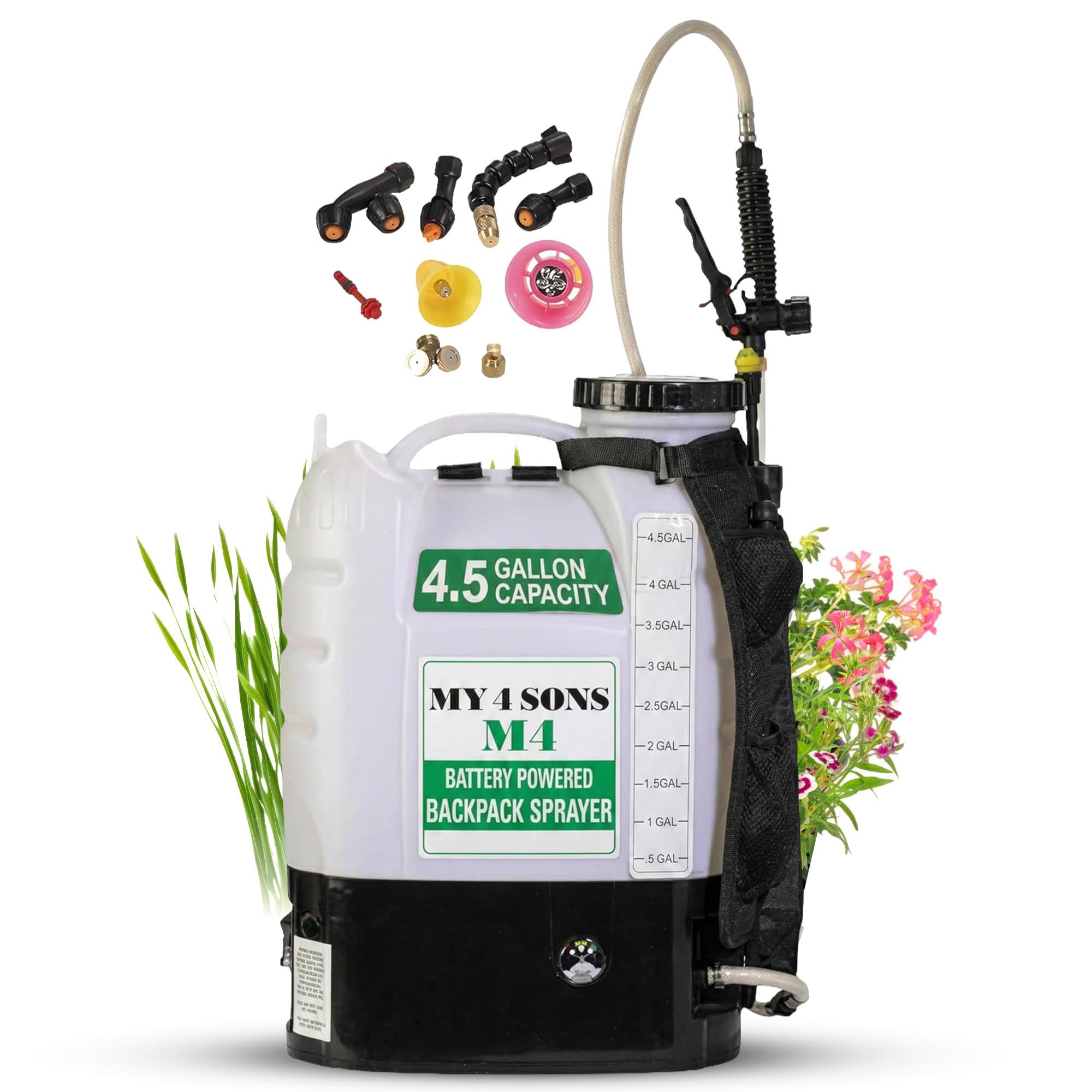
1. My 4 SONS M4 Battery Powered Backpack Sprayer
Our pick — over 4.5★ from 700+ verified ratings; the strongest balance of quality and price.
The heavy lifter built for all-day spraying across big properties without losing pressure.
The My 4 SONS M4 is the best overall pick because its 4.5-gallon tank is larger than typical 4.2-gallon models, and buyers report it handled 320-plus gallons on only 3 charges. This sprayer uses a 12V 8Ah sealed lead-acid battery to run an 80 PSI self-priming pump. You dial in pressure from 20 PSI up to 80 PSI with a rotary switch — useful for switching between a gentle mist for fertilizer and a stronger stream for weed killer without changing nozzles. The stainless steel wand extends from 24 to 48 inches, so you can reach under shrubs or up into low tree branches while keeping the tank strapped to your back.
Owners mention the variable pressure control helps reduce overspray and chemical waste. At 14 pounds empty, it runs heavier than some competitors, but the thick shoulder straps spread the load well. Some owners mention the lid gasket is thin and prone to falling out, so check the seal before filling.
Unlike the SideKing models that use common power-tool batteries, this one has its own dedicated 12V system and charger. That means you always have a battery ready with no sharing needed, but you cannot swap in a fresh pack from your DeWalt collection mid-job.
Built to Last
- 4.5-gallon tank — larger than 4.2-gallon competitors
- Adjustable 20–80 PSI pressure dial for precision spraying
- Stainless steel wand extends 24–48 inches for better reach
- Customers note great battery stamina over multiple uses
The Trade-Offs
- Uses a 12V sealed lead-acid battery, not swappable with common tool batteries
- At 14 pounds empty, it is heavier than some 4-gallon models
- Max pressure of 80 PSI is lower than the 100 PSI found on the SideKing
- Lid gasket can be flimsy per several owner reports
Who it fits: Homeowners or professionals spraying multiple acres regularly who want a dependable pump and don’t need to share batteries with other tools.
One real limitation: The sealed lead-acid battery takes longer to recharge than modern lithium packs, so plan charging between big jobs.
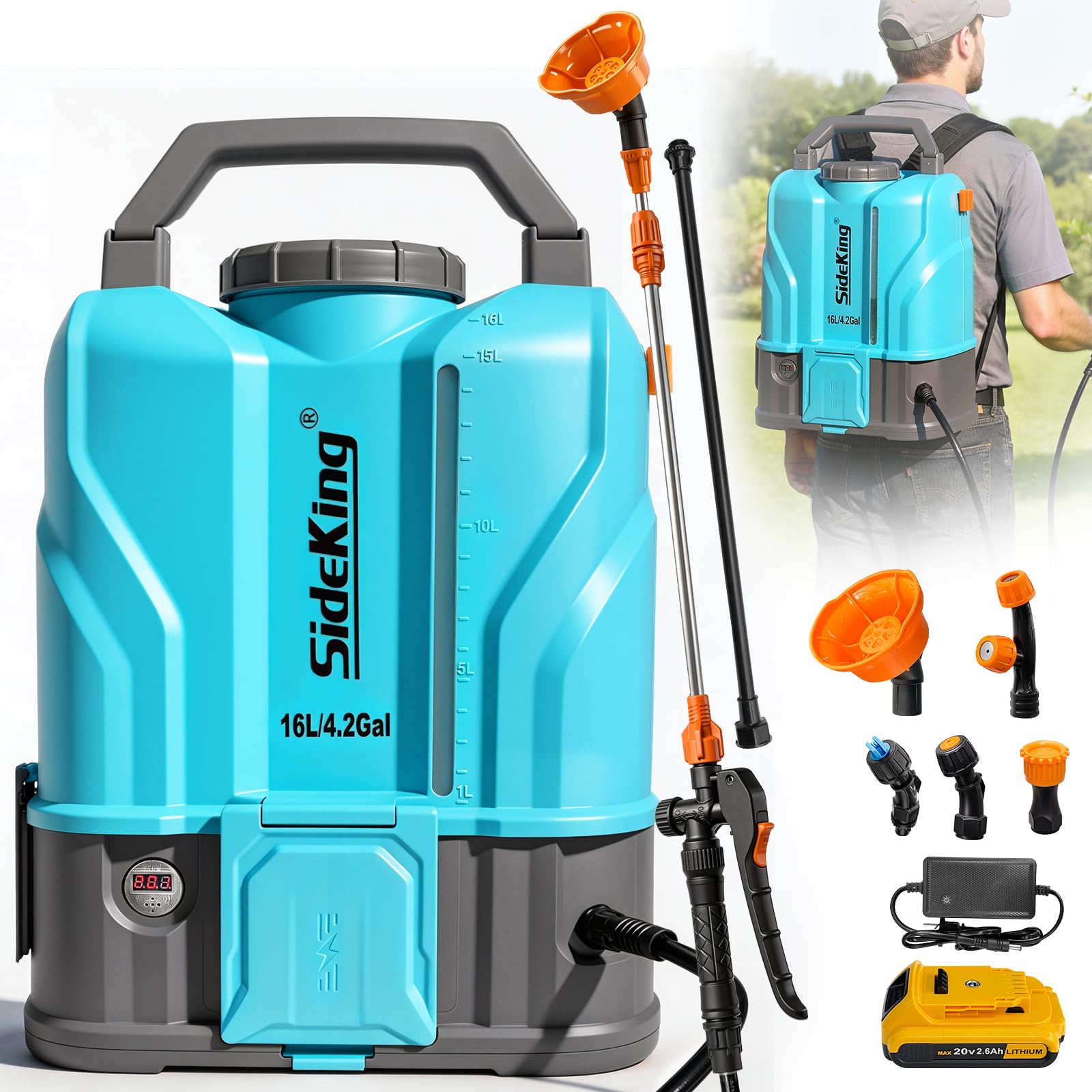
2. SideKing 4.2 Gallon Battery Powered Backpack Sprayer (DeWalt)
The pressure king with stepless adjustment from a whisper to a full 120 PSI blast.
This SideKing model stands apart because you can dial the pressure continuously from 0 all the way up to 120 PSI — no preset steps, just a smooth range. That means you can spray a fine mist on seedlings at low pressure and then twist the knob to a hard jet for killing weeds or cleaning the driveway, all with the same wand. It also delivers a flow rate of 1.0 GPM (gallons per minute), so you cover ground fast on larger lawns or landscaping areas.
It comes with two wands: a corrosion-resistant 50-centimeter fiberglass wand for chemicals and a stainless steel telescopic wand for general use. Five nozzles — Fan, Cone, Windproof, F-Type Dual, and Stream — let you change spray patterns instantly. The included 2.6Ah battery runs up to about 2 hours per charge. Reviewers point out it is lightweight, leak-free, and appreciate the easy-to-reach controls on the left side. A few report the fuse can blow early, so keep spare fuses handy.
Compared to the VAXMAY DeWalt-compatible model above, this SideKing offers the same 120 PSI max but adds a stepless pressure dial instead of fixed levels and includes a dedicated fiberglass wand for chemical spraying. The trade-off is a slightly smaller hose length at 1.6 meters versus 1.8 meters on some rivals.
Stepless power: The 0–120 PSI adjustment is rare at this tier and genuinely useful for skipping nozzle swaps mid-task.
One catch: A few owners say the included battery fits tightly in the compartment; test the fit before you need a quick swap in the field.
Reach for this if: you want maximum pressure versatility and already own DeWalt 20V or Milwaukee 18V batteries for extended runtime.
Look elsewhere if: you prefer a simpler on/off pump and don’t want to keep track of spare fuses.
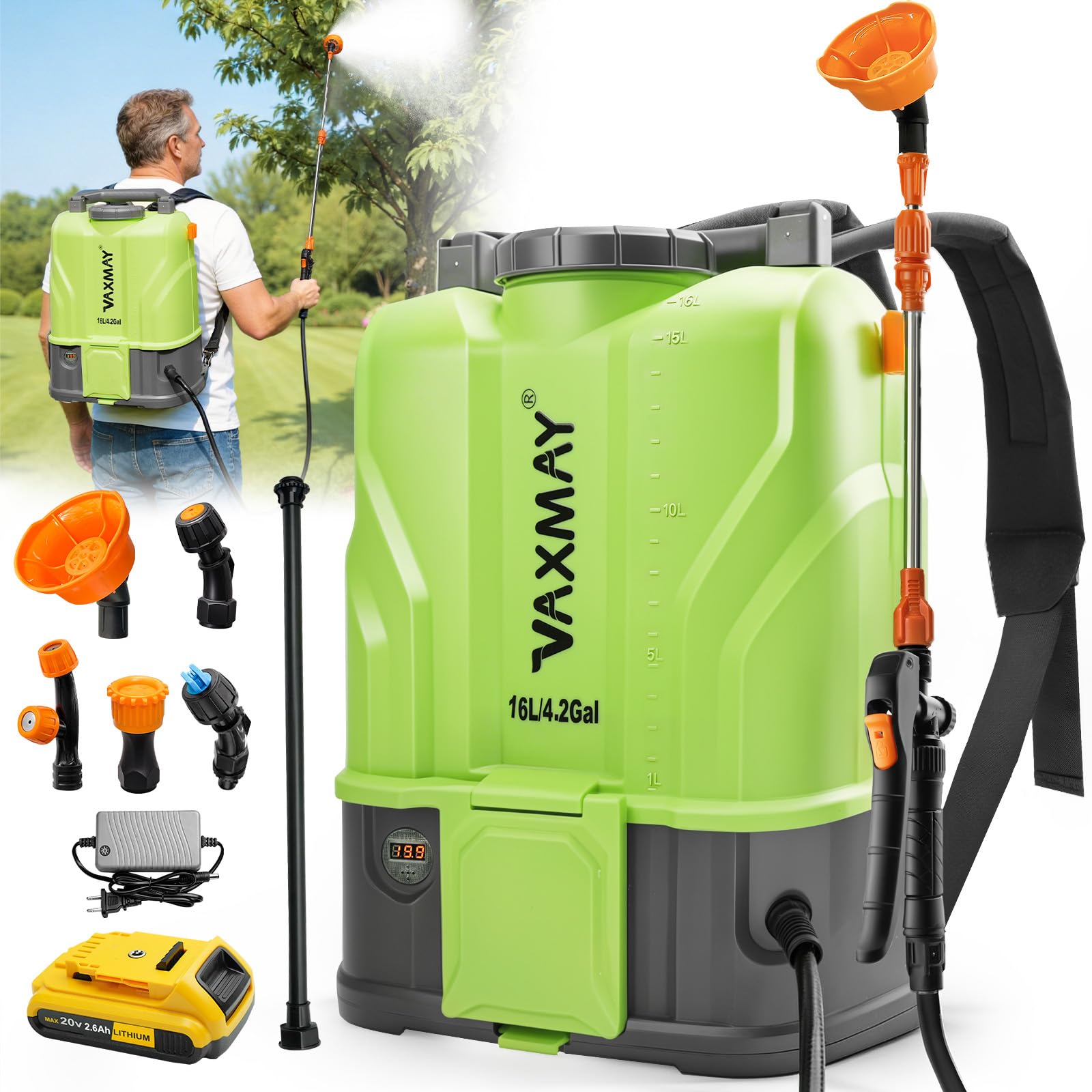
3. VAXMAY Battery Powered Backpack Sprayer 4.2 Gallon (DeWalt/Milwaukee)
The budget-friendly sprayer that outruns hand pumps and works with batteries you already own.
The VAXMAY is the best value because it delivers the same 120 PSI max pressure as the SideKing but at a lower cost. A 3800 RPM high-speed motor drives that 120 PSI — enough to shoot a strong stream for weeds or a fine mist for flower beds. It holds 4.2 gallons and claims up to 16 tank refills on a single charge with its included 2.6Ah battery, though real-world runtime depends on how hard you run the pump. You also get two wands: a telescopic stainless steel wand that extends to 39.3 inches for reach, plus a 30-inch fiberglass wand for chemical spraying that resists corrosion.
Buyers who switched from manual-pump sprayers say they no longer need to re-pressurize every few minutes, and that the battery lasts through multiple spray sessions without recharging. Several owners note the weight with a full tank is about 40 pounds, and the on/off switch is hard to reach while wearing the pack, so plan your operation sequence before strapping in. The unit comes with a 1-year warranty.
Compared to the SideKing DeWalt model above, this one delivers the same 120 PSI max but uses a simpler standard spray wand rather than an integrated electronic handle. That means if the hose or wand breaks, you can replace it with any generic garden spray wand — a nice repairability bonus that owners highlight.
Why It Stands Out
- 120 PSI pump at a budget-friendly cost
- Two wands — telescopic steel and corrosion-resistant fiberglass
- Compatible with DeWalt 20V and Milwaukee 18V batteries (battery included)
- Standard wand design is easy to repair with generic parts
What to Watch
- On/off switch is awkward to reach while wearing the pack
- Full tank weighs about 40 pounds, and no waist belt is included for support
- Some buyers wish for more spray pattern options beyond the 5 nozzles
Great for: budget-conscious homeowners who already have DeWalt or Milwaukee batteries and want strong pressure without a high upfront cost.
Not ideal if: you need a waist support belt for all-day comfort or want finer control over spray patterns.
4. SideKing 4 Gallon Battery Powered Backpack Sprayer (Makita)

A compact, lightweight sprayer that plugs right into your Makita 18V tool system.
The SideKing Makita model weighs 4.06 kilograms (about 8.9 pounds) empty versus the NPGLOBAL model’s 4.94 kg — making it the best pick for Makita users who want an all-day comfortable carry. It works with Makita 18V batteries (a 2.6Ah battery and charger are included), so if you already own Makita tools you can pull a fresh battery off the charger and keep spraying without waiting. The tank holds 4 gallons and features a semi-transparent wall with gallon markings so you can see your liquid level at a glance.
The double-layer padded shoulder straps and wide-mouth lid add comfort and convenience. A digital voltage display shows remaining battery life. Shoppers say it is reliable, leak-free, and comfortable for extended use, though a few mention the hose is stiff and battery removal can be tight at first. The included battery provides about 2 hours of continuous spraying per charge.
This model is 14 inches wide by 18 inches tall, making it more compact than the 18-by-24-inch My 4 SONS M4, which helps when storing it in a crowded shed or garage.
Weight win: At 4.06 kg it is 22% lighter than the NPGLOBAL model, so your shoulders feel the difference.
One note: A small number of owners had assembly issues with tight-fitting battery doors and a leaking trigger lever; check seals before first use.
Pick this if: you run Makita tools and want to share batteries across your equipment, keeping only one charger plugged in.
skip it if: you need maximum pressure above 100 PSI or want a waist belt for heavy-load support.
5. EARTHCRAFT Battery Powered Backpack Sprayer 5.3 Gal

The only sprayer here with a built-in mixing system that stops chemicals from settling.
This EARTHCRAFT model does something unique among this lineup: it has a one-touch automatic mixing system that continuously stirs the liquid while you spray. If you mix powdered fertilizer, wettable herbicides, or any chemical that separates over time, this feature keeps the concentration consistent from the first squirt to the last. No more shaking the tank mid-job or ending up with weak chemical at the bottom.
It holds the largest tank of any pick here at 5.3 gallons, so you can cover more ground between refills. Pressure adjusts from 45 to 90 PSI — lower than the 120 PSI models but still enough for typical weed and feed tasks. It works with DeWalt 20V batteries (battery not included), so if you already own DeWalt tools, you set your own runtime by grabbing the biggest battery you have. Buyers report the pump builds pressure then stops, saving battery, and that the mixing button works very well for consistent spraying. One owner mounted it on a dolly with foam and uses it for large flower beds and fence lines.
Compared to the VAXMAY DeWalt model, this one gives up some top-end pressure (90 PSI versus 120 PSI) but gains a bigger tank and that sediment-fighting mixer, which matters if you spray a lot of wettable powders.
what separates it
- 5.3-gallon tank — the largest in this guide
- Built-in automatic mixing system for consistent concentration
- Low battery draw, pumps to pressure then stops
- 39-inch telescopic wand and 6 interchangeable nozzles
What to Consider
- Max pressure of 90 PSI is less than the 120 PSI available on SideKing and VAXMAY models
- DeWalt battery is not included, so factor in that cost if you don’t own one
- Advertised dimensions are listed as 1 inch by 1 inch — likely a listing error, so measure actual storage space
Best for: anyone who regularly sprays powders or tank-mixed chemicals that settle, and wants a single sprayer that handles large jobs without refilling.
Not for: high-pressure cleaning tasks or if you don’t already own a DeWalt 20V battery — adding one increases the total cost.
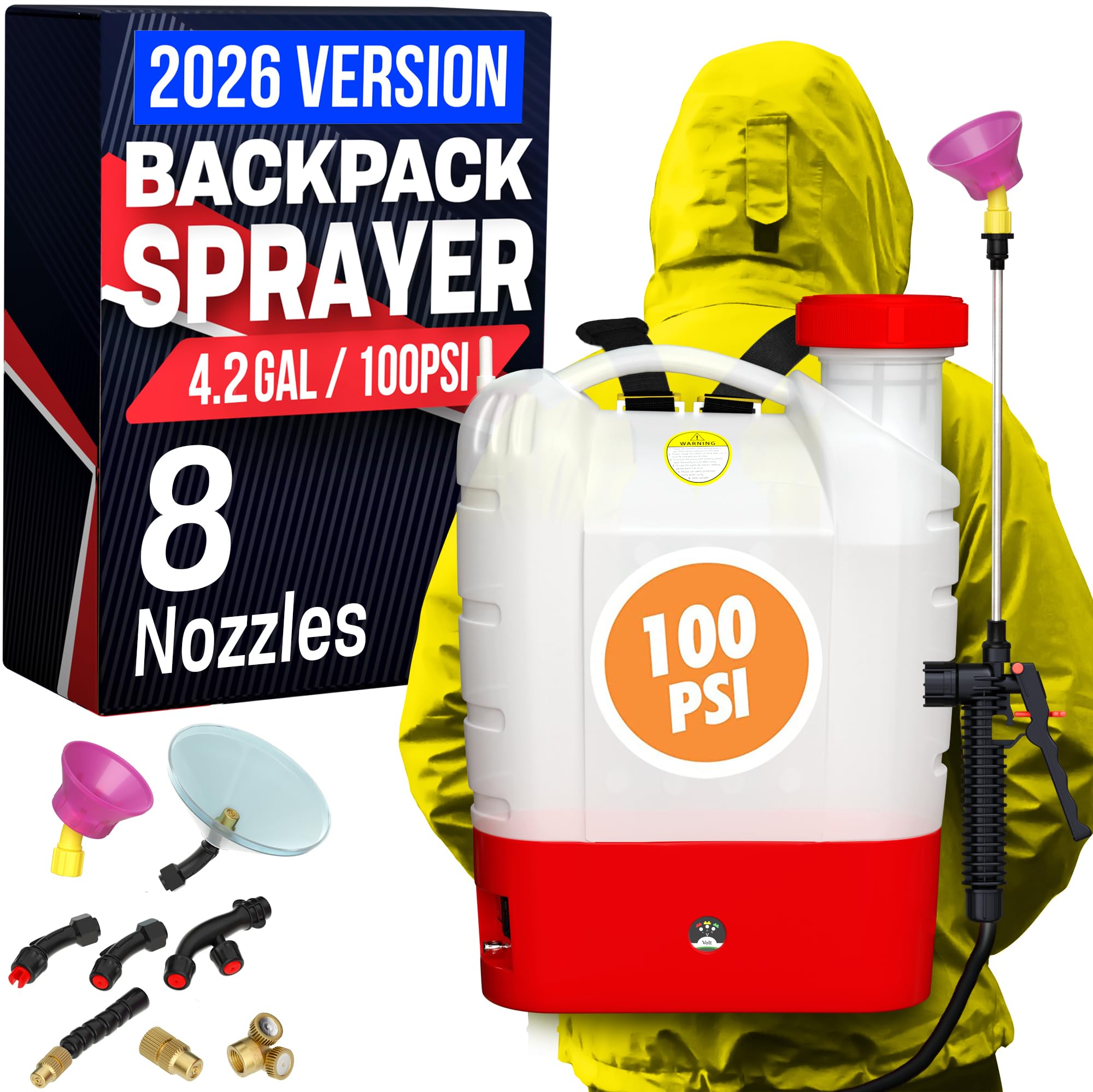
6. NPGLOBAL Battery Powered Backpack Sprayer 4.2 Gallon
The biggest nozzle selection at the lowest entry price for battery-powered spraying.
If you are stepping up from a manual pump sprayer and want to keep the upfront cost low, this NPGLOBAL model gives you a lot of accessories without a high price tag. It includes eight different nozzles — more than any other sprayer here — plus a mouth lid strainer, measuring bottle, and a wide mouth lid. The tank is translucent, so you can see the liquid level without opening it, and the pump delivers adjustable pressure from 21.8 PSI up to 100 PSI. The hose is 4.26 feet long, and the flow rate is 4.0 liters per minute.
Owners mention the sprayer works well for 600- to 700-foot driveways and edges, and that the customer service is outstanding — one reviewer whose battery died after 4 months received a complete replacement sprayer free in 5 days. Another owner mentions the reach is impressive enough to clean two-story house siding from ground level. The main downsides reported are that the hose could be a couple feet longer and the padded straps could be more secure. At 4.94 kilograms (10.9 pounds) empty, it is the heaviest of the 4-gallon-class sprayers in this guide, heavier than the SideKing 4-gallon model (4.06 kg).
A lifetime warranty backs this unit, which is unusual at this price point and adds confidence if you are unsure about battery-powered sprayer longevity.
Accessory king: Eight nozzles and a measuring cup give you real spray-pattern flexibility without buying extras.
Weight caveat: At 4.94 kg it is heavier than the 4.06 kg SideKing Makita model — your shoulders will feel the difference on long jobs.
Grab this if: you are budget-conscious, want the most nozzles, and value a lifetime warranty that covers potential early battery failure.
Pass if: weight is your top concern or you want battery compatibility with existing power-tool packs.
7. VAXMAY Backpack Sprayer 4 Gallon (Makita Compatible)

A no-frills Makita-compatible sprayer with a surprisingly long 4-hour runtime claim.
This VAXMAY model is the entry-level option for Makita tool owners. It delivers up to 100 PSI from a 4-gallon tank and claims up to 4 hours of continuous operation on a single charge — enough to spray the equivalent of 18 full tanks of solution. A digital voltage display helps you track remaining battery. The wide tank inlet includes a filter screen for easy filling and debris protection, and the back straps are padded with a foam cushion for comfort.
Customers note it is easy to use and that the battery lasts through multiple refills without recharging. One owner mentions being able to spray a long distance with the adjustable nozzle. However, there is a serious safety report to be aware of: one reviewer experienced an inlet hose coming loose during use, causing a chemical leak that led to second-degree burns. If you buy this model, check all hose connections and clamps before each use, especially with harsh chemicals. The unit includes 5 nozzles and comes with a 12-month warranty.
Compared to the SideKing Makita model, this one costs less but has fewer nozzles (5 versus 5 — same count), does not include a digital voltage display with discharge protection like the SideKing’s, and has a less detailed backpack harness. The trade-off for the lower price is fewer included accessories and a less sturdy build.
What You Get
- Works with Makita 18V batteries (2.5Ah battery and charger included)
- Up to 4 hours claimed runtime per charge
- Wide tank inlet with filter screen for easy filling
- Digital voltage display for battery monitoring
Use Caution
- One verified report of an inlet hose disconnect causing chemical burns
- Only 5 nozzles included, fewer than the 8 on the NPGLOBAL model
- Backpack straps are less padded than premium models
- Some owners wish for more spray pattern variety
Try this if: you are on a tight budget, use Makita tools, and are comfortable inspecting hose connections before each job.
pass on it if: safety concerns about chemical leaks are a dealbreaker — pay a bit more for the SideKing Makita model with more consistent build reviews.
Understanding the Specs
PSI (Pounds per Square Inch)
PSI measures how much force the pump pushes liquid out of the nozzle. For weed killer and cleaning tough surfaces, aim for 100 PSI or higher so the stream penetrates thick foliage or blasts dirt. For fertilizing lawns or misting delicate plants, lower PSI around 20 to 45 PSI gives a soft spray that won’t wash away soil or damage leaves. Adjustable pressure — a dial that lets you set the PSI anywhere within a range — is the most useful feature because you can tune the spray to each task without changing nozzles.
GPM (Gallons Per Minute)
GPM tells you how fast the sprayer moves liquid out of the tank. A higher GPM like 1.0 means you cover large areas faster because more liquid comes out each second. For big lawns or commercial properties, a high flow rate cuts down spraying time. For precision spot-treating or slow, careful applications, a lower flow rate gives you better control and less waste. Matching GPM to your property size saves time without overspraying.
Battery Compatibility and Voltage
Some sprayers include a proprietary battery and charger, while others are designed to share batteries with popular tool brands like DeWalt, Makita, or Milwaukee. Shared-battery systems save you from maintaining another charger and let you pull a fresh pack from your tool collection when the sprayer dies. Check the voltage: 12V sealed lead-acid batteries are heavier and take longer to recharge than modern 18V or 20V lithium-ion packs, which typically charge in 1 to 3 hours and maintain consistent power until empty.
Tank Material and Visibility
Most backpack sprayer tanks are made from high-density polyethylene (HDPE) or similar plastic, which resists chemical corrosion and is lighter than metal. A translucent or semi-transparent tank with volume markings lets you see how much liquid remains without opening the lid — a small convenience that prevents you from running dry mid-row or overfilling. Wide-mouth openings (4 to 6 inches across) make filling and cleaning much easier than narrow necks that trap residue.
FAQ
How long does a backpack sprayer battery last on a single charge?
Can I use any brand battery in a backpack sprayer designed for DeWalt or Makita batteries?
How much does a full 4-gallon backpack sprayer weigh?
What PSI do I need for weed killer vs. fertilizer?
Is a backpack sprayer better than a handheld or wheeled sprayer?
How do I clean a backpack sprayer after using chemicals?
What does a built-in mixing system do?
Can I use a backpack sprayer for cleaning, not just gardening?
Why do some sprayers come with a fiberglass wand?
Are backpack sprayers safe to use with bleach or acids?
Final Thoughts: The Verdict
Across the board, the backpack spray gun winner is the My 4 SONS M4 because its 4.5-gallon tank, adjustable 20–80 PSI pressure, and proven battery longevity from real buyers make it a reliable workhorse for large properties without depending on a specific tool battery ecosystem. If you want maximum pressure versatility and already own DeWalt or Milwaukee batteries, grab the SideKing